Table of Contents
- What does each chord in a key actually do?
- Why can two different chords do the same job?
- Why write a chord progression backward from the ending?
- Where should the progression land?
- What chord sets up the landing, and what sets up that one?
- How do you know what chord comes next?
- Do these rules apply to rock and pop?
- How should the bass move between chords?
- What do root moves by fifth, third and step sound like?
- How do slash chords turn jumps into a walking bass line?
- When should the bass hold still?
- Should your progression loop or go somewhere?
- What makes a loop feel like it never finishes?
- How do you get out of the loop into a new section?
- Should the verse and chorus use different chords?
- When should you borrow a chord from outside the key?
- Does this work in a minor key?
- How do you test a progression before there's a melody?
- How does Song Cage help you write a progression?
- Frequently Asked Questions
A guitarist on Music Stack Exchange described the problem better than most lessons do. Every progression they wrote came out as "some combination of Em, C, D (sometimes Em, C, G, D) or Am, F, G." When they tried adding more chords, "it doesn't sound right," and changing strumming patterns and timing didn't help, because "the rhythm guitar is still playing the same three damn chords." That was in 2017. Another writer, years earlier, had tried stock sequences like 1-4-5 and still reached "a point where I'm dumbfounded on where I can go next."
The usual advice is to learn the common progressions and borrow one. That gets you a progression. It doesn't get you a way to make the next one.
This guide is the method underneath: how to write a chord progression from the ending backward. You pick where the progression has to land, you work backward from that ending, you choose each chord for the job it does rather than its name, and you decide what the bass does in between. It assumes you have an instrument and no melody yet. If you already have a tune and need chords under it, how to harmonize a melody is the post for you.
Quick summary
To write a chord progression, choose the ending first: a full stop (V–I), a comma that leaves the listener hanging (ending on V), a softer IV–I, or a swerve from V to vi. Then work backward. Ask which chord sets up that ending, and which chord sets up that one. Chords do three jobs (home, leaving home and pulling back), and any chord doing the right job will work. After that, decide how the bass moves between them and whether the progression loops or goes somewhere.
What does each chord in a key actually do?
Each chord in a key has a job. Tonic chords feel like home. Predominant chords lead away from home and point toward tension. Dominant chords are the tension that pulls back to home. Pick the job you need at each point in the progression first, then pick a chord that does it.

Music theorists call these jobs harmonic functions. The textbook version, as Open Music Theory puts it, is that "you can generally think of I, III, and VI as tonic, II and IV as subdominant, and V and VII as dominant." Subdominant is the older word for predominant. In the key of G, that sorts the seven chords like this:
| Job | Roman numerals | In G major | What it feels like |
|---|---|---|---|
| Home (tonic) | I, sometimes vi and iii | G, sometimes Em and Bm | Settled. Nothing needs to happen next. |
| Leaving home (predominant) | IV, ii | C, Am | Moving. Something is on the way. |
| Pulling back (dominant) | V, vii° | D, F♯dim | Tension that wants to resolve to G. |
Textbooks disagree about vi and iii. Some treat them as home, some as a gentle way out of home. Both readings are useful.
The vi and iii chords are the flexible ones. The current edition of Open Music Theory calls them "weak predominants" in classical music, chords that "transition away from tonic, typically moving to a stronger predominant." Robert Hutchinson's open textbook gives them a category of their own, tonic prolongation: chords that tend to follow I and move on toward the predominants. In practice that makes them a natural choice for the second slot of a progression, the step just after home.
Why can two different chords do the same job?
Because they share most of their notes. C major (C E G) and A minor (A C E) share two notes, and both lead away from G toward D. So if C sounds too bright in a spot, Am does the same job with a darker colour. Em (E G B) shares two notes with G (G B D), which is why it can stand in for home without the progression losing its footing.
This is the idea that gets you out of the "same three chords" rut. The chord you keep reaching for is only one of two or three chords that do that job. Swap it for another and the progression changes colour without falling apart.
Why write a chord progression backward from the ending?
Because the ending decides everything before it. Pick how the progression should finish, then ask which chord sets that ending up and which chord sets that one up. By the time you reach bar one, every chord already has a reason to be there, and you haven't guessed at any of them.
Theorists read phrases the same way. Open Music Theory's method for analysing a phrase starts at the end: find the cadence, then "identify the strong predominant that leads to the cadence," and only then go back to the beginning. That is a way of listening, not a composing rule. It works just as well turned around into one.
A cadence is the chord move that ends a phrase. Hutchinson compares it to "a comma or period in written language". There are four basic ones, and choosing between them is the first real decision you make.
Where should the progression land?
| Ending | Chords | In G | Sounds like | Use it for |
|---|---|---|---|---|
| Authentic cadence | V–I | D–G | A full stop | The end of a chorus, the end of the song |
| Half cadence | anything–V | C–D | A comma, a question left open | The end of a verse or pre-chorus that has to lead on |
| Plagal cadence | IV–I | C–G | A softer landing, the "amen" | Rock and hymn-style endings, a chorus that should settle rather than slam |
| Deceptive cadence | V–vi | D–Em | A swerve. The ear expected home and got something darker. | Delaying the ending, turning a line toward sadness |
The half cadence is the one beginners most often overlook, and it answers the "my verse and chorus sound the same" problem. A verse that ends on V hasn't finished its sentence, so the chorus arrives as the answer. Drew Nobile's analysis of Van Halen's "Dance the Night Away" shows both verse phrases and the first pre-chorus phrase ending on V, with the full V–I held back until the lead-in to the chorus (Nobile, 2014).
The deceptive move is a swerve you can hear. In George Harrison's "Something", the verse builds to the V chord and, in Alan Pollack's words, it "resolves deceptively to vi at the start of the refrain" (Pollack).
What chord sets up the landing, and what sets up that one?
Here is the method worked through for a four-bar verse in G that has to lead into a chorus.
- Bar 4, the ending. The verse has to hand over, so end on a half cadence: D (V).
- Bar 3, what sets up D? D is pulling back, so the chord before it should be leaving home. Two chords do that job: C (IV) or Am (ii).
- Bar 2, what sets up the predominant? Something that moves away from home without committing yet. Em (vi) or Bm (iii), or stay on G.
- Bar 1. Home: G.
Take the first option each time and you get G, Em, C, D. That's I–vi–IV–V, the doo-wop "50s progression." You weren't copying a formula. You rebuilt one from the jobs, which is why that formula works.
Now take the other options. G, Bm, C, D is the same shape with a cooler colour. G, G, C, D is plainer and more rock. G, Em, Am, D swaps the bright IV for the minor ii. Each is a different progression, and every one lands where the verse needed it to.
For the chorus, flip the ending to a full stop. End on G, put D before it, a predominant before that, and something before that: Em, C, D, G. It's the same toolkit, and because the ending is different it answers the verse instead of repeating it.
How do you know what chord comes next?
Ask what job the next slot needs, list the two or three chords that do that job, and play each one. The ear chooses between two or three candidates easily. It struggles when it has to choose from seven chords with nothing narrowing them down.
The textbook norm, which Trevor de Clercq and David Temperley summarise in their rock-harmony corpus study, is that "pre-dominants move to dominants, dominants move to tonics, and tonics can move to any category." They call these "general norms that apply most of the time," not laws. So:
- After home, you can go anywhere. This is the freest slot in the progression.
- After a leaving-home chord, the pull is toward a dominant, or back home for a plagal feel.
- After a dominant, the pull is toward home, or toward vi if you want the swerve.
If you already have two or three chords and you're stuck, work out which key they belong to. Then name the job of the gap you're trying to fill, and try only the chords that do that job.
Do these rules apply to rock and pop?
Loosely. De Clercq and Temperley analysed 100 songs from Rolling Stone's "500 Greatest Songs of All Time", 20 from each decade from the 1950s to the 1990s, and found "little evidence" of the classical predominant-to-dominant pattern. In rock, IV is the most common chord after I itself, and it's the chord that most often comes right before the tonic. In their data the chord just before the tonic was IV about 40% of the time, V about 27% and ♭VII about 13%.
So in rock the plagal IV–I landing is at least as normal as V–I. Christopher Doll goes further in Hearing Harmony (University of Michigan Press, 2017): he suggests IV–I "would seem to be the foremost progression in confirming or establishing a tonal center in rock." Even V–IV, which classical theory calls a "retrogression", is standard in blues and rock: every 12-bar blues closes V–IV–I. The Beatles' "Can't Buy Me Love" ends each verse G, F, F, C in the key of C, and Pollack notes the home chord is held back until the last bar (Pollack).
The jobs still work. What changes in rock is which endings sound normal.
How should the bass move between chords?
The bass is the second melody in every progression. Moving it by a fourth or fifth sounds strong and decisive, moving it by a step sounds smooth, and holding one note while the chords change above it builds tension. Choose the bass motion on purpose instead of letting the chord shapes decide it for you.
In most pop and rock the chords sit in root position, so the bass simply plays each chord's root. That means your chord choice has already written a bass line whether you meant it to or not. Three moves are worth knowing.
What do root moves by fifth, third and step sound like?
A root falling a fifth, or rising a fourth, is the strongest move in classical harmony. The textbook model is V to I. The open textbook Composing Music: From Theory to Practice explains why: when the root rises a fourth or falls a third, the new root wasn't in the previous chord, so the move pushes forward. When the root rises a third or falls a fourth, the new root was already in the old chord, so the move sounds more static. The author is careful to say that "strong" and "weak" are not value judgments. Static is sometimes exactly what a verse needs.
Rock, again, is looser. De Clercq and Temperley found rising and falling fourths about equally common in their corpus, with fourth motions the most common of all.
How do slash chords turn jumps into a walking bass line?
Put a chord's third or fifth in the bass instead of its root, and a jumpy bass line becomes a line that walks. In G, the move G to Em has the bass jump from G down to E. Write G, D/F♯, Em instead and the bass steps G, F♯, E. You've added a chord and made the line smoother at the same time.
Procol Harum's "A Whiter Shade of Pale" is built on this idea: a bass that walks down from C a step at a time, one step every half bar, with slash chords filling the gaps between the main chords. Chord inversions explains the shapes on guitar and piano.
When should the bass hold still?
When you want tension without leaving home. Keep G in the bass while the chords above it move to C/G and D/G, and the progression churns in place. The opposite trick is a bass that moves while the harmony above it barely changes. In "Something", the refrain opens on A minor and the bass slides down from A one semitone at a time. Pollack calls the chords above it a side effect of that descending line.
Should your progression loop or go somewhere?
Both are legitimate, and many modern songs use both. A loop repeats three or four chords without a strong ending and builds a mood. A goal-directed progression travels somewhere and cadences. Decide which one each section needs before you choose its chords.
Philip Tagg's terms help. A shuttle is a "repeated to-and-fro movement between two chords," and a loop is a "short repeated sequence of typically three or four different chords." Mark Spicer calls these short, goalless circular progressions "central to the tonal design of many if not most pop and rock songs."
Fleetwood Mac's "Dreams" is the extreme case. Heard in C major, its shuttle between F and G never lands on the home chord at all (Multimodal Musicianship). U2's "With or Without You" repeats one four-chord loop for the whole song, and all the build comes from the arrangement.
What makes a loop feel like it never finishes?
A loop without a V–I leaves the key slightly open. Open Music Theory points out that the vi–IV–I–V loop "does not, on its own, clearly communicate a definitive tonic chord", and one reason is that it has no authentic cadence in it. That ambiguity is the appeal. The loop keeps circling.
When a loop is the plan, build it backward like any other progression, but treat bar one as the landing. The last chord's job is to lead back to the first. Rhythm and pacing are the other half of making a loop hold attention, and why chord progressions sound boring covers that side.
How do you get out of the loop into a new section?
This is another common complaint. The loop works, but any new chords feel like a different song. The fix is to write the new section toward its own ending instead of trying to extend the loop. In Drew Nobile's account of verse, pre-chorus and chorus form, the classic layout that took shape from the mid-1960s has the verse and chorus hold the home chord's job the whole way through, often with a shuttle or loop, while the pre-chorus does the travelling, from a predominant to the dominant. After about 1991, he notes, texture and sound took over more of that build, but the shape stayed. So the loop can stay. The section between loops is the one that goes somewhere.
Should the verse and chorus use different chords?
Not necessarily. They need a different ending more than different chords. A verse that stops on V and a chorus that lands on I will contrast even if they use exactly the same four chords, because the listener feels the question and the answer.
The start is the other lever, and "Let It Be" shows it. Its verse and refrain share almost the same four chords, C, G, Am and F, and both end on I. The verse opens on I while the refrain opens on vi, and Pollack notes the song's "almost consistent use of Plagal (IV → I) cadences" (Pollack). The new starting chord, with a refrain tune pitched higher, is what makes the refrain sound like its own section.
The Beatles use tension the other way in "I Want to Hold Your Hand". The first two phrases of each verse end on B major, the V of E minor, and Pollack notes they leave it "repeatedly unresolved". Then the title line lands with IV–V–I in G, and it feels like release because the song has made you wait for it.
If you want the lift between sections to be bigger, what is a pre-chorus covers the section built for exactly that.
When should you borrow a chord from outside the key?
When one chord in the key is doing the right job with the wrong colour. Borrow its version from the parallel minor. It keeps the job and changes the mood. Do it once, return straight to the key, and it sounds intentional instead of wrong.
Open Music Theory describes borrowing, or modal mixture, as changing "the quality of a chord, but not its function." Two borrowed chords turn up especially often in songs:
- Minor iv in place of IV. Going IV–iv–I lets one note sag a half step before home. Open Music Theory calls minor iv used this way "a very common plagal schema in rock and popular music", most often as IV–iv–I. The Beatles' "In My Life" ends its verse phrase D, Dm, A in the key of A.
- ♭VII on the way home. ♭VII–IV–I is Walter Everett's "double plagal". In "With a Little Help from My Friends" the refrain goes D, A, E in E major (Pollack). ♭VII was the third most common chord before the tonic in de Clercq and Temperley's rock sample.
The detail on which borrowed chord comes from where is in modal interchange and borrowed chords. Radiohead built a whole song on the minor iv trick, which the "Creep" chord progression takes apart.
Does this work in a minor key?
Yes. The three jobs work the same way in minor: i is home, iv and ii° lead away, and V pulls back. The one change is the dominant. Natural minor gives you a minor v with a weak pull, and raising its third turns it into a major V that pulls home.
In natural minor the chord on the fifth degree is minor (Em in A minor), and a minor v has no leading tone, so its pull home is weak. Raise its third and you get E major, a real V. That's why minor-key songs often mix Em and E, or use E only right before the landing. The jobs are the same: Am is home, Dm leads away, E pulls back. Minor chord progressions lists every chord you have in minor and the one change that matters.
How do you test a progression before there's a melody?
Loop it and hum over it, then change one decision at a time: the ending, one chord for its job-mate, one bass step, one borrowed chord. Keep a change only when you prefer it. That is how to make chord progressions that are yours rather than borrowed.
If a melody comes easily, the progression has room in it. If you keep humming the same note over every chord, the chords are probably too close to one another. Then test one decision at a time:
- Swap the ending. Play the section ending on V, then on I, then on vi. Choose the one that suits what comes next.
- Swap one chord for its job-mate. Replace IV with ii, or I with vi. Keep the change only if you prefer it.
- Walk the bass. Try one slash chord where the bass jumps furthest.
- Borrow once. Try the minor iv, or ♭VII, in one spot. If the song gets better, keep it. If not, go back.
Ten of the shapes you'll end up rebuilding this way are in the most useful chord progressions for songwriters. By then you'll know why each one works.
How does Song Cage help you write a progression?
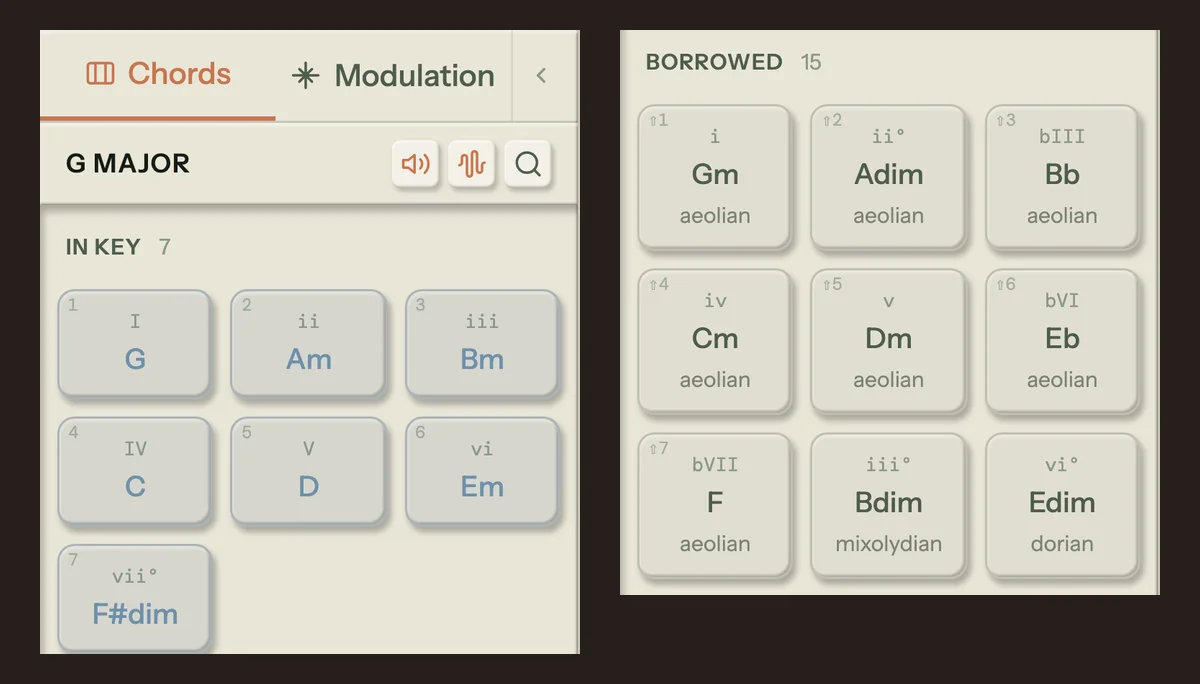
Song Cage doesn't hand you a finished progression. It shows every chord in your key with its Roman numeral, suggests one next chord at a time, and labels the job each suggestion does, so you can work the method in this post with your own chords.
Set a key, or place a couple of chords and choose one from Sounds like, and the Chords sidebar shows every chord in three groups: In Key, Borrowed (each tagged with the mode it comes from), and Secondary Dominants (each showing where it resolves). Every chip carries its Roman numeral. Click any chip to hear it.
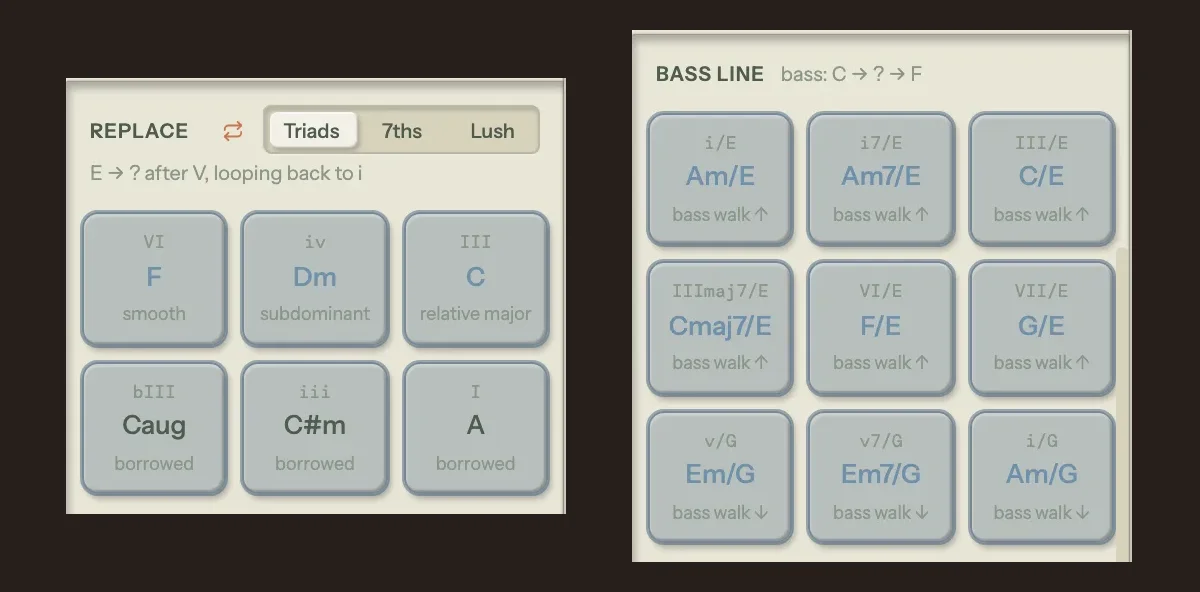
Click the slot after a chord and a short list of suggestions appears, ranked by the chord before the slot and the chord after it. Each one names its move: "subdominant", "sets up V", "plagal", "deceptive". When you're filling the last chord of a section, a loop toggle re-ranks the suggestions to lead back to the section's first chord, which is how you write a loop's turnaround. A Bass Line strip underneath offers slash chords whose bass steps from the chord before into the chord after.
On a keyboard you can think in numbers: keys 1 to 7 place the chord on that scale degree, Shift places the borrowed version, and Alt places its secondary dominant. Each section can have its own key, and each section loops on its own so you can hum over it. The chord progressions docs cover every control.
Build the progression, one job at a time
Capture the chords you found, see what each one is doing in the key, and hear the ending before you commit to it.
Frequently Asked Questions
Do you have to start a chord progression on the I chord?
No. Starting on I tells the listener where home is straight away, which is useful. Starting on vi or IV is common in pop, and it leaves the key a little ambiguous for longer. What matters more is the ending. If the phrase lands clearly, the start can be almost anything.
How many chords should a chord progression have?
Loops are typically three or four chords, but two chords can carry almost a whole song: "Dreams" by Fleetwood Mac is built almost entirely on two. A goal-directed phrase needs at least a home chord and one chord that leads back to it, such as V or IV. Add chords when each one has a job, not to make the progression longer.
How do I make my chord progressions less generic?
Change the ending before you change the chords. A verse that stops on V and a chorus that lands on I contrast more than two sections with different but equally settled chords. Then swap one chord for another that does the same job, or borrow one chord from the parallel minor, and change one thing at a time.
Is it okay to use a chord progression from another song?
Yes. Common progressions are shared musical language, and the famous ones turn up in hits from every decade. The real limit of borrowing is practical: if you only copy, you never learn how to make the next one. Build a few from their jobs and you'll recognise the famous ones as destinations you reached yourself.
What is the strongest way to end a chord progression?
V to I, with both chords in root position and the home note on top, which theorists call a perfect authentic cadence. In rock, IV to I is at least as common and sounds softer. Neither is better. Choose by whether the section should end with a full stop or a gentler landing.
Should I write the chords or the melody first?
Either works, and many writers do both at different times. Chords first gives you a mood and a structure to sing over, which is the case this guide covers. If a tune arrives first, harmonizing the melody is a different process that starts from the notes you sang.