Table of Contents
- 1. I-V-vi-IV — The Axis Progression
- 2. I-IV-V — Blues and Rock Foundation
- 3. vi-IV-I-V — The Relative Minor Rotation
- 4. I-vi-IV-V — The 50s Progression
- 5. ii-V-I — The Jazz Cadence
- 6. i-♭VII-♭VI-V — The Andalusian Cadence
- 7. I-♭VII-IV — Classic Rock's Borrowed Flat-Seven
- 8. The 12-Bar Blues — A Complete Form
- 9. i-♭VI-♭III-♭VII — The Natural Minor Loop
- 10. i-iv-V — The Harmonic Minor Feel
- How do I use these progressions in my own songs?
- Start with the emotional arc, not the chord chart
- Understand harmonic function before you start substituting
- Combine complementary progressions across sections
- How does one borrowed chord change everything?
- Quick reference: the 10 most useful chord progressions
- Frequently Asked Questions
A chord progression is a sequence of chords played in order that establishes the harmonic foundation of a song: its emotional arc, its sense of tension and resolution, its genre and mood. Most of the songs you know and love are built on a surprisingly small number of progressions. This is not a limitation; it is a feature. The richness comes from what you do over them: melody, rhythm, lyrics, arrangement, and the small harmonic variations that turn a familiar pattern into something that sounds unmistakably yours.
This guide covers the 10 most useful chord progressions for songwriters: not just the theory, but the practical application. For each one, you get the pattern in Roman numerals, why it creates the emotion it does, the songs that prove it, the keys it suits best, and how to use it in your own songs. Every song example has been verified against published sources. If you are looking for the software that lets you experiment with these progressions interactively, see our roundup of the best chord progression tools for songwriters and music theory apps for beginners.
How to read this guide
Every progression is presented in Roman numerals (I, IV, V, vi), the same scale-degree shorthand as the Nashville Number System, so the pattern works in any key. Uppercase = major chord; lowercase = minor chord. A flat sign (♭) means the chord is one semitone lower than the diatonic chord at that position: this is how borrowed chords are labeled. The "in C major" line under each progression shows the actual chord names so the theory and the real chords stay connected throughout.
1. I-V-vi-IV — The Axis Progression
Pattern and keys
I — V — vi — IV. C major: C–G–Am–F. G major: G–D–Em–C. D major: D–A–Bm–G. A major: A–E–F♯m–D. E major: E–B–C♯m–A. Genres: pop, rock, country, singer-songwriter, gospel.
The I–V–vi–IV is the most common chord progression in contemporary popular music, often called the Axis progression. It moves from home (I) to tension (V) to emotional depth at the relative minor (vi) to gentle release (IV), then loops. The progression never fully settles, which creates the perpetual forward motion that makes chorus-based pop songs feel impossible to exit. Older hits used it far less: it turns up in only 15 of 612 Hot 100 choruses from 1958 to 1991, in our count of pop chord progressions.
The I chord is your key center. The V chord is the dominant: it creates tension and a strong pull back toward I, but instead of resolving, the progression moves to the vi (the relative minor), creating an unexpected emotional depth, a moment of melancholy or longing inside an otherwise stable progression. The IV chord then provides a soft landing, not a full resolution but a release of tension before the loop returns to I.
The progression was famously documented in a 2008 medley by the comedy group Axis of Awesome called "Four Chords," which demonstrated its ubiquity by playing it continuously while singing dozens of recognizable songs over it. Music theorist Mark Richards has analyzed it academically in Music Theory Online (2017).
Songs that use it (verified): "With or Without You" by U2 (D major), "Someone Like You" by Adele (A major), "Girls Like You" by Maroon 5 (C major), "Demons" by Imagine Dragons (E♭ major), "No Woman No Cry" by Bob Marley (C♯ major), "I'm Yours" by Jason Mraz (B major), "Let It Be" by The Beatles (C major), "Cornelia Street" by Taylor Swift (C major).
Variations and rotations:
- vi–IV–I–V — Starts on the relative minor for a darker, more introspective feel. "Despacito" (B minor), "Numb" by Linkin Park (F♯ minor).
- IV–I–V–vi — Opens on the IV for a more uplifting, anthemic quality. "Anti-Hero" by Taylor Swift (E major).
- I–V–vi–iii–IV — Extends to five chords by adding the mediant between vi and IV for extra harmonic movement.
How to use this in your songs:
- Start a song on the vi instead of the I for an emotionally darker entry. Same four chords, completely different feeling.
- Use vi–IV–I–V in the verse and switch to I–V–vi–IV for the chorus. The harmonic shift creates an automatic sense of arrival.
- Add a borrowed ♭VII chord between IV and I on the repeat: I–V–vi–IV–♭VII–I. The extra borrowed chord adds unexpected weight before landing home.
- This progression works in any tempo and any genre. Its emotional neutrality (neither too dark nor too bright) is a feature, not a limitation.

2. I-IV-V — Blues and Rock Foundation
Pattern and keys
I — IV — V. G major: G–C–D. A major: A–D–E. E major: E–A–B. D major: D–G–A. C major: C–F–G. Genres: blues, rock, country, folk, gospel, R&B.
The I–IV–V is the oldest and most fundamental chord sequence in popular music. Together, these three chords span all seven notes of the major scale, which is why the progression feels simultaneously complete and resolved. The IV chord moves away from home with a subdominant function (a gentle lift away from the tonic); the V chord is the dominant (maximum tension, strongest pull back to I). Together they create the engine of resolution that drives most Western music.
In blues, the I–IV–V is extended into the 12-bar blues form (covered as progression #8 in this guide), which distributes the three chords across twelve bars in a specific pattern. In rock and folk contexts the three chords are used more freely: sometimes all in equal measure, sometimes with extended time on the I. The progression also underlies three-chord songs in country and folk, where the simplicity of the harmonic structure allows the focus to fall entirely on melody and lyric.
Songs that use it (verified): "La Bamba" by Ritchie Valens (C major: C–F–G), "Twist and Shout" by The Beatles (D major: D–G–A), "Johnny B. Goode" by Chuck Berry (B♭ major), "Wild Thing" by The Troggs (A major: A–D–E), "Blowin' in the Wind" by Bob Dylan (G major: G–C–D), "Brown Eyed Girl" by Van Morrison.
Variations:
- I–IV–I–V — Ends on V for a stronger sense of anticipation before repeating.
- I–IV–V–IV — Returns to IV before I, creating a softer, less final landing.
- I7–IV7–V7 — Seventh-chord versions for blues character and a more complex sound.
- I–IV–♭VII–IV — Extended rock version with a borrowed flat-seven chord (see progression #7).
How to use this in your songs:
- In guitar-friendly keys (G, D, A, E, C major) the I–IV–V gives you all open chords, physically comfortable to play and sustain naturally.
- Extend the time on the I chord: play four bars of I, two of IV, return to I, then V, IV, I. This is the 12-bar blues form that underlies decades of rock and blues.
- Make the V a dominant seventh (V7) for stronger harmonic pull back to I. This is the sound of blues and early rock and roll.
- The I–IV–V can support a huge dynamic range. Whisper it fingerpicked in a folk ballad, or drive it hard in a rock anthem. The progression holds either context.
3. vi-IV-I-V — The Relative Minor Rotation
Pattern and keys
vi — IV — I — V. G major: Em–C–G–D. C major: Am–F–C–G. D major: Bm–G–D–A. A major: F♯m–D–A–E. Genres: pop, rock, indie, folk, singer-songwriter.
This is a rotation of the I–V–vi–IV Axis progression, starting from the vi (the relative minor) rather than the I. The effect is significant: instead of beginning at the stable tonic and moving toward emotional depth, this version opens in emotional depth and works toward resolution. It feels darker and more introspective than its parent progression while sharing all the same chords and the same underlying logic.
The vi–IV–I–V appears across an enormous range of songs. Marc Hirsh, writing in The Boston Globe (2008), dubbed the vi–IV–I–V ordering the "sensitive female chord progression" when he noticed it in songs by artists who had performed at the Lilith Fair: a label that has not aged well, but the observation about its emotional character was accurate. The progression has a particular bittersweet quality: it resolves to the major I chord, but always from the perspective of having begun in the relative minor, giving it an emotional complexity that I–V–vi–IV does not carry the same way.
Songs that use it (verified): "Someone Like You" by Adele (A major: F♯m–D–A–E, chorus), "Despacito" by Luis Fonsi (B minor), "Numb" by Linkin Park (F♯ minor), "Poker Face" by Lady Gaga (G♯ minor), "Zombie" by The Cranberries (E minor), "Perfect" by Ed Sheeran (A♭ major, chorus), "Cheap Thrills" by Sia (E minor).
Variations:
- IV–I–V–vi — Opens on the IV for a brighter, more uplifting feel. Used in "Anti-Hero" by Taylor Swift (E major).
- vi–IV–I–V with borrowed ♭VII — Insert F major between I and V in G major for added colour: Em–C–G–F–D.
- Minor key parallel — In E minor, use Em–C–G–D: same pattern, but now actually in a minor key.
How to use this in your songs:
- Use vi–IV–I–V in the verse for a more uncertain feel, then switch to I–V–vi–IV for the chorus. The arrival at the tonic feels like emotional release.
- The vi chord as the opening chord creates natural stress and longing: it implies the I chord is home but does not give it to you immediately.
- Because it shares its chords with the Axis progression, you can move freely between the two orderings across sections of the same song without any chord changes, just different starting points.

4. I-vi-IV-V — The 50s Progression
Pattern and keys
I — vi — IV — V. Also known as "ice cream changes," "Heart and Soul," the doo-wop progression, and the "Stand by Me" changes. C major: C–Am–F–G. G major: G–Em–C–D. D major: D–Bm–G–A. A major: A–F♯m–D–E. Genres: doo-wop, early rock & roll, pop, soul, R&B.
The I–vi–IV–V is the same four chords as the Axis progression, in yet another order, but this one has a distinctly different character. By placing the vi immediately after the I, the progression creates a smooth, rolling stepwise movement. The I and vi share two notes in common (in C major, Am contains A and C from the C major chord), creating an almost seamless voice-leading connection. The progression then moves through IV to V for a clean dominant cadence before repeating. The result is a warm, fluid motion that sounds inevitably correct rather than surprising.
Wikipedia documents this as the "'50s progression" (also: the doo-wop progression, ice cream changes, "Stand by Me" changes, "Heart and Soul" chords). It dominated 1950s and 1960s popular music and has been in consistent use ever since. The progression's smoothness makes it especially effective for slow songs and ballads, where the chord changes need to feel liquid rather than angular.
Songs that use it (verified): "Stand By Me" by Ben E. King, "Blue Moon" by The Marcels (I–vi–IV–V), "Heart and Soul" by Hoagy Carmichael, "Every Breath You Take" by The Police (A major), "All I Have to Do Is Dream" by The Everly Brothers, "Crocodile Rock" by Elton John, "Blank Space" by Taylor Swift (verses).
Variations:
- I–vi–ii–V — Replace the IV with the ii chord (same root, but minor) for a jazzier, more sophisticated sound. Common in jazz standards.
- I–vi–iv–V — Use the minor iv instead of major IV. "Sleep Walk" by Santo & Johnny uses this for a darker, more melancholic feel.
- I–VI–IV–V — Make the vi a major chord (VI) for a secondary dominant effect that adds brightness and forward motion.
How to use this in your songs:
- This progression is ideal for ballads and slow songs. The smooth voice leading between I and vi creates a natural, relaxed feel.
- In 6/8 or 12/8 time signatures, the I–vi–IV–V takes on a swaying, lilting quality characteristic of many classic soul ballads.
- The I–vi–ii–V version (swapping IV for ii) sounds more jazz-influenced and sophisticated. Use it when you want a more adult-contemporary or jazz-pop feel.
- Experiment with keeping the bass moving in quarter notes while the chords sustain above. This creates the classic doo-wop locking-in feel.
5. ii-V-I — The Jazz Cadence
Pattern and keys
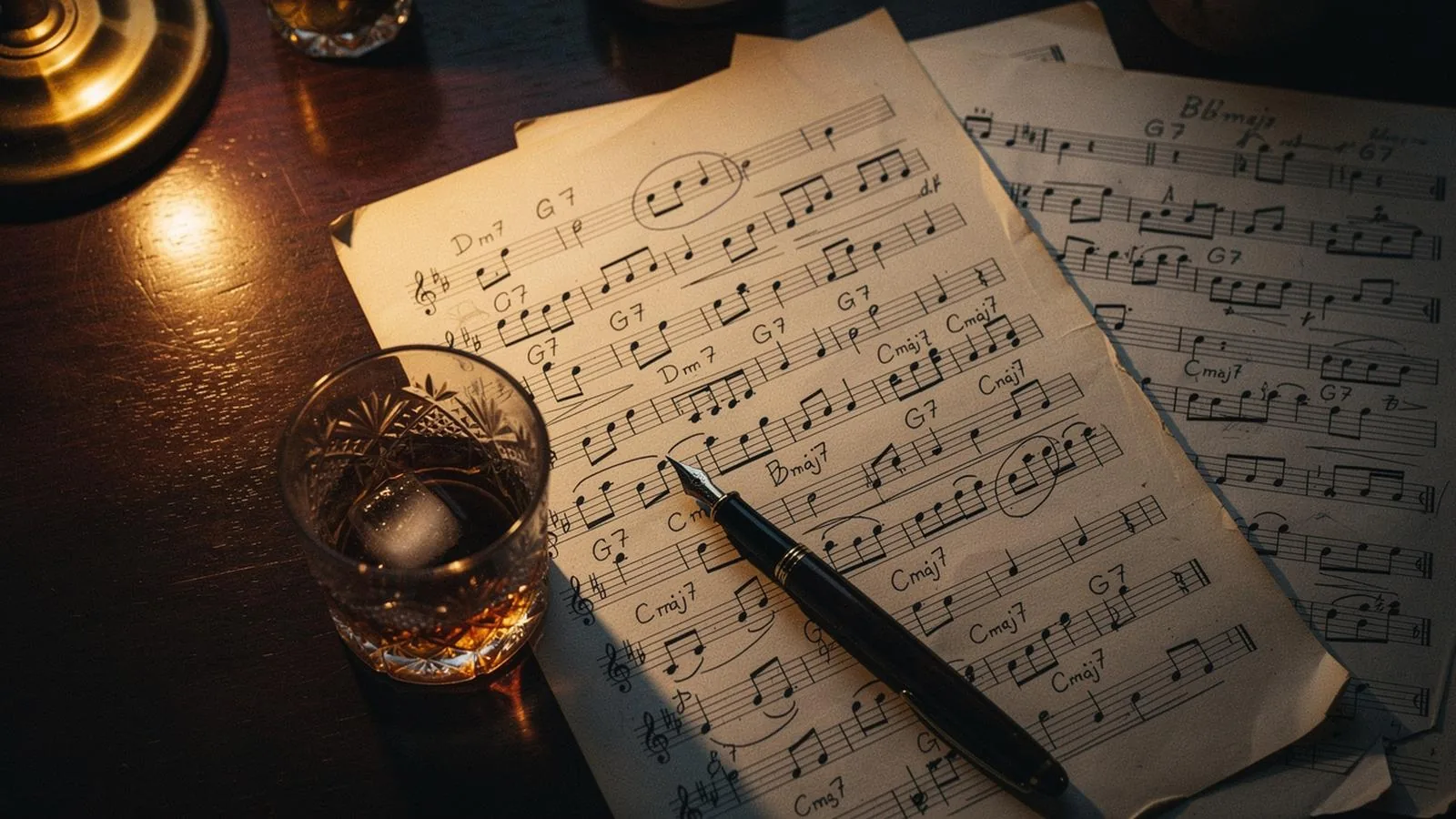
ii — V — I. The strongest cadential motion in tonal harmony. C major: Dm–G–C. G major: Am–D–G. F major: Gm–C–F. B♭ major: Cm–F–B♭. In jazz practice the chords are voiced as sevenths (Dm7–G7–Cmaj7). Genres: jazz, bossa nova, soul, pop ballads, R&B.
The ii–V–I (also written 2-5-1) is the most harmonically directed progression in Western music. The ii chord is pre-dominant: it prepares the ear for the tension to come. The V chord is the dominant (maximum tension; it contains the tritone, the most dissonant interval in tonal music). The I chord is the resolution. Preparation, tension, release: the most satisfying arc in harmony.
In jazz practice, the chords are typically voiced as sevenths: Dm7–G7–Cmaj7 in C major. The G7 chord contains the tritone B–F, which resolves to C–E in the Cmaj7: a half-step and whole-step motion respectively, creating the smoothest possible voice leading. Jazz musicians practice the ii–V–I in all 12 keys because it appears, in some form, in virtually every jazz standard. Outside jazz, it appears in many pop ballads and singer-songwriter songs as a more sophisticated substitute for the simpler I–IV–V pattern.
Songs that use it (verified): "Fly Me to the Moon" — multiple artists (F major: Gm7–C7–Fmaj7), "Autumn Leaves" — jazz standard, "My Funny Valentine" by Rodgers & Hart, "Just the Two of Us" by Grover Washington Jr., "Misty" by Erroll Garner, "The Girl from Ipanema" by Antônio Carlos Jobim (as harmonic foundation).
Variations:
- ii–V–I with extensions — Dm9–G13–Cmaj7. More colorful voicings, still the same functional motion.
- iiø–V7♭9–i (minor key) — In A minor: Bm7♭5–E7♭9–Am. The half-diminished ii° and the altered dominant create extra tension.
- Tritone substitution — Replace the V7 with ♭II7 (a chord a tritone away): Dm7–D♭7–Cmaj7. The bass moves by half step, ultra-smooth voice leading.
- I–vi–ii–V — The full jazz turnaround: Cmaj7–Am7–Dm7–G7. Extends the ii–V–I with a preceding vi chord.
How to use this in your songs:
- Use a ii–V–I at the end of a section to create a strong sense of arrival. It is the harmonic equivalent of a full stop, much stronger than ending on a simple V–I.
- Embed a ii–V–I within a longer progression: I–IV–ii–V–I creates a richer version of the standard I–IV–V pattern.
- In a pop context you do not need seventh chords. A simple Dm–G–C works just as well. The function is the same; the voicings can be simpler.
- The minor ii–V–i (Bm7♭5–E7–Am in A minor) creates an intense, melancholic resolution ideal for introspective or dramatic moments.
6. i-♭VII-♭VI-V — The Andalusian Cadence
Pattern and keys
i — ♭VII — ♭VI — V. A 400-year-old descending minor progression from flamenco. A minor: Am–G–F–E. E minor: Em–D–C–B. D minor: Dm–C–B♭–A. The major V at the end (E in A minor, not Em) is what turns the descent into a loop. Genres: flamenco, rock, soul, pop, film scores, R&B.
The Andalusian cadence — i–♭VII–♭VI–V — generates its emotional power from its bass line. Every chord root descends by a whole step (A→G→F→E in A minor), creating an irresistible sense of downward motion, gravity, and inevitable arrival. The progression is named for its origin in flamenco and the Andalusian region of Spain, but its emotional universality has made it one of the most widely borrowed chord sequences in all of popular music.
Three of its four chords are already in a minor key; only the major V is borrowed. It also is not really a cadence: it is almost always used as a repeating loop, which changes the question from how to arrive at it to how to leave it. We pulled the whole thing apart in a dedicated guide to the Andalusian cadence, covering the flamenco reading in which the final major chord is home, the songs that are commonly miscredited to it, and three ways out of the loop.

7. I-♭VII-IV — Classic Rock's Borrowed Flat-Seven
Pattern and keys
I — ♭VII — IV. The defining sound of guitar-driven classic rock, built on a chord borrowed from the parallel minor (or, equivalently, the Mixolydian mode). D major: D–C–G. A major: A–G–D. G major: G–F–C. E major: E–D–A. Genres: classic rock, hard rock, southern rock, indie rock, folk-rock.
The I–♭VII–IV takes one chord from outside the diatonic key (the ♭VII, borrowed from the parallel minor) and uses it as a bridge between the I and IV. The result is more open, more driving, and more rock-oriented than the diatonic alternative. In D major, the diatonic progression would be D–C♯m–G; the ♭VII substitutes a major C chord for the diatonic C♯ minor. The ♭VII is borrowed from the Mixolydian mode (the major scale with a lowered seventh degree), which is why this sound is sometimes labeled "Mixolydian" in analysis.
According to Richard Scott's analysis in Money Chords: A Songwriter's Sourcebook of Popular Chord Progressions, the I–♭VII–IV is the defining harmonic pattern of 1960s–1970s classic rock, appearing in hundreds of songs from that era. In D Mixolydian (D–C–G), "Sweet Home Alabama" by Lynyrd Skynyrd is perhaps the most iconic example, confirmed by Hooktheory's TheoryTab analysis which identifies the song as written in D Mixolydian. The ♭VII chord gives these songs their open, powerful quality: it is a major chord, so it sounds strong rather than dark, but its borrowed nature creates harmonic tension that pulls the progression forward.
Songs that use it (verified): "Sweet Home Alabama" by Lynyrd Skynyrd (D: D–C–G, D Mixolydian), "More Than a Feeling" by Boston (C: C–B♭–F), "Gloria" by Shadows of Knight / Van Morrison (E: E–D–A), "All Right Now" by Free, "You Ain't Seen Nothing Yet" by Bachman-Turner Overdrive, "Wild Thing" by The Troggs (A: A–G–D).
Variations:
- I–♭VII–♭VI–IV — Adds a borrowed ♭VI chord for even more minor-key colour.
- I–♭VII–IV–I — Loop variant with an explicit return to I, creating a closed progression.
- I–IV–♭VII–IV — The arch form: goes up to IV, borrows ♭VII, returns to IV. Used in "And She Was" by Talking Heads.
- I–V–♭VII–IV — Adds the V before the ♭VII: "Summer of '69" by Bryan Adams, "Born to Run" by Bruce Springsteen.
How to use this in your songs:
- In guitar-friendly keys (D, A, G, E major), the ♭VII chord often falls in an open chord position. D→C→G in D major all use open strings on standard tuning. Our guitar songwriting apps roundup covers the tools that visualize these voicings in real time.
- This progression gives a major-key song a blues-influenced, slightly modal quality without fully leaving the major tonality.
- Use I–♭VII–IV for your chorus if your verse uses I–V–vi–IV. The borrowed chord creates an immediate sense of lift and differentiation between sections.
- Make the ♭VII chord last longer than the I and IV. Giving the borrowed chord more time lets its character register emotionally before moving on.
8. The 12-Bar Blues — A Complete Form
Structure
Bars 1–4: I | bars 5–6: IV | bars 7–8: I | bar 9: V | bar 10: IV | bars 11–12: I (turnaround). In E major: E–E–E–E / A–A–E–E / B–A–E–E. In A major: A–A–A–A / D–D–A–A / E–D–A–A. Jazz blues uses dominant sevenths (I7–IV7–V7). Genres: blues, rock & roll, jazz blues, R&B, country blues.
The 12-bar blues is not just a chord progression: it is a complete musical form, a container for expression. Its longevity (over a century of continuous use) comes from its combination of structural predictability and expressive freedom. Listeners who know the form can hear where they are within the 12 bars at any moment, which creates anticipation: you can hear the V chord approaching from bar 8 onward, knowing the climax and return are coming. This predictability allows performers to focus all their creative energy on what they play over the changes rather than on navigating the changes themselves.
The standard 12-bar form, as documented by JustinGuitar.com and confirmed across multiple academic sources, is: four bars of I, two bars of IV, two bars of I, one bar of V, one bar of IV, two bars of I (with the last bar often being a "turnaround" that leads back to the top). In jazz blues contexts, these are commonly played as dominant seventh chords (I7–IV7–V7) for a richer, more harmonically complex sound. The "quick change" variation puts IV in bar 2 (not bar 5): check "Before You Accuse Me" by Eric Clapton for a clear example of the quick-change 12-bar.
Songs that use it (verified): "Red House" by Jimi Hendrix (B major 12-bar), "Sweet Home Chicago" by Robert Johnson, "Texas Flood" by Stevie Ray Vaughan (G major, slow blues), "Johnny B. Goode" by Chuck Berry, "Boom Boom" by John Lee Hooker, "The Thrill Is Gone" by B.B. King, "Hound Dog" by Elvis Presley.
Variations:
- Quick change — IV in bar 2 instead of bar 5: I–IV–I–I / IV–IV–I–I / V–IV–I–V.
- Jazz blues — Extended chords: Imaj7–IV7–iim7–V7. Moves toward jazz harmony while keeping the blues form.
- Minor blues — Replace all major chords with minor: i–iv–v. Darker, more melancholic blues feel.
- Turnaround — Bar 12 replaces the resting I with a V7 chord (or I–♭VII–IV–V7) to create momentum back to bar 1.
How to use this in your songs:
- The 12-bar form works at any tempo and in any style: slow blues ballads, fast shuffle, uptempo rock, jazz. The form is genre-neutral; the groove and feel determine the genre.
- Use dominant seventh chords (I7, IV7, V7) instead of plain major chords for the authentic blues sound. The added minor seventh interval gives each chord its characteristic blues quality.
- The turnaround in bars 11–12 is where you make the form personal. A I–♭VII–IV–V7 turnaround, or a more complex jazz turnaround, each creates a different character going back into the top.
- Even outside a strict 12-bar form, the principle holds: giving one chord significantly more time than the others creates the blues-influenced feel of rootedness and forward motion.

9. i-♭VI-♭III-♭VII — The Natural Minor Loop
Pattern and keys
i — ♭VI — ♭III — ♭VII. The most common diatonic minor-key progression in contemporary music. A minor: Am–F–C–G. E minor: Em–C–G–D. B minor: Bm–G–D–A. D minor: Dm–B♭–F–C. Genres: indie rock, alternative, pop, R&B, film scores.
The i–♭VI–♭III–♭VII is the most versatile minor-key progression in contemporary music. Its unique character comes from the all-major borrowed chords that follow the minor i: ♭VI, ♭III, and ♭VII are all major chords, creating a paradox of a minor-key song that feels simultaneously melancholic and uplifting. The minor i announces darkness; the three major chords that follow lift the emotional register without fully leaving it. This is why the progression works equally well for anthemic rock songs and quiet, intimate indie ballads.
In A minor, this is Am–F–C–G, and all four chords are diatonic to C major, which means the progression naturally bridges the relationship between A minor and its relative major key. Many songwriters encounter this progression by accident when writing in C major and ending up on Am: the same four chords support both tonal centers depending on where the melody resolves. Songs like "Losing My Religion" by R.E.M. and "With or Without You" by U2 demonstrate how the progression sustains emotional intensity across an entire song without requiring harmonic variation.
Songs that use it (verified): "Losing My Religion" by R.E.M. (E minor: Em–C–G–D), "With or Without You" by U2 (D major / B minor: D–A–Bm–G), "Zombie" by The Cranberries (E minor), "Otherside" by Red Hot Chili Peppers (A minor), "When I Come Around" by Green Day (G major / E minor), "Save Tonight" by Eagle Eye Cherry (C major / A minor).
Variations:
- i–♭VII–♭VI–♭VII — Inverted: minor i, then descend to ♭VII, up to ♭VI, back to ♭VII. More cyclic, less directional.
- i–♭VI–♭III–♭VII–i — Explicit return to i closes the loop more definitively.
- ♭VI–♭III–♭VII–i — Starts on ♭VI: major chords first, minor arrival. Creates a brighter opening with a darker landing.
- Major key parallel: I–IV–♭VII–IV — Same harmonic territory, but written as a major-key progression with borrowed chords.
How to use this in your songs:
- This progression works over an incredibly wide dynamic range. Play it softly fingerpicked for a folk-indie sound, or drive it hard for anthemic rock. It holds both equally well.
- Because the ♭VI–♭III–♭VII are all major chords, the progression never sounds oppressively dark. Use it when you want minor-key emotion without bleakness.
- The Am–F–C–G version in A minor / C major is one of the most guitar-friendly chord sequences available: all open chords in standard tuning, comfortable in a wide range of tempos.
- Extend the time on the i chord and compress the three major chords for a more pensive, lingering feel. Equalize all four chords for a more propulsive, driving feel.
10. i-iv-V — The Harmonic Minor Feel
Pattern and keys
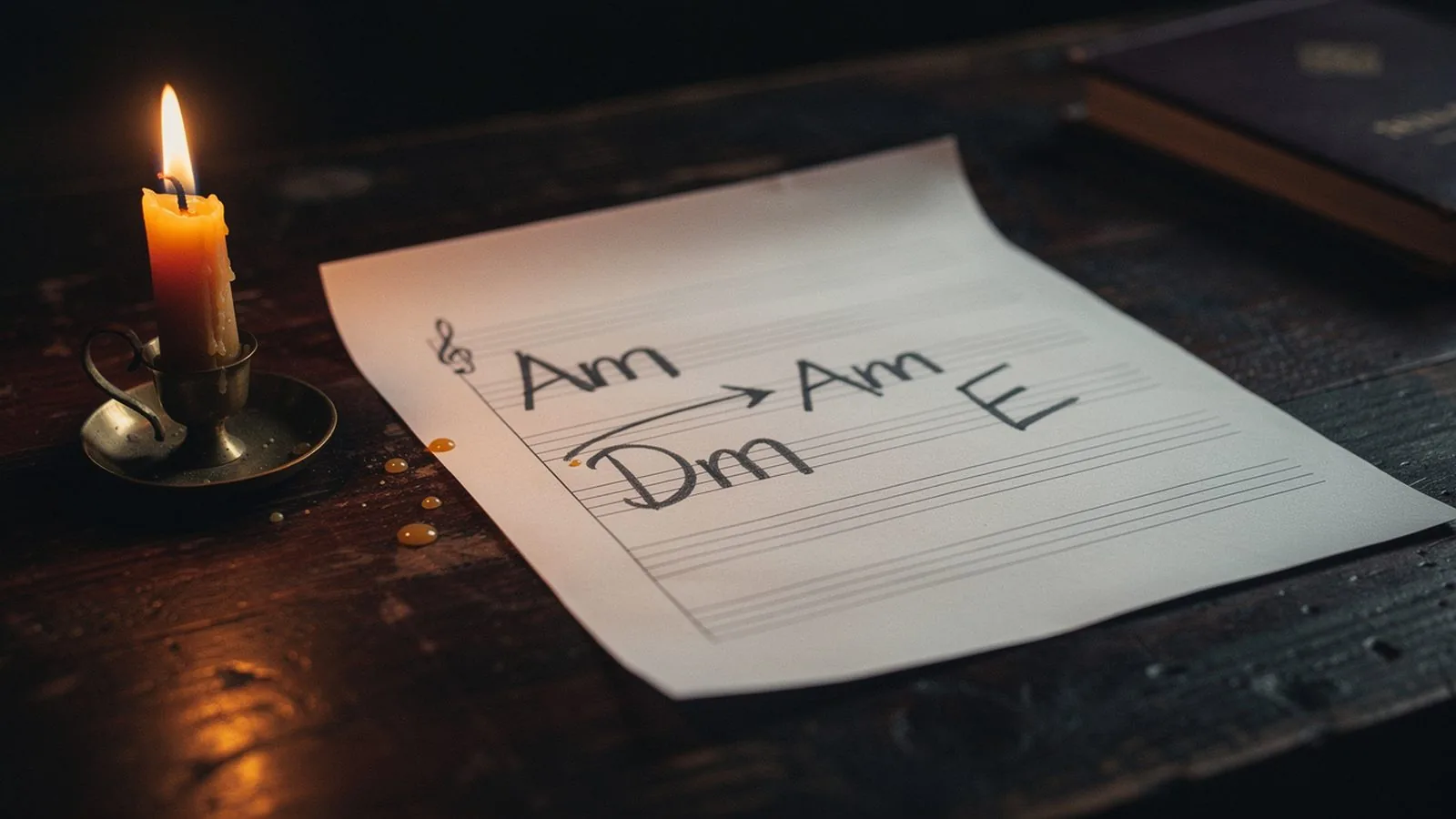
i — iv — V (major). A three-chord minor progression with a major dominant chord borrowed from the harmonic minor scale. A minor: Am–Dm–E (major). E minor: Em–Am–B (major). D minor: Dm–Gm–A (major). Genres: blues, flamenco, jazz, classical-influenced pop, rock ballads.
The i–iv–V uses a major V chord in a minor key. Instead of the natural minor's minor v, this progression borrows the major V from the harmonic minor scale, producing the most intense harmonic tension and resolution available in a minor-key context. The harmonic minor scale raises the seventh degree (creating G♯ in A minor rather than G), which gives the V chord its major quality (E major in A minor: E–G♯–B). This raised seventh creates a leading tone, a note that strongly pulls toward the root, amplifying the resolution from V back to i enormously.
The progression underlies "House of the Rising Sun" by The Animals (analyzed by multiple music theory sources as using a i–♭III–IV–♭VI–i–♭III–V structure centered on A minor with a major E chord) and "Summertime" from George Gershwin's Porgy and Bess. As documented by Musical-U and confirmed in Jeffrey Pepper Rodgers' songwriter's guide, "Black Magic Woman" (Santana, written by Peter Green of Fleetwood Mac) uses i–v–i–iv–i–v–i: a pure minor framework that amplifies the blues feel through modal ambiguity.
Songs that use it (verified): "House of the Rising Sun" by The Animals (A minor with E major V), "Summertime" by George Gershwin (A minor), "Black Magic Woman" by Santana / Peter Green (i–v–i–iv variation), "The Thrill Is Gone" by B.B. King (B minor blues variation), "Hurt" by Nine Inch Nails / Johnny Cash (A minor).
Variations:
- i–IV–V — Use a major IV instead of minor iv. Slightly brighter, while keeping the harmonic minor V.
- i–iv–v — Use a minor v instead of major V. Returns to pure natural minor for a more gentle resolution.
- i–♭II–V — Neapolitan variation: the ♭II (B♭ in A minor) is borrowed from Phrygian for an exotic, dramatic sound before the V.
- i–iv–V7 — Add the seventh to the V chord: E7 in A minor. The dominant seventh amplifies the pull back to i even further.
How to use this in your songs:
- The major V chord (E major in A minor, not Em) is the key to this progression's intensity. Always use the major V for the full harmonic minor effect.
- Make the V a dominant seventh (V7) for even stronger tension. E7 in A minor contains the leading tone G♯ and the minor seventh D, both of which pull urgently toward Am.
- In a blues context, play all three chords as dominant sevenths (i7–iv7–V7) for the classic blues-minor sound that sits between pure minor and blues tonality.
- Use i–iv–V for a bridge or pre-chorus within a song that mostly uses the natural minor loop (i–♭VI–♭III–♭VII). The major V creates maximum tension at the critical moment before a chorus.
How do I use these progressions in my own songs?
The 10 progressions above are the raw materials of popular music. Knowing the patterns is the first step; using them well is a matter of matching progression to emotional intent, understanding harmonic function so substitutions become deliberate, and combining progressions across sections so a song has shape. Four practical principles below cover the moves that take a stock progression and turn it into your song.
Start with the emotional arc, not the chord chart
Before choosing a chord progression, identify the emotional arc of your song: not just the overall mood, but the movement between sections. A verse that feels uncertain and searching (vi–IV–I–V) is more effective when the chorus resolves to the stable I–V–vi–IV. A verse built on the natural minor loop (i–♭VI–♭III–♭VII) can create an anthemic chorus by staying on the same progression and simply raising the dynamic and energy level. The progression is not just mood; it is the shape of the emotional journey and the structure of the song.
Understand harmonic function before you start substituting
Each chord in a progression serves a harmonic function: tonic (home: I and vi), subdominant (gentle movement away from home: IV and ii), or dominant (tension pulling toward home: V and vii°). Once you understand function, substitution becomes intuitive. Replace the IV in I–IV–V with the ii (same function, different colour) and you have made the progression jazzier. Replace the V with the ♭VII (similar but borrowed; function slightly weakened, rock character added). Understanding the functions behind the Roman numeral labels is what separates intentional harmonic choices from guessing.
Combine complementary progressions across sections
Most songs do not use the same progression throughout. The most effective songs often use complementary progressions that share chords but differ in starting point, pace, or the addition of one borrowed chord. A verse on vi–IV–I–V naturally leads to a chorus on I–V–vi–IV (same chords, different starting point and feel). A verse on i–♭VI–♭III–♭VII can move to a bridge using i–iv–V for maximum tension before the final chorus. The relationship between section progressions, how they contrast and resolve into each other, is one of the most powerful tools in songwriting.
How does one borrowed chord change everything?
The single most efficient way to add emotional depth to a familiar progression is to substitute one borrowed chord. In G major using I–V–vi–IV: add the ♭VII (F major) between IV and the return to I → G–D–Em–C–F–G. The borrowed F creates a moment of unexpected weight before home. Replace the IV in I–IV–V with the minor iv (Cm in G major): G–Cm–D–G. The borrowed minor iv adds a melancholy that the major IV never carries. A single chord from outside the key changes the emotional colour of the entire progression.
Using Song Cage to explore these progressions
Song Cage's chord palette is built for the kind of harmonic exploration this guide describes. Every chord lives in one of three tabs by its relationship to your current key: the In Key tab shows the seven diatonic triads with Roman numeral labels (I, ii, iii, IV, V, vi, vii°); the Borrowed tab shows chords pulled from parallel modes (♭VII, ♭VI, minor iv) labeled with their source mode; the Secondary Dominants tab shows the V chords that resolve to non-tonic targets (V/ii, V/V, V/vi). Place a chord on the timeline and the palette ranks what comes next by how its tones match your melody and how smoothly the new chord connects to the chords on either side, with voice-leading dots on every suggestion. The Modulation panel maps pivot chords and cadential routes between any two keys: the kind of harmonic navigation this guide can only describe in words, Song Cage runs live on your own song. Try it free →
Go beyond the standard 10
Song Cage ranks every next chord by how it fits the melody you've already written and the chords around it. Diatonic, borrowed, secondary dominants, modulation routes, all in any key. Drop one on the timeline and see exactly how to play it on guitar or piano.
Quick reference: the 10 most useful chord progressions
| # | Progression | In G or Gm | Genre | Emotional character | Borrowing? |
|---|---|---|---|---|---|
| 1 | I–V–vi–IV | G–D–Em–C | Pop, rock, country | Balanced, forward-moving, universal | No (all diatonic) |
| 2 | I–IV–V | G–C–D | Blues, rock, folk | Direct, complete, resolved | No (all diatonic) |
| 3 | vi–IV–I–V | Em–C–G–D | Pop, indie, folk | Introspective, bittersweet | No (rotation of #1) |
| 4 | I–vi–IV–V | G–Em–C–D | Doo-wop, soul, pop | Smooth, warm, timeless | No (all diatonic) |
| 5 | ii–V–I | Am–D–G | Jazz, bossa nova, soul | Directed, resolved, sophisticated | No (all diatonic) |
| 6 | i–♭VII–♭VI–V | Gm–F–E♭–D | Flamenco, rock, pop | Dramatic, descending, intense | ♭VII, ♭VI from Aeolian |
| 7 | I–♭VII–IV | G–F–C | Classic rock, indie | Open, driving, rock-influenced | ♭VII from Mixolydian |
| 8 | 12-Bar Blues | G–G–G–G / C–C–G–G / D–C–G–G | Blues, rock & roll, jazz | Structural, expressive, grounded | Optional (dominant 7ths) |
| 9 | i–♭VI–♭III–♭VII | Gm–E♭–B♭–F | Indie, rock, pop | Anthemic, uplifting-melancholic | ♭VI, ♭III, ♭VII (all Aeolian) |
| 10 | i–iv–V | Gm–Cm–D | Blues, flamenco, jazz | Intense, tension-and-release, minor | V from harmonic minor |
Frequently Asked Questions
What are the most useful chord progressions for songwriters?
The 10 most useful chord progressions for songwriters are: (1) I–V–vi–IV — the most common in contemporary pop, (2) I–IV–V — the blues and rock foundation, (3) vi–IV–I–V — the relative minor rotation, (4) I–vi–IV–V — the 50s/doo-wop progression, (5) ii–V–I — the jazz cadence, (6) i–♭VII–♭VI–V — the Andalusian cadence, (7) I–♭VII–IV — classic rock's borrowed flat-seven, (8) the 12-bar blues form, (9) i–♭VI–♭III–♭VII — the natural minor loop, and (10) i–iv–V — the harmonic minor feel. Each has distinct emotional qualities and works across different genres.
What is the I–V–vi–IV chord progression?
The I–V–vi–IV (also called the Axis progression) is the most common chord progression in contemporary popular music. In G major: G–D–Em–C. In C major: C–G–Am–F. Its emotional arc moves from home (I) to tension (V) to emotional depth at the relative minor (vi) and then to resolution (IV). Wikipedia's verified song list confirms its use in "With or Without You" by U2 (D major), "Someone Like You" by Adele (A major), "Girls Like You" by Maroon 5 (C major), "Demons" by Imagine Dragons (E♭ major), and hundreds more. The progression was named the Axis progression and demonstrated in the comedy group Axis of Awesome's "Four Chords" medley (2008).
What is the difference between major and minor chord progressions?
Major vs minor is the first distinction to understand. Major chord progressions (I–V–vi–IV, I–IV–V, I–vi–IV–V) are built from a major key's diatonic chords. Uppercase Roman numerals (I, IV, V) indicate major chords; they generally sound brighter, more stable, more resolved. Minor chord progressions (i–♭VI–♭III–♭VII, i–iv–V, i–♭VII–♭VI–V) are built from a minor key and generally sound darker, more melancholic, more emotionally intense. The distinction is not absolute: borrowed chords routinely cross the boundary. The I–♭VII–IV progression uses a major key tonic with a borrowed minor-key ♭VII chord, and the Andalusian cadence uses a major V chord in a minor-key context. The most emotionally complex songs blur the major/minor line deliberately.
What chord progressions do most pop songs use?
Most contemporary pop songs use one or more rotations of the four-chord Axis progression: I–V–vi–IV, vi–IV–I–V, IV–I–V–vi, or V–vi–IV–I. The I–vi–IV–V (50s progression) is also extremely common, particularly in ballads and classic pop. Wikipedia's verified lists document hundreds of songs using each of these patterns. The I–IV–V underlies blues, folk, and rock. Together, these patterns — all using the same four diatonic chords in different orderings — underpin the vast majority of popular songs from the 1950s to today.
What are borrowed chords and why do they matter?
Borrowed chords are chords taken from the parallel key, for example using chords from G minor inside a G major song. The most useful borrowed chords are: the ♭VII (flat-seven major; F major in G major), which adds rock energy and is characteristic of Mixolydian-influenced music; the ♭VI (flat-six major; E♭ major in G major), which adds cinematic weight; and the minor iv (Cm in G major), which adds profound melancholy. Borrowed chords add emotional depth and surprise that purely diatonic progressions cannot produce. The ♭VII is arguably the single most useful borrowed chord for popular songwriting: it appears in the I–♭VII–IV classic rock progression, the i–♭VII–♭VI–V Andalusian cadence, and the i–♭VI–♭III–♭VII natural minor loop.
What is the ii–V–I chord progression?
The ii–V–I is the most important jazz chord progression in Western music. In C major: Dm7–G7–Cmaj7. The ii chord (pre-dominant) prepares the tension; the V chord (dominant) contains the tritone, the most dissonant interval in tonal harmony, which creates an irresistible pull toward resolution; and the I chord provides that resolution. It is the strongest cadential motion in Western music. Jazz musicians practice it in all 12 keys because it appears in virtually every jazz standard. In popular music, it appears in ballads and sophisticated pop as a harmonically richer substitute for the I–IV–V pattern.
What is the Andalusian cadence?
The Andalusian cadence (i–♭VII–♭VI–V) is a descending minor-key progression from flamenco and Spanish classical music with over 400 years of documented history. In A minor: Am–G–F–E. Its power comes from the descending bass line (A–G–F–E, a falling tetrachord), which creates irresistible downward momentum. The major V chord at the end (E major, not Em) borrows from the harmonic minor scale, creating maximum tension before resolution. Confirmed examples include "Hit the Road Jack" by Ray Charles (G♯ minor: G♯m–F♯–E–D♯7) and Alphaville's "Big in Japan" (confirmed on Wikipedia's Andalusian cadences list).
What are the best chord progressions for beginners?
The best chord progressions for beginners to learn first are: (1) I–IV–V — only three chords, all major, easy to play on guitar in open-chord keys like G, D, A; (2) I–V–vi–IV — four chords with one minor chord, the foundation of most pop music; and (3) I–vi–IV–V — the same four chords in a more flowing order, ideal for ballads. Starting in G major on guitar gives you G, C, D, and Em: all open chords that feel natural on standard tuning. Song Cage's chord palette shows these progressions in any key with guitar fretboard diagrams so you can see the chord shape and hear the sound simultaneously.
What chord progressions work best for sad songs?
The most effective chord progressions for sad songs are: the i–♭VII–♭VI–V (Andalusian cadence) for dramatic descending emotion; the i–♭VI–♭III–♭VII natural minor loop for sustained melancholy with anthemic undertones; the i–iv–V harmonic minor for intense, tense sadness; and the vi–IV–I–V for bittersweet emotion within a major-key context. The minor iv borrowed into a major-key song (e.g. Cm in G major) is one of the most emotionally powerful single-chord substitutions for adding melancholy to an otherwise bright progression.
What is the 12-bar blues chord progression?
The 12-bar blues is a complete musical form built on three chords (I, IV, V) distributed across 12 bars in a specific pattern: bars 1–4 on the I chord, bars 5–6 on IV, bars 7–8 returning to I, bar 9 on V, bar 10 on IV, bars 11–12 on I (with a "turnaround" in bar 12 to lead back to bar 1). In E major: E–E–E–E / A–A–E–E / B–A–E–E. In jazz blues, dominant seventh chords are used: I7–IV7–V7. The "quick change" variation adds IV in bar 2. Songs confirmed to use the standard 12-bar form include "Red House" (Jimi Hendrix, B major), "Sweet Home Chicago" (Robert Johnson), and "Texas Flood" (Stevie Ray Vaughan, G major).
How do I write a chord progression from scratch?
Start by picking a key (G major is the most guitar-friendly starting point: open chords G, C, D, and Em). Choose your emotional direction: stable and uplifting suggests I–V–vi–IV; introspective and searching suggests vi–IV–I–V; dramatic and dark suggests i–♭VII–♭VI–V in the parallel minor. Play through the progression and listen for where it wants to go. Does it feel like it needs tension (move toward V) or resolution (move toward I)? Then add one borrowed chord: try the ♭VII between IV and I for a rock feel, or the minor iv for added melancholy. Song Cage's chord palette makes this process immediate: every option in any key is one tap away, with a guitar diagram and audio preview for each chord.
What is a diatonic chord progression?
A diatonic chord progression uses only chords built from the notes of a single key, no borrowed chords, no chromatic alterations. In G major, the seven diatonic chords are: G (I), Am (ii), Bm (iii), C (IV), D (V), Em (vi), and F♯° (vii°). Progressions like I–V–vi–IV, I–IV–V, I–vi–IV–V, and ii–V–I are all diatonic. They use only chords from the key. This is why they sound naturally harmonious: all the notes across the progression share the same scale. Borrowed chords (♭VII, ♭VI, minor iv) step outside the diatonic set to add emotional colour, but must be used against the diatonic backdrop to have their effect.
What is the I–♭VII–IV chord progression?
The I–♭VII–IV is the characteristic progression of classic rock, borrowing the ♭VII chord from the Mixolydian mode (the major scale with a lowered seventh degree). In D major: D–C–G (D Mixolydian). The ♭VII gives the progression its open, driving rock quality without darkening it into minor territory: it is a major chord, so it sounds powerful rather than melancholic. "Sweet Home Alabama" by Lynyrd Skynyrd (analyzed by Hooktheory as D Mixolydian) is the most iconic example. Richard Scott's Money Chords documents its prevalence in 1960s–1970s classic rock including "Gloria," "More Than a Feeling," and "Magic Bus."
How do borrowed chords work in songwriting?
Borrowed chords work by temporarily importing a chord from the parallel key, bringing in an outside colour that contrasts with the diatonic chords surrounding it. To use them: (1) establish the diatonic key firmly with two or more diatonic chords first, so the listener has a harmonic reference point; (2) place the borrowed chord at a moment of emotional emphasis, often before a return to the tonic, before a chorus, or at the peak of a verse; (3) let the borrowed chord sit long enough to register emotionally (at least one full bar); (4) resolve it back to a diatonic chord. The borrowed chord's effect is entirely relative to the diatonic context: without establishing home first, there is no sense of borrowed-ness, just a different chord.