Table of Contents
- What is a chord inversion?
- How does the bass note decide the inversion?
- What are the three inversions of a triad?
- How many inversions does a seventh chord have?
- Slash chords vs figured bass: how are inversions written?
- When is a slash chord NOT an inversion?
- Why do songwriters use chord inversions?
- Smoother voice leading and common tones
- Building a stepwise bass line
- The special case of the second inversion
- What songs use chord inversions?
- "Dust in the Wind" walks the bass both ways
- "While My Guitar Gently Weeps" and the line cliché
- "Stairway to Heaven" and the chromatic descent
- How do chord inversions work on guitar vs piano?
- How do you practice chord inversions?
- Common mistakes to avoid
- How does Song Cage help you hear inversions?
- Chord inversions at a glance
- Frequently Asked Questions
Play a C major chord with C at the bottom and it sounds settled, like home. Now play the exact same three notes but put E at the bottom instead, then G. Same chord, same name, yet the ground shifts under it each time: one feels grounded, one leans forward, one floats. That is a chord inversion, and it is the difference between a progression that lurches and one that glides.
Inversions are the quiet workhorse of good songwriting. They are how a four-chord verse gets a bass line that walks down the staircase instead of jumping around it, and they are why two arrangements of the same chords can sound amateur or professional. This guide covers what an inversion actually is, how to read and write one, why you would reach for it, and the real songs that live on inverted chords.
What is a chord inversion?
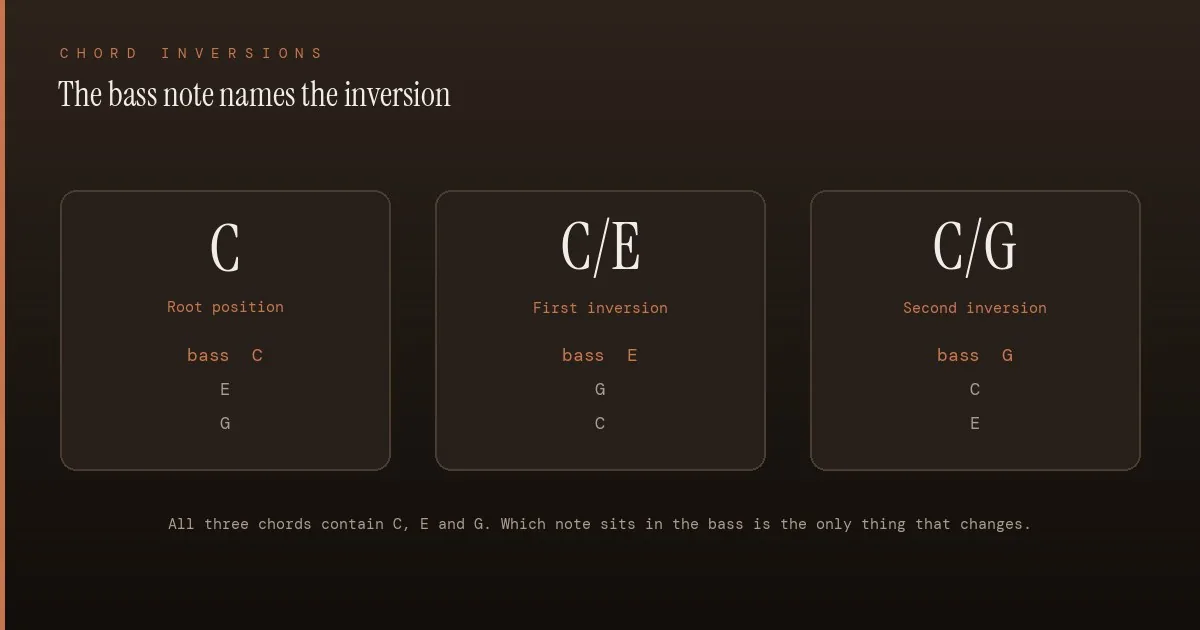
A chord inversion is the same chord with a note other than its root as the lowest (bass) note. The bass note is what defines the inversion: root in the bass is root position, the third in the bass is first inversion, the fifth in the bass is second inversion. The notes and the chord name stay the same; only the bottom changes.
A C major triad is always the notes C, E, and G in some order. Stack them with C at the bottom and you have root position. Put E at the bottom and it is first inversion. Put G at the bottom and it is second inversion. The chord is still "C major" in all three, and it still does the same job in your key. What changes is the bass note, and the bass note is the most powerful single voice in any progression, because the ear hears it as the foundation everything else sits on.
How does the bass note decide the inversion?
Only the lowest note matters for naming the inversion. The order of the notes above the bass can be anything: a first-inversion C (E in the bass) is first inversion whether the upper notes are C and G, G and C, or doubled. This is why "which note is on top" is a common point of confusion. The top note changes the color and the melody, but the bottom note is what the ear reads as the chord's footing, so the bottom note is what sets the inversion. Spreading those upper notes out or moving them up an octave gives you a different voicing of the same inversion, not a new one: the inversion only changes when the bass note changes.
What are the three inversions of a triad?
A triad has three notes, so it has three possible bass notes and three positions: root position, first inversion, and second inversion. Each one has a figured-bass shorthand (the numbers classical scores write under the bass) and a modern slash-chord spelling (the way a lead sheet writes it). Here is the full map for a C major triad.
| Position | Bass note | Figured bass | Slash chord | Notes (bottom to top) |
|---|---|---|---|---|
| Root position | Root (C) | 5/3 (usually blank) | C | C E G |
| First inversion | Third (E) | 6 | C/E | E G C |
| Second inversion | Fifth (G) | 6/4 | C/G | G C E |
The figured-bass number is shorthand for the intervals above the bass: a first-inversion triad has a sixth and a third above the bass (abbreviated to just "6"), a second-inversion triad has a sixth and a fourth ("6/4").
Read the slash spelling as "chord over bass note." C/E is "C over E," meaning a C major chord with E in the bass. Because E is the third of C, C/E is automatically a first inversion. C/G is "C over G," and because G is the fifth, that is a second inversion. You do not need the figured-bass numbers to use inversions in a song, but you will see both systems, so it helps to recognize them.
How many inversions does a seventh chord have?
A seventh chord has four notes, so it has four positions: root position plus first, second, and third inversion. The third inversion is the one triads do not have, and it puts the seventh of the chord in the bass. A G7 (G, B, D, F) in third inversion is G7/F, with F sitting at the bottom.
That extra inversion is useful precisely because the seventh is a restless note that wants to resolve down by step. Putting it in the bass turns that tension into bass-line motion: a G7/F sliding to a C/E gives you a bass that steps F down to E while the harmony moves from dominant to tonic. The figured-bass shorthands shift too, as the table shows, but the idea is the same as a triad: the lowest note names the inversion.
| Position | Bass note | Figured bass | Slash example (G7) |
|---|---|---|---|
| Root position | Root (G) | 7 | G7 |
| First inversion | Third (B) | 6/5 | G7/B |
| Second inversion | Fifth (D) | 4/3 | G7/D |
| Third inversion | Seventh (F) | 4/2 (or 2) | G7/F |
Slash chords vs figured bass: how are inversions written?
The two notations answer the same question in different eras. Figured bass came from the Baroque period, where a keyboard player read a bass line with numbers underneath telling them which intervals to stack on top. Modern lead sheets and chord charts use slash notation instead, because it names the chord you already know and simply tells you the bass note: write the chord on the left of the slash and the bass note on the right.
For a songwriter, slash chords are the practical system. "G/B," "D/F#," and "C/E" tell a guitarist or pianist exactly what to play without a theory degree. The Nashville Number System handles the same idea with a number for the chord and a smaller number underneath for the bass, which is how session players chart an inverted chord on the fly. All three notations describe the identical sound: a known chord sitting on a chosen bass note.
When is a slash chord NOT an inversion?
This is the trap most explainers skip. A slash chord is only an inversion when the bass note is one of the chord's own notes. If the bass note is not in the chord, it is a slash chord but not an inversion.
Inversion or not?
- C/E and C/G are inversions: E and G are notes of C major.
- C/D and C/F are not inversions: D and F are not in a C major triad, so these are non-chord-tone bass notes (a pedal or added-bass color), not a re-stacking of the chord.
The distinction matters when you analyze a song or chart it for other players. Calling C/D a "second inversion" will confuse anyone reading your chart, because there is no way to invert C major and land on D. It is its own kind of color, useful for a pedal bass that stays put while chords change above it, but it is not an inversion.
Why do songwriters use chord inversions?
Inversions do not add new chords to your song. They change the bass note of chords you already have, and that small change buys three big things: smoother voice leading, a bass line that moves by step, and stability you can place exactly where you want it.
Smoother voice leading and common tones
Voice leading is the art of moving from one chord to the next with the smallest possible motion in each voice. Root-position chords force the bass to leap by the distance between roots, and they often make the inner notes jump too. Choosing an inversion lets you keep common tones in place and move the other voices a step or less. On piano this means less hand-flying across the keyboard; for the listener it means a progression that feels connected rather than blocky. This is the same craft that makes borrowed chords sit smoothly next to your diatonic ones.
Building a stepwise bass line
This is the headline use. Take the everyday progression C to G to A minor. In root position the bass leaps C up to G then up to A, which is fine but static. Swap the G for its first inversion, G/B, and the bass now walks straight down the scale: C, B, A. That is exactly what Kansas does in the verse of "Dust in the Wind," where C, G/B, A minor sends the bass gently down a staircase. Inversions turn a set of chords into a melody in the bass, and a moving bass line is one of the fastest ways to make a simple progression sound intentional and polished.
The special case of the second inversion
Second-inversion triads (the 6/4 chords) are the one inversion to handle with care. With the fifth in the bass, a 6/4 sounds slightly unstable on its own, so in traditional harmony it appears in three specific spots: the cadential 6/4 that delays a final chord for tension, the passing 6/4 that harmonizes a stepwise bass line, and the pedal 6/4 that sits over a held bass note. You do not have to obey the classical rules in a pop song, but knowing why a 6/4 feels suspended helps you use that suspense on purpose instead of stumbling into it.
What songs use chord inversions?
Chord inversions show up in famous songs as a moving bass line: instead of leaping between chord roots, the bass walks by step because one chord is inverted. Most often you are hearing a first-inversion chord, the third in the bass, smoothing the path between two root-position chords. Once you know the sound, you hear it everywhere. The table below maps five well-known songs to the inverted chord doing the work.
| Song | Key | Inverted chord | What the bass does |
|---|---|---|---|
| "Dust in the Wind" (Kansas) | C major | G/B (V, 1st inv.) | Walks down C, B, A in the verse |
| "Wonderful Tonight" (Eric Clapton) | G major | D/F# (V, 1st inv.) | Falls a step G to F# instead of leaping to D |
| "While My Guitar Gently Weeps" (The Beatles) | A minor | Am/G, then D/F# | Descends A, G, F#, F under a held chord |
| "Stairway to Heaven" (Led Zeppelin) | A minor | C/G (2nd inv.), D/F# (1st inv.) | Chromatic fall A, G#, G, F#, F |
| "Bridge Over Troubled Water" (Simon & Garfunkel) | E-flat major | Bb/D (V, 1st inv.), Eb/Bb (I, 2nd inv.) | Gospel piano walk-downs by step |
"Dust in the Wind" walks the bass both ways
Kansas's "Dust in the Wind" is the clearest inversion lesson in the rock canon, because it uses the trick in both directions. The verse runs C, G/B, A minor: G/B is the dominant (G) in first inversion, its third (B) in the bass, so the bass steps straight down C, B, A into the A minor. The chorus then flips it to climb: D/F#, G, A minor sends the bass up F#, G, A, where D/F# is a first-inversion D acting as a secondary dominant. One song, two stepwise bass lines, each built from a single inverted chord. Play the verse with a root-position G instead and the descending line disappears, which is the fastest way to hear what the inversion is buying you.
"While My Guitar Gently Weeps" and the line cliché
George Harrison's "While My Guitar Gently Weeps" opens with the same device in A minor: A minor, Am/G, D/F#, F. The bass walks down A, G, F#, F while the A minor sound is held above it. Am/G puts the flat seventh (G) in the bass, an A minor seventh in third inversion, and D/F# is a first-inversion D major. Guitarists call this a "line cliché," a descending bass threaded under a static chord, and it is one of the most reliable ways to make a simple minor vamp sound like it is going somewhere. The chords are not new; only the bass note moves.
"Stairway to Heaven" and the chromatic descent
The intro to Led Zeppelin's "Stairway to Heaven" is the most famous descending bass line on guitar, and inversions are how it is built. Over a held A minor sound, the bass falls by half steps, A, G#, G, F#, F, and the chords bend to follow it: a common reading is A minor, a chord on G#, then C/G, D/F#, and F major. C/G is a C major triad in second inversion (its fifth, G, in the bass) and D/F# is a D major in first inversion (its third, F#, in the bass). The upper voices barely move while the bass does all the walking. That is the whole effect: not five unrelated chords, but one slowly sinking bass line wearing different chords as it goes.
How do chord inversions work on guitar vs piano?
The theory is identical on both instruments, but the playing reality is different, and most explanations only show piano. On a keyboard an inversion is literally rebuilding the chord with a different note at the bottom, which is why pianists think in clear stacks of root, first, and second inversion. On guitar, inversions are usually played as slash chords, because the lowest string you let ring is your bass note.
That is why D/F# is the single most common slash chord in guitar music: it is a D major chord with the third (F#) reached by the thumb wrapped over the low E string, and it smooths the move from G to E minor by stepping the bass down G, F#, E (the progression G, D/F#, Em). G/B is its near-twin, a G chord with its third (B) in the bass, used to fill the step between C and A minor. Guitarists also get inversions for free higher up the neck through triad shapes and the CAGED system, where the same three notes appear in a new order on a different string set. Whether you think in keyboard stacks or fretboard shapes, the rule that names the inversion never changes: it is whatever note is lowest.
How do you practice chord inversions?
Start on one chord and one instrument. Play a C major triad in root position, then first inversion (E in the bass), then second inversion (G in the bass), and back down, saying the bass note out loud each time. Do the same with G and with A minor. Once the shapes are under your fingers, practice the musical payoff rather than the drill: take C, G, A minor, F and find the inversions that make the bass walk smoothly instead of leaping.
A three-step practice loop
- Name the bass. For every chord, decide which note you want in the bass before you play it.
- Connect by step. Choose inversions so the bass moves by a step or holds a common tone into the next chord.
- Use your ears, not a rule. Play both the root-position and the inverted version back to back and keep the one that sounds more connected.
The goal is not to memorize every inversion of every chord. It is to stop defaulting to root position and start hearing the bass line as something you compose, the same way you compose the melody on top.
Common mistakes to avoid
A few misunderstandings trip up nearly everyone learning inversions. None of them are hard to fix once you can name them.
Watch out for these
- Thinking an inversion is a new chord. C, C/E, and C/G are all C major and all do the tonic's job. The function does not change, only the bass.
- Naming the inversion from the top note. The lowest note sets the inversion, not the highest or the order of the inner voices.
- Treating every slash chord as an inversion. C/D and C/F have a non-chord-tone bass, so they are slash chords but not inversions.
- Leaning on the second inversion in exposed spots. A bare 6/4 sounds unsettled; save it for the cadential, passing, or pedal uses where that suspense helps.
- Forgetting the guitar reality. On guitar your lowest ringing string is the bass, so muting or fretting the right low note is how you actually get the inversion.
How does Song Cage help you hear inversions?
The hard part of inversions is not the definition, it is hearing which one connects best before you commit to it. That is exactly what Song Cage is built for. Every chord you place opens a voicing carousel: on piano you flip between root position, first, second, and (for seventh chords) third inversion, plus open and spread layouts, and on guitar you step through real fretboard voicings. You hear each one against your actual progression and melody, so the choice is made by ear, not by guesswork.
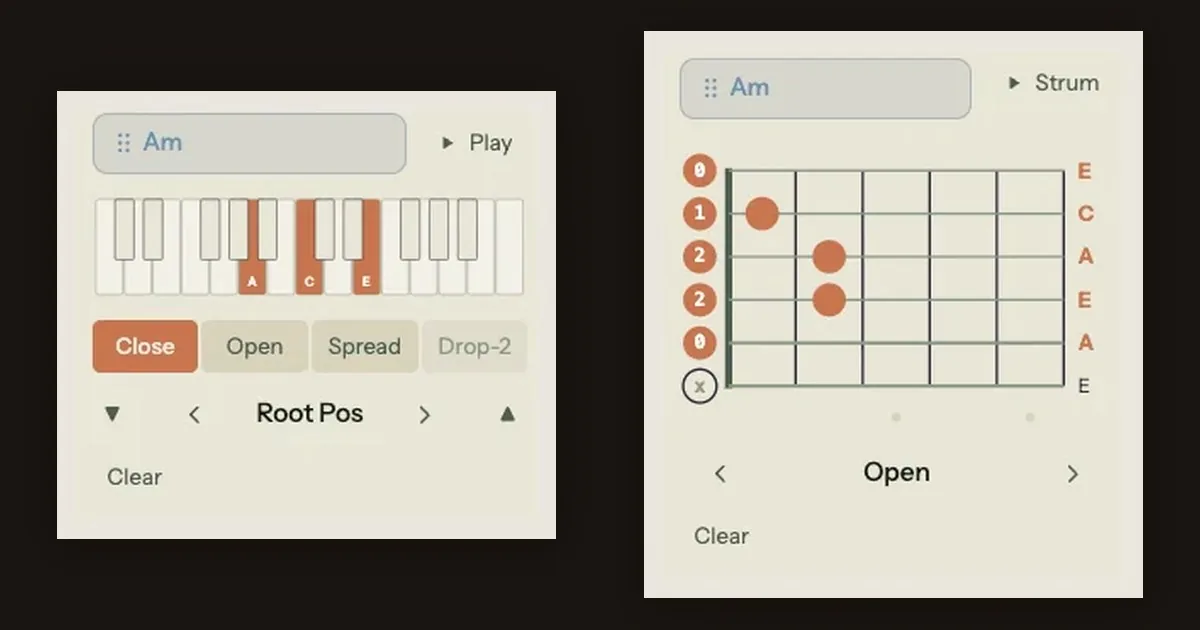
The chord palette also suggests slash-chord inversions like D/F# right when they would smooth the bass line under what you are writing, and every chord stays labeled by its scale-degree function so you always know the inversion has not changed the chord's job. Nothing is generated for you and there are no canned progressions: you make every call, capture the melody over it, and the app just lets you hear the consequence. When a singer needs the whole idea higher or lower, one-click transpose moves every chord and inversion with it. You can dig into the details in the guitar and piano voicings guide.
Hear every inversion before you commit
Song Cage labels every chord by function, flips through piano and guitar voicings, and suggests slash-chord inversions that walk your bass line, so a simple progression sounds intentional.
Chord inversions at a glance
| Term | What it means |
|---|---|
| Root position | The root is the lowest note (C in a C chord). The stable, settled sound. |
| First inversion | The third is in the bass. Written C/E, figured bass 6. The everyday smoothing inversion. |
| Second inversion | The fifth is in the bass. Written C/G, figured bass 6/4. Less stable, used for passing and cadential motion. |
| Third inversion | The seventh is in the bass (seventh chords only). Written C7/Bb, figured bass 4/2. |
| Slash chord | "Chord / bass note." An inversion only when the bass note belongs to the chord (C/E yes, C/D no). |
| Why use them | Smoother voice leading and stepwise bass lines. The chord's name and function never change. |
Frequently Asked Questions
What are the three inversions of a chord?
A triad has three positions: root position (the root is the lowest note), first inversion (the third is lowest), and second inversion (the fifth is lowest). The chord keeps its name and function in all three; only the bass note changes. A seventh chord adds a fourth position, third inversion, with the seventh of the chord in the bass.
Is a slash chord the same as an inversion?
Sometimes. A slash chord is written "chord over bass note," like C/E. When the bass note belongs to the chord (E is in C major), the slash chord is an inversion. When the bass note is not in the chord, like C/D or C/F, it is still a slash chord but not an inversion, because there is no way to re-stack C major and reach D or F in the bass.
Does an inversion change the chord's name?
No. C, C/E, and C/G are all C major and all do the same harmonic job in your key. An inversion only changes which note is in the bass, which changes the color and the bass line, not the chord's identity or function. This is why you can freely swap an inversion in to smooth a progression without rewriting the harmony.
Why do chord inversions matter in songwriting?
They turn a static set of chords into a moving bass line. Choosing inversions lets the bass walk by step instead of leaping between roots, keeps voices close together for smoother transitions, and lets you place stability or tension exactly where you want it. A descending bass like C, B, A under C to G/B to A minor is the difference between a flat progression and one that feels designed.
What is the most common slash chord on guitar?
D/F# is the most common, a D major chord with F# (its third) in the bass, making a first inversion. Guitarists reach the F# with the thumb wrapped over the low E string. It is everywhere because it walks the bass smoothly from G down to Em, as in the progression G, D/F#, Em. G/B is the next most common, used to step the bass between C and A minor.
How do you write a chord inversion?
The practical way is slash notation: write the chord, a slash, then the bass note, like C/E for a first-inversion C. Classical scores use figured bass instead, adding numbers under the bass note (6 for first inversion, 6/4 for second inversion of a triad). The Nashville Number System writes the chord's number with the bass scale degree beneath it. All three describe the same sound.