Table of Contents
- What is a pre-chorus?
- What does a pre-chorus actually do?
- Does your song need a pre-chorus?
- Test 1: does the chorus arrive too early?
- Test 2: how far is the jump?
- Test 3: does your verse already feel finished?
- When should you fix the verse instead?
- Which chord should your pre-chorus use?
- What if your chorus doesn't start on I?
- What about minor keys?
- Should the chords change faster?
- How long should a pre-chorus be?
- Does the melody have to climb?
- What if the climb is out of your range?
- Should the pre-chorus lyric repeat?
- Pre-chorus vs bridge: what is the difference?
- Lift, climb, ramp, B section: what do co-writers call it?
- Where did the pre-chorus come from?
- Pre-chorus examples worth studying
- Which famous pre-choruses are not actually pre-choruses?
- How to build a pre-chorus in Song Cage
- Frequently Asked Questions
Your verse ends. Your chorus starts. And the join sounds wrong: too sudden, too soon, or like the chorus has to shout to be heard as an arrival at all.
Every guide says the fix is a pre-chorus, and then says the same three things about it. It builds tension. It goes between the verse and the chorus. It's usually four to eight bars. None of that tells you which chord to play. This guide does. Here is what a pre-chorus is, how to write a pre-chorus that earns its place, how to test whether your song needs one, which chord it should leave on and which it should land on, how long it really runs, and the famous examples that turn out not to be pre-choruses at all.

What is a pre-chorus?
A pre-chorus is a section between the verse and the chorus that leaves the tonic chord, moves through a pre-dominant, and ends on the dominant, so the chorus arrives as a resolution rather than just a louder part. It repeats each time through, and it is optional.
That harmonic shape is not folklore. Music theorist Drew Nobile, writing in Music Theory Online in 2022 about the form as it stood from the 1960s to the 1980s, puts it exactly: the prechorus "spends its time away from tonic, beginning with a move to an unstable pre-dominant (most often IV, ii, or vi) and ending on dominant." Across the three sections you get a single large arc: tonic in the verse, pre-dominant to dominant in the pre-chorus, and a cadence landing on tonic at the start of the chorus.
That last detail is the real definition. Nobile puts the difference in one sentence: "in verse–chorus forms without prechorus, the cadence arrives at the end of the chorus, whereas in verse–prechorus–chorus form, the cadence generally arrives at the beginning of the chorus." The chorus stops being the part that finishes the sentence and becomes the part that answers it.
Two honest qualifications, both from the same paper. That is the general tendency rather than a law, and Nobile notes an alternative in which the pre-chorus ends open and the chorus runs its own cadence. And after 1991, he finds, "prechorus function often arises without any harmonic contributions" at all, which is exactly what several of the modern examples below do.
For where the pre-chorus sits among the other parts, see our full guide to song structure.
What does a pre-chorus actually do?
A pre-chorus turns momentum-building from a passing effect into a whole section. Jay Summach's phrasing is the cleanest in the literature: in a standard verse-chorus song "momentum building is a transitional effect; in the verse-prechorus-chorus song, momentum building is the function of an entire formal section."
Summach, whose 2011 Music Theory Online study analysed 700 Billboard Annual Top 20 songs from 1955 to 1989, describes the consequence for the chorus itself. It "becomes something other than the loudest or most memorable part of the song—it is raised to the status of destination towards which the whole succession of modules is directed."
The Open Music Theory textbook names four things pre-chorus sections often do: motivic fragmentation, acceleration of harmonic rhythm, movement away from tonic harmony, and harmonic openness. Three of those four are things you can do at a guitar or a piano this afternoon. Only the last one describes the result.
The songwriter Mark Bacino, writing for Guitar World, gives the shortest useful version: "if the chorus can be thought of as the 'punch-line' of a song, then the pre-chorus would be the 'set-up.'"
Does your song need a pre-chorus?
Most songs do not. At the peak of the device's popularity, in the late 1980s, Summach's corpus shows a pre-chorus in 60% of verse-chorus hits, which also means two songs in five managed without one.
A pre-chorus is a solution, so the useful question is what problem you have. There are only three worth checking, and each has a test you can run in the time it takes to play the song once. If none of them fires, the join between your verse and your chorus is working and the section you are about to write will only get in its way.
Test 1: does the chorus arrive too early?
Gary Ewer, of The Essential Secrets of Songwriting, states the diagnostic in one line: "by the time you get to the end of the verse, it feels too soon for the chorus." Play the verse and cut straight to the chorus. If the chorus lands and the song breathes, you are finished. If it feels like you skipped a step, you have found the gap.
His warning matters as much as the test: "if you've added a pre-chorus to your song, it absolutely needs a reason for being there." A section that exists because pop songs have one is the most common way to make a good song longer and worse.
Test 2: how far is the jump?
This one is measurable. Sing your verse's last note, then the chorus's first note. If the interval is large enough that you have to lunge for it, the pre-chorus's job is to carry you across.
Ewer names Katy Perry's "Firework" (2010) as the model case: "the last note of the verse melody is too far away from the first note of the chorus to make a logical connection." The interval bears it out. The verse's last note and the chorus's first note are a full octave apart, and the eight-bar pre-chorus is the only thing that crosses that distance, climbing up through the octave and past it.
Test 3: does your verse already feel finished?
Play the verse and count its phrases. Verses tend to feel complete at two, four, or eight. If yours arrives at a satisfying stopping point and the chorus then has to restart the song from a standstill, a pre-chorus gives you somewhere to go that is neither a finished verse nor the chorus.
The reverse case is just as common. If your verse sounds unresolved but you cannot say why, check whether the last two bars are already doing pre-chorus work. On the Everly Brothers' "Cathy's Clown" (1960), the lift sits inside the verse: bars five and six move IV–vi–V before the phrase falls back home. Open Music Theory has a name for that. A climb is a phrase with pre-chorus function that is too short to be its own section, and it is always the last phrase of the verse.
When should you fix the verse instead?
If the verse feels short, low, or harmonically flat, a pre-chorus is one answer and a better verse is the other. Ewer's own condition for adding one is telling: "if your verse is short, or otherwise melodically or harmonically unadventurous." Both of those are also descriptions of a verse worth rewriting.
The test that settles it: write the pre-chorus, then play the song without it. If the verse now sounds like it is missing its second half, the material belonged in the verse.
Which chord should your pre-chorus use?
Leave the tonic on the first chord, move to a pre-dominant (IV, ii, or vi), and end on the dominant so the chorus's first chord resolves it. This is the one rule with independent support from both the academic and the craft literature, and it is the question the rest of the internet does not answer.
Ewer, writing for songwriters, arrives at it from the other direction: "the pre-chorus chord progression should end by connecting smoothly to whatever the chorus starts with. If your chorus starts on a tonic (I) chord, your pre-chorus should end with something that makes the I-chord sound like an important target." His worked suggestion for a chorus beginning I–vi–IV is a pre-chorus ending ii IV V or vi IV ii.
So the two chords that decide everything are the one your verse ended on and the one your chorus starts on. Here is what that looks like in real songs, each one verified against published analysis rather than a chord site.
| Song | Verse ends on | Pre-chorus | Chorus starts on |
|---|---|---|---|
| Be My Baby (1963, E) | V7 (B7) | Built on V/vi (G♯7) | I (E) |
| She Loves You (1963, G) | V (D) | I–vi–iv–V (G–Em–Cm–D) | vi (Em) |
| Billie Jean (1983, F♯m) | the two-chord vamp | VI–i ×3, then VI–V7 (D–F♯m, D–C♯7) | i (F♯m) |
| Don't Stop Believin' (1981, E) | IV (A) | B7/A–A, then B/E–E over a pedal | I (E) |
| Rolling in the Deep (2010, Cm) | ♭VII (B♭) | ♭VI–♭VII–v–♭VI, then ♭VI–♭VII–v–V | i (Cm) |
| Firework (2010, A♭) | IV (D♭) | I–ii–vi–IV (A♭–B♭m–Fm–D♭) | I (A♭) |
| BIRDS OF A FEATHER (2024, D) | V (A) | I–vi7–ii7–V (D–Bm7–Em7–A) | I (D) |
Progressions in Roman numerals with chord symbols. Sources for each song are listed in the study table below.
Two of those repay a closer look. "She Loves You" reaches the departure by borrowing a minor iv from the parallel minor, a chord that is not in G major at all. And "Rolling in the Deep" saves its move for the last bar: the pre-chorus runs a minor v three times and then swaps it for a major V on the way into the chorus. There is something even better going on at the top of that section. The verse's three chords are Cm, Gm and B♭, none of which contains an A♭, so the pre-chorus's opening ♭VI is where the song first reaches for its own flat sixth degree. Eight bars later it borrows a raised seventh for the major V. The whole section is defined by two notes the verse never plays.
What if your chorus doesn't start on I?
Then aim the dominant at whatever chord the chorus does start on. "She Loves You" ends its pre-chorus on V and the chorus enters on vi, which Alan Pollack describes as the V resolving deceptively into the refrain. The pull is real; the landing is just displaced.
Petula Clark's "Downtown" (1964) goes further. Summach describes its pre-chorus turning "unexpectedly to the mediant," a deliberate "shying away from the cadence," and then the chorus arrives over a six-bar dominant pedal rather than a tonic. If your chorus opens on IV or vi, treat the chorus's first chord as the target and set up a dominant that resolves to it, not to the key.
What about minor keys?
The field's total published coverage of minor-key pre-choruses is close to nothing, which is odd, because minor is where the best departures live. You have two extra tools. The first is the major V borrowed from harmonic minor, which is the strongest possible pull into a minor tonic and exactly what "Rolling in the Deep" reaches for in its final bar. The second is the ♭VI and ♭VII pair, which leave the tonic without leaving the key.
"Billie Jean" is the cleanest demonstration. Its intro, verse and chorus all run the same two-chord vamp. The pre-chorus is the only section in the record with any harmonic movement at all: VI to i, three times, then VI to a dominant seventh. One departure, eight bars, and the whole song turns on it. For the full set of chords a minor key gives you, see our guide to minor chord progressions.
Should the chords change faster?
Yes, and this is the mechanism most guides describe as "energy" without naming it. Open Music Theory lists acceleration of harmonic rhythm among the four markers of pre-chorus function, and it is the change a listener feels most directly.
Journey's "Don't Stop Believin'" (1981) does the opposite, and proves the same point. Its verse runs one chord per bar; its pre-chorus halves the rate to one chord every two bars, sitting on a pedal while the vocal climbs. Slowing down builds as much tension as speeding up, because either one breaks the pattern the verse established. What matters is that the rate changes. We wrote about that lever at length in why your chord progressions sound boring.
How long should a pre-chorus be?
Four or eight bars is the common case, not a rule. Jason Blume, writing for BMI, describes the pre-chorus as "most often comprised of four or eight musical bars," and that observational framing is the honest one, because charting hits run to five, six, nine and twelve bars. Blume gives the same figure for bridges, so it describes short sections generally rather than pre-choruses specifically.
The confident numbers you see quoted are all guesses. One popular guide says two to four bars, another says eight is "the most popular option," a third says two to eight, and Ewer says outright that "there's no rule or guideline for how long a pre-chorus section should be." None of them cites anything.
The corpus data is more useful. Summach offers eight to twenty-four bars as a rough indicator for a section of any kind in this repertoire, and "Downtown" has a nine-bar pre-chorus. Von Appen and Frei-Hauenschild's table of the earliest complete verse-pre-chorus-chorus songs lists lengths of five, four, six and nine bars alongside the eights. The Supremes' "Come See About Me" (1964) has a twelve-bar pre-chorus, which they note is the longest section in the song, quietly falsifying the near-universal claim that a pre-chorus is always shorter than the chorus.
Trevor de Clercq supplies the reframe that actually helps. Analysing a slow ballad whose pre-chorus is only four bars, he points out that "in terms of absolute time" it "lasts about as long—at roughly 15 seconds—as many prechorus sections that other theorists have identified." A slow four bars and a fast eight can occupy the same span of a listener's attention. Count seconds, not bars.
Does the melody have to climb?
No. Climbing is the most common shape and the least reliable rule. Three of the most-analysed pre-choruses of the last fifteen years narrow, flatten or descend, and they work by contrast rather than by ascent.
The climb is real when it is there. "Firework" is a pure register bridge, traversing a full octave to hand the singer the chorus's opening note. The Weeknd's "Blinding Lights" (2019) climbs entirely by melody, over a chord loop that never changes for the whole song, taking the verse's closing figure and transposing it up a fifth.
Now the counter-examples. Taylor Swift's "Style" (2014) has the lowest, narrowest section in the song sitting in the pre-chorus slot, five semitones wide, pedalling on the exact pitch that becomes the chorus's tonic. Billie Eilish's "BIRDS OF A FEATHER" (2024) narrows to a three-semitone band with the overwhelming majority of its notes on a single pitch, drops the stacked harmonies used elsewhere, and straightens the rhythm, before the chorus opens to more than an octave. Adele's "Rolling in the Deep" stays inside the verse's range and parks on two notes for seven bars before releasing on the eighth.
Ewer, who does teach the climb, allows the inversion himself twice over. His practical advice: "if your verse melody is already reasonably high in pitch, and you need to build musical energy for other reasons, you might try moving the melody down at the start of the pre-chorus, and move it upward to meet the chorus melody." And more bluntly, in a later piece: "don't make the assumption that all pre-chorus sections must move steadily upward."
What if the climb is out of your range?
If you write your own songs and sing them, this is the moment a song decides your highest note, and it is worth deciding on purpose. A climb that hands the chorus a pitch you can only reach on a good day will quietly cap where you can perform the song.
You have three options and none of them is straining for it. Move the whole song: transpose down until the chorus's top note is comfortable, and check the verse's bottom note has not fallen out of your range at the other end. Narrow the pre-chorus instead, the way "Style" does, and let the chorus supply the contrast on its own. Or keep the climb and lower the chorus, which usually means rewriting the chorus's opening interval rather than the whole melody. For the transposition maths, see our guide to changing key in a song.
Should the pre-chorus lyric repeat?
Either is normal, and the published teachers disagree, so decide by function rather than by rule. Repeat the lyric when the section makes the same argument each time, and rewrite it when it has to move the story forward. Keep the melody identical either way, because that is what makes the section recognisable when it returns.
This is one of the few places where the honest answer is better than a rule.
Three positions, all published
- The Open University: a pre-chorus "tends to make use of the same words and the same melody each time it is heard."
- Jason Blume (BMI): both are normal, and he names one hit that keeps the same lyric each time and one that keeps the melody but changes the words.
- Mark Bacino (Guitar World): the content "usually differs from pre-chorus to pre-chorus," though he adds that it "could also recycle its lyric or appear purely as an instrumental, lyric-free section."
Pick by function. If the pre-chorus is making the same argument each time, repeat it and let the repetition do its work. If it is advancing the story so the second chorus means something different from the first, rewrite it. What should stay identical either way is the melody, because that is what makes the section recognisable as a return.
Pre-chorus vs bridge: what is the difference?
The usual answers, that a bridge comes after the second chorus and appears once, both fail on real songs. The distinction that survives is functional: a pre-chorus is an extra section added inside a cycle, while a bridge replaces the verse or pre-chorus in a cycle of its own.
Start with why the easy answer breaks. Trevor de Clercq notes that pre-choruses and bridges "both typically have unstable harmonic content, beginning off-tonic and ending on a dominant-functioning sonority; and both typically precede a chorus." Harmonically they are the same animal.
Position and repeat count fail too, because pre-choruses do not behave. Von Appen and Frei-Hauenschild document hits that drop the pre-chorus before the final chorus (Alice Cooper's "School's Out," 1972), run one straight off a solo or bridge with no verse in front of it (The Beatles' "The Fool on the Hill," 1967), carry two different pre-choruses (Lou Christie's "Lightnin' Strikes," 1965), and open the song with one (Diana Ross and the Supremes' "Love Child," 1968).
Open Music Theory's rule is the one that holds: "within a cycle, bridges will replace the verse and/or prechorus sections instead of being added in as an extra element." The Open University's OpenLearn course on musical form adds a useful listening cue, that a pre-chorus is "introduced relatively early in a song" and "is more likely than a bridge to occur more than once." For the other half of this pair, see our guide to what a bridge is in a song.
One honest caveat. De Clercq's own conclusion is that "prechorus quality can be considered to exist along a continuum," and that many songs might or might not be considered to have one depending on how strongly the markers show up. Some sections really are borderline, and no rule is going to fix that.
Lift, climb, ramp, B section: what do co-writers call it?
Co-writers call the pre-chorus the lift, the climb, the ramp, the B section, and confusingly the bridge. Only "pre-chorus" is settled in the scholarship. The rest are trade usage, and two of them name a different section entirely, which is where most co-writing arguments about this start.
If you walk into a co-write and someone says "the lift," they mean this section. The vocabulary is genuinely unstandardised, and knowing the map saves an argument.
| Name | Who uses it | Notes |
|---|---|---|
| Pre-chorus | The settled academic term | Summach, Nobile, de Clercq, Osborn, Open Music Theory |
| Climb / ramp | Working musicians | Summach: "musicians sometimes refer to a nascent prechorus of this sort as a 'climb' or 'ramp'" |
| Lift | Nashville | Attested in trade usage; no scholarly source uses it |
| B section | Working songwriters | Desmond Child uses it in the anecdote below |
| Bridge | Common among musicians, especially in the UK | A documented, genuinely confusing misuse; the bridge is a different section |
| Transitional bridge | Berklee | Proposed to separate it from the "primary bridge"; von Appen notes both terms "remain seldom used in practice" |
| Take-off / pre-refrain | Historians of the form | Von Appen's names for the doo-wop and AABA ancestors |
| Vest, prime, verse extension | Berklee | Pat Pattison catalogues these alongside ramp, climb and lift in Managing Lyric Structure |
One term is genuinely contested. Blume lists "channel" as a pre-chorus synonym, while von Appen and Frei-Hauenschild list "channel" among the names for the AABA bridge, alongside "release" and "middle eight." Expect to be misunderstood if you use it.
And now the anecdote, because it contains the single most useful craft point in this article. Desmond Child, describing writing "Livin' on a Prayer" with Jon Bon Jovi and Richie Sambora, recalled what happened when he heard the section the band had. It "was the first chorus," he said. "And Jon was happy with that, and I said, 'No, no, no, that's just the B section. Let's write the chorus now.'"
That section became one of the most famous pre-choruses in rock, and Child had to talk Jon Bon Jovi into the chorus that now sits after it. If your chorus is good but not quite arriving, consider that you may have written an excellent pre-chorus and not yet written the chorus.
Where did the pre-chorus come from?
The pre-chorus emerged in the early 1960s and became normal over the following twenty-five years. Summach's corpus of Billboard Annual Top 20 songs shows the share of verse-chorus hits containing one rising from 0% in 1955 to 1959, to 29% in the late 1960s, to 60% by the late 1980s.
Two independent studies, conducted without knowledge of each other, reached the same conclusion. Von Appen and Frei-Hauenschild's survey of roughly 3,000 songs finds the pre-chorus appearing "as an independent formal section with increasing frequency beginning c. 1961 in songs by the composer teams located in the Brill Building in New York," and traces its ancestry further back: "the earliest proto-prechorus is in fact a phenomenon typical of Doo Wop, in which the 'take off' effect is moved back from the beginning of the bridge to the A-section." Their count of Billboard number ones tells the same story from the other side: verse-pre-chorus-chorus songs go from 0% in 1960 to 22% in 1965, while AABA form falls from 52% to 15%.
Both papers push back on Walter Everett's suggestion that the form was "invented in 1964." Mark Spicer credits Summach with finding it "a few years earlier, specifically, in 1961 with Del Shannon's 'Runaway,'" though Summach himself is more careful, calling that song "a very early candidate" rather than a settled case. Nobody claims a first song, and Summach says so directly: "the emergence of the prechorus is not traceable to any particular song."
Two useful footnotes for working writers. Country adopted the device roughly two decades late, arriving with the Countrypolitan style around 1980, with an isolated crossover precedent a decade earlier, which is why "the climb" reads as a Nashville word. And pre-choruses do not make songs longer: Summach found that verse-chorus and verse-pre-chorus-chorus songs of the same era run to roughly the same length.
Pre-chorus examples worth studying
Eleven pre-chorus examples spanning 1961 to 2024, every one checked against published analysis rather than a chord site. They are chosen to disagree with each other: some climb and some narrow, one carries the only harmonic movement in its record, and one has no harmonic content at all.
Chord spellings are given as Roman numerals so you can move them into your own key.
| Song | Bars | What makes it worth studying |
|---|---|---|
| Del Shannon — Runaway (1961) | 8 | The earliest candidate the literature names. The verse is minor and descending; the pre-chorus flips to the parallel major and stays there into the chorus. |
| The Ronettes — Be My Baby (1963) | 8 | Departure by secondary dominant (V/vi). The verse spans a fourth, the pre-chorus widens to a sixth, and the chorus lifts the floor. Widen, then lift. |
| Petula Clark — Downtown (1964) | 9 | Nine bars, and the chorus does not start on the tonic. Proof that both "rules" are averages. |
| Stevie Wonder — Sir Duke (1976) | ~8 | One dominant-ninth voicing slid chromatically down and back up while the vocal stays nearly on one note. All the motion is underneath. |
| Journey — Don't Stop Believin' (1981) | 16 | Sixteen bars, and the harmonic rhythm halves. The chorus's very first note is a pitch the song has not used yet. |
| Michael Jackson — Billie Jean (1983) | 8 | The only harmonic movement in the entire record. The pre-chorus opens the register up an octave and the chorus simply lives there. |
| Adele — Rolling in the Deep (2010) | 8 | Sits on two notes for seven bars, then springs. The ♭VI is the first flat sixth in the song, and the minor v becomes a major V on the way out. |
| Katy Perry — Firework (2010) | 8 | The textbook register bridge: it fills the exact octave between the verse's last note and the chorus's first. |
| Taylor Swift — Style (2014) | 4 | The anti-climb. Lowest and narrowest section in the song, pedalling on the pitch that becomes the next section's tonic. |
| The Weeknd — Blinding Lights (2019) | 8 | A pre-chorus with no harmonic content at all: the same loop as everything else, climbing purely by melody and arrangement. |
| Billie Eilish — BIRDS OF A FEATHER (2024) | 8 | Three semitones wide, almost every note the same pitch, harmonies stripped. Contrast by subtraction. |
Verified against Summach (2011), von Appen & Frei-Hauenschild (2015), Nobile (2022), Alan Pollack's Beatles notes, Hooktheory, and published artist interviews.
Which famous pre-choruses are not actually pre-choruses?
Several songs routinely cited as pre-chorus examples are not. "Help!" has no such section in Alan Pollack's analysis. "Beat It" has no pre-chorus in any published section list. "Brown Eyed Girl" is a two-bar tag on V, which is a climb rather than a section. And "Smells Like Teen Spirit," the most-cited example of all, is genuinely contested between published analysts.
The pages ranking for this topic keep reaching for the same handful of examples, and several of them are doing something other than what they are cited for. One framing note before the list: every claim here is about labelling, which is a matter of analysis rather than a fact about the recording, so where published analysts split I say so.
Checked
- "Brown Eyed Girl" (1967) is usually cited as a pre-chorus and is closer to a climb. What sits between the verse and the chorus is a two-bar tag on V. The tell is in the labelling itself: song sites put a "pre-chorus" after verse 1, where no chorus follows it.
- "Help!" (1965) has no such section in Alan Pollack's analysis, whose form runs intro, verse, refrain, outro. The sixteen-bar verse is one eight-bar phrase stated twice, and it closes on the tonic. Nothing departs.
- "Beat It" (1982) has no pre-chorus in any published section list. The chorus runs a bare two-chord vamp; the verse and solo add a ♭VI on top of it. There is no section between verse and chorus doing the building.
- "Dancing Queen" (1976) is a borderline case worth knowing. The link into the chorus is two bars of ii7–V, which is a climb by length. Some song sites label a four-bar pre-chorus by counting the tail of the verse into it.
The most-cited example of all, "Smells Like Teen Spirit," is genuinely contested, and de Clercq lays the disagreement out: Doll and Adams hear a pre-chorus there, Covach and Temperley hear more verse. His explanation for why it is arguable at all: "unlike clearer examples of prechorus sections, we find no change of harmony prior to the chorus." He is careful to add that the absence of a harmonic change does not cancel the pre-chorus-like behaviour happening in texture, guitar tone and vocal doubling. Worth noting for anyone who believes the climb rule: in Nobile's reading, that section sits in a low register, not a high one.
Two more that circulate as examples and should not. "Blank Space" ends its verse on V and lands on I one bar later, with no section in between. "good 4 u" tips an F♯ minor verse straight into a chorus that reorients to A major, with no transition section at all. And "Shallow" is a genuine naming dispute rather than a clear case either way: the section in the pre-chorus slot uses the same chord loop as the intro and the verses, and published labels for it range from pre-chorus to refrain.
How to build a pre-chorus in Song Cage
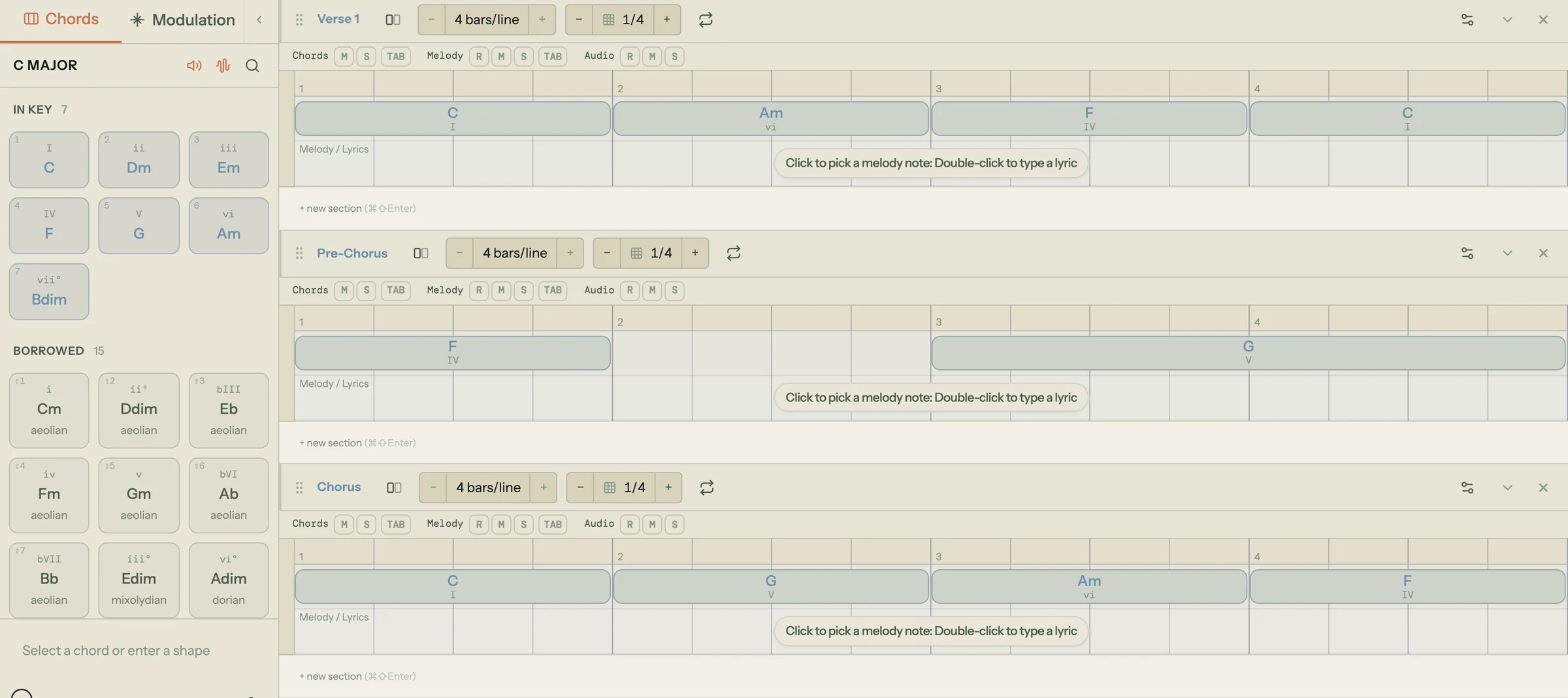
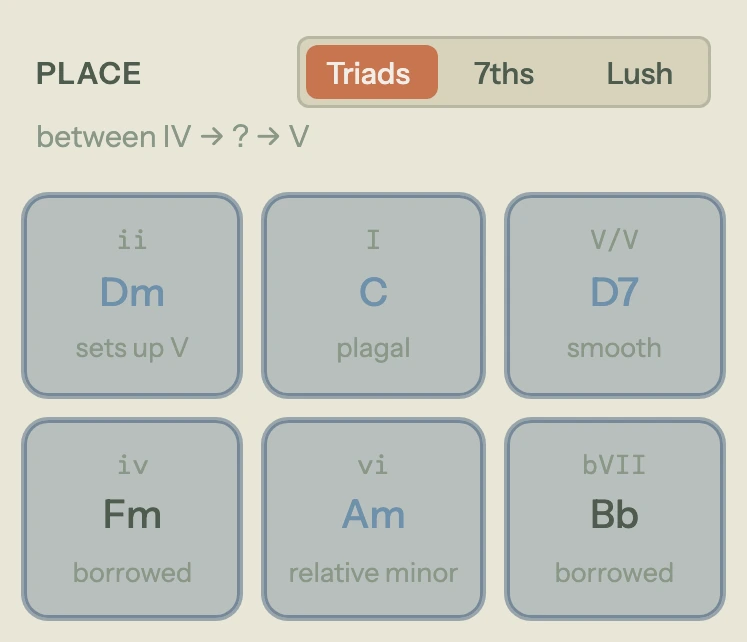
Song Cage ranks chords for the exact slot you are filling. Click the gap between your verse's last chord and your chorus's first, and the palette re-ranks against both sides, printing the context above the suggestions and labelling each candidate by its Roman numeral and by the reason it fits.
Two chords decide a pre-chorus, and they are the ones on either side of it. That is awkward to hold in your head at an instrument, because by the time you are trying chords for the new section you are no longer hearing the verse's last chord or the chorus's first.
Song Cage keeps both in view. Click the empty slot between them and the chord palette re-ranks itself for that exact position, showing the context above the suggestions: between IV → ? → V. Each suggestion carries its Roman numeral, its chord name, and the reason it scored: sets up V, plagal, smooth, borrowed, relative minor. It is the verse-end-to-chorus-start question, asked and answered in the place where you are actually making the decision.
Pre-Chorus is one of the seven section types, so you can tag the section, see it coloured on the timeline, and give it its own key or time signature if it goes somewhere the rest of the song does not. Change a section's key and the palette rebuilds for that section alone: the diatonic chords, the borrowed set, and the secondary dominants all reorient, and the Roman numerals relabel to match.
Two honest limits. The section type is a label, not an instruction. Song Cage will not tell you that your song needs a pre-chorus, will not suggest where one goes, and will not write one. It ranks chords against the ones you have already placed, and the decisions stay yours. More on how sections work in the sections and the grid chapter, and on how the palette is built in chord progressions.
Write the section, not just the chord
Tag a Pre-Chorus, click the slot between your verse and your chorus, and see which chords actually connect them.
Frequently Asked Questions
How long should a pre-chorus be?
Four or eight bars covers most cases, but treat that as an observation rather than a rule. Charting hits have run to five, six, nine and twelve bars, and The Supremes' "Come See About Me" (1964) has a twelve-bar pre-chorus that is the longest section in the song. Time it in seconds instead: roughly fifteen seconds is typical at any tempo.
What is the difference between a pre-chorus and a bridge?
Both leave the tonic and end on a dominant, so harmony will not tell them apart. The reliable difference is structural: a pre-chorus is an extra section added inside a verse-chorus cycle, while a bridge replaces the verse or pre-chorus in a cycle of its own. Pre-choruses also tend to appear early and more than once. See our guide to what a bridge is in a song.
Does every pop song need a pre-chorus?
No. At the device's documented peak in the late 1980s, 60% of verse-chorus hits used one, which means two songs in five did not. "Back in Black" goes straight from riff to chorus, and "Blank Space" hands V to I with nothing in between. Add one only when the verse-to-chorus join is genuinely failing.
Which chord should a pre-chorus end on?
The dominant is the default, because it resolves onto the chorus's first downbeat. If your chorus does not start on the tonic, aim the dominant at whatever chord the chorus does start on instead. In a minor key, the major V borrowed from harmonic minor gives the strongest pull, and ♭VI and ♭VII let you leave the tonic without leaving the key.
Does the pre-chorus melody have to go up?
No. Climbing is the most common shape, and "Firework" is the textbook case because it spans the exact octave between the verse's last note and the chorus's first. But "Style" goes lower and narrower than anything else in the song, "BIRDS OF A FEATHER" collapses to a three-semitone band, and "Rolling in the Deep" holds still for seven bars. Contrast is the requirement; ascent is one way to get it.
Should the pre-chorus lyric be the same every time?
Published teachers split on this, so decide by function. Keep the lyric if the section makes the same argument each time; rewrite it if it needs to move the story forward so the second chorus means something new. Keep the melody identical either way, because that is what makes the section recognisable when it returns.