Table of Contents
- What is the chord progression in "Creep"?
- Why is there a B major chord in a G major song?
- Where is the B chord supposed to go?
- Is it a secondary dominant or just a major III?
- What does the C minor do?
- The chromatic line the song is named after
- Why are the two outside notes the same pitch?
- Where did the progression come from?
- Did Radiohead know they were borrowing it?
- Which other songs use these two moves?
- How do I use this in my own song?
- Doing it in Song Cage
- What people get wrong about "Creep"
- Did Jonny Greenwood try to sabotage the song?
- Did Radiohead sue Lana Del Rey?
- Frequently Asked Questions
- The short version
Four chords, one loop, the same order from the first bar to the last. "Creep" has no key change, no modulation, and no second progression hiding in the bridge. It is one of the most analysed loops in rock, and almost everything written about it stops at naming the chords.
Two of those four chords do not belong to the key the song is in. That is the whole song.
Quick Summary
"Creep" is in G major and loops G, B, C, Cm. The B major and the C minor are both foreign to G major, and the two notes that make them foreign are the same pitch spelled two different ways.
What is the chord progression in "Creep"?
"Creep" is in G major and repeats one four-chord loop for the entire song: G, B, C, C minor. In Roman numerals that is I, III, IV, iv. The B major and the C minor are both non-diatonic, meaning neither chord occurs naturally in G major. The song stays in 4/4 throughout, and officially licensed editions notate it between 92 and 96 beats per minute, most often at 92 or 93.
The progression is the same in the verse, the chorus and the middle eight. Nothing about the harmony marks the chorus as a chorus. That job is done by dynamics, by the vocal moving up into full voice, and by the guitar noise that arrives before it, none of which is a chord change.
This matters for the analysis that follows, because it means every effect in "Creep" is produced by the same four chords doing the same thing again. There is no contrast section to hide behind.
Why is there a B major chord in a G major song?
The seven chords that occur naturally in G major are G, A minor, B minor, C, D, E minor and F sharp diminished. The chord built on B is B minor. "Creep" plays B major instead.
Swapping that minor third for a major third introduces a D sharp, and D sharp is not in the G major scale. It is the one note in the chord that tells your ear something has changed. Everything else in a B major triad, the B and the F sharp, is already sitting in the key.
Ethan Hein of NYU makes the point cleanly about a different song built on the same move, Otis Redding''s "(Sittin'' On) The Dock of the Bay": "The D-sharp in the B chord sounds out of place in a G major context, but it''s the leading tone in E minor." That is the tension in one sentence. The note is foreign to the key you are in, and native to a key you are being pulled toward.
Where is the B chord supposed to go?
A major chord built on the third degree of a major key is usually heard as a secondary dominant: a temporary V chord aimed at a chord other than the tonic. B major is the V of E minor, written V/vi, and its D sharp is E minor''s leading tone. Every convention in the style says the next chord should be E minor.
"Creep" goes to C instead.
One name for that refusal is a deceptive resolution, though not every analyst accepts the label. Robert Hutchinson''s university textbook Music Theory for the 21st-Century Classroom calls it "a rather common deceptive resolution of a secondary dominant", specifically V7/vi moving to IV, and cites exactly three examples: "Dock of the Bay", John Lennon''s "Imagine", and Beethoven''s Op. 53. The leading tone does not fall to its target. It rises one semitone into the next chord and keeps going.
Is it a secondary dominant or just a major III?
Here the published sources genuinely disagree, and no page currently ranking for this progression admits that they do.
Wikipedia labels the loop I, V7/vi, IV, iv, and for its harmonic analysis it cites peer-reviewed scholarship: Guy Capuzzo''s "Neo-Riemannian Theory and the Analysis of Pop-Rock Music", Music Theory Spectrum 26/2 (Autumn 2004), pp. 177 to 199. Capuzzo does not use that label. He gives the chords as G, B, C and C minor and reads them in G major as I, III with a sharp, IV, iv. Vulture, reporting on the 2018 dispute, writes the same loop a third way, as "a famous one written as I-III-IV-iv". Three sources, three numerals, the same four chords.
The argument is real and it is not settled. Signals Music Studio, analysing the identical chord in "Imagine", puts the honest version plainly: "since it''s not really behaving like a secondary dominant, I personally think it''s fine to give the numeral a label of III7 instead. Just note that this specific chord, III7 or V7/vi, has two very popular destinations: the vi and the IV."
That is the useful takeaway. The chord has two common exits. "Creep" takes the second one.
What does the C minor do?
The fourth chord is the one most people can hear without being told, even if they cannot name it. C major is the IV chord of G major and it is completely at home. Flattening its third from E to E flat turns it into C minor, a chord that belongs to G minor, not G major.
That is modal interchange, and the minor iv is the most-used borrowed chord in popular music. One note moves down a semitone, and the chord sags. It is the same device that lands under "nothing really matters" in "Bohemian Rhapsody" and under the word "senses" in the Eagles'' "Desperado", which is in the same key as "Creep" and uses the same two chords, C to C minor, nineteen years earlier.
The clearest demonstration of the effect is not in a rock song at all. Victoria Malawey''s open textbook Multimodal Musicianship opens its chapter on mode mixture with "Edelweiss", where the same melodic phrase is harmonised first with B flat major and later reharmonised with B flat minor. The tune is held constant, so the only thing that changed is the chord underneath. Three examples later in the same chapter, she reaches "Creep".
The chromatic line the song is named after
This is the part that makes the four chords a unit rather than two clever substitutions in a row.
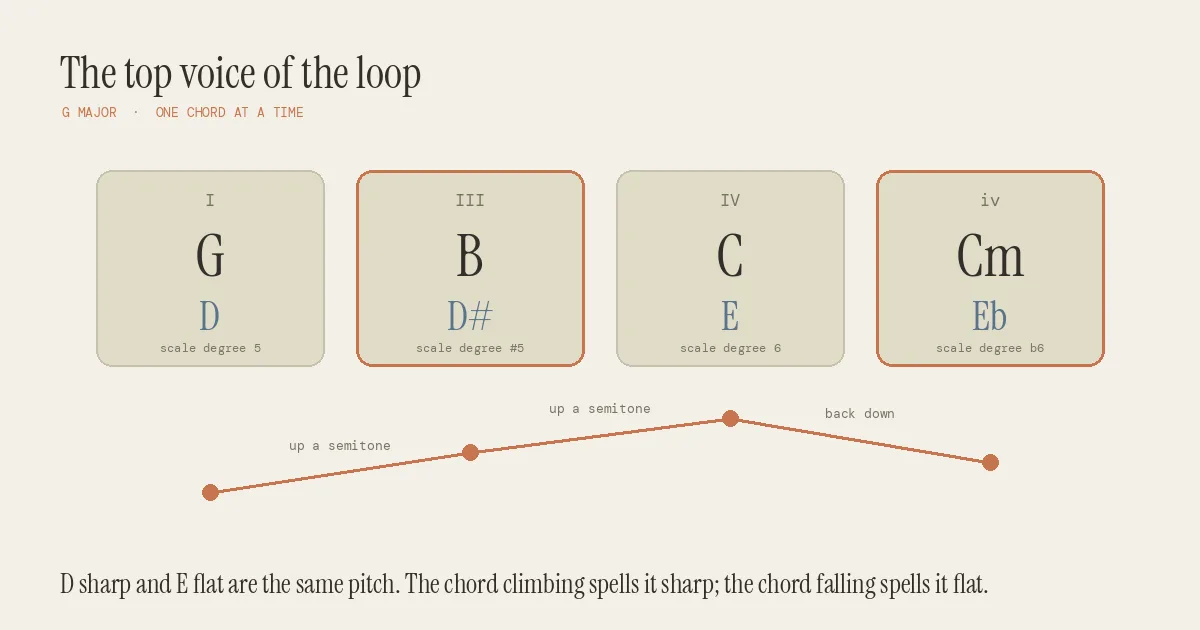
Track the top note of each chord. G major has a D. B major raises it to D sharp. C major moves to E. C minor drops to E flat. Then the loop returns to G and the note falls back to D. That is one voice climbing two semitones and walking back down again.
The mechanism is well documented in the scholarship. Capuzzo writes that the ostinato''s highest pitches form a prominent chromatic line that "creeps" up, then down, running through scale degrees 5, sharp 5, 6 and flat 6. Andrew Aziz sets out the same motion chord by chord in Music Theory Online, describing "Radiohead''s I–III♯–IV–iv progression in ''Creep,'' where the ♯5 in a III♯ (or V/vi) chord first resolves up to 6 in a IV chord, then recedes to ♭6 in a iv chord", citing Philip Tagg''s Everyday Tonality II. In G major those degrees are D, D sharp, E and E flat.
The loop''s top voice
- G → D (scale degree 5)
- B → D sharp (sharp 5, climbing)
- C → E (6, arriving)
- Cm → E flat (flat 6, sinking back)
Why are the two outside notes the same pitch?
Read that column and the two chords that break the key turn out to break it with the same pitch. D sharp and E flat are the same key on a piano. The chord on the way up spells it sharp because it is pushing toward E; the chord on the way down spells it flat because it is falling toward D. One note, two jobs, decided entirely by which direction the line is travelling. Aziz''s paper is titled "Billy Joel''s Enharmonic Duplicity", and "Creep" turns up in it as an example of exactly that.
What is missing from the field is not the analysis, it is the joining up. Of the pages currently competing for this progression, not one puts the B chord''s chromatic note and the C minor''s in the same sentence. Two notes get named separately, the line connecting them does not. It is also worth knowing that this line lives in the guitar figure rather than the sung vocal, and that the ostinato''s top voice is simply the third of each chord in turn.
Where did the progression come from?
"Creep" did not invent this loop, and Radiohead never claimed it did.
"The Air That I Breathe" was written by Albert Hammond and Mike Hazlewood and released by Hammond on his 1972 debut album. Phil Everly cut it in 1973, and the Hollies made it a hit in 1974. Its verse runs the same I, III, IV, iv. The forensic musicologist Joe Bennett of Berklee sets the two bar for bar, and notes a structural difference most retellings skip: the older song turns home to the I chord partway through its loop, where "Creep" stays on the IV and the iv before going back.
Did Radiohead know they were borrowing it?
The borrowing was deliberate, and Radiohead described it in print in 1993. Jonny Greenwood told Fender Frontline how it happened: "we wrote ''Creep'', and the middle eighth just had...my guitar playing a tune. And Ed stopped [us] and said, ''This is the same chord sequence as that Hollies song,'' and then sang it. So Thom copied it. It was funny to us in a way." The middle eight had been a guitar solo. After O''Brien spotted the resemblance, Yorke rewrote it around the older song''s vocal melody, which is why the closest similarity between the two records is in that section rather than in the loop everyone knows.
Rondor Music, the publisher of "The Air That I Breathe", then took action. It was settled out of court, with confidential terms. Hammond and Hazlewood were added to the credits of a song originally credited to Radiohead alone, which is why "Creep" now has seven writers.
Three things commonly reported wrong
- It never went to court. There was no trial, no jury and no reported judgment. Every substantive account describes an out-of-court settlement.
- The royalty share has never been disclosed. Every mainstream account says only "a percentage" or "a small part". The "one third" figure in circulation traces to a user-maintained database, not to either party.
- It was not an accident. The band spotted the resemblance themselves, in the writing room, and deliberately leaned into it.
Which other songs use these two moves?
Both halves of "Creep" are common on their own. What is unusual is putting them back to back. The Quietus reports a survey of 1,300 hit singles that turned up only one other song sharing the full structure, David Bowie''s "Space Oddity".
| Song | Key | The move | Where |
|---|---|---|---|
| "The Air That I Breathe" (Hollies, 1974) | B flat | Full I–III–IV–iv | Verse; resolves home a bar earlier |
| "Space Oddity" (Bowie, 1969) | C | Full I–III7–IV–iv | "And the papers want to know whose shirts you wear" |
| "Get Free" (Lana Del Rey, 2017) | B flat | Full I–III–IV–iv | Verse and pre-chorus |
| "(Sittin'' On) The Dock of the Bay" (Otis Redding, 1968) | G | III that goes to IV | Verse opens G, B, C: Creep''s first three chords, same key |
| "Imagine" (John Lennon, 1971) | C | III that goes to IV | End of every chorus phrase |
| "Build Me Up Buttercup" (The Foundations, 1968) | C | Both, in one chorus | C–E7–F, then F–Fm |
| "Don''t Look Back in Anger" (Oasis, 1995) | C | III that does resolve to vi | "Take that look from off your face" |
| "In My Life" (The Beatles, 1965) | A | Borrowed iv | End of every verse, D to Dm |
| "Desperado" (Eagles, 1973) | G | Borrowed iv | C to Cm, landing on "senses" |
| "Sleep Walk" (Santo & Johnny, 1959) | C | Borrowed iv | Fm inside a doo-wop loop |
"Don''t Look Back in Anger" is the useful contrast: its III resolves to vi the way the textbook says it should, which is precisely what "Creep" refuses to do.
How do I use this in my own song?
Take the two moves separately, because they are separable.
The IV to iv turn is the easy one and it works almost anywhere. Find a spot where your progression already goes to the IV chord and hangs there before returning home. Play the IV again with its third flattened, then go home. In G major that is C, C minor, G. The reason it lands is voice leading, not novelty: one voice steps down a semitone and then down again into the tonic.
The major III is the harder one, and the decision is where you send it. Build a major triad on the third degree, then choose its exit. Send it to vi and you get the conventional, slightly triumphant resolution of "Don''t Look Back in Anger". Send it up a semitone to IV, as "Creep" and "Imagine" and "Dock of the Bay" all do, and you get the sound people describe as unsettled.
The test for both is what your melody is doing while the chord moves. "Edelweiss" is the clean case, the same phrase harmonised two ways. In "Creep" the verse melody circles a single scale degree rather than sitting on one note, but the principle is the same: give the ear something steady and it will hear the chord change underneath.
Doing it in Song Cage
In Song Cage, set a song to G major and the In Key tab of the chord palette gives you the seven diatonic chords, where the chord on B is B minor. Both of Creep''s outsiders live on other tabs. The Secondary Dominants tab carries B7, labelled V/vi with an arrow to the vi chord it is nominally aimed at. The Borrowed tab carries C minor, labelled iv and tagged with the parallel mode it comes from.
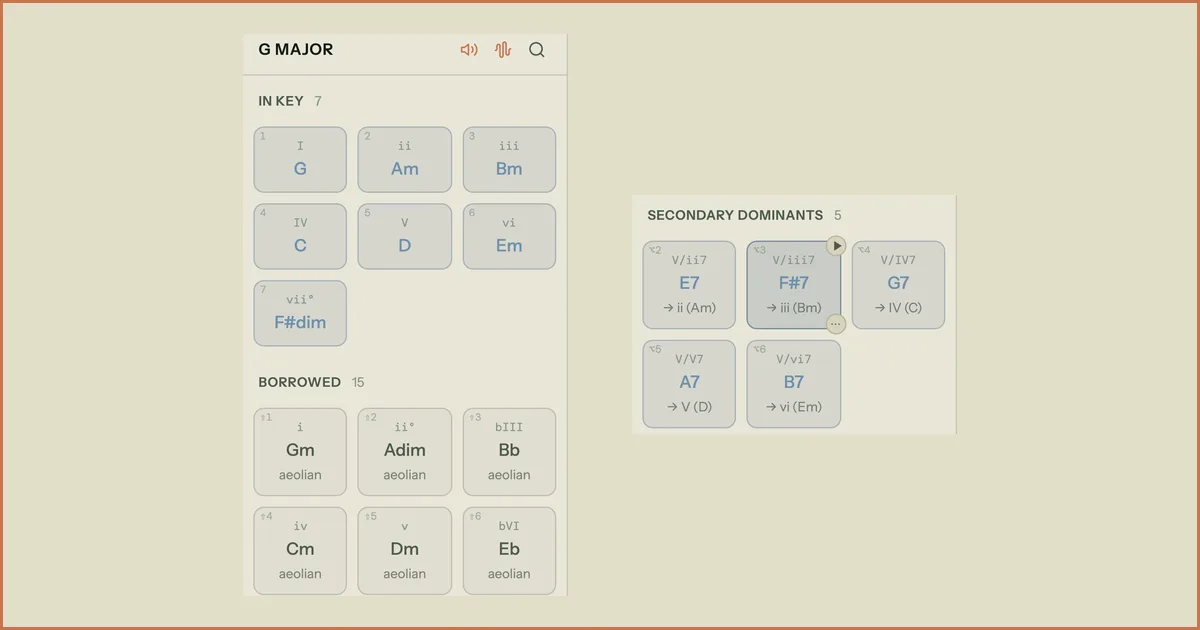
Two honest notes. "Creep" uses a plain B major triad where the palette offers B7, so the same root and the same D sharp without the seventh. And the app''s suggestion strip currently offers the minor iv after the I chord rather than after the IV chord, so for the Creep ordering you take it from the Borrowed tab directly.
The part that matters more is the ranking. When there are melody notes over a slot, the palette re-ranks the chords by how well their tones fit those notes, and every suggestion carries a short label naming its role, "borrowed", "subdominant", "sets up V", or a resolution arrow. That is the question this whole post is about: given the note you are singing, which chord underneath it changes the colour without breaking the line. You can read more in the chord palette documentation.
What people get wrong about "Creep"
Two stories about this song are repeated constantly and neither survives contact with the primary sources.
Did Jonny Greenwood try to sabotage the song?
The line everyone quotes is not Greenwood''s. It belongs to his bandmate Ed O''Brien, who said of the guitar bursts: "That''s the sound of Jonny trying to fuck the song up." It is worth noticing that Wikipedia''s own citation for that sentence is a dead personal CD-catalogue page, not an interview.
Greenwood''s account of himself is far milder. He told Mojo he found the song "a bit wimpy" and wanted it louder. And Sean Slade, one of the two producers in the room, was asked directly whether the noise was Greenwood just testing his guitar and answered: "No, no, no. There''s all kinds of ''Jonny was trying to ruin the song,'' and all kinds of wonderful myths that have arisen. No, it was a very deliberate part. He thought the song was boring and he wanted to spice it up." The noise on the record is an overdub, cut onto its own track after the fact.
Did Radiohead sue Lana Del Rey?
No lawsuit was ever filed. Warner/Chappell, Radiohead''s publisher, said so on the record in January 2018, adding that the band had not said they would "only accept 100%" of the publishing. What was requested was a credit "in favour of all writers of ''Creep''", which by then meant seven people including Hammond and Hazlewood. The writing credits on "Get Free" were never changed.
The second story is the more instructive one for songwriters. A shared chord progression is not, on its own, the actionable part. The musicologist Vulture consulted during that dispute put it flatly: duplicated chord progressions are so common in music that they cannot be copyrighted. Where "Creep" itself ran into trouble was a melodic resemblance in the middle eight, not the loop everybody knows. This is the sort of thing worth filing away as music theory for songwriters rather than as trivia: the chords are the common property, and the tune on top of them is where you are actually exposed.
Frequently Asked Questions
What key is "Creep" in?
G major. The loop is G, B, C and C minor, and it repeats for the whole song. Officially licensed sheet music lists the original published key as G major, and notates the tempo between 92 and 96 beats per minute.
Why does the B chord in "Creep" sound strange?
Because the chord that belongs on B in G major is B minor, not B major. Making it major introduces a D sharp, which is not in the key. That note is the leading tone of E minor, so your ear expects E minor next. The song goes to C instead.
Is the C minor in "Creep" a borrowed chord?
Yes. C major is the IV chord in G major; C minor is the same chord borrowed from G minor, which makes it the minor iv. It is the most common borrowed chord in popular music, and it is what produces the sag people hear as the sad part of the song. See what makes a song sound sad for more on the device.
Did Radiohead steal "Creep" from the Hollies?
They reused the chord progression from "The Air That I Breathe" and said so publicly in 1993, before any claim was brought. The publisher took legal action, it was settled out of court on confidential terms, and Albert Hammond and Mike Hazlewood were added as co-writers. It never went to trial.
What is the I III IV iv progression called?
It has no single agreed name. The third chord is either a major III or a secondary dominant V/vi depending on which analyst you read, and the fourth is a borrowed minor iv. Because of this song, most players simply call the loop the Creep chord progression, which is why searching for the theory behind it turns up tab pages rather than analysis.
Does "Creep" change chords in the chorus?
No. The same four chords run through the verse, the chorus and the middle eight. The lift into the chorus comes from dynamics, the vocal moving into full voice, and the guitar bursts that arrive just before it, not from any change in the harmony.
Try the move in your own song
Set a key, and every chord that fits it is one click away, with the borrowed chords and secondary dominants labelled for what they do.
The short version
"Creep" is four chords that never change, and two of them come from outside the key: one is a dominant aimed at the relative minor that never arrives there, and one is borrowed from the parallel minor. Between them they trace a single chromatic step up and back down, D to D sharp to E to E flat, which is the line the song takes its name from.
None of that requires a theory degree to use. It requires noticing that the chord you were going to play has a version one semitone away, and being willing to go there before you come home.