Table of Contents
- Why do my chord progressions sound boring?
- What is harmonic rhythm?
- Hear it: the same four chords at three speeds
- Why do the same chords feel different at different speeds?
- How do you lift a chorus without new chords?
- When is a boring progression actually the point?
- The second lever: where your melody lands
- What about changing chords off the beat?
- What order should you fix a boring progression in?
- A ten-minute exercise to hear it yourself
- Audition the same progression at three speeds in Song Cage
- Frequently Asked Questions
You wrote four chords. They are honest chords, the same four half the songs you love are built on, and when you play them the progression just sits there. Flat. So you do the thing everyone tells you to do: you go looking for fancier chords. A borrowed chord here, a seventh there, a key change to shake things loose. Sometimes it helps a little. Usually it just makes a boring progression boring and complicated.
Here is the part almost nobody says out loud. The problem is usually not which chords you picked. It is that all of them change at exactly the same speed. Every bar, a new chord, forever, until the ear learns the pace and stops listening. The lever you are missing is not harmony. It is timing.
Quick summary
A chord progression usually sounds boring because its harmonic rhythm never changes: every chord gets the same number of beats, so the ear predicts the pace and tunes out. You can fix it without adding a single new chord. Hold some chords longer and change others faster, so verses breathe and choruses push. Then look at the second lever almost no one mentions: where your melody lands on top of each held chord.
Why do my chord progressions sound boring?
Your progression most likely sounds boring because every chord changes at the same rate, not because the chords are too simple. When each chord gets an identical number of beats, the ear predicts the next change and stops paying attention. The fastest fix is to vary the pacing, then to check where your melody sits over each chord.
This runs against the usual advice, which is to reach for richer harmony the moment a progression feels dull. More sevenths, a borrowed chord, a surprise modulation. That advice treats boredom as a vocabulary problem. Most of the time it is a rhythm problem. The four chords in the songs everyone knows are the same four chords in your flat demo. The difference between the record and your version is rarely the chords themselves. It is how long each one is allowed to ring before the next one arrives, and what the tune is doing on top.
What is harmonic rhythm?
Harmonic rhythm is the rate at which the chords change: how many beats you hold one chord before moving to the next. It is separate from the tempo, which is the speed of the beat, and separate from your melody's rhythm, which is how fast the notes move. It is simply the pace of the chord changes underneath everything else.
The composer Walter Piston set the classic definition in 1944, calling it "the rhythmic life contributed to music by means of the underlying changes of harmony." You do not need a staff or any theory vocabulary to work with it. Sit at a guitar or piano and count: is a new chord landing every beat, every bar, or every four bars? A slow ballad can change chords on every beat, and a fast rocker can sit on one chord for eight bars. That independence is the whole point. Once you can hear pacing as its own dial, separate from tempo and separate from the notes, you have found the control that actually governs whether a progression feels alive or asleep.
Hear it: the same four chords at three speeds
Take one plain loop, C, G, Am, F, and do nothing to the chords at all. Change only how long you hold each one. The same four chords, in the same order, become three different moods.
| Pacing | Each chord is held | One lap of C–G–Am–F takes | How it feels |
|---|---|---|---|
| Slow (Held) | 2 bars each | 8 bars | Floating, spacious, suspended in the air |
| Medium (Steady) | 1 bar each | 4 bars | Grounded, song-like, the default pop feel |
| Fast (Active) | half a bar each | 2 bars | Restless, urgent, pushing forward |
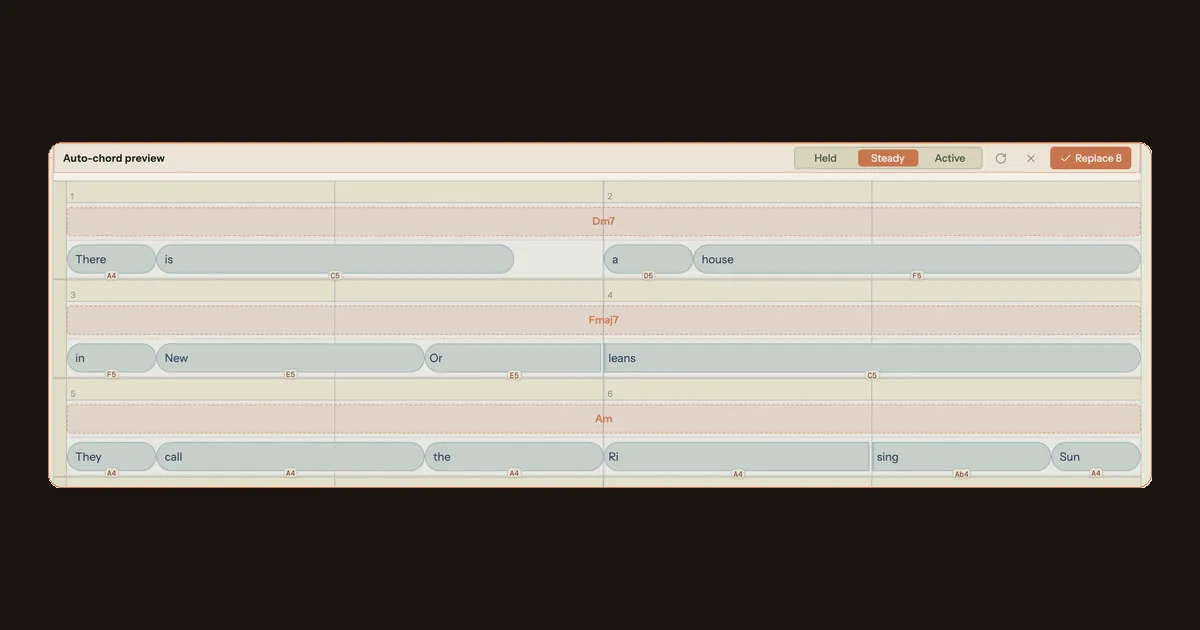
Done by hand, this is the same four chords in the same order, with only their lengths changed. Song Cage's Held / Steady / Active dial is the same idea applied automatically, with one difference worth knowing: it re-fits chords to your melody across each pacing's spans, so the picks can change along with the timing. Same palette, re-fitted. Only the harmonic rhythm changes.
Of course you cannot hear a table. That is exactly the trouble with reading about this: the whole lesson is in your ears, not your eyes. Play the three rows yourself, or let Song Cage audition the same progression at each speed for you, and the point lands in about ten seconds. The slow version wants a widescreen chorus over it. The fast version is already sprinting. Neither is right or wrong. They are the same harmony wearing three different clothes.
Why do the same chords feel different at different speeds?
Harmonic rhythm works like an energy dial. A slow rate of change feels spacious and stable, because each chord has time to settle. A fast rate of change feels urgent and driven, because a new harmony keeps arriving before you have finished hearing the last one. Speeding the chords up can make a passage feel like it is accelerating even when the tempo never moves.
The failure mode has a name worth remembering: the loop trap. When every section of your song changes chords at the identical rate from the first bar to the last, the ear learns that pace within a few seconds and then predicts it perfectly. Predicted music is ignored music. The harmony stops feeling like it means anything, not because the chords are wrong, but because nothing about their timing ever changes. This is why "add a fancier chord" so often disappoints. You have introduced a new color into a rhythm the listener already stopped tracking. Change the pacing instead and the same plain chords suddenly have somewhere to go.
How do you lift a chorus without new chords?
Give your sections different harmonic rhythms. Hold the chords longer in the verse and change them faster in the chorus, or the reverse, so the arrival of the new section is something the listener feels in their body before they can name it. You are shifting energy with timing alone, no new chords required.
Real records do this constantly. "(Sittin' On) The Dock of the Bay" speeds its harmonic rhythm up in the bridge to gently raise the temperature. John Lennon's "Woman" runs the opposite way, moving from a chord every two beats in the verse to roomier, slower changes in the chorus so the hook can open up. "Man in the Mirror" revs across the whole song: a stop-and-go verse, a steadier pre-chorus at one chord per bar, then a chorus that doubles to two changes a bar. The Beatles' "Day Tripper" deliberately stalls on one chord, then accelerates into what one analyst calls "long-awaited kinetic relief." In every case the lift comes from the pace of the changes, not from a chord you have never heard before.
When is a boring progression actually the point?
A slow, static harmonic rhythm is often a deliberate choice, not a mistake. Whole genres are built on holding one chord and letting rhythm, texture, and groove carry the interest. If your song lives on a vamp, the lack of chord movement may be the feature, and the fix is in the groove, not the harmony.
Funk and soul made an art of this. The Temptations' "Papa Was a Rollin' Stone" sits on a single B-flat minor chord for its entire twelve-minute run, and everything that moves is the bassline, the wah guitar, and the strings fading in and out. James Brown grooves "on the one," locking to a single chord and only jumping to a IV chord when he calls to be taken "to the bridge." The Beatles' "Tomorrow Never Knows" is essentially one C drone, freeing the ear to follow the tape loops instead of a progression. When the harmony holds still on purpose, chasing more chords is the wrong move. Interest comes from what you place on top of the stillness.
The second lever: where your melody lands
After pacing, the most overlooked reason a progression feels flat is where your melody sits over each chord. A tune built only from the safe notes of each chord, its roots, thirds, and fifths, sounds grounded but bland. Reaching for a note that is not in the chord, a seventh, a ninth, a suspended fourth, makes the very same held chord ache and lift.
"Twinkle, Twinkle, Little Star" is the classic example of an all-chord-tone melody: correct, stable, and completely without tension. A melody needs a few notes that rub against the harmony to sound like music rather than an exercise. This matters most over the long, slow chords you just learned to write, because a held chord gives a color note room to sing before it resolves. The same F major feels resigned under its own root and yearning under a G on top. If you are stuck on chords for a tune you already have, finding the notes that lift each chord is the other half of this work. Fix the pacing first, then aim the melody. Together they do far more than any borrowed chord.
What about changing chords off the beat?
Anticipations are the small-scale version of the same idea. Instead of waiting for the downbeat, change the chord a half-beat early, on the "and" of the previous bar, and the progression stops feeling square. It is a timing change, not a harmony change, and it is one of the oldest tricks for making a plain loop groove.
Most beginners land every chord change squarely on beat one of the bar, because that is the safe, predictable place for it. Predictable is exactly the problem. Pushing a chord slightly ahead of the beat, so it arrives before the listener expects it, injects momentum the same way a syncopated drum fill does. Country, gospel, and soul players do this by feel, sliding into the next chord just before the barline. You do not need to notate anything. Try changing to your next chord on the last upbeat of the current bar instead of the first downbeat of the next one, and listen to how much more the identical chords lean forward.
What order should you fix a boring progression in?
Reach for the cheapest, highest-leverage fixes before the expensive ones. New chords are the last resort, not the first.
Fix a flat progression in this order
- Pacing first. Vary the harmonic rhythm: hold some chords longer, change others faster, and give each section its own rate.
- Melody-landing second. Aim the tune at a color note over your held chords instead of only the safe root, third, and fifth.
- Voicing and bass motion third. Use inversions and a stepwise bass so the chords glide instead of jumping around.
- Groove fourth. Add syncopation, accents, and space to the strum or comp instead of hitting every chord flat and even.
- New chords last. Only after the four above should you reach for a secondary dominant or a borrowed chord, and now it will actually be heard.
This is the honest hierarchy the "just add a maj7" advice skips. Fancier harmony is real and useful, but dropping it into a progression whose timing, melody, and groove are all flat is like repainting a stalled car. Get the thing moving first.
A ten-minute exercise to hear it yourself
The fastest way to trust any of this is to feel it under your own hands. It takes one instrument and no theory.
Try this at your instrument
- Pick any two chords you already know. C and G will do.
- Play them holding each one for 8 bars. Sing a simple melody over the top. Notice how much room it has.
- Play the same two chords holding each for 2 bars. Sing the same melody. It suddenly feels like a song.
- Now change chords every bar, then twice a bar. The same melody starts to feel hurried.
- Ask the diagnostic question about your own song: is every section changing chords at the same speed? If yes, you have found the boredom.
Nothing about the chords changed across those four passes. Only the pacing did, and yet the mood moved from floating to grounded to frantic. Once you have heard that shift in your own playing, you will never again reach for a fancier chord as your first move when something sounds dull.
Audition the same progression at three speeds in Song Cage
Song Cage was built to make this exact experiment one click instead of a homework assignment. Hum or enter a melody and it lays a set of ghost chords over it as a preview you can keep, adjust, or throw away. A three-way flavor dial sets the harmonic rhythm without touching which chords are chosen: Held keeps each chord ringing across two measures for the fewest changes, Steady gives you one chord per measure, and Active moves up to twice a measure where the melody supports it. Flip between them and you hear the same progression floating, then grounded, then driving, in real time. It is about how often the chords change, not about making them fancier, which is the whole lesson made audible. The preview never overwrites your work until you accept it, so it is safe to experiment. You can read how the chord tools and Auto Chords work in the docs.
Stop adding chords. Start moving them.
Song Cage lets you hum a melody, get chords that fit, and hear the same progression at three different speeds in a click. Fix the pacing, aim the tune, and finish the song.
Frequently Asked Questions
Why do my chord progressions sound boring even though I use the "right" chords?
Because the chords are usually not the problem. If every chord changes at the same rate, the ear predicts the pace within a few seconds and stops paying attention, no matter how good the chords are. Vary the harmonic rhythm first, hold some chords longer and change others faster, before you reach for richer harmony.
What is harmonic rhythm in simple terms?
Harmonic rhythm is how often the chords change: how many beats you hold one chord before moving to the next. It is separate from tempo (the speed of the beat) and from your melody's rhythm (how fast the notes move). A slow ballad can change chords every beat, and a fast song can sit on one chord for eight bars.
Does changing chords faster always make a progression more interesting?
No. Faster is not better, varied is better. A progression that changes on every beat from start to finish is just as predictable as one that never changes. The goal is contrast: give your verse and chorus different rates so the shift between them carries energy. Sometimes the most powerful move is to slow the harmony down, not speed it up.
Can a one-chord or two-chord song still sound good?
Absolutely. Much of funk, soul, and groove-based music lives on a single held chord or a two-chord vamp, from "Papa Was a Rollin' Stone" to countless James Brown grooves. When the harmony holds still on purpose, the interest comes from rhythm, bassline, and texture. A static progression is only boring when the stillness is an accident rather than a choice.
What should I fix first when a progression sounds boring?
In order: pacing, then where the melody lands, then voicing and bass motion, then the groove of the strum, and only last, new chords. Most advice jumps straight to fancier harmony, which is the least reliable fix. Adjusting the timing and the melody costs nothing and almost always does more.
How does Song Cage help fix a boring progression?
Song Cage fits chords to a melody you hum or enter, then lets you set the harmonic rhythm with a three-way dial, Held, Steady, or Active, so you hear the section at three different pacings in one click. Each setting re-fits the chords to your melody over its own spans, so the picks can change along with the pacing rather than staying identical; the palette they are drawn from is the same either way. It changes how often the chords land, not how fancy they are, which makes the pacing lesson audible instead of theoretical. The preview is non-destructive, so you can experiment freely.