Table of Contents
- What is a cadence in music?
- Is a cadence just the last two chords?
- What are the four types of cadences?
- Why does "perfect cadence" mean something different in the UK?
- What is an authentic cadence?
- What does an authentic cadence look like in a pop chorus?
- What is a plagal cadence?
- Is the plagal cadence really a cadence?
- How can you tell a plagal cadence from an authentic one by ear?
- What is a minor plagal cadence?
- What is a half cadence?
- Should your pre-chorus end on the V chord?
- Do half cadences have to resolve?
- What is a Phrygian half cadence?
- What is a deceptive cadence?
- Which songs use a deceptive cadence?
- How do you use a deceptive cadence to extend a chorus?
- What cadences do rock and pop songs use instead of V–I?
- What is a ♭VII–I cadence?
- What is an Aeolian cadence?
- What is a double plagal cadence?
- Where does the name "Aeolian cadence" come from?
- What are the plagal stop and the grand plagal cadence?
- Do four-chord loop songs have cadences at all?
- How do cadences work in a minor key?
- What is a Picardy third?
- Where do cadences fall in a song?
- What is the melody doing at a cadence?
- How do you end a song?
- How do you find the cadence in a song you already know?
- How does Song Cage label cadences?
- Frequently Asked Questions
"She Loves You" is a two-minute Beatles single, and it ends its phrases four different ways.
Each verse stops on a D chord and leaves it hanging. The refrain then starts on E minor, where your ear expected G. The end of the refrain is where D finally resolves to G as a full stop: Alan Pollack, in his Notes On series, calls it the only place in the song where you hear a complete V to I cadence. Then the last chords skip D altogether: C to a G with an added sixth, an ending George Martin questioned at the time.
Those four endings have names. A cadence is the chord move, and the melody note, that closes a phrase, and choosing one is a choice about whether your listener should feel finished, unsettled, surprised or soothed. It is easy to make that choice by accident. The four standard types are below, then the rock cadences that theory classes skip, then what the published corpus studies say about where each one goes in a song.
Quick Summary
A cadence is the end of a phrase. The four standard types are authentic (V to I, a full stop), plagal (IV to I, the "Amen"), half (anything to V, a comma) and deceptive (V to something other than I, usually vi). Rock adds its own: ♭VII to I, ♭VI–♭VII–I and ♭VII–IV–I.
What is a cadence in music?
A cadence is the point where a musical phrase ends: a chord move, a melody note and a spot in the bar that together tell the listener a thought is complete, or only paused. The four standard cadences are authentic (V–I), plagal (IV–I), half (ending on V) and deceptive (V to anything but I).
The word comes from the Latin cadere, "to fall". Etymonline traces it through Old Italian cadenza and dates the English word to the late 14th century, when it meant the flow of rhythm in prose or verse, from the idea of the voice falling at the end of a sentence. It was applied to music in the 1590s.
The speech comparison still holds up. Robert Hutchinson's open textbook calls a cadence "a harmonic arrival point, a harmonic moment of stasis" and compares it to a comma or a period. Open Music Theory uses the same image: patterns that create goals, "kind of like punctuation marks in literary sentences."
A song is built from phrases, often four bars long, and each one ends somewhere. Cadences in music are how they end.
Is a cadence just the last two chords?
No. The same two chords can be a cadence in one place and nothing in another. Wikipedia's Cadence article is careful about this: using a cadential chord progression does not by itself make a cadence, because "there must be a sense of closure, as at the end of a phrase." A G to C in the middle of a line is just a G to C.
What turns it into a cadence is everything happening around the chords. David Temperley, writing about rock in Music Theory Online, defines a cadence as a gesture "defined by melodic, harmonic, or rhythmic characteristics or some combination." The melody lands on a note and stays there. The arrival usually falls on a strong beat. The singer breathes.
The data backs the rhythm part up. In a study of 909 Chinese pop songs, Shuqi Dai, Huan Zhang and Roger Dannenberg found that 72% of melody notes a whole note or longer sit at the end of a phrase that closes a section. Only 6.4% sit at phrase ends in the middle of one. Long notes mark the big endings.
What are the four types of cadences?
The four standard types of cadences are the authentic cadence (V to I), the plagal cadence (IV to I), the half cadence (any chord to V) and the deceptive cadence (V to a chord other than I). The first two end on the home chord and sound finished. The last two do not.
| US name | UK name | Chords | In C | In G | Sounds like | Typical place in a song |
|---|---|---|---|---|---|---|
| Authentic | Perfect | V–I | G–C | D–G | A full stop | End of a chorus, end of the song |
| Plagal | Plagal | IV–I | F–C | C–G | A softer, settled stop ("Amen") | End of a verse or chorus, final chords |
| Half | Imperfect | any chord–V | F–G, Dm–G | C–D, Am–D | A comma: something has to follow | End of a verse, pre-chorus or bridge |
| Deceptive | Interrupted | V–vi (usually) | G–Am | D–Em | A swerve away from home | Late in a chorus, to extend it |
Roman numerals count up the scale of your key: I is the home chord, IV and V the chords built on the fourth and fifth notes, vi the minor chord on the sixth.
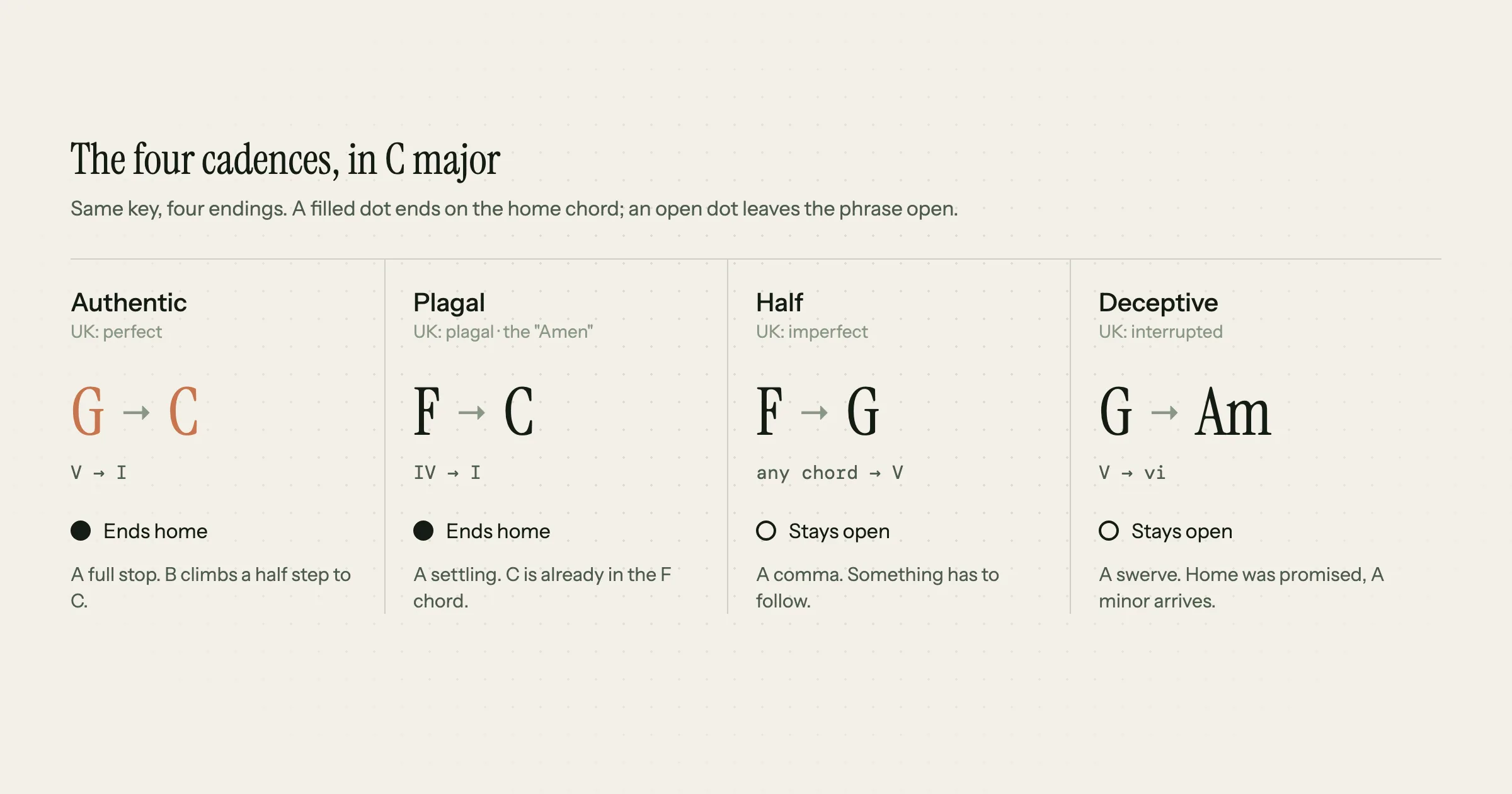
Open Music Theory treats only two of these as the primary types, authentic and half, and calls the perfect authentic cadence "the strongest kind of cadence available to a composer" and the half cadence the weakest. The other two come with arguments attached, which the sections below get into.
Why does "perfect cadence" mean something different in the UK?
Because British and American teaching use different names for the same things, and one of them collides. In the UK, BBC Bitesize calls V–I a perfect cadence and a phrase ending on V an imperfect cadence, and describes an interrupted cadence as a perfect cadence that lands on a minor chord instead (usually V–vi). The ABRSM theory syllabus tests the same names: perfect, imperfect, plagal and interrupted. Plagal is plagal everywhere.
The trap is the word "imperfect". A British imperfect cadence ends on V. An American imperfect authentic cadence ends on I. They are opposite kinds of ending with nearly the same name, so if a guide says "imperfect cadence", check which side of the Atlantic it was written on before you trust the example.
German textbooks add a third set: Ganzschluss for a full close on the tonic, Halbschluss for the half cadence and Trugschluss, literally "deceptive close", for V to vi.
What is an authentic cadence?
An authentic cadence is V to I: the chord on the fifth note of the scale moving to the home chord, G to C in the key of C. It is the strongest ending in tonal music. Five to one is an authentic cadence, and in the UK it is called a perfect cadence.
The pull comes from one note. The V chord contains the seventh note of the scale, the leading tone, a half step below home. In G to C that is the B in the G chord, and it steps up into the C. That half step is the pull.
Theory splits authentic cadences in two. A perfect authentic cadence needs both chords in root position and the melody landing on the home note itself. Open Music Theory gives the classic melody approaches as re to do (2 to 1) or ti to do (7 to 1). An imperfect authentic cadence is any V–I that misses one of those conditions, for example because the melody ends on the third or fifth of the chord instead of the root. It still lands, just with less weight.
Real songs use it where they mean business. In "Yesterday", key of F, each phrase of the middle section ends Gm, C, F, and Pollack points out that these are the only places where the home key is established by a clean V to I. Bob Dylan's "The Times They Are A-Changin'" closes every verse with D to G in G major, approached through C from the second verse on.
What does an authentic cadence look like in a pop chorus?
Usually it comes at the very end of the chorus and is set up by IV or ii. In Rick Springfield's "Jessie's Girl", key of D, the chorus reaches G, A, D (IV, V, I), then immediately swerves to B minor and A to keep the song moving instead of letting it stop. The full stop happens, and the song refuses to sit in it.
That IV–V–I approach is the norm in rock. In Trevor de Clercq and David Temperley's corpus study of Rolling Stone's top songs, when V is the chord right before the tonic, the chord before V is "overwhelmingly likely" to be IV. Their trigram table counts 352 IV–V–I against just 63 II–V–I (any chord built on the second degree, ii or V of V, moving through V to I). The ii–V–I that jazz is built on is comparatively rare in this music.
The authentic cadence is also less universal than theory books imply. In Temperley's sample of 200 songs from Rolling Stone's 500 Greatest Songs, 59% end their chorus vocal with a move to the home chord, and only 32% of the songs do it with V to I. The rest of this guide is mostly about the other 68%.
What is a plagal cadence?
A plagal cadence is IV to I: the chord on the fourth note of the scale moving to the home chord, F to C in C major. It is called the "Amen" cadence because hymns so often set the word "Amen" to it. It sounds settled and warm rather than conclusive.
A famous classical example is the end of Handel's "Hallelujah" chorus, which, as Wikipedia notes, "culminates powerfully with an iterated plagal cadence": G to D in D major, over and over.
Pop and rock use it constantly. "Yesterday" ends each verse B♭ to F, IV to I. Pollack hears "Let It Be" as having "a modal harmonic flavor due to the almost consistent use of Plagal (IV -> I) cadences": the verse and the refrain both close G, F, C. In Adele's "Someone Like You", key of A, the BBC Bitesize analysis points to a D to A plagal cadence every four bars. In P!nk's "Just Give Me a Reason" the verse closes C to G, IV to I, while the first and last choruses end on a D to G authentic cadence.
In rock, IV–I is at least as common as V–I. In de Clercq and Temperley's corpus, the chord most often heard right before I is IV (1,162 times), ahead of V (788) and ♭VII (386). Hooktheory's 2012 analysis of about 1,300 song sections found IV to I "actually shows up just as often as V → I." Christopher Doll goes further in Hearing Harmony (2017): IV–I, rather than V–I, "would seem to be the foremost progression in confirming or establishing a tonal center in rock."
Is the plagal cadence really a cadence?
In classical theory, not everyone thinks so, and the argument is worth knowing because it explains why plagal endings feel the way they do. William Caplin, a leading theorist of classical form, argues that IV to I cannot confirm a key because the IV chord lacks the leading tone. In a 2004 article he calls the plagal cadence "a fiction, at least for the classical repertory," and says that what theorists normally call a plagal cadence is either a tag after a real cadence (a postcadential codetta) or not a cadence at all, just a pause inside a phrase. Open Music Theory sidesteps the fight by calling it plagal motion.
Daniel Harrison, in the Oxford Handbook of Critical Concepts in Music Theory, calls Caplin's position "a bald overstatement" once you look beyond the Classical style. Temperley's rock data settles it for songwriters: 18.5% of his 200 songs end their chorus on a plagal cadence. Whatever IV–I is in Mozart, in rock it closes sections.
How can you tell a plagal cadence from an authentic one by ear?
Listen to the bass and to the top note. In an authentic cadence in C, the bass falls from G to C and some voice climbs from B to C, a half step that sounds like a door clicking shut. In a plagal cadence the bass moves F to C, the C is already sitting in the F chord, and the other notes slide down: A to G, F to E. Nothing climbs to the home note, because it was there all along.
That shared note is why plagal endings sound like an exhale rather than an arrival. If the last chord change of a phrase sounds like a confirmation, it is probably V–I. If it sounds like a sigh of relief, it is probably IV–I.
What is a minor plagal cadence?
A minor plagal cadence borrows the minor iv chord from the parallel minor key and moves it to a major I: F minor to C in C major, often after a plain F, so the line inside the chords falls A, A♭, G. Open Music Theory calls IV–iv–I the "plagal sigh" and credits the name to J. Kent Williams and Frank Lehman, who hear it as nostalgic.
It is all over the songs people call bittersweet. The Beatles' "In My Life" ends each verse phrase D, Dm, A. Radiohead's "Creep" loops G, B, C, Cm, so every pass comes home through Cm to G. The chorus of David Bowie's "Space Oddity" moves C, E7, F, Fm and back to C. Green Day's "Wake Me Up When September Ends" closes each verse C, Cm, G, and Sabrina Carpenter's "Please Please Please" uses D, Dm, A as its final cadence, according to Mike Senior's analysis.
It is rarer than it sounds, though. Only 2 of the 37 plagal cadences in Temperley's rock sample use a minor iv. The minor iv is a spice. For more on borrowing chords this way, see modal interchange and borrowed chords.
What is a half cadence?
A half cadence is a phrase that ends on the V chord, no matter which chord comes before it: C to G, F to G or Dm to G in the key of C. It sounds like a comma. The listener hears that the music has stopped but is not finished, and waits for what comes next.
Wikipedia's definition is wide on purpose: "any cadence ending on V, whether preceded by II (V of V), ii, vi, IV, or I", or any other chord. Open Music Theory writes it as x–V and notes that the melody at a half cadence typically sits on re, the second note of the scale, though ti and sol are also possible.
Listeners treat it exactly as advertised. In a 2020 study, David Sears and colleagues had 40 listeners rate continuously how strongly they expected an excerpt to end. Half cadences got the lowest and latest ratings of any cadence type. Listeners expect a phrase to end on I much more strongly than on V.
That is precisely why songwriters use it. In "Ticket to Ride", key of A, the first half of each verse opens up to E, the V chord, before the second half closes F♯m, E, A. In "Hey Jude" the bridge ends on C7, the V of F, and Pollack describes the section as "open at both ends". In "Lady Madonna" the V chord appears only once per pass, at the end of each bridge, to set up the return of the verse.
Should your pre-chorus end on the V chord?
Usually, yes, and the data says most songs do. Heetderks surveyed the 103 verse, pre-chorus, chorus songs in the McGill Billboard corpus (Hot 100, 1958 to 1991) and reports in GAMUT that about 51% of pre-choruses end on V. IV (11%) and ♭VII (10%) are the next most common. Only about 12% end on I, and 76% of the choruses that follow start on I.
Drew Nobile describes the same plan in Music Theory Online: tonic in the verse, pre-dominant to dominant in the pre-chorus, and the cadential arrival on the home chord at the start of the chorus. The half cadence is the setup; the chorus is the payoff.
Ed Sheeran's "Thinking Out Loud" does it plainly. Hutchinson's textbook clips the pre-chorus at about 1:08 to 1:20 of the official video: a passage that starts on E minor, returns to it, and stops on A, the V of D, before the chorus. Bob Dylan's "Like a Rolling Stone" builds through Dm, F, G and stops on the G before the chorus lands on C.
Some songs hold back longer. In "Let It Go" from Frozen, the pre-chorus alternates E♭ and D♭ and hangs on D♭ until the chorus finally brings in A♭ at 0:59. For the full anatomy of that section, see what a pre-chorus is and whether your song needs one.
Do half cadences have to resolve?
No. A half cadence promises that something follows, but nothing obliges the next section to start on I. In Boston's "Peace of Mind", the verse ends on B, the V of E, and Temperley lists it as a half cadence. The chorus then starts on C♯ minor, not E. The promise is kept with a different chord, which gives the chorus a lift instead of a landing.
What is a Phrygian half cadence?
A Phrygian half cadence is a minor-key half cadence with a particular bass line: iv in first inversion moving to V, so in A minor, D minor with F in the bass going to E major. The bass falls a half step, F to E. Open Music Theory explains the name: that half-step fall sounds like the one between the first two notes of the Phrygian mode. It is rare in pop, but the falling bass half step it relies on is the same one the Andalusian cadence ends with.
What is a deceptive cadence?
A deceptive cadence is V moving to a chord other than I, most often vi: G to A minor in the key of C. The ear expects home and gets a near miss. In British English it is called an interrupted cadence. Five to six is the classic deceptive cadence.
Hutchinson notes that "V to not-I" is technically the more accurate definition, with V–vi just its most common form. The French name, cadence rompue, means "broken cadence", which is how it feels. Some theorists, Open Music Theory among them, prefer deceptive motion, on the grounds that the move avoids a cadence rather than making one.
Why vi? It shares two of the three notes of the I chord. A minor contains C and E, so the leading tone still climbs to C as promised. Only the bass goes somewhere unexpected.
It works on the brain whether or not you know it is coming. A 2011 study in PLoS ONE by Kim, Kim and Chung found that chord sequences ending V to vi produce a larger early brain response than V to I, the response that marks a less expected chord. David Huron argues in Sweet Anticipation (2006) that a deceptive cadence keeps sounding deceptive even when you know exactly where it is. In a 2014 listening study by Sears, Caplin and McAdams, non-musicians rated deceptive cadences as more complete than musicians did.
Which songs use a deceptive cadence?
Near the end of the chorus of Cyndi Lauper's "True Colors", a suspended G resolves to A minor, Vsus to vi, which Hutchinson's textbook clips at about 1:00 to 1:15. The verse of The Police's "Every Breath You Take" loops A♭, Fm, D♭, E♭, Fm: V goes to vi the first time round and to I the second.
The Beatles used it as a structural trick. In "P.S. I Love You", key of D, the verse ends A, B♭, C, D: the V goes to ♭VI, a borrowed chord, and only reaches home by way of ♭VII. In "Ob-La-Di, Ob-La-Da", Aaron Krerowicz counts three normal V–I endings to the refrain, at about 0:42, 1:16 and 2:07. The fourth time, at about 2:58, the same V7 goes to vi, and that swerve is what sets up the outro.
That borrowed ♭VI version has become a cliché of its own. Hutchinson traces V–♭VI–♭VII–I as the "epic" (his word, with "somewhat clichéd" attached) ending of the Star-Spangled Banner as sung at the Super Bowl by Whitney Houston in 1991 and Lady Gaga in 2016.
How do you use a deceptive cadence to extend a chorus?
Write the chorus ending you want, with V going to I. Then, the first time through, replace that I with vi and repeat the last line. Now the chorus has to end twice, and the second ending lands harder because the first was withheld.
"I Will" stretches its final verse this way. Pollack charts a once, twice, three times loop of IV, V, vi, then a final V to ♭VI, D♭ in the key of F, before the song finally lets the F arrive.
Rock has its own variation. Temperley describes a "deceptive IV", where IV turns up where the home chord was expected, and points to the end of the verse-chorus unit of Crosby, Stills & Nash's "Wasted on the Way". In the de Clercq and Temperley rock corpus, by my count from their Table 3, V goes to IV about 26% of the time, often on its way to I, and to a chord on the sixth degree about 13%.
What cadences do rock and pop songs use instead of V–I?
Rock and pop often skip the V chord and come home from the flat side of the key instead: ♭VII to I (D to E in E major), the Aeolian ♭VI–♭VII–I (C, D, E), and the double plagal ♭VII–IV–I (D, A, E). None of them has a leading tone, so they sound strong but not classical.
Nicole Biamonte describes the double plagal and Aeolian progressions in Music Theory Spectrum (2010) as harmonic structures "unique to rock music that cannot be interpreted in conventional tonal terms." Drew Nobile makes the general point: in rock, the role of the dominant is "often played by chords unrelated to V, such as IV, ii, ♭VII, or even versions of I."
What is a ♭VII–I cadence?
A ♭VII–I cadence comes home from the chord a whole step below the tonic instead of from V: D to E in E major, G to A in A major. It has no leading tone, and in de Clercq and Temperley's rock corpus ♭VII is the third most common chord heard right before I, after IV and V.
In "Help!", key of A, each verse closes D, G, A, and Pollack notes that the G "is used in place of V to make a complete cadence with I." Dolly Parton's "Jolene", in C♯ minor, comes home B to C♯m without ever playing the V chord.
What is an Aeolian cadence?
An Aeolian cadence is ♭VI–♭VII–I: two major chords borrowed from the parallel minor key, each climbing a whole step to the tonic, A♭, B♭, C in C major or C, D, E in E major. Nicole Biamonte names it, with the double plagal, as one of the cadence types rock uses in place of V–I.
"Lady Madonna" ends each verse F, G, A. "With a Little Help from My Friends" opens with C, D, E. "Hello, Goodbye" closes its refrain phrases F, A♭, C and F, B♭, C, with no V at all. Open Music Theory notes it has also been called the "Mario cadence", after the level-clear fanfare in Super Mario Bros. In a minor key it lands on a minor tonic, as in the chorus of Talking Heads' "Psycho Killer": F, G, A minor.
What is a double plagal cadence?
A double plagal cadence is ♭VII–IV–I: two plagal moves in a row, each root falling a fourth to the next, D, A, E in E major. It reaches home with no V chord and no leading tone, and Walter Everett, who coined the name, hears it as a chain of flat-side chords rather than a mode.
Everett calls it "the double-plagal cadence as articulated in the celebrated 'Hey Jude' coda", where F, E♭, B♭, F repeats eighteen and a half times by Pollack's count. The refrain of "With a Little Help from My Friends" is D, A, E, and the chorus of Nazareth's "Love Hurts" ends F, C, G. Everett traces the move into rock through the first three months of 1965, after the Four Tops used it in the introduction to "Baby I Need Your Loving" in 1964.
Stretch it further and you get chains. The chorus of "Jumpin' Jack Flash" runs ♭III, ♭VII, IV, I. "The Time Warp" goes F, C, G, D, A in the key of A, four plagal steps into the tonic.
Where does the name "Aeolian cadence" come from?
The name "Aeolian cadence" comes from a newspaper review, and it originally meant something else. In December 1963 The Times ran an unsigned review, later attributed to the critic William Mann, praising "the Aeolian cadence at the end of Not A Second Time." Wouter Capitain's 2018 study concludes that the passage Mann meant is best read as a deceptive cadence, not the modern ♭VI–♭VII–I. The name stuck to a different progression.
What are the plagal stop and the grand plagal cadence?
The plagal stop and the grand plagal cadence are two rock cadences that Temperley named in his 2011 article. In a plagal stop cadence, the band hits the IV chord on a downbeat and then drops out, the vocal carries on through the gap, and the band comes back in on I as the next section starts. His model example is the first chorus of Heart's "Barracuda": the A chord, the IV, is struck once and left empty, and the band returns on the home chord, E.
A grand plagal cadence happens once per song, near the end, usually with the tempo suspended. At the end of the third chorus of Led Zeppelin's "Whole Lotta Love", a long held IV finally resolves to I before the riff returns. Temperley found that in virtually every grand cadence he collected, the chord before I was IV.
Do four-chord loop songs have cadences at all?
Often not in the textbook sense. Ken Stephenson, as summarized by Temperley, calls a rock cadence "closed" when the melody comes to rest on the home note, over I or V, on the fourth downbeat of a four-bar unit. Endings that tick only some of those boxes are "open", and open cadences are far more common in rock.
Temperley also notes that in many songs the chorus vocal does not end over the home chord at all, and gives "Hotel California", "Back in Black" and "Come as You Are" as examples. In Trevor de Clercq's 2017 analysis of the same 200 songs, only about 44 to 46% of choruses end on I. Earth, Wind & Fire's "September" is usually charted in A, and an A major chord never sounds in it.
A loop can still have cadences inside it. "Someone Like You" goes IV to I every four bars. What a loop gives up is the single, decisive arrival. If your loop-based chorus feels like it never ends, that is the reason.
How do cadences work in a minor key?
In a minor key the natural V chord is minor (E minor in A minor), and it pulls home weakly because it has no leading tone. The usual fix is to raise its third to make it major (E major), borrowed from the harmonic minor scale. The rock alternatives, ♭VII to i and ♭VI–♭VII–i, need no borrowing at all.
The raised third of that major V is the G♯ in E major, a half step under the A it resolves to. The harmonic minor scale exists largely to supply that one note. Without it, v to i is a gentle drift rather than an arrival, which is a sound plenty of folk and modal songs want.
In a minor key the plagal cadence is just iv to i. The Phrygian half cadence, iv6 to V, is minor-only. And the flat-side rock cadences are native to minor: "Psycho Killer" lands F, G, Am and "Jolene" lands B to C♯m using nothing but the notes of the natural minor scale.
What is a Picardy third?
A Picardy third is a major tonic chord at the end of a piece or section in a minor key: ending a song in A minor on A major. The name, tierce de Picardie, turns up in Jean-Jacques Rousseau's 18th-century writing on music, and nobody is sure where it comes from.
Bach used it constantly. In de Clercq's 2015 count of the minor-key chorales, final tonic cadences with a Picardy third outnumber those without one by about ten to one. Pop uses it for a lift at the end. "And I Love Her" modulates up a half step for its last stretch and finishes on a D major chord in a D minor context, which Pollack calls "the Piccardy Third". Each verse of "I'll Be Back" runs Am, G, F, E and resolves to A major. The chorus of the Zombies' "Time of the Season" ends on E major in E minor.
Roberta Flack changed the ending of "Killing Me Softly with His Song" to finish on a major chord herself. As Wikipedia records it, she said the song wasn't written that way.
Where do cadences fall in a song?
Cadences sit at the end of every phrase, but the strong ones mark section boundaries. Pre-choruses and bridges mostly end on V, a half cadence. Choruses and verses end on I a little under half the time. The final cadence of the song is where the most decisive ending usually goes.
The best numbers come from de Clercq's 2017 study of Temperley's 200-song Rolling Stone sample, Heetderks' survey of the McGill Billboard corpus, and Jay Summach's data on Billboard's top-20 songs.
| End of the... | Most common last chord | Cadence | Source |
|---|---|---|---|
| Verse | I 47–48%, V 24%, IV 12–14% | Mixed | de Clercq 2017 |
| Pre-chorus | V about 51%, IV 11%, ♭VII 10% | Half | Heetderks 2023 |
| Chorus | I 44–46%, V 25–31%, IV 14% | Authentic or plagal, often open | de Clercq 2017 |
| Bridge | V 58%, I 22–23% | Half | de Clercq 2017 |
Ranges show the two analysts' readings of the same songs. De Clercq notes the 200-song sample leans toward the 1960s and 1970s.
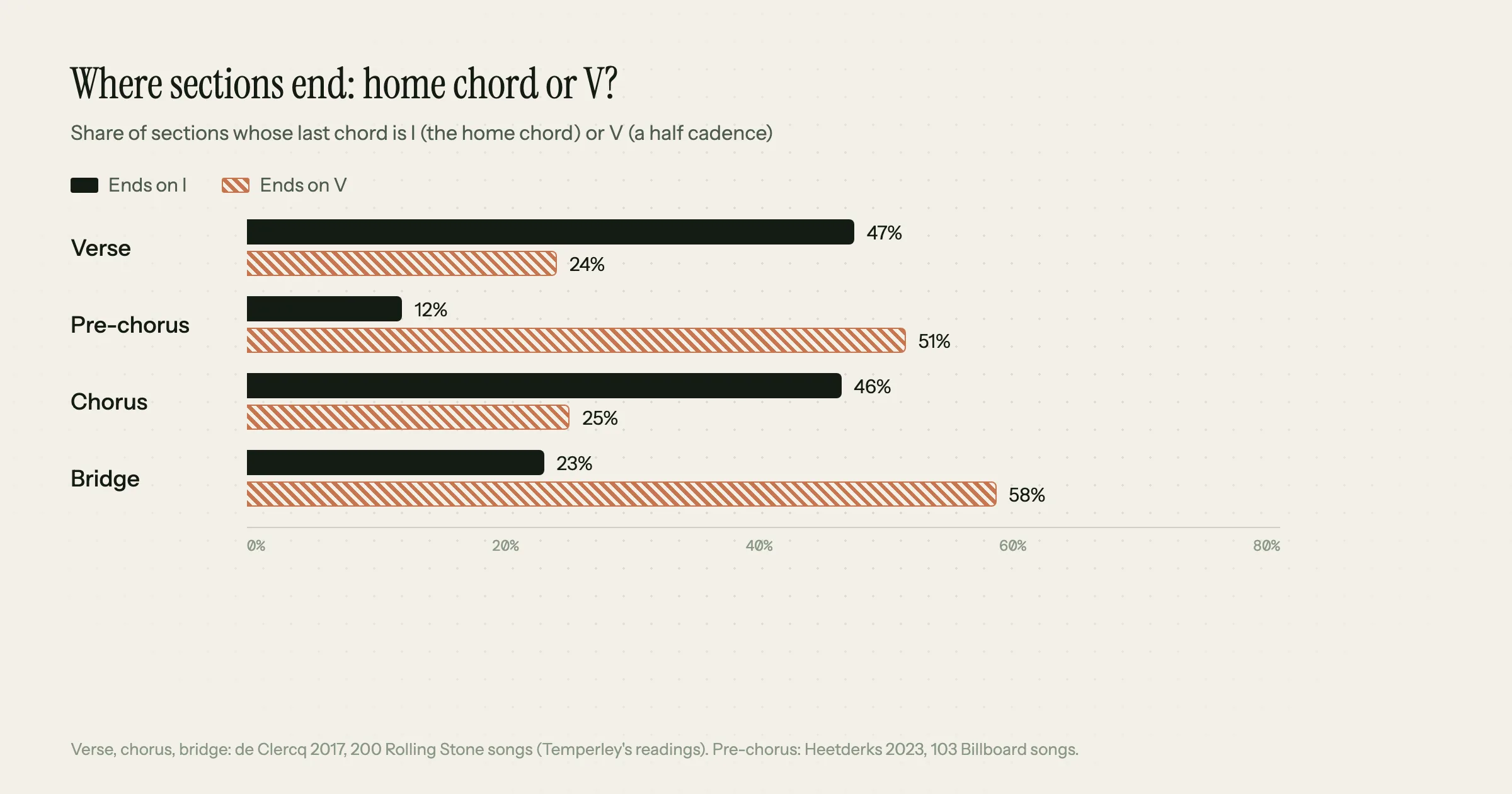
The chorus figure has moved over time. In Summach's study of 700 Billboard top-20 songs, reproduced by de Clercq, the share of choruses ending on the tonic fell from 100% in 1955 to 1959 to 55% in 1985 to 1989. Verses ending on the tonic fell further, from 84% to 29%.
The practical reading: put the comma before the chorus and the full stop at the end of it, unless you want the chorus to keep rolling. If your chorus ends on I every time and the song feels like it stops dead after each one, try ending the first chorus on V or vi and saving I for the last. There's more on that in what makes a chorus lift.
What is the melody doing at a cadence?
At a cadence the melody slows down and lands. On a full authentic cadence it usually lands on the home note, on a strong beat, and holds. On a half cadence it more often stops on the second note of the scale, re. The final note decides how finished the ending sounds as much as the chords do.
Hold the chords constant and change only the last melody note, and the cadence changes strength. Over G to C, a melody ending on C makes a perfect authentic cadence. Ending on E or G makes it imperfect: the same chords, a softer close. Over a half cadence, Open Music Theory gives mi to re (3 to 2) and do to ti (1 to 7) as the typical melody moves.
Placement matters as well. Wikipedia separates a metrically accented cadence, where the final note lands on a strong beat, usually the downbeat, from an unaccented one that lands on a weak beat. Stephenson's "closed" rock cadence requires the melody to rest on the home note on the fourth downbeat of a four-bar unit. And Dai, Zhang and Dannenberg's 72% figure shows how much length does: the big endings get the long notes.
So when a chorus feels unfinished even though the chords go V to I, check the last note. If it is the third of the chord, on a weak beat, and short, the melody is overruling the harmony.
How do you end a song?
To end a song, choose its final cadence on purpose: a full V to I close, a softer IV to I, a bittersweet iv to I, a major chord at the end of a minor song, a held IV before the last chord, or no resolution at all. The last cadence is the one listeners remember.
A full authentic close. "The Long and Winding Road" finishes Fm, B♭, E♭, then a B♭7 with extensions to E♭, which Pollack calls "a clear, full cadence". It is unambiguous, which is the point.
A plagal close. "She Loves You" ends C to G6, IV to I with an added sixth. Handel ends the "Hallelujah" chorus on repeated IV–I. It sounds like the song settling rather than stopping.
A minor plagal close. "Please Please Please" ends D, Dm, A. It is sweeter and sadder at once.
A Picardy third. End a minor-key passage on a major tonic, as "And I Love Her" does: it closes on D major where the ear expects D minor.
A grand plagal cadence. Stop the band on a held IV, let it hang, then resolve, as "Whole Lotta Love" does near its end.
Not ending on I at all. Taylor Swift's "Blank Space" stops abruptly on B♭, the IV of F. The Killers' "Mr. Brightside" ends on A♭, the V. "For No One" ends on V and simply stops. "And Your Bird Can Sing" finishes on an A chord, the IV of E. "A Hard Day's Night" fades out on virtually the same chord it opens with, an ending George Martin said he wanted left "dangling." Each leaves the listener leaning forward, which can be exactly right for a song about something unresolved.
How do you find the cadence in a song you already know?
Find the phrase ends first, then look at the chords. Play the song and mark where the singer holds a note or takes a breath. Those are the cadence points.
At each one, ask two questions. Does it sound finished or does it sound like a comma? If it sounds finished, the last chord is almost certainly I, and the chord before it tells you which cadence: V for authentic, IV for plagal, ♭VII or ♭VI for a rock cadence. If it sounds like a comma, the last chord is probably V, which makes it a half cadence. If it sounded like it was about to finish and then didn't, look for V going to vi or IV.
The bass is the fastest tell. Hum the lowest note at the arrival. A bass falling G to C (or climbing up to it) in C is authentic; F to C is plagal; stopping on G is half; G to A is deceptive.
How does Song Cage label cadences?
Song Cage's chord palette ranks its suggestions against the chord before the slot and the chord after it, and every suggestion chip carries a short label naming the move. Several of those labels are cadences. A chip reads "cadence" when it completes IV, V, I; "plagal" when IV goes to I; "minor plagal" for iv to I; "deceptive" when V goes to vi; and "aeolian" for the ♭VII or ♭VI–♭VII route home. If the same chord also completes a bigger pattern, such as the I–V–vi–IV loop, the chip names that pattern instead.
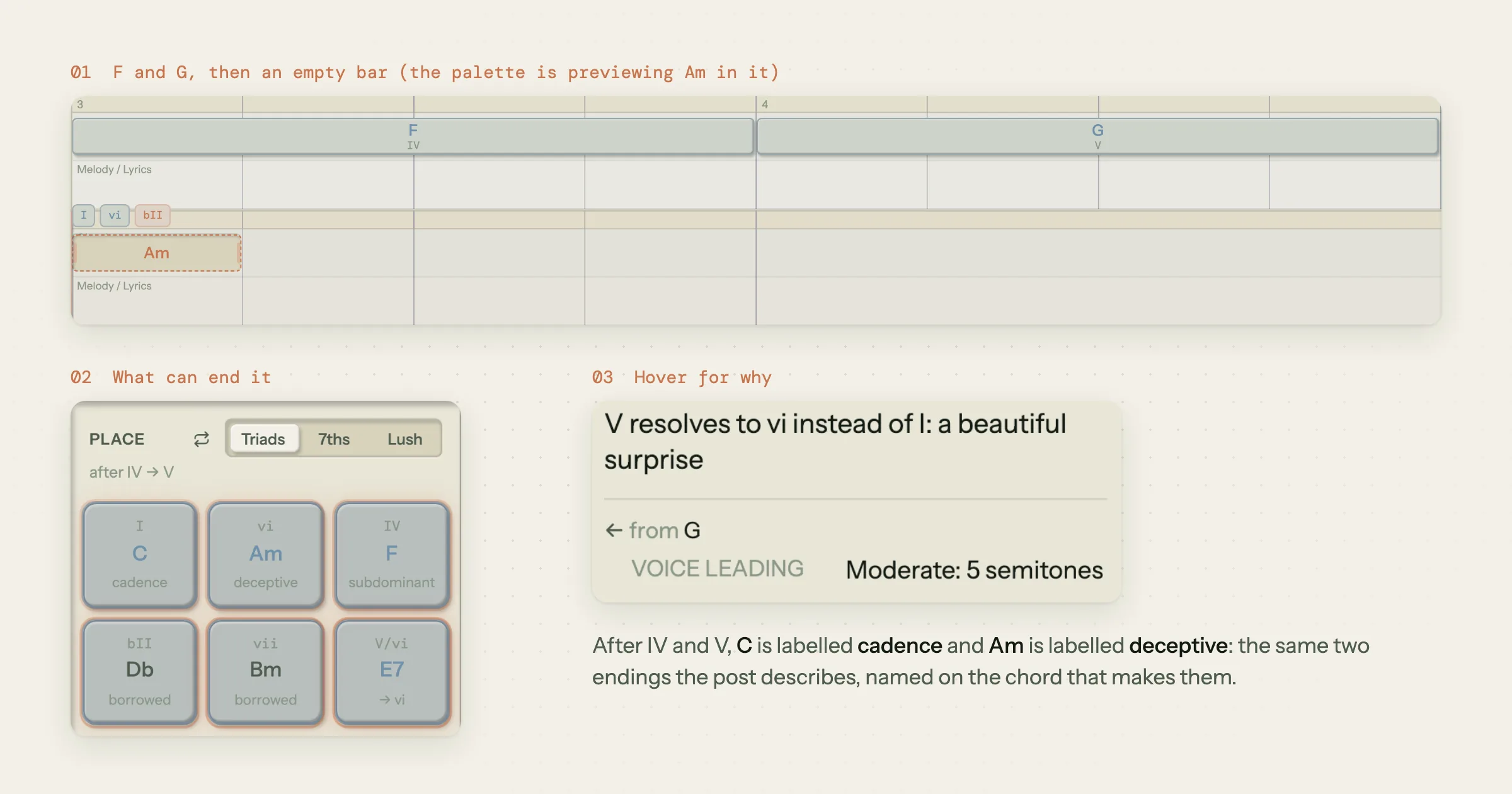
Hover a chip and the panel under the palette spells it out. For a deceptive move it reads "V resolves to vi instead of I: a beautiful surprise." Half cadences are not labelled by name: a move to the V chord reads "dominant", described as tension that pulls back toward the tonic, which is what a half cadence is when it ends the phrase.
At the end of a section, a loop icon appears next to the palette's context label. Turn it on and the suggestions re-rank toward the first chord of the same section instead of whatever comes next, so they favour turnarounds that lead back to the top: V7 moves, ii–V, secondary dominants of the section's home chord. It switches off again when you move to another slot. The chord palette documentation covers both.
Hear which ending your phrase wants
Song Cage ranks chords against the ones on either side and names the move each one makes, so you can try an authentic, plagal or deceptive ending on the same line and hear the difference.
Frequently Asked Questions
What are the four types of cadences?
Authentic (V to I), plagal (IV to I), half (any chord to V) and deceptive (V to a chord other than I, usually vi). In the UK the authentic cadence is called perfect, the half cadence imperfect and the deceptive cadence interrupted. Authentic and plagal end on the home chord and sound finished; half and deceptive do not.
What cadence is 5 to 1?
V to I is an authentic cadence, called a perfect cadence in the UK. In C major it is G to C. It is a perfect authentic cadence when both chords are in root position and the melody ends on the home note, and an imperfect authentic cadence when the melody ends on the third or fifth instead.
Is 5 to 6 a deceptive cadence?
Yes. V to vi, G to A minor in C, is the standard deceptive cadence. More broadly, any V that moves somewhere other than I counts, including V to the borrowed ♭VI and, in rock, what Temperley calls the "deceptive IV". The British name for it is the interrupted cadence.
Which cadence sounds the most final?
The perfect authentic cadence. In a 2014 study by Sears, Caplin and McAdams, musicians rated perfect authentic cadences most complete, followed by imperfect authentic, half, deceptive and evaded cadences. In rock, a plagal IV to I can sound just as final in context: 18.5% of the songs in Temperley's Rolling Stone sample close their chorus with it.
What is the difference between a plagal and a perfect cadence?
A perfect (authentic) cadence goes V to I, and the leading tone climbs a half step to the home note. A plagal cadence goes IV to I, and the home note is already in the IV chord, so nothing climbs. The perfect cadence sounds like an arrival; the plagal one sounds like a settling. It is nicknamed the "Amen" cadence because hymns so often set the word "Amen" to it.
Can a song end on the V chord?
Yes. "Mr. Brightside" ends on its V chord and "For No One" stops on V. Ending on a half cadence leaves the listener expecting more, which suits songs about something unresolved. Ending on IV, as "Blank Space" does, has a similar open feeling.
Is a cadence the same as a cadenza?
No, though the words share a root. A cadence is the chord move that ends a phrase. A cadenza is a showy solo passage, often improvised, that a soloist plays near the end of a movement, traditionally over a held chord just before the final cadence.
What does it mean when a chord resolves?
A chord resolves when the tension in it moves to a more stable chord, most often the home chord. V resolves to I because its leading tone, a half step below home, steps up to the home note. A cadence is where that resolution happens at the end of a phrase.
The four textbook cadences cover a lot of songwriting, but the published data shows how often popular songs step outside them: IV–I about as often as V–I, more than half of the choruses not ending on the home chord at all, and a whole family of flat-side endings with no V in sight. Pick the ending on purpose. If you want the next step after this one, how to write a chord progression by working backward from where it lands starts from the cadence and builds the rest.