Table of Contents
- What is modal interchange?
- Modal interchange, borrowed chords, and modal mixture: same thing
- The one idea that makes it click: same tonic, different mode
- The borrowed-chord reference table
- Borrowing from the parallel minor (the workhorse)
- The color cases: ♭II and II
- What each borrowed chord actually feels like
- minor iv: the bittersweet drop
- ♭VII: the anthemic lift
- ♭VI: the cinematic turn, and the heroic cadence
- ♭III: the warm surprise
- ♭II: the exotic color
- How to use modal interchange in your own song
- Reach for it at the moment that feels too predictable
- Audition it in real voicings before you commit
- Do it inside your DAW, without leaving the session
- Common mistakes to avoid
- Frequently Asked Questions
You write a progression, it sounds fine, and somehow it still sounds like a hundred songs you have already heard. The chords are all correct. That is the problem. Staying inside the key is safe, and safe is where "samey" lives.
Modal interchange is the fastest way out. It is the move behind the chord in "Creep" that makes the whole song ache, the lift in the "Hey Jude" coda, and the bittersweet turn in a thousand choruses you already love. None of it requires a theory degree. It requires one idea and a short list of chords to reach for. This guide gives you both, plus a copy-able reference table and real songs so you can hear each chord before you use it.
What is modal interchange?
Modal interchange, also called modal mixture or borrowing, is the technique of taking a chord from a parallel mode or key that shares the same tonic and using it inside your home key. In plain terms: if you are writing in C major, you borrow a chord from C minor. Same root note, C, but a different flavor underneath it. The borrowed chord is a guest. Your home key stays home.
That is the entire concept. Everything below is just which chords are worth borrowing and what each one does to a listener.
Modal interchange, borrowed chords, and modal mixture: same thing
These three terms get used interchangeably, and for a songwriter's purposes they mean the same thing: a chord that does not belong to your key, pulled in from a parallel scale that shares your tonic. "Borrowed chord" describes the chord. "Modal interchange" and "modal mixture" describe the technique. If a video calls it one and a blog calls it another, they are pointing at the same sound. Do not let the vocabulary slow you down.
The one idea that makes it click: same tonic, different mode
Every key has a parallel partner that starts on the same note. C major and C minor both begin on C. They share a home, they just furnish it differently: C minor lowers the 3rd, 6th, and 7th degrees. Those lowered notes are where the new chords come from.
Because the tonic is shared, you can leave C major for a single chord, grab the color you want from C minor, and step right back. The ear never loses the plot, because C is still the center of gravity. That is why modal interchange feels surprising but not jarring. You are not changing keys. You are visiting the parallel mode for one chord and coming home.
The borrowed-chord reference table
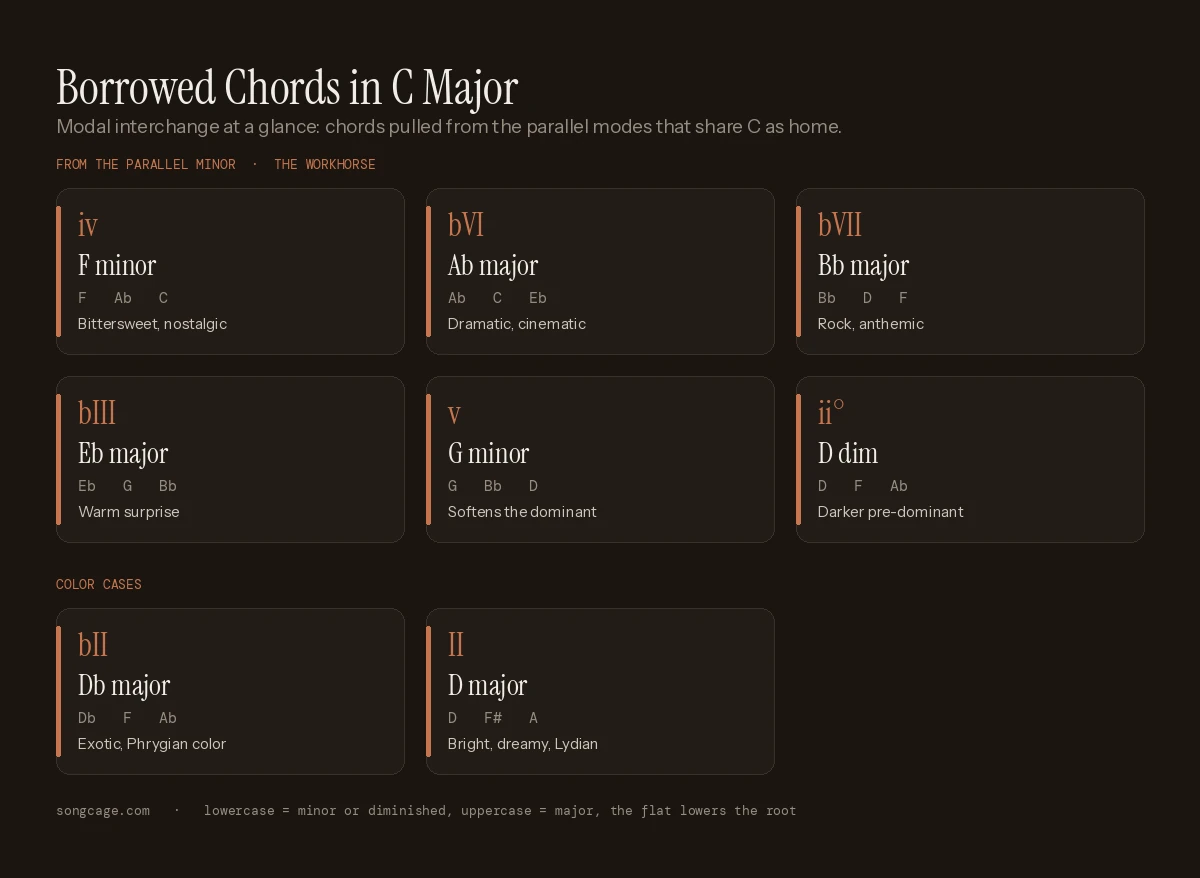
These are the eight most useful borrowed chords in modal interchange (modal mixture), shown in C major alongside the parallel mode each one comes from. Transpose the shapes to any key by keeping the same scale degrees. The flat in front of a numeral means the root is lowered relative to the major scale, so ♭VI in C is A♭ major, not A major, a detail half the internet gets wrong.
| Borrowed chord | In C major | Borrowed from | The feeling |
|---|---|---|---|
| minor iv | F minor (F–A♭–C) | parallel minor | Bittersweet, nostalgic. The classic IV → iv → I drop. |
| ♭VI | A♭ major (A♭–C–E♭) | parallel minor | Dramatic, cinematic lift or darkening. |
| ♭VII | B♭ major (B♭–D–F) | parallel minor / Mixolydian | Rock, folk, anthemic. Slides up into I. |
| ♭III | E♭ major (E♭–G–B♭) | parallel minor | Warm, surprising. A colorful chromatic mediant. |
| minor v | G minor (G–B♭–D) | parallel minor | Softens the dominant. Mellow, modal. |
| ii° / iiø7 | D dim (D–F–A♭) | parallel minor | Darker pre-dominant tension leaning into V. |
| ♭II (Neapolitan) | D♭ major (D♭–F–A♭) | Phrygian | Exotic, dark, "Spanish." Leans hard back to I. |
| II (major) | D major (D–F♯–A) | Lydian | Bright, dreamy lift. (See the warning below.) |
Uppercase numeral = major chord, lowercase = minor or diminished. The flat lowers the root relative to the major scale.
Borrowing from the parallel minor (the workhorse)
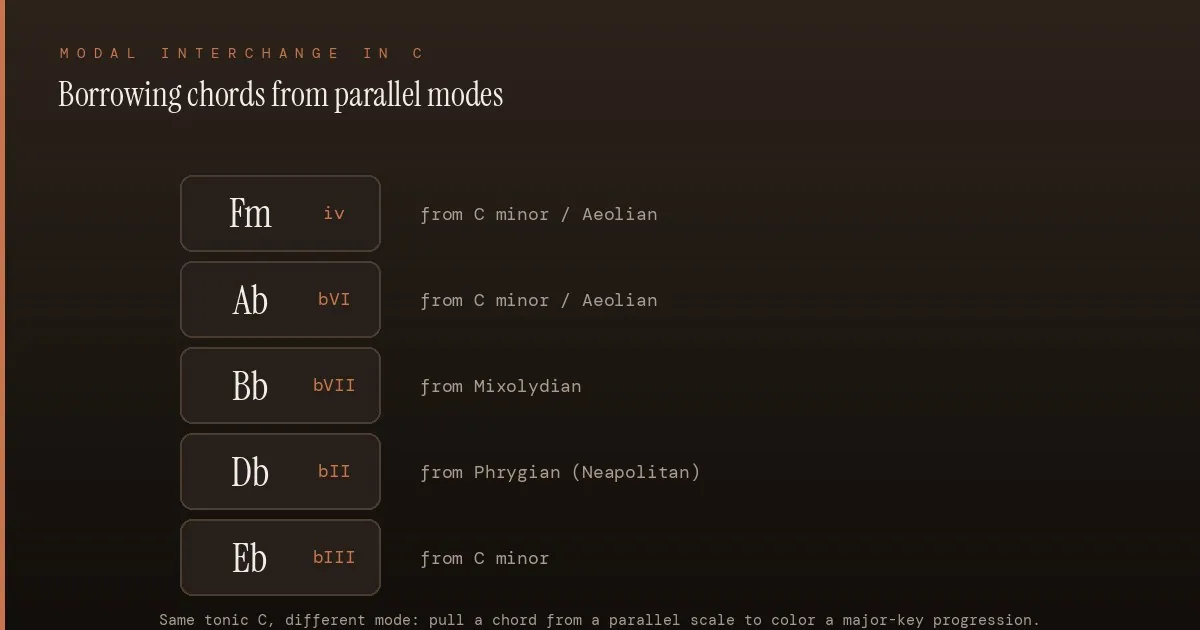
If you only ever learn one source, make it the parallel minor. It gives you the four chords that do most of the heavy lifting in pop, rock, folk, and film music:
- minor iv keeps its root (F) and lowers only the 3rd, A to A♭. That single lowered note is the saddest sound in popular music.
- ♭VI lowers the root to A♭ (A♭ major, not A major). Big, cinematic, slightly heroic.
- ♭VII is B♭ major, a whole step below the tonic. It slides up into C without a leading tone, which is why it feels open and modal instead of formally "final."
- ♭III is E♭ major, a warm chromatic surprise that often shows up as a lift in a bridge.
The color cases: ♭II and II
Two more are worth knowing once the parallel-minor chords feel natural:
- ♭II, the Neapolitan, is D♭ major in C. It sits a half step above the tonic and leans heavily back down to I. Classical writing uses it in first inversion (with F in the bass) as a pre-dominant; pop writing often just drops it in root position for drama. Either way, the lowered 2nd, D♭, is the whole effect.
- II major is D major (D, F♯, A). Bright and floating, borrowed from Lydian. One warning: those are the exact same notes as the secondary dominant V/V. The label depends on what the chord does, not how it is spelled. If it pulls toward G (the V chord), it is functioning as V/V. If it lingers and drifts back to C, it is a Lydian color. Spelling alone will not tell you which.
A quick honesty note: you will see guides promising exotic chords "borrowed from Dorian" or "from Mixolydian" in a major key. Most of those turn out to be the same B♭ and E♭ you already have from the parallel minor. Mixolydian is really just another name for the ♭VII flavor. Keep your attention on the parallel minor and you have the 90 percent that matters.
What each borrowed chord actually feels like
Theory tables tell you the spelling. Songs tell you the sound. Here is each chord in a track you already know, with the exact move so you can find it by ear.
minor iv: the bittersweet drop
In Radiohead's "Creep," the loop is G, B, C, Cm, one chord per bar in G major. That fourth chord should be C major to stay in key. Flipping it to C minor borrows the minor iv from G minor, and the lowered note (E♭) drags the harmony downward right under "you're so very special." The full loop, including the B major chord that gets there, is broken down in the "Creep" chord progression. That single substitution is the emotional hinge of the entire song.
The Beatles reached for the same color in "The Night Before," where a G minor (the minor iv in D major) shadows the verse before the bright I and IV return. The classic deployment is IV → iv → I: play the major IV, then darken it to minor, and let the lowered 6th sink chromatically into the tonic. It is the sound of something good turning a little sad.
♭VII: the anthemic lift
The "na-na-na" coda of "Hey Jude" repeats F, E♭, B♭, F in F major. The E♭ is ♭VII, borrowed from the parallel minor, and it gives the jam its open, Mixolydian glow against the strictly diatonic first half of the song. "Sweet Child O' Mine" runs the same idea harder: the D, C, G riff is I, ♭VII, IV in D major, and that C major (non-diatonic, since D major wants C♯) is the bluesy pull that defines the riff.
Frame it honestly
The ♭VII in these songs is borrowed from the parallel minor or heard as Mixolydian color. It is not a dominant chord in disguise and it does not "resolve" the way a V chord does. It slides up a whole step into the tonic, which is exactly why it sounds modal and open instead of formal.
♭VI: the cinematic turn, and the heroic cadence
"P.S. I Love You" does two jobs in one phrase. At each verse ending the Beatles play A, B♭, C, D in D major. Instead of the V chord (A) resolving straight home, it deflects to B♭, the ♭VI borrowed from D minor, then climbs. That climb is the famous ♭VI → ♭VII → I cadence: two major chords borrowed from the parallel minor, roots rising by whole steps (B♭ up to C up to D), arriving triumphantly on the tonic. It is the "heroic" or "Mario" cadence you hear at the top of countless rock and film climaxes, and it is built entirely from borrowed chords.
♭III: the warm surprise
The intro and turnaround of "Something" run F, E♭, G/D, C in C major: IV, ♭III, V, I. The E♭ interrupts a standard IV → V → I with a borrowed chromatic mediant, carried by a smooth descending bassline (F, E♭, D, C). It does not sound dark. It sounds rich, like the harmony briefly opened a window.
♭II: the exotic color
The rarest of the set in a major key. In "Do You Want to Know a Secret," the verse lands on an F major chord, the ♭II (Neapolitan) in E major, right before the word "closer." The lowered 2nd gives it a yearning, almost Spanish color that stands out precisely because major keys so rarely visit it. Use it when you want one chord to feel genuinely unexpected.
How to use modal interchange in your own song
You do not analyze your way into a borrowed chord. You reach for it when the music asks, and you keep the one that sounds right.
Reach for it at the moment that feels too predictable
Write your diatonic progression first. Then find the bar where the ear already knows what is coming, usually a IV or a V near the end of a phrase, and try the borrowed version: swap IV for minor iv, or deflect the V to ♭VI. The surprise lands hardest where the listener was most sure.
Audition it in real voicings before you commit
A borrowed chord on paper means nothing until you hear it against your melody. The lowered note that makes minor iv ache (the A♭ in C major) might clash with a melody note sitting on A natural. The only way to know is to play it.
This is what Song Cage is built for. The chord palette keeps your diatonic chords, your borrowed chords from the parallel modes, and your secondary dominants side by side, so you reach for the ♭VII or the minor iv, click it, and hear it instantly in real guitar and piano voicings against what you have already written. Nothing is generated for you and there are no canned progressions. You make the call, and the app lets you hear the consequence in a second instead of a minute.
If you want the broader map of which chords tend to lead where, our guide to the most useful chord progressions for songwriters pairs naturally with this one. For the apps and chord progression tools that handle borrowed chords well, plus the wider set of music theory tools for songwriters, we have full roundups, and music theory for guitarists covers the fretboard side. To write any of these progressions as numbers that transpose to any key, see the Nashville Number System.
Do it inside your DAW, without leaving the session
If you write in a DAW, the same borrowing now happens in your project. The Song Cage plugin runs the full songwriting workspace as an AU or VST3 inside Logic Pro, GarageBand, Ableton Live, FL Studio, Cubase, Studio One, and REAPER. Reach for the borrowed chord, hear it, and send it out as MIDI to any instrument in your session. The idea you captured by ear becomes notes on a track without breaking your flow or opening another app.
Common mistakes to avoid
Four traps
- Over-borrowing. One or two borrowed chords per section is a spice. A whole progression of them erases the home key and the surprise stops being a surprise.
- Spelling ♭VI as A major. The root is lowered, so in C major it is A♭ major. Same for ♭III (E♭, not E) and ♭VII (B♭, not B). Lowering the root is the step writers skip most.
- Ignoring voice leading. Borrowed chords sound best when their lowered note moves smoothly, like the A♭ in minor iv stepping down to G. Drop the chord in cold and it can sound bolted on.
- Confusing a borrowed chord with a key change. A borrowed chord is a one- or two-chord guest, and the tonic never moves. If the music settles into a new home with its own cadence, that is a modulation, not modal interchange.
Frequently Asked Questions
Is modal interchange the same as borrowed chords?
Yes. "Borrowed chord" names the chord, and "modal interchange" (or "modal mixture") names the technique of borrowing it. They describe the same sound: a chord pulled from a parallel mode or key that shares your tonic.
Do I need to know the modes to use modal interchange?
No. For nearly everything you will use, "borrow from the parallel minor" covers it. In C major that means looking at C minor for the minor iv, ♭VI, ♭VII, and ♭III. You can learn the rest of the modes later, or never, and still write great borrowed-chord progressions.
What is the difference between modal interchange and a key change?
A borrowed chord is a momentary guest: one or two chords, with your original tonic still clearly home. A key change (modulation) establishes a new tonic, usually confirmed by a cadence in the new key, and the tonal center actually moves. If the music quickly returns home with no new cadence, it is modal interchange.
What is the most common borrowed chord?
The minor iv, borrowed from the parallel minor. In C major that is F minor, almost always in the move IV → iv → I. The lowered 6th sinking into the 5th of the tonic is the bittersweet sound in "Creep" and countless choruses.
Is a secondary dominant a borrowed chord?
Not quite. A secondary dominant is a temporary V chord that pulls toward a chord other than the tonic, so it is functional tension. A borrowed chord is color pulled from a parallel mode. They can even share spelling: D major in C is a Lydian II as a floating color, but the same notes act as V/V when they drive toward G. What the chord does decides which it is.
Hear your borrowed chords the moment you reach for them
Song Cage puts your diatonic chords, parallel-mode borrowed chords, and secondary dominants in one palette, in real guitar and piano voicings, so you can try a minor iv or a ♭VII against your melody and keep what sounds right. No AI, no canned progressions. You write it.