Table of Contents
- What chords are in a minor key?
- Why does every minor-key chord chart say "or"?
- Which chord does each note control?
- Should the 5 chord be minor or major?
- Two songs that choose differently
- Should the 4 chord be minor or major?
- The song that uses every option at once
- Why do III, VI and VII do most of the work?
- The loop with no dominant in it
- Is the 2 chord really diminished?
- How do you decide which version to use?
- What do people get wrong about minor keys?
- How Song Cage shows you both options
- What does it not do?
- Frequently Asked Questions
Search for minor chord progressions and you get lists. Eleven sad ones, fourteen beautiful ones, five for piano. Every page hands you finished progressions and moves on.
None of them answers the question you actually have, which is the one people keep asking on music forums and never getting resolved: which chords do I even have in a minor key? Look up the chart and you find a row full of hedges. The 2 chord is diminished or minor. The 4 chord is minor or major. The 5 chord is minor or major.
That row of "or"s is not sloppiness. It comes from one specific fact about minor keys, and once you know it, every fork resolves into a decision you can make on purpose.

What chords are in a minor key?
A minor key gives you seven basic chords, built from the natural minor scale: a minor chord on 1, a diminished chord on 2, and major chords on 3, 6 and 7, with minor chords on 4 and 5. In A minor that is Am, Bdim, C, Dm, Em, F and G. Three of those seven are major, which surprises people who expect a minor key to be all minor chords.
That set is the starting point for every minor chord progression you will write, not the whole story. But it is the part that never changes, and it is what your key signature actually means. Open Music Theory is blunt about this: minor keys "are always identified as simply 'minor'" and are "based on the natural minor scale," regardless of which minor scale a melody happens to use.
Here is that set in all twelve keys.
| Key | i | ii° | III | iv | v | VI | VII |
|---|---|---|---|---|---|---|---|
| A minor | Am | Bdim | C | Dm | Em | F | G |
| E minor | Em | F♯dim | G | Am | Bm | C | D |
| B minor | Bm | C♯dim | D | Em | F♯m | G | A |
| F♯ minor | F♯m | G♯dim | A | Bm | C♯m | D | E |
| C♯ minor | C♯m | D♯dim | E | F♯m | G♯m | A | B |
| G♯ minor | G♯m | A♯dim | B | C♯m | D♯m | E | F♯ |
| D minor | Dm | Edim | F | Gm | Am | B♭ | C |
| G minor | Gm | Adim | B♭ | Cm | Dm | E♭ | F |
| C minor | Cm | Ddim | E♭ | Fm | Gm | A♭ | B♭ |
| F minor | Fm | Gdim | A♭ | B♭m | Cm | D♭ | E♭ |
| B♭ minor | B♭m | Cdim | D♭ | E♭m | Fm | G♭ | A♭ |
| E♭ minor | E♭m | Fdim | G♭ | A♭m | B♭m | C♭ | D♭ |
The C♭ in E♭ minor is correct by spelling and is usually played as a B major shape.
A note on the numbers
You will see these same chords written two ways. In a minor-key context they are numbered against the minor scale, so the three major chords are III, VI and VII. In rock analysis they are often numbered against the major scale instead, which makes them ♭III, ♭VI and ♭VII. Nicole Biamonte, writing in Music Theory Spectrum in 2010, concedes the flat-side labels are open to "a valid criticism" because they mark as non-diatonic some chords that are "at least as normative as their diatonic counterparts." Same chords either way. This article uses the minor-key numbering.
Why does every minor-key chord chart say "or"?
Because scale degrees 6 and 7 are variable in a minor key and everything else is fixed. Raising or lowering those two notes changes the quality of five of the seven chords. That single fact produces every "or" you see in a minor chord chart, and it is the only thing you have to understand.
Stephen Gosden, writing in the Journal of Music Theory Pedagogy, states it precisely: 6 and 7 "exist in two different forms," a lowered form and a raised form, and the raised 7 has its own name, the leading tone, while the lowered 7 is the subtonic. His conclusion is the sentence the whole topic turns on: "except for the tonic triad (which is always minor), every chord in a minor key has the potential for at least two different qualities."
That is also why the count of available chords is bigger than seven. Robert Hutchinson's Music Theory for the 21st-Century Classroom puts the total at 13 possible diatonic triads in minor, because "the sixth and seventh scale degrees affect all of the triads except the tonic."
Which chord does each note control?
Degrees 1 through 5 do not move. Only 6 and 7 do, so you can trace every fork back to one of them.
The two switches
- Degree 7 controls the 5 chord and the 7 chord. Leave it low and you get minor v and major VII. Raise it and you get major V and diminished vii°.
- Degree 6 controls the 2 chord and the 4 chord. Leave it low and you get ii° and minor iv. Raise it and you get minor ii and major IV.
- The 1 chord and the 3 chord never change. The tonic triad contains neither note, and the 3 chord is left alone on purpose.
Should the 5 chord be minor or major?
This is the biggest single decision in a minor-key song, and it comes down to whether you want a leading tone. Natural minor gives you a minor v, which is a whole step below the tonic and pulls weakly. Raising that note by a half step gives you a major V, which pulls hard.
The mechanism is simple. In A minor the 7th note is G, a whole step below A. Build a chord on the 5th degree and you get Em, spelled E-G-B. Raise the G to G#, only a half step below A, and Em becomes E major. As bass teacher Andrew Pouska puts it, "the minor v chord to minor i chord doesn't produce the same kind of tension that a major triad or dominant V chord produces," because a whole-step approach is weaker than a half-step one. That raised note is where the harmonic minor scale gets its name.
Gosden's data-backed guidance is worth knowing: when a chord is rooted on 5 or 7, it is "much more likely to use the leading tone" than the subtonic.
Two songs that choose differently
Black Magic Woman never raises it. Wikipedia's entry describes the song as "set in the key of D minor," with a verse "alternating between D minor 7, A minor 7, and G minor 7." That is i, v and iv, and the 5 chord stays minor throughout. The result is the song's floating, unresolved sway; there is no leading tone anywhere to snap it home.
The Thrill Is Gone does the opposite. It sits in B minor, and its 5 chord is F#7. As Desi Serna points out, the A# inside that chord "comes from the B harmonic minor scale," raising the 7th degree from A to A# and turning a minor 5 chord into a dominant one. The turnaround lands like a door closing. Both are minor blues. One decision separates them.
Should the 4 chord be minor or major?
The 4 chord is controlled by degree 6, and raising it turns minor iv into major IV. Musicians usually call that sound Dorian, because a raised 6th is exactly what separates the Dorian mode from natural minor. It is the brightest single change you can make without leaving the key.
In A minor the 6th note is F, and the 4 chord is Dm. Raise F to F# and Dm becomes D major. Nothing else about the key has to change.
Santana's Evil Ways is the cleanest possible demonstration, because it is essentially only this. The song is a two-chord vamp of Gm to C, and Hooktheory files it under G Dorian precisely because that C major is the raised-6th chord. Swap the C for a Cm and the whole track collapses into something ordinary.
House of the Rising Sun uses both switches in eight bars. Its chords are Am, C, D, F, Am, C, E. Guitar teacher Desi Serna's breakdown attributes each one: Am and C are natural minor, F is the natural-minor 6 chord, the D major is the raised 6th and the E major is the raised 7th. Two altered notes, and the progression stops sounding like a scale exercise.
The song that uses every option at once
Hotel California is the fullest example in popular music. Wikipedia notes that its intro and verse pattern "counts eight measures, each one assigned to a single chord," with "seven different chords" in those eight bars: Bm, F#, A, E, G, D, Em, F#.
Read against B minor, that is i, V, VII, IV, VI, III, iv, V. It contains the major V, F# (raised 7th) and the subtonic A (lowered 7th). It contains the major IV, E (raised 6th) and the minor iv, Em (lowered 6th). Wikipedia observes that "the presence of E major suggests a modality of B Dorian." Don Felder, who wrote the music from a 12-string demo made at a rented house on Malibu Beach, put both versions of both chords into the same loop, which is why it never settles. The band did not even land on B minor at first: Felder lowered the key step by step from E minor until it sat comfortably for Henley's voice.
Why do III, VI and VII do most of the work?
The three major chords in a minor key turn up in more minor chord progressions than anything else, and they travel as a group. In a hand-analysed corpus study of rock harmony, these three are the only trio whose every pair is strongly correlated, meaning that where you find one you tend to find the others.
Trevor de Clercq and David Temperley built their corpus by taking the top 20 songs from each decade of Rolling Stone's "500 Greatest Songs of All Time," 1950s through 1990s, then analysing all of them by hand. Writing in Popular Music in 2011, they report the finding directly: "♭VII, ♭III and ♭VI emerge as a group in which all three pairs are highly correlated; clearly, these three chords tend to co-occur."
There is a reason these chords feel native to songwriting and foreign to a theory textbook. Temperley's analysis of the Kostka and Payne common-practice corpus found that the ♭VII to I progression never occurs there at all, and a later survey of five corpora spanning 1650 to 1900 put ♭VII no higher than 4%. In rock it is the most common non-primary triad. The chord your classical harmony class barely mentions is the one your song probably wants.
The loop with no dominant in it
All Along the Watchtower is three chords, and none of them is a 5 chord. Dylan plays the shapes Am, G, F, G with a capo at the fourth fret, sounding in C# minor. That is i, VII, VI, VII: down two steps and back, forever.
Musicologist Wilfrid Mellers described the song's "grandly swinging Aeolian melody," and Albin Zak noted that its "entire harmonic substance consists of three chords repeated in an unchanging cyclic pattern." No leading tone, no resolution, no dominant. It is one of the most recognisable songs ever recorded.
Is the 2 chord really diminished?
Technically yes, and practically almost never. The diminished chord on degree 2 is the one chord in the minor set that songwriters skip. Across de Clercq and Temperley's 99 hand-analysed rock songs, diminished chords account for 0.7% of all chords, against 75.8% major and 23.4% minor.
The reason is sound, not theory. A diminished triad is unstable by construction, it does not sit comfortably under a strummed guitar, and it resolves so strongly that it rarely survives being held for a bar.
What songwriters do instead is one of three things. Raise degree 6 and the chord becomes a plain minor ii, which is usable and gives you the Dorian colour. Add a seventh and it becomes iiø7, half-diminished, which is softer and standard in minor jazz. Or skip it and use iv, which shares two of its three notes and does the same job with none of the awkwardness.
If you want to work with the chord rather than around it, our guide to diminished chords covers it in full.
How do you decide which version to use?
Ask what the melody note is doing. That is the whole method, and it is more reliable than memorising progressions. The two variable notes have strong preferences about where they go, and matching the chord to that motion is what makes a minor chord progression sound intentional rather than assembled.
Gosden reduces the practice to two voice-leading principles. First: when 7 moves up to 1, use the raised form, and when 6 moves down to 5, use the lowered form. Second: avoid jumping between lowered 6 and raised 7, which is the awkward interval the melodic minor scale exists to smooth over.
Translated into decisions at a guitar or a piano:
| You want | Use | In A minor | Why |
|---|---|---|---|
| A hard landing on the tonic | major V | E or E7 | Raised 7th sits a half step under the root |
| A loop that never resolves | minor v or VII | Em or G | No leading tone, so nothing pulls home |
| Brightness without leaving the key | major IV | D | Raised 6th, the Dorian colour |
| The darkest available 4 chord | minor iv | Dm | Lowered 6th, pulling down to 5 |
| A lift toward the relative major | VII into III | G into C | VII acts as the dominant of III |
| A step up before the 5 chord | VI into V | F into E | Lowered 6th falling a half step to 5 |
That fifth row is worth dwelling on. Gosden notes that when the III chord appears it is "often preceded by a VII or VII7 chord," where the subtonic "tends to sound like a secondary dominant that is tonicizing III," the relative major. It is the most common way a minor-key song brightens without changing key. If you want to go further and actually change key, we cover that in how to change key in a song.
What do people get wrong about minor keys?
Three claims circulate widely and all three are wrong.
Myth 1: the 3 chord is augmented
A frequently upvoted answer on Music Stack Exchange lists the mediant in A minor as C augmented, on the logic that harmonic minor raises G to G♯. Textbooks disagree, and give a reason. Fundamentals, Function, and Form states that the raised 7th "applies only to the chords built on scale degrees 5 and 7," and explains why: the 3 chord "is the tonic of the relative major. Having an augmented triad here would subvert this important relationship and is therefore not permitted." Your 3 chord is a plain major triad. The augmented version does exist on paper, and it is worth knowing as a colour, but it belongs with the borrowed chords rather than in the key's basic seven.
Myth 2: songs are written "in harmonic minor"
Harmonic and melodic minor are not keys. Open Music Theory compares the three minor scales to "flavors of ice cream" and says plainly that "musicians do not consider music to be 'in' a specific type of minor scale." Fundamentals, Function, and Form agrees, calling harmonic minor "not a key in its own right, but rather a variant." You are in A minor. You borrow a raised note when you want the chord it produces.
Myth 3: a minor key means a sad song
Jeffrey Pepper Rodgers, whose guide is one of the few on the open web that teaches the system rather than listing progressions, warns against exactly this: "don't stereotype keys as 'major = happy' and 'minor = sad.'" His counterexamples are Gershwin's "Summertime," the Commodores' "Brick House" and Dire Straits' "Sultans of Swing." Sadness runs on tempo, delivery and where the melody lands at least as much as on harmony, which we take apart in sad chord progressions.
How Song Cage shows you both options
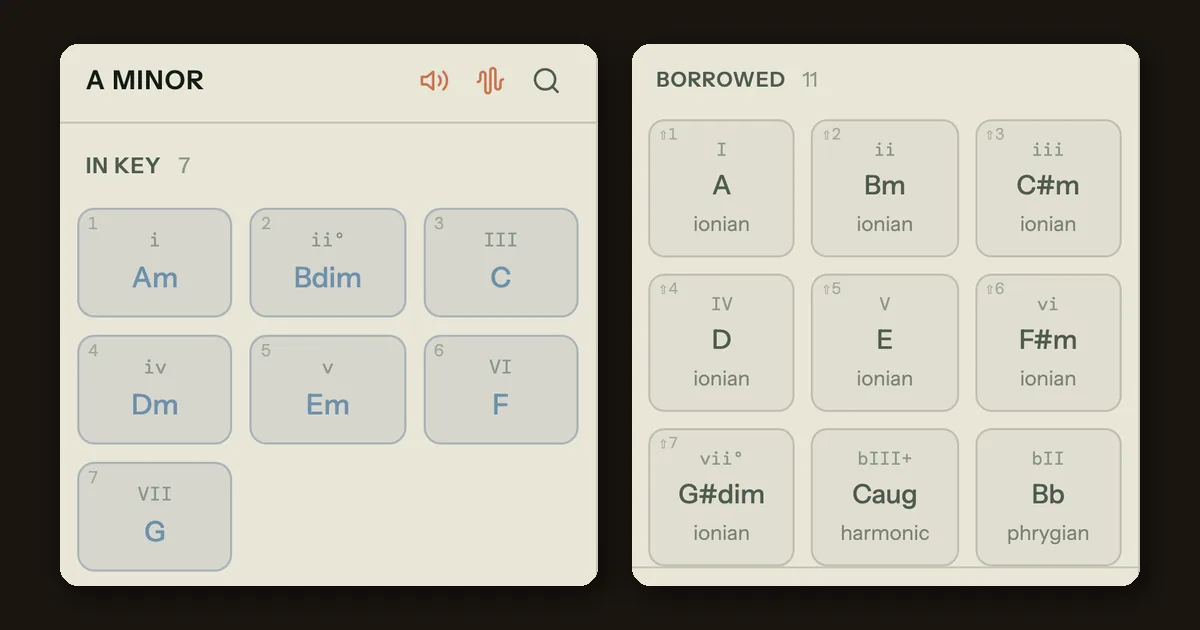
Set a song to a minor key in Song Cage and the chord sidebar splits into three labelled sections. In Key holds the seven natural-minor chords. Borrowed holds the alternatives, and each one is tagged with the scale it came from. The app does not resolve the "or" for you. It shows you both chords and names the source of each.
In A minor, In Key reads Am, Bdim, C, Dm, Em, F and G, numbered i through VII. Borrowed sits underneath with eleven more, and the two that matter most for this article are right there in it: D major, labelled IV, and E major, labelled V. Those are the exact two chords House of the Rising Sun reaches for. Both are tagged ionian, because the quickest way to describe a raised 6th and a raised 7th together is that they are what the parallel major has. Further down sit B♭ labelled ♭II, tagged phrygian, and Caug labelled ♭III+, tagged harmonic, which is the augmented mediant from the myth above sitting exactly where it belongs.
A separate Secondary Dominants section lists five more, each with its target spelled out, including A7 marked "→ iv (Dm)" and B7 marked "→ v (Em)".
What does it not do?
Two honest limits. Song Cage does not hand you progressions, so nothing here writes the song for you. And its key setting is major or minor only, so there is no Dorian switch; the raised-6th chord shows up as a borrowed chord in a minor key, which is how most songwriters meet it anyway. For more on the borrowed side, see modal interchange and secondary dominants, or the chord progressions chapter in the docs.
See every chord in your minor key
Set a key, and the sidebar shows the seven chords you have, the borrowed alternatives, and where each one came from.
Frequently Asked Questions
What are the 7 chords in a minor key?
Built from the natural minor scale, they are a minor chord on 1, diminished on 2, major on 3, minor on 4, minor on 5, and major on 6 and 7. In A minor: Am, Bdim, C, Dm, Em, F, G. The chords on degrees 2, 4, 5 and 7 can each change quality if you raise the 6th or 7th note of the scale.
Why is the 5 chord minor in a minor key?
Because the natural minor scale's 7th note sits a whole step below the tonic rather than a half step. In A minor that note is G, which makes the 5 chord Em. Raising G to G♯ turns Em into E major and creates a leading tone that pulls strongly back to Am. That raised note is what defines the harmonic minor scale.
Are minor keys made only of minor chords?
No. Three of the seven basic chords are major: the ones on degrees 3, 6 and 7. In A minor those are C, F and G. Raising the 6th or 7th degree can make the 4 chord and the 5 chord major too, so a minor-key song can easily contain more major chords than minor ones.
What is the most common minor chord progression?
Loops built from i, VI, III and VII are the most common family, because those three major chords are strongly correlated in the rock corpus. "All Along the Watchtower" uses i, VII, VI, VII and nothing else. For the wider set, including the named ones like the Andalusian cadence, see our roundup of the most useful chord progressions.
What is the difference between the subtonic and the leading tone?
They are the two forms of the 7th degree. The subtonic is the lowered form, a whole step below the tonic, and it produces the major VII chord. The leading tone is the raised form, a half step below, and it produces the major V and the diminished vii°. Major keys have only a leading tone, which is why minor keys need the extra name.
Can a minor key song end on a major chord?
Yes. Ending a minor-key piece on a major tonic is a long-standing device known as a Picardy third, made by raising the third of the final chord, so A minor ends on A major. It is a deliberate brightening at the finish rather than a key change, and the rest of the song stays in minor.