Table of Contents
- What does it mean to harmonize a melody?
- First, get the tune out of your head
- How do you find the key of a hum you cannot write down?
- The home-note test
- Does it sound bright or dark?
- What if you only hummed three or four notes?
- Why does every melody note fit more than one chord?
- The three chords that fit almost any tune
- Chords under "Twinkle, Twinkle" by ear
- How many chords do you need, and where do they land?
- Do you have to put a chord under every note?
- Add color once the bones are there
- What if the hum sounds sad?
- How do you know the chords are right?
- Can software just find the chords for your hum?
- Chord detectors
- Transcribers
- Generative co-writers
- How Song Cage puts chords under what you hummed
- Can you harmonize a sung take inside your DAW?
- Frequently Asked Questions
You hummed something in the shower, or on a walk, or half-asleep, and it was good. Now it is sitting in your head with no chords under it, and every guide you open starts three steps ahead of where you are. Find the key, they say. Write out the notes. Read the sharps and flats. But you cannot read sharps and flats. You have a tune, not a page.
This is the gap nobody fills. Search for how to harmonize a melody and the strong results all begin at "once you know your key and your notes," which quietly assumes you have already turned your hum into notation. The one job you are actually stuck on, getting from a wordless melody to the chords that hold it up, is the step everyone skips.
So this guide starts where you are. No staff, no key signatures you have to already know, no assumption that you can name the note you are singing. Just a tune in your head and a plan to find the chords underneath it.
Quick summary
To harmonize a hummed melody: capture it before it fades, find the key by singing the note the tune wants to rest on, then try the three primary chords (I, IV, and V) under the notes that land on your strong beats. Between them, those chords contain every note of the scale, so one of them always fits. Add a minor chord or a seventh for color once the plain version sounds right.
What does it mean to harmonize a melody?
To harmonize a melody is to choose the chords that sound underneath it, one moment at a time. The melody is the single line you hummed; the harmony is the stack of notes supporting each part of it. Harmonizing is picking, for each important note, a chord that contains it and carries the feeling you want.
There is a distinction hiding here that almost no guide names, and it explains why "just use an app" so often fails. Finding chords for a melody you hummed is not the same job as detecting the chords in a finished recording. A full recording already has harmony baked into it, and a chord detector reverse-engineers what is there. A bare hum has no harmony yet. There is nothing to detect. You are not extracting chords, you are inventing them.
That is good news, because it means there is no single correct answer waiting to be uncovered. The same melody can be dressed in several different, equally valid sets of chords. Your job is to choose, not to guess right.
First, get the tune out of your head
Capture the melody before you do anything else. Ideas evaporate faster than you expect, and you cannot harmonize what you can no longer remember. Sing or hum it into a voice recorder, straight through, two or three times, so you have a stable version to work against instead of a moving target.

This is the step the other guides assume you have already done, and it is the one that actually blocks people. You do not need to write anything down to capture a melody. Your phone's voice recorder is enough. Hum it plainly, without trying to add rhythm or expression, so the pitches are clear. Do a few passes, because the version you settle into by the third take is usually the one you meant.
Once you have a recording you trust, you have something to work with: a fixed melody you can loop, slow down, and test chords against. Everything below is easier when the tune is sitting in front of you instead of slipping around in your memory.
How do you find the key of a hum you cannot write down?
Your key is named by the note your melody wants to rest on, and you can find it by ear without reading anything. Sing your tune, let it end where it naturally settles, and hold that last note. That resting note is almost always the tonic, and the tonic names the key.
The home-note test
Melodies crave resolution. Listeners feel uneasy when a tune is left hanging, which is exactly why the note it lands on feels like home. To use this, sing your melody to its end and sustain the final note, then find that pitch on a piano or guitar. The note you land on is your tonic. A tune that has no sharps or flats and settles on C is almost certainly in C major. As guitar teacher Paul Challenger puts it, the last note of a verse or chorus "is usually the tonic note, and therefore gives you the song's key."
Does it sound bright or dark?
Once you have your home note, decide whether the tune feels bright or heavy. Bright, sturdy, resolved usually means a major key. Dark, wistful, or tense usually means minor. If you are unsure, sing the home note, then sing the note three steps up in your tune's scale: a wide, sunny gap says major, a closer, sadder gap says minor.
What if you only hummed three or four notes?
A very short fragment is genuinely ambiguous. Three or four notes can belong to several keys, so more than one harmonization will sound fine, and that is allowed. Pick the reading that matches the mood you felt. This is also the reason a melody-to-chords tool needs at least three notes to work with before it has enough to suggest anything.
Why does every melody note fit more than one chord?
Because a single note can be the root, the third, or the fifth of a chord, any one melody note belongs to three different in-key chords at once. That is why harmonizing is a choice rather than a hunt: there is no lone correct chord under each note, there are several, and you pick the one that sounds like your song.
Take the note C in the key of C major. It is the root of a C chord, the third of an A minor chord, and the fifth of an F chord. All three contain a C, so all three will sound consonant under a melody sitting on that note. The one you choose changes the color completely: the C chord sounds settled, the A minor sounds shadowed, the F sounds like it is reaching somewhere.
This is the mental shift that makes the whole process click. You are not searching for the chord your melody secretly demands. You are auditioning the two or three chords that genuinely fit and keeping the one that carries the feeling. Everything that follows, from the plain three-chord version to richer inversions and substitutions, is built on this freedom.
The three chords that fit almost any tune
In any major key, the chords built on the first, fourth, and fifth notes of the scale (I, IV, and V) contain every note of that scale between them. So whatever note your melody is sitting on, at least one of these three chords holds it. Harmonizing with only I, IV, and V is the fastest way to get any diatonic tune sounding supported.
The math is simple and worth seeing once. In C major, I is C-E-G, IV is F-A-C, and V is G-B-D. Line up the notes they cover: C, D, E, F, G, A, B, the entire scale. There is no note you can hum in the key that one of these three chords does not include.
Chords under "Twinkle, Twinkle" by ear
"Twinkle, Twinkle, Little Star," whose melody is the eighteenth-century French tune "Ah! vous dirai-je, maman" and firmly in the public domain, needs only these three chords in C major. The opening "twinkle, twinkle" sits on C, so a C chord fits. The melody then climbs to an A on the word "little," a note no C chord contains, but the IV chord (F) does, because A is its third. Put F under that word and it locks in. The whole nursery rhyme harmonizes with nothing but C, F, and G.
How many chords do you need, and where do they land?
You do not put a chord under every note. You choose a rate at which the chords change, called the harmonic rhythm, and place the changes on the strong beats. For most hummed tunes, start with one chord per bar and change on the downbeat, then speed up only where the melody asks for it.
The notes that matter for choosing chords are the ones that fall on strong beats, usually beats one and three in common time, or any note the phrase leans into and holds. These are your target notes. Match a chord to each target note first, and let the quicker notes in between take care of themselves. As one harmonization guide frames it, the fundamental chord tones "serve as anchor points" and belong on the strong beats.
Slower harmonic rhythm, holding one chord for a whole bar or more, leaves the melody room to breathe and feels spacious. Faster changes, two chords a bar or more, build drive and momentum. The pace often quickens as a phrase approaches its ending, which is a natural place to add a change. Deciding this early tells you how many chords you actually need to find, which is usually fewer than you think.
Do you have to put a chord under every note?
No, and trying to is the most common way beginners over-complicate a melody. Many notes are non-chord tones: passing decorations that are supposed to brush against the chord and move on. Harmonize the important notes, and let the in-between notes clash lightly and resolve.
Music theory has clean names for these embellishing notes. A passing tone fills the gap between two chord tones a step apart, approached and left by step in the same direction. A neighbor tone steps away from a chord tone and steps right back. An appoggiatura leaps in and leans on a strong beat before resolving down by step. A suspension holds a note over from the previous chord and resolves down into the new one. Open Music Theory catalogs all four.
The practical upshot: a note that does not fit the chord under it is usually fine, especially on a weak beat, because it is passing through. In "Ode to Joy," an almost entirely stepwise tune, most of the melody glides over just a few held chords, with several notes acting as passing tones rather than demanding chords of their own. Chase every note with a new chord and you smother the tune. Harmonize the anchors and let the rest pass.
Add color once the bones are there
After the plain three-chord version works, swap in richer chords that keep a similar job in the key, so the melody still fits over them. The easiest upgrades are the minor chords already in your key, a seventh added to a chord to give it pull, and the occasional borrowed chord for a splash of somewhere else.
The first place to reach is the relative minor, the vi chord, which shares two of its three notes with your I chord and darkens a phrase without leaving the key. "Auld Lang Syne" harmonizes beautifully with the three primary chords plus an E minor (vi) for shadow. From there, adding a seventh to your V chord sharpens its pull back home, and a secondary dominant can point briefly at a chord other than the tonic for a lift.
Further out, borrowed chords pull a color from the parallel key, the minor iv under a major tune being the classic ache. Every one of these substitutions lives or dies on the same test: does the melody note still fit the new chord? As Berklee's reharmonization guide notes, a substitute chord should share the original's function so the line stays intact. Change the color, keep the melody the boss.
What if the hum sounds sad?
A dark or wistful tune is usually in a minor key, and most harmonize-a-melody advice ignores minor keys entirely. The move is the same as before, only your home note is the tonic of a minor scale, and your three anchor chords are the minor i, the iv, and the V (often made major for a stronger pull back home).
Minor keys are also where the "one melody, many chords" idea is most obvious. "Greensleeves," an English tune documented since the sixteenth century and squarely public domain, has been harmonized over several completely different historical chord grounds, as its long documented history shows. The same haunting line sits comfortably over more than one progression, which is the whole thesis of this guide made audible.
So if your hum feels heavy, do not force it into a cheerful major frame. Find the note it rests on, confirm the sadness is coming from a minor home rather than a single blue note, and build up from the minor i. If you want to understand why some minor tunes feel folk-like or ancient rather than simply sad, the musical modes are the next layer down.
How do you know the chords are right?
The by-ear sanity check is simple: play the chord you chose under the melody note that lands on the strong beat, and listen. If the chord contains that note, it will lock in and sound settled. If it clashes and does not resolve, the note is either a passing tone, or you have the wrong chord.
You do not need theory to run this test, only your ears and the loop of your captured melody. Play your candidate chord and sing the target note over it. A note that belongs to the chord rings; a note that fights it buzzes. If the buzz is on a quick, weak-beat note, leave it, it is passing through. If the buzz is on a held note landing on beat one, try a different chord from the two or three that fit that note.
The whole method on one card
- Capture the hum as a voice recording, a few clean passes
- Find the key by singing the note the tune rests on
- Mark the notes on the strong beats: those are your targets
- Try I, IV, and V under the targets, one chord per bar to start
- Leave quick, in-between notes unharmonized as passing tones
- Add a minor chord or a seventh for color once it works
- Check by ear: does the chord hold the strong-beat note?
Can software just find the chords for your hum?
Some of it can, but not all software is doing the same job, and knowing the difference saves hours. There are three kinds of tool people reach for here, and only one actually fits chords to a bare melody you sang. The other two are built for different problems and will frustrate you if you expect them to harmonize a hum.
Chord detectors
Tools like Chordify are built to pull the chords out of a finished recording that already has harmony in it. Point one at a full track and it does well. Point it at a solo hum and it stumbles, because there is no harmony present for it to detect. A bare melody is exactly the case these tools are not designed for.
Transcribers
Notation tools like ScoreCloud turn your sung melody into a written lead sheet. That is genuinely useful, and often accurate, but it hands you back a staff full of notes, which is the reading barrier you came here to get around. It converts your hum into notation; it does not decide the chords for you.
Generative co-writers
AI tools like Hooktheory's Hookpad ask you to enter the melody and then generate harmony around it. They are great for sparking ideas, but they reinterpret your tune rather than harmonize the exact notes you sang, and the output can change from one generation to the next. The question worth asking is whether the result is still the melody you hummed, and whether you would get the same answer twice.
How Song Cage puts chords under what you hummed
Song Cage is built for exactly this moment: a tune in your head and no way to write it down. On your computer, you hum the melody straight into it, it finds the pitches for you and lays them on the grid, and once you have a few notes down, one press fits a chord under each part. It is not AI and it is not a set of presets. It reads the notes you actually sang and harmonizes those, so the melody stays the source of truth.
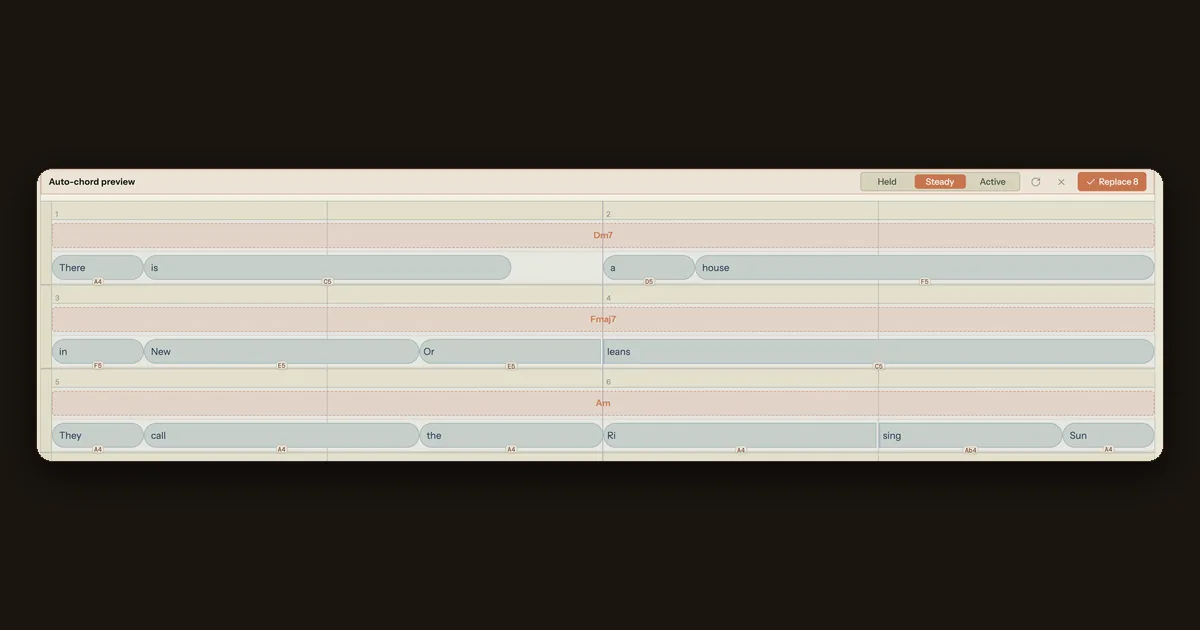
You never have to name a note or know your key. Hum into the mic, and Song Cage turns your take into melody notes, then reads them and tells you what key it sounds like. When the section has three or more notes, the Auto Chords button appears; press it and a set of suggested chords drops in under your melody, fitted to the notes you sang rather than pulled from a template. If you would rather not sing, you can click the notes on the on-screen piano or type them in, so a tune that is still only in your head works too. The relevant docs cover getting a melody in and the chord palette in more depth.
Because the suggestions are built from real music theory rather than a guess, the same melody always yields the same, explainable chords. From there you shape them: a Held, Steady, or Active control sets how often the chords change, so you can go from long, spacious changes to a busier rhythm without touching the melody. Hover a suggested chord to swap it or type the chord you want, and the bars after it are re-chosen around your pick. The regenerate arrow steps through other whole progressions that fit the tune, from the 2nd best to the 6th, and each one comes back the same every time. If you already have chords you like, Keep my chords leaves them in place and fills only the gaps. Nothing commits until you accept it. It is the manual method from this whole guide, with the paperwork removed, and you keep authorship of every note.
Can you harmonize a sung take inside your DAW?
Yes. Melody Rack, a separate plugin made by Song Cage, loads as a MIDI effect in Logic Pro, Ableton Live and REAPER. You sing a line over your session, and its Chords slot works out a progression under the take, weighing the notes you sang against where the progression is heading next. Like the manual method in this guide, it needs a key first: the plugin ranks the likely keys from what you sang, and you pick one. An Answer dial then steps through other whole progressions that fit the take, best fit first, and a chord you choose by hand on any bar stays put across every answer. Chords is one slot in a chain of fourteen, and the harmony it works out is what keeps the rest of the rack inside your song. Bones keeps the notes that carry your tune and writes a new line on them, and Harmony adds a second voice that follows the chords. The Melody Rack page covers it in full.
Hear the chords under your melody before you write anything down
Hum your tune into Song Cage and it finds the notes, suggests chords that fit what you actually sang, and lets you shape them by ear. No notation, no music theory required, and your melody stays the source of truth. Capture your song before it is gone.
Frequently Asked Questions
How do I find the key of a melody I only hummed?
Sing the melody to its end and hold the note it naturally settles on. That resting note is almost always the tonic, and the tonic names the key. Find that pitch on a piano or guitar to name it. Then decide whether the tune feels bright (major) or dark (minor). You do not need to read notation or identify every note to do this, just the one note the melody wants to come home to.
Can I harmonize a whole melody with just three chords?
Very often, yes. In any major key, the three primary chords (I, IV, and V) contain every note of the scale between them, so at least one of them fits whatever note your melody is on. Countless well-known tunes, including "Twinkle, Twinkle, Little Star" and "Amazing Grace," need nothing more. Start with these three under your strong-beat notes, and only add more chords once the plain version sounds right.
Do all the notes in my melody need a chord?
No. You harmonize the important notes, the ones that land on strong beats or that the phrase holds, and let the quicker notes in between pass by. Those in-between notes are non-chord tones, such as passing tones and neighbor tones, and they are meant to brush against the chord and resolve. Putting a chord under every single note usually smothers the tune. Match the anchors and let the rest pass.
What if my hummed melody sounds sad?
A sad or wistful tune is usually in a minor key. Use the same method, but your home note is the tonic of a minor scale, and your three anchor chords are the minor i, the iv, and the V (frequently made major for a stronger pull home). Minor keys are also where one melody most obviously supports several different harmonizations, so trust your ear and choose the chords that match the mood you felt.
My hum is out of tune or only a few notes. Now what?
Record a few clean passes and keep the steadiest one, humming plainly so the pitches are clear rather than adding expression. A three or four note fragment is genuinely ambiguous and will fit more than one key, which is fine: pick the reading that matches the feeling. If you want a tool to suggest chords from your notes, it will generally need at least three notes to have something to work with.
If an app suggests the chords, is it still my song?
It depends on the tool. A generative AI co-writer reinterprets your melody and can produce different results each time, which can pull the song away from what you sang. A deterministic melody-to-chords tool like Song Cage's Auto Chords instead fits chords to the exact notes in your melody using music theory, so the melody stays the source of truth and the same notes always yield the same, explainable chords. You choose, swap, and keep what sounds like you.