Table of Contents
- What is the difference between perfect pitch and relative pitch?
- What is perfect pitch (absolute pitch)?
- How rare is perfect pitch?
- Can you learn perfect pitch as an adult?
- Do you already have some perfect pitch?
- How can you test yourself for perfect pitch?
- What is relative pitch?
- Why do songwriters need relative pitch more than perfect pitch?
- How do you develop relative pitch?
- Learn intervals from songs you already know
- How do you hear notes as degrees of the key?
- Why should you check your singing with a pitch display?
- How do you practise writing down a melody?
- Do you need perfect pitch to write songs?
- Writing down a melody without perfect pitch
- Frequently Asked Questions
Most people who look up perfect pitch want to know whether they have it. The odds say no: the usual estimate is fewer than 1 in 10,000 people. The research has a second finding that gets far less attention, though. Most people already have half of what perfect pitch is made of, and the skill songwriters lean on every day is a different one, relative pitch, which anyone can train.
Here's what each one is, how rare perfect pitch really is, whether an adult can learn it, how to test yourself, and how to build the relative pitch that writing a melody depends on.
Quick Summary
Perfect pitch (absolute pitch) is naming or singing a note with no reference note. Relative pitch is hearing the distance between notes and where they sit in a key. Perfect pitch is rare and mostly forms in early childhood. Relative pitch is what you use to write, transpose, harmonize and write down a melody, and it can be trained at any age.
What is the difference between perfect pitch and relative pitch?
Perfect pitch, also called absolute pitch, is the ability to name or sing a note with no reference: hear one piano key and say "that's a B♭." Relative pitch is the ability to hear the distance between notes: know that a melody climbed a fifth, or that the tune you're humming starts on the third note of the key.
The difference shows up the moment the music moves. Start "Happy Birthday" on any note and everyone in the room still recognizes it, because the song is its intervals, not its first pitch. Relative pitch is what hears that. Perfect pitch adds a name to each note on top. In their review of the research for Psychological Bulletin, Annie Takeuchi and Stewart Hulse put it plainly: most people process "the melodic and harmonic relations among pitches instead of the absolute pitches themselves" (Takeuchi and Hulse, 1993).
| Perfect pitch | Relative pitch | |
|---|---|---|
| What it does | Names or sings a note with no reference | Hears the gap between notes and where each sits in the key |
| Example | Hears a single piano note and names it | Hears that "Over the Rainbow" leaps up an octave on "Some-where" |
| How common | Under 0.01% of people, by the usual estimate | Most people use it, usually without names for what they hear |
| Can adults learn it? | Rarely: 2 of 6 adults in one eight-week study | Yes, it's what ear training trains |
| What a songwriter gets | Note names, instantly | Transposing, harmonizing, writing down a tune, hearing whether a line works |
Sources for the figures are linked in the sections below.
What is perfect pitch (absolute pitch)?
Perfect pitch is the ability to identify a note, or produce one, without hearing a reference note first. Researchers call it absolute pitch. Someone with it can name a single note played on a piano, name the key of a recording as it starts, or sing an A on request with no tuning fork.
It comes in degrees. Takeuchi and Hulse found that people with perfect pitch vary in how accurately they name notes, in whether they can also sing a named note, and in how well they cope with different instruments and very high or low registers. Naming a note and singing one on demand are separate abilities, and naming is the one usually tested.
It also isn't sharper hearing. People with perfect pitch don't detect smaller differences in pitch than anyone else. What they have is a fixed category and a name for each note, closer to the way you recognize a colour as blue without comparing it to anything (Wikipedia, Absolute pitch). That detail matters later, because it means the rare part of perfect pitch is the naming, not the hearing.
How rare is perfect pitch?
Perfect pitch is rare, but nobody has an exact count. The figure you'll see everywhere is 1 in 10,000. It goes back to a 1955 paper by Bachem in the Journal of the Acoustical Society of America, and Takeuchi and Hulse repeat it as "less than .01% of the general population." Wikipedia's article is blunter: the frequency in the general population "is not known," and the 1 in 10,000 figure is widely reported but may not be accurate.
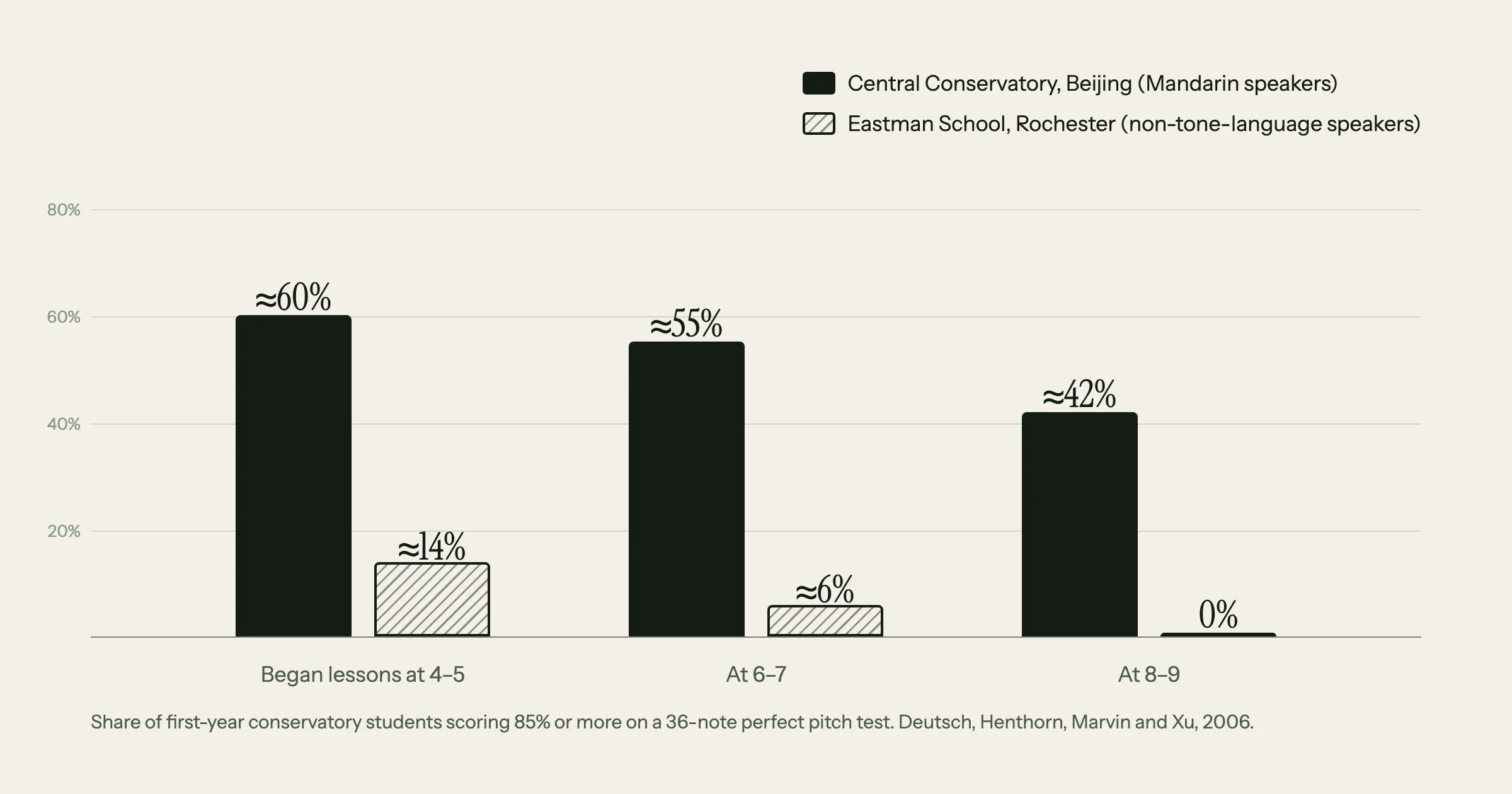
What has been measured is how much it depends on when, and where, you started music. In a study published in 2006, Diana Deutsch and colleagues tested first-year students taking a required course at two conservatories: 88 at the Central Conservatory of Music in Beijing, all Mandarin speakers, and 115 at the Eastman School of Music in Rochester, none of whom spoke a tone language. Everyone invited took the test. They heard 36 piano notes, each more than an octave from the last so relative pitch couldn't help, and wrote down the names.
Among students who began lessons at ages 4 to 5, about 60% in Beijing scored 85% or better, against about 14% at Eastman. Among those who began at 8 to 9, roughly 42% in Beijing passed and none at Eastman (Deutsch et al., 2006; figures). In Mandarin, pitch changes what a word means, and Deutsch's explanation is that infants who learn to tie pitches to meanings while learning to talk find it easier to tie pitches to note names later.
Can you learn perfect pitch as an adult?
Some adults can, but it's rare and slow. In the study below, two of six adults reached perfect-pitch accuracy after eight weeks of training, and most of the rest improved only modestly. For most of the last century the answer was a flat no: Takeuchi and Hulse summarized the evidence as an early-learning window "up to about age 6," after which people shift from hearing individual notes to hearing the relations between them.
The best case for yes is a 2019 study from the University of Chicago. Stephen Van Hedger, Shannon Heald and Howard Nusbaum trained six adults for eight weeks, about 32 hours in all. Two of them reached accuracy and speed matching people who'd had perfect pitch since childhood, and the best learner passed every test the team gave and still passed them four months later (Van Hedger, Heald and Nusbaum, 2019). The authors are frank about the rest: most participants "only exhibited modest improvements in performance," and all six were musically trained and had been picked for exceptional auditory memory.
So adult perfect pitch is possible for some people, with a lot of work. For a songwriter, it's a long road to a skill a free pitch detector can stand in for, which is where the next section comes in.
Do you already have some perfect pitch?
Probably. Perfect pitch has two parts: remembering what a note sounds like, and knowing its name. The research suggests the memory part is common and only the naming part is rare, which is why people who can't name a single note still sing familiar songs in the right key.
In 1994 Daniel Levitin asked 46 people to sing two popular songs they knew well, from memory, and compared their first notes with the original recordings. 40% sang the correct pitch on at least one of the two songs, 12% on both, and 44% came within two semitones on both. Musical background didn't seem to make a difference. Levitin's reading was that perfect pitch is two abilities: pitch memory, which is common, and pitch labeling, which is rare (Levitin, 1994).
Glenn Schellenberg and Sandra Trehub found the same thing in listening. College students heard five-second clips of instrumental TV theme songs, either at the original pitch or shifted up or down by one or two semitones, and picked out the originals. Students who heard unfamiliar recordings shifted the same way couldn't. Their conclusion was that adults' reportedly poor memory for pitch "is likely to be a by-product of their inability to name isolated pitches" (Schellenberg and Trehub, 2003). Takeuchi and Hulse found the mirror image: people with perfect pitch remember notes through their names and "do not have superior memory for pitches per se."
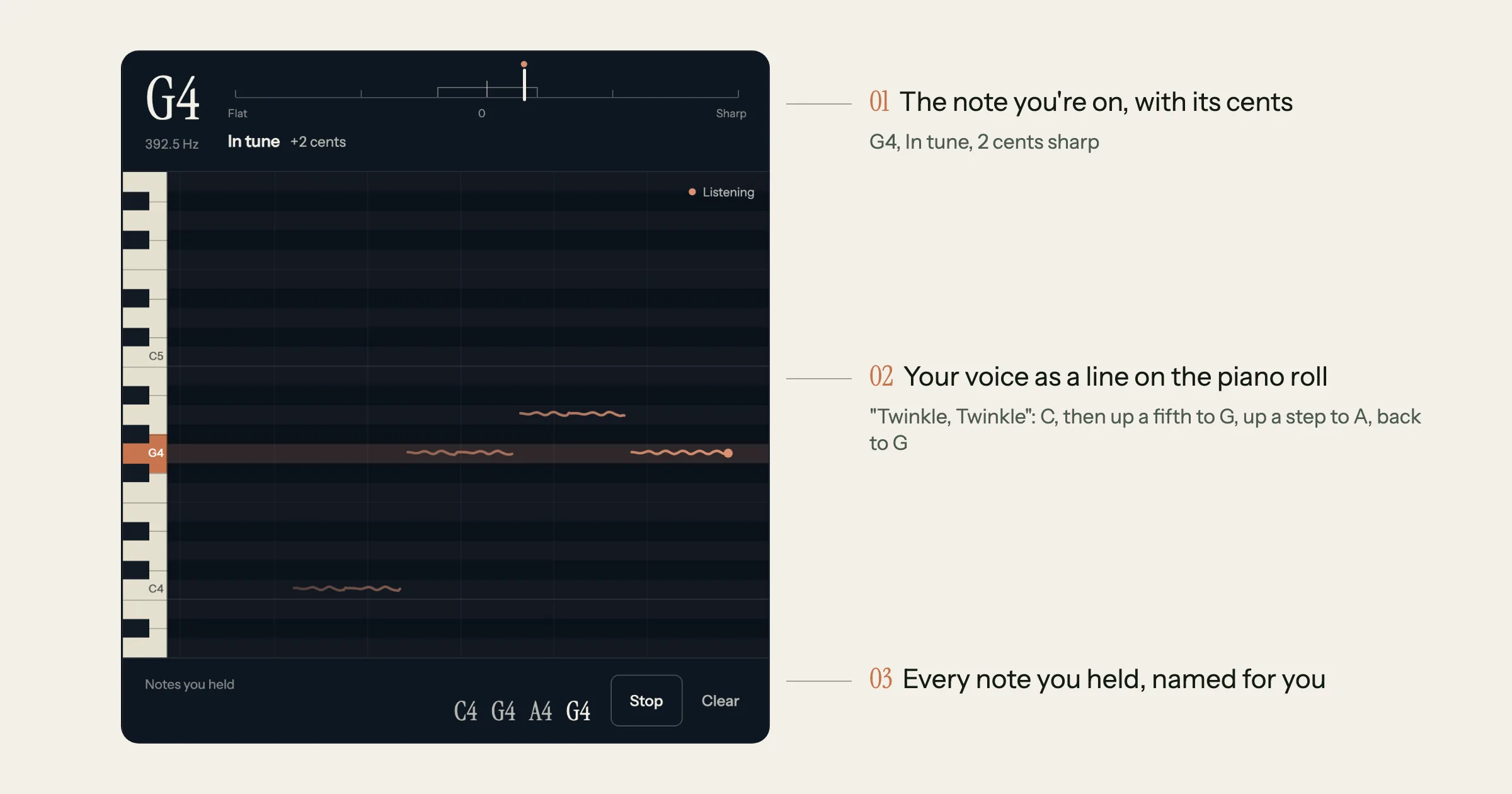
The scarce part, then, is the label. A pitch detector supplies labels: sing into it and it names the note you're on and how many cents sharp or flat you are.
How can you test yourself for perfect pitch?
Three checks, from strictest to easiest:
- Name notes you hear. Ask someone to play single piano notes in random order, each more than an octave from the one before, so you can't work one out from the last. That's how Deutsch's test was built, and her pass mark was 85% of 36 notes.
- Sing a note you name. Away from any instrument, pick a note, say A, and sing it into the pitch detector. Try a few different notes on a few different days. Landing on the named note again and again is the singing side of perfect pitch.
- Start a song you know. Sing the first note of a record you've heard many times, then play the record and check both notes on the detector. That's Levitin's test. It measures pitch memory, the common half, not naming.
What is relative pitch?
Relative pitch is the ability to hear how notes relate to each other: the size of the jump from one note to the next, and where each note sits in the key. It lets you recognize a tune in any key, sing a harmony part, or hear that a melody has come back to the note the song calls home.
It works on two levels. The first is intervals, the distance between two notes, counted in semitones or named: a major third is four semitones, a perfect fifth is seven. The second is scale degrees, the position of each note in the key, written as numbers from 1 to 7 or sung as do, re, mi. Intervals tell you a melody jumped up a fourth. Degrees tell you it jumped from 5 up to 1, home, which is why it sounds like an arrival. "Here Comes the Bride" opens with exactly that move.
Wikipedia's article on absolute pitch draws the line well: someone with perfect pitch can work an interval out by naming both notes, but relative pitch "identifies an interval directly by its sound." Most people already do the second without any training. What ear training adds is names for what they hear.
Why do songwriters need relative pitch more than perfect pitch?
A song is a set of relationships. Move it into another key so a different singer can reach it, and every note changes while nothing a listener cares about does. That move is routine (if a chorus strains at full volume, your song may be in the wrong key for your voice), and relative pitch is what tells you the song survived it. Writing a harmony line that stays right through the chords, picking out a melody on guitar, hearing that the chorus should start higher than the verse: each is a judgement about distance, and none needs a note name.
Perfect pitch can even get in the way. In a 1993 study titled "Absolute Pitch as an Inability," Ken'ichi Miyazaki had listeners name melodic intervals after a short cadence set up a key. Listeners without perfect pitch did equally well in C major, F♯ major and an out-of-tune E major. Some listeners with perfect pitch were slower and less accurate in F♯ and the out-of-tune key than in C, because they held on to note names in a task that needed relations (Miyazaki, 1993). Wikipedia lists a related problem: a musician with perfect pitch can hear a transposed piece as being "in the wrong key."
Perfect pitch does have real uses. Takeuchi and Hulse point to atonal music, where there's no home note to hear anything relative to. Most songs have a home note.
How do you develop relative pitch?
Treat it like learning vocabulary: tie a sound to a name, then use the names on real music. Learn intervals from songs you already know, then learn to hear notes as degrees of the key, and check your singing against a pitch display so you know whether you sang what you meant.
Learn intervals from songs you already know
The classic shortcut is a reference song for each interval: a tune that opens with that jump, so you can sing the opening and compare. These all go up:
| Interval | Semitones | Songs that open with it |
|---|---|---|
| Minor second | 1 | Theme from Jaws |
| Major second | 2 | "Happy Birthday" ("-py" to "Birth-"), "Frère Jacques" |
| Minor third | 3 | "Greensleeves," "Smoke on the Water" |
| Major third | 4 | "When the Saints Go Marching In," "Kumbaya" |
| Perfect fourth | 5 | "Here Comes the Bride," "Amazing Grace" |
| Tritone | 6 | "Maria" from West Side Story, The Simpsons theme |
| Perfect fifth | 7 | "Twinkle, Twinkle, Little Star" (first to second "twinkle"), the Star Wars theme |
| Minor sixth | 8 | "The Entertainer" (the leap after the pickup), "Nothing Compares 2 U" |
| Major sixth | 9 | "My Bonnie Lies over the Ocean," the NBC chimes |
| Minor seventh | 10 | The original Star Trek theme, "Somewhere" from West Side Story |
| Major seventh | 11 | "Take On Me" |
| Octave | 12 | "Over the Rainbow" |
Ascending intervals, from Wikipedia's list of reference songs. Going down: "Hey Jude" (minor third), "Summertime" (major third), The Flintstones theme (fifth).
Reference songs have a limit, and the same article notes it: each song teaches an interval between particular degrees of the key. "Here Comes the Bride" is 5 up to 1. Once a song has given you the sound, practise the same interval from other notes of the key so you don't need the song to hear it.
How do you hear notes as degrees of the key?
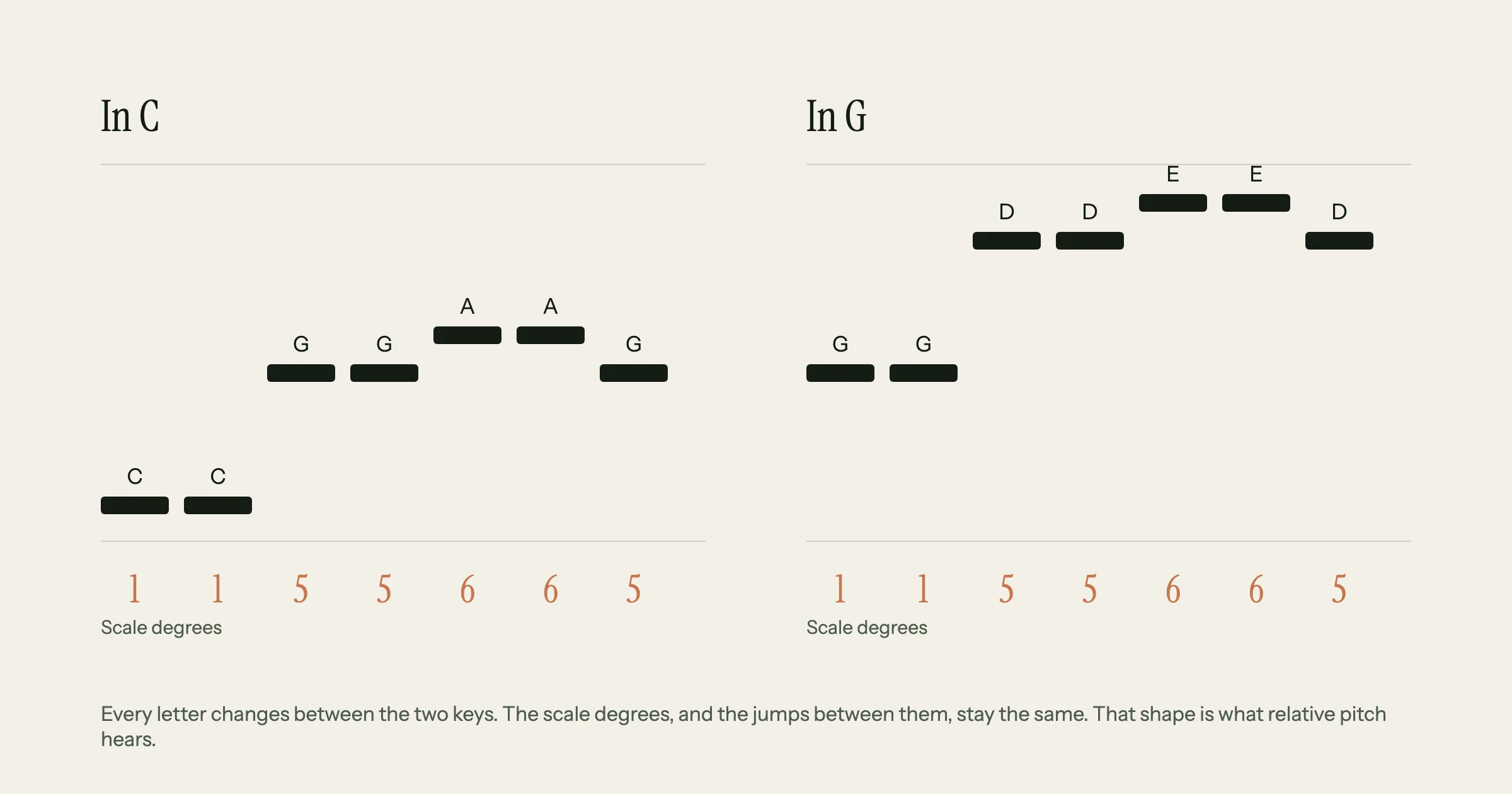
Intervals measure jumps; degrees tell you where you are. Pick a key, play or sing the home note, then sing 1, 3, 5 and back to 1 until the home note feels like a place. Then take a melody you know and find each note's number before you name any letter. "Twinkle, Twinkle, Little Star" goes 1 1 5 5 6 6 5 in every key. Once a melody is numbers, moving it to another key is arithmetic, and hearing a new melody as numbers is how you write one down.
Finding the home note of a song you didn't write is the same skill from the other side, and how to tell what key a song is in walks through it from the chords.
Why should you check your singing with a pitch display?
Ear training that stays in your head is guesswork, because you can't hear your own small errors while you sing. The tone deaf test plays a note, you sing it back, and it scores how close you got, in cents, over eight notes. The pitch detector shows the note you're singing and how far sharp or flat you are as you sing.
Use them for interval work. Play a note, sing a major third above it, and watch where the needle settles. If it settles a third of a semitone flat, you've learned that interval slightly small, which is worth finding out before you sing a harmony part on a recording. The vocal range test uses the same detector to find the lowest and highest notes you can sing, which tells you which keys give you room.
How do you practise writing down a melody?
Writing down a melody you hear is called melodic dictation. Start with tunes you could sing in your sleep. Pick any starting note, work out each next note by its distance from the last, then sing or play your answer back to check it. Tunes that move mostly by step, like "Mary Had a Little Lamb," are the easiest place to begin. Then do the same with your own voice memos, which is where it pays off.
Do you need perfect pitch to write songs?
No. Writing a melody needs you to hear whether a line goes where you want it to, which is relative pitch. Naming the notes so you can play them, share them or put chords under them is the part perfect pitch would cover, and a pitch detector or a songwriting app that reads your voice does that part for anyone.
If you can't name the notes you sing, the old fix was hunting for them on a guitar or piano, often losing the idea while you looked. Software has made that the easy half. The judgements that make a melody work are still yours: whether the leap into the chorus lands, whether the last note feels like home, whether the second verse should sit lower than the first. Each one is a call about how notes relate, which is the ear you've been training above.
Writing down a melody without perfect pitch
Song Cage is a songwriting app that keeps a song's melody, lyrics and chords together, and it does the naming half for you. Hold M and sing to put one note on a lyric syllable. Or record a whole take, press Detect melody, and the pitches come back as notes on a lane lined up with your chords and words. From there you can snap them to the key, fix any note, and play the recording and the notes back to back to hear whether they match (Writing Melody). Once a take is notes, Audio to MIDI: What to Fix and What to Keep covers what to clean up.
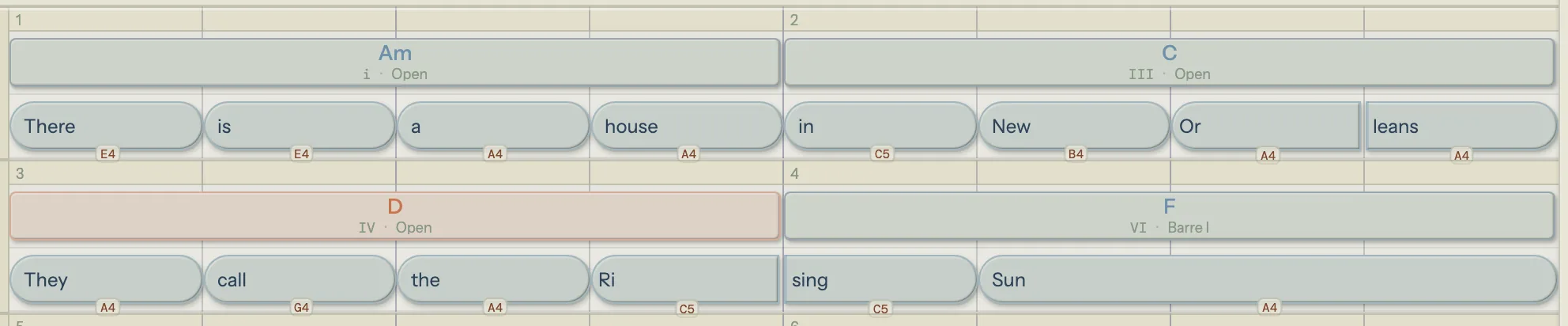
Then Song Cage suggests chords that fit the notes you sang, so you can hear the line against harmony while you decide whether it's right. The notes get their names without you knowing a single one, and your ear stays on the part that matters.
Sing the tune, get the notes
Song Cage writes down the melody you sing as notes under your lyrics, then suggests chords that fit it. You bring the ear; it brings the note names.
Frequently Asked Questions
Do singers need perfect pitch?
No. Singers need to land on the notes they hear and stay in tune with the band, which is pitch matching and relative pitch. Perfect pitch would let a singer start a song with no cue note, but a note from the piano or a pitch pipe does the same job. The tone deaf test is a quick check of the pitch-matching part.
Is being tone deaf the opposite of perfect pitch?
Roughly. True tone deafness, which researchers call congenital amusia, is a lifelong difficulty hearing differences between pitches, and a large online study put it at about 1.5% of people (Peretz and Vuvan, 2017). Far more people believe they're tone deaf than are: nearly 17% of over 2,000 first-year students at Queen's University said they were, and the researchers concluded that many who consider themselves tone deaf "may not, in fact, have perceptual difficulties" (Cuddy et al., 2005). The usual trouble is getting the voice onto a note the ear hears fine, and the tone deaf test tells the two apart.
Is a pitch detector the same as having perfect pitch?
It covers the naming part. A pitch detector tells you the note you just sang. Perfect pitch tells you the note before you sing it, in your head, and inside a chord. For writing down a melody you can already sing, the naming is the part you need.
Is relative pitch rare?
No. Most people hear music relatively, which is why they recognize a tune in any key. What's less common is naming what you hear: the interval, the degree of the key, the chord. That naming is what ear training adds, and it can be learned at any age.
Can a child learn perfect pitch?
The evidence points to early childhood. Takeuchi and Hulse described a window up to about age 6, and in Deutsch's conservatory study the earlier students had started lessons, the more of them had perfect pitch, in both countries. Starting early is no guarantee: about 14% of the Eastman students who began lessons at 4 or 5 passed her test.