Play a C chord, then a D major chord, then go back to C. That D shouldn't be there. The key of C has an F, and its chord on the 2nd degree is D minor. A D major chord brings in F♯. If the D moves on to G, nobody notices anything odd: it's the V of V, a chord that points at G. But if the D goes straight back to C, the song has slipped into the Lydian mode. It's the sound of the verse of R.E.M.'s "Man on the Moon," and of the G-to-A rocking under the sung sections of Led Zeppelin's "Over the Hills and Far Away."
Lydian is the brightest of the seven modes and one of the least used in pop. In Song Cage's count of 436 major-key songs from the Billboard Hot 100, 134 used a major II chord at least once. Most of those used it to lead to V. Only 28 ever sent it straight home. Below: the notes, the chords, the songs, what those hits did with the chord, and how to write in Lydian without the song sliding into a different key.
Quick Summary
The Lydian mode is a major scale with a raised 4th: 1, 2, 3, ♯4, 5, 6, 7. F Lydian is the white keys from F to F. The ♯4 turns the minor ii chord into a major II (D in C), and that chord carries the sound. In Song Cage's count of major-key Hot 100 songs from 1958 to 1991, the major II most often led to V, the classical job of a secondary dominant. Used the Lydian way, going back to I, it was rare, though two songs repeated the move dozens of times.
What is the Lydian mode?
The Lydian mode is a seven-note major scale with a raised 4th. Its formula is 1, 2, 3, ♯4, 5, 6, 7, and its step pattern is whole, whole, whole, half, whole, whole, half. On a piano it's the white keys from F to F. It sounds like major, only brighter and less settled.
Compare it with the major scale on the same root. C major is C, D, E, F, G, A, B. C Lydian is C, D, E, F♯, G, A, B. One note moves, the 4th, up a half step from F to F♯. That's the whole difference, and it's why plenty of players just call the mode "major with a sharp 4."
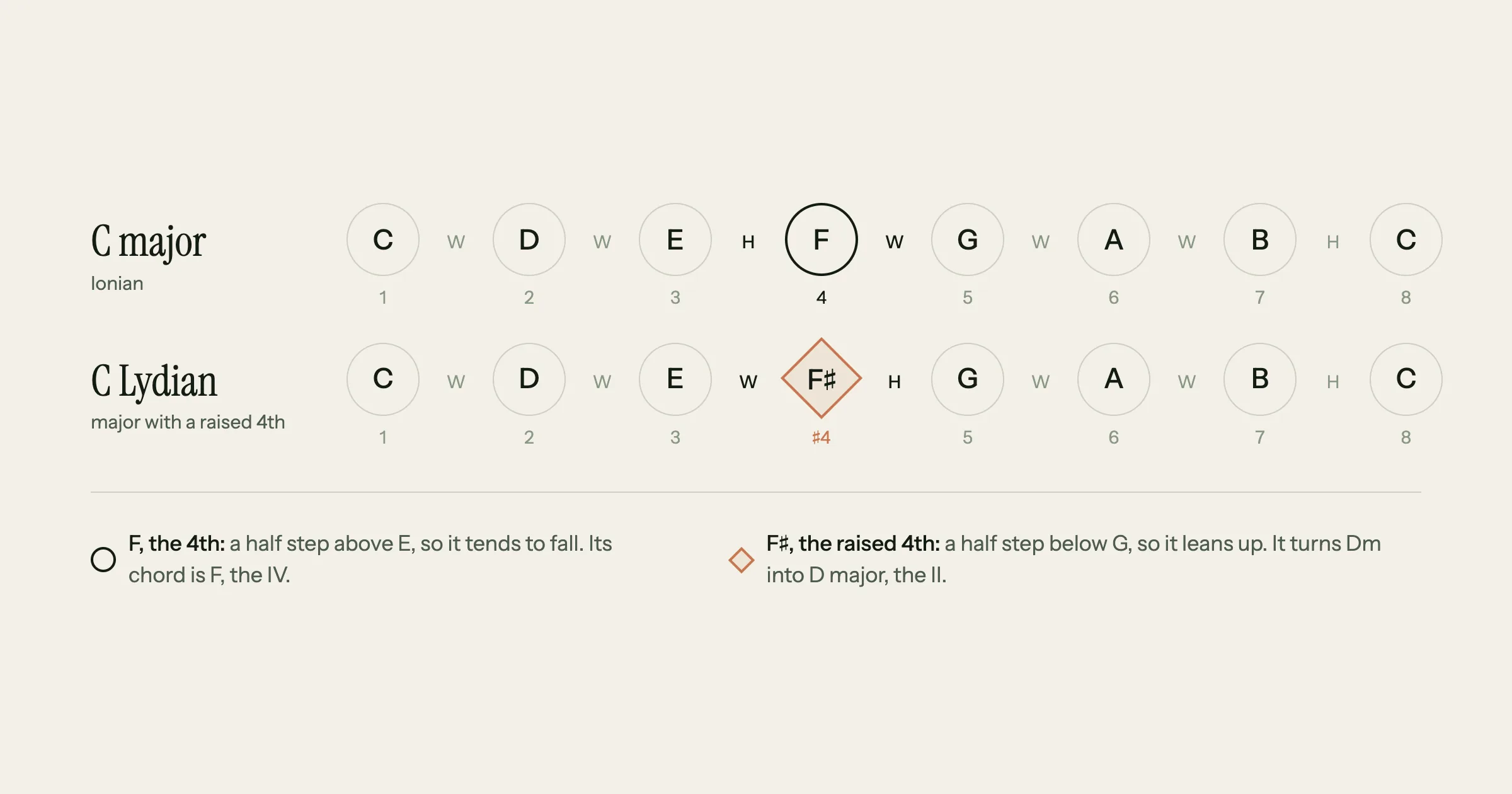
There are two ways to find it, and both give the same scale. The first is to take a major scale and raise its 4th. The second is to play a major scale starting on its 4th note: F Lydian uses the notes of C major, C Lydian uses the notes of G major. That's why C Lydian has G major's key signature, one sharp, even though its home chord is C.
The raised 4th sits a tritone above the home note. Wikipedia's article on the Lydian mode points out that Lydian and Locrian are the only modes with a tritone above the tonic. In our guide to musical modes, Lydian sits at the bright end, one step brighter than the major scale, which is in turn one step brighter than Mixolydian and two brighter than Dorian.
What does the Lydian scale sound like?
The 4th of a major scale is the note that likes to fall. In C major, F sits a half step above E and tends to drop onto it. Raise it to F♯ and the pull flips: F♯ sits a half step below G and leans up toward it, like a second leading tone. Over the home chord, F♯ is the ♯11 of a Cmaj7♯11, the chord jazz players often call the Lydian chord. The result is major with the floor taken out: bright, open, a little unresolved.
Joe Satriani's "Flying in a Blue Dream" (1989) is the textbook case. Hooktheory's transcription of the intro is in C Lydian, with C as its most-used chord, and Wikipedia's page on the song says it strongly features the C Lydian mode. That's the setting the raised 4th needs: F♯ heard against a C chord, the only place it sounds Lydian. Over a D chord, the same F♯ is just the chord's 3rd, and nobody hears anything unusual.
How do you find any Lydian scale?
Take the major scale a fifth above your home note and play it from your home note. C Lydian uses G major's notes, D Lydian uses A major's, F Lydian uses C major's. Or take the major scale on your home note and raise the 4th a half step.
Here are the Lydian scales songwriters reach for most, with the parent major scale and the note that makes each one Lydian:
| Lydian scale | Notes | Same notes as | Raised 4th (major has) |
|---|---|---|---|
| C Lydian | C D E F♯ G A B | G major | F♯ (F) |
| D Lydian | D E F♯ G♯ A B C♯ | A major | G♯ (G) |
| E Lydian | E F♯ G♯ A♯ B C♯ D♯ | B major | A♯ (A) |
| F Lydian | F G A B C D E | C major | B (B♭) |
| G Lydian | G A B C♯ D E F♯ | D major | C♯ (C) |
| A Lydian | A B C♯ D♯ E F♯ G♯ | E major | D♯ (D) |
| B♭ Lydian | B♭ C D E F G A | F major | E (E♭) |
Each Lydian scale shares its notes with the major scale a fifth above. The last column is the note that separates it from the major scale on the same root.
How do you play the Lydian mode on guitar and piano?
On piano, start with F Lydian: every white key from F to F, no black keys. The B natural is the raised 4th, since F major has B♭. For any other root, play the major scale a fifth up but treat your root as home, or play the major scale on your root and raise the 4th.
On guitar, take a major scale shape you already know and move every 4th up one fret. In G, that means every C becomes C♯: the 3rd fret of the A string moves to the 4th, and the 1st fret of the B string moves to the 2nd. Then play it over a G chord that doesn't move, or over G and A traded back and forth. The C♯ is the note to lean on, and the place to land it is over the G chord, a tritone above the root. A quick test: if your line sounds like an ordinary major-key melody, you're probably skipping the 4th, or you've only been playing C♯ over the A chord, where it's a plain chord tone.
What chords are in the Lydian mode?
Building a chord on each note of Lydian gives I, II, iii, ♯iv°, V, vi and vii. In C Lydian that's C, D, Em, F♯°, G, Am and Bm. Three of them hold the raised 4th: II, ♯iv° and vii. The major II does the most work, because the ♯4 is its 3rd, the note that makes a chord major.
| Degree | Triad | In C Lydian | In G Lydian | As a 7th chord (C) |
|---|---|---|---|---|
| I | major | C | G | Cmaj7 |
| II | major | D | A | D7 |
| iii | minor | Em | Bm | Em7 |
| ♯iv° | diminished | F♯° | C♯° | F♯m7♭5 |
| V | major | G | D | Gmaj7 |
| vi | minor | Am | Em | Am7 |
| vii | minor | Bm | F♯m | Bm7 |
As triads, the II, ♯iv° and vii chords contain the raised 4th (F♯ in C Lydian, C♯ in G Lydian) and the other four are shared with the major scale. As 7th chords, the V becomes a major 7th (Gmaj7), which holds the F♯ too.
Two details matter when you write. First, the V chord loses its bite. In C major, G7 holds F, and the F-to-E fall is half of what pulls G7 home to C. In Lydian that F is gone, the V's 7th chord is Gmaj7, and the pull home weakens. Second, the mode's own dominant 7th chord is D7, and D7 points at G. Lydian carries a built-in signpost toward the key a fifth above, and that's the trap most Lydian songs have to get around.
What is a Lydian chord progression?
Open Music Theory names two Lydian patterns in pop, both built on the major II, which it writes II♯:
- I–II, the Lydian shuttle. Two major chords a whole step apart, rocking back and forth. The verse of "Man on the Moon" trades C and D. Led Zeppelin's "Over the Hills and Far Away" trades G and A through its sung sections, which McGill's transcribers label as verses and Hooktheory files in G Lydian as its pre-chorus and chorus. Otis Redding's "(Sittin' On) The Dock of the Bay" uses the II–I half as a turnaround: G, B, C, A, and the A drops straight back to G at the top of the next line.
- II–IV–I, the Lydian cadence. The major II goes to IV, then home: D, F, C in C. The F cancels the F♯ right away, a half step down, which makes the voice leading smooth. Open Music Theory says CeeLo Green's "Forget You" may be the clearest example; the song loops C, D, F, C. The Beatles got there in 1964 with "Eight Days a Week": D, E, G, D.
What these patterns don't do is send the II to V. That's the whole trick, and the Billboard count below shows how rarely hit songs pulled it off.
What songs are in Lydian mode?
Well-known songs in Lydian, or built on its I–II move, include "Flying in a Blue Dream," the verse of "Man on the Moon," "Over the Hills and Far Away," "Eight Days a Week," "The Dock of the Bay" and "Forget You." Each sits on a major home chord and uses the raised 4th, usually through a major II chord.
| Song | Artist, year | Chords | Where the raised 4th is |
|---|---|---|---|
| "Eight Days a Week" | The Beatles, 1964 | D–E–G–D | G♯ in the E chord |
| "(Sittin' On) The Dock of the Bay" | Otis Redding, 1968 | G–B–C–A, back to G | C♯ in the A chord |
| "Over the Hills and Far Away" | Led Zeppelin, 1973 | G–A (sung sections) | C♯ in the A chord |
| "Flying in a Blue Dream" | Joe Satriani, 1989 | C Lydian (main theme) | F♯, featured in the tune |
| "Man on the Moon" | R.E.M., 1992 | C–D (verse) | F♯ in the D chord |
| "Waltz #1" | Elliott Smith, 1998 | D♭ Lydian | G natural, where D♭ major has G♭ |
| "Forget You" | CeeLo Green, 2010 | C–D–F–C (chorus) | F♯ in the D chord, cancelled by the F |
Years are first release. Chords are in the key of the recording.
Sources: Flying in a Blue Dream, Man on the Moon, Over the Hills and Far Away, Forget You (key) and Open Music Theory (the Lydian cadence), Eight Days a Week, and Wikipedia's Lydian article for "Waltz #1." The chords for "Eight Days a Week," "The Dock of the Bay" and "Over the Hills and Far Away" are read from the McGill Billboard transcriptions described below.
Classical music has a famous one too. Beethoven titled the slow movement of his String Quartet No. 15, Op. 132 (1825), "Holy Song of Thanksgiving by a Convalescent to the Divinity, in the Lydian Mode," and its passages in F use the raised 4th, B natural, throughout.
Is The Simpsons theme in Lydian?
Close, but no. The Simpsons theme is the example people reach for most, and it's one note off. Wikipedia's page on the theme, which Danny Elfman wrote in 1989, says it's in the Lydian dominant scale, also called the acoustic scale: a raised 4th and a flat 7th. In C that's C, D, E, F♯, G, A, B♭. The composer and educator Elissa Milne explains why it fools people: the raised 4th is the note the melody keeps featuring, while the flat 7th only shows up as the theme wraps up.
The difference matters when you write. Plain Lydian keeps the major 7th, so its home chord is Cmaj7 and it sounds like floating. Lydian dominant puts a C7 at home, and the flat 7th makes it brassier and more mischievous, which suits a cartoon. Both share the F♯. If your tune leans on the raised 4th and you can't decide which 7th to use, sing the 7th over the home chord and listen. B sounds dreamy; B♭ sounds like Springfield.
Why do people disagree about which songs are Lydian?
Because two major chords a whole step apart can belong to three different keys. C to D is I–II in C Lydian, IV–V in G major, or ♭VII–I in D Mixolydian. Which one you hear depends on where the music rests. Open Music Theory's warning case is Taylor Swift's "Starlight": its verses trade A and B, which looks like a Lydian shuttle, but the chorus shows the two chords were IV and V in E major all along.
"Man on the Moon" shows both sides in one song. Hooktheory files the verse in C Lydian and the chorus in G major, the key that shares Lydian's notes. The verse rests on C, so the D sounds like a bright II. The chorus rests on G, and the same notes become an ordinary major key. Fleetwood Mac's "Dreams" gets miscalled F Lydian for the same reason; our modes guide explains why its melody points to A minor instead. The test is the one in our guide to telling what key a song is in: find the chord that feels like rest, then check the color note against it.
Analysts don't always reach for the Lydian label even when the move is there. Alan W. Pollack's notes on "Eight Days a Week" list its E chord as V-of-V, though in the verse it goes to G, not A. What he hears instead is a "false relation": the G♯ in the E chord contradicted by the G natural in the next chord. That clash is the Lydian cadence's half step, described from the other side.
How do hit songs actually use the Lydian chord?
Mostly not the Lydian way. In Song Cage's count of 436 major-key Hot 100 songs from 1958 to 1991, 134 used a major II chord. 93 of those sent it on to V at least once, a secondary dominant's job. Only 28 ever sent it straight home to I, and just 15 did that without also sending it to V.
We read every major-key song in the McGill Billboard dataset, found every major chord on the 2nd degree (D, D7 or D over another bass note, in C), and recorded the next chord each time the song left it:
| Next chord after a major II | In C | Moves (of 741) | Share |
|---|---|---|---|
| V (secondary dominant) | G | 322 | 43.5% |
| I (Lydian shuttle) | C | 184 | 24.8% |
| IV (Lydian cadence) | F | 93 | 12.6% |
| Anything else | 142 | 19.2% |
Song Cage's count of 134 major-key songs with a major II chord, from the McGill Billboard dataset. A V chord counts whatever its type (G, G7, Gsus4). Repeated lines are counted as many times as the transcription marks them.
A quarter of moves going home looks like a lot, until you see who made them. Two songs account for 95 of the 184. "Over the Hills and Far Away" goes from A back to G 37 times. Michael Jackson's "Wanna Be Startin' Somethin'" goes from E back to D 58 times, because McGill's transcribers hear its vamp in D; Hooktheory puts it in E Mixolydian, which makes the same two chords ♭VII and I. Leave those two out and the major II went to V 50.1% of the time and home to I just 13.8%.
That's the shape of Lydian in pop: rare, but committed. A song that wants the sound builds a vamp on it and repeats it. A song that doesn't uses the chord once on the way to V.
Does the dominant 7th change where the II goes?
Yes. In Song Cage's count of the McGill Billboard sample, when the transcription spelled the II as a dominant 7th (D7 in C), the song sent it to V in 60 of 86 songs, 70%. With any other spelling (a plain triad, an added note, or a triad over another bass note), the share fell to 38 of 68 songs, 56%. A song that used both spellings counts in both groups. Counted move by move, the gap is wider: 57.5% of dominant-7th moves went to V, against 31.0% for everything else. The 7th adds C, the note that makes D7 the dominant of G, so a D7 points harder at G than a plain D does. If you want the II to stay Lydian, leave the 7th off.
Did the major II get less common?
Yes. In Song Cage's count of the McGill Billboard sample, split by the date each song charted, the share of major-key Hot 100 songs using a major II fell from 37.6% in 1958 to 1969 (67 of 178) to 29.7% in the 1970s (47 of 158) and 20.0% in 1980 to 1991 (20 of 100).
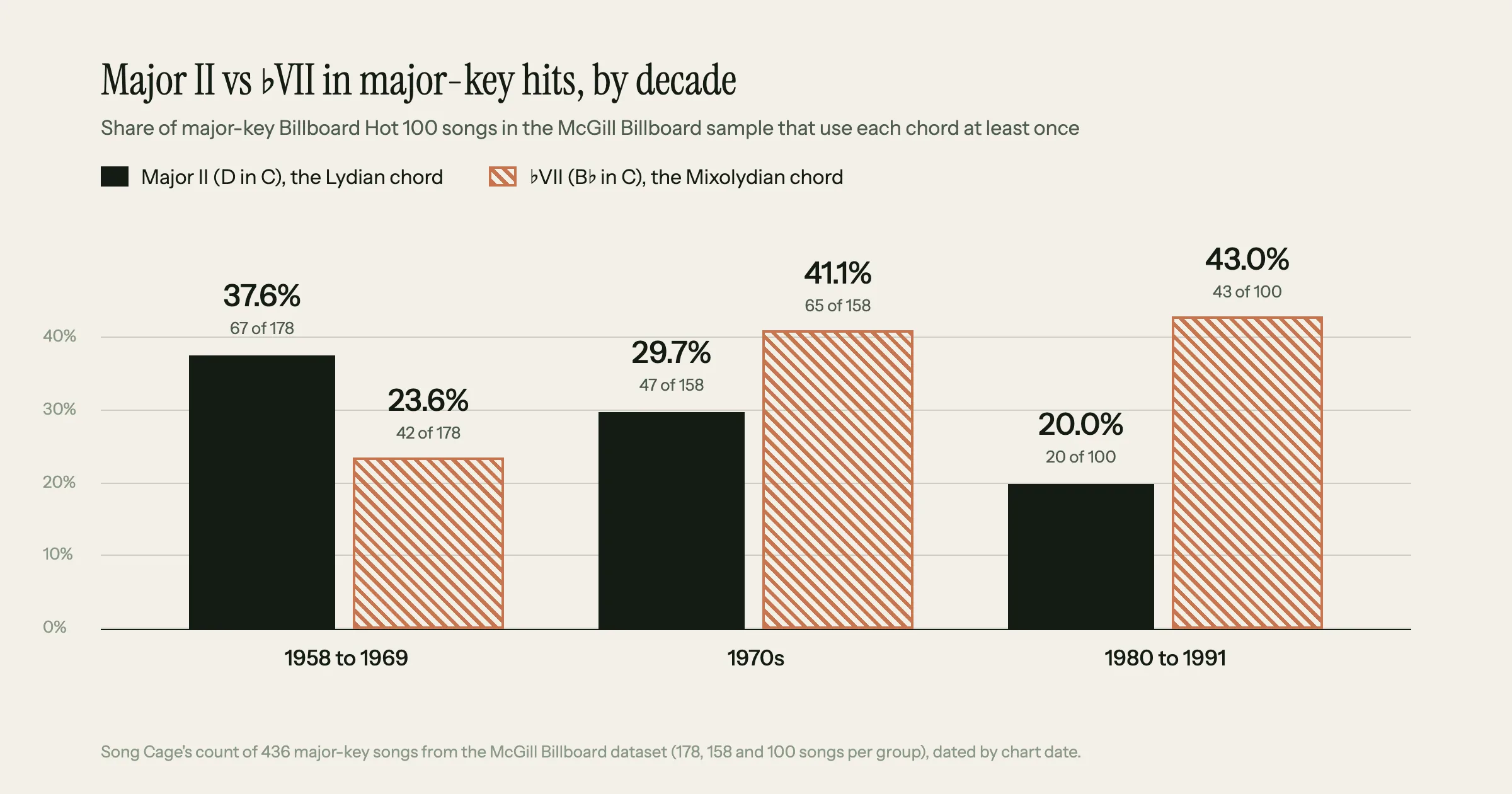
Over the same years, the Mixolydian ♭VII went the other way, from 23.6% of the same songs to 43.0%. By the 1970s, ♭VII had pulled ahead. In the early sample, the major II, usually working as the V of V (50 of the 67 songs sent it to V), turned up in more major-key songs than ♭VII did. By the 1980s the order had flipped, by more than two to one. The dataset samples songs from across the chart, so these are shares of a sample rather than every hit, and the last group is the smallest. The count shows that it happened, not why.
How we counted
The McGill Billboard dataset is a set of expert chord transcriptions of songs sampled from across the Billboard Hot 100 between 1958 and 1991, described by Burgoyne, Wild and Fujinaga at ISMIR 2011. We used the same rule as our Mixolydian count: a song is major-key when its most-played chord is a major chord on the tonic the annotators marked, tracking key changes line by line. Songs the dataset sampled twice were counted once (736 distinct songs), and 436 of them qualified. A song uses a major II if any chord on the 2nd degree has a major third and a perfect fifth, including II7 and II over another bass note. A move is the next chord with a different root or quality; 32 of the 741 are the II turning minor on the same root (D to Dm7), counted under "anything else." Each song was dated by the chart date in the dataset's index.
A move into a chord without a full triad (a suspended chord, a power chord) counts by its root, so a II followed by Gsus4 counts as II to V. The count follows the annotators' tonic, so a song whose home is debatable counts in the key they marked.
How do you write a song in Lydian mode?
Set up a major home chord, bring in the major II early, and send it back to I instead of on to V. Leave the 7th off the II. Put the raised 4th into the melody over the I chord. Avoid resting on V, which pulls the song into the major key a fifth up (G major for C Lydian).
Rock between I and II, and keep I on the downbeat
The shuttle sets the mode in two bars. Play C for a bar and D for a bar, and start every phrase on C. That's the "Man on the Moon" verse, and it's enough. To make it stronger, hold the bass on C under the D (D/C). Over a held bass note, the II never quite becomes its own chord. It sounds like the home chord with the raised 4th lifted into it.
Send II home, or to IV, but not to V
Our count says the major II's habit is to go to V, and that's the move to avoid. D to G makes D the V of V and G a new home. Go from D back to C, or use the Lydian cadence, D to F to C. Gary Ewer of The Essential Secrets of Songwriting describes the pull exactly: after C and D, you feel tempted to play G, and then the music just sounds like G major. The secondary dominants guide covers what D does when it does go to G.
Put the raised 4th in the melody, over the I chord
The chords can suggest Lydian, but the melody decides it. Sing F♯ while the C chord sounds and let it rise to G or hang there. Over the D chord the same F♯ is just the chord's 3rd and blends in. Over C it's the ♯11, the note that makes the mode audible. A good test is to strip the harmony back to a held C: if the line still sounds Lydian, the melody is doing the work.
Watch the V chord
In C Lydian, the V chord is G, and resting on G turns the scale into G major, because it's the same set of notes. You don't have to ban G, but don't end phrases on it, and don't let D lead into it. If you need a dominant, try Gmaj7, which keeps the F♯, or skip V and cadence D–C or D–F–C.
Use Lydian for one section
Open Music Theory notes that very few pop songs stay in Lydian all the way through, and that many major-key songs use the major II for a brief Lydian flavor. "Man on the Moon" is the model: a Lydian verse, then a chorus that settles on G, the key that shares its notes. Open Music Theory's own example, "Sara" by Fleetwood Mac (1979), opens on a Lydian shuttle with a held tonic bass, then neutralizes the II later. Write a verse that rocks between I and II, then let the chorus settle into plain major, and the section changes color without a key change.
How is Lydian different from major and Mixolydian?
All three are major modes with a major 3rd. Lydian raises the 4th; the major scale leaves every note alone; Mixolydian lowers the 7th. Each change creates a signature chord: the major II in Lydian, the major V with its leading tone in major, and the ♭VII in Mixolydian.
| Scale | Notes in C | 4th | 7th | Signature chord |
|---|---|---|---|---|
| Lydian | C D E F♯ G A B | ♯4 (F♯) | 7 (B) | II (D major) |
| Lydian dominant | C D E F♯ G A B♭ | ♯4 (F♯) | ♭7 (B♭) | C7 at home, with D major |
| Major (Ionian) | C D E F G A B | 4 (F) | 7 (B) | V (G major) with a leading tone |
| Mixolydian | C D E F G A B♭ | 4 (F) | ♭7 (B♭) | ♭VII (B♭ major) |
Four major scales on C. Lydian, major and Mixolydian each differ from the next by one note. Lydian dominant takes the raised 4th from Lydian and the flat 7th from Mixolydian.
The major scale sits in the middle, and its 4th and 7th are the two notes that do the most work. The 4th falls to the 3rd and the 7th rises to the root, which is what makes V7 to I such a strong cadence. Lydian sharpens the 4th, so it no longer falls. Mixolydian flattens the 7th, so it no longer rises. Each mode removes half of that cadence, from opposite ends, and each one sounds less settled than major for that reason. Lydian loses the falling half, which is why it sounds lifted. Mixolydian loses the rising half, which is why it sounds relaxed.
Where does the name Lydian come from?
The name comes from Lydia, an ancient kingdom in Anatolia, and the ancient scale was a different one. According to Wikipedia, the Greek Lydian scale, in its diatonic form, matched the modern Ionian mode: the major scale.
Medieval chant theorists borrowed the Greek names for their eight church modes. The fifth mode, the Lydian, had its final on F, and in theory it used B natural, the raised 4th. In practice, Wikipedia notes, many theorists of the period observed that B♭ was used more often, which turned the mode into plain F major and removed the tritone between F and B.
Two later uses kept the name alive. Beethoven's Op. 132 quartet movement labels itself "in the Lydian mode." And in 1953 the jazz composer George Russell published the Lydian Chromatic Concept of Tonal Organization, which argued that the Lydian mode, not the major scale, is the natural center of tonal gravity. Wikipedia credits Bill Evans and Miles Davis with using the theory to record modal jazz such as Kind of Blue.
How do you write in Lydian in Song Cage?
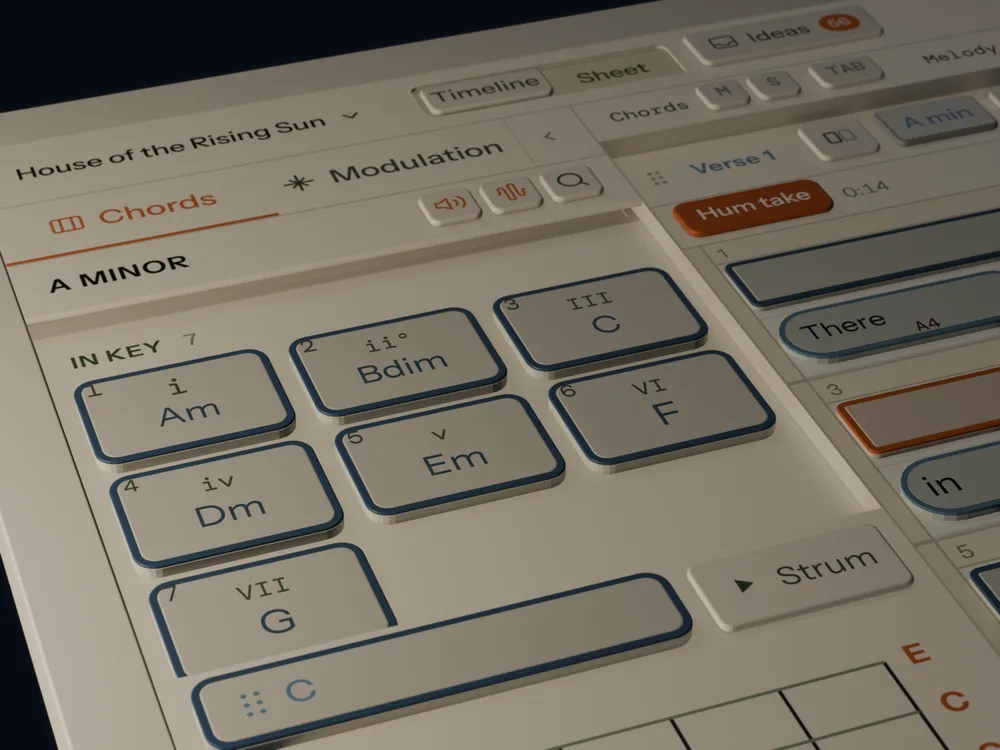
Song Cage keys are major or minor, so set the song to the major key of your home note, C major for C Lydian. The Lydian chords are then one tab away. The Borrowed tab of the chord palette lists the chords a major key borrows from its parallel modes, and in C major that includes D (II), F♯dim (♯iv°) and Bm (vii), each with a small lydian label. The same root shows up a second time on the Secondary Dominants tab, as D7 labeled V/V7, with an arrow to V (G). That's the split from the Billboard count, as two chips: one to stay home, one to leave.
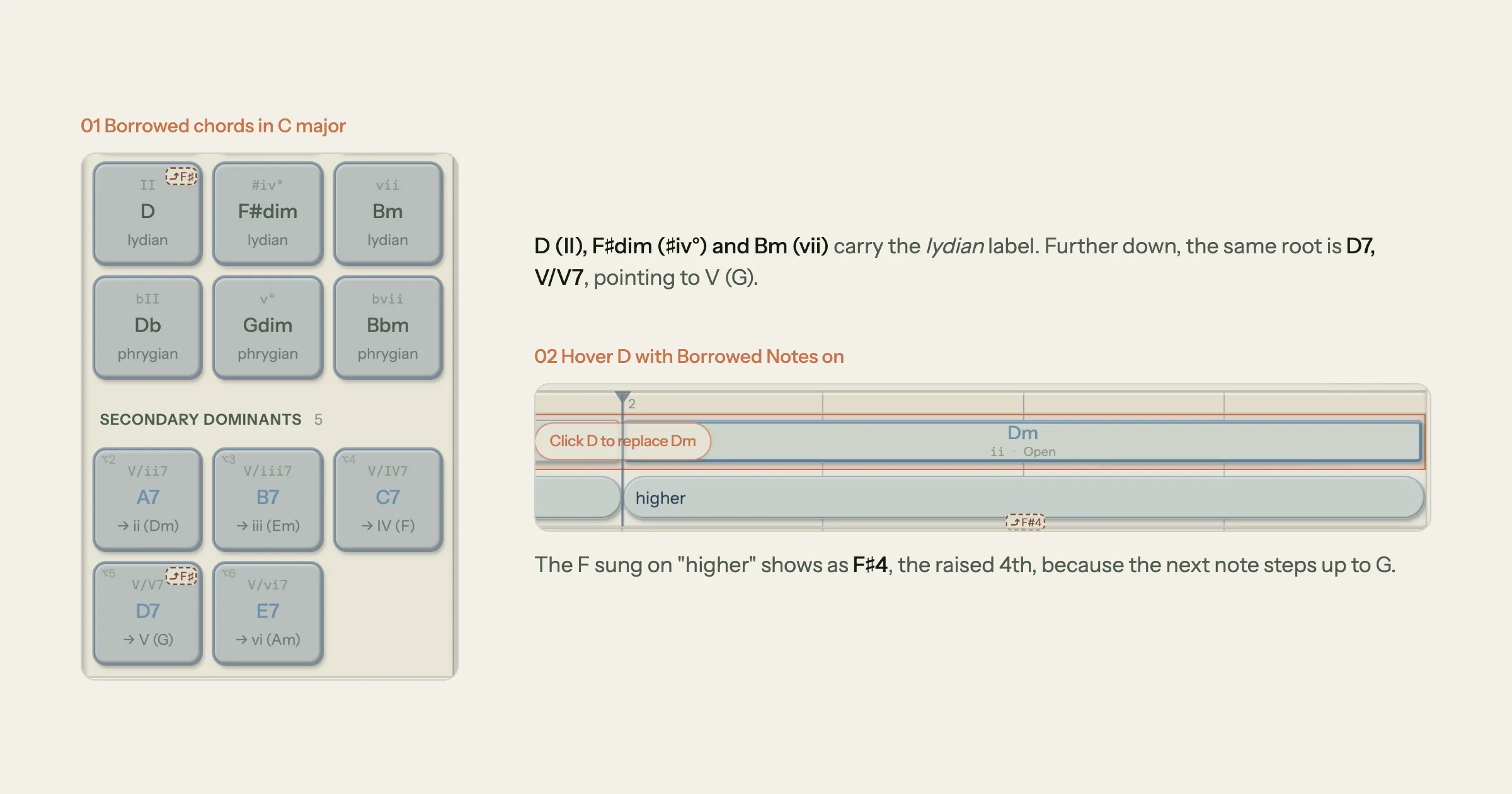
If you hum or play the melody in first, Fits Melody ranks chords against the notes you sang, borrowed ones included, so a melody that already sings F♯ can bring up D as a fit. The reverse case is covered too. Switch on Borrowed Notes (Settings, under Input) and try D under a melody that sings F and then steps up to G: the chip shows a tag with F♯ before you click, and trying it raises that one note a half step, so it leans into the G. A raised note has to step up like that, or be held at the end of a phrase. Keep it and the chord and the moved note go in as one undo. The Borrowed Notes docs list the rules.
Frequently Asked Questions
Is the Lydian mode major or minor?
Major. Its 3rd is major, so the chord on its home note is a major chord. What sets it apart from the major scale is the raised 4th, which turns the minor ii chord into a major II and the IV chord into a diminished ♯iv°.
What is the difference between Lydian and major?
One note. The major scale has a natural 4th and Lydian has a ♯4. In C, that's F against F♯. The change turns Dm into D, F into F♯° and B° into Bm.
What is F Lydian?
The Lydian mode starting on F: F, G, A, B, C, D, E. It's every white key on the piano from F to F, the same notes as C major with F treated as home. Its raised 4th is B, where F major has B♭.
What key signature does C Lydian use?
One sharp, F♯, the key signature of G major, because C Lydian uses the notes of G major starting on C. Some charts use C major's empty key signature instead and mark each F♯ as an accidental.
Why does Lydian sound dreamy?
Because its 4th leans up instead of down. In major, the 4th falls to the 3rd. In Lydian, the raised 4th sits a half step under the 5th and pulls upward, a tritone above the home note, so the scale sounds bright but unsettled.
What is the most famous song in Lydian?
Joe Satriani's "Flying in a Blue Dream" is the standard example of a Lydian piece: Wikipedia says the track strongly features the C Lydian mode, and Hooktheory files its intro in C Lydian. In pop, the verse of R.E.M.'s "Man on the Moon" is a clear example, and Led Zeppelin's "Over the Hills and Far Away" rocks between I and II through its sung sections. The Simpsons theme is often named too, but it's in Lydian dominant, with a flat 7th.
Capture the tune before it's gone
Song Cage keeps your melody, chords and words together in one place. Sing the tune in, set the key, and reach the major II from the Borrowed tab while the idea is still fresh.