Table of Contents
- What is the Mixolydian mode?
- What does the Mixolydian scale sound like?
- How do you find any Mixolydian scale?
- How do you play the Mixolydian mode on guitar and piano?
- What chords are in the Mixolydian mode?
- What is a Mixolydian chord progression?
- What songs are in Mixolydian mode?
- Why do people disagree about which songs are Mixolydian?
- How do hit songs actually use Mixolydian?
- Did the ♭VII get more common?
- Do hit songs stay in Mixolydian the whole way through?
- How do you write a song in Mixolydian mode?
- Put ♭VII next to I, early
- Send ♭VII to IV, then home
- Put the flat 7th in the melody
- Keep V out, or make it a moment
- Use Mixolydian for one section
- How is Mixolydian different from major and Dorian?
- Where does the name Mixolydian come from?
- How do you write in Mixolydian in Song Cage?
- Frequently Asked Questions
Play an A major chord, then a G, then a D, and come back to A. That G shouldn't be there. The key of A major has a G♯, and its chord on the 7th degree is G♯ diminished. Yet the move sounds like rock and roll rather than a mistake, and you've heard it in the four-minute coda of "Hey Jude," in "Sweet Home Alabama" and in Lorde's "Royals." That G natural is the Mixolydian mode.
Most guides teach Mixolydian as a scale for soloing over a dominant 7th chord. Songwriters mostly meet it as one chord: the major ♭VII a whole step below home. In our own count of 436 major-key songs from the Billboard Hot 100, that chord showed up in a third of them, and its share grew from about one song in four in the 1960s to more than two in five by the 1980s. Below: the notes, the chords, the songs, what those hits show, and how to write in the mode without it turning back into an ordinary major key.
Quick Summary
The Mixolydian mode is a major scale with a lowered 7th: 1, 2, 3, 4, 5, 6, ♭7. G Mixolydian is the white keys from G to G. The ♭7 gives the mode a major chord a whole step below home, the ♭VII (G in A, F in G), and takes away the leading tone that pulls a major key home. In Song Cage's count of major-key Hot 100 songs from 1958 to 1991, most songs that used ♭VII also used the ordinary V chord, so Mixolydian usually works as a color inside major.
What is the Mixolydian mode?
The Mixolydian mode is a seven-note major scale with a lowered 7th. Its formula is 1, 2, 3, 4, 5, 6, ♭7, and its step pattern is whole, whole, half, whole, whole, half, whole. On a piano it's the white keys from G to G. It sounds major, but looser and less resolved than the major scale.
Compare it with the major scale on the same root. A major is A, B, C♯, D, E, F♯, G♯. A Mixolydian is A, B, C♯, D, E, F♯, G. One note moves, the 7th, down a half step from G♯ to G. Everything that makes Mixolydian sound like Mixolydian comes from that note, so plenty of players just call it "major with a flat 7."
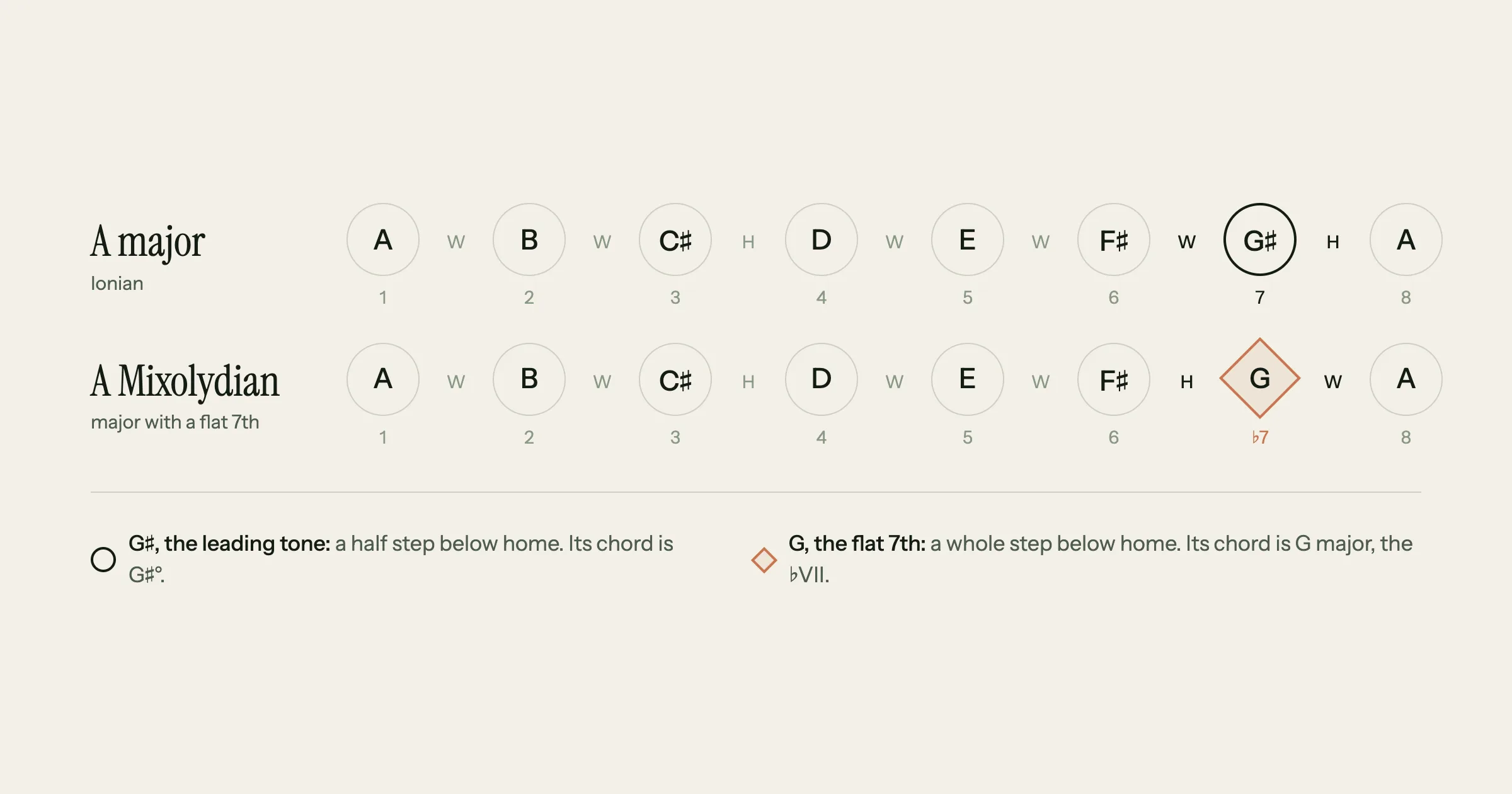
There are two ways to find it, and both give the same scale. The first is to take a major scale and lower its 7th. The second is to play a major scale starting on its 5th note: G Mixolydian uses the notes of C major, A Mixolydian uses the notes of D major. That's why A Mixolydian has the key signature of D major (two sharps), even though its home chord is A.
Because it starts on the 5th degree, the dominant, Mixolydian is sometimes called the dominant scale, according to Wikipedia's summary. In our guide to musical modes, it sits one step darker than Ionian (the major scale) and one step brighter than Dorian.
What does the Mixolydian scale sound like?
The 7th is the note a melody passes on its way back up to the tonic. In the major scale that note is a half step below home, the leading tone, and it pulls upward hard. In Mixolydian it's a whole step below, so the melody can sit on it, or step down from it, without the pull. The result is major at the root and relaxed on top: bluesy, open, a little rough around the edges.
You can hear the flat 7th against a single held chord in "Norwegian Wood." Alan W. Pollack's notes put the song in E major, with the hook's eight bars bound to a drone-like E chord, and point to "the modal use of the melodic flat seventh (D-natural)" in that hook as the spice. The harmony never moves while John Lennon's tune falls through the D natural, so the color comes from one note in the melody against a chord that holds still. A major-key tune would sing D♯ there.
How do you find any Mixolydian scale?
Take the major scale a fourth above your home note and play it from your home note. D Mixolydian uses G major's notes, E Mixolydian uses A major's, C Mixolydian uses F major's. Or take the major scale on your home note and lower the 7th a half step.
Here are the Mixolydian scales songwriters reach for most, with the parent major scale and the note that makes each one Mixolydian:
| Mixolydian scale | Notes | Same notes as | Lowered 7th (major has) |
|---|---|---|---|
| C Mixolydian | C D E F G A B♭ | F major | B♭ (B) |
| D Mixolydian | D E F♯ G A B C | G major | C (C♯) |
| E Mixolydian | E F♯ G♯ A B C♯ D | A major | D (D♯) |
| F Mixolydian | F G A B♭ C D E♭ | B♭ major | E♭ (E) |
| G Mixolydian | G A B C D E F | C major | F (F♯) |
| A Mixolydian | A B C♯ D E F♯ G | D major | G (G♯) |
| B♭ Mixolydian | B♭ C D E♭ F G A♭ | E♭ major | A♭ (A) |
Each Mixolydian scale shares its notes with the major scale a fourth above (or a fifth below). The last column is the note that separates it from the major scale on the same root.
How do you play the Mixolydian mode on guitar and piano?
On piano, start with G Mixolydian: every white key from G to G, no black keys. For any other root, play the major scale a fourth up but treat your root as home, or play the major scale on your root and lower the 7th.
On guitar, take the major scale shape you already know and drop every 7th by one fret. In A, that means every G♯ becomes G. Around the 5th fret, the G sits at the 5th fret of the D string and the 8th fret of the B string. Then play it over an A chord that doesn't move. The G is the note to lean on, because it's the one that tells the listener this isn't plain A major. A quick test: if your line sounds like a normal major-key melody, you're probably still playing G♯ somewhere, or skipping the 7th altogether.
What chords are in the Mixolydian mode?
Building a chord on each note of Mixolydian gives I, ii, iii°, IV, v, vi and ♭VII. In A Mixolydian that's A, Bm, C♯°, D, Em, F♯m and G. Three of them hold the flat 7th: iii°, v and ♭VII. The major ♭VII does the most work, because an ordinary major key has a diminished chord on its 7th.
| Degree | Triad | In A Mixolydian | In G Mixolydian | As a 7th chord (A) |
|---|---|---|---|---|
| I | major | A | G | A7 |
| ii | minor | Bm | Am | Bm7 |
| iii° | diminished | C♯° | B° | C♯m7♭5 |
| IV | major | D | C | Dmaj7 |
| v | minor | Em | Dm | Em7 |
| vi | minor | F♯m | Em | F♯m7 |
| ♭VII | major | G | F | Gmaj7 |
As triads, the iii°, v and ♭VII chords contain the flat 7th (G in A Mixolydian, F in G Mixolydian) and the other four are shared with the major scale. As 7th chords, the I becomes a dominant 7th (A7), which holds the G too.
Two details matter when you write. First, the home chord's 7th chord is a dominant 7th (A7: A, C♯, E, G). In a major key that chord wants to resolve somewhere else; in Mixolydian it is home, which is why so much blues, funk and rock sits on a I7 without ever leaving. Huey Lewis and the News' "I Want a New Drug" opens on A7, G and D, over and over. Second, the v chord is minor. Mixolydian has no leading tone, so there's no major V pulling you home. "Louie Louie" loops A, D, Em, D, and that Em is the minor v.
What is a Mixolydian chord progression?
Any progression that sits on a major I and uses ♭VII (or the minor v) reads as Mixolydian. The most common shapes in real songs:
- I–♭VII, the two-chord vamp. The Grateful Dead's "Fire on the Mountain" rocks between B and A.
- I–♭VII–IV–I, down a whole step, down a fourth, and home. The coda of "Hey Jude" runs F, E♭, B♭, F for its whole length, and Robert Palmer's "Addicted to Love" runs A, G, D, A.
- ♭VII–IV–I as a cadence. The music theorist Walter Everett calls it the double plagal, because ♭VII is the IV of IV. The cadences guide covers the single plagal move it extends.
- I–♭VII–IV as a loop that keeps going. Ray Parker Jr.'s "Ghostbusters" cycles B, A, E through its verses.
- I–IV–v–IV, the minor v version. "Louie Louie" (A, D, Em, D).
Notice where ♭VII sits: right after I, or right before IV. That placement keeps the song pointing at its own home chord.
What songs are in Mixolydian mode?
Well-known songs in Mixolydian include "Norwegian Wood," "Louie Louie," the "Hey Jude" coda, "Sweet Home Alabama," "Fire on the Mountain," "Ghostbusters," "Addicted to Love," "Sweet Child O' Mine" and "Royals." Each one sits on a major home chord and uses the flat 7th, usually through a major ♭VII chord.
| Song | Artist, year | Chords | Where the flat 7th is |
|---|---|---|---|
| "Louie Louie" | Richard Berry, 1957; The Kingsmen, 1963 | A–D–Em–D | G in the Em, the minor v |
| "Norwegian Wood" | The Beatles, 1965 | E held under the hook | D natural in the melody |
| "Hey Jude" (coda) | The Beatles, 1968 | F–E♭–B♭–F | E♭ in the E♭ chord |
| "Born to Be Wild" | Steppenwolf, 1968 | E–D (end of chorus) | D in the D chord |
| "Sweet Home Alabama" | Lynyrd Skynyrd, 1974 | D–Cadd9–G | C, if you hear D as home (see below) |
| "Fire on the Mountain" | Grateful Dead, 1978 | B–A | A in the A chord |
| "I Want a New Drug" | Huey Lewis and the News, 1983 | A7–G–D | G in the A7 and the G |
| "Ghostbusters" | Ray Parker Jr., 1984 | B–A–E | A in the A chord |
| "Addicted to Love" | Robert Palmer, 1985 | A–G–D–A | G in the G chord |
| "Sweet Child O' Mine" | Guns N' Roses, 1987 | Verse and chorus in C♯ Mixolydian | B, the flat 7th of C♯ |
| "Royals" | Lorde, 2012 | D–C–G (chorus) | C in the C chord |
Years are first release. Chords are in the key of the recording.
Sources: Louie Louie (key) and the Kingsmen's chord pattern, Norwegian Wood, Hey Jude, Fire on the Mountain, Sweet Home Alabama, Sweet Child O' Mine, Royals. The chords for "Born to Be Wild," "Sweet Home Alabama," "I Want a New Drug," "Ghostbusters" and "Addicted to Love" are read from the McGill Billboard transcriptions described below.
Folk music has older examples. Wikipedia lists the American fiddle tune "Old Joe Clark" and the Irish song "She Moved Through the Fair" as Mixolydian, and notes the mode's place in Great Highland bagpipe music and in klezmer, where it's called the Adonai malakh mode.
Why do people disagree about which songs are Mixolydian?
Because a three-chord loop that never cadences lets the listener choose where home is. "Sweet Home Alabama" is the classic case. It's built almost entirely on D, C and G. Hooktheory files it under D Mixolydian, which makes the loop I, ♭VII, IV. The expert annotators of the McGill Billboard dataset marked its tonic as G instead, which makes the same loop V, IV, I in plain G major, with no flat 7th in the loop. Same three chords; different home.
"Hey Jude" gets two labels at once. Pollack hears the coda's E♭ chord giving the jam "a decidedly modal, Mixolydian flavor" and, on the same page, calls the progression the "so-called double plagal cadence," a term Open Music Theory credits to Walter Everett: a run of IV chords, each one the IV of the next. The two labels describe the same notes. When you write, the useful lesson is that the label depends on which chord feels like rest, and you control that with where you put the I chord. Our guide to telling what key a song is in walks through how to hear home when the chords are ambiguous.
How do hit songs actually use Mixolydian?
Mostly as one chord inside ordinary major. In Song Cage's count of 436 major-key Hot 100 songs from 1958 to 1991, 34% used a major ♭VII chord. But 117 of those 150 songs also used the major V, and only 33 used ♭VII while avoiding V entirely.
We read every major-key song in the McGill Billboard dataset and counted which chords each one used, relative to its home chord:
| Chord | In A major | Songs using it (of 436) | Share of chord bars |
|---|---|---|---|
| I | A | 436 (100%) | 46.5% |
| IV | D | 402 (92%) | 17.5% |
| V (major) | E | 376 (86%) | 13.2% |
| vi | F♯m | 216 (50%) | 4.8% |
| ii | Bm | 188 (43%) | 4.1% |
| ♭VII (Mixolydian) | G | 150 (34%) | 3.4% |
| iii | C♯m | 112 (26%) | 1.6% |
| v (minor, Mixolydian) | Em | 55 (13%) | 0.7% |
Song Cage's count of 436 major-key songs from the McGill Billboard dataset. A song counts if it uses the chord at least once. "Chord bars" are the 39,970 bars that carry a major or minor chord; a bar with two chords is split between them by beats.
The ♭VII, a chord outside the key, turned up in more songs than iii, a chord inside it. And when it appeared, it moved in a narrow way. Of the 1,830 times a song left ♭VII for another chord, 45% went to IV and 37% went straight to I. More than half the time (55%), the chord right before ♭VII was I. So the typical move is I down to ♭VII, then IV or home: 53 of the 150 songs used the full ♭VII–IV–I.
Did the ♭VII get more common?
Yes, and quickly. In Song Cage's count of the McGill Billboard sample, split by the date each song charted, the share of major-key Hot 100 songs using ♭VII rose from 23.6% in 1958 to 1969 (42 of 178) to 41.1% in the 1970s (65 of 158) and 43.0% in 1980 to 1991 (43 of 100).
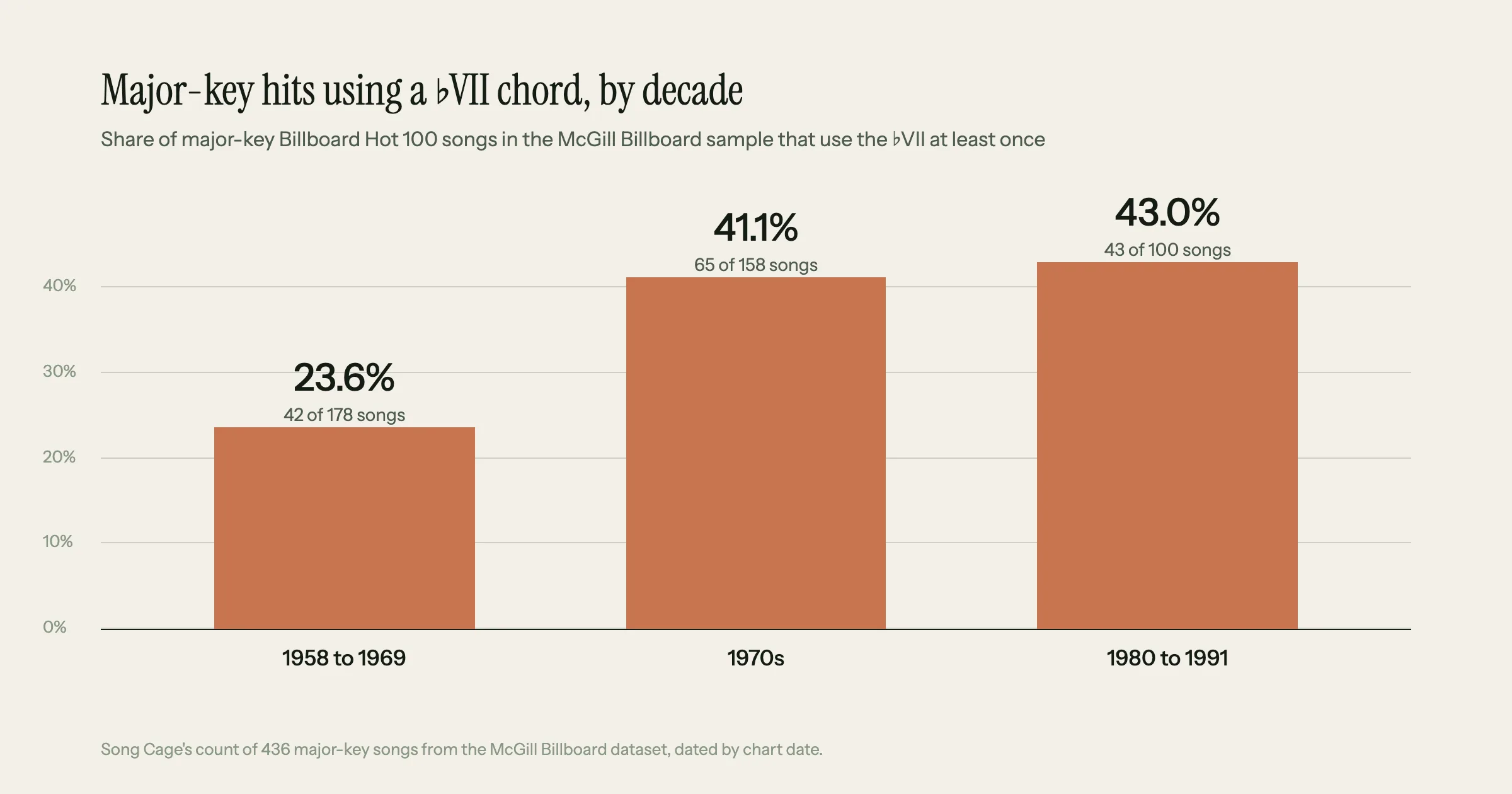
The dataset samples songs from across the chart, so these are shares of a sample rather than every hit, and the last group is the smallest. But the jump from the 1960s to the 1970s is large enough to read plainly: the ♭VII went from an occasional color to a chord that two in five major-key hits reached for. Guitar-led writing may be part of it, since on a guitar the chord a whole step below home is one shape away, but the count shows that it happened, not why.
Do hit songs stay in Mixolydian the whole way through?
Rarely. In Song Cage's count, only 33 of the 150 major-key Hot 100 songs that used ♭VII never touched a major V. "Addicted to Love," "Ghostbusters," "I Want a New Drug" and "Born to Be Wild" are four of them: each uses ♭VII and never plays the major V that would bring back the leading tone. The other 117 mixed the two 7ths. ♭VII outweighed V, by bars, in 68 of the 150.
For a songwriter, that means Mixolydian works as a chord you add to a major song for a section or a lift, as well as a scale for a whole song. The idea is the same one behind borrowed chords. In our count, ♭VII was the parallel-minor chord major-key songs borrowed most: 150 songs, against 89 for ♭VI and 64 for the minor iv.
How we counted
The McGill Billboard dataset is a set of expert chord transcriptions of songs sampled from across the Billboard Hot 100 between 1958 and 1991, described by Burgoyne, Wild and Fujinaga at ISMIR 2011. After removing repeats, we could read chords from 739 songs. We called a song major-key when its most-played chord was a major chord on the tonic the annotators marked, tracking key changes line by line. 436 songs qualified. Chords were read by root and quality (major or minor third) relative to that tonic, and each song was dated by the chart date in the dataset's index.
Chords without a full triad (power chords, suspended chords, bare bass notes and bass-plus-interval shorthand) are left out. The count follows the annotators' tonic, so a song like "Sweet Home Alabama," marked in G, counts as G major with D–C–G as V–IV–I.
How do you write a song in Mixolydian mode?
Set up a major home chord, bring in ♭VII early, and keep returning to I on strong beats. Send ♭VII to IV or straight home. Put the flat 7th into the melody. Avoid a major V chord, and avoid ending phrases on IV, which pulls the song toward the major key it shares notes with (D major for A Mixolydian).
Put ♭VII next to I, early
The ♭VII is the chord that announces Mixolydian, so let the listener hear it in the first few bars. A two-chord vamp, A to G with two bars each, is enough to set the mode for a verse, the way "Fire on the Mountain" does it with B and A. Keep I on the downbeat of each phrase and end phrases on it. A song that opens on G and lingers there invites the ear to hear G as home instead.
Send ♭VII to IV, then home
The Billboard count says the ♭VII's favorite destination is IV, and the double plagal (G, D, A in A) is the sound most people mean by "Mixolydian rock." It works because each chord drops a fourth to the next, so the bass falls by the same interval twice before landing. "Addicted to Love" holds each chord for two bars and loops A, G, D, A through its verses.
Put the flat 7th in the melody
The chords can carry Mixolydian on their own, but a melody that lands on the ♭7 makes it unmistakable. In A Mixolydian, sing G over the A chord and let it fall to F♯ or E. Over the G chord the same note is just the root, so it blends in; over I it stands out as the color note. "Norwegian Wood" does all of this over one held chord, which is a good test of your own line: if the tune still sounds Mixolydian with only I underneath, the melody is doing the work.
Keep V out, or make it a moment
In A Mixolydian, a major E chord brings back G♯, and a strong E to A cadence pulls the song into ordinary A major. The other risk is IV. A to D is V to I in D major, so a song that keeps resting on D starts to sound like it's in D. Wikipedia, citing Guitar Theory For Dummies, notes that Mixolydian is often used with a major 7th in the cadences, and calls the Troggs' "Wild Thing" a "perfect example."
Use Mixolydian for one section
"Hey Jude" is the model. Pollack describes the song half as "purely diatonic F Major," with a single chromatic chord, and the coda as F, E♭, B♭, F repeated more than eighteen times. The one new chord, E♭, is the whole contrast. Write the verse in plain major, then bring in ♭VII for a chorus, a bridge or an outro, and the section changes color without a key change.
How is Mixolydian different from major and Dorian?
Mixolydian and the major scale share a major 3rd; Mixolydian lowers the 7th. Dorian and Mixolydian share the ♭7, but Dorian also lowers the 3rd. Each change creates a signature chord: the major V in the major scale, the ♭VII in Mixolydian and the major IV in Dorian.
| Mode | Notes in A | 3rd | 7th | Signature chord |
|---|---|---|---|---|
| Lydian | A B C♯ D♯ E F♯ G♯ | 3 (C♯) | 7 (G♯) | II (B major) |
| Major (Ionian) | A B C♯ D E F♯ G♯ | 3 (C♯) | 7 (G♯) | V (E major) with a leading tone |
| Mixolydian | A B C♯ D E F♯ G | 3 (C♯) | ♭7 (G) | ♭VII (G major) |
| Dorian | A B C D E F♯ G | ♭3 (C) | ♭7 (G) | IV (D major) under a minor i |
| Aeolian (natural minor) | A B C D E F G | ♭3 (C) | ♭7 (G) | ♭VI (F major) |
Five modes on A, brightest to darkest. Each one changes a single note from its neighbor.
The blues sits right next to Mixolydian. Wikipedia quotes the keyboard author Mark Harrison describing a blues that uses D Mixolydian triads over the D7 chord, then G Mixolydian triads over the G7. In a basic 12-bar blues every chord can be a dominant 7th, and Mixolydian is the scale that fits each one. That's also why jazz players call it the dominant scale. A songwriter using a I7 as home, or a I7 to IV7 vamp, is already writing in this neighborhood.
Where does the name Mixolydian come from?
The name is ancient Greek, and the ancient scale was a different one. According to Wikipedia, ancient writers credited the poet Sappho with inventing the Greek Mixolydian, and "mixo-" means mixed, for its resemblance to the Lydian. In its diatonic form, the Greek Mixolydian matched the white keys from B to B, the pattern we now call Locrian, according to the New Grove Dictionary as Wikipedia summarizes it.
Medieval chant theorists borrowed the Greek names in the 9th century and attached them to their own eight modes. The seventh mode, the Mixolydian, had its final on G and ran from G up to the G above, which is where the modern scale comes from. Its plagal partner, the Hypomixolydian, has no modern counterpart. You don't need any of this to write in the mode, but it explains why an old textbook and a new one can disagree about what "Mixolydian" means.
How do you write in Mixolydian in Song Cage?
Song Cage keys are major or minor, so set the song to the major key of your home note, A major for A Mixolydian. The Mixolydian chords are then one tab away. The Borrowed tab of the chord palette lists the chords a major key borrows, and in A major that includes G (♭VII) and Em (v). They carry a small aeolian label, because Song Cage lists the chords natural minor lends first, and A minor has the same G.
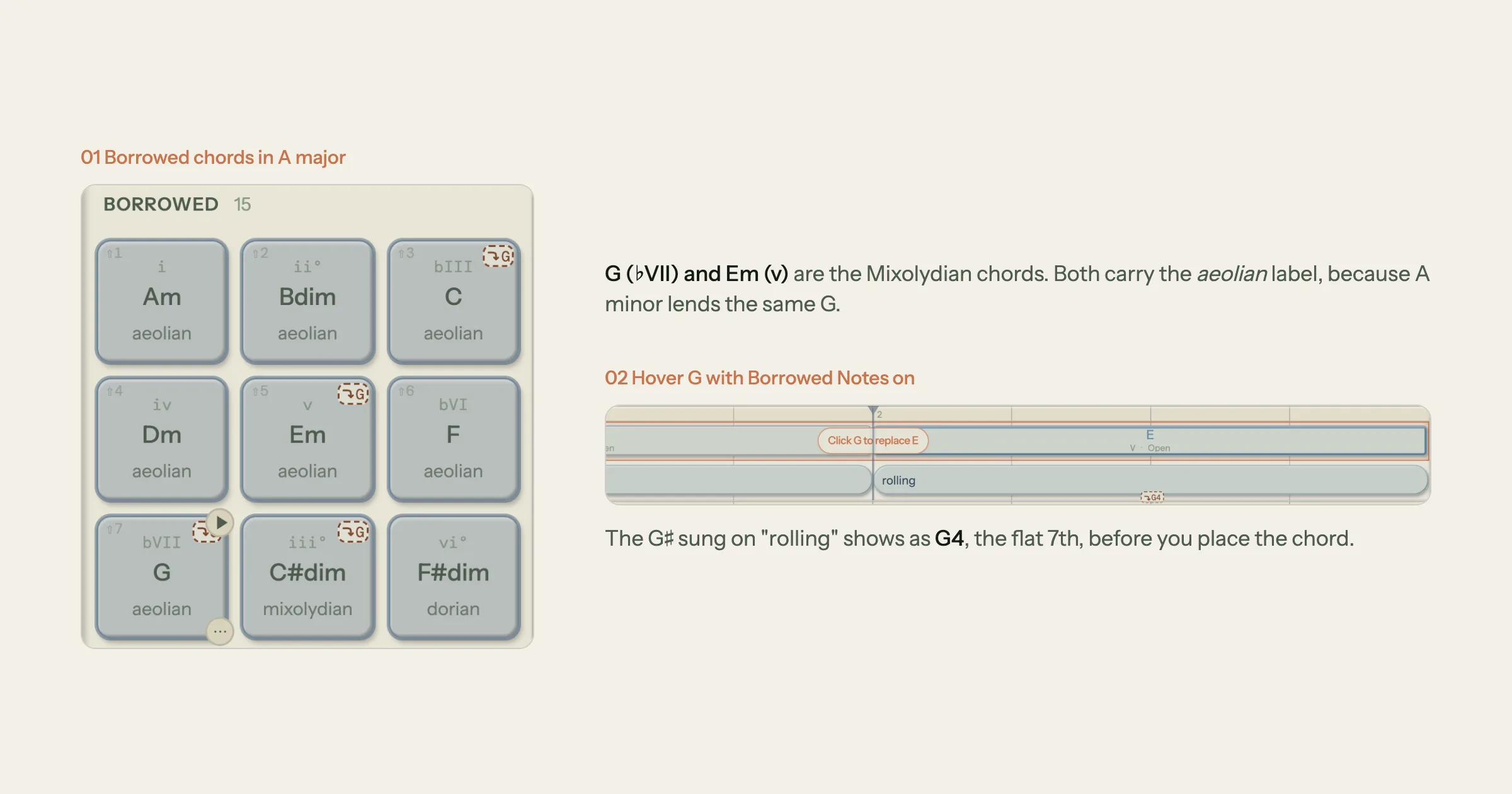
If you hum or play the melody in first, Fits Melody ranks chords against the notes you sang, borrowed ones included, so a melody that already sings G can bring up the G chord as a fit. The reverse case is covered too. Switch on Borrowed Notes (Settings, under Input) and try G under a melody that sings G♯: the chip shows a tag with G before you click, and trying it moves that one note down a half step, as long as the note then steps down, lifts to the home note, or is held at the end of a phrase. Keep it and the chord and the moved note go in as one undo. The Borrowed Notes docs list the rules.
Frequently Asked Questions
Is the Mixolydian mode major or minor?
Major. Its 3rd is major, so the chord on its home note is a major chord. What sets it apart from the major scale is the lowered 7th, which gives it a major ♭VII chord and a minor v, and takes away the leading tone.
What is the difference between Mixolydian and major?
One note. The major scale has a natural 7th and Mixolydian has a ♭7. In A, that's G♯ against G. The change turns the vii° chord (G♯°) into a major ♭VII (G) and the major V (E) into a minor v (Em).
What is G Mixolydian?
The Mixolydian mode starting on G: G, A, B, C, D, E, F. It's every white key on the piano from G to G, the same notes as C major with G treated as home. Its lowered 7th is F, where G major has F♯.
What key signature does A Mixolydian use?
Two sharps, F♯ and C♯, the key signature of D major, because A Mixolydian uses the notes of D major starting on A. Some charts use A major's three sharps instead and mark the G natural as an accidental.
Why is Mixolydian called the dominant scale?
Because it starts on the 5th degree of a major scale, the dominant, and because its four-note home chord is a dominant 7th (A7 in A Mixolydian). Jazz and blues players use it over dominant 7th chords for that reason.
What is the most famous song in Mixolydian?
In rock, "Sweet Home Alabama" and the "Hey Jude" coda are the most cited, along with "Louie Louie" and "Norwegian Wood." In recent pop, Lorde's "Royals," which Hooktheory files in D Mixolydian. In folk, the fiddle tune "Old Joe Clark."
Capture the riff before it's gone
Song Cage keeps your melody, chords and words together in one place. Sing the tune in, set the key, and reach the ♭VII from the Borrowed tab while the idea is still fresh.