Table of Contents
- What is a key change?
- Key change or transposition: which one do you actually need?
- Should your song change key at all?
- What are the main types of key change?
- How do you find a pivot chord?
- Why is the truck driver's gear change mocked?
- When does the gear change still work?
- Which real songs change key, and how?
- Which of these teach the mechanism best?
- How do you get back to your home key?
- Can your singer actually reach the new key?
- What do most key change guides get wrong?
- Did the key change actually die?
- Where Song Cage fits
- Frequently Asked Questions
There are two completely different jobs hiding inside the phrase "change the key of my song," and almost nobody says so out loud. One is moving the whole song so your singer can actually reach the chorus. The other is changing key partway through, on purpose, so the listener feels the floor rise. The first is a performance decision that changes nothing about the composition. The second is the composition.
Search for how to do either and you land in a strange place: the results split into two families of page that never acknowledge each other. One family explains mid-song modulation and never once mentions vocal range. The other explains transposing a whole song and never mentions modulation. Google mixes them together because writers type the same words for both jobs, and the beginner who wanted the second one ends up dragging a pitch slider and wondering why nothing feels different.
This guide separates the two, then covers the part everyone skips: how to decide whether your song needs a key change at all, how to actually find a pivot chord and use it, why the final-chorus lift became the most mocked move in pop and when it still works, how to get back home again, whether your singer can survive the new key, and a table of nineteen real songs where every key, interval, and mechanism has been checked against published charts and analyses rather than copied from other blogs.
Quick summary
A key change (modulation) moves the song's tonal center to a new home mid-song. Transposing moves the entire song by a fixed interval and changes nothing else. To modulate smoothly, find a chord shared by both keys, use it as a pivot, then confirm the new key with a cadence. To modulate abruptly, just start the new key at a section boundary and let the seam show.
What is a key change?
A key change is a modulation: the song abandons its tonal center and establishes a new one. The two words mean the same thing. The best test for whether it really happened is a cadence. If the music leans toward a new chord and moves on, that is tonicization. If it arrives, cadences, and settles in, the key has changed.
That test is the reason so many songs get argued about. Your ear does not read key signatures. It tracks which note feels like home, and it updates that judgment slowly. A single borrowed chord does not relocate you. A secondary dominant pointing at the vi chord does not relocate you either: that is tonicization, a brief visit with the engine running. Eight bars in a new key with its own V going to its own I is a move.
Treat the cadence as your strongest piece of evidence rather than as a verdict, though, because the boundary is genuinely soft. Open Music Theory draws the line exactly there, and it is the cleanest working test available. Kostka and Payne, whose Tonal Harmony is the standard text in American theory classrooms, say flatly that the line between modulation and tonicization "is not clearly defined in tonal music, nor is it meant to be." Other sources ignore cadences and split the two by duration and structural weight: a tonicization passes inside a phrase, a modulation takes hold of a section. Anyone who tells you the distinction is crisp is teaching, not describing.
What follows assumes the softer version. A modulation needs somewhere to go, a way in, and enough time on the ground to convince the ear it has arrived.
Key change or transposition: which one do you actually need?
Transposing moves every note in the song up or down by the same interval. Every chord relationship, every melodic leap, every emotional beat stays identical, just higher or lower. Modulating changes key partway through and is something the listener hears happen. Transposition serves the singer. Modulation serves the song.

The confusion is not the reader's fault. Both jobs get typed into the search bar with the same words, and the pages that answer one never mention the other. But the practical difference is enormous. If your chorus is straining your singer, transposing the whole song down a minor third fixes it, and the song is otherwise unchanged: nobody listening can tell you did it. If your last chorus feels flat, transposing does nothing at all, because the relationship between the sections is exactly what you did not change.
There is one place the two jobs meet, and it is the thing nobody tells you: modulating up a whole step also moves your highest melody note up a whole step. That is a transposition question hiding inside a composition decision, and it is covered further down.
Song Cage separates these deliberately. The key chip in the toolbar is the whole-song control, and when you pick a different key in the same mode and there is something to move, it stops and asks which job you meant: move the song there, which carries every chord over and keeps its role in the key, or relabel only. Its own wording is the clearest statement of the distinction I know: move keeps every chord's role in the key, and recorded takes keep their pitch. Mid-song key changes are a different tool entirely, and they live in the Modulation tab.
Should your song change key at all?
Most songs should not. The honest diagnostic: if you are reaching for a key change because your final chorus feels flat, the key change is usually treating a symptom. An undifferentiated last chorus, a melody with no register arc, or an arrangement that peaked in verse two are all more common causes, and a semitone bump fixes none of them.
Gary Ewer has made this point since 2012 and it is still the best advice on the topic: most songs do not need a key change, and instrumentation, melodic register, and dynamics will usually get you the lift you wanted with less collateral damage. Ask the question in this order. Is the final chorus doing anything the first chorus did not? Does the melody go somewhere it has not been? Has the arrangement been building, or has it been flat since the second verse?
If the answers are no, no, and flat, a key change will announce that something is supposed to be happening without anything actually happening, and listeners hear that distinction clearly even when they cannot name it. If the answers are yes, and the song has been accumulating pressure that needs somewhere to go, then the lift releases it and lands.
The test is whether the key change is cashing a check the song already wrote, or writing one it cannot cover.
What are the main types of key change?
There are six moves worth knowing, and they differ in one dimension: how much the listener is prepared for the arrival. Pivot and common-tone modulations hide the seam. Direct modulation makes the seam the point. Relative and parallel shifts move the tonal center without moving much of the pitch material. Enharmonic modulation respells a chord so it means something new.
| Type | Mechanism | Feels like | Reach for it when |
|---|---|---|---|
| Pivot (common chord) | A chord belonging to both keys is reheard mid-stream | Inevitable, seamless | The lift should register emotionally without being noticed |
| Direct (phrase) | Old key stops, new key starts, no preparation | A jolt, a reset | A section boundary already justifies the cut |
| Common tone | One sustained pitch bridges both keys | Luminous, cinematic | A voice can hold the note while the ground moves |
| Chromatic | A note keeps its letter, gains an accidental, and pulls | Driving, directional | A plain pivot feels too polite for the lyric |
| Relative major / minor | Same key signature, new tonic | Same world, different light | You want shadow or brightness without relocating |
| Parallel major / minor | Same tonic, new mode | Opposite weather, same address | The feeling inverts but the song must stay anchored |
Closely related keys (the dominant, the subdominant, the relative minor) sit one accidental from home and are the cheapest destinations. In a major key the standard goal is the dominant. In a minor key it is the relative major instead.
Two of these are genuinely contested, and it is worth knowing which. The parallel shift moves the key signature but not the tonal center, so a single borrowed chord is modal mixture, while a sustained section that re-establishes the parallel mode with its own cadences is what most working writers will call a modulation. Theorists disagree, openly and in print. The relative shift is disputed for the mirror-image reason: the pitch collection never changes, only your sense of which note is home.
How do you find a pivot chord?
List both keys' chords in two columns. Keep the ones that match on root and quality. Then rank what survives by function: the best pivot reads as a predominant (ii or IV) in both keys at once, because a V is coming shortly in either reading. Second best is a chord that is tonic in the old key and predominant in the new. Play the pivot, then the new key's V, then its I.
Try it with C major going to G major:
The two columns
- C major: C, Dm, Em, F, G, Am, Bdim
- G major: G, Am, Bm, C, D, Em, F#dim
- Shared, on root and quality: C, Em, G, Am
Bm and Bdim do not count. Same root, different quality, so B is not a pivot. Of the four that survive, Em is the textbook-best choice: it is vi in C major and ii in G major, a predominant in the new key that points straight at D. C is the strong second: tonic in C major, stable and arrived at naturally, and IV in G major, which still lands you on a predominant, and a tonic can move directly to V anyway. G is the one to avoid, because analyzing it as "V becomes I" asks the ear to hear one chord as both unstable and fully at rest, which, as Open Music Theory puts it, "isn't how we're likely to hear it." Hutchinson's Music Theory for the 21st-Century Classroom makes a related point from the composer's side: pick a pivot with dominant function in the new key and the modulation tends to sound abrupt and unconvincing.
So the shape is: C established, then C reheard as IV, then D, then G. And then the step songwriters skip, which is the one that matters most: cadence in the new key, or you have not modulated at all. You have visited. Give the ear a little time before you cadence, too. It needs a moment to accept a new home.
Song Cage builds this move for you rather than making you draw the columns. Open the Modulation tab, pick a target key on the Key Map, and it lists routes into that key ranked from simplest to richest: a direct V to I, a plagal IV to I, a ii to V to I in triads, the same in sevenths, a tritone substitution, and on up to a five-chord approach it calls the grand tour. Every route has a play button, so you hear the difference between a prepared arrival and a blunt one on your own progression instead of imagining it. Press Add here or drag the route onto the timeline and the chords land in your song.
Why is the truck driver's gear change mocked?
Because it is the one modulation that can be applied to a finished song without changing anything about it. Near the end, the whole arrangement jumps up a half or whole step into a repeated final chorus and never comes back. The material is identical, just higher. The critique is not that it is a key change; it is that the lift is borrowed rather than earned.
The device is well documented. Walter Everett records it in The Foundations of Rock: the most commonly heard technique whereby the original tonic is forsaken for another tonal center, he writes, is known as the "truck driver's modulation," in which "the tonic is replaced by a new center lying a minor or major second above." He reports the name as already current rather than claiming it, and concedes on the same page that "the ultimate origins of this technique have not been traced," while pointing to forebears in the Mills Brothers' "The Glow-Worm" (1952) and Patti Page's "(How Much Is) That Doggie in the Window" (1953). The device also acquired a dedicated shaming apparatus: a website that existed purely to catalog offenders, a TV Tropes page, and a parody song that calls out the modulation as it performs it.
Structurally the complaint has three parts. It is unprepared where classical modulation is pivoted or common-toned. It goes to a distant relationship rather than a closely related key. And it strands you, never returning home.
One name, or two? A distinction worth not repeating
You will find teaching resources claiming that a pump-up modulation goes straight from old tonic to new tonic, while a truck driver's modulation proper routes through the new key's dominant first. It is a tidy split, and the scholarship does not support it. Everett defines the truck driver's modulation as the bare shift itself, with no preparation clause, and groups it with non-functional key relationships. Griffiths, Biamonte and Ricci all treat "pump-up," "truck driver's," "crowbar" and "arranger's" as rival names for a single device. Whether the new key simply arrives or is announced by its own dominant is a real and studied variable, catalogued across Ricci's corpus of roughly 250 songs. It is just not what separates those two names.
When does the gear change still work?
The honest counter-case holds up. The mockery is aimed at a failure mode, not at the interval. Academics concede both halves: the device has associations of being unimaginative and mechanical, and popular musicians use it profusely to genuine creative effect. "Livin' on a Prayer" is the case for the defense, because the chorus pattern is established over several repetitions before the key lifts and the band hits harder. The lift releases accumulated pattern instead of substituting for it.
There is one cost nobody mentions in theory books. The gear change permanently raises the vocal, so your singer lives in the new key for the rest of the song, and for every live performance for the rest of their life.
Which real songs change key, and how?
Every row below has been checked against published sheet music, Hooktheory section analyses, or bar-by-bar scholarship rather than copied from other articles. Several are corrections: songs the field routinely mislabels, including one of the most famous key changes in pop, which is widely reported at the wrong interval by pages that outrank this one.
| Song | Year | Key move | Interval | Mechanism | Where |
|---|---|---|---|---|---|
| I Want to Hold Your Hand — The Beatles | 1963 | G → C | Up a 4th | To the subdominant; C pivots home as IV | Both bridges |
| My Girl — The Temptations | 1965 | C → D | Up a whole step | Prepared: Em7 pivots, A is the new V | End of the break |
| Penny Lane — The Beatles | 1967 | B → A | Down a whole step | Pivot: E is IV in B, V in A | Verse to chorus |
| While My Guitar Gently Weeps — The Beatles | 1968 | Am → A | Parallel | E closes the verse and swerves major | Both bridges |
| Layla — Derek and the Dominos | 1970 | Dm → C#m | Down a semitone | Direct, unprepared, and downward | Chorus to verse |
| Bohemian Rhapsody — Queen | 1975 | B♭ → E♭ | Up a 4th | Chromatic descending bass, not a secondary dominant | Verse to chorus |
| We Are the Champions — Queen | 1977 | E♭ → F | Up a whole step | Expected resolution evaded; new key's own V announces it | Pre-chorus to chorus |
| Save Me — Queen | 1980 | G → D | Up a 5th | To the dominant; G sits at the seam as I and IV | Verse to chorus |
| Come On Eileen — Dexys Midnight Runners | 1982 | C → D | Up a whole step | Direct, at the first chorus, and it drops back | Verse to chorus |
| I Just Called to Say I Love You — Stevie Wonder | 1984 | D♭ → D → E♭ | Two semitones | Direct step-up, twice, back to back | Around 3:00 |
| Summer of '69 — Bryan Adams | 1984 | D → F | Up a minor 3rd | Direct; a chromatic third relation across the seam | Bridge |
| Livin' on a Prayer — Bon Jovi | 1986 | Em → Gm | Up a minor 3rd | Final-chorus lift; a beat is dropped at the seam | After the solo |
| Man in the Mirror — Michael Jackson | 1988 | G → A♭ | Up a semitone | Textbook gear change: no pivot, no preparation | 2:52, choir enters |
| I Will Always Love You — Whitney Houston | 1992 | A → B | Up a whole step | Verse's V never resolves; a drum fill covers the seam | Final chorus |
| My Heart Will Go On — Céline Dion | 1997 | E → A♭ | Up a major 3rd | Direct, smoothed by a descending bass | Final chorus |
| Love Story — Taylor Swift | 2008 | D → E | Up a whole step | Arrives through A: V in D, IV in E | Final chorus |
| Love on Top — Beyoncé | 2011 | C → E | Four semitones | Four consecutive direct step-ups | Final choruses |
| Mirrors — Justin Timberlake | 2013 | Cm → E♭ | Relative major | Direct at the section line; no key signature change | Verse to chorus |
| Dynamite — BTS | 2020 | E → F# | Up a whole step | The whole four-chord loop, set down a step higher | After the bridge |
Keys reflect published sheet music and section analyses. Where sources conflict, the reading with primary-source support is given.
Which of these teach the mechanism best?
Three are worth a closer look, because they show you how the move is built rather than just proving it happened.
"Penny Lane" is the pivot done perfectly, in both directions. The verses sit in B major and every chorus drops a whole step to A. The corner is turned on the E major chord that ends the verse: one chord doing two jobs, IV in B and V in A, so the chorus is already home before you notice you moved. Getting back is done differently, on an F#7, which is a chromatic chord in A but the dominant of B. Two mechanisms, one song, and the final chorus stays up in B to close.
"My Girl" is the song the field gets wrong. It is routinely filed under the abrupt final-chorus lift, and it is the opposite: the instrumental break closes Dm7, G, Em7, A into D. The Em7 is a pivot, iii in C and ii in D, and the A arrives as the dominant of the incoming key. It is a fully prepared modulation wearing a pop song's clothes.
"Layla" goes down. The intro and chorus sit in D minor and the verse drops a semitone to C-sharp minor with no preparation whatsoever, which is both direct and the wrong direction according to every rule of thumb about lifting for energy. It confirms the new key properly, cadencing G#7 to C#m, a real V to i. Then it climbs home on an A major chord whose C# works as a leading tone back into the D minor riff.
How do you get back to your home key?
Nobody teaches this, and it is the single structural difference between a modulation and a gimmick. The gear change is defined partly by the fact that it never returns. If you want the key change to read as composition rather than as a rescue, plan the trip home before you take the trip out.
The return is not a special technique. It is the same set of moves pointed the other way, and it is often easier, because your home key is the one the listener still half expects. The cleanest route is the one "Penny Lane" uses: find the chord that leads back. A chord that is chromatic in your new key but functions as the dominant of your home key will snap the ear back in a single move. In "Layla" that job is done by a single A major chord.
The trap is the one Ewer identifies: modulations belong at structurally important places, which means the decision is really a question about song structure. A key change that goes out at the bridge and returns for the last chorus is doing narrative work. One that shuttles back and forth every eight bars is just restless, and the ear stops treating either key as home.
In Song Cage this is symmetrical by design. Once a section is sitting in the new key, open the Modulation tab from inside it and pick your original key as the target: the routes it builds are routes home, ranked the same way. It is the same tool run in reverse, which is exactly what the return leg is.
Can your singer actually reach the new key?
This is where the two halves of the question finally meet, and it is the check nobody shows you how to run. Modulating up a whole step moves your highest melody note up a whole step. If your chorus already peaks at the top of your singer's comfortable range, the modulation is unsingable, and you will not find that out until the take.
To know where that top is before the take, run the singer through the free vocal range test. It names the highest note and keeps the top two semitones spare, which is exactly the headroom a whole-step lift needs.
The procedure takes thirty seconds. Find the highest note in your final chorus. Add the interval you intend to modulate by. Check that note against the singer's range, honestly, at the volume the song needs, not the volume they can manage in a warm-up. Then decide before you write, not after you have fallen in love with the arrangement.
The fix, when it fails, is the other job entirely: transpose the whole song down first, then modulate up into the space you just freed. That is the moment the two families of advice needed each other, and it is why keeping them separate in your head matters practically and not just pedantically.
Worth noticing that this cost is permanent. A gear change into the last chorus commits the singer to the new key for the rest of the song, live, forever. The harmonies in the last chorus of "Livin' on a Prayer" are a standing example: Berklee's own instructors describe them as impossible to belt out after the change.
What do most key change guides get wrong?
A surprising amount, and the errors propagate because the pages copy each other instead of checking sheet music. Two pages ranking for this query give different intervals for the same Whitney Houston modulation. Two give different intervals for "Livin' on a Prayer." One states the relative and parallel definitions backwards, which is the single most consequential beginner error in the topic.
Corrections worth carrying
- "I Will Always Love You" moves a whole step, not a half. Hal Leonard's published sheet music puts the song in A major and the final chorus in B. The half-step claim is common and wrong, and one widely cited page names the wrong keys entirely. The modulation arrived with the arrangement cut for The Bodyguard, credited to David Foster and Houston herself: Dolly Parton's 1973 original has no such lift.
- "Livin' on a Prayer" moves a minor third, not a tritone. The tritone reading comes from measuring the pre-change verse against the post-change chorus, which compares two different sections across the change.
- Relative keys share a key signature; parallel keys share a tonic. Getting this backwards means picking the wrong pivot chords for every modulation you ever attempt.
- You cannot transpose a major-key song into a minor key. Transposition moves every note by a constant interval, which preserves mode by definition. Changing major to minor alters the intervals themselves.
- An octave shift is not a key change. It preserves the tonic, the key signature, and every pitch class. Dragging your MIDI up twelve semitones produces no harmonic change at all.
- "Man in the Mirror" lands in A-flat major, not G-sharp major. A G-sharp major key signature takes eight sharps, six single sharps plus an F double-sharp. It turns up as a passing key area in Bach and Chopin, but as a song's home key it is a curiosity rather than a working option, and A-flat is how the chart gets written. Fittingly, A-flat is the key co-writer Glen Ballard wrote the song in to begin with, before Jackson asked to take it down a half step to G.
Did the key change actually die?
The most repeated claim in this field is that it did, and the truth is more interesting than either side of it. The statistic everyone quotes, that only one #1 hit in the 2010s contained a key change, comes from Chris Dalla Riva's survey of every Billboard #1, and it is correct: that song is Travis Scott's "SICKO MODE." In March 2025 Dalla Riva revisited his own chart and found five #1s between 2015 and 2025 with key changes, adding BTS's "Dynamite," Silk Sonic's "Leave the Door Open," Drake's "Jimmy Cooks," and Sabrina Carpenter's "Please Please Please." He writes that the key change "began to resurrect."
Read the window carefully, because it is the whole story: four of those five topped the chart in the 2020s, so the original 2010s finding stands untouched. Dalla Riva also stops well short of calling it a revival, concluding that he does not expect more key changes while hip-hop and digital production remain dominant. The device did not die, and it has not come back. It thinned out, and it has been turning up again.
One wrinkle worth noticing: "SICKO MODE," the only Billboard #1 of the 2010s with a key change by Dalla Riva's count, moves down a half step rather than up, which quietly undercuts the universal framing that key changes exist to lift. The shift arrives with a full beat switch rather than as a conventional modulation, so read it as a curiosity rather than a counterexample.
Where Song Cage fits
Song Cage is a songwriting app, not a generator: it does not write your key change for you, and it will not tell you whether your song has earned one. What it does is remove the paperwork between deciding to modulate and hearing it. The two jobs this article separates are separate in the app, which is the point.
The toolbar key chip handles the whole-song job, and where the move is well defined it asks which one you meant rather than guessing: move the song and carry every chord over, or relabel only. A move takes the melody and any section key overrides with it. Recorded takes keep their pitch either way, because nothing is pitch-shifted behind your back. If you want the mechanics of thinking in scale degrees rather than letter names, our guide to the Nashville Number System covers why that mindset makes transposition trivial.
The Modulation tab handles the mid-song job. The Key Map puts your current key at the center with the six most closely related keys around it, positioned so that distance and line weight show how many chords each one shares with home: harmonic distance, made visible before you commit to anything. Pick one and you get the routes in, from a bare V to I up to the five-chord grand tour, each with a play button and an Add here that drops the chords onto the timeline. Place one and it offers to set that section to the new key, which is the thing that actually makes the change stick: the chord palette re-ranks, and the Roman numerals recalculate against the new home.
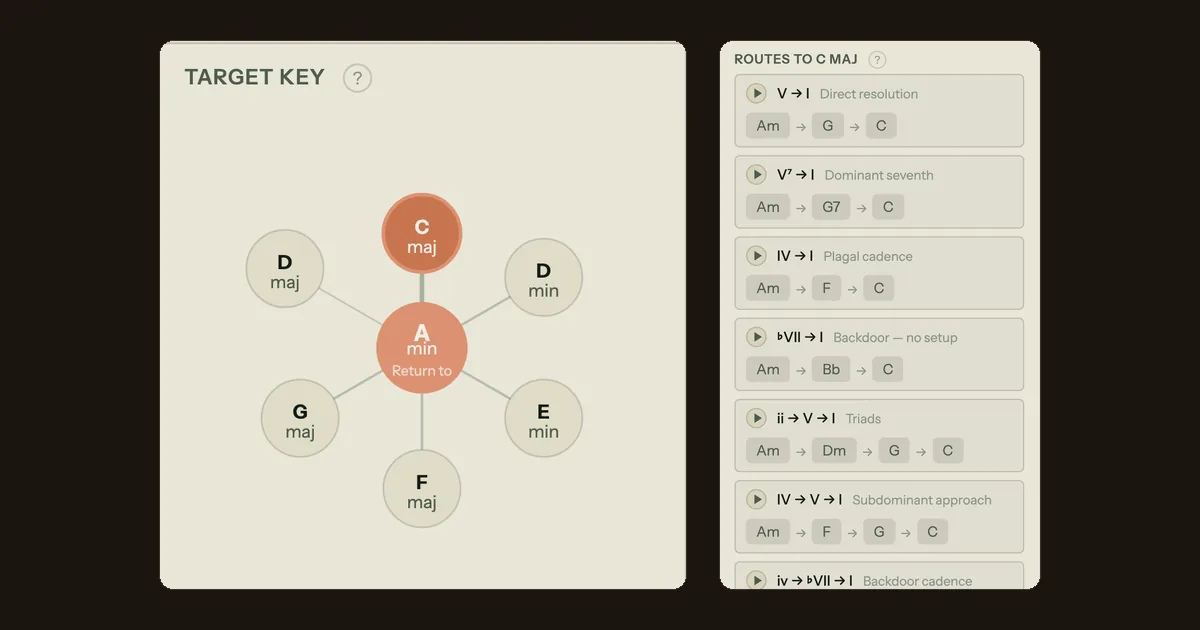
The song in that screenshot is in A minor, and the six keys the map offers are the ones that actually share chords with it: C major, D minor, E minor, F major, G major, and D major. Nothing is hidden behind theory you have to already know. You pick a destination, you hear the ways in, and you drag the one that sounds like your song onto the timeline.
Hear the key change before you commit to it
Song Cage shows you which keys sit closest to home, builds the routes into each one from a blunt V to I to a five-chord approach, and plays them against your own progression. Capture the idea before it is gone, then take it somewhere.
Frequently Asked Questions
What is the difference between a key change and a modulation?
In everyday use, nothing: both name the same event, the song's tonal center moving to a new home. Open Music Theory notes that modulation "involves a longer-term change of tonic" and that "sometimes people refer to modulation as a ‘change of key.’" So the popular claim that modulation is the process while a key change is the permanent result is not a distinction standard references make. Theory does draw a permanence line, but it runs between tonicization, a temporary tonic, and modulation, a longer-term change of tonic confirmed by a cadence.
Is transposing a song the same as changing key?
No, and conflating them is the most common mistake in this topic. Transposing moves every note by the same interval, so the whole song sits higher or lower and nothing else changes: it is a performance decision, usually made for a singer's range. A key change happens partway through the song and is a compositional event the listener hears. Transposing a finished song will not make its last chorus lift.
What is a pivot chord?
A chord that belongs to both the old key and the new one, so the ear reinterprets its function mid-stream instead of hearing a seam. C major and G major share C, Em, G, and Am. The best pivot is the one that functions as ii or IV in the target key, because it points straight at the new dominant. Avoid pivoting on a chord that becomes the new I, since the ear will not hear one chord as both unstable and at rest.
What is the truck driver's gear change?
A lift of a half or whole step into a repeated final chorus that never returns home. Walter Everett records the term in The Foundations of Rock, describing a tonic "replaced by a new center lying a minor or major second above," and notes its origins have never been traced. It is mocked because it can be applied to a finished song without changing anything else about it, so the lift is borrowed rather than earned. It still works when the song has built genuine pressure first, which is why "Livin' on a Prayer" survives the criticism.
Which key should I modulate to?
Start with a closely related key, one accidental from home: the dominant, the subdominant, or the relative minor. These share the most chords with your current key, so a pivot is easy to find and the arrival feels natural. In a major key the standard goal is the dominant, which is why it reads as climbing; the subdominant broadens and settles instead. In a minor key the default is the relative major, with the minor dominant a less common second choice.
Do key changes still happen in modern pop?
Yes, and the widely repeated claim that they died is out of date. It comes from Chris Dalla Riva's survey of Billboard #1 hits, and he has since revised the finding: five #1s between 2015 and 2025 contain key changes, including BTS's "Dynamite," which lifts its four-chord loop from E major to F-sharp major after the bridge. His own read is that the key change has been resurrecting.