Table of Contents
- What is the circle of fifths?
- What does the circle actually answer?
- Why doesn't it tell you what to play next?
- Where do secondary dominants live on the circle?
- Where do borrowed chords live on the circle?
- What is a circle of fifths progression?
- Which keys are closest to mine?
- What key should the song be in for the singer?
- Why do guitarists live on the right-hand side?
- Why does the bottom of the circle have two names?
- Does the circle actually close?
- When is the circle of fifths the wrong tool?
- Who invented the circle of fifths?
- How does Song Cage handle this?
- Frequently Asked Questions
Somebody on a ukulele forum put it better than any textbook. He had studied the circle of fifths "half to death", printed charts, bought one with a woolly mammoth on it, and reported back that it "just doesn't seem to be working much of the time." He was trying to work out the chords to "(Sittin' On) The Dock of the Bay" and the wheel would not tell him.
It never was going to. The circle is a map of how keys relate to each other. He wanted a recipe for a song that famously does not follow the pattern. As one of the highest-voted answers on Music Stack Exchange puts it, the trap is "thinking the 'Circle of Fifths' is a set of instructions."
So this is not another guide to memorising the wheel. It is a list of the jobs the circle genuinely does while you are writing, the jobs it quietly fails at, and where the chords that make a song interesting actually sit on it.
Quick summary
The circle of fifths arranges the twelve keys so the most closely related ones sit next to each other. It answers four questions fast: how many sharps or flats a key has, which two chords are your IV and V, where the relative minor is, and which keys are one step from home. It does not choose your chords, and it will not find your capo fret. Its most underused feature is that everything outside your key has an address on it: secondary dominants sit one step clockwise of their target, borrowed chords sit on the flat side to your left.
What is the circle of fifths?
The circle of fifths arranges the twelve pitch classes in a ring of ascending perfect fifths, so that C, G, D, A, E, B, F♯, C♯, A♭, E♭, B♭ and F fall in a loop back to C. Each clockwise step adds one sharp to the key signature; each counter-clockwise step adds one flat. Keys that sit next to each other are the ones that sound closest.
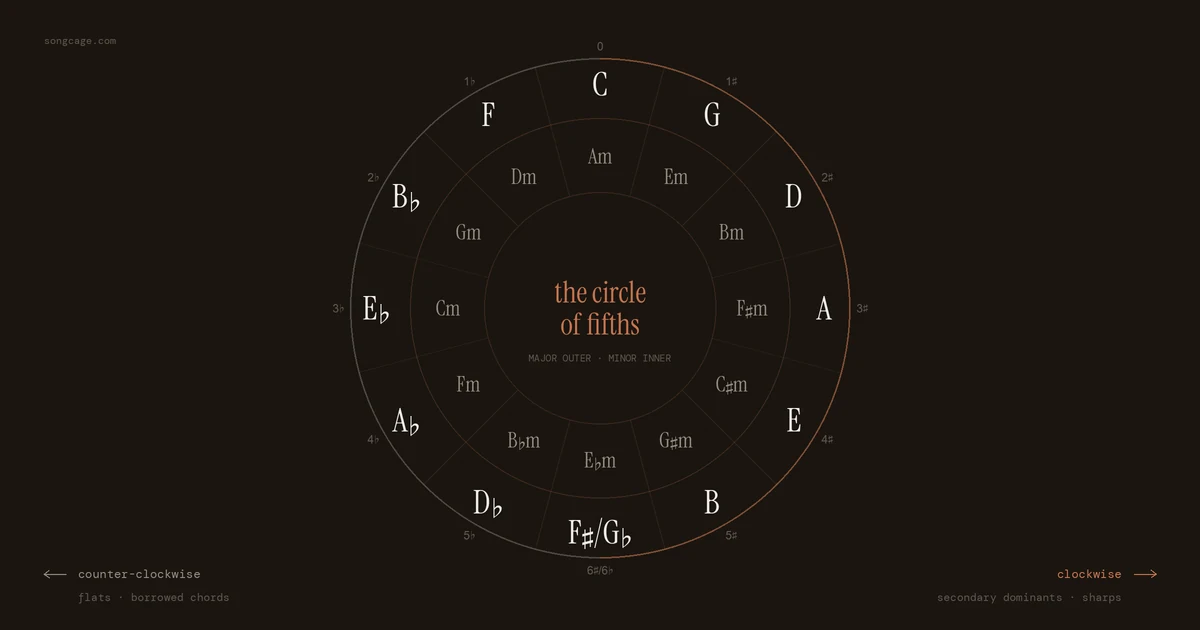
C sits at twelve o'clock because it has no sharps and no flats. Move clockwise to G and you gain F♯. To D and you gain C♯. The sharps arrive in a fixed order, F C G D A E B, and that order is itself a run of fifths. The flats arrive in exactly that order reversed, B E A D G C F.
The inner ring is the relative minors. Each one is a minor third below its major and shares its key signature: A minor with C major, E minor with G, D minor with F. On most charts the major is a capital letter and the minor is lower case.
What does the circle actually answer?
Four questions, quickly. How many sharps or flats is this key? What are my IV and V chords? Where is the relative minor? And which keys are nearest to mine? Everything else people expect from the diagram, including which chord comes next, is a question the circle was never built to answer.
The IV and V lookup is the one working players actually use. Your two immediate neighbours are your subdominant and your dominant. Sitting in C, the neighbour to the left is F and the neighbour to the right is G, and there is your I–IV–V. One bass forum member framed it as a bet: if you could wager on the next chord after C, "the clear winners more often times than not, would be F and G."
Add the relative minor and you have the four chords that carry an enormous amount of popular music. In A major that is A, D, E and F♯m.
The four lookups, in order of how often you will use them
- Key signature. Position on the wheel equals number of accidentals. Two steps clockwise from C is D, so D major has two sharps.
- IV and V. Your left and right neighbours, always.
- Relative minor. Three steps clockwise, or the inner ring directly below your key.
- Nearest keys. One step either way shares six of its seven notes with you.

Why doesn't it tell you what to play next?
Because it is a descriptive tool, not a prescriptive one. It shows how keys and chords are related; it makes no claim about which relationship your song needs. A diagram of every road in a city does not tell you where you were going.
This is the single most common complaint about the circle, and it turns up on every instrument forum. A guitarist and bassist of ten years asked on Music Stack Exchange what the circle was even for, and the answer he got was that he had been using it without knowing: "Don't worry about LEARNING the circle of 5ths. Just recognise it in what you're already playing."
The songwriting sites make this worse. Skoove's chord-progression section tells you to "follow the natural movement around the circle" and names no progression and no chord. American Songwriter lists ten progressions in a table and does not describe what a single one of them feels like, or name one song that uses any of them.
The circle is a reference. The writing happens somewhere else.
Where do secondary dominants live on the circle?
Every chord in your key has a dominant of its own, and it is always the next stop clockwise from that chord. To tonicise Am in the key of C, look one step clockwise of A, find E, and make it E7. That is V/vi, and the circle gives you it without any arithmetic.
This is the most useful thing the diagram does for a songwriter, and almost no circle-of-fifths article says it. Work through the key of C: one step clockwise of D gives A, so V/ii is A7. One step clockwise of G gives D, so V/V is D7. One step clockwise of F gives C, so V/IV is C7.
Be careful with one popular page here. American Songwriter tells readers that V/V "is the same as the bVII above". It is not. In C, V/V is D major and ♭VII is B♭. Different chords, opposite sides of the wheel.
Chain them and you get the ragtime engine: E7–A7–D7–G7–C, which is simply the circle walked clockwise with every chord turned dominant. Our guide to secondary dominants works through what each one feels like.
Where do borrowed chords live on the circle?
On the flat side, to your left. The chords you borrow from the parallel minor — ♭III, ♭VI, ♭VII and iv — all sit counter-clockwise of your key. That is why modal interchange sounds darker: borrowing is literally a move toward the flats.
In C major, the parallel minor hands you E♭, A♭, B♭ and Fm. Every one of them is anticlockwise of C. In G major it hands you B♭, E♭, F and Cm, and again every one of them sits to the left. The circle turns a vague idea, "borrow something from the minor", into a direction you can point at.
Radiohead's "Creep" is the cleanest example on record. The song is in G major and runs G – B – C – Cm, which we pull apart in full in the "Creep" chord progression. That final Cm is iv borrowed from G minor, and it is the chord the whole song is built to arrive at. The B major before it is V/vi, a secondary dominant that sets up Em and then never goes there, sliding to C instead.
Modal interchange covers the full set of borrowed chords and which ones survive contact with a chorus.
What is a circle of fifths progression?
A chord sequence whose roots fall by a fifth each time: I–IV–vii°–iii–vi–ii–V–I in major, i–iv–VII–III–VI–ii°–V–i in minor. It is a different circle from the key-signature one. This version stays inside a single key, which means one of its steps is a tritone rather than a perfect fifth.
That distinction trips up most articles. Robert Hutchinson's open textbook states it plainly: the harmonic circle "contains diatonic notes only", where the key-signature circle contains all twelve. In C, the awkward step is F to B natural.
The reason it feels like it is always landing is that descending-fifth root motion is, in the words of the open textbook Fundamentals, Function, and Form, "by far the strongest and most frequent" progression in tonal music. Baroque composers added sevenths to most of the chords to sharpen the pull.
| Song | Key | The cycle |
|---|---|---|
| "Fly Me to the Moon" (Bart Howard, 1954) | C major | Am7 – Dm7 – G7 – Cmaj7 – Fmaj7 – Bm7♭5 – E7 – Am7 |
| "I Will Survive" (Gloria Gaynor, 1978) | A minor | Am – Dm – G – Cmaj7 – Fmaj7 – Bm7♭5 – E – Am |
| "You Never Give Me Your Money" (The Beatles, 1969) | A minor | Am7 – Dm9 – G7 – Cmaj7 – F – B°/E – Am |
| "Autumn Leaves" (Kosma, 1945) | G minor | Cm7 – F7 – B♭maj7 – E♭maj7 – Am7♭5 – D7 – Gm7 |
Four songs, one shape. Note how little the pattern cares about genre or decade.
"I Will Survive" is the most extreme case. Writing at The Mix Review, Mike Senior calls it "a complete minor-key cycle of fifths" and counts the pattern repeating eleven times in the single edit and twenty-eight in the album version.
Which keys are closest to mine?
Your two neighbours and their relative minors, plus your own relative minor. For C major that is G, F, E minor, D minor and A minor. C and G share six of their seven notes, differing only in F versus F♯, which is why moving between them barely registers as an event.
The textbook definition is keys "that differ by no more than one accidental in the key signature", from Benward and Saker's Music: In Theory and Practice. Note that sources disagree on the count. Hutchinson and Open Music Theory both say five closely related keys. Wikipedia says six, because it includes the parallel minor on the grounds that it shares a tonic, even though it sits three accidentals away.
Both are defensible. The five-key version is the one the circle expresses geometrically; the parallel key is a different kind of closeness that the diagram deliberately does not show. If you want the mechanics of actually getting between two keys, how to change key in a song covers pivot chords and the pop key change in detail.
What key should the song be in for the singer?
The circle will not tell you. Vocal range is measured in semitones and the right key is usually one to five semitones from where you wrote it, which is a distance the wheel has no way of expressing. Find the key by singing it, then use the circle to work out what that key costs you.
To shortlist keys before you sing them, the free vocal range test measures your lowest and highest notes and ranks the keys whose home octave fits between them.
Not one of the twelve most prominent circle-of-fifths guides I read mentions vocal range, tessitura or the break at all. That gap is real, and it matters, because transposing for a voice is one of the most common reasons a working songwriter changes key at all.
Bands do this openly. Tesla's Jeff Keith said in 2023 that the band tunes down, "instead of in E, the key of E, we dropped it to E flat", and to D on a couple of songs, "so I can sing the same melody but dropped down a whole step". Stryper's Michael Sweet has said the same about performing a half step down.
The move is small and it is found by ear. Do not go looking for a fifth because the diagram makes fifths look tidy; seven semitones will strand a singer at the other end of their range.
Why do guitarists live on the right-hand side?
Because G, D, A and E sit clockwise of C and those are the keys with open strings. B♭, E♭, A♭ and D♭ sit counter-clockwise, and those are the keys that turn into barre chords. Singers do not care which side they land on, which is where the capo comes in.
This is the join the circle-of-fifths pages never make. The transposition guides know that flat keys are "frequently great for voices but awkward on guitar", as ChordSwitch puts it. The circle-of-fifths pages know the layout. Neither side says the two things together: the left half of the wheel is a map of where you will need a capo.
The workflow is two steps. Transpose the chart into a guitar-friendly key, then capo up to the key the singer needs. If the singer wants B♭, that is three semitones above G, so you play G shapes with the capo on the third fret.
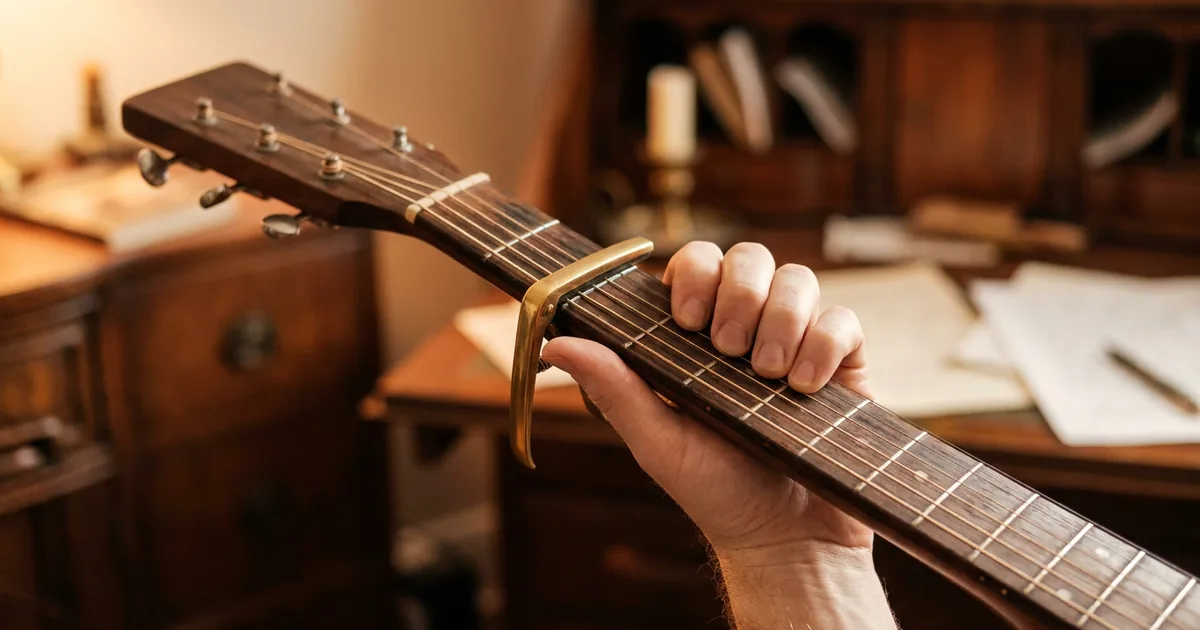
Capo positions for the flat keys
- B♭: G shapes, capo 3. Or A shapes, capo 1.
- E♭: D shapes, capo 1. Or C shapes, capo 3.
- A♭: G shapes, capo 1. Or E shapes, capo 4.
- D♭: C shapes, capo 1. Or A shapes, capo 4.
- Label the chart with the sounding key, not the shape. "G shapes, capo 3" means nothing to a bass player, who needs to be told B♭.
Our guitar capo chart has the full grid of shapes against sounding keys.
Why does the bottom of the circle have two names?
Because three pairs of keys are the same pitches spelled differently: B and C♭, F♯ and G♭, C♯ and D♭. There are fifteen major key signatures for twelve pitches, and the extra three are those enharmonic doubles.
The usual advice is to pick whichever spelling needs fewer accidentals, which is right most of the time. B major has five sharps against C♭ major's seven flats, so B wins. D♭ major has five flats against C♯ major's seven sharps, so D♭ wins.
But be careful which pair you use as your example. Guitar World's circle-of-fifths lesson tells readers that F♯ has three sharps and G♭ has six flats, so F♯ is easier to read. F♯ major has six sharps. The two are exactly equal, which makes it the one pair where the fewer-accidentals rule has nothing to say.
Function sometimes overrides the count. Debussy notated a D♭ minor passage in "Clair de lune" as C♯ minor rather than write eight flats.
Does the circle actually close?
Not in tune, only on paper. Twelve justly tuned perfect fifths overshoot seven octaves by the Pythagorean comma, about 23.46 cents, roughly a quarter of a semitone. Equal temperament closes the gap by flattening every fifth by about two cents.
Stack twelve pure 3:2 fifths from C and you do not arrive back at C. You arrive slightly above it. In just intonation the fifths form a spiral, not a circle, and the six-flat and six-sharp keys are genuinely different pitches rather than two names for one thing.
Historical tunings dealt with this by dumping the whole error into one interval, producing the wolf fifth: a single, sour, unusable fifth that closed the loop by force. Equal temperament spreads the error evenly instead, which is why every key on a modern piano is equally in tune and equally slightly wrong.
None of this changes what you play. It is worth knowing because it settles what kind of object the circle is. It is a diagram of a convention, not a law of physics.
When is the circle of fifths the wrong tool?
Whenever the music is not diatonic and functional. The circle assumes major and minor keys with V pulling to I. Modal rock, blues and loop-based writing all break that assumption, and the diagram will quietly mis-advise you.
Three specific cases. Modal rock progressions like I–♭VII–IV are not diatonic to a major key at all, so reading them off the wheel makes them look like mistakes. Blues treats I, IV and V as all-dominant sevenths, which the circle's diatonic qualities flatly deny. And a minor-key V only pulls home because you raised the seventh degree by hand, which no circle diagram shows.
The teaching sites are more honest about this than the marketing pages. Piano-ology's "The Circle of Fifths is Overrated!" lists seven shortcomings, starting with the fact that a key signature does not actually tell you the key. Pianote ran a piece headlined around the same doubt, whose author writes that she knows "many pianists who never use the Circle of 5ths."
You do not have to memorise it. Plenty of working musicians never did.
Who invented the circle of fifths?
The earliest known circle diagram is in the composition treatise Grammatika by the Kyiv-born theorist Nikolai Diletsky, written in the late 1670s; the surviving versions are dated 1677, 1679 and 1681. Johann David Heinichen arrived at one independently in 1711.
Diletsky has chronological priority but was not the route by which the idea reached Western practice. Claudia Jensen's 1992 study in the Journal of the American Musicological Society, the scholarly source most later accounts rest on, notes that his circles were "certainly unknown to contemporary theorists."
Heinichen called his the Musicalischer Circul, published in Neu erfundene und gründliche Anweisung in 1711 and again in Der General-Bass in der Composition in 1728. His version placed each relative minor next to its major, which does not reflect how close the keys really are. The two-ring layout we use now came later, from David Kellner's Treulicher Unterricht im General-Bass in the 1730s.
The frequent attribution to Pythagoras is an anachronism. Britannica is blunt: there are no records indicating he developed the concept.
How does Song Cage handle this?
There is no circle-of-fifths wheel in Song Cage, and adding one would be the wrong feature. The circle is a memory aid for a fact, and the app can simply show you the fact.
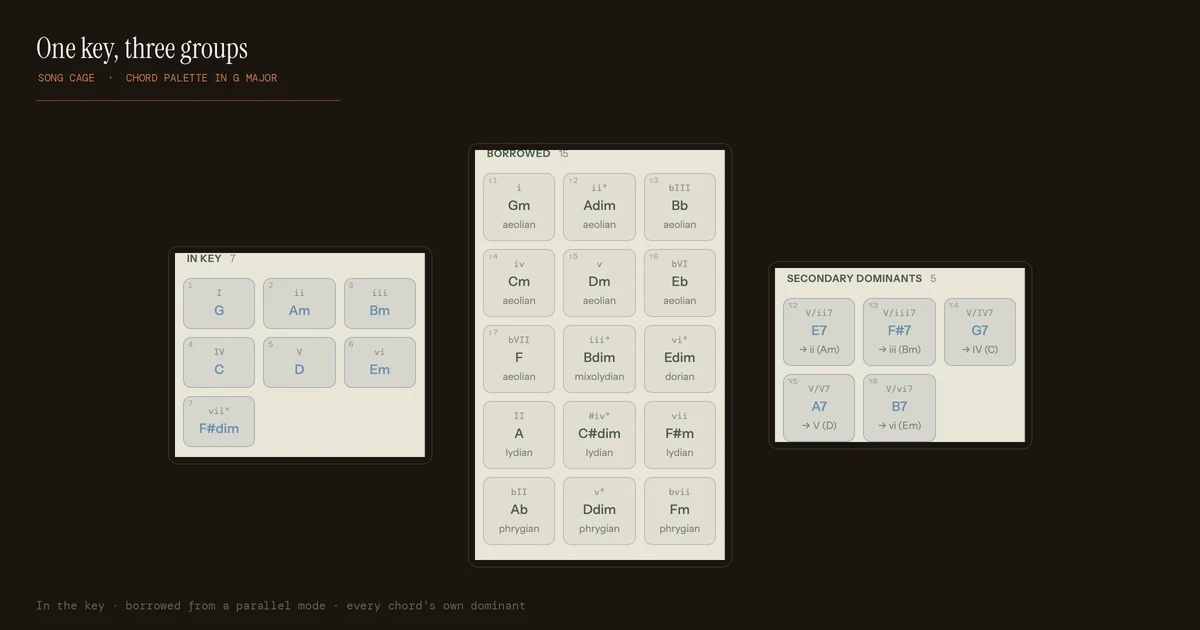
The chord palette is grouped by exactly the distinctions this article has been drawing. Chords in your key sit in one section, Borrowed in another with the parallel mode they came from named, and Secondary Dominants in a third. You do not have to count clockwise to find that V/vi in G is B7; it is in the list, labelled, with the chord it resolves to written underneath. When the app suggests a next chord it will sometimes give "Circle of 5ths" as the reason, meaning the roots are falling by a fifth. See the chord palette docs for how the groups work.
The Key Map does the closely-related-keys job directly. Rather than laying keys out by position on a wheel, it ranks them by how many chords they actually share with your key and draws the closest ones nearest, which is the thing the circle's geometry was standing in for all along. Key detection works the same way round: play some chords and it proposes keys, with a breakdown you can open showing how many chords are diatonic, how many are borrowed, how many are secondary dominants, and whether there is a V–I cadence in there.
For guitarists there is a capo setting in the toolbar, and the chord shapes redraw for the fret you put it on while the chart keeps naming the sounding key. That is the transpose-then-capo workflow from earlier, without the arithmetic. Guitar and piano voicings covers the fretboard side.
See which chords are in your key, borrowed, or someone else's V
Song Cage groups and labels every chord by its relationship to the key you are in, so you can reach for the dark one on purpose.
Frequently Asked Questions
Is it the circle of fifths or the circle of fourths?
Both, and it is the same diagram. Going clockwise you ascend by perfect fifths; going counter-clockwise you ascend by perfect fourths to the same pitch classes. Jazz players tend to say circle of fourths because the ii–V–I motion they use constantly runs anticlockwise. Nothing about the wheel changes.
Do I need to memorise the circle of fifths?
No. Guitarists can find it on the fretboard, pianists can find it by counting sharps, and plenty of working musicians never learned it as a diagram at all. What is worth internalising is the relationships it encodes: your neighbours are IV and V, one step is a small move, the far side is a jolt.
How do I find the relative minor on the circle?
Three steps clockwise, or read the inner ring directly beneath your key. C major gives A minor, G major gives E minor, F major gives D minor. The relative minor is always a minor third below the major and shares its key signature exactly.
Does the circle of fifths work for minor keys?
Partly. The inner ring gives you every minor key and its signature, and the descending-fifths progression has a minor form, i–iv–VII–III–VI–ii°–V–i. What the diagram never shows is that the V in a minor key needs its third raised by hand, from the natural minor's minor v. Without that raised leading tone the pull home does not happen.
How do I use the circle of fifths to change key?
Move one step and pivot on a chord the two keys share, which for adjacent keys is most of them. Moving further needs more preparation, and moving to the opposite side of the wheel is a tritone away and will sound like an event whether you wanted one or not. How to change key in a song works through the methods.
Which chords go together in a key?
Your key plus its two neighbours give you I, IV and V. Add the relative minors of those three and you have the six chords that carry most popular songs: in C, that is C, F, G, Am, Dm and Em. The seventh diatonic chord, the diminished one on the leading tone, is not on the wheel because the wheel is showing keys, not chords.
Why do some circle of fifths charts leave out C♭ major?
Because most charts print only one spelling per position and B major, with five sharps, is easier to read than C♭ major's seven flats. The side effect is that A♭ minor, which is C♭'s relative minor, disappears from those charts too. Both keys are real and both get used.
Does the circle of fifths help with a capo?
Indirectly. It will not count frets for you, since capo maths is in semitones and the circle steps in fifths. What it does show is which keys are on the guitar-hostile side: B♭, E♭, A♭ and D♭ all sit counter-clockwise, and those are exactly the keys where you transpose to open shapes and capo up.