Table of Contents
- What is a secondary dominant?
- Why does a secondary dominant work? The one note that leaves the key
- What are the five secondary dominants in a major key?
- V/V: "five of five," the most common one
- V/IV: your tonic chord turned into a dominant seventh
- V/vi: the bittersweet turn
- Secondary dominant, borrowed chord, or key change: what's the difference?
- How do secondary dominants work in a minor key?
- What is a chain of secondary dominants?
- What happens when a secondary dominant doesn't resolve as expected?
- How do you spot a secondary dominant in a chord chart?
- Secondary dominants in real songs
- How Song Cage builds secondary dominants for you
- Frequently Asked Questions
Some chords sit still. A secondary dominant shoves. It is the chord that leans into the next one so hard the song seems to fall forward: the jolt under the A7 in "Yesterday" a half-second before the sadness lands, the lift in the chorus of "9 to 5," the engine inside every ragtime turnaround and jazz bridge you have ever hummed.
Songwriters reach for it when a chord progression is correct but inert. Everything is in key, nothing is pulling. One borrowed dominant fixes that. This guide covers what a secondary dominant is, the single outside note that makes it work, all five of them in a major key, how they behave in minor, how to spot one in a chart, and a stack of real songs, every one fact-checked, so you can hear the chord before you write it.
What is a secondary dominant?
A secondary dominant is a chord that acts as the V (the dominant) of some chord other than your key's home chord. Instead of the usual five-to-one pull toward the tonic, it aims that same pull at a different target inside the key, so that chord feels, for a moment, like a little home of its own. The theorist Walter Piston named the device in his 1941 textbook Harmony, and it has been the standard label since.
Read the slash notation out loud and it explains itself. "V/V" is "five of five," the dominant of your dominant. "V/vi" is "five of six," the dominant of your sixth chord. The Roman numeral after the slash names the chord being targeted. In C major the dominant is G, so the dominant of G, a D or D7 chord, is V/V. That momentary spotlight on a non-tonic chord has its own name: tonicization. The target gets briefly tonicized while the song never actually leaves its key.
Why does a secondary dominant work? The one note that leaves the key
Every secondary dominant smuggles in exactly one note that does not belong to your key, and that note is the whole trick. It is the leading tone of the target chord: the note a half step below the chord you are aiming at, which pulls up into it the same way the seventh degree of a scale pulls up to the tonic. Remove that note and the chord collapses back into something ordinary.

Watch it happen in C major. Look a fifth above C and you find G, your dominant. G's own dominant is D, and the diatonic D chord in C major is D minor. Raise its third, F, up to F#, and D minor becomes D major (add the seventh and it is D7). That new F# is the leading tone of G, and it drags the ear straight up into the G chord. F# is the "tell": scan any chord chart for a major or dominant-seventh chord carrying a note from outside the key, and you have almost certainly found a secondary dominant. Notice, too, that a chord which "should" be minor showing up major is the clearest giveaway of all.
What are the five secondary dominants in a major key?
In any major key there are exactly five secondary dominants, one aimed at each diatonic chord that can hold still long enough to be tonicized: ii, iii, IV, V, and vi. You cannot build a useful one on the tonic (it is already home) or on the seventh chord (it is diminished, too unstable to pose as a temporary tonic), which leaves precisely five. Here they are worked out in C major, each with the single outside note it introduces.
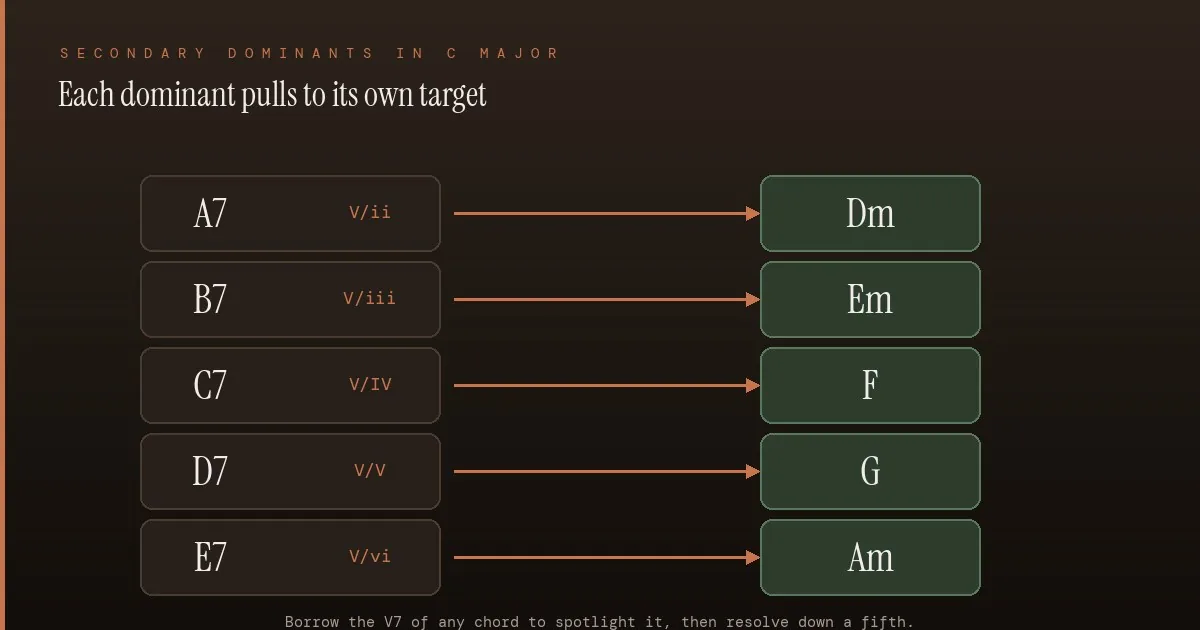
| Symbol | Chord in C major | Resolves to | Outside note |
|---|---|---|---|
| V/ii | A7 | Dm (ii) | C♯ |
| V/iii | B7 | Em (iii) | D♯ (and F♯) |
| V/IV | C7 | F (IV) | B♭ |
| V/V | D7 | G (V) | F♯ |
| V/vi | E7 | Am (vi) | G♯ |
To move this to another key, count scale degrees, not letter names: each secondary dominant is the major or dominant-seventh chord built a fifth above (a fourth below) its target.
V/V: "five of five," the most common one
V/V is the secondary dominant you will meet first and most often, because the chord it targets, the dominant, is already the most gravitational chord in the key. Hank Williams builds an entire hook on it: "Hey, Good Lookin'" sits in C major and runs C - D7 - G7 - C, where D7 (with its chromatic F#) is V/V pushing into G7, the real dominant. Dolly Parton's "9 to 5" does the same in F# major, where the chorus climbs B - G#7 - C#, and that G#7 is V/V driving home to the C# dominant. Same move, two very different songs.
V/IV: your tonic chord turned into a dominant seventh
V/IV is the sneaky one. The plain triad a fifth above IV is identical to your tonic chord, so the only way to make it function is to drop a flat-seventh onto your home chord. In C major, C becomes C7 and slides into F. Your tonic just went bluesy and turned into a dominant. It is the only secondary dominant in a major key built on a lowered note (that ♭7) rather than a raised leading tone. You hear it the instant the verse of the Beatles' "Something" moves C - Cmaj7 - C7 - F, and again when "Me and Bobby McGee" rolls G - G7 - C, and once more in Bob Dylan's "Don't Think Twice, It's Alright," where the tonic sprouts a seventh and tips down to IV on "look out your window." Learn this one and you will catch it everywhere.
V/vi: the bittersweet turn
V/vi points a bright, major dominant at your minor sixth chord, and the collision of that sunny setup with a minor landing is why it always sounds like a catch in the throat. In "Yesterday," Paul McCartney sits in F major and plays F - Em7 - A7 - Dm: the A7 is V/vi, and its C# leans hard into the D minor that carries the song's whole mood. The Bangles place a B7 (V/vi) at the very melodic peak of the "Eternal Flame" chorus before it settles onto Em. Charlie Puth saves his for a single dramatic moment: "One Call Away" waits until the final chorus to slip an F7 (V/vi) under the hook so the drums can crash back in on the B♭ minor.
Secondary dominant, borrowed chord, or key change: what's the difference?
These three get tangled constantly, but the distinction is clean. A secondary dominant borrows a dominant function and aims it at a chord already inside your key. A borrowed chord borrows color from a parallel key that shares your tonic. A key change actually relocates the song's center of gravity to a new home. The first two are guests; the third moves in.
The test is what happens next. If the music snaps back home right after the surprising chord, you tonicized: you gave one chord a moment in the spotlight without leaving the key. If the following chords settle into a new key and stay there, you modulated. Theorists put it plainly: a tonicization that outlasts a phrase has become a modulation. So the same D7 in C major can be a fleeting V/V or the doorway into the key of G, and only the bars after it decide which. When you are reading a chart, resist labeling anything until you see where the progression settles.
How do secondary dominants work in a minor key?
Minor keys get secondary dominants too, aimed at the five stable targets there: III, iv, V, VI, and VII. As in major, the two diminished chords (ii° and vii°) are off-limits, since a diminished chord is too shaky to impersonate a tonic. Worked in A minor, the set looks like this.
| Symbol | Chord in A minor | Resolves to | Note |
|---|---|---|---|
| V/III | G7 | C (III) | Already in the key (same as the diatonic ♭VII7) |
| V/iv | A7 | Dm (iv) | C♯ is the outside note |
| V/V | B7 | E (V) | D♯ and F♯ add real color |
| V/VI | C7 | F (VI) | B♭ is the outside note |
| V/VII | D7 | G (VII) | F♯ is the outside note |
The wrinkle worth knowing: V/III in a minor key is not chromatic at all. Its notes already live in natural minor, so it is identical to the ordinary subtonic seventh chord (♭VII7). Context and resolution, not spelling, tell you which label fits. The two most useful colors are V/iv and V/V, and B7 driving to the E chord is the sound of countless minor-key choruses tightening before they resolve.
What is a chain of secondary dominants?
Because each secondary dominant resolves down a fifth, you can line several up in a row so each one is the dominant of the next, a domino run around the circle of fifths that only comes to rest on the tonic. The classic pop-and-jazz form is the "ragtime progression," which in C major is C - E7 - A7 - D7 - G7 - C. Every chord after the first is a dominant seventh yanking the ear toward the next link.
You already know these by ear. The 1925 standard "Five Foot Two, Eyes of Blue" is essentially this chain end to end (E7 = V/vi, A7 = V/ii, D7 = V/V, G7 = V). "Sweet Georgia Brown" runs D7 - G7 - C7 - F, where D7 is a dominant of a dominant of a dominant (an extended dominant, V/V/V) reaching back two links, G7 is V/V, and C7 is the true V. The bridge of Gershwin's "I Got Rhythm," the source of the "rhythm changes" every jazz musician learns, is nothing but D7 - G7 - C7 - F7 back to B♭. Phil Spector even built the bridge of "Be My Baby" on a four-chord dominant chain (G#7 - C#7 - F#7 - B7) before it drops home to E. String them together and the key blurs deliciously until the last dominant lands.
What happens when a secondary dominant doesn't resolve as expected?
A secondary dominant is defined by the chord it points at, not by where it actually lands, so it keeps its label even when a songwriter dodges the obvious resolution. That evasion is often the best part. The Beatles' "Eight Days a Week" is the textbook case, and it is craftier than most write-ups admit.
The song is in D major, and the famous opening riff runs D - E - G - D. That E major is V/V, promising an A chord, but the verse never delivers one: the E slides to G (IV) instead and the phrase drifts plagally back home, a deliberate tease. Only in the bridge does that same E finally reach its A target, and even then it detours through G (IV) first, so the E chord's G# grinds against the following G-natural in a "false relation" that gives the passage its restless edge. The lesson for your own writing: setting a secondary dominant up and then denying its landing is a move, not a mistake.
How do you spot a secondary dominant in a chord chart?
Three quick passes will catch almost every one. First, scan for a major or dominant-seventh chord whose root or quality is not diatonic to the key, especially a chord that "should" be minor showing up major (in C major, an E7 where you expected E minor). Second, look at the chord immediately after it: does the suspect resolve down a fifth (up a fourth) to a diatonic chord? Third, if it does, label it V/that-chord.
The mislabels to avoid are the common ones. In C major, E7 is V/vi, not "iii," even though the diatonic E chord is minor; the raised G# is what changed. D7 is V/V, not "II." When you write in scale-degree terms, a habit the Nashville Number System and Roman-numeral analysis both encourage, these chords announce themselves: any 7 that is not the V7 of your key is almost always the V7 of something else. Track where it points and the analysis writes itself.
Secondary dominants in real songs
Every example below was checked against multiple published chord charts and harmonic analyses. Use it as a listening list: play each song, wait for the row's chord, and hear the outside note pull.
| Song | Artist | Key | The move | Function |
|---|---|---|---|---|
| Yesterday | The Beatles | F major | A7 → Dm | V/vi |
| Something | The Beatles | C major | C7 → F | V/IV |
| Hey, Good Lookin' | Hank Williams | C major | D7 → G7 | V/V |
| 9 to 5 | Dolly Parton | F♯ major | G♯7 → C♯ | V/V |
| Eternal Flame | The Bangles | G major | B7 → Em | V/vi |
| One Call Away | Charlie Puth | D♭ major | F7 → B♭m | V/vi |
| Me and Bobby McGee | Kris Kristofferson / Janis Joplin | G major | G7 → C | V/IV |
| Don't Think Twice, It's Alright | Bob Dylan | E major | E7 → A | V/IV |
| Isn't She Lovely | Stevie Wonder | E major | F♯9 → B7 | V/V |
| The Longest Time | Billy Joel | E♭ major | F7 → B♭ | V/V |
| Be My Baby | The Ronettes | E major | G♯7-C♯7-F♯7-B7 | chain |
| Five Foot Two, Eyes of Blue | Ray Henderson (1925) | C major | E7-A7-D7-G7 | chain |
| I Got Rhythm | George Gershwin | B♭ major | D7-G7-C7-F7 (bridge) | chain |
How Song Cage builds secondary dominants for you
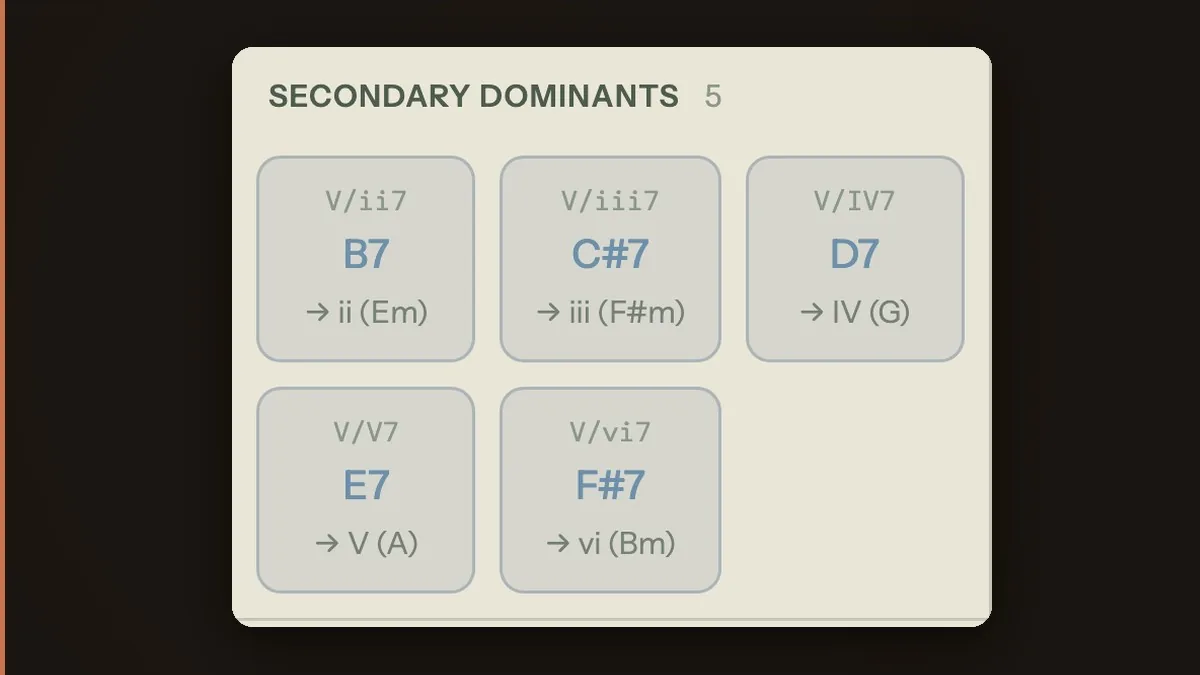
Song Cage is a songwriting app that spells these chords out for you instead of making you work the theory by hand. Its chord palette knows your key and sorts every chord into three tabs, In Key, Borrowed, and Secondary Dominants, so the exact five for wherever you are writing are always one click away, each labeled with the chord it resolves to. No counting fifths, no double-checking accidentals.
The Secondary Dominants tab lists the V-of-each-diatonic-chord for your current key and tags each one with its target (V/ii, V/vi, and so on), so the theory in this article is already done and named on screen. Place one and it drops into audition mode first: you hear it against the surrounding chords, on your choice of guitar or piano voicing, before it commits to the timeline. Automatic key detection keeps the palette correct even after you change keys mid-song. If you want the full mechanics, the chord progressions guide walks through the palette, voicings, and how suggestions are ranked against your melody.
Try a secondary dominant in your next progression
Open the chord palette, pick the Secondary Dominants tab, and drop a V/V or V/vi into a spot that feels flat. Hear it before you keep it.
Frequently Asked Questions
What is a secondary dominant in simple terms?
It is a chord that acts as the "V" (the dominant) of a chord other than your key's home chord. Normally the dominant pulls toward the tonic; a secondary dominant aims that same strong pull at a different chord inside the key, making it feel like a temporary home for a moment. In C major, a D7 pulling to G is a secondary dominant (V/V), because D7 is the dominant of G.
What is the difference between a dominant and a secondary dominant?
The primary dominant is the V chord of your actual key, and it pulls to the tonic (in C major, G7 to C). A secondary dominant is the V chord of some other diatonic chord, and it pulls to that chord instead (in C major, A7 to D minor). The primary dominant is built only from notes in the key; a secondary dominant always adds one chromatic note from outside it.
Is V/V a secondary dominant?
Yes. V/V, read "five of five," is the most common secondary dominant of all: the dominant of your dominant. In C major that is a D or D7 chord resolving to G. Its outside note, F#, is the leading tone of G and pulls the ear up into it. You hear it in songs from "Hey, Good Lookin'" to "9 to 5."
How do you find secondary dominants in a song?
Look for a major or dominant-seventh chord that is not in the key, especially a chord that "should" be minor showing up major. Then check the chord right after it: if the suspect resolves down a fifth (up a fourth) to a diatonic chord, it is a secondary dominant, and you label it V/target. In C major, an E7 moving to A minor is V/vi.
Can you use secondary dominants in a minor key?
Yes. A minor key has five targets: III, iv, V, VI, and VII (the two diminished chords cannot be tonicized). The most colorful are V/iv and V/V. One quirk: V/III in minor uses only notes already in the key, so it is identical to the ordinary ♭VII7 chord, and only the resolution tells you which label fits.
Do secondary dominants change the key?
Not by themselves. A secondary dominant tonicizes a chord, giving it a brief spotlight, while the song stays in its home key. If the music returns home right after, it is a tonicization. If the following chords settle into a new key and stay there, the tonicization has grown into a modulation, an actual key change.