Table of Contents
- What is a Picardy third?
- What's the difference between a minor third and a major third?
- Why is it called a Picardy third?
- Why does a Picardy third sound so final?
- What does the melody do at a Picardy third?
- Why does a sung minor third clash with the major chord?
- Where did Bach put the raised third?
- When should the sung note rise a half step instead?
- How do you write a Picardy third at the end of a song?
- How does Song Cage handle the sung note?
- Can you use a Picardy third at the end of a verse or chorus?
- What songs use a Picardy third?
- Which classical pieces end with a Picardy third?
- Which Christmas carols end with a Picardy third?
- What is a reverse Picardy third?
- When should you not use a Picardy third?
- Frequently Asked Questions
Play a song in A minor and stop on the last chord. Now play the same ending with A major instead. One note changed, C became C sharp, and the ending turned bright. That move has had a name since the 18th century: the Picardy third. Classical composers used it so often that it became a cliché, and the Beatles, Roberta Flack and Radiohead all used it anyway. The guides that rank for it explain the chord and skip the tune, which is where songwriters get stuck: if your melody is sitting on that C when the band hits A major, the two rub against each other. Below is the chord, the name, why it works, what the melody has to do, the songs and carols that use it, and the reverse move.
Quick Summary
A Picardy third is a major chord on the home note at the end of a minor-key song or section: A minor ends on A major. Only the chord's third moves, up a half step (C to C♯). The chord fixes the harmony, but a melody holding the old minor third will clash with it, so the tune should land on the root or the fifth, or rise with the chord. Bach's chorale endings almost always leave the raised third to an inner voice.
What is a Picardy third?
A Picardy third is a major tonic chord at the end of a piece or section in a minor key. A song in A minor ends on A major instead of A minor. The chord's root and fifth stay put and its third rises a half step, C to C♯, so one note turns a dark ending bright.
The French name is tierce de Picardie, and you'll see both. It's usually the last chord, but it doesn't have to be: a verse or chorus can end on the major chord and then drop back to minor for the next section, which is how the Beatles use it in "I'll Be Back." It happens at a cadence, and it's also a borrowed chord: A major belongs to the key of A major, the parallel major of A minor, and the song borrows it for one moment.
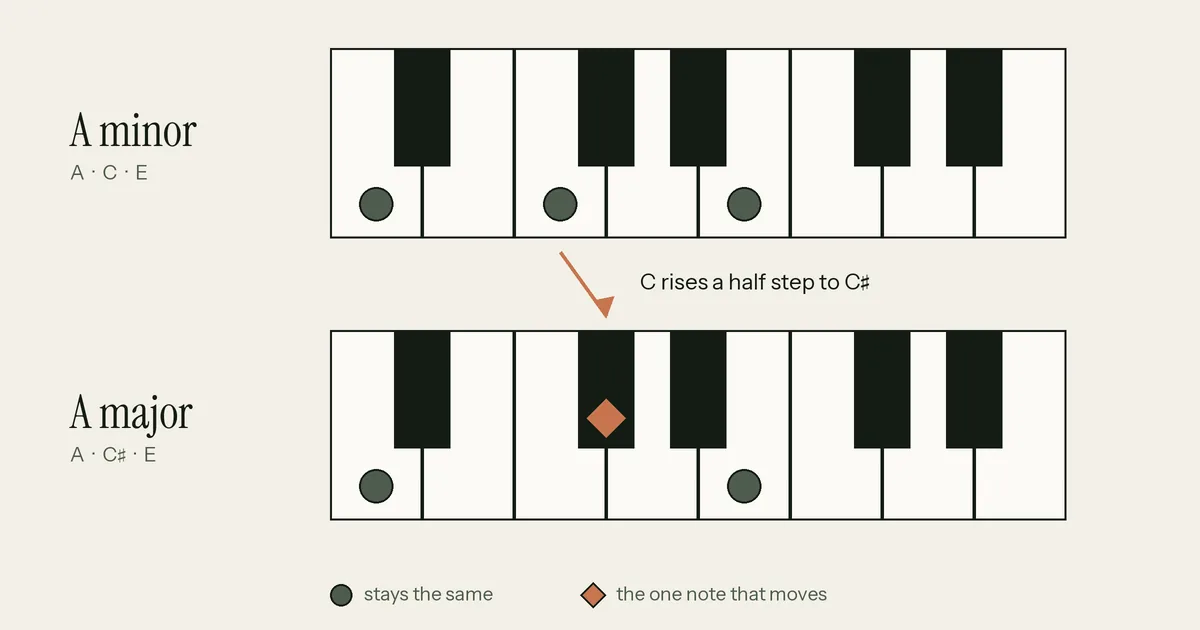
The approach is up to you. A Picardy third can follow the dominant (E to A), the four chord (Dm to A), or the flat seven (G to A). What makes it a Picardy third is the arrival: home, but major.
What's the difference between a minor third and a major third?
A minor third spans three half steps and a major third spans four. From A, the minor third is C and the major third is C♯. A minor chord stacks a minor third under a major third (A, C, E); a major chord does the reverse (A, C♯, E). The Picardy third swaps the first for the second.
On a keyboard, count the keys, black and white, from A: B♭, B, C is three steps up, and C♯ is the fourth. That single key is the whole difference between the two chords, which is why the change sounds so large and costs so little. The fifth (E) is the same in both, and so is the root.
A common mix-up: C up to A is not a third at all. Going up from C, A is a major sixth. The third is measured from the root of the chord, so the question is always "how far is the third note above A?" and never the other way round.
Why is it called a Picardy third?
Nobody knows for certain. The name is first explained by Jean-Jacques Rousseau, whose Dictionnaire de musique (dated 1768) says musicians call it that "as a joke" because the habit survived longest in church music, and Picardy, in northern France, had music in a great many cathedrals and churches.
Rousseau's entry is on pages 514 and 515 of the Dictionnaire. He'd already written nearly the same words for the article "Tierce" in volume 16 of Diderot and d'Alembert's Encyclopédie, whose title page is dated 1765, so you'll see different dates around the web. Rousseau didn't like the device much. He wrote that the ending, though harmonious, had quelque chose de niais & de mal-chantant, something silly and badly sung about it, which was why it had been dropped.
Other theories followed. The linguist Robert A. Hall Jr. proposed in 1975 that "Picardy" comes from the Old French picart, meaning pointed or sharp, a nod to the sharpened third. That's a theory, and others have challenged it. The first edition of Grove's dictionary suggested the name "may perhaps be accounted for by the proximity of Picardy to Flanders." The Concise Oxford Dictionary of Music still says "Reason for name unknown." It's pronounced PICK-er-dee.
Why does a Picardy third sound so final?
Because one note changes and nothing else does. The root and fifth hold still while the third rises a half step, so the ending feels like the same chord coming into the light rather than a new place. In the 1500s a minor third in the final chord was already heard as harsh, and the major third was written in on purpose.
The rule was written down early. In 1533 the theorist Stefano Vanneo said a minor third in the final chord of a cadence should be made major with a sharp, because the minor third "is held to be not very sweet, indeed rather harsh" (parum suauis, immo duriuscula habetur), as quoted by Thomas Synofzik in his 2012 history of the device. The other common answer was to leave the third out: medieval cadences, Machaut's among them, typically end on bare fifths and octaves, and in 1725 Johann Joseph Fux still advised dropping the third from a final chord when the mode's third is minor.
The acoustic explanation is a theory, not a settled fact. Rameau argued that a vibrating string's overtones contain only the major triad (for A, the fifth harmonic is C♯), and Helmholtz argued in 1863 that minor triads are less consonant in pure tuning. What's measured is the habit: in Trevor de Clercq's 2015 study of the Bach chorales, minor-key chorales ending on a Picardy third "outnumber those without a Picardy third ... by a 10-to-1 ratio."
What does the melody do at a Picardy third?
It has to stay out of the chord's way. If your melody is singing the minor third (C in A minor) when the band plays A major, the sung C grinds a half step against the chord's C♯. Land the tune on the root or the fifth, raise the sung note with the chord, or hand the raised third to a harmony part.
This is the part of the Picardy third that chord charts leave out, and it's the part a songwriter hears first. Changing the last chord from Am to A takes one click in most apps. But a melody written over Am was written to fit Am, and a minor-key tune can easily come to rest on the minor third, a stable note of the chord it was written over. Swap the chord under it and that note goes from stable to wrong in an instant.
So before you change the chord, look at the last note of the tune, and every note sung over that final chord. If none of them is the minor third, you're done. If one is, you have three choices, covered below: move the melody off it, move it up with the chord, or keep the clash on purpose.
Why does a sung minor third clash with the major chord?
Because C and C♯ are a half step apart, the closest two different notes can be. When one voice sings C natural while the chord holds C♯, theory calls it a false relation, or cross-relation. It sounds less like a colour and more like someone singing the wrong note.
In a slow ballad the effect is usually just that: the singer sounds flat. There is one style where the same clash is the point. In the blues, a minor or bent third sung over a major chord is the sound of the genre, and Rob van der Bliek writes in the journal Popular Music that in blues practice "minor thirds or slightly flattened major thirds" sit "comfortably over major thirds played in the accompaniment." Spelled as B♯, the C natural over A is the sharp nine of an A7♯9, the chord guitarists call the Hendrix chord.
So the test is the song around it. If your verse already bends its thirds and the band plays dominant sevenths, a sung C over a final A can sound right. If the song is a minor-key ballad with clean chords, the same note will sound like a non-chord tone that never resolves. Listen to both before you decide.
Where did Bach put the raised third?
Almost never in the melody. In our count of Bach's chorales, 137 minor-key settings end on a major chord, and the raised third sits in the tenor 99 times, the alto 37 times and the soprano, which carries the tune, once. In 147 of 148 minor chorales the melody's last note is the home note.
We counted Craig Sapp's public encoding of Bach's 370 chorales, duplicates included. Of the 148 in a minor key or Dorian that end with the home note in the bass, 137 end on a major chord and 11 on a minor one, close to de Clercq's ten to one. The single soprano case is BWV 313. This is our own tally, not a published figure.
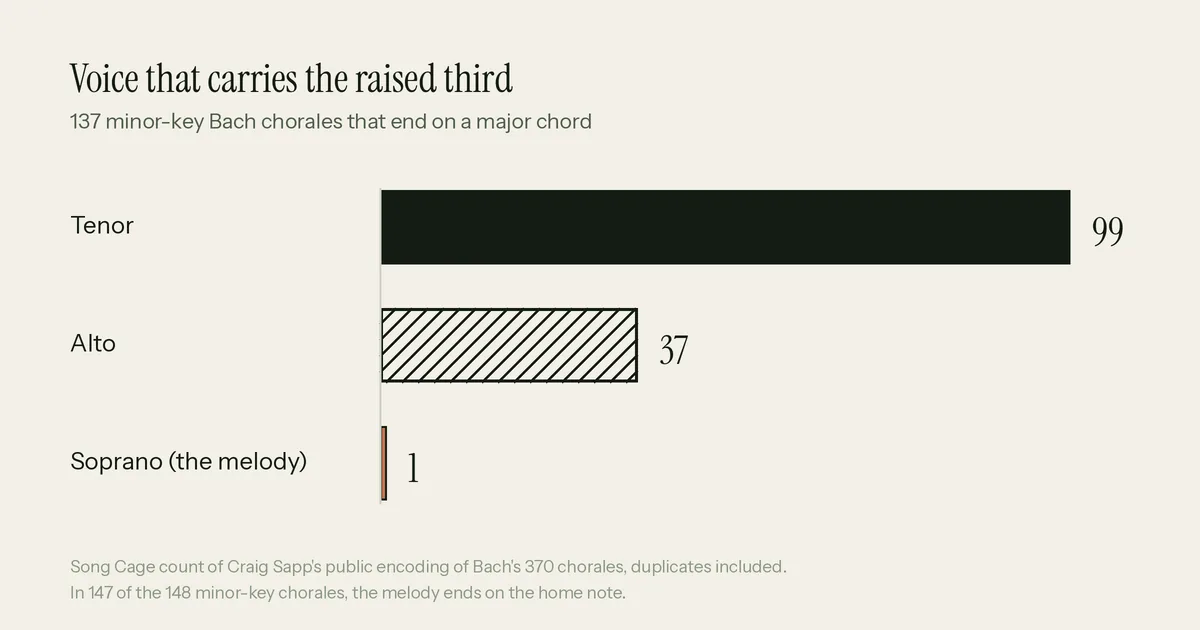
Bach wasn't alone. In The Division-Viol (1665), Christopher Simpson wrote that in a minor key it is "in my opinion" better to end the treble on the octave "than to have the Treble end in the sharp Third; that Concord being more proper to some inward Part at a Conclusion." For a songwriter that's the simplest fix there is: end the tune on the root, and let the guitar, the piano or a harmony vocal carry the raised third.
When should the sung note rise a half step instead?
When the melody belongs on the third and the song wants the lift in the voice. The "Coventry Carol" does this in its tune: in modern four-part settings its melody ends on B natural in G minor, the major third of a G major chord.
Raising the note works best when the note is held to the end or steps to a neighbour. A held C that becomes C♯ in the last bar sounds deliberate, and so does C♯ stepping on to B or D. A leap straight off the new note is harder for a singer to tune.
Sometimes the singer finds it alone. Writing about Janis Joplin's "Summertime" with Big Brother and the Holding Company (1968), the musicologist Paul Machlin notes that her closing vocal gesture, "a descent to the raised third degree of the scale that comes almost as an afterthought, seems to function rather like the tierce de Picardie."
The other way out is to write a melody that never needs the third. As the musician David Bennett points out, "My Favorite Things" moves from minor verses to a major third verse without touching the tune, because it's built from the first, second and fifth notes of the scale, which minor and major share.
How do you write a Picardy third at the end of a song?
Pick the chord that leads into it, then check the melody. Any approach that works into the minor home chord works into the major one: the dominant (E to A in A minor), the four (Dm to A), the flat seven (G to A) or a full descent (Am, G, F, E, A). Then fix any sung minor third over the last chord.
| Approach | In A minor | Sounds like | Heard in |
|---|---|---|---|
| V to I | E to A | The classical ending; strongest pull | Bach's chorales |
| iv to I | Dm to A | The "amen"; soft and hymn-like | Hymn "amen" endings |
| ♭VII to I | G to A | A whole step up into home | Rock and folk endings |
| ♭VI, ♭VII to I | F, G to A | A climb that lands bright | "This Wheel's on Fire" chorus |
| i, ♭VII, ♭VI, V to I | Am, G, F, E to A | A descending bass, then light | "I'll Be Back" verses |
Capital I means the home chord is major. The V chord in a minor key is usually major too, borrowed from harmonic minor.
Save it for the last time through. A Picardy third on every chorus wears out; held back for the final chorus or the last chord, it sounds like the song arriving somewhere. The common minor keys map simply: Am ends on A, Em on E, Dm on D, Bm on B, Gm on G and Cm on C, and our guide to minor chord progressions lists the chords that lead there. On guitar, each of the open minor chords turns major by raising one note a fret: the C on the B string for A, the open G string for E, and the F on the high E string for D.
How does Song Cage handle the sung note?
Turn on Borrowed Notes (Settings, Input). In a minor-key section, pick A from the Borrowed group, where it reads I and ionian, or press Shift+1. If the melody holds a C under that chord, the chip shows a C♯ tag, and trying it moves the sung note up with the chord.
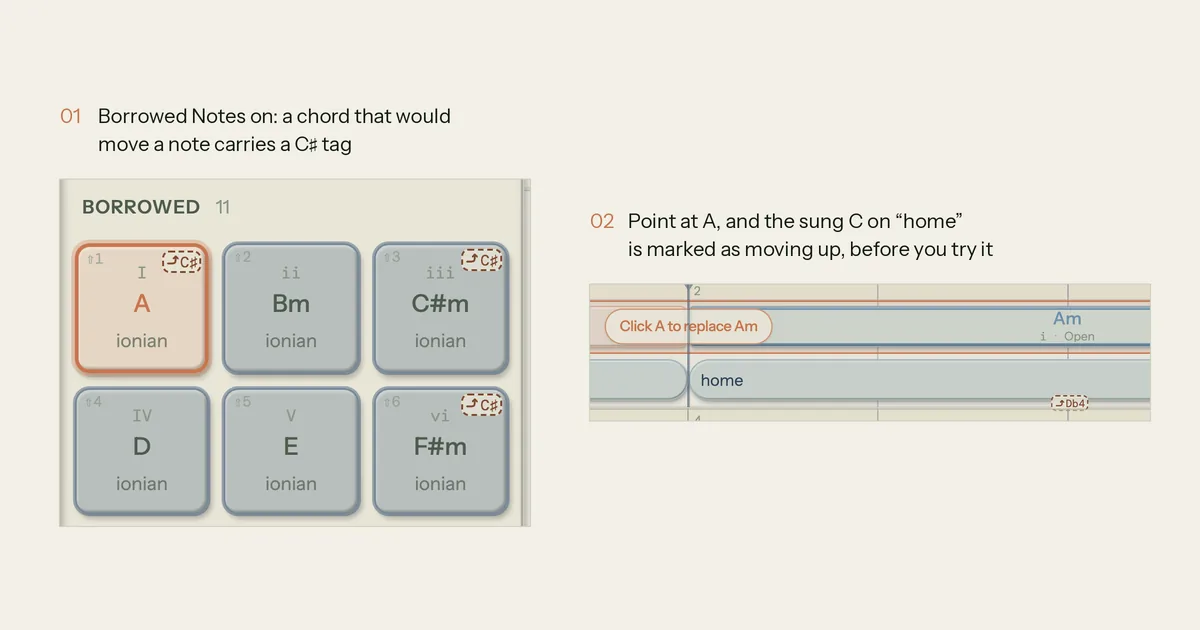
The setting is off by default, so nothing ever touches your melody unless you switch it on. With it on and the last chord selected, every chord that would move a note carries the tag before you try it, and trying a chord lets you hear the moved note with it, so you can compare the ending both ways before you keep anything. All the Cs under that one chord move together. Notes under other chords stay as you wrote them.
It only moves a note it can move cleanly: one held to the end of the section or to a rest, or one that steps on to the next note. If the tune leaps away from the C, or another note under the chord would clash, the C stays where you put it. It works at the end of any section, not only the end of the song. The chord suggestions rarely offer the major I here, so pick it yourself. The Borrowed Notes chapter has the details. It's in the web app, the Mac and Windows desktop app and the plugin. It isn't in the iPad app yet.
Can you use a Picardy third at the end of a verse or chorus?
Yes, and pop songs often use it there, not only at the very end. A verse or chorus that closes on the major home chord gives the section a bright full stop, and the next section can drop straight back to minor. The trick is that the major chord leans forward instead of sounding final.
In "I'll Be Back" (1964), each six-bar verse phrase runs A minor, G, F, E and lands on A major instead of A minor, and Alan W. Pollack traces how the song keeps trading the two. In "Things We Said Today," from the same album, the A minor verses that lead into the bridges end on a surprise A major. Each chorus of The Band's "This Wheel's on Fire" (1968) climbs F, G, A in an A minor song. In Roberta Flack's "Killing Me Softly with His Song" (1973), each chorus resolves to F major instead of F minor, and that F major then works as the dominant that leads into the B♭ minor verse.
That last one shows why a mid-song Picardy third doesn't stop the song. A major is one note away from A7, and A7 is the dominant of D minor, the four chord of the key. A major home chord in the middle of a song tends to pull onward. Use too many and each one starts to sound like a false ending.
What songs use a Picardy third?
Plenty, especially since the 1960s. The Beatles used it on "And I Love Her," "I'll Be Back" and "A Taste of Honey"; later examples include Yes's "Roundabout," Radiohead's "Exit Music (For a Film)" and Seal's "Kiss from a Rose."
| Song | Artist, year | Minor key | Where the major chord lands |
|---|---|---|---|
| A Taste of Honey | The Beatles, 1963 | F♯ minor | The final chord, F♯ major |
| And I Love Her | The Beatles, 1964 | D minor (after a half-step lift) | The final chord, D major |
| I'll Be Back | The Beatles, 1964 | A minor | The end of each verse phrase |
| Happy Together | The Turtles, 1967 | F♯ minor | The choruses and the last chord, F♯ major |
| Time of the Season | The Zombies, 1968 | E minor | The title line, A minor to E major |
| Tin Angel | Joni Mitchell, 1969 | E minor | The closing line of the refrain |
| Roundabout | Yes, 1971 | E minor | The last chord, on acoustic guitar |
| Killing Me Softly with His Song | Roberta Flack, 1973 | F minor (chorus) | The end of each chorus |
| Under the Bridge | Red Hot Chili Peppers, 1991 | A minor (outro) | The outro keeps resolving to A major |
| Kiss from a Rose | Seal, 1994 | G minor | The last chord of the album version |
| Exit Music (For a Film) | Radiohead, 1997 | B minor | The verse close (Bsus4 to B) and the last chord |
| Ain't Talkin' | Bob Dylan, 2006 | G♯ minor | The final chord |
"Time of the Season" fades out on its minor vamp, so the Picardy third is in the title line, not the last chord.
Two stories stand out. On "And I Love Her" the song moves up a half step for the guitar solo and finishes on a D major chord in a D minor context, which Pollack calls "the Piccardy Third." And Roberta Flack chose her ending herself: as quoted on Wikipedia, she said she "chose to end on a major chord" and that the song "wasn't written that way."
Which classical pieces end with a Picardy third?
A great many, because from the late 1500s to Bach's time it was the usual way to end a piece in minor. Famous ones include Bach's Prelude in C minor from Book I of The Well-Tempered Clavier, his Passacaglia and Fugue in C minor, the first movement of Beethoven's last piano sonata, Op. 111, and the end of Carl Orff's "O Fortuna."
Bach's C minor Prelude (BWV 847) ends on a low C with E natural on top, and almost every minor-key movement in Book I of the Well-Tempered Clavier avoids a minor final chord. Beethoven's Op. 111 turns to C major in the closing bars of its stormy first movement. Chopin's posthumous Nocturne in C♯ minor ends on C♯ major. In "O Fortuna" (1937), Wikipedia notes that "the last syllable of the song shifts in both key and emotional valence, from D minor to D major."
One famous piece is often listed by mistake. Bach's Toccata and Fugue in D minor, BWV 565, does not end with a Picardy third: its slow final cadence lands on D minor. Only the opening flourish resolves to a D major chord.
Which Christmas carols end with a Picardy third?
Fewer than you'd think in print, and more than you'd think in church. The "Coventry Carol" has one in its tune. "O Come, O Come, Emmanuel" and "What Child Is This?" end on minor chords in the hymnal settings we checked, but organists and pianists may finish them major by choice.
The "Coventry Carol" is the real one: its tune ends on B natural in G minor, so the last chord is G major with the raised third in the melody. For the others it's the player's call. The printed four-part settings of "O Come, O Come, Emmanuel" in the Cyber Hymnal and the Methodist Hymn Book (1933) both end on E minor, yet on an organists' forum, one player who calls the device "totally hackneyed and passé" admits, "Veni Emmanuel is my one exception - I do play a Picardie third on the last chord!" The piano teacher Duane Shinn puts it this way: "if you want to end on a Picardy third, you can. It's traditional to do that sometimes if you hear Greensleeves or What Child Is This?"
Two others don't have one in their standard settings. John Stainer's standard 1867 harmonization of "God Rest Ye Merry, Gentlemen" ends on E minor, and "We Three Kings" moves to its relative major, G, for the refrain, which is a different move. Even the hymn tune named PICARDY ("Let All Mortal Flesh Keep Silence") ends on D minor in the English Hymnal (1906). If you're writing a Christmas song in a minor key, the Coventry Carol's trick, putting the raised third in the tune itself, is worth borrowing.
What is a reverse Picardy third?
It's the opposite move: a song in a major key that ends on the minor home chord, C major ending on C minor. It has no settled name, and it's rare. In 1911 the critic J. A. Fuller Maitland, writing about a Brahms rhapsody, called it "most rare, then and later."
The Brahms is the Rhapsody in E♭ major, Op. 119 No. 4 (1893), whose coda ends in E♭ minor. Mendelssohn's "Italian" Symphony starts in A major and ends in A minor, because its last movement stays minor throughout. Satie's first Gymnopédie (1888) begins in D major and ends on D minor, with the same cadence ending major the first time and minor on the repeat.
Pop uses it inside songs more than at the end. The Beatles' "The Fool on the Hill" (1967) has D major verses and D minor refrains, and in "When I Get Home" (1964) the refrain starts in A major and turns to A minor near its end, which Pollack describes as "the arrival of a minor in a place where you expect it to be Major." The melody rule flips too: a tune holding the major third (E in C major) has to come down a half step to E♭ when the chord turns minor, or move off the third.
When should you not use a Picardy third?
When the song hasn't earned the lift. A bright last chord after a sad lyric can sound like a forced smile, and in some styles the device is so familiar it reads as a cliché. It also doesn't suit an ending that is meant to stay open, or a stressed word that sits on the minor third and can't move.
The cliché charge is old. Rousseau already found it silly in 1768, and the organist above calls it "totally hackneyed and passé." The more useful test came from Telemann, who wrote in his 1730 hymn book (as quoted by Synofzik) that a minor-key hymn should normally end minor, "since what sounds at the beginning can also sound at the end," and allowed the major third when the words express splendour, joy, wonder, terror or anger. That's still a good rule: let the last line of the lyric decide.
Skip it, too, when the home chord is already major. A standard major-key blues sits on a dominant seventh chord at home, so there's nothing to raise. And count how many of your sections already end on the major chord: if three in a row land there, the final one has nowhere left to go.
Frequently Asked Questions
Is a Picardy third a key change?
No. The song stays in the minor key and borrows one chord, the major tonic, for the ending. A key change moves the home note or the scale for a whole passage. A Picardy third changes one note of one chord, usually the last.
Is a Picardy third a borrowed chord?
Yes. The major tonic belongs to the parallel major key (A major for A minor), so a Picardy third is a borrowed chord, an example of what theory calls modal mixture.
Does a Picardy third have to be the last chord?
No. It can end any section. In "I'll Be Back" every verse phrase ends on A major before the song returns to A minor, and in "Killing Me Softly with His Song" each chorus ends on F major. A mid-song major tonic tends to pull forward rather than sound final.
Is ending on the relative major the same thing?
No. The relative major of A minor is C major, a different home note. A Picardy third keeps the home note, A, and only changes its third. "We Three Kings" moves from E minor to its relative major, G, for the refrain, which is a change of key, not a Picardy third.
How do you play a Picardy third on guitar?
Play the major version of the minor home chord. In A minor, end on A instead of Am; in E minor, E instead of Em; in D minor, D instead of Dm. In open position each change raises one note by a fret: the C on the B string, the open G string, or the F on the high E string.
How do you pronounce Picardy third?
PICK-er-dee, like the region of northern France it's named after. The French form is tierce de Picardie.
Hear your ending both ways before you keep it
Song Cage keeps borrowed chords, like the major I a Picardy third needs, in the same palette as the rest of your key. Turn on Borrowed Notes and the sung note under that chord can move with it, so you hear the melody and the chord change together. No canned progressions: you choose every chord by ear.