Table of Contents
- What is the Andalusian cadence?
- Why isn't it actually a cadence?
- Where does the descending bass line come from?
- How is it different from the lament bass?
- Is it a minor progression or a flamenco one?
- Which of the four chords are already in your key?
- What do you do on bar five?
- Which famous songs actually use it?
- Where Song Cage fits
- Frequently Asked Questions
The oldest famous version of this progression came with no chords attached.
When Claudio Monteverdi published the Lamento della ninfa in his Eighth Book of Madrigals in 1638, the accompaniment survived as a single line: A, G, F, E, repeated for the length of the piece. What a keyboard player was supposed to put above those four notes was never written down. Four centuries later it still has not been settled. In Performance Practice Review, Roland Jackson notes that the harmonisation "has not been agreed upon among scholars or performers, despite its critical bearing on the effect of the piece," and then spends an article arguing for one reading over another.
That argument never ended. It just moved. Open any two guides to Ray Charles's "Hit the Road Jack" and you will find the same disagreement about what belongs on top of the same four bass notes.
Quick Summary
The Andalusian cadence is four chords walking down a step at a time: in A minor, Am, G, F, E. Written as numbers it is i, ♭VII, ♭VI, V. Despite the name, it is almost never used as a cadence. It is a loop.
What is the Andalusian cadence?
The Andalusian cadence is a four-chord progression whose roots descend by step from the tonic to the fifth. In A minor it is Am, G, F, E. As numbers, i, ♭VII, ♭VI, V. The one chord that is not simply lifted from the minor scale is the last one: the V arrives major, not minor.
That single alteration is what makes the loop turn. Em, the chord the natural minor scale actually hands you on the fifth degree, has a G in it. E major has a G♯, a half step below the A you are heading back to. The Wikipedia entry calls the shape the "minor descending tetrachord," because the four roots are the top four notes of a natural minor scale played backwards.
The other common key on guitar is D minor: Dm, C, B♭, A. Flamenco players call the A minor shape por arriba and the D minor shape por medio, and the tradition extends to four more positions, including por granaína (Em, D, C, B) and por rondeña (F♯m, E, D, C♯).
Why isn't it actually a cadence?
Because a cadence happens once, at the end of a phrase, and this does not. It repeats. Wikipedia is blunt about it: "Despite the name it is not a true cadence... it is most often used as an ostinato." An ostinato is a figure that keeps coming back. The Andalusian cadence is a loop wearing a cadence's name.
This is not pedantry, and it is not a minority view. Players who write about the progression keep arriving at it unprompted, correcting the name in the same breath they teach the chords. One r/musictheory thread on the term puts it flatly: it "is NOT a cadence, but an ostinato whose name is a misnomer."
The distinction matters because it changes the question you should be asking. If it were a cadence, the useful thing to know would be how to arrive at it. It is not, so the useful thing to know is how to leave it. Four bars of Am, G, F, E sound wonderful. Sixteen bars of it sound like a backing track, and the songs that use it well nearly all do something specific at the point where a lesser song would simply go round again.
Where does the descending bass line come from?
It predates flamenco guitar, pop and the idea of chord progressions themselves. Ellen Rosand identified the stepwise fall from tonic down to dominant in 1979 as a prototypical ground bass, the "emblem of lament," and the label stuck to a pattern that had already been in use for centuries.
Tim Carter traces where it went in the Cambridge Companion to Monteverdi. The emblem, "in diatonic or chromatic form, and with or without a cadential extension," permeated Baroque music by way of Purcell's "When I am laid in earth" and the Crucifixus of Bach's B minor Mass, and carried into the Classical period as far as the opening of Mozart's D minor string quartet, K. 421.
The Renaissance connection is the one worth holding onto as a songwriter. Monteverdi's nymph is singing over a bass that never resolves and never stops, and that is the emotional engine: something underneath the song keeps sinking while the singer stays where they are. Every pop song further down this page inherits that. The Roland Jackson article weighs two competing harmonisations of it, i, vii, vi, V against i, v6, iv6, V, and comes down on the second. The bass is agreed. The chords never were.
How is it different from the lament bass?
They are relatives, and the difference is one of spelling. The lament bass is the same descent from tonic to dominant, but it comes in two versions: the diatonic one, which uses the four scale notes, and the chromatic one, which fills in every semitone in between.
The Andalusian cadence is the diatonic version, harmonised in root position with plain triads. In A minor that is four notes, A, G, F, E, and four chords sitting squarely on top of them.
The chromatic version walks A, G♯, G, F♯, F, E, and the harmony above it gets stranger with every step because most of those bass notes are not in the key at all. "Stairway to Heaven" is the standard example, and Robert Hutchinson lists it among four centuries of descending chromatic bass lines in his open theory textbook.
Worth separating from both: the line cliche, where the chromatic descent happens in an inner voice while the bass stays put. That is what "Something" does under "I don't want to leave her now," moving A, G♯, G, F♯ through Am, AmMaj7, Am7 and D7 while the harmony sits on A minor until the last step. Same falling sensation, different mechanism.
Diatonic descent is hypnotic. Chromatic descent is unstable and pulls hard toward a resolution. If the diatonic one feels too comfortable, either of the other two is the obvious next experiment.
Is it a minor progression or a flamenco one?
Both, and they disagree about which chord is home. Read as A minor, the loop ends on E, the dominant, and wants to fall back to Am. Read the way flamenco players read it, E is the tonic and the loop has already arrived. Same four chords, opposite destinations.
The flamenco reading treats the progression as sitting in the Phrygian mode. In a paper on the flamenco key, the linguist and flamenco scholar John Moore numbers it iv, III(7), II, I, with the final chord as the tonic rather than the dominant. The guitarist Manolo Sanlúcar goes further, assigning E the tonic function, F the dominant function, and Am and G the subdominant and mediant.
That inversion explains something you can hear. Flamenco pieces built on this progression end on the major chord and stay there. A pop song built on it ends on the minor chord, because pop hears the same E as a dominant that has one more job to do.
It also explains the ♭II. Where a minor-key reading hears F as the ♭VI, the Phrygian reading hears a B♭ as the chord with dominant pull, a Neapolitan that can be thought of as a tritone substitution for the V.
Which of the four chords are already in your key?
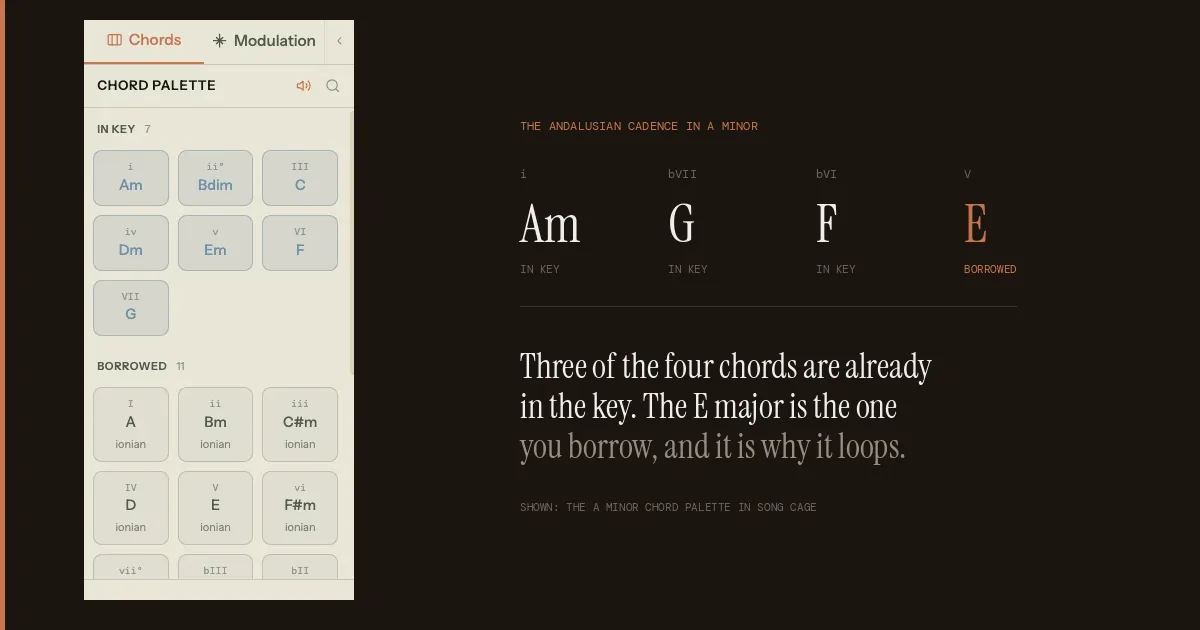
Three of them. In A minor, the seven chords the key hands you are Am, B°, C, Dm, Em, F and G. The Andalusian cadence uses three of those, i, ♭VII and ♭VI, without asking for anything. Only the final E major sits outside the key, and it is the entire reason the progression works.
This is worth stating plainly because the progression has a reputation for exoticism it does not deserve. It is not a Spanish scale, a mode you have to learn or a set of unusual shapes. On guitar in A minor it is three open chords and one barre, the F.
The chord that costs you something is the E. In the key of A minor the fifth degree naturally produces Em, and swapping it for E major imports a G♯ from outside the scale, the note the harmonic minor supplies. That borrowed note is the leading tone, and it is what turns an aimless descent into something that pulls back round to the top. If you want the wider picture of what a minor key does and does not give you, we covered it in minor chord progressions.
What do you do on bar five?
The songs that use this progression well almost never simply repeat it. They use the V at the bottom of the descent as a door. Because that chord is a functioning dominant, it can resolve back to the minor tonic, or it can be treated as the dominant of somewhere else entirely and used to change key.
"Good Vibrations" is the clearest demonstration. The verse is in E♭ minor and, per the song's harmonic analysis, runs i, ♭VIIadd6, ♭VIadd6, V, whole-step root movement Brian Wilson had already used in "Lonely Sea" and "Don't Hurt My Little Sister." Then he leaves. The chorus lifts into G♭ major, the relative major, functioning as ♭III. The loop does not wear out because it does not get the chance.
"Sultans of Swing" takes the other route and stays put. Mark Knopfler runs Dm, C, B♭, A twice in the verse and then breaks the pattern with F and C before returning, so the descent becomes a thing the song visits rather than a thing it is trapped in.
"California Dreamin'" ornaments the arrival instead. Recorded in C♯ minor and played in A minor with a capo, it delays the E7 with an E7sus4, holding the A in place where the G♯ wants to be, so the resolution lands a beat later than the ear expects.
Three exits, in order of how much they change
- Ornament the V. Suspend it, add the seventh, or approach it from a ♭II. Cheapest change, keeps the loop.
- Interrupt the descent. Run it twice, then go somewhere flat for two bars and come back, as "Sultans of Swing" does.
- Pivot on the V. Treat the major V as a dominant belonging to a different key and modulate out of the loop rather than round it. Our guide to how to change key in a song covers the mechanics.
Which famous songs actually use it?
Wikipedia's list is the one everybody copies, and it is worth reading with care. "Stray Cat Strut," "Happy Together," "Like a Hurricane," "Runaway," "California Dreamin'," "Good Vibrations" and "Sultans of Swing" all appear. So does "Walk, Don't Run," with a correction attached that most secondary sources drop.
The Ventures' 1960 surf hit uses the bass structure, but the first chord is A major rather than A minor, which Wikipedia flags as "a common misconception about the song." If you are collecting examples, that is a useful reminder: a descending A, G, F, E in the bass is not on its own proof of an Andalusian cadence. It tells you about the bass, not about the chords above it.
"Hit the Road Jack" is the sharpest case. Ray Charles's recording is usually written out as Am, G, F, E7 and cited as the definitive pop example. Yet a detailed piano breakdown of the song argues the standard reading is wrong for this particular record, that the major V's raised third "sounds and feels too much like European tonal music, not modal blues," and recommends a minor triad over the same bass instead.
Which is Monteverdi's problem again, in a different century. The four bass notes are not in dispute. The chords are.
Where Song Cage fits
In a minor key, Song Cage's chord palette puts the seven chords of the key in an In Key row and everything else a tap away, so the shape of this progression is visible before you play a note. In A minor, Am, G and F are In Key. E major is not; it sits in the Borrowed section, labelled V, one row down.
The part that matters for this progression is what happens after the second chord. The palette re-ranks its suggestions against what you have already placed, so putting Am then G pushes F up the list, and putting G then F pushes E up. The chip that appears carries a name: Andalusian cadence. You are not being handed a canned progression, you are being told what the move you are already making is called, and you can ignore it.
The ♭II is there too. Place the F and the Borrowed row offers B♭ alongside the E, which is the flamenco reading of the same moment sitting next to the pop one. Every chord carries its Roman numeral, so the choice between them reads as a decision rather than a guess. The chord palette documentation covers how the three rows are built.
See which chord you are actually borrowing
Song Cage labels every chord in your key by function, so a progression like this one reads as three chords from the key and one from outside it.
Frequently Asked Questions
What is the Andalusian cadence in A minor?
Am, G, F, E. The roots descend by step from the tonic to the fifth, and the final chord is E major rather than E minor. Flamenco players call this position por arriba. On guitar it is three open shapes and one barre chord.
Is the Andalusian cadence really a cadence?
No. A cadence closes a phrase once; this progression is nearly always used as an ostinato, a figure that repeats. Wikipedia says so directly, and so do most players who write about it. Treat it as a loop and the useful question becomes how to get out of it.
Why is the last chord major instead of minor?
Because the natural minor scale's fifth-degree chord has no leading tone. In A minor, Em contains G; E major contains G♯, a half step below the tonic. That raised note is what makes the loop pull back to the top instead of drifting. It comes from the harmonic minor.
Is this the same as the flamenco chord progression?
The chords are the same and the analysis is not. Flamenco treats the final major chord as the tonic and reads the progression in the Phrygian mode as iv, III, II, I. Pop treats it as a minor progression ending on the dominant. This is why flamenco pieces stop on the major chord and pop songs do not.
What is the Andalusian cadence in other keys?
D minor gives Dm, C, B♭, A, the flamenco por medio position and the one Dire Straits used. E minor gives Em, D, C, B. B minor gives Bm, A, G, F♯. The pattern is always i, ♭VII, ♭VI, V.
How do I stop it sounding repetitive?
Leave it. Run the loop twice rather than four times, then break the pattern, as "Sultans of Swing" does with F and C. Or use the major V as a pivot and modulate, as "Good Vibrations" does into its relative major chorus. Repetition is the progression's strength and its only real risk.
The Andalusian cadence is the rare bit of music theory for songwriters that arrives fully formed. It is a flamenco chord progression, a Baroque ground bass and a rock loop at once, and its descending bass line has been carrying songs for four hundred years without anybody agreeing on what should sit above it. That disagreement is not a gap in the record. It is the invitation.
For the wider family this belongs to, see our roundup of the most useful chord progressions for songwriters, and for the Phrygian mode it borrows its second identity from, the seven musical modes.