Table of Contents
- What does "the key of a song" actually mean?
- Do you need perfect pitch or sheet music to find the key?
- Step 1: Write the chords down, one section at a time
- What do you do with sus, 7th, slash and power chords?
- Step 2: Which key holds most of your chords?
- How many chords can two keys share?
- Step 3: Which chord feels like home?
- How do you test a chord by ear?
- Is the first or last chord always the key?
- What if the song never plays the home chord?
- Shortcuts that name the key fast, and when each one lies
- Does a dominant 7th chord always point to the key?
- Are two major chords a whole step apart always IV and V?
- Is it major or its relative minor?
- Why can't the chords alone tell C major from A minor?
- What does a major V chord in a minor song tell you?
- Why is "happy or sad" a bad way to tell major from minor?
- What if the chords don't fit one key?
- Is that odd chord a borrowed chord or a key change?
- Is a D, C and G song in D or G?
- Can a song have two keys?
- Does a capo change the key?
- How do you find the key of a song you're writing?
- How does Song Cage suggest a key for your chords?
- Practice: find the key of these progressions
- Frequently Asked Questions
When Lynyrd Skynyrd recorded "Sweet Home Alabama", the session produced an argument that is still going. The producer, Al Kooper, heard Ed King's guitar solo and told him he was playing in the wrong key. King's answer, as Kooper tells it in his memoir and Desi Serna retells it, was that the song is in G, because G is the chord the band ends on live. Kooper heard D as home. The song's main progression has three chords, D, C and G, and two people who made the record disagreed about which one is the key.
That is the useful version of this question. Most guides tell you to read the key signature or run the audio through a key-finder app. Neither helps when all you have is a chord sheet, a song you're learning by ear, or a song you're halfway through writing.
This guide works from the chords. It takes three steps, then covers the shortcuts that name a key in seconds, the cases where each shortcut lies, and what to do when a song won't fit one key at all.
Quick summary
To tell what key a song is in, write down its chords, find the key whose seven chords cover most of them, then decide which chord in that set feels like home. That home chord names the key. The first and last chord, a V to I move and a major V in a minor song are strong clues, but each one fails on some songs, so check them against your ear.
What does "the key of a song" actually mean?
A key has two parts: a home note, called the tonic, and a family of notes and chords built around it. Songs are written in a key because that home chord is where the music settles, and the other chords in the family lead away from it and back. Finding the key means finding both.

Wikipedia's definition is compact: a key represents "the most common pitches and the center of tonal stability," and it "has two components: a tonic pitch and a mode." The mode is major or minor for most songs, and the tonic is the note a piece is "oriented around and almost always conclude[s] with."
So "the key of G major" means two things at once. G is the chord that sounds like home, and the song draws most of its chords from the seven that belong to G major. You need both halves, because the same seven chords can belong to two different keys. More on that below.
Some keys turn up far more than others. Across more than 75,000 songs in Hooktheory's TheoryTab database, C major is the most common major key, at 15% of major-key songs, and A minor is the most common minor key, at 13%. Keys that sit well on a guitar, like G, D, A and E, follow close behind. That's a hint about where to guess first, not proof of anything.
Do you need perfect pitch or sheet music to find the key?
No. Perfect pitch lets you name a note by ear, but the key is about which chord feels like home, and almost anyone can hear that once they know to listen for it. You can check the note names on any instrument or tuner afterwards.
Sheet music helps less than people expect. The key signature at the start of a staff tells you which sharps or flats the song uses, but as Wikipedia puts it, "the key signature does not specify the tonic pitch." One sharp fits G major and E minor equally, and it also fits a song centred on D that uses a C major chord. You still have to decide where home is.
That's why this guide starts from chords. A chord sheet is the thing most players actually have, and chords carry more information about the key than a key signature does: which chords appear, which one the song keeps returning to, and which chord leads into it.
Step 1: Write the chords down, one section at a time
List every chord in the song, section by section, and simplify each one to a plain major or minor chord with the same root. A verse and a chorus can sit in different keys, so keep them separate until you know they agree. Then circle the chord each section starts on, ends on and keeps returning to.
Write the verse chords on one line, the chorus on the next, and the bridge on a third. Don't merge them into one list yet. A lot of songs put the verse in a minor key and the chorus in its relative major, and a merged list hides that. "Hotel California" is a well-known case, with a B minor verse and a chorus that leans toward D major, as the later section on two keys shows.
Then mark three things per section: the first chord, the last chord, and the chord that appears most often or lasts longest. You'll use all three in Step 3. Mark the chords that fall on the first beat of a bar too. In a study of 200 rock songs, David Temperley and Trevor de Clercq found that the tonic chord is much more frequent in metrically strong positions, which they defined as the downbeat of an odd-numbered bar, than elsewhere.
If you're working from a recording, you don't need every passing chord. The chords under the main sections are enough.
What do you do with sus, 7th, slash and power chords?
Reduce each one to its root and its basic quality, because the key depends on those two things and not on the colour on top.
- 7th and extended chords: Em7 counts as Em, Cmaj7 as C, Dadd9 as D. Keep a note of any dominant 7th (like A7 or E7), because it's a clue in its own right, covered below.
- Sus chords: Dsus4 and Dsus2 have no third, so they're neither major nor minor. Count them as D and let the other chords decide the quality.
- Slash chords: in G/B the chord is G and B is only the bass note. Count it as G.
- Power chords: E5 is just E and B with no third. Riff-based songs full of power chords are decided by the resolution, which is Step 3, more than by the chord list.
Step 2: Which key holds most of your chords?
Every major key has the same pattern of seven chords: I, ii, iii, IV, V, vi and vii°, meaning three major chords, three minor chords and one diminished chord. Compare your chord list against the keys below and find the one that contains most or all of your chords.
The pattern comes straight from the major scale. Open Music Theory lists it as I major, ii minor, iii minor, IV major, V major, vi minor and vii° diminished. Here it is in the keys guitarists and pianists use most:
| Key | I | ii | iii | IV | V | vi | vii° |
|---|---|---|---|---|---|---|---|
| C major | C | Dm | Em | F | G | Am | Bdim |
| G major | G | Am | Bm | C | D | Em | F♯dim |
| D major | D | Em | F♯m | G | A | Bm | C♯dim |
| A major | A | Bm | C♯m | D | E | F♯m | G♯dim |
| E major | E | F♯m | G♯m | A | B | C♯m | D♯dim |
| F major | F | Gm | Am | B♭ | C | Dm | Edim |
| B♭ major | B♭ | Cm | Dm | E♭ | F | Gm | Adim |
Each row is also its relative minor: the vi chord is the minor key's home. A minor uses the same chords as the C major row, E minor the G major row, and so on, though minor songs often swap in a major V chord (E instead of Em in A minor).
Take "Knockin' on Heaven's Door." Its chords are G, D, Am and C, and all four sit in the G major row as I, V, ii and IV. Hooktheory lists the song in G major. The match took one glance.
Most songs won't match perfectly. One or two chords from outside the row is normal, and the later section on borrowed chords explains what they are. Pick the row that covers the most chords, and note which ones don't fit.
How many chords can two keys share?
More than most guides admit. wikiHow's guide to this topic says most keys have one or two chords in common, "but never more than 2", and that isn't true. Look at the table: C major and G major share C, Em, G and Am. That's four of seven. Any two keys next to each other on the circle of fifths share four chords, which is why a short chord list can fit two keys.
The bigger overlap is between a major key and its relative minor. They share all seven chords, because they use the same seven notes. Wikipedia's article on relative keys spells out the consequence: "it can occasionally be difficult to determine whether a particular piece of music is in a major key or its relative minor."
That's why Step 2 can only narrow the answer down. It tells you which family of chords the song uses, which usually means two candidate keys, the major one and its relative minor. Sometimes a third, nearby key is still in the running. Step 3 picks between them.
Step 3: Which chord feels like home?
Play or loop the song and stop on each candidate chord in turn. The home chord is the one that sounds finished when you stop on it, where nothing needs to happen next. The other candidates sound like they're waiting for something. That home chord names the key.
Theory has a name for that finished feeling. A cadence is the chord move that ends a phrase, and cadences are "strong indicators of the tonic or central pitch of a passage". The strongest is V to I: the fifth chord of the key moving to the home chord. When you hear a phrase come to rest, the chord it rests on is almost always the tonic.
Listening for it is a skill, and it gets quicker with practice. Singing helps: hum a single note that feels like the end of the song. That note is usually the tonic, and the chord built on it is your home chord. Check it against the candidates from Step 2.
Don't worry if your ear and the chord list disagree at first. That disagreement is where the interesting songs are, and the rest of this guide is mostly about those songs.
How do you test a chord by ear?
Loop the section, or strum through the chords, and stop dead on each candidate chord in turn. Then ask one question: does the song sound finished, or paused?
On the true home chord, silence feels natural. On any other chord, the silence has a question in it. Stopping on V is the most obvious case. It feels like a sentence cut off mid-word, because V wants to move to I.
A second test is the drone. Hold a single low note, or have a tuner app play one, and play the song over it. Try each candidate root. The drone that sounds stable under the whole song, rather than clashing in some places, is the tonic. This works well for riff songs and power-chord songs, where the chords themselves carry little major or minor information.
If two candidates both sound restful, you're usually looking at a major key and its relative minor. The section on relative minors deals with exactly that case.
Is the first or last chord always the key?
Often, not always. Rock listeners, as Mark Richards writes in Music Theory Online, quoting Ken Stephenson, learn "to interpret the first chord of the piece as the tonic harmony unless or until further evidence suggests another interpretation." That rule of thumb works for a lot of songs and misleads you on others.
"Take On Me" by a-ha opens its verse on Bm7. A first-chord reading says B minor. But the verse runs Bm7, E, A: a ii–V–I that lands on A, and the chorus starts on A. Wikipedia gives the key as A major.
The last chord is less reliable in pop than in classical music, because so many records fade out or end on a loop. Every phrase of "Knockin' on Heaven's Door" ends on Am or C, never on G. G is still home, because each loop restarts on it and every phrase begins there. In a looping song, ask which chord the loop restarts from, not which chord it stops on.
What if the song never plays the home chord?
It happens more than you'd think. When Hooktheory's Dave Carlton analyzed the chords of 1,300 popular songs, he found that, with every song transposed to C, F and G "actually show up in more chord progressions than C," because writers often leave the home chord out of a section for effect.
The musicologist Mark Spicer has a vocabulary for this. In a 2017 paper, he describes songs with an "emergent" tonic, where the home chord is "saved for a triumphant arrival later in the song, usually at the onset of the chorus," and songs with an "absent" tonic, where "the promised tonic chord never actually materializes."
In both cases you find home the same way: by where the other chords point. A V chord that keeps pulling toward a chord you never hear still tells you where home is. If a verse circles around F, G and Am without ever landing, and the chorus finally hits C, the verse was in C all along.
Shortcuts that name the key fast, and when each one lies
Two shortcuts name the key almost instantly: a dominant 7th chord usually points to the home chord a fifth below it, and two major chords a whole step apart are usually IV and V. Both are right most of the time, and both have well-known exceptions that put you in the wrong key.
These shortcuts are worth learning because they save you the full comparison against the chord table. Use them to make a first guess, then confirm the guess with your ear, as in Step 3.
There's also a third, quieter clue. In rock and pop, the chord right before the home chord isn't always V. In Trevor de Clercq and David Temperley's 2011 study of 100 songs from Rolling Stone's 500 greatest list, "the most frequent chord to precede the tonic is IV; V is a strong second and ♭VII is third." So a chord that keeps resolving from IV, like the F to C in "Let It Be," is just as good a clue as V to I.
Does a dominant 7th chord always point to the key?
Usually. In a major key, V7 is the only chord with a dominant 7th sound. Open Music Theory's table of seventh chords shows the others: major 7ths on I and IV, minor 7ths on ii, iii and vi, and a half-diminished chord on vii. So if you see an A7 in a song, the song is probably in D.
There are two exceptions to watch for:
- Secondary dominants. A dominant 7th can point at a chord other than home for a moment. "Here Comes the Sun" is in A major, and its refrain moves from D to B, a chord often played as B7, which is V of V: it points at E, the V chord, not at a new key. See secondary dominants for how these work.
- Blues. In a 12-bar blues, the I, IV and V chords are often all dominant 7ths. An A7, D7 and E7 song is in A, even though every chord has the "V" sound.
Are two major chords a whole step apart always IV and V?
This one is taught widely. JustinGuitar's lesson says that when you find two major chords a tone apart, they have to be the IV and V, which puts the key a fourth below the lower chord. G and A point to D. It works in most major-key songs.
It fails in two common cases. The first is rock's ♭VII. In "Sweet Home Alabama," D and C are major chords a whole step apart. The rule reads them as V and IV of G. Many listeners hear D as home, which makes C the ♭VII. The second is natural minor. In E minor, C and D are VI and VII, both major, a whole step apart. The rule would call the song G major.
When the rule gives an answer, play the chord it predicts as home and check that the song actually settles there.
Is it major or its relative minor?
A major key and its relative minor use the same seven chords, so the chord list alone can't decide between them. Listen for which of the two chords the song resolves to, and look for a major V chord in a minor song, which is the clearest giveaway there is.
Every major key has a relative minor that starts on its sixth note. C major's relative minor is A minor, and G major's is E minor. They're the same chords in a different order of importance.
This is the most common way to get the key wrong from a chord sheet. The next three questions give you three ways to settle it: the resting chord, the major V, and a warning about the happy-or-sad test.
Why can't the chords alone tell C major from A minor?
Because both keys use C, Dm, Em, F, G, Am and Bdim. Take "Zombie" by the Cranberries. Its four chords, Em, C, G and D, loop through the whole song. In G major they're vi, IV, I and V. In E minor they're i, VI, III and VII.
The song is in E minor. Hooktheory gives E minor for every section, and published sheet music does too. The tie-breaker is where the loop rests: every cycle starts on Em, and the bass walks G, F♯, E back down into it.
Music theorists have studied this exact loop. Mark Richards calls the minor-first version of the four-chord loop "both extremely widespread and tonally ambiguous", because the first-chord rule points to the minor chord while listeners' habit of hearing major points the other way. In those loops, he writes, the conflict "places the burden of key-finding on the melody." Hum the note the melody keeps coming back to.
What does a major V chord in a minor song tell you?
That the song is almost certainly in the minor key. In natural minor, the chord on the fifth note is minor: in B minor, that's F♯m. Minor-key songs often raise one note to make that chord major, which gives it the same pull home that V has in a major key. Wikipedia calls a raised 7th "a strong indication of a minor scale."
"Hotel California" shows how strong the clue is. Its eight-bar verse loop is Bm, F♯, A, E, G, D, Em, F♯. The F♯ is major, not minor, and it needs an A♯, a note that's in neither D major nor natural B minor. That F♯ pulls back to Bm every time the loop restarts. Wikipedia places the song in B minor.
The same clue works in any minor key: an E or E7 in an A minor song, a B or B7 in E minor. If you spot a major chord whose root is a fifth above one of your minor candidates, that minor chord is very likely home.
Why is "happy or sad" a bad way to tell major from minor?
Because it tests mood, and mood comes from many things: tempo, lyrics, instrumentation, the singer. Plenty of minor-key songs sound upbeat, and plenty of major-key songs are heartbreaking. Guides that tell you to decide by mood are asking you to guess.
It also runs into a bias. Richards cites a 2008 study by Halpern, Martin and Reed in which "musicians considered all the tunes major until they turned minor". Your ear leans toward major until something forces it off.
Use a structural test instead. Find the chord the song rests on. Then check the third of that chord: if the resting chord is minor, the key is minor. The chorus of "Africa" by Toto is a good test case. It loops F♯m, D, A, E, and the WJEC/Eduqas exam board's published analysis calls it "resolutely in A major," and notes that the melody of its first three phrases uses only two notes, A and its leading note G♯. The loop starts on F♯m, so a quick listen can suggest F♯ minor, but the melody keeps pointing at A. The melody, not the mood, is what settles it.
What if the chords don't fit one key?
One or two outside chords don't change the key. They're usually borrowed from the parallel minor or major, or they point briefly at another chord. A song only changes key when a new home chord takes over for a whole section, with its own V or IV leading into it.
Most chord sheets have at least one chord that isn't in the row you picked in Step 2. That's normal, and it rarely means you picked the wrong key.
Three things explain most outside chords. Borrowed chords come from the parallel key: a B♭ or an Fm in a C major song. Secondary dominants point briefly at another chord in the key, like the B7 in "Here Comes the Sun." And modal chords, especially ♭VII, give rock songs their sound without moving home.
The next three questions help you decide which one you're looking at, and when a song really has moved to a new key.
Is that odd chord a borrowed chord or a key change?
Ask how long it stays and whether a new home chord follows. A single borrowed chord passes through and the song returns home. "Let It Be" is in C major and its main sections use only C, G, Am and F. The famous piano walkdown adds a passing B♭, and Alan W. Pollack's analysis notes a "lonesome appearance of the bluesy flat 7th" in the coda. Neither pulls the song away from C.
A key change is different. The new key gets its own home chord, its own V or IV into it, and it stays for at least a section. If you find a section whose chords fit a different row of the table, with a clear resting chord of its own, analyse that section separately. How to change key in a song covers how writers set these up.
For the borrowed-chord case, modal interchange lists which chords come from where. Once you know them, a B♭ in a C song reads as colour, not as a clue to a different key.
Is a D, C and G song in D or G?
This is the "Sweet Home Alabama" question, and it has no single answer. D, C and G are all in G major, where they're V, IV and I. But if D feels like home, they're I, ♭VII and IV, and the song is in D Mixolydian: a major key with a lowered seventh note, which is where the C chord comes from.
Open Music Theory explains that in major-key pop songs "the ♭VII chord is borrowed from the mixolydian mode" and often stands in for V. Its test is simple: "If you heard a major tonic and 7̂ is lowered (te), then you are in mixolydian."
For "Sweet Home Alabama," the evidence splits. The song opens on D and each two-bar cycle starts on D, which Hooktheory reads as D Mixolydian. The studio recording fades out, so no final chord settles it, and the band's live endings land on G, which is Cover Band Central's case for G. Pick the chord you hear as home and you'll be in good company either way. For more on these modal flavours, see the seven musical modes.
Can a song have two keys?
Yes, and plenty of well-known songs do. The usual pattern is a verse in one key and a chorus in a closely related one, most often the relative major or minor.
"Hotel California" is in B minor, but its chorus leans toward D major. Hooktheory analyses the chorus in D major, and the chorus returns to B minor through a major F♯ chord. "Africa" goes further. The Eduqas analysis puts its verse in B major and its chorus in A major, and says the key outside the chorus is ambiguous.
This is the reason Step 1 separates sections. If you'd merged the "Hotel California" chord list, you'd have Bm, D, G, A, Em, F♯ and E, which doesn't fit any single row cleanly. Split by section, each part makes sense.
A song can also sit in one key and simply change it later, like the classic last-chorus lift a step higher. That's a modulation, not ambiguity: each section still has one key.
Does a capo change the key?
Yes. A capo raises every chord by one semitone per fret, so the chord shapes you finger aren't the chords that sound. Count up from each shape by the capo's fret number before you name the key. Capo 2 turns G shapes into A, and capo 7 turns D shapes into A.
This trips up guitarists constantly. "Here Comes the Sun" is fingered with D, G and A7 shapes, but George Harrison played it with a capo at the seventh fret, "resulting in the final key of A major," as Wikipedia notes. Seven semitones up from D is A.
"Wonderwall" is capo 2. The shapes are Em7, G, Dsus4 and A7sus4, which sound as F♯m7, A, Esus4 and B7sus4. Hooktheory gives the key as F♯ minor. Forget the capo and you'd say E minor. Mistake it for its relative major and you'd say G, or A once you've counted the capo in.
Tuning does the same thing in reverse. "Sweet Child O' Mine" is played with D-shape chords on guitars tuned down a half step, so the record sounds in D♭, which Real World Music Theory analyses as D♭ Mixolydian. The guitar capo chart gives the sounding key for every shape and fret.
How do you find the key of a song you're writing?
Use the same three steps on your own chords: list them, find the key that holds most of them, and decide which one feels like home. Knowing the key tells you which chords come next easily, where your melody will want to land, and what to do if the song sits too high or low for your voice.
Songwriters often pick chords by feel and never name a key. That's fine for a first draft. It gets harder when you're stuck on the next chord, want to add a bridge, or need to hand a chart to someone else.
Once you know you're in G, the table above becomes a menu: the chords in that row will sound at home, and the ones outside it will sound like colour. You can also borrow deliberately from outside the row, now that you know you're doing it.
Knowing the key also matters for your voice. If the melody keeps landing on a note you strain for, you can move the whole song into a better key. Your song is in the wrong key for your voice covers how to choose one.
Finally, a key gives you a common language with other players. "It's in D, the chorus goes to the relative minor" gets a band playing faster than any chord list.
How does Song Cage suggest a key for your chords?
Song Cage doesn't make you choose a key before you write. A new song starts in Wander mode, where the chord palette shows all 24 major and minor chords with no key applied. Once you've placed two chords, a Sounds like strip appears at the top of the palette with up to three candidate keys, the best fit first.
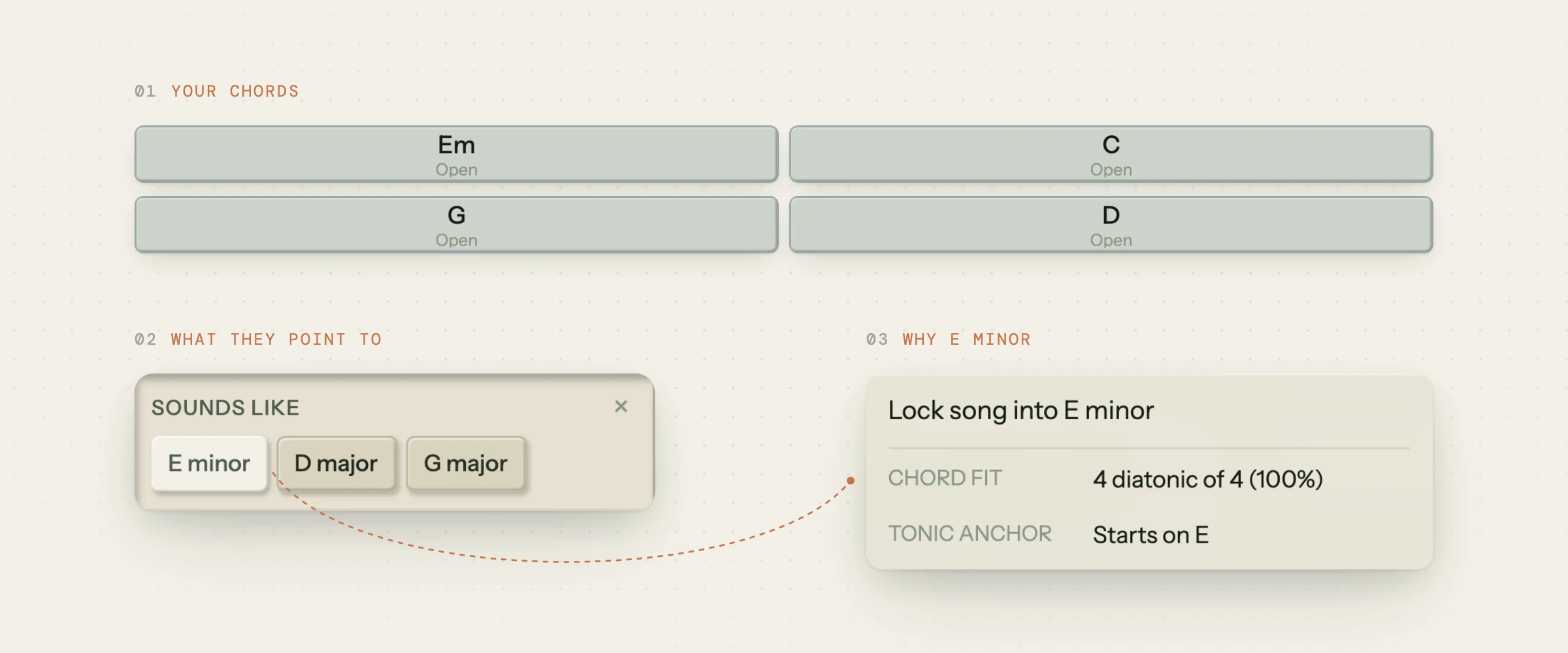
Hover a candidate and it explains itself using the same clues this guide uses: how many of your chords fit the key, whether the song starts or ends on its home chord, and any V to I moves it found. If your song already has a melody, it can break a close tie between two keys. Click a key to lock it in. Your chords stay exactly where they are, and the palette switches to that key, with a Roman numeral on every chord. The free iPhone and Android apps have a compact Sounds like button that suggests keys the same way and locks one in with a tap.
It suggests major and minor keys only, so a Mixolydian song like "Sweet Home Alabama" will show up as D major or G major, and the call is yours. The changing keys docs cover Wander mode and locking a key in.
Practice: find the key of these progressions
Try each progression below with the three steps, then check your answer. They're chord loops only, played in order and repeated, so the first chord is where each loop restarts.
| Progression | Key | The clue |
|---|---|---|
| G, D, Em, C | G major | All four chords are in G, and the loop restarts on G, so that's where it comes home. |
| Am, F, C, G | A minor or C major | Same chords in both keys. The melody decides; with no melody, the restart on Am favours A minor. |
| E, A, B7, E | E major | B7 is the only dominant 7th and it resolves straight to E. |
| Dm, Gm, A7, Dm | D minor | A7 is a major V in a minor key, pulling back to Dm. |
| A, G, D, A | A (Mixolydian) | A and G are a whole step apart, so the shortcut says IV and V of D. But the loop settles on A, making G the ♭VII. |
| C, Am, F, G (capo 3) | E♭ major | The shapes say C, but capo 3 raises everything three semitones. |
Loop each one and stop on each candidate chord to hear the difference yourself.
Write first, name the key when you're ready
Start a song without choosing a key, see which keys your chords point to, and lock one in when it sounds right.
Frequently Asked Questions
What is the quickest way to tell the key from a chord chart?
Look for a dominant 7th chord and count down a fifth, or look for two major chords a whole step apart and count down a fourth from the lower one. Then confirm the answer is in the chart and sounds like home. Both shortcuts work on most major-key songs and fail on blues and on songs with a ♭VII.
Is the first chord of a song always the key?
No. It's the tonic often enough that listeners assume it, but many songs open on ii, IV or vi. "Take On Me" starts its verse on Bm7 and is in A major. Check where the song resolves, not only where it starts.
How do I find the key of a song without an instrument?
Hum the note that feels like the end of the song, the one you could stop on. Then name that note with a free tuner app on your phone. Then decide whether the chord that would sit on that note is major or minor: strum or play both on any keyboard app and keep the one that matches.
Why do chord sites list different keys for the same song?
Usually one of three reasons: the site lists capo shapes instead of the sounding key, it names the relative major or minor instead of the other, or the song is genuinely ambiguous, like "Sweet Home Alabama."
Can a song be in no key at all?
Some music has no clear tonic, and Wikipedia notes that "not all music has a well-defined key." Most songs do. In a 2011 study of 100 classic rock songs, the two music theorists who analysed them agreed on the key 97.3% of the time.
Do sharps or flats matter when I write the key down?
The sound is the same, but the spelling follows the key. D♭ major is written with flats and C♯ major with sharps, and each key has a conventional choice. Pick the one with fewer accidentals: D♭ major has five flats, C♯ major has seven sharps, so D♭ is the usual spelling.