Table of Contents
- What makes a chord progression sound sad?
- Which chords actually carry sadness?
- What about the flat-six chord?
- Why doesn't my minor progression sound sad?
- How does a descending bass line create sadness?
- Does the bass have to move to a new chord?
- Does tempo matter more than the chords?
- Where should the melody land?
- Can a sad song be in a major key?
- In what order should you fix it?
- What about guitar and piano specifically?
- How Song Cage helps
- Frequently Asked Questions
Search "sad chord progressions" and you get a list. Eleven of them, or fourteen, or five. You play the first one, and it sounds fine. It does not sound sad. It sounds like a chord progression.
That gap between the list and the result is the whole problem, and it is not because you were given the wrong chords.
What makes a chord progression sound sad?
Sadness in music is carried by four things working together: which chords you choose, how the bass moves underneath them, how long each chord is allowed to sit, and where the melody lands on top. Harmony is one lever of four. Change only the chords and you change roughly a quarter of the result.
This is not a stylistic opinion. When researchers have gone looking for the acoustic signature of sadness, harmony is not what they find. The psychiatrist Emil Kraepelin catalogued the sound of depressed speech in 1899: quieter, slower, lower in pitch, with small pitch movements, mumbled articulation and a dark tone. Music researchers led by David Huron have since matched each of those features to music we call sad. Not one of them is a chord.
That leaves a practical order of operations, and it is close to the reverse of how most songwriters work. The chords are the last thing to change, not the first.
Which chords actually carry sadness?
The reliable sad harmony in a major key is not a minor chord in general. It is a specific one: the minor iv, borrowed from the parallel minor. In C major, that is F minor where the ear expected F major. One note moves down a half step, and the chord sounds like it has sagged.
Radiohead's "Creep" is the case study. The song sits in G major and runs G, B, C, Cm on a loop. The last chord should be C major. Flattening its third to make C minor pulls a note from G minor into a G major song, and that single half step does the emotional work of the entire chorus. The B major chord that precedes it is doing something different again, unpacked in the "Creep" chord progression. Robert Hutchinson's open textbook Music Theory for the 21st-Century Classroom uses it as a canonical example of mode mixture, alongside Nirvana's "Lithium" and Lennon and McCartney's "Blackbird".
The move has a name worth knowing. When that borrowed minor iv resolves home to I, it is a minor plagal cadence, and it lands softer and more resigned than the bright IV to I you already know.
What about the flat-six chord?
The other dependable borrowing is ♭VI, the major chord built on the lowered sixth degree. In C major that is A flat. It arrives from outside the key with no leading tone pushing it anywhere, which is exactly why it reads as a widening or a sinking rather than a step forward. It is also a useful contrast to the minor iv: where iv sags, ♭VI opens out. Same borrowed source, two different emotional gestures.
Both come from the same place, the parallel minor scale sitting underneath your major key, which our modal interchange guide covers in full. Borrowing from it gives you seven candidate chords rather than one. Most of them are situational, and the two that do sad work reliably enough to reach for on purpose are iv and ♭VI. If you take nothing else from this section, take those two and the knowledge that they live one half step away from chords you already play.
Why doesn't my minor progression sound sad?
Because minor is not sadness. It is an association, and it only reads as sad when the performance supplies the other cues. Huron and Davis put it plainly in 2013: transposing a passage from major to minor is not, in itself, sufficient to evoke or represent a sad affect.
The counter-examples are the proof, and they come from the same paper. Mozart's "Rondo Alla Turca" is in a minor key and nobody has ever cried to it, because it is fast and played with detached articulation. Handel's "He Was Despised" from Messiah is in a major key and is one of the saddest things in the repertoire, because it is slow and quiet.
Pop makes the point louder. Pharrell Williams's "Happy" is in F minor. Anthony Kelley, a music professor at Duke, described the chorus as starting in the darkness of minor and ending on a big F major chord right as the word "happy" lands.
The test that saves you an afternoon
Before you swap any chords, play your progression at half tempo, quietly, with a legato right hand and no percussion. If it turns sad, your harmony was never the problem. If it still sounds inert, then go looking at the chords.
How does a descending bass line create sadness?
A bass that walks downward, step by step, is the oldest sad device in Western music. It has a name, the lament bass, and it is a descending fourth from the tonic down to the dominant with every step harmonized. It predates pop by roughly four centuries and it still works.
Ellen Rosand named and traced it in The Musical Quarterly in 1979, identifying Monteverdi's "Lamento della ninfa" of 1638 as the prototype. From there it runs through Purcell's "When I am laid in earth" from Dido and Aeneas, composed by 1688, on to the Crucifixus of Bach's Mass in B minor and the opening of Mozart's String Quartet in D minor, K. 421.
You already know the pop version. "Hit the Road Jack", written by Percy Mayfield and cut by Ray Charles in 1961, is a four-chord loop walking down the minor scale, charted in A minor as Am, G, F and E7.
Does the bass have to move to a new chord?
No, and this is the part that gets missed. The bass can descend while the chord above it stays put, which is what a slash chord does. C, then C with a B in the bass, then A minor gives you a descending line under barely any harmonic change. That is voice leading rather than a new progression, and our guide to chord inversions and slash chords walks through the shapes.
One honest caveat, because the field tends to overclaim here. The descending tetrachord was not exclusively a sadness signal even in its own era. Writing about Purcell, the scholar Peter Holman characterised the same descending ground as the pattern associated with love in seventeenth-century opera. Context decided then, and context decides now.
Does tempo matter more than the chords?
Usually, yes. Slow tempo is one of the most reliable cues for sadness in the research literature, and it is the single cheapest change available to you. But tempo and harmonic pacing are different dials, and the second one is the one songwriters forget.
Tempo is how fast the beat goes. Harmonic pacing, or harmonic rhythm, is how often the chord changes. You can slow a song to a crawl and still change chords every bar, which keeps the harmony busy and the sadness at arm's length. Letting one chord sit for two full bars does something a tempo change cannot: it gives the listener time to sit inside the chord rather than waiting for the next one.
This is the same lever we pulled apart in why chord progressions sound boring, aimed at a different target. Boring and inert-sad have the same root cause and opposite fixes: boring wants motion, sad wants stillness.
Where should the melody land?
Over a fixed progression, the melody decides most of the emotional result. Two properties do the heavy lifting: which direction the line moves, and how far it travels between notes. Falling contours and small intervals both read as sad, and both are independent of your chords.
Juslin and Laukka's 2003 review of the emotion-in-music literature lists falling pitch contour among the reliable cues for sadness, alongside slow tempo, low volume and low pitch. Huron's work adds the interval finding: music we call sad uses smaller melodic steps on average. A line that inches downward by step will out-sad a line that leaps up an octave over identical harmony.
There is a harmonic version of the same idea. Landing the melody on the third of a chord rather than the root softens it, and holding a note through a chord change so it becomes a suspension delays the resolution the ear is waiting for. Our guide on writing a melody from scratch covers contour in more depth.
Can a sad song be in a major key?
Yes, routinely, and some of the saddest songs ever recorded are. Once you stop treating minor as the source of sadness, the major-key sad song stops being a paradox and starts being a technique: the warmth of the harmony lowers the listener's guard before the lyric arrives.
R.E.M.'s "Everybody Hurts" is in D major, and the verse is little more than D and G going back and forth. What carries it is the slow tempo, the sparse arrangement and a vocal melody delivered in short fragments with space between them. Eric Clapton's "Tears in Heaven" is in A major and opens over a descending bass line. Sinéad O'Connor's recording of Prince's "Nothing Compares 2 U" is in F major and spends most of its time on I, V and vi. The Everly Brothers' "Love Hurts" is major throughout, and its vocal phrases fall, again and again.
| Song | Key | What carries the sadness |
|---|---|---|
| "Creep" (Radiohead, 1992) | G major | Borrowed minor iv (Cm) where C major was expected |
| "Everybody Hurts" (R.E.M., 1992) | D major | Slow tempo, sparse arrangement, fragmented vocal phrases |
| "Tears in Heaven" (Eric Clapton, 1992) | A major | Descending bass line under the verse |
| "Nothing Compares 2 U" (Sinéad O'Connor, 1990) | F major | Slow tempo and a restrained arrangement under I, V and vi |
| "Hit the Road Jack" (Ray Charles, 1961) | Minor | Stepwise descending bass through the whole loop |
| "Happy" (Pharrell Williams, 2013) | F minor | Nothing. A minor key used for an unambiguously happy song |
Keys verified against published harmonic analyses. "Happy" is included as the control case.
In what order should you fix it?
Work outside in. Most songwriters start with the chords because chords are the thing you can look up, and that is why the list of eleven progressions did not help.
The order that actually works
- Pacing first. Let the chord you already have sit twice as long. Free, instant, and it fixes more songs than any substitution.
- Delivery second. Quieter, slower, more legato, lower register. These are the research-backed cues, and none of them requires new harmony.
- Melody third. Make the line fall. Shrink the leaps. Hold a note across a chord change and let it hang.
- Bass fourth. Walk it downward by step, using slash chords so the harmony barely has to move.
- Chords last. Now borrow the minor iv or the ♭VI, and hear how much more they do once everything else is in place.
What about guitar and piano specifically?
Most of the pages ranking for this topic are written for piano, which leaves guitarists translating chord symbols into shapes on their own. Two things are worth knowing at the instrument.
On guitar, the borrowed minor iv is often a one-finger move away from the major IV you were already playing. In the key of A, D major to D minor moves a single finger. In the key of E, A major to A minor does the same. In the key of C, the F barre to F minor is one finger lifted. The descending bass line is also more available than it looks: C, C/B, Am, Am/G is standard open-position fingering, and it walks the bass down four steps without leaving first position.
On piano, keep the descending line in the left hand and hold the right hand still. The temptation is to move both, which turns a lament into a busy passage. Voicing matters more than it does on guitar: a minor iv voiced low and close sounds heavy, while the same chord spread across two octaves sounds spacious rather than sad.
How Song Cage helps
Song Cage will not hand you a sad progression, and that is deliberate. It shows you the chords available in your key and labels what each one is doing, so the borrowing is a decision you make rather than a preset you accept.
Set a song to C major and the chord sidebar groups everything available into three labelled sections: In Key, Borrowed, and Secondary Dominants. In Key lists the seven diatonic chords with their function attached: I on C, ii on D minor, IV on F, and so on. Borrowed lists the chords available from outside the key, each one tagged with the mode it came from. F minor appears there as iv, sourced from aeolian, one section below the F major you would otherwise have reached for. A flat appears as ♭VI from the same source.
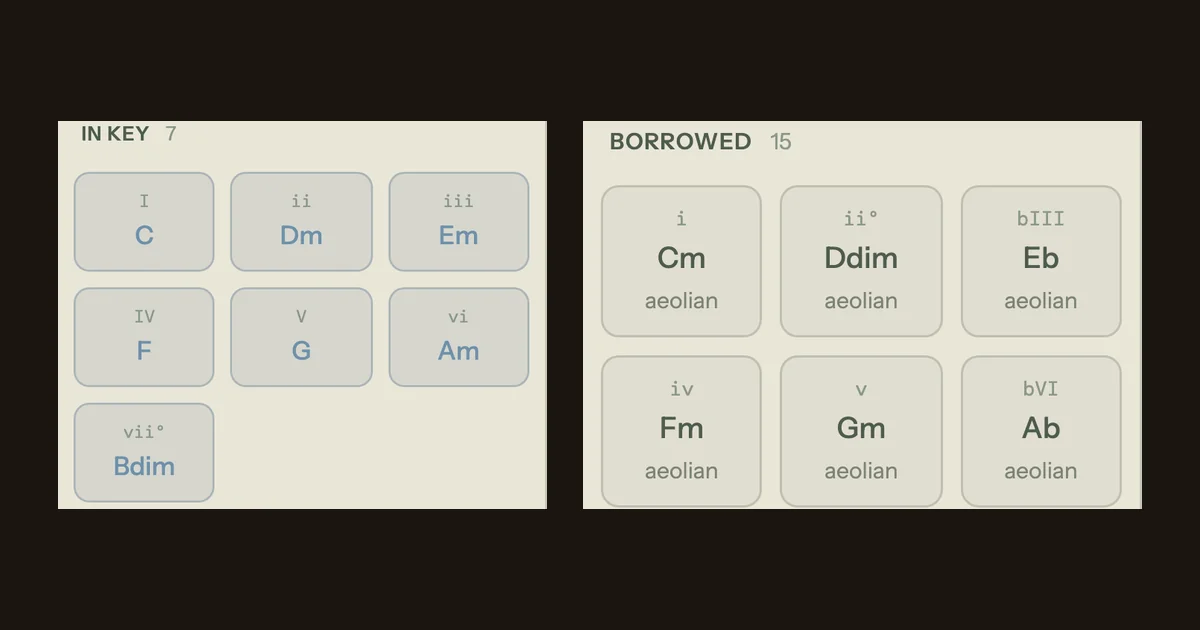
That is the harmony lever made visible. For the pacing lever, the Auto Chords preview has a Held, Steady and Active setting that changes how often the chords change, so you can hear stillness against motion before committing to either. The chord progressions documentation covers the palette in detail.
Hear the borrowed chord before you commit to it
Set your key, and Song Cage shows you what is in it, what you can borrow, and what each chord is doing. Capture the idea while it is still in your head.
Frequently Asked Questions
What is the saddest chord progression?
There isn't one, and any page that names a single winner is selling you a shortcut. The most reliably sad harmonic move in a major key is the borrowed minor iv resolving to I, as in Radiohead's "Creep". But the same progression sounds sad, neutral or triumphant depending on tempo, harmonic pacing and where the melody sits.
Why do minor chords sound sad?
Partly through learned association. Kate Hevner demonstrated the major-happy and minor-sad link experimentally in 1935, but later work shows the association only holds when other cues are present. Minor mode also carries associations with seriousness and passion, and scales resembling the harmonic minor are used widely in Balkan, North African and Middle Eastern music with no sad connotation at all.
What is the minor iv chord?
It is the chord on the fourth degree of your key with its third lowered, borrowed from the parallel minor. In C major the IV chord is F major, and the borrowed version is F minor. Only one note changes, A down to A flat. Moving from the major IV to the minor iv and then home to I is called a minor plagal cadence.
Can a song be sad in a major key?
Yes. R.E.M.'s "Everybody Hurts" is in D major, Eric Clapton's "Tears in Heaven" is in A major, and Sinéad O'Connor's "Nothing Compares 2 U" is in F major. In each case the sadness comes from slow tempo, sparse arrangement and descending melodic phrases rather than from the key. The reverse also happens: Pharrell Williams's "Happy" is in F minor.
What is a lament bass?
A bass line descending a fourth from the tonic to the dominant, with each step harmonized. Ellen Rosand traced it in 1979 to Monteverdi's "Lamento della ninfa" of 1638, and it runs through Purcell's "Dido's Lament" and Bach's Crucifixus. The chromatic version fills in every semitone. It is the reason a stepwise descending bass reads as sorrow without anyone having to explain why.
Does tempo make a song sadder than the chords do?
Frequently. Slow tempo is one of the most consistent acoustic cues for sadness across the research, along with low volume, low pitch and falling melodic contour. It is also the cheapest change you can make. Try halving your tempo and letting each chord sit twice as long before you touch a single chord symbol.