Table of Contents
- What is the harmonic minor scale?
- Is it "raised" or "sharpened"?
- Why is it called the harmonic minor scale?
- Where does the raised 7th go in a melody?
- Which real melodies use the raised 7th?
- What is the augmented second, and why does it sound exotic?
- How often do composers actually use it?
- Should you use the augmented second or avoid it?
- What is the difference between harmonic minor and melodic minor?
- What chords does the harmonic minor scale give you?
- Does harmonic minor turn up in major-key songs?
- Which songs use the harmonic minor scale?
- Songs that borrow the V chord
- Songs whose melody uses the raised 7th
- What is the Phrygian dominant scale?
- Which songs use the Phrygian dominant scale?
- What are the other modes of harmonic minor?
- How do you write with harmonic minor in Song Cage?
- What if you sing the raised 7th into a DAW?
- What do other guides get wrong about the harmonic minor scale?
- What are the harmonic minor scales in all 12 keys?
- Frequently Asked Questions
Play a minor-key song and listen to the last chord before it lands home. In A minor that chord is often E major rather than E minor, and E major needs a note A minor doesn't have: G#. Raise the 7th note of the natural minor scale like that and you get the harmonic minor scale. The formula takes one line. The useful part for a songwriter is everything around it: where the raised 7th belongs in a melody, what to do with the strange-sounding gap it opens up, which chords and modes come out of it, and which songs actually use it rather than just borrowing one chord. The full scale in all 12 keys is at the end.
Quick Summary
Harmonic minor is natural minor with the 7th raised a half step: A B C D E F G# in A minor. The raised 7th makes the minor key's V chord major, so it pulls back home. It also leaves a three-semitone gap between the 6th and 7th notes, the augmented second, which gives the scale its Middle Eastern and flamenco colour. Songs mostly borrow its V chord, and melodies mostly use the raised 7th on the way up to the home note. The full scale, augmented second and all, is the exception: it falls more often than it climbs.
What is the harmonic minor scale?
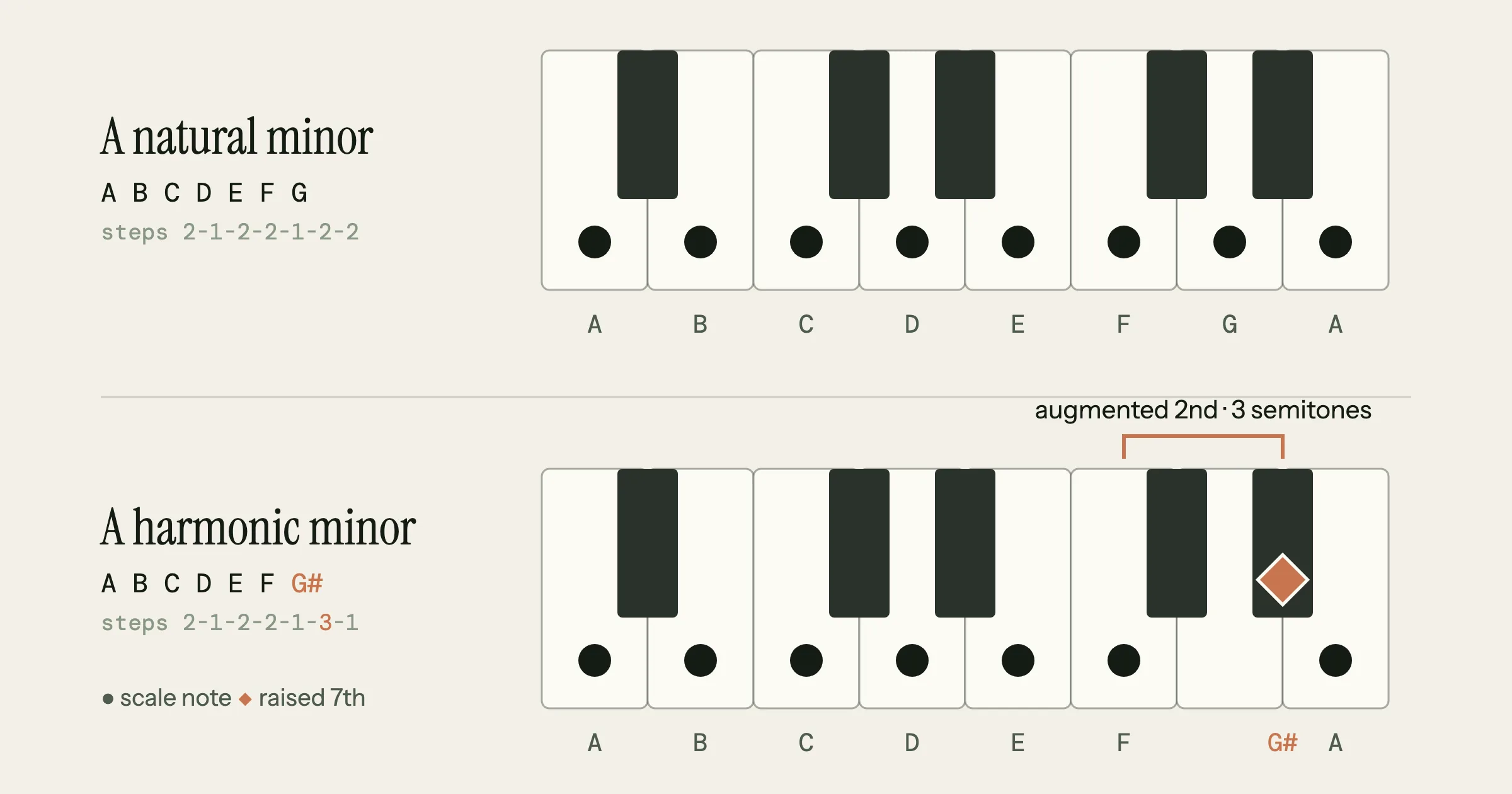
The harmonic minor scale is the natural minor scale with its 7th note raised a half step. In A minor that gives A B C D E F G#. Its steps run whole, half, whole, whole, half, augmented second, half (2-1-2-2-1-3-1 in semitones), and its scale degrees are 1, 2, ♭3, 4, 5, ♭6 and 7.
Only one note changes. In A natural minor the 7th note is G, a whole step below A. Raise it to G# and it sits a half step below A, close enough that your ear expects it to move up. That note is called the leading tone, and it's the whole reason the scale exists. The harmonic minor scale keeps everything else from natural minor, including the flat 6th (F in A minor), which is what creates the wide gap between the 6th and 7th notes.
| A natural minor | A harmonic minor | C natural minor | C harmonic minor | |
|---|---|---|---|---|
| Notes | A B C D E F G | A B C D E F G# | C D E♭ F G A♭ B♭ | C D E♭ F G A♭ B |
| Semitone steps | 2-1-2-2-1-2-2 | 2-1-2-2-1-3-1 | 2-1-2-2-1-2-2 | 2-1-2-2-1-3-1 |
| 7th note | G, a whole step under A | G#, a half step under A | B♭, a whole step under C | B, a half step under C |
Bold marks what changes: one raised note, which turns the last two steps from 2-2 into 3-1.
Is it "raised" or "sharpened"?
Raised, and the difference matters when you read a chart. In A minor the raised 7th happens to be a sharp (G to G#), but in C minor it's a natural (B♭ to B), and in G# minor it's a double sharp (F# to F##). The key signature never changes: a piece in C minor keeps its three flats, and each raised 7th is written as an accidental where it appears. That's also why you'll never see "harmonic minor" as a key on a chart. The song is in C minor, and the B natural is a note the song borrows where it wants the pull. Our guide to minor chord progressions makes the same point from the chord side: a minor key is natural minor plus a few optional raised notes, chosen chord by chord.
Why is it called the harmonic minor scale?
The harmonic minor scale is named for the harmony it makes possible. Raising the 7th turns a minor key's minor v chord into a major V, and its major VII chord into a diminished vii°. Those are the two chords that pull hardest back to the home chord, and harmonic minor is simply the set of notes that contains them.
The idea is older than the name. In the early 1800s theorists started treating it as the foundation of the minor key. Music theorist Suzannah Clark puts it like this in an essay for the Institute for Advanced Study: "theorists began to argue that this dominant major harmony was so prevalent in minor-mode music that it needed to be shown to be diatonic, rather than borrowed from elsewhere. They therefore turned to the harmonic minor as their new foundational scale." Gottfried Weber's treatise (1817–21) built its minor-key Roman numerals on it.
The names "harmonic" and "melodic" came later still. In a 2026 study in Music Theory Online, Jenine Brown and Yeonju Lindsey Lee trace them, as names for practice scales, to Charles-Louis Hanon's The Virtuoso Pianist (1878 edition), and call Hanon "quite possibly the source" of the terms we use today. Hanon's own wording hints the label may be a little older: in the translation Brown and Lee give, he calls it the "modern" minor scale, "which is also called the harmonic minor scale." Either way, he and Ferdinand Beyer are the ones who put it into pianists' daily practice.
Where does the raised 7th go in a melody?
Put the raised 7th of harmonic minor where the V chord is, and let it step up to the home note. In A minor that means a G# sung over E or E7, moving to A as the chord moves to Am. Over the other chords in the key it either clashes or changes the chord's colour, so it's a note with one main job.
The G# is the 3rd of E major. That's why it sounds settled over E and odd almost everywhere else. Here's what the same G# does over each chord you're likely to use in A minor:
| Chord under it | What the G# does | Use it? |
|---|---|---|
| E or E7 | It's the chord's 3rd, and it wants to rise to A | yes Its home |
| B° (B D F) | Adds to it and makes G#°7 (G# B D F), another chord that leads to Am | yes |
| Am | Makes Am(maj7): tense and unresolved | partly As a passing colour |
| C | Rubs against the chord's G. It only works if the chord itself becomes C augmented (C E G#) | partly Only over Caug |
| Dm | Sits a tritone from the chord's root, D | partly Short passing notes only |
| F | Rubs a half step under the chord's A | partly Short passing notes only |
| G | Clashes head-on with the chord's G | avoid |
Yes: a chord tone, safe on a strong beat. Partly: works briefly, usually on a weak beat. Avoid: the raised and natural 7th fight each other.
The simplest shape circles the home note: B, G#, A, landing on A on the downbeat as the chord changes from E to Am. Mozart's Rondo alla Turca opens with a fuller version of the same move, B-A-G#-A-C, and the G# is the lowest note of the phrase. The raised 7th also tends to be an upward note. Coming back down from the home note, melodies more often use the plain natural-minor G.
Which real melodies use the raised 7th?
Three you can check by ear. In "Bésame Mucho" (Consuelo Velázquez, first released in 1940) the melody keeps cadencing into D minor through A7, and at those phrase ends it dips to C#, a half step under the tonic, before landing on D. That C# is the lowest note of the vocal line on the Musicnotes lead sheet (range C#4 to E5).
"Greensleeves" is a lesson in using all of minor at once. A 2019 teaching article in the Journal of Music Theory Pedagogy by Paula Telesco shows the A-minor tune reaching its cadences through G#, using F# just before it to avoid the awkward gap from F, and using plain F and G elsewhere.
In "We Don't Talk About Bruno" (Encanto, 2021), in C minor, the raised 7th sits right in the hook. Ethan Hein's analysis points out that "the second syllable of 'Bruno' is on B natural", and the song's G7 chords come from the same scale.
What is the augmented second, and why does it sound exotic?
The augmented second is the gap between the 6th and raised 7th of harmonic minor: F to G# in A minor. It spans three semitones, the same distance as a minor third on a keyboard, but it's spelled across two neighbouring letters, F and G, so it counts as a second. It's the scale's most recognisable sound.
It has bothered teachers for a long time. In 1789 the keyboard teacher Daniel Gottlob Türk wrote that the harmonic form produces an augmented second "which would probably not be present in a diatonic scale", and called the melodic form "the most customary" (Brown and Lee quote both lines).
The exotic sound comes from where other traditions put the same gap. In the Arabic jins Hijaz and the Jewish Ahava Rabbah (Freygish) mode, the augmented second sits low in the scale, between the 2nd and 3rd degrees, just a half step above the home note. That's the music Western ears associate with the sound, so the gap reads as Middle Eastern, klezmer or flamenco wherever it turns up. In Arabic practice that interval is often played narrower than written: Maqam World notes it "is usually played smaller than notated by raising the 2nd a little and lowering the 3rd a little."
How often do composers actually use it?
Less than scale practice would suggest. Brown and Lee searched the top line of the Yale-Classical Archives Corpus (13,769 MIDI files) and pulled 17,328 stepwise runs through the 6th and 7th to or from the home note, from 166 composers. The harmonic-minor pattern was the least common of the four minor forms they counted. When it did appear, it fell from the home note (1,365 times) about twice as often as it climbed to it (694 times). Bach is the extreme case: when his melodies climb 6-7-1 in minor, 67% use melodic minor and just 4% use harmonic minor.
Should you use the augmented second or avoid it?
Use the augmented second of harmonic minor when you want its colour, and let it fall. When composers kept the gap, it came down from the home note about twice as often as it climbed. The V chord is the safest place for it: the G# is a chord tone, and the F can fall straight on to E, another one.
You have four choices when a melody crosses from the 6th to the 7th:
- Feature it, ideally falling. Beethoven's Piano Sonata Op. 2 No. 1 runs a descending F harmonic minor scale over the V chord in its first-movement recapitulation (Brown and Lee point to bars 133 and 137). Gounod's Funeral March of a Marionette, the Alfred Hitchcock Presents theme, puts the raised 7th right next to the flat 6th, and Telesco speculates it was "a special effect": a funeral march for Gounod, a scary TV show for Hitchcock.
- Smooth it. Raise the 6th as well on the way up. That's melodic minor, and it's what "Greensleeves" does with its F# before the G#.
- Skip it. Reach the raised 7th from above (B to G# to A) or from the home note (A to G# to A), so the F never sits next to it.
- Harmonize it. E7♭9 (E G# B D F) and G#°7 (G# B D F) both contain F and G#. Put either chord under the gap and both notes are chord tones. Our guide to diminished chords covers that second chord in detail.
What is the difference between harmonic minor and melodic minor?
Harmonic minor raises only the 7th note. Melodic minor raises the 6th and the 7th on the way up, which closes the augmented-second gap, and in the classical version it comes back down as natural minor. In A: harmonic minor is A B C D E F G#; melodic minor rising is A B C D E F# G#.
| A minor scale | Going up | Coming down | What it gives a songwriter |
|---|---|---|---|
| Natural | A B C D E F G | G F E D C B A | The plain minor sound; a minor v and a major VII |
| Harmonic | A B C D E F G# | G# F E D C B A | The major V and the diminished vii°; the augmented-second colour |
| Melodic (classical) | A B C D E F# G# | G F E D C B A | A smooth climb to the home note, then plain minor on the way down |
Jazz players usually keep the rising melodic form in both directions and call it the jazz minor scale.
Through the eighteenth and nineteenth centuries, melodic minor was the one people practised. Brown and Lee found that the keyboard manuals of C. P. E. Bach, Clementi and Czerny teach only major and melodic minor scales, and that harmonic minor became the preferred practice scale only after Ferdinand Beyer (1850) and Hanon (1878) put it first. The habit stuck: the Royal Conservatory's Level 1 exam asks for natural and harmonic minor, and not melodic. If you learned harmonic minor first, that's most likely Beyer and Hanon's legacy, not a sign it's the more common sound in real music. In the corpus, rising melodic minor was the most common way up to the home note, whatever the period.
What chords does the harmonic minor scale give you?
Stack thirds on each note of A harmonic minor and you get Am, B°, C+, Dm, E, F and G#°, or with sevenths Am(maj7), Bø7, Cmaj7#5, Dm7, E7, Fmaj7 and G#°7. Songs mostly take two of them, E (or E7) and G#°7, and keep the rest of their chords from natural minor.
| Degree | Triad | Seventh chord | How songs use it |
|---|---|---|---|
| i | Am | Am(maj7) | The triad is home. The (maj7) is a passing colour |
| ii° | B° | Bø7 | Sets up the V in a minor ii-V-i |
| III+ | C+ | Cmaj7#5 | Rare; a dark, unsettled colour. Most songs keep plain C |
| iv | Dm | Dm7 | Same as natural minor |
| V | E | E7 | The reason the scale exists: pulls hard to Am |
| VI | F | Fmaj7 | Same as natural minor |
| vii° | G#° | G#°7 | A tenser stand-in for E7, also leads to Am |
Only the chords containing G# differ from natural minor: the i seventh, III, V and vii°.
The progression that shows the scale off best is the minor ii-V-i: Bø7, E7, Am. You hear it at the end of the A section of "Autumn Leaves" (Joseph Kosma, 1945), which closes on iiø, V7, i. The augmented III is rarer and moodier; our posts on augmented chords and scary chord progressions cover it.
Does harmonic minor turn up in major-key songs?
Yes, any time a major-key song borrows the V of its relative minor. In C major, an E7 heading to Am uses G#, the raised 7th of A harmonic minor, for a few beats. That chord is a secondary dominant, V of vi. Our guide to secondary dominants covers how it works and where songs put it. You don't need to think "harmonic minor" to use it. It's the same raised note, doing the same job, just pointing at a chord other than home.
Which songs use the harmonic minor scale?
Many minor-key songs borrow the harmonic minor scale's V chord, and fewer put the raised 7th in the tune. Keep the two apart: a song in A minor with one E major chord is borrowing a chord, not "in harmonic minor". Here are verified examples of each, with the note that comes from the scale.
Songs that borrow the V chord
| Song | Key | The harmonic-minor note |
|---|---|---|
| Smooth, Santana feat. Rob Thomas (1999) | A minor | The E7 in Am, F, E7 (G#) |
| Back to Black, Amy Winehouse (2006) | D minor | The A7 in the Dm, Gm, B♭, A7 loop (C#) |
| Sultans of Swing, Dire Straits (1978) | D minor | The A major in Dm, C, B♭, A (C#) |
| Havana, Camila Cabello feat. Young Thug (2017) | G minor | The D in Gm, E♭, D (F#) |
| Paint It Black, The Rolling Stones (1966) | E minor | The B major chord the verse swings to from Em (D#) |
| Ghost Town, The Specials (1981) | C minor | The dominant G chord in the Cm, G verse (B), and the diminished chords around it |
| Easy Please Me, Katy B (2011) | B♭ minor | The F in F, B♭m, G♭, E♭m, F (A natural) |
Wikipedia's entry on "Sultans of Swing" puts the distinction neatly: all its chords fit D natural minor "except for the A major triad, which suggests a D harmonic minor scale." For The Specials' "Ghost Town", Jerry Dammers said he used "weird, diminished chords" to convey "impending doom".
Songs whose melody uses the raised 7th
| Song | Key | Where the raised 7th is |
|---|---|---|
| We Don't Talk About Bruno, Encanto cast (2021) | C minor | B natural on "Bru-no"; the song's G7 chords use it too |
| Bésame Mucho, Consuelo Velázquez (released 1940) | D minor | C# at the phrase ends, over A7, before D |
| Greensleeves, traditional (registered 1580) | A minor | G# at the cadences, with F# before it |
| Für Elise, Beethoven (1810) | A minor | The E-G#-B figure in bar 3, answering the opening |
| Rondo alla Turca, Mozart (c. 1783) | A minor | B-A-G#-A-C, the opening notes |
The famous D# at the start of Für Elise and the D# in bar 2 of Rondo alla Turca are chromatic neighbour notes, not harmonic minor.
What is the Phrygian dominant scale?
Phrygian dominant is the 5th mode of the harmonic minor scale: the same seven notes with home on the 5th. A harmonic minor played from E gives E F G# A B C D, a major chord with a flat 2nd right above it and the augmented second low in the scale. That low gap over a major chord is the sound of flamenco and klezmer.
It's the same seven notes as A harmonic minor with a different home, so it gathers names. Wikipedia lists Spanish Phrygian, Phrygian major, Freygish, Ahava Rabbah, Hijaz and harmonic dominant among them. It's also just what harmonic minor sounds like when you play it over the V chord, so a neoclassical metal guitarist running A harmonic minor over an E chord is playing E Phrygian dominant.
To write with it, vamp the home chord and the chord a half step above: E to F and back. Sing the F and G# against them and you've got it.
Which songs use the Phrygian dominant scale?
You can hear Phrygian dominant in the first part of "Hava Nagila", which the University of Washington's Stroum Center for Jewish Studies places in this mode. Kirk Hammett's solo in Metallica's "Wherever I May Roam" (1991) leans heavily on E Phrygian dominant, mixed with E minor pentatonic. In Duke Ellington and Juan Tizol's "Caravan" (1936), each A section holds a C7(♭9) for 12 bars before resolving to F minor, and the scale that fits that long dominant is C Phrygian dominant, the 5th mode of F harmonic minor.
Dick Dale's "Misirlou" (1962) climbs E-F-G#-A over E and F chords, which is exactly this sound. Dale's full scale also adds a D#, though, which makes it the double harmonic scale, a close cousin.
What are the other modes of harmonic minor?
Every note of the scale can be home, so harmonic minor has seven modes. Only two get regular use in songs: the scale itself (mode 1) and Phrygian dominant (mode 5). Mode 4, Ukrainian Dorian, turns up in klezmer and Eastern European folk tunes, the others mostly in jazz and metal soloing, and our guide to musical modes explains how modes work in general.
| Mode | Starts on (from A) | Common name |
|---|---|---|
| 1 | A | Harmonic minor |
| 2 | B | Locrian ♮6 |
| 3 | C | Ionian #5 |
| 4 | D | Dorian #4 (Ukrainian Dorian) |
| 5 | E | Phrygian dominant |
| 6 | F | Lydian #2 |
| 7 | G# | Altered diminished (Super-Locrian ♭♭7) |
How do you write with harmonic minor in Song Cage?
Song Cage has no harmonic minor setting, and it doesn't need one. A song in A minor is in A minor, and the raised 7th is something you borrow where you want the pull. Write a G# into the melody and the chord suggestions move toward E and G#dim, the V and vii° chords built around that note.
In a minor key, the chord palette's Borrowed section holds the chords harmonic minor adds: E (V), G#dim (vii°) and Caug. You can also type them by scale degree: in A minor, 5 places Em and Shift+5 places E, while 7 places G and Shift+7 places G#dim. Rest the pointer on a chord in the suggestion strip and its card ends with "Borrowed from harmonic minor" when that's where the chord comes from.
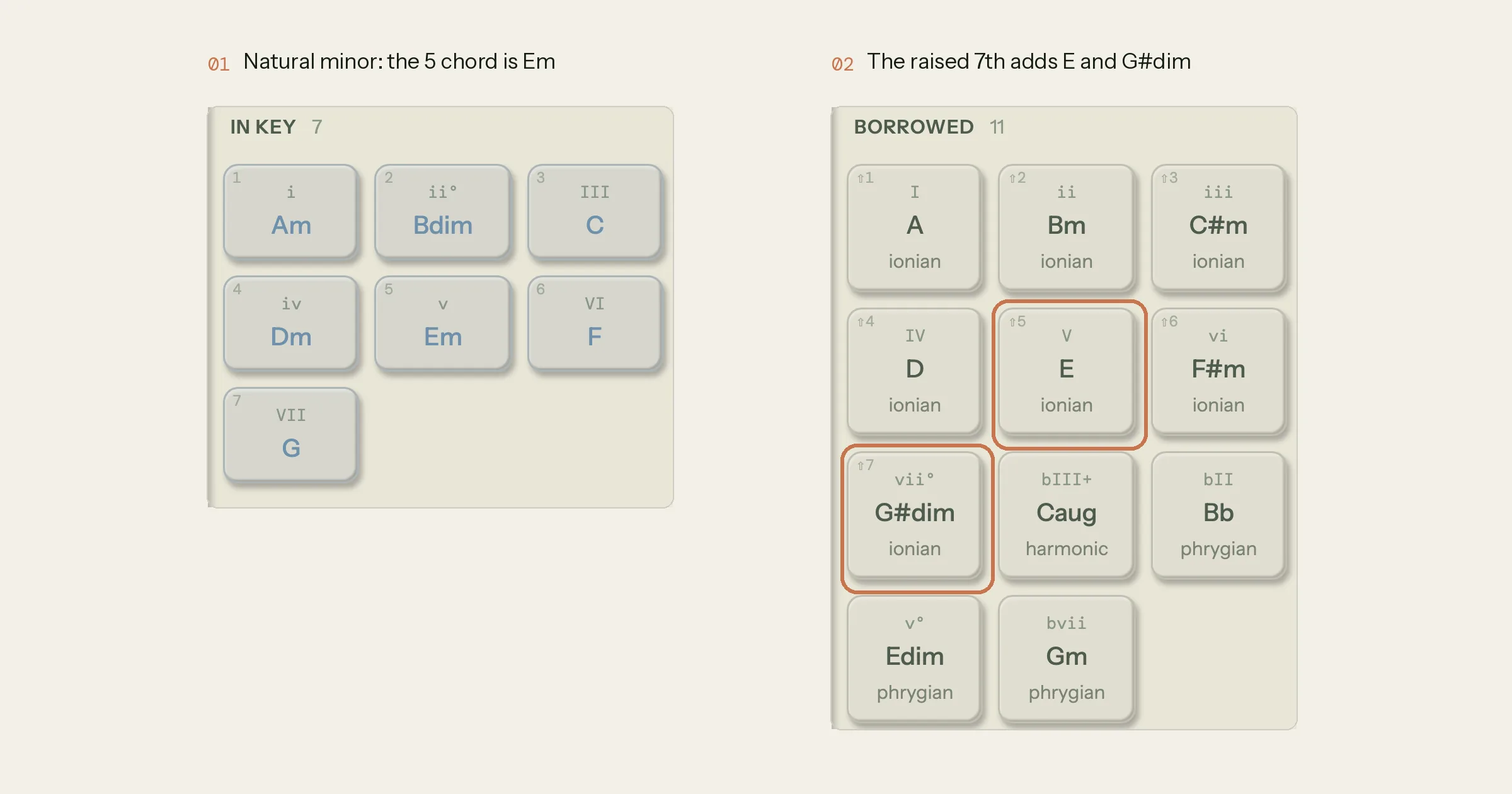
The suggestions follow the progression too. After Dm, E comes first with the label "dominant"; after E, Am comes first with "resolves". Set the voicing dial to 7ths and that E becomes E7. And when you write a G# into the melody over a slot, the Fits Melody suggestions put G#dim and E at the top. Write a G there instead and they offer G, Gm and Em.
One thing to know if you sing a melody in: snapping a take to A minor moves a G# onto a note of A natural minor. To keep a raised 7th you sang, leave the take on As sung.
What if you sing the raised 7th into a DAW?
Melody Rack, a separate plugin from Song Cage that loads as a MIDI effect, handles this differently. Its keys are major or minor too, and minor means natural minor, but its In Key correction doesn't flatten a raised 7th you meant. With Keep notes you meant on (the default), a G# you sang squarely on pitch is left alone, and resting on it shows why: "You meant it." A G# that wobbled between notes gets moved, unless Follow the chords is on and the chord under it contains G#, or you hold the note by moving it by hand or pressing H. The Melody Rack page covers the rest of the rack.
What do other guides get wrong about the harmonic minor scale?
Several of the pages that rank for this scale repeat the same few mistakes. Here's what to watch for:
Six corrections
- The gap is an augmented second, not a minor third. F to G# sounds like a minor third, but it spans two letters, so it's a second.
- The last step is a half step. G# to A is one semitone. A formula ending in a whole step adds up to 13 semitones.
- The raised 7th is the leading tone, not the subtonic. Subtonic is the name for the plain, lowered 7th (G in A minor).
- The III chord becomes augmented, not major. In natural minor III is already major (C E G). Raising the 7th makes it C E G#.
- One major V doesn't put a song "in harmonic minor". Many songs listed as harmonic minor keep natural minor and only borrow the V chord.
- Hava Nagila doesn't open in harmonic minor. Its first part uses the same notes with home on the 5th: Phrygian dominant.
What are the harmonic minor scales in all 12 keys?
Every harmonic minor scale uses each letter name once and raises the 7th. Depending on the key, the raised note is a sharp, a natural or a double sharp (written ##). The V chord is always major, and the relative major is the same as for natural minor.
| Key | Harmonic minor scale | Raised 7th | V chord | Relative major |
|---|---|---|---|---|
| A minor | A B C D E F G# | G to G# | E | C |
| E minor | E F# G A B C D# | D to D# | B | G |
| B minor | B C# D E F# G A# | A to A# | F# | D |
| F# minor | F# G# A B C# D E# | E to E# | C# | A |
| C# minor | C# D# E F# G# A B# | B to B# | G# | E |
| G# minor | G# A# B C# D# E F## | F# to F## | D# | B |
| E♭ minor | E♭ F G♭ A♭ B♭ C♭ D | D♭ to D | B♭ | G♭ |
| B♭ minor | B♭ C D♭ E♭ F G♭ A | A♭ to A | F | D♭ |
| F minor | F G A♭ B♭ C D♭ E | E♭ to E | C | A♭ |
| C minor | C D E♭ F G A♭ B | B♭ to B | G | E♭ |
| G minor | G A B♭ C D E♭ F# | F to F# | D | B♭ |
| D minor | D E F G A B♭ C# | C to C# | A | F |
E♭ minor is also written D# minor (D# E# F# G# A# B C##). G# minor is sometimes written A♭ minor (A♭ B♭ C♭ D♭ E♭ F♭ G), and B♭ minor as A# minor.
Frequently Asked Questions
What is the formula for the harmonic minor scale?
Whole, half, whole, whole, half, augmented second, half: 2-1-2-2-1-3-1 in semitones. As scale degrees that's 1, 2, ♭3, 4, 5, ♭6, 7. Start on A and you get A B C D E F G#. It's the natural minor scale with the 7th raised a half step.
Is harmonic minor the same going up and down?
Yes. Harmonic minor uses the same notes in both directions, so A harmonic minor comes down A G# F E D C B A. That's the difference from classical melodic minor, which raises the 6th and 7th going up and returns to natural minor coming down.
Is harmonic minor a key?
No. A song is in a minor key, and harmonic minor describes one set of notes that key can use. The key signature stays the natural minor one, and the raised 7th is written as an accidental wherever the song wants it, usually over the V chord.
Why does harmonic minor sound Middle Eastern or Spanish?
Because of the augmented second, the three-semitone gap between its 6th and 7th notes. The same kind of gap sits at the heart of the Arabic jins Hijaz and the Jewish Freygish mode, and played from its 5th note the scale becomes Phrygian dominant, often called Spanish Phrygian.
Can you use harmonic minor over a minor chord?
Briefly. Over Am, the G# makes Am(maj7), a tense, unresolved sound that works as a passing colour. The raised 7th settles over the V chord (E or E7) and over G#°7, where it's a chord tone heading up to the home note.
What is the 5th mode of harmonic minor?
Phrygian dominant. It uses the notes of harmonic minor with home on the 5th, so A harmonic minor becomes E F G# A B C D. It's the sound of the first part of "Hava Nagila", and it also goes by Spanish Phrygian, Freygish and Hijaz.
Write the raised 7th and hear the chord it asks for
Song Cage keeps borrowed chords, like a minor key's major V, in the same palette as the rest of your key, and its suggestions follow the notes you write: put a G# in an A-minor melody and E and G#dim rise to the top. No AI, no canned progressions. You decide every chord by ear.