Table of Contents
- What is a diminished chord?
- Why does a diminished chord sound so unstable?
- Dim, dim7, half-diminished: what is the difference?
- How do you read the symbols: °, ø, dim, and m7♭5?
- Where do diminished chords live in a key?
- Why are there only three diminished seventh chords?
- How do you play diminished chords on guitar and piano?
- How do you use a diminished chord in a progression?
- The ascending passing chord (1 – ♯1°7 – 2m)
- The descending passing chord (♭3°7 falling into 2m)
- The gospel lift (4 – ♯4°7 – 1 over 5)
- The dominant in disguise (dim7 as a rootless V7♭9)
- The trapdoor key change
- What does a half-diminished chord sound like in a real song?
- Which songs use diminished chords? (Verified list)
- What do other guides get wrong about diminished chords?
- How do you hear a diminished chord in your own song?
- Frequently Asked Questions
A diminished chord is the sound of the floor tilting. It is the second chord of "Friends in Low Places," the little stumble in the turnaround of Patsy Cline's "Crazy," the slide-guitar shiver in "My Sweet Lord." For one bar, every note in the chord leans hard toward somewhere else, and then the song lands and the relief feels earned.
This guide covers what a diminished chord actually is, how the three types (dim, dim7, and half-diminished) differ, where they live in a key, why only three diminished seventh chords exist in all of music, how to play them on guitar and piano, and the five moves songwriters actually use them for, with a table of real songs where every chord has been checked against published charts and analyses.
Quick summary
A diminished chord stacks two minor thirds: root, flat three, flat five. That flat five puts a tritone inside the chord, and the tritone is the tension. Add a diminished seventh on top for the dramatic dim7, or a plain minor seventh for the bittersweet half-diminished. All three exist to pull your ear somewhere else.
What is a diminished chord?
A diminished chord is a triad built from a root, a minor third, and a diminished fifth: two minor thirds stacked on top of each other. Built on B, that is B–D–F. Take a minor chord and lower its fifth by a half step, and you have it. The symbol is "dim" or a small circle: Bdim, or B°.
That flattened fifth is the whole personality. A major or minor chord rests on a perfect fifth, the most stable interval there is. A diminished chord replaces it with a tritone, the interval old theory manuals nicknamed the devil in music, and the chord stops being furniture and becomes a spring. Classical composers used the diminished seventh to announce the statue in Mozart's Don Giovanni; silent-film pianists wore it out under every villain. Songwriters use it for something subtler: one bar of instability that makes the next chord feel inevitable.
Why does a diminished chord sound so unstable?
Because nothing in it agrees to sit still. The tritone between the root and the flat five wants to collapse inward or burst outward, and in a full diminished seventh every single note sits a half step or whole step from a note of the chord next door. Play Bdim and then C major and you can hear each voice click into place: B rises to C, F falls to E, D slides to C or E. That is the practical definition worth keeping: a diminished chord is stored motion. It does not describe a mood the way major and minor do; it describes a direction. Which is exactly why it shows up between chords more often than on the downbeat of a chorus, and why the exceptions (coming below) are so striking when a writer plants one and lets it ring.
Dim, dim7, half-diminished: what is the difference?
There are three diminished chords, and they share the same bottom: root, flat three, flat five. The plain diminished triad stops there. The diminished seventh (dim7) adds a double-flat seventh, one more minor third on top. The half-diminished adds a regular minor seventh instead: one note higher, and a completely different mood.
| Chord | Formula | Built on B | Symbols | Character |
|---|---|---|---|---|
| Diminished triad | 1–♭3–♭5 | B–D–F | Bdim, B° | Tense, hollow, in motion |
| Diminished seventh | 1–♭3–♭5–𝄫7 | B–D–F–A♭ | Bdim7, B°7 | Maximum drama: two interlocking tritones |
| Half-diminished | 1–♭3–♭5–♭7 | B–D–F–A | Bm7♭5, Bø7 | Bittersweet, jazzy, yearning |
One note separates dim7 from half-diminished (A♭ vs A on a B root), but the dim7 carries two tritones and the half-diminished only one. Your ear registers the difference immediately.
How do you read the symbols: °, ø, dim, and m7♭5?
The small circle (°) means fully diminished; the slashed circle (ø) means half-diminished; "m7♭5" spells the half-diminished chord out literally as a minor seventh chord with a flat five. The name "half-diminished" exists because only half the chord is actually diminished: the triad is, the seventh is not. Composer Milton Babbitt reportedly quipped that it should really be called the "one-third diminished" seventh chord. Now the gotcha that trips up almost everyone reading charts: in most pop and guitar chord books, a bare "dim" or "°" symbol actually means the four-note dim7, not the triad. Jazz and theory sources are stricter and write dim7 or °7 when they mean four notes. When a chart says Bdim, listen to the recording before assuming three notes or four; the songs table below spells every chord out so there is no guessing.
Where do diminished chords live in a key?
Every major key contains exactly one diminished triad, built on the seventh degree: in C major it is Bdim (B–D–F), written vii°. Every minor key has one on the second degree: in A minor, that same Bdim, now written ii°. Same chord, two different jobs.
That double life is worth pausing on. As vii° in C major, Bdim is built on the leading tone and behaves like a dominant: it shoves the ear home to C. As ii° in A minor, it sets up the dominant instead, the first half of the classic minor-key two-five. Stack a seventh on it and the split gets clearer: the key of C major natively gives you B half-diminished (viiø7), while harmonic minor produces the fully diminished vii°7. When songwriters in a major key want that darker fully diminished color, they borrow it from the parallel minor, the same pantry that supplies every borrowed chord. None of this requires reading music: count up to the seventh note of your key, build on it, and you have found the one diminished chord your key hands you for free.
Why are there only three diminished seventh chords?
A diminished seventh chord splits the octave into four equal pieces: minor third, minor third, minor third, minor third. Because the spacing never changes, every inversion of a dim7 is just another dim7. Twelve possible roots, four names per chord: only three distinct diminished seventh sounds exist in all of music.
Write them out and the trick is visible. Cdim7 contains C–E♭–G♭–A (the seventh is spelled B double-flat but your ear hears A). Move any note to the bottom and you have spelled E♭dim7, G♭dim7, or Adim7: same four pitches, new name. The other two chords are the collection on C♯–E–G–B♭ and the one on D–F–A♭–B. That is the complete inventory. This is the same logic as chord inversions, pushed to its extreme: a chord so symmetrical that inverting it changes nothing but the label. For a songwriter the payoff is enormous. Learn one dim7 grip and you know four chords. And because any of the four notes can act as a leading tone, one dim7 can resolve into four different keys, which is the modulation trick covered below.
How do you play diminished chords on guitar and piano?
On guitar, one movable four-string grip covers it: x–x–2–3–2–3 sounds E–B♭–C♯–G, a diminished seventh you may call Edim7, Gdim7, C♯dim7, or B♭dim7. On piano, play a key, skip two, play, skip two, play: equal three-half-step gaps all the way up.

The guitar shape has a superpower: slide it three frets in either direction and you get the same chord, re-stacked. That is the symmetry from the last section made physical, and it means you are never more than two frets from a diminished seventh voicing. For the half-diminished, shift one finger: x–2–3–2–3–x sounds B–F–A–D, a ready-made Bm7♭5. On piano, the equal spacing means all twelve dim7 chords reduce to three shapes your hand already knows after learning one. One spelling note so the charts do not spook you: the seventh of Cdim7 is written B double-flat because chords are spelled in stacked thirds on paper, but it is the same key as A. Play the A. Nobody at the writing session will file a complaint.
How do you use a diminished chord in a progression?
Five moves cover nearly every diminished chord you will meet in a songbook. Each one is a formula you can move to any key: numbers first, letters second, the way Nashville players think.
The ascending passing chord (1 – ♯1°7 – 2m)
Slide a dim7 between your I chord and your ii chord and the bass walks up in half steps. This is the workhorse of diminished moves, the one you will meet most often in songbooks. Garth Brooks's "Friends in Low Places" opens with it: A, A♯dim7, Bm7, with the famous arpeggiated intro walking straight up the crack between I and ii. Patsy Cline's "Crazy" (written by Willie Nelson) does it at a crawl, C to C♯dim7 to Dm7, slow enough that you can taste the leaning chord. The Beatles' "Till There Was You" puts F♯dim7 in bar two of the verse, standing in for the old-fashioned D7 of a 1950s turnaround. And it is not a museum piece: Laufey's "Like the Movies" tucks C♯dim7 between Cmaj7 and Dm9 in the interlude, and her song "Clockwork" stacks two of these connectors back to back (B♭6, Bdim7, Cm7, C♯dim7).
The descending passing chord (♭3°7 falling into 2m)
Run the elevator the other way and you get the descending version: from the iii chord (or an inverted I) down through a dim7 into ii. In C major that is Em7, E♭dim7, Dm7, with the bass melting downward by half steps. Jazz pianists have nicknames for both directions, and the pairing is everywhere in stride piano, bossa nova, and the Great American Songbook; Cole Porter's "Night and Day" rides a chromatic chain of exactly this kind down to the tonic. The verse of Laufey's "Like the Movies" is a clean modern example: Cmaj7, E♭dim7, Dm9, G7, the second line of every verse sliding down into the two-five. Ascending dim7s feel like a lift; descending ones feel like a sigh. Same chord, opposite emotional signs, entirely a matter of which neighbor it walks you toward.
The gospel lift (4 – ♯4°7 – 1 over 5)
Take your IV chord, raise its root a half step into a dim7, and let it resolve to the tonic with the fifth in the bass: in G major, C, C♯dim7, G/D. The bass climbs 4, ♯4, 5 while the harmony blooms open, and the whole move reads as hands-in-the-air uplift. It earned its name honestly: Thomas A. Dorsey's "Precious Lord, Take My Hand," as harmonized in the United Methodist Hymnal, walks C, C♯dim7, G/D, D7 through the middle of every stanza. Ray Charles's "Georgia on My Mind" leans on the same C♯dim7 in G, and one published analysis singles it out as the only chromatic chord in the song. Hall & Oates built the pre-chorus lift of "Every Time You Go Away" on it; Paul Young's hit cover keeps the move a whole step down (B♭, Bdim7, F). Old trick, zero rust.
The dominant in disguise (dim7 as a rootless V7♭9)
Here is the insight jazz players guard: a diminished seventh chord is a dominant seventh flat-nine with its root removed. In C minor, B°7 spells B–D–F–A♭, which is every note of G7♭9 except the G. That means a dim7 built on any leading tone can do the dominant's job with extra menace. Maroon 5's "This Love" is the proof that this is a working pop device, not trivia: the keyboard loop runs G7/B, Cm, Fm7, Ddim7, and that Ddim7 (voiced B–D–F–A♭ on the record) is a rootless G7♭9 slingshotting the loop back to its dominant, a full bar of every cycle, the opposite of a passing chord. The Beatles' "Michelle" aims the same weapon at a different target: its Bdim7 tonicizes C, the dominant of F, working exactly like the secondary dominants it substitutes for.
The trapdoor key change
Because any note of a dim7 can act as a leading tone, one chord can resolve into four different keys: each of its four notes sits a half step below a possible new tonic. Hold the chord, choose your exit, and the listener only learns which door you took when you land. Schubert pulled A minor into E flat major, a tritone away, through a single respelled dim7. You do not need Schubert's destination to use his hinge: even a move from C major to A major, pivoting on the shared diminished seventh, sounds inevitable in a way that a hard cut never does. If you enjoy this kind of engineering, the same logic drives half-diminished pivots too, and it is the most fun you can have with four notes and a key change.
What does a half-diminished chord sound like in a real song?
Where the dim7 is theatrical, the half-diminished is emotional: minor, but with the floor softened underneath. Its natural habitat is the minor-key two-five, iiø7 to V, the move that powers "Autumn Leaves," and its most famous pop appearance loops through "I Will Survive" from the first bar to the last.
Gloria Gaynor's anthem runs one eight-chord cycle the entire song: Am, Dm, G, Cmaj7, Fmaj7, Bm7♭5, Esus4, E. Chord six is the half-diminished, hit head-on eleven times in the single edit, which makes it a strong candidate for the most-heard m7♭5 in pop. Jazz treats the chord as load-bearing: "Autumn Leaves" resolves its iiø7–V into the relative minor, while "Stella by Starlight" opens cold on Em7♭5 and then famously refuses to resolve it where the ear expects. The Beatles arpeggiate D♯m7♭5 through the verse of "Because." And Mariah Carey's "All I Want for Christmas Is You" hides one in plain sight: the "Christmas chord" analysts point to is spelled Cm6 over E♭, the exact same four notes as Am7♭5, the minor-plagal ache Irving Berlin used in "White Christmas."
Which songs use diminished chords? (Verified list)
Song examples in diminished-chord guides are notoriously unreliable, so every row below was checked against multiple published charts and analyses before making the table. Where sources disagreed, we either resolved the disagreement or left the song out.
| Song | Key | The chord | Where it happens | Type / function |
|---|---|---|---|---|
| "Friends in Low Places" (Garth Brooks) | A | A♯dim7 | Second chord of the intro and every verse line (A, A♯dim7, Bm7, E) | Ascending passing dim7 (1–♯1°7–2m) |
| "Crazy" (Patsy Cline) | C (as charted) | C♯dim7 | Verse turnaround: C, C♯dim7, Dm7, G7 | Ascending passing dim7 |
| "Till There Was You" (The Beatles) | F | F♯dim7 | Bar 2 of each verse: F, F♯dim7, Gm7 | Ascending passing dim7, subbing for a VI7 turnaround |
| "My Sweet Lord" (George Harrison) | E (before the modulation) | G♯dim7 | The slide-guitar turnaround: E, G♯dim7, C♯7, F♯m; the move recurs a whole step up after the key lift | Chromatic passing dim7 between I and ii |
| "Michelle" (The Beatles) | F | Bdim7 | Late verse: E♭6, Bdim7, C, with the dim7 returning between dominant bars | vii°7 of V (tonicizes the dominant) |
| "This Love" (Maroon 5) | C minor | Ddim7 (voiced B–D–F–A♭) | Fourth chord of the main loop: G7/B, Cm, Fm7, Ddim7 | Rootless V7♭9: structural, a full bar every cycle |
| "Georgia on My Mind" (Ray Charles) | G | C♯dim7 | A section, second phrase: C, C♯dim7, G/D | Gospel lift (♯iv°7) |
| "Precious Lord, Take My Hand" (Thomas A. Dorsey) | G (hymnal setting) | C♯dim7 | Mid-stanza: C, C♯dim7, G/D, D7 | Gospel lift (♯iv°7) |
| "Every Time You Go Away" (Hall & Oates / Paul Young) | G original; F for Paul Young | C♯dim7 / Bdim7 | The pre-chorus lift into the chorus | Gospel lift (♯iv°7) |
| "Like the Movies" (Laufey) | C | E♭dim7 and C♯dim7 | Verse line 2: Cmaj7, E♭dim7, Dm9, G7; interlude swaps in C♯dim7 | Descending and ascending passing dim7 in one song |
| "I Will Survive" (Gloria Gaynor) | A minor | Bm7♭5 | Chord 6 of the eight-chord cycle that runs the whole song | iiø7 in a minor circle-of-fifths |
| "All I Want for Christmas Is You" (Mariah Carey) | G | Cm6/E♭ (the notes of Am7♭5) | Verse, third line and at each refrain: C, Cm6/E♭, G | Minor plagal color: iv6, equally readable as iiø7 |
| "Because" (The Beatles) | C♯ minor | D♯m7♭5, plus a passing Ddim | The arpeggiated intro and verse (D♯m7♭5, G♯7); the track also ends unresolved on a diminished sonority | iiø7–V, plus chromatic color |
| "Autumn Leaves" (jazz standard) | G minor (concert) | Am7♭5 | Bars 5–6 of the A section: Am7♭5, D7, Gm | The textbook minor-key iiø7–V–i |
| "Stella by Starlight" (Victor Young) | B♭ | Em7♭5 | The very first chord, a minor ii–V that never resolves where you expect | Unresolved iiø7 opener |
Chords and locations cross-checked against published charts, hymnals, sheet music, and song-by-song analyses. Keys reflect the most commonly charted version; some records sit a step away from the printed key.
What do other guides get wrong about diminished chords?
Diminished chords attract errors the way they attract drama, and some of the most-repeated "facts" in ranking guides do not survive contact with the recordings. Four corrections worth making in public. First, "a diminished chord is only ever a passing chord" is false: "This Love" gives its dim7 a full bar of every loop, "I Will Survive" hits its half-diminished head-on all song, and "Stella by Starlight" opens on one. Second, "each key has only one diminished chord" only counts the diatonic triad; borrowing and sevenths multiply the family fast. Third, wrong song claims circulate freely: one popular guide credits Kendrick Lamar's "Sing About Me, I'm Dying of Thirst" with "an E diminished chord at key moments," yet no published chart of the song contains any diminished chord at all, and an E diminished triad would require a G natural the song's key does not offer. Fourth, guides place ABBA's "SOS" diminished color in the sung verse; the verse is plain D minor and A7, and the diminished-flavored sonority actually lives in the piano riff between vocal sections. More than one high-ranking page also prints the dim7 formula missing its flat five entirely. Check the chart against the record; this table did.
How do you hear a diminished chord in your own song?
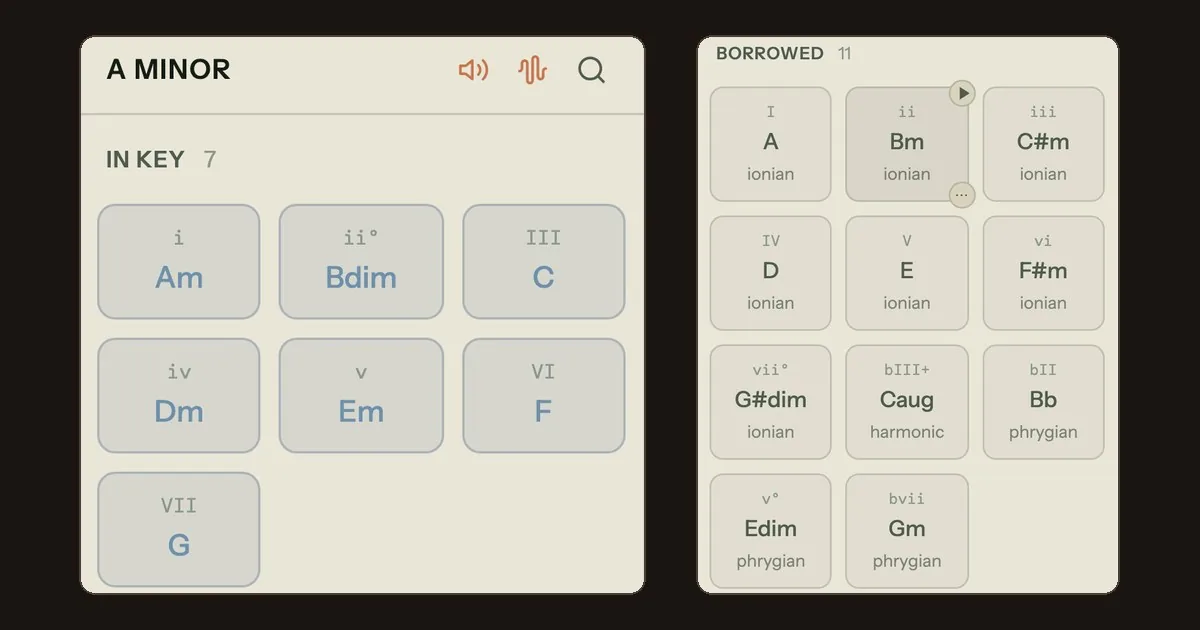
Reading about stored motion is one thing; hearing it inside your own progression is what makes the chord stick. Open a song in Song Cage and set a key, and the In Key tab of the chord palette lays out all seven chords that key contains, including its diminished one, each labeled with its Roman numeral: Bdim reads vii° in C major, and the same chord reads ii° in A minor. The Borrowed tab adds the darker relatives from the parallel scale, extra diminished colors included. Tap the extension on a diminished chip and you get the half-diminished version, labeled with the slashed-circle ø7 the way a jazz chart would write it. Every chord in the palette comes with guitar fretboard shapes and piano voicings, so you can audition that 1–♯1°7–2m walk-up on the instrument you actually play. Capture a melody first and the Auto Chords suggestions include the key's diminished chords whenever they genuinely fit your notes, and the Modulation tab's routes use diminished seventh and half-diminished pivots to steer a key change, the trapdoor trick from this post, wired into the app.
Put a diminished chord where it hurts (in a good way)
Song Cage shows you every chord in your key, the borrowed colors next door, and the half-diminished upgrade one tap away, with guitar shapes and piano voicings for each. Capture the idea before it is gone, then make the floor tilt on purpose.
Frequently Asked Questions
What is the diminished chord in the key of C major?
Bdim (B–D–F), built on the seventh scale degree and written vii°. It is the only diminished triad C major contains. The same three notes also serve as ii° in A minor, where the chord sets up the dominant instead of resolving to the tonic.
Is Bdim the same as Bm7♭5?
No. Bdim is the three-note diminished triad (B–D–F). Bm7♭5 adds a minor seventh (B–D–F–A) and is called half-diminished, written Bø7. Bdim7 adds a diminished seventh instead (B–D–F–A♭). The two sevenths sit one half step apart and give the chords very different jobs.
Why are there only three diminished 7th chords?
A dim7 divides the octave into four equal minor thirds, so every inversion contains the same four pitches under a different name. Cdim7, E♭dim7, G♭dim7, and Adim7 are one sound. Group the twelve roots that way and only three distinct diminished seventh chords exist.
Can a song end on a diminished chord?
It is rare, because the chord is engineered to lean somewhere else, but it happens: The Beatles end "Because" on an unresolved diminished sonority, letting the tension just hang. Most writers resolve the diminished chord and end on the chord it points to instead.
What is the difference between a diminished chord and a minor chord?
One note: the fifth. A minor chord has a perfect fifth above the root (B–D–F♯ for Bm); a diminished chord flattens it (B–D–F), which puts a tritone inside the chord. The minor chord sounds sad but stable; the diminished chord sounds unstable and in motion.
What scale works over a half-diminished chord?
The Locrian mode, the seventh mode of the major scale, matches a half-diminished chord note for note: play B Locrian over Bm7♭5 and every chord tone is covered. Jazz players also reach for Locrian with a natural 2 for a smoother melody. See our guide to the seven musical modes for how Locrian relates to the rest.