Table of Contents
- What makes a song sound like Christmas?
- Why do these chords sound like Christmas?
- How do you start writing a Christmas song?
- Which chords make a song sound like Christmas?
- Move 1: Why add sevenths and sixths?
- Move 2: What does a secondary dominant add?
- Move 3: Where does a diminished passing chord go?
- Move 4: What is the "Christmas chord"?
- Why does the minor iv sound bittersweet?
- Move 5: What is a chromatic inner line?
- Move 6: How should a Christmas song end a section?
- Worked example: turning a plain loop into a Christmas progression
- Should a Christmas song be in 3/4 or 6/8?
- What about swing?
- How do you write a Christmas melody?
- How do you write Christmas lyrics without clichés?
- Does a Christmas song have to mention Christmas?
- How should you structure a Christmas song?
- How do you write a Christmas song for kids?
- A note on a book I wrote
- Can a new Christmas song still become a standard?
- How do you capture a Christmas song idea before it's gone?
- How does Song Cage help you write a Christmas song?
- Frequently Asked Questions
Mel Tormé and Bob Wells wrote "The Christmas Song" in July 1945, during a heat wave, trying to "stay cool by thinking cool." By Tormé's account the whole thing took well under an hour. Sammy Cahn and Jule Styne wrote "Let It Snow! Let It Snow! Let It Snow!" in Hollywood that same July, and its lyric never mentions Christmas at all.
Both songs sound like Christmas anyway, and the lyric is only part of the reason. The rest is a small set of harmonic moves that songwriters of the 1940s and 1950s used again and again: secondary dominants, a borrowed minor iv, diminished passing chords, chromatic inner lines and the I–vi–ii–V turnaround, often in waltz time or with a swing.
This guide shows you how to write a Christmas song of your own by taking those moves one at a time, with the real songs that use each one. Then it builds them into a single progression you can play today, and covers melody, lyrics, meter and a song for small children.
The short version
Start from a plain major-key loop such as C, Am, Dm, G. Add sevenths and sixths for warmth. Turn a minor chord into a secondary dominant (A7, D7 or E7 in C). Slip a diminished chord between two chords a step apart. Let a major IV fall to a minor iv before you come home. Try the song in 3/4 or 6/8. Then write a lyric about one real Christmas, not all of them.
What makes a song sound like Christmas?
A song sounds like Christmas when a few signals line up: a major key, rich chords borrowed from mid-century jazz and pop, a turnaround that keeps pulling home, and a lyric about home, snow, love or memory. Sleigh bells help. The harmony carries the feeling, and it works in any genre.
The best data on this comes from musicologist Joe Bennett, who analysed the 78 Christmas songs among the UK's 200 most-streamed tracks on Spotify in the week of Christmas 2016. His study found 95% of them in a major key and 90% in 4/4, with 35% of the total swung. Only 6% were in 12/8 and 4% in 3/4. Almost half, 38 songs, had sleigh bells, and the median tempo was about 115 beats per minute.
Bennett is careful about what that means. "There is no formula for any kind of songwriting," he told Berklee, "just a set of creative choices in the songwriter's craft." The numbers describe what the hits have in common. The moves below are the creative choices behind them.
Why do these chords sound like Christmas?
Mostly because of when the songs were written. The secular Christmas canon came out of the jazz-influenced popular songwriting of the 1930s to the 1950s, and its seventh chords, diminished chords and turnarounds now signal both the season and the past. Newer songs borrow that harmony to sound classic.
Adam Ragusea made the case in Slate. Before rock 'n' roll, he wrote, popular songs "had a lot more in common with jazz," and writers such as Ralph Blane, Mel Tormé and Jule Styne "all brought the rich harmonic palette of jazz" to the Great American Songbook. Mental Floss put it more bluntly: since jazz stopped being pop music decades ago, a newer song that uses a 2-5-1 or another jazzy progression "often gives it that nostalgic Christmassy feel."
The religious carols came first. According to Wikipedia's history of Christmas music, the Great Depression brought "a stream of widely popular songs of U.S. origin" about the season's customs rather than its Christian meaning. Singer Michael Feinstein summed up those songs: they "are not about Jesus, but they're about sleigh bells and Santa and the trappings of Christmas."
How do you start writing a Christmas song?
Start with something plain enough to hear each change on. A four-chord loop in a major key, such as I–vi–ii–V, is ideal: in C that is C, Am, Dm, G. Every move in this guide is applied to that loop, one at a time, so you can hear what each one adds.
That loop is already Christmas music. Wham!'s "Last Christmas" runs one I–vi–ii–V loop through its verse, chorus and instrumental (Hooktheory transcribes it in D as Dadd9, Bm(add11), Em(add11), A6), and its verse and chorus share the same chords and melody with no middle eight. "It's the Most Wonderful Time of the Year" opens its verse on the same four functions, and Leroy Anderson's "Sleigh Ride" repeats I7–vi7–ii7–V9.
George Michael wrote "Last Christmas" in February 1984 in his childhood bedroom, then played every part on the record himself. The chords are simple. The colour comes from the added notes and the sleigh bells.
If you want the reasoning behind choosing chords by function, our guide to writing a chord progression covers it. Here, play the plain loop a few times, then change one thing.
| Move | In C | What it adds | Heard in |
|---|---|---|---|
| Starting loop | C, Am, Dm, G | A turnaround that always points home | "Last Christmas" |
| 1. Sevenths and sixths | Cmaj7 or C6, Am7, Dm7, G7 | Warmth, a wistful edge | "The Christmas Song", "Christmas Time Is Here" |
| 2. Secondary dominants | A7 for Am, E7 into Am, C7 into F | Forward pull, a swing-era bounce | "Jingle Bell Rock", "Santa Tell Me" |
| 3. Diminished passing chord | C, C#dim7, Dm7 | A bass line that climbs by half steps | "Jingle Bell Rock", "Sleigh Ride" |
| 4. Borrowed minor iv | F, Fm6, C | The bittersweet sigh before home | "All I Want for Christmas Is You" |
| 5. Chromatic inner line | C, C+, C6, C+ | Motion inside one chord | "Rockin' Around the Christmas Tree" |
| 6. Waltz or 6/8 | Any of the above in 3 | A rocking, lullaby feel | "Silent Night", "It's the Most Wonderful Time of the Year" |
Which chords make a song sound like Christmas?
Six moves do most of the work: sevenths and sixths on the basic chords, secondary dominants, diminished passing chords, the borrowed minor iv, chromatic lines inside a held chord, and a steady I–vi–ii–V turnaround. You don't need all six. Two or three, chosen for the song, are usually enough.
Each one below comes with the songs that use it. The chord names come from transcriptions of the original recordings, mostly Hooktheory's TheoryTabs, in the key of the record, with the Roman numerals so you can move them to your own key.
Move 1: Why add sevenths and sixths?
A major seventh or an added sixth on the home chord softens it. Cmaj7 or C6 sounds warmer and less final than a plain C, and minor sevenths on the other chords do the same. Berklee Online songwriting instructor Jimmy Kachulis suggests major sevenths because they "invoke a 'wistful' feeling."
Kachulis gives that as an exercise in Berklee Online's guide to writing holiday songs. Vince Guaraldi's "Christmas Time Is Here" (1965) opens on an F major seventh and rocks back and forth to an E♭7 with a raised eleventh.
The sixth is the swing-era version. Nat King Cole's recording of "The Christmas Song" opens on D♭6, a major chord with an added sixth, then climbs the scale in seventh chords: D♭6, E♭m7, Fm7, G♭maj7, and back to Fm7. Frank Sinatra's "Santa Claus Is Coming to Town" voices nearly every home chord and IV chord as a sixth chord, and his "Let It Snow" closes on D6/9.
On the loop, play Cmaj7 or C6, Am7, Dm7, G7. Nothing else changes.
Move 2: What does a secondary dominant add?
A secondary dominant is a major chord, usually with a flat seventh, that points at a chord other than home. In C, A7 points at Dm, E7 at Am and C7 at F. Swap one into the loop and the next chord feels like an arrival instead of a step.
The simplest one turns the home chord into a dominant seventh so it leans into IV. Ariana Grande's "Santa Tell Me" (2014) does it in its verse and pre-chorus: G, G7, C. Bobby Helms's "Jingle Bell Rock" (1957) makes D into D7 in its chorus, in D, then passes through B7 on the way to G.
The V of ii and the V of V are just as common. Gene Autry's "Here Comes Santa Claus" repeats D♭, B♭7, E♭m, A♭7, D♭ in its verse, and Eartha Kitt's "Santa Baby" loops D♭, D♭/F, E♭7, A♭. Perry Como's "It's Beginning to Look a Lot Like Christmas" ends its verse A7, Am7, D7 in G.
"All I Want for Christmas Is You" puts one in its chorus: G, B7, Em. B7 is the V of vi, so Em lands with weight. Wikipedia calls secondary dominants "a cornerstone of popular music and jazz in the 20th century."
Chain them around the circle of fifths and you get the ragtime progression: A7, D7, G7, C in the key of C, sometimes with E7 in front. Wikipedia notes it is "much older" than ragtime and "also typical of parlour music." The theory in full is in our guide to secondary dominants.
In Song Cage, the chord palette lists these under their own Secondary Dominants heading, worked out from your key. In C, E7 is marked V/vi7 with an arrow to vi (Am), and A7 is marked V/ii7 with an arrow to ii (Dm), so you can see where each one leads before you place it.
Move 3: Where does a diminished passing chord go?
Between two chords a whole step apart. In C, put C#dim7 between C and Dm7, and the bass climbs C, C sharp, D. In "Jingle Bell Rock" the same move is D to D#dim7 to Em7. The diminished chord lasts a beat or two and exists to connect.
The verse of "Jingle Bell Rock" runs D, Bm7/D, D6, D#dim7, Em7, so the bass walks up by half steps into the ii chord. Leroy Anderson's "Sleigh Ride" does the same in G in its middle section: G9, G#dim7, Am7.
The other common spot is the raised fourth, on the way to V or back home. "It's the Most Wonderful Time of the Year" goes G, G#dim7, D in Hooktheory's key of D. Sinatra's "Santa Claus Is Coming to Town" climbs from E♭6 through E diminished to B♭6. "White Christmas" uses a D# diminished to point at E in A major, in Hooktheory's transcription of the Bing Crosby record.
A diminished seventh is four notes a minor third apart, so C#dim7 is C#, E, G and B♭. More on building and using them is in our guide to diminished chords.
Move 4: What is the "Christmas chord"?
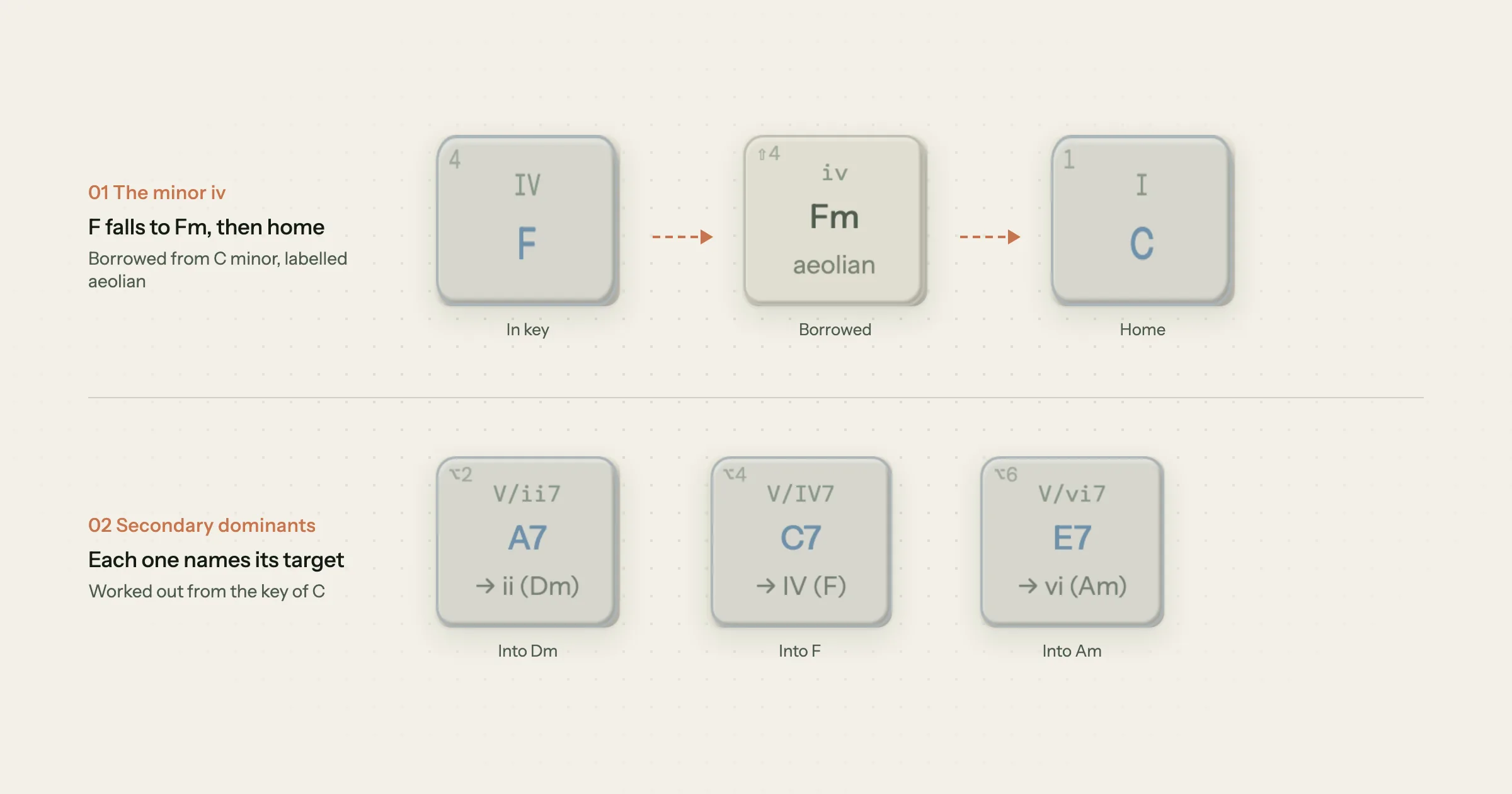
The minor iv, often with an added sixth: in C, Fm or Fm6. It often arrives straight after a major IV, so F falls to Fm, then resolves home to C. Adam Ragusea called it "the most Christmassy chord of all." It is borrowed from the parallel minor key.
Ragusea wrote in Slate that the minor iv with an added sixth is "what I consider the most Christmassy chord of all." In both "White Christmas" and "All I Want for Christmas Is You," he noted, it "comes immediately after a major subdominant chord," so the bright IV "sighs" or "melts" into the dark iv before the song settles home. Composer Vivek Maddala, analysing the Carey song for Stereogum, heard the verse close with a IV–iv–I minor plagal cadence in G, the iv voiced as Cm6 over E♭. Music like this, he argued, has "trained us as listeners to experience this sound as 'sentimental.'"
Hooktheory shows the move in the verse (G, C, Cm7/E♭) and again in the chorus (G, B7, Em, Cm6/E♭, G/D). "Jingle Bell Rock" has it in its chorus, G to Gm, then Em7, A and home to D. Kelly Clarkson's "Underneath the Tree" (2013) lands on it too: its verse slides E♭, Gm, G♭m, Fm7 down to A♭m, the minor iv of E♭.
Fm6 is F, A♭, C and D. The same four notes spell Dm7♭5, the half-diminished ii, which is why theorists name it both ways. The wider idea is in our guide to modal interchange and borrowed chords.
Why does the minor iv sound bittersweet?
Because it darkens one note in a major key. The A in F major drops to A♭ in F minor, and that A♭ then falls a half step to G, a note of the home chord. The ear hears a moment of shadow resolve into light, which suits a lyric about missing someone.
That is the harmonic tool for the most common Christmas theme. Bennett found nostalgia the leading theme in his study: "coming home for Christmas, missing those we love at Christmas, reminiscing about Christmases past," as he told Berklee. A song can stay in a major key, as 95% of his sample did, and still carry that ache for a beat.
Plagal cadences, IV to I, have a church history. Wikipedia notes the move is sometimes called the Amen cadence "due to its prevalence at the ending of hymns." The minor iv is the same cadence with one note lowered, and Maddala writes that Tin Pan Alley songwriters used it "regularly to summon a wistful feeling," with "White Christmas" as his example.
In Song Cage, the palette's Borrowed chords include Fm in C major, labelled iv, with the word "aeolian" under it for the minor mode it comes from. Set the voicing dial to Lush and the minor-iv suggestion becomes Fm6.
Move 5: What is a chromatic inner line?
A line that moves by half steps inside a chord that otherwise stays put. Over C, the fifth rises G, G sharp, A, then falls back: C, C+, C6, C+. Wikipedia calls this a line cliché, "any chromatic line that moves against a stationary chord."
The line cliché comes in two common forms. The major one "moves from the fifth of the chord to the sixth, then back to the fifth," passing through the raised fifth on the way, which is where the augmented chord comes from. The minor one "moves down from the root to the major seventh, to the minor seventh, and can continue until the fifth."
Brenda Lee's "Rockin' Around the Christmas Tree" (1958) puts a line in the bass. Hooktheory gives its chorus in A♭ as D♭, Cm, Fm, A♭+ over E, A♭ over E♭, then B♭7. The bass falls F, E, E♭ under the change. "Christmas Kids" by ROAR, a 2010 indie song that went viral on TikTok in 2023, uses the textbook major line cliché through its verse.
"Christmas Time Is Here" does it with whole chords. Its A section slides down by half steps, B♭m7, Am7, A♭m7, Gm7, into a C13♭9 and home to F.
Move 6: How should a Christmas song end a section?
With a turnaround that points back to the top. The ii–V into I is the classic ending, and Mental Floss notes that "many of the Christmas classics from the '40s, '50s, and '60s feature this sequence of chords." Put a V7 or a secondary dominant on the last bar so the section loops.
"Sleigh Ride" repeats ii9, V7, I(add6) through the section Hooktheory labels its bridge. "All I Want for Christmas Is You" ends its chorus and outro on a plain I–vi–ii–V. Donny Hathaway's "This Christmas" (1970) starts one chord earlier, iii7, vi11, ii7, V11, which is the same pull home with one more step.
For the final chord of the song, a 6/9 or a major seventh sounds more like the swing era than a plain triad: Sinatra's "Let It Snow" ends on D6/9.
Some of the most-played songs keep this part simple on purpose. José Feliciano called "Feliz Navidad" (1970) "the simplest song ever written," with 19 words. Its chorus repeats I, ii, V three times, then closes I, vi, IV, V, I.
In Song Cage, placing the last chord of a section shows a loop icon. Turn it on and the suggestions change to chords that lead back to the top of the section, including secondary dominants.
Worked example: turning a plain loop into a Christmas progression
Here is the starting loop in C with moves 1 to 4 applied, over eight bars. It is one possible result, not a formula. Change the order, drop a move, or keep only the two you like, and you have a different progression that is still yours.
| Bar | Plain loop | Christmas version | Move |
|---|---|---|---|
| 1 | C | Cmaj7 | Seventh for warmth |
| 2 | Am | C#dim7 | Diminished passing chord |
| 3 | Dm | Dm7 | Seventh |
| 4 | G | G7 | Dominant seventh |
| 5 | C | C7 | Secondary dominant, V of IV |
| 6 | Am | F, then Fm6 | Borrowed minor iv |
| 7 | Dm | C/G, then A7 | Home, then V of ii |
| 8 | G | Dm7, then G7 | ii–V turnaround |
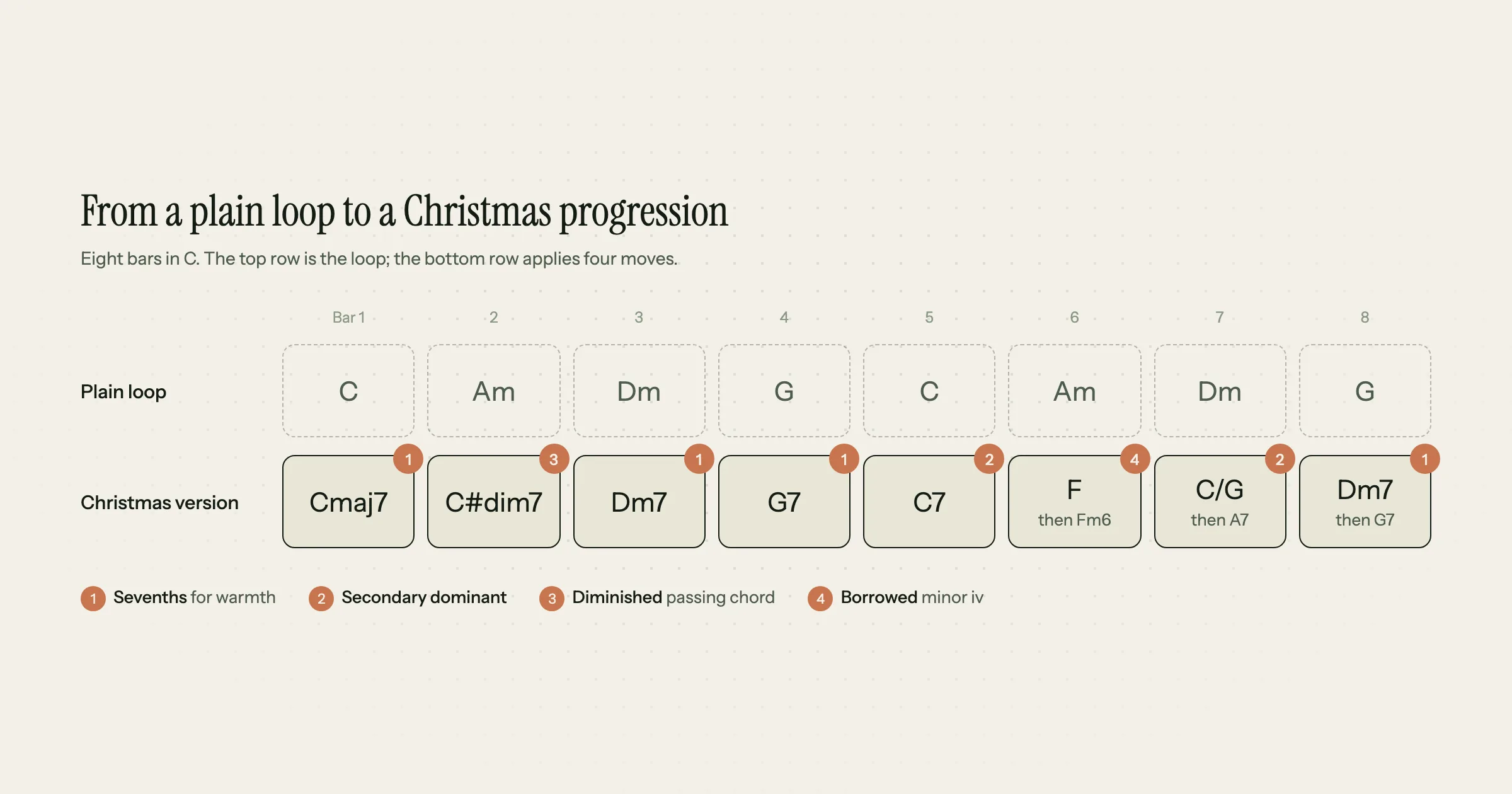
Bars 6 and 7 borrow a move from the "All I Want for Christmas Is You" chorus: a minor iv with a sixth resolving to the home chord over its fifth, Cm6 to G/D in that song's key.
On guitar, the same progression in G is Gmaj7, G#dim7, Am7, D7, G7, C to Cm6, G/D to E7, Am7 to D7. Every chord except the G#dim7 and Cm6 is an open shape.
Now try it three other ways. For a swing standard, replace bars 5 to 8 with the ragtime chain E7, A7, D7, G7. For a carol, put it in 3/4, drop the sevenths and keep only the F to Fm to C. For a modern pop song, loop C, G, Am, F and turn the F into Fm on the last pass before the chorus.
Should a Christmas song be in 3/4 or 6/8?
It can be, and a waltz will stand out. Most modern Christmas hits are in 4/4, straight or swung, but carols and lullabies lean on triple and compound meters, and some of the best-loved secular songs are waltzes. Try your song in 3/4 or 6/8 before you settle on 4/4.
Lullabies are "usually in triple meter or 6/8 time," according to Wikipedia, which gives them a "characteristic swinging or rocking motion." "Silent Night" began that way. Franz Xaver Gruber wrote it for guitar and voice for Christmas Eve mass in 1818, as a moderato tune in 6/8 with a siciliana rhythm, and today it is usually sung as a slow lullaby. "O Holy Night" is published in 12/8 with "a slow triplet feel."
Karen Gibson, founder of The Kingdom Choir, told BBC Radio 3 that "tunes written in 3/4 time make your body move automatically."
The secular canon has its waltzes too. "It's the Most Wonderful Time of the Year" is marked "Bright Waltz Tempo", felt one beat to the bar. "Christmas Time Is Here" is a waltz, and "The Christmas Waltz," by Sammy Cahn and Jule Styne, is one that Frank Sinatra recorded in 1954.
In Bennett's streaming sample, only one song in ten was in 3/4 or 12/8. That makes a waltz a way to sound different from the playlist around it.
What about swing?
Swing is the other Christmas feel. In Bennett's sample, 35% of the songs were in swung 4/4, so each beat divides long-short instead of evenly. It is the rhythm of the swing-era standards, and it is how a 1990s song such as "All I Want for Christmas Is You" borrows their sound.
Maddala hears an "eighth-note triplet rhythmic figure forming a peppy shuffle groove" in both "All I Want for Christmas Is You" and Darlene Love's "Christmas (Baby Please Come Home)" (1963), in his Stereogum analysis. Wikipedia calls "Jingle Bell Rock" "a fairly basic swingin' pop Christmas melody."
There is a practical reason to pick an up-tempo feel. Publisher Justin Wilde told BMI that to get a song placed you should "write mid- or up-tempo songs. There are probably ten ballads out there for every mid-tempo song." Most songs on Christmas albums are standards, and BMI's Jason Blume notes they typically include no more than two or three originals.
In Song Cage you can set a song, or a single section, to 3/4, 6/8 or 12/8, then play it back with a waltz strum, a 6/8 strum or an arpeggio, so you hear the feel before you commit to it.
How do you write a Christmas melody?
Decide who sings it. A song for a room full of people needs a small range and room to breathe. A song for one strong voice can take a wider range and one big leap. Then let the melody land on the new colour notes your chords create.
The group version has limits. "A group of people will need time to breathe together," composer Bob Chilcott told BBC Radio 3. He adds that "many people don't like singing too low or too high, so you might need to keep the range fairly small." Justin Wilde warns against two-octave ranges and awkward octave jumps for the same reason.
The solo showpiece can do more. Toronto musician Chris Tsujiuchi pointed out to CBC that "The Christmas Song" starts with an octave jump, "a really bold move," and in his reading changes key twice in its first 16 bars. It was written for Nat King Cole's voice, not a carol-singing crowd.
The chords from the moves above give the melody new places to land. Over Fm6, sing an A♭, the note that makes the chord minor, and let it fall to G as the harmony goes home. Over C+, the G sharp in the melody pulls up to A. Over a C#dim7, the melody can climb with the bass. These are the notes that make a melody sound like it belongs to the harmony instead of sitting on top of it.
There is no special Christmas key. Bennett's recipe for an "ultimate" Christmas song suggested C or A major, but the right key is the one that suits the singer. If a draft sits too high or too low, here is how to find the right key for your voice.
How do you write Christmas lyrics without clichés?
Pick one real Christmas moment and write about that, in specific detail: a place, a person, a year. Bennett found the most common themes are home, love, lost love, parties, Santa, snow, religion and peace on earth. The theme can be familiar. The details are where your song becomes yours.
Bennett's 2017 analysis listed snow, party, tree, Santa, love, home and cold among the common words. A later study with John Pierce O'Reilly of Oxford, covering 11 years of UK Christmas-week charts, found "home for Christmas" the largest lyric theme, peaking in 2021 at about 30% of the charting tracks (Bennett, 2025).
The familiar words aren't a problem. What makes them feel generic is using them without a scene. Bennett points out that "All I Want for Christmas Is You" names the tree, the snow and the presents only to say the singer doesn't care about any of them (NPR). It uses the conventions and turns them into a love song.
A Christmas song can be sad, too. One of Vulture's rules for writing an original Christmas song is "It doesn't have to be positive." When Judy Garland, her co-star and director Vincente Minnelli heard the first draft of "Have Yourself a Merry Little Christmas," they found it depressing and asked for changes. Hugh Martin rewrote it to be more hopeful, and in 1957 revised a line again for Frank Sinatra. The song kept its melancholy.
Does a Christmas song have to mention Christmas?
No. "Let It Snow! Let It Snow! Let It Snow!" never mentions Christmas: it is a love song set in a snowstorm, and it became a Christmas standard anyway. Winter, home, a year ending and someone missing are enough for listeners to hear the season.
That gives you room. Sammy Cahn and Jule Styne wrote it in July 1945 during a Hollywood heat wave, imagining cooler weather. José Feliciano wrote "Feliz Navidad" while homesick in a Los Angeles studio, missing his family in New York. A song built on one feeling, written in the middle of it, travels further than a list of holiday objects.
It doesn't even have to start life as a Christmas song. Vulture reports that Hit-Boy made the beat for Kanye West's "Christmas in Harlem" as one of many for a different album, and that Kelly Clarkson's "Glow," with Chris Stapleton, was meant for a non-Christmas project "before a bit of rewriting turned it into a holiday song."
For rhyme work, Song Cage's Words panel follows the word under your cursor and lists exact rhymes grouped by syllable count, slant rhymes and synonyms, next to your chords. It won't write the line for you.
How should you structure a Christmas song?
Either verse–chorus or the AABA form of the swing-era standards. Put the title in the chorus or at the end of each A section. Save your strongest harmonic move, the minor iv or a chain of secondary dominants, for the moment the title arrives or for the bridge.
AABA means three sections with the same melody and one contrasting bridge. Wikipedia describes it as "commonly found in Tin Pan Alley songs and other American popular music, especially in the first half of the 20th century," the era most of the standards come from. "Christmas Time Is Here" is a waltz in AABA form, and its B section leans into D♭ major, a major third below F, before returning. A key shift in the bridge is a standard way to make the last A feel like a homecoming.
The pop hits are simpler. "Last Christmas" uses the same chords and melody for verse and chorus and has no middle eight at all.
Whichever you choose, the chorus is where the move goes. In "All I Want for Christmas Is You," the minor iv sits in the chorus, right before the home chord.
How do you write a Christmas song for kids?
Keep it simple and repetitive. Use a few chords, mostly I, IV and V, a small melodic range, and a chorus a child can learn after one listen. For a lullaby, add a rocking 3/4 or 6/8 and a slow tempo. One minor iv at the end is enough colour.
Wikipedia describes lullabies as usually simple and slow, often alternating the home chord and the dominant, with that rocking triple or compound meter. Much of the children's Christmas canon keeps the harmony just as plain. Johnny Marks based "Rudolph the Red-Nosed Reindeer" (1949) on a 1939 Montgomery Ward promotional story by his brother-in-law, Robert L. May, and the song tells one story with one hero.
Write it for a particular child. A song with their name, their dog or the view from their window will get requested long after the season ends, and the small range means they can sing it back.
A note on a book I wrote
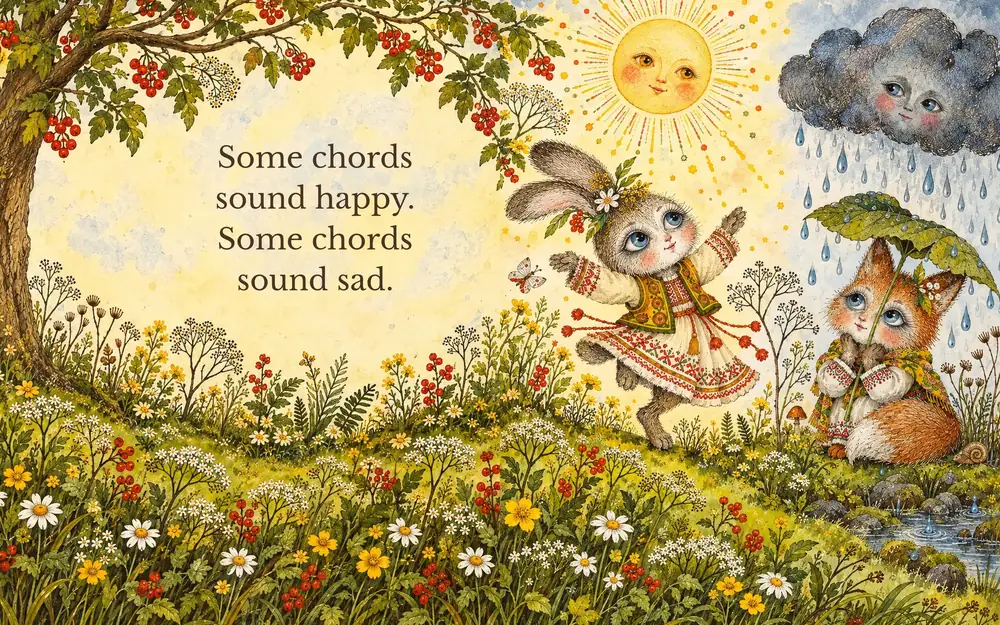
This one is mine, so take the mention with that in mind. I wrote a picture book for my own two small children, Music Theory for Babies, for ages 0 to 3. It turns the first ideas of music into one short line a page: high and low, loud and quiet, then rhythm, the beat, melody, the scale, harmony and chords, with a page on how some chords sound happy and some sound sad. If you're writing a song for a baby this Christmas, it covers the same basics you're using, at their level. It's also in our list of gifts for songwriters.
Can a new Christmas song still become a standard?
Yes, but slowly. Only 16 holiday songs have ever reached the Billboard Hot 100 top 10, and the two newest, from 2013 and 2014, took about a decade to get there. Write the song because you want it to exist. If it lasts, it will take years to find its audience.
Billboard counted those 16 in December 2025. Ariana Grande's "Santa Tell Me," released in 2014, and Kelly Clarkson's "Underneath the Tree," from 2013, both first reached the top 10 on the chart dated December 28, 2024. Nat King Cole's "The Christmas Song" first reached the top 10 in 2023, which Billboard says makes it the oldest seasonal song ever to get there.
The canon is crowded. On the Hot 100 dated January 3, 2026, holiday songs held the top 24 places. Bennett doesn't think new songs are worse: "It isn't that new songs are bad; it's that they haven't existed long enough to feel timeless," he told NPR.
The prize for the rare survivor is large. By one Billboard estimate, "All I Want for Christmas Is You," written by Mariah Carey and Walter Afanasieff in 1994, earned almost $8.5 million in global revenue and publishing royalties in 2022 alone.
How do you capture a Christmas song idea before it's gone?
Record it the moment it arrives, even if it's a hummed line over one chord. Most Christmas songs start in the wrong season, so the idea you have in July has to survive until you finish it. Write the chords down with it while you still remember them.
Tormé and Wells wrote theirs in July. George Michael wrote "Last Christmas" in February. Christmas records are often made months before anyone hears them, so the writing happens whenever the idea shows up.
The free Song Cage app for iPhone and Android is built for that step. Hum the idea on the Record tab, type the lines on the Lyrics tab and tap the chords in on the Chords tab. You don't need an account.
Sign in and your captures sync to your account. With the Song Cage licence, or during the 14-day trial of the desktop app or plugin, they arrive in the Ideas inbox on your computer, ready to drag into a song. There you can try borrowed chords and secondary dominants under your melody, switch the section to 3/4, and move the whole song to the singer's key.
How does Song Cage help you write a Christmas song?
Song Cage is a songwriting app for capturing an idea and building it into a song: chords that know your key, a melody lane over the chord grid, lyrics on the same timeline, and playback so you can hear it. It contains no generative AI, so the song stays yours.
What it does for a Christmas song
- Secondary dominants by key: each one labelled with the chord it resolves to, such as E7 as V/vi7 pointing to vi (Am) in C.
- The minor iv, labelled: the Borrowed chords show Fm in C as iv from aeolian, and the Lush setting turns it into Fm6.
- Routes inside your key: select a chord and the Modulation tab lists moves such as a diminished passing chord (#iv°7, V7, Imaj7) and a vi–ii–V–I, ready to place.
- Any chord by name: type C#dim7 or Caug into chord search. Write flats with a lowercase b, such as Ab or Bbdim7.
- Waltz and 6/8 playback: set a song or one section to 3/4, 6/8 or 12/8 and hear it with a matching strum or arpeggio.
- Chords under a hummed tune: Auto Chords suggests a progression for your melody, and its Reharm setting moves borrowed chords and secondary dominants up the list. You choose every chord.
The full tour of the palette is in the chord progressions docs.
Write your own, not a cover
Capture the tune, then try the minor iv, a secondary dominant or a waltz under it and hear the difference before you play it for anyone.
Frequently Asked Questions
What chord makes a song sound like Christmas?
The one most often named is the minor iv with an added sixth, Fm6 in the key of C, which Adam Ragusea called "the most Christmassy chord of all." It often follows a major IV and resolves home, as in F, Fm6, C. Secondary dominants and diminished passing chords are close behind. No single chord does it alone. It's the combination, usually in a major key.
What key are most Christmas songs in?
A major key, almost always: 95% of the 78 songs in Joe Bennett's 2017 study were major. There is no single Christmas key. The recordings in this guide range from C and D to A♭ and D♭. Pick the key that suits the singer, then use the moves in this guide inside it.
What are the basic chords for a Christmas song?
The same I, IV and V as most songs, with ii and vi for the turnaround: in C, that is C, F, G, Dm and Am. "Feliz Navidad" builds its chorus from I, ii, IV, V and vi. What makes the Christmas sound is what you add to those: a seventh, a secondary dominant such as A7 or E7, a diminished passing chord, or F falling to Fm before C.
Are Christmas songs in 3/4 or 4/4?
Mostly 4/4. In Bennett's sample, 90% were in 4/4, over a third of them swung, while 6% were in 12/8 and 4% in 3/4. Carols and lullabies lean on 3/4 and 6/8, and "It's the Most Wonderful Time of the Year" and "Christmas Time Is Here" are both waltzes. A waltz is a good way to stand out.
Can a Christmas song be sad?
Yes. "Have Yourself a Merry Little Christmas" was rewritten because its first draft was thought too depressing, and it still carries that sadness. Nostalgia and missing someone are the most common Christmas themes. You can stay in a major key and let the minor iv carry the ache for a beat before the song comes home.
Can I use another Christmas song's chord progression?
Standard progressions are shared ground. The US Copyright Office's Compendium lists "chord symbols based on standard chord progressions" as common property, and its example of a sequence "both standard and too short to be sufficiently creative" is C, Am, Dm, G, the loop this guide starts from. What makes a song yours is the melody and the lyric. Borrowing a move such as the minor iv is how songwriters have always learned. Copying someone's melody or words is not. This is general information, not legal advice.
How long does it take to write a Christmas song?
It varies, and the famous stories are short. Mel Tormé said "The Christmas Song" was finished in well under an hour, and José Feliciano's "Feliz Navidad" was recorded in 10 minutes. Most songs take longer, with several rewrites. Start early: the idea you have in the summer is the one you can finish and record before December.