Table of Contents
- What is a time signature?
- What is the difference between simple, compound and odd meters?
- How common is each time signature in popular music?
- What does 4/4 do to a lyric and a chord progression?
- What is cut time (2/2)?
- What does the 3/4 time signature (waltz time) do to a melody?
- How do lyrics fit 3/4?
- How do chords move in 3/4?
- What does the 6/8 time signature feel like, and why does it count in two?
- How do you count 6/8?
- Which lyric rhythms sit naturally in 6/8?
- How do chords move in 6/8?
- Is my song in 3/4 or 6/8 (or 12/8)?
- How do you tell 3/4 from 6/8 by ear?
- When is it 12/8 instead of 6/8?
- How do you tell what meter a melody you hummed is in?
- How do odd time signatures like 5/4 and 7/8 work in a song you can sing?
- How do you count 5/4 and 7/8?
- What is the difference between 7/8 and 7/4?
- Where do the chords and stressed words go in an odd bar?
- When should you change meter for one bar or one section?
- The line runs long: add beats
- The chorus should land sooner: cut beats
- The section needs a different feel: change the section's meter
- How do you make a meter change sound on purpose?
- Which time signature should you pick?
- Setting the time signature in Song Cage
- Frequently Asked Questions
You hummed it swaying. You wrote it down in 4/4 because that's what the app opened in, and now every line has a beat too many, the long note lands in the wrong place, and the chorus arrives half a bar late. Nothing is wrong with the tune. It was in three the whole time.
A time signature looks like sheet-music bookkeeping: two numbers stacked at the start of a staff, the top one counting beats per bar and the bottom one naming the note that gets the beat. For a songwriter it is a decision about where your strong words land and how often your chords are allowed to move. Most guides teach you to read the numbers. This one is about choosing them, and about the arguments over famous songs that every "songs in 6/8" list gets wrong.
Quick summary
A time signature tells you how many beats a bar holds and what kind of note counts as the beat. Pop is overwhelmingly in 4/4: in our count of the McGill Billboard dataset, 689 of 739 charting songs from 1958 to 1991 open in it. The other meters are feel choices. 3/4 gives one strong slot per bar, 6/8 and 12/8 give two or four big beats that each split into three, and 5/4 and 7/8 are short-plus-long groups of twos and threes. Many famous songs are written down two different ways, which is a notation choice, not a mistake.
What is a time signature?
A time signature is the pair of numbers at the start of a song that sets the length of every bar. The top number says how many beats are in a bar and the bottom number says which note value counts as one beat. In 4/4 there are four quarter-note beats per bar; in 3/4 there are three.
Wikipedia's definition is the standard one: "an indication in music notation that specifies how many note values of a particular type fit into each measure (bar)." The bottom number is a code. A 4 means a quarter note, an 8 means an eighth note, a 2 means a half note.
It is not a fraction, even though it looks like one. Open Music Theory makes the point directly: there is no line between the numbers, and 3/4 is not "three quarters" of anything. Treat it as a label for a feel.
For a writer, the useful part is what the numbers imply. Every meter has strong positions where a stressed syllable sounds natural and a chord change sounds settled, and weak positions where a stressed word sounds pushed. Pick the meter and you have picked those positions for the whole section. That's why a lyric written to one meter can feel lumpy in another, even when every note is "right."
What is the difference between simple, compound and odd meters?
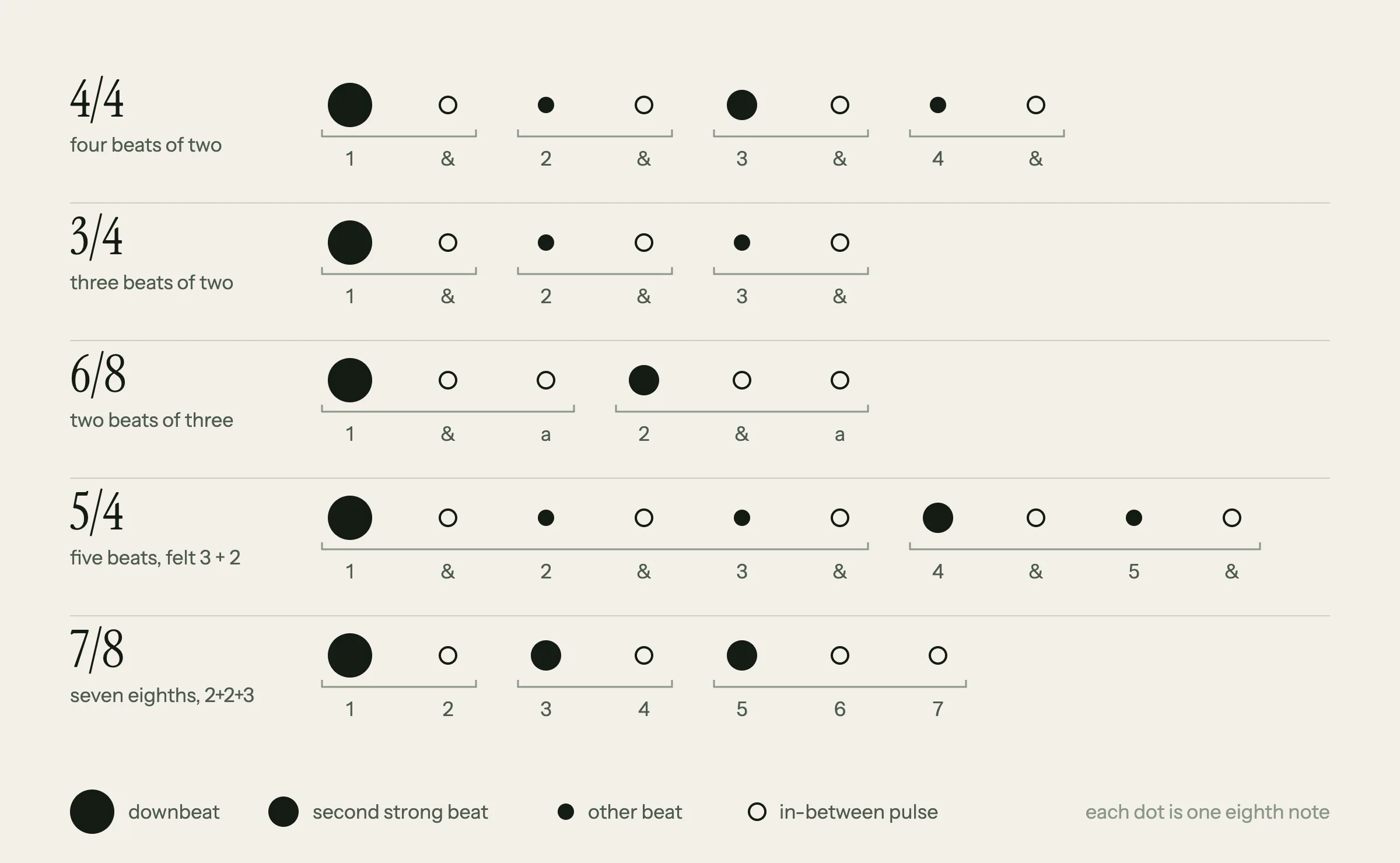
Simple meters split each beat into two (2/4, 3/4, 4/4). Compound meters split each beat into three (6/8, 9/8, 12/8). Odd, or asymmetric, meters mix beats of two and three in one bar, so the beats are unequal lengths (5/4, 7/8).
Open Music Theory puts the first distinction in one line: "meters that divide the beat into two equal parts are simple meters; meters that divide the beat into three equal parts are compound meters." Count a simple bar as "1 and 2 and." Count a compound beat as "1 and a," three even pulses inside each big beat.
The compound numbers trick people. In 6/8 the top number counts eighth notes, not beats: six eighths, felt as two big beats of three. Open Music Theory's compound meter chapter spells it out: top numbers of 6, 9 and 12 mean two, three and four beats.
Odd meters are the third family. A 5 is "either 3 + 2 or 2 + 3," according to Macalester's Multimodal Musicianship text, and the group of three is "slightly longer." That unevenness is the sound of an odd meter.
How common is each time signature in popular music?
Almost everything is 4/4. In our count of the McGill Billboard dataset, 93.2% of 739 charting songs from 1958 to 1991 open in 4/4. The next most common meter is 12/8, not 3/4, and only two songs in the whole set open in an odd meter.
No one publishes a clean "percentage of songs per meter" chart, so we counted. The McGill Billboard Project is a random sample of Hot 100 songs from 1958 to 1991, transcribed by trained annotators who mark the meter at the start of each song and wherever it changes. We tallied the opening meter of each distinct song, and repeated the count on the Rolling Stone 200 rock corpus built by Trevor de Clercq and David Temperley.
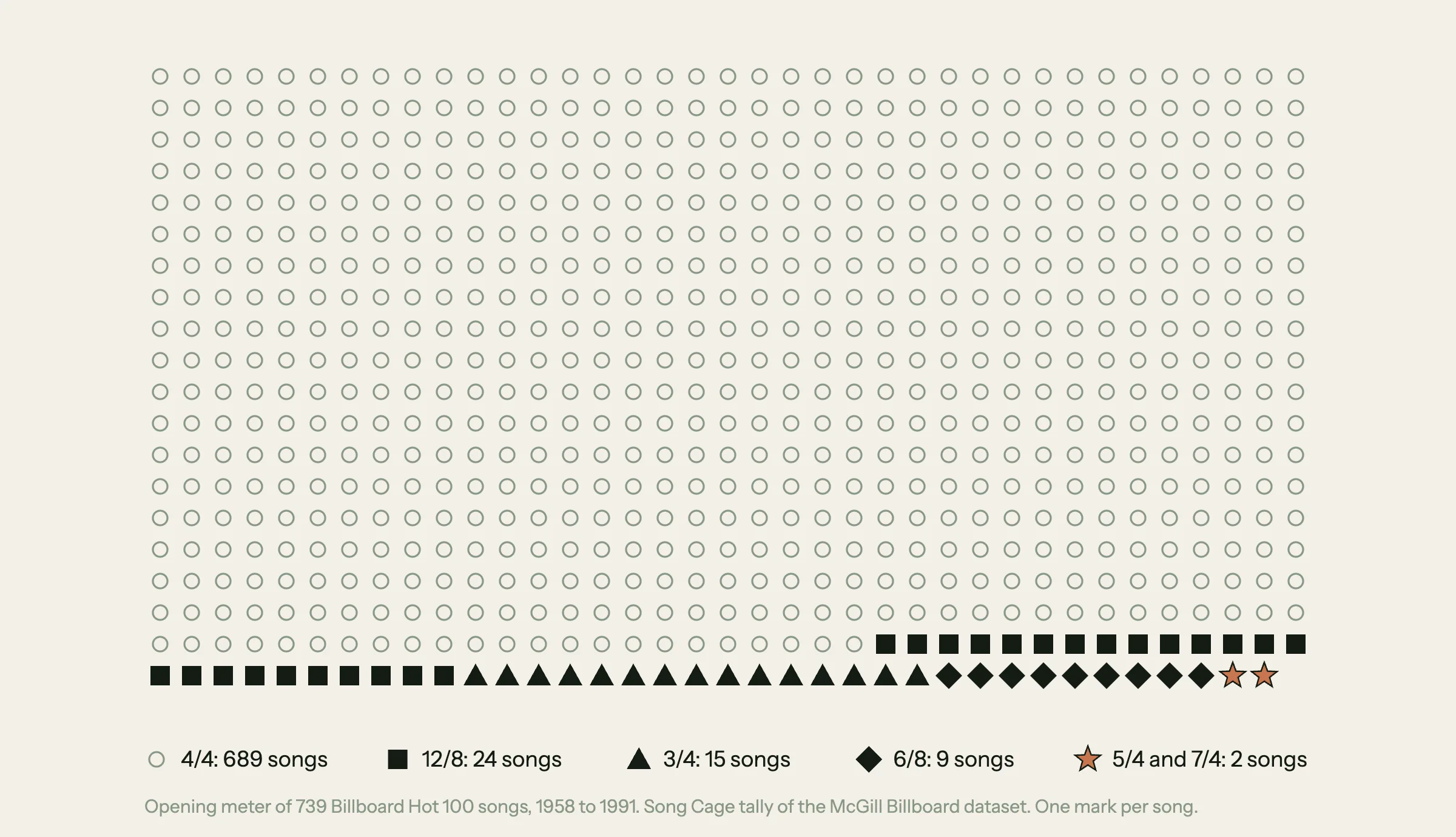
| Meter | McGill Billboard (739 songs, 1958–1991) | Rolling Stone 200 rock corpus |
|---|---|---|
| 4/4 | 689 (93.2%) | 168 (84%) |
| 12/8 | 24 (3.2%) | 24 (12%) |
| 3/4 | 15 (2.0%) | 1 (0.5%) |
| 6/8 | 9 (1.2%) | 6 (3%) |
| 9/8 | 0 | 1 (0.5%) |
| 5/4 | 1 ("Living in the Past") | 0 |
| 7/4 | 1 ("Money") | 0 |
Opening meter as annotated in each dataset. Song Cage's own tally of the public data files; the labels are the annotators' judgments, and annotators can disagree.
The 12/8 songs cluster early. A study of 21,320 Hot 100 tracks found that the 1964 turn in pop "involved a significant decline in the use of swung 8th notes and compound meters (e.g. the 12/8 meter so common in earlier soul and pop music)." So choosing anything but 4/4 sets you apart from most of the chart before anyone hears a word.
What does 4/4 do to a lyric and a chord progression?
In 4/4 the first beat is the strongest and the third is the next strongest. Stressed syllables and chord changes sound settled on 1 and 3, and pushed on 2 and 4. A chord usually lasts one bar or half a bar, and the line has room for two strong words per bar.
Hooktheory's meter reference describes the hierarchy: in 4/4 "the first and third beats are 'strong'" compared with 2 and 4. That gives a lyric line two landing spots per bar, which suits English. A lot of English falls into weak-strong pairs (da-DUM da-DUM), and that pattern lays across four beats with two stresses per bar and nothing left over.
It is also why 4/4 feels neutral. You can change chord once per bar, twice per bar on beats 1 and 3, or hold one chord for two bars, and each still sounds normal. That flexibility is what harmonic rhythm works with, and it's one reason 4/4 is the default in rock, country and pop.
The backbeat sits on 2 and 4, the snare hits that most rock and pop drum parts use. Your stresses land on 1 and 3 and the drums answer on 2 and 4. When a word moves off those slots on purpose, you get syncopation. When it moves off them by accident, you get a line that sounds like it tripped.
What is cut time (2/2)?
Cut time, written 2/2 or as a C with a line through it, has two half-note beats per bar instead of four quarter notes. It sounds like a fast 4/4 counted in two, and it is common for country two-beat songs and marches.
The difference is how you feel the pulse, not what you hear. Most published editions of Johnny Cash's "I Walk the Line" (1956) are in 2/2, including the Guitar Recorded Versions transcription at half note = 106. Dolly Parton's "Jolene" (1973) shows up both ways: one Musicnotes edition is in 2/2, a beginner edition is in 4/4. Same record, two arrangers, two time signatures.
The C symbol is older than the word "common." In medieval notation a full circle marked triple time and a broken circle marked duple time. The LilyPond music glossary notes that the C-shaped sign "originally designated tempus imperfectum" and "now stands for common time." The slashed version became cut time.
What does the 3/4 time signature (waltz time) do to a melody?
3/4 has three beats per bar and one strong beat, the first. That gives a lyric one landing spot per bar instead of two, so lines feel slower and more swung, and chords usually change once per bar. Waltz time is 3/4.
Wikipedia calls the waltz "a ballroom and folk dance, in triple (3/4) time," and the songs that use it lean on that sway. Bob Dylan's "The Times They Are a-Changin'" (1964) is in 3/4 in the published guitar transcription, at a brisk quarter note = 168. "Tennessee Waltz," written in 1946 by Pee Wee King and Redd Stewart and a No. 1 hit for Patti Page in 1950, is a country waltz. "Moon River," by Henry Mancini and Johnny Mercer, first sung by Audrey Hepburn in Breakfast at Tiffany's (1961), is a slow 3/4 throughout.
Fast 3/4 is a different animal. Jimi Hendrix's "Manic Depression" (1967) is written in 3/4 in Hal Leonard's piano/vocal/guitar edition, marked "triplet feel," while another Musicnotes arrangement writes the same groove in 9/8. One feel, two spellings, which is a theme you'll see again.
How do lyrics fit 3/4?
With one strong beat per bar, 3/4 suits words that fall DUM-da-da: one stressed syllable followed by two light ones. A line built from da-DUM pairs, the normal shape of English, tends to fight it, because the stresses keep landing on the weak beats.
Sound On Sound's lyric series uses "Lucy in the Sky with Diamonds" (1967) to show it. The verse is in 3/4, and the stresses fall in threes: "Pic-ture your-self on a boat on a riv-er." When the chorus arrives, the article notes, the switch to a stressed-plus-unstressed pattern corresponds with the switch from 3/4 to 4/4. The meter changes when the words change shape.
You can test your own line the same way. Say it out loud at normal speed and mark the syllables your voice leans on. If the gaps between stresses are mostly two light syllables, try it in three. If they are mostly one, 4/4 will feel easier. This is the same stress-mapping that fitting lyrics to a melody starts from, applied to the bar instead of the note.
How do chords move in 3/4?
Usually once per bar. With only three beats and one strong one, changing chord mid-bar puts the change on a weak beat, which sounds rushed. The classic accompaniment is "oom-pah-pah": bass note on 1, chord on 2 and 3.
That means a 3/4 song needs more bars to cover the same progression. Four chords at one per bar fill four bars, about 12 beats, where 4/4 at two chords per bar would fill two bars. The song breathes slower even at the same tempo, which is part of why waltzes feel like ballads.
When a 3/4 song does change faster, it usually holds two chords in a two-plus-one shape: the first for two beats, the second on beat 3 leading into the next bar. Use it at a cadence, the end of a phrase, where the push helps. A whole verse of mid-bar changes in three sounds busy.
What does the 6/8 time signature feel like, and why does it count in two?
6/8 has six eighth notes per bar, grouped into two big beats of three: ONE-and-a TWO-and-a. You feel two pulses per bar, each with a lilt inside it. Beats 1 and 4 of the six are the strong ones.
Wikipedia: "Most often, 6/8 is felt as two beats, each being a dotted quarter note." Hooktheory names "the first and fourth beats being the strongest." The official easy piano edition of Metallica's "Nothing Else Matters" (1991) makes the counting explicit: it is in 6/8, marked "Slowly, in 2" at dotted quarter = 48.
The 6/8 hits are mostly ballads and anthems. Queen's "We Are the Champions" (1977), Elvis Presley's "Can't Help Falling in Love" (1961) and the Red Hot Chili Peppers' "Breaking the Girl" (1991) are all in 6/8 in their published editions. Seal's "Kiss from a Rose" (1994) is in 6/8 too, though Seal calls it a waltz, and producer Trevor Horn has said "my main contribution to the song arrangement itself was that I put in a 3/8 bar."
Tempo is the hidden rule. Trevor de Clercq found that 6/8 songs in three pop corpora average about 60 dotted-quarter beats per minute, and "no song in these corpora analyzed in 6/8 had a tempo of more than 80 BPM." The bar still lasts about two seconds, roughly the same as a 4/4 bar at 120.
How do you count 6/8?
Count "ONE-and-a TWO-and-a," or "1-2-3 4-5-6" with weight on 1 and 4. Tap your foot only on the ONE and the TWO. If your foot is tapping all six, you are counting it like a fast 3/4 and it will feel stiff.
The counting matters when you set a tempo. A Gearspace user setting up "The House of the Rising Sun" in GarageBand found the song too slow at the sheet music's 78 BPM. A reply pointed out that the 78 referred to the dotted quarter, the big beat, not the quarter note. In 6/8, a tempo marking almost always counts the two big beats.
Which lyric rhythms sit naturally in 6/8?
6/8 suits words that come in threes: da-da-DUM or DUM-da-da, two light syllables to every stressed one, with two stresses per bar. It also lets a single stressed word stretch across a whole group of three, which gives slow 6/8 ballads their held, rocking vowels.
Wikipedia's time signature article notes that anapestic tetrameter, the da-da-DUM line of "'Twas the night before Christmas," "fits into 6/8 time when said aloud." Read that line at speaking pace and you'll hear the lilt. Two stresses per bar, three syllables per stress.
That gives you a quick check for a lyric that isn't sitting right in 4/4. If your line keeps landing stresses every third syllable, it was probably written in a compound meter in your head. Moving it to 6/8 usually fixes the stumble without changing a word.
How do chords move in 6/8?
Once per bar is the default, sometimes twice, on beat 1 and beat 4. Changing on the 2, 3, 5 or 6 sits inside a group of three and sounds off-balance unless it's deliberate. Picked accompaniment usually outlines the chord across each group of three.
"The House of the Rising Sun" shows the default. The guitar-teaching sources that write it in 6/8 put one chord in each bar, and the arpeggio rises across one group of three and falls across the next. A Gearspace reply sums up why it reads as 6/8: "The chords change every 6 beats."
Two chords per bar is the 6/8 version of "faster." It doubles the harmonic rhythm without crowding the bar, because each chord still owns a full big beat.
Is my song in 3/4 or 6/8 (or 12/8)?
3/4 is three equal beats per bar; 6/8 is two big beats that each split into three. The notes can be identical, but in 3/4 you feel ONE-two-three and in 6/8 you feel ONE-and-a TWO-and-a. Count the big pulses you'd tap your foot to, and how often the chord changes.
The confusion is real, and it reaches famous records. Billy Joel's "Piano Man" (1973) is in 3/4 in the official sheet music, but Joel himself told an interviewer in 2024, "It's in 6:8 time, which is a waltz." The Beatles' "Norwegian Wood" (1965) has been analysed in 3/4, 6/8 and 12/8 by three different Beatles scholars, as de Clercq notes in Music Theory Online.
The Animals' "The House of the Rising Sun" (1964) is 6/8 to most guitar teachers, 12/8 in the official Musicnotes guitar tab and lead sheet, and 4/4 in another official edition. Tears for Fears' "Everybody Wants to Rule the World" (1985) is the reverse: its official piano/vocal/guitar edition is in 6/8 while other arrangements write 12/8.
None of these are mistakes. They are the same sound counted at different bar lengths. What matters to you as a writer is which counting makes your phrases and chord changes line up.
How do you tell 3/4 from 6/8 by ear?
Listen for a backbeat on the "4" of the six. If the drums or strum answer the downbeat halfway through each bar, it is 6/8. If the bar goes "oom-pah-pah" with nothing in the middle, it is 3/4. Tempo is the other clue: slow, rocking pulses suggest 6/8.
A working drummer on the Acoustic Guitar Forum put it in one sentence, in a thread about "Piano Man": "Usually a 3/4 will feel like a waltz (oom-pah-pah) and 6/8 will feel like have a back beat on the '4' of the six." Another tip: pick the reading that makes your phrases come out in tidy four- or eight-bar groups.
The famous example of the two meters rubbing is Leonard Bernstein's "America" from West Side Story, which switches between them. That rub has a name, hemiola: "three beats of equal value in the time normally occupied by two beats."
When is it 12/8 instead of 6/8?
12/8 has twelve eighth notes per bar, felt as four big beats that each split into three. It sounds like 4/4 with triplets, and it is the usual meter for slow blues, doo-wop and soul ballads. If you feel four pulses before the phrase turns over, write 12/8; if you feel two, write 6/8.
Wikipedia's article on swing says "in 12/8, the beat is written differently but has a similar sound as songs in common time with eighth-note triplets," and names "Unchained Melody" (1955) as an example. Leonard Cohen's original "Hallelujah" (1984) is "in 12/8 time, which evokes both early rock and roll and gospel music." Alicia Keys' "Fallin'" (2001) and Ed Sheeran's "Perfect" (2017) are both in 12/8 in their published sheet music.
12/8 can also be a rewrite. Chris Stapleton's "Tennessee Whiskey" (2015) is in 12/8, "slowly, in 4," but musicologist Jocelyn Neal shows that Stapleton "recast the song in a slow compound meter"; the David Allan Coe and George Jones versions weren't in it. Same song, new meter, new feel.
A writer's test for 3/4, 6/8 or 12/8
- Tap the slowest pulse that still feels like a beat. Two taps per chord change points to 6/8, four to 12/8, three to 3/4.
- Count the stressed syllables per chord. One per bar suggests 3/4. Two suggests 6/8.
- Check the phrase length. Pick the meter that makes your lines four or eight bars long.
This test is our rule of thumb, not a theory rule, and it is the same decision those scholars and arrangers made differently for "Norwegian Wood." If two answers both make your phrases tidy, either is right. Pick one and stay consistent.
How do you tell what meter a melody you hummed is in?
Sing it back slowly, and tap along with the syllables you lean on. Count the taps until the melody starts to repeat. If the count settles into twos or fours, it is 4/4 or 2/4. If it settles into threes, it is 3/4. If each tap holds a lilt of three quick syllables, it is 6/8 or 12/8.
Almost every "how to find the time signature" guide assumes a recording with drums. A voice memo of a hummed idea has none, so you're working from the voice alone. These steps are our method for that case:
Finding the meter of a hummed idea
- Say the words out loud at normal speaking speed and underline the syllables your voice leans on. Those are your strong beats.
- Sway, then nod. A side-to-side sway that fits suggests a compound meter (6/8, 12/8). A head nod that fits suggests simple time.
- Count your taps from the first stressed syllable to where the phrase starts again. Then find the bar length that divides it evenly.
- Find the longest notes. Long notes usually sit on beat 1, so the distance between them is often one bar.
The counting-speed rule comes from a Stack Exchange answer with nearly 200,000 views. If you count "at a comfortable talking speed" the bottom number is probably 4. If you're counting fast enough to trip over your tongue, it's 8. The accepted answer adds the honest caveat: by ear you can find the pulse and where beat 1 falls, but the exact written signature is a convention.
How do odd time signatures like 5/4 and 7/8 work in a song you can sing?
5/4 has five quarter-note beats per bar and 7/8 has seven eighth notes, and both split into unequal groups: 5 is 3+2 or 2+3, 7 is usually 2+2+3 or 3+2+2. Put your chord changes and stressed words at the start of each group and keep one part steady.
The best-known 5/4 tunes are instrumentals: the Dave Brubeck Quartet's "Take Five" (1959), composed by Paul Desmond and "written in quintuple time (5/4)," and Lalo Schifrin's 1966 "Mission: Impossible" theme. Sung 5/4 songs exist and are worth studying. Jethro Tull's "Living in the Past" (1969) reached No. 3 in the UK and is "notable for being written in the unusual 5/4 time signature." Nick Drake's "River Man" (1969), Sting's "Seven Days" (1993) and Radiohead's "15 Step" (2007) are all in 5/4, and "Everything's Alright" from Jesus Christ Superstar (1970) rocks in five for most of its length.
Fives and sevens are the usual odd meters. Scott Hanenberg's 2018 doctoral study of irregular meter in rock found quintuple and septuple to be "the two most common irregular meters" in his 240-song corpus.
Peter Gabriel's "Solsbury Hill" (1977) is the model for a singable seven. It runs mostly in 7/4, settling into 4/4 at the end of each chorus. Gabriel told Sounds magazine, as quoted by Songfacts, "That 7/4 rhythm works well because it feels like a normal rhythm but isn't quite right."
How do you count 5/4 and 7/8?
Count the groups, not the beats. Count 5/4 as "ONE-two-three FOUR-five" (3+2) or the reverse. Count 7/8 as "ONE-two THREE-four FIVE-six-seven" (2+2+3) or "ONE-two-three FOUR-five SIX-seven" (3+2+2). The grouping is a choice, and it changes the feel.
Open Music Theory puts it plainly: "a 7/8 meter signature may be written as 2+2+3/8, 3+2+2/8, or another way." A 2+2+3 bar feels like it stumbles at the end; 3+2+2 feels like it leans forward from the start. Try both under the same melody and listen.
Radiohead's "15 Step" is a good one to count along with. Composer Nick Collins heard it as "an easy 5/4 (with 3+3+2+2 eighth note non-isochronous meter)," which is the same five beats split into ten eighths and grouped long-long-short-short.
What is the difference between 7/8 and 7/4?
7/4 has seven quarter-note beats and feels like a slow bar of 4 plus a bar of 3. 7/8 has seven eighth notes and feels like a quick, clipped bar that arrives early. Same seven, very different speed of pulse.
Pink Floyd's "Money" (1973) is the case that proves how blurry this gets. It's mostly in 7/4, with a 4/4 guitar solo. David Gilmour told Guitar World in 1993, "We created a 4/4 progression for the guitar solo, but made the poor saxophone player play in 7/4." But Gilmour also called it "the quirky 7/8 time" in a 2015 Uncut interview, so lists that say 7/8 are repeating Pink Floyd.
The Grateful Dead's "Estimated Prophet" (1977) is written as 7/4 by some sources and 7/8 by others, and drummer Bill Kreutzmann made it groove by regrouping it. His idea, as he told writer Alan Paul in 2015 and JamBase quoted, was to "make two bars of seven into a 14."
The quick 7/8 sound lives mostly in riffs. Alice in Chains' "Them Bones" (1992) runs its main riff in 7/8 and switches to 4/4 for the chorus. Rush's "Tom Sawyer" (1981) is 4/4 until the synth instrumental, which starts in 7/8. Radiohead's "Paranoid Android" (1997) drops into short bursts of 7/8 in its second section.
Where do the chords and stressed words go in an odd bar?
At the start of each group. In 3+2+2, the strong spots are beats 1, 4 and 6. Land your stressed syllables and chord changes there and the listener hears the grouping. Land them anywhere else and the bar sounds like a mistake.
The trick most working writers use is to keep something steady. Soundgarden's riffs are a good model. In "Outshined" (1991) the intro and verse riff is in 7/4, which you can feel as a bar of 4 plus a bar of 3, and the pre-chorus and chorus go back to 4/4. In "Spoonman" (1994) drummer Matt Cameron describes the verse as "the 7/4 part, plus a bar of four." The odd bar works because the 4/4 around it keeps you oriented.
Foo Fighters' "Times Like These" (2002) does the same with one riff. The main riff that comes in after the opening chords is in 7/4, counted 4+3, and the verses and choruses are 4/4. If you want an odd meter in a song people can sing along to, put it in the riff or the turnaround and let the vocal sections sit in four.
When should you change meter for one bar or one section?
Change meter when the words or the arrangement need it: a lyric line runs long, a chorus should land sooner, or a section needs a different feel. One extra 2/4 bar is the most common change in pop, and it sounds deliberate when it comes back in the same place every time.
Meter changes are more common than most writers assume. In our count of the McGill Billboard dataset, 129 of 739 songs (17.5%) contain at least one bar in a meter other than the one they open in, and 97 (13.1%) slip in at least one 2/4 bar. Hanenberg's survey of about 2,000 top-3 Hot 100 hits found that "approximately 12% (or one in eight)" cannot be said to keep a constant meter throughout.
The line runs long: add beats
When a lyric line has one phrase too many to fit the bar, add the beats it needs instead of cramming the words. A single 6/4 bar, or a 4/4 bar plus a 2/4 bar, lets the line finish and the next one start on beat 1.
This is often how odd bars happen in the first place. On Gearspace, discussing the Beatles' "Two of Us," one member said "the lyrical phrase kind of spilled over for a couple of extra beats. It was purely a natural occurrence."
"All You Need Is Love" (1967) is the extreme case. Its verse alternates bars of 4/4 and 3/4 (4+3, 4+3, 4+4, 4+3), according to Alan W. Pollack's analysis. You can also count that as 7/4, 7/4, 8/4, 7/4. The verse is shaped by the words and the meter follows.
The chorus should land sooner: cut beats
When a section feels like it's waiting for the next one, cut beats. A 2/4 bar at the end of a 4/4 phrase pulls the next downbeat two beats early, so the chorus or the next line arrives sooner than the ear expected.
OutKast's "Hey Ya!" (2003) does this in every phrase. The song is mostly 4/4, but each six-bar phrase has a single 2/4 bar in fourth position, on the D chord. Wikipedia describes it as a "change of meter on the fourth measure (creating a song with 22 quarter note beats per phrase)." It's easy to miss on a first listen. What you notice is the song running slightly ahead of you.
Led Zeppelin's "The Ocean" (1973) does it inside a riff: one bar of 4/4, then one bar of 7/8. John Paul Jones, who wrote the riff, explained it in a lesson column he wrote for Guitar World: "Dropping half a beat from the two-bar phrase sounded good to our ears."
The section needs a different feel: change the section's meter
Switching the meter for a whole verse, chorus or bridge is the clearest contrast a song can make without changing key. The most common move is from 4/4 into 3/4 or 6/8 and back.
"Lucy in the Sky with Diamonds" is the textbook case: the verses are in 3/4, and the chorus changes to 4/4, as BBC Bitesize sets out for GCSE students. The Goo Goo Dolls' "Iris" (1998) goes the other way: the intro and instrumental breaks are in 4/4, the verses and choruses in 6/8, with one shortened 3/4 bar before the second verse.
George Harrison's "Here Comes the Sun" (1969) keeps its verses in 4/4 and turns the bridge ("Sun, sun, sun, here it comes") into a repeating three-bar phrase of 11/8, 4/4 and 7/8, according to Pollack.
You can also borrow a meter's feel without changing it. In "We Can Work It Out" (1965), McCartney said it was Harrison's idea to put the middle into "3/4 time, like a German waltz." Musicologist Walter Everett hears it as slow triplets inside the regular 4/4, a waltz effect with no formal meter change, as Wikipedia's article on the song summarises.
How do you make a meter change sound on purpose?
Repeat it. An odd bar that shows up once sounds like a slip; the same odd bar in the same spot every verse sounds like a hook. Keep the pulse speed steady across the change and let one part, usually the drums or a riff, carry the new count.
"Hey Ya!" never moves its 2/4 bar. "Here Comes the Sun" repeats its odd bridge phrase rather than writing a new one each time. Both make the listener learn the pattern by the second pass.
The other rule is direction. A Gearspace member put it this way: "Time signatures should be used to describe your rhythm, not to design your rhythm." If the change comes out of the words or the groove, it'll feel natural. If it's there to look clever, the listener usually hears that too.
Which time signature should you pick?
Start in 4/4 unless the melody tells you otherwise. Pick 3/4 for a waltz sway and one stress per bar, 6/8 for a rocking ballad with two lilting beats, 12/8 for a slow blues or soul groove, and 5/4 or 7/8 when you want a bar that feels slightly off-balance.
| Meter | Big beats you feel | Strong spots per bar | Typical chord changes | Lyric shape that fits | Example |
|---|---|---|---|---|---|
| 4/4 | 4 | 1 and 3 | 1 or 2 per bar | da-DUM pairs | Most of the chart |
| 2/2 (cut time) | 2 | 1 | 1 per bar | Quick, speech-like lines | "I Walk the Line" |
| 3/4 | 3 | 1 | 1 per bar | DUM-da-da | "Moon River" |
| 6/8 | 2 (each split in 3) | 1 and 4 | 1 or 2 per bar | da-da-DUM, held vowels | "We Are the Champions" |
| 12/8 | 4 (each split in 3) | 1, 4, 7, 10 | 1 or 2 per bar | Slow lines with triplet runs | "Hallelujah" |
| 5/4 | 2 unequal (3+2) | 1 and 4 | 1 per bar, or per group | Lines with one extra beat to rest on | "Living in the Past" |
| 7/8 or 7/4 | 3 unequal (2+2+3) | Group starts | 1 per bar, often in a riff | Short, clipped phrases | "Them Bones" (7/8 riff) |
A writer's guide, not a rule. Strong spots for 5/4 assume a 3+2 grouping; 7/8 assumes 2+2+3.
The table is a starting point. Plenty of songs break it, and the meter that's right is the one where your stressed words and your chord changes keep landing in the same places. If you're starting from a melody you already hummed, let the stresses choose the meter. Don't force them into the default.
Setting the time signature in Song Cage
In Song Cage, the time signature is a setting on the song and, separately, on each section. Click the meter chip in the toolbar (on the phone, it's in Song settings) to pick one of eight: 2/4, 3/4, 4/4, 5/4, 6/8, 7/8, 9/8 or 12/8. To give one section its own meter, open that section's settings and choose a meter instead of "Inherit from song," so a bridge can drop into 6/8 while the verses stay in 4/4. The sections and grid chapter covers both.
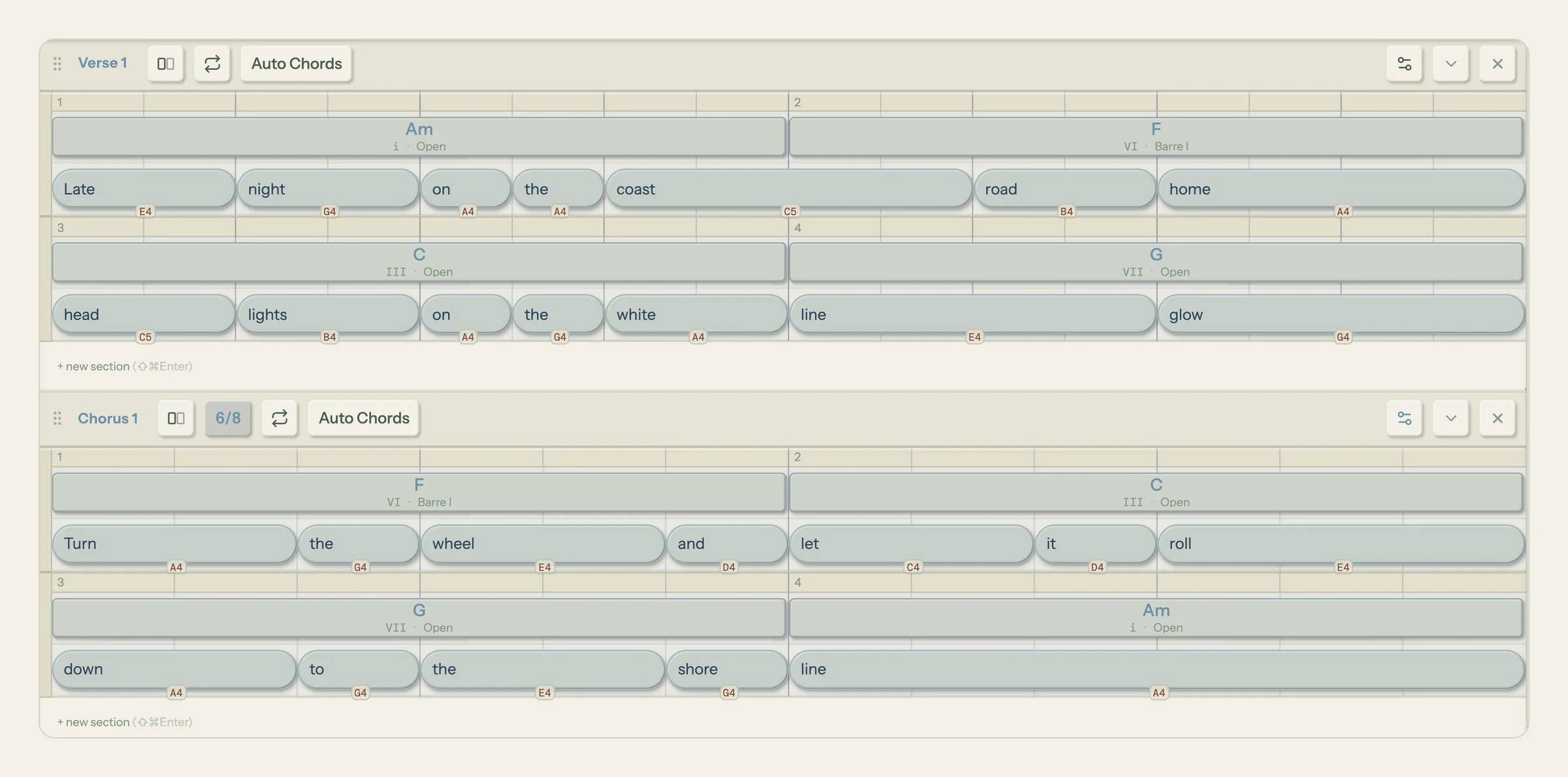
What changes when you switch is what you see and hear. The beat grid redraws: compound meters get a line every group of three eighths, and 7/8 is marked in groups of 3+2+2. Playback patterns follow the meter too, so a 3/4 song can use the Waltz Strum or a waltz piano part, and a 6/8 section can use the 6/8 Strum, 6/8 Pulse or 6/8 Arpeggio (see playback and accompaniment). The metronome clicks in eighth notes for the x/8 meters, so 6/8 gives six clicks, with an accent on beat 1.
Some honest limits. A meter change happens at a section boundary, so a single 2/4 bar inside a verse has to be its own short section. 7/8 is always grouped 3+2+2 and 5/4 has no grouping marked; you can't choose another. The metronome accents only beat 1, not the start of each group.
Hear your song in three before you commit to four
Song Cage puts your lyrics, melody and chords on one beat grid, and every section can have its own time signature, so you can try the bridge in 6/8 and play it back.
Frequently Asked Questions
What is the most common time signature?
4/4, by a wide margin. In our count of the McGill Billboard dataset, 689 of 739 charting songs from 1958 to 1991 open in 4/4. The next most common is 12/8, followed by 3/4 and 6/8.
What is the difference between 3/4 and 6/8?
Both bars hold six eighth notes, but 3/4 groups them as three beats of two (ONE-two-three) and 6/8 groups them as two beats of three (ONE-and-a TWO-and-a). 3/4 feels like a waltz; 6/8 feels like a slow rocking two, often with a backbeat on the fourth eighth.
Is 6/8 an odd time signature?
No. 6/8 is a compound meter: two even beats, each split into three. Odd, or asymmetric, meters such as 5/4 and 7/8 have beats of unequal length.
Is 12/8 the same as 4/4 with triplets?
They sound alike: four big beats, each split into three. 12/8 is the clearer way to write it when every beat is in threes, as in a slow blues or a soul ballad. Faster shuffles are usually written in 4/4 with a swing marking.
What time signature is a waltz?
3/4. Some waltz-feel songs are written in 6/8, and songwriters disagree about which is which: Billy Joel calls "Piano Man" 6/8, while its published sheet music is in 3/4.
Can a song change time signature in the middle?
Yes, and many hits do. "Lucy in the Sky with Diamonds" has 3/4 verses and a 4/4 chorus, and "Hey Ya!" adds a 2/4 bar to every phrase. In the McGill Billboard data, about one song in six contains at least one bar in a different meter from the one it opens in.
How do I find the time signature of a song I wrote?
Say the lyric at speaking speed and mark the stressed syllables, then tap along and count the taps until the melody repeats. Twos or fours suggest 4/4, threes suggest 3/4, and a lilt of three quick syllables per tap suggests 6/8 or 12/8.