Table of Contents
- What chords do you need to play lullabies?
- Twinkle, Twinkle, Little Star chords
- Brahms' Lullaby chords
- Hush, Little Baby chords
- Rock-a-bye Baby chords
- Frère Jacques (Are You Sleeping?) chords
- Row, Row, Row Your Boat chords
- Mary Had a Little Lamb chords
- All the Pretty Little Horses chords
- How do you play a lullaby on guitar?
- How do you play a lullaby on piano?
- What key should you sing a lullaby in?
- Which books teach a baby about music?
- Music Theory for Babies
- Guitar for Babies
- Piano for Babies
- How do you write your own lullaby?
- Frequently Asked Questions
Most lullabies need only three chords: G, C and D on guitar, or C, F and G on piano. Below are the chords for eight of the best-known lullabies and nursery songs, from Twinkle, Twinkle, Little Star to Brahms' Lullaby, with the piano version of each and how to play them for a baby.
I've written every chart in G for guitar, because G, C and D are among the first chords many guitarists learn. On piano, swap each chord for the one in the table below and you're playing the same song in C, mostly on the white keys. Seven of the eight songs are in a major key and use nothing but those three chords. The eighth is in a minor key, for the nights when a major key feels too bright.
If you'd like a book to read with the instrument on your lap, I've written three for babies and toddlers: Music Theory for Babies, Guitar for Babies and Piano for Babies. There's more on them further down.
The short version
On guitar, G, C and D (with D7 for the way home) play seven of these eight songs. On piano, the same seven take C, F and G (with G7). Frère Jacques needs one chord. Four need two: Hush, Little Baby; Rock-a-bye Baby; Row, Row, Row Your Boat; and Mary Had a Little Lamb. Twinkle, Twinkle, Little Star and Brahms' Lullaby need three. All the Pretty Little Horses is the minor one, with four.
What chords do you need to play lullabies?
For the seven major-key songs on this page you need three chords. On guitar they're G, C and D, and D7 sounds a little softer on the way home than plain D. On piano they're C, F and G, with G7. The minor-key song adds Em, Am and Bm on guitar, or Am, Dm and Em on piano.
These are the 1, 4 and 5 chords of the key. In G they're G, C and D; in C they're C, F and G. Because the numbers stay the same, a lullaby you know in one key moves to any other key by swapping each chord for the one with the same number. That's the idea behind the Nashville Number System, and it's why a guitarist and a pianist can play these songs together from one chart.
| Number | Guitar (key of G) | Piano (key of C) | Piano notes |
|---|---|---|---|
| 1 | G | C | C, E, G |
| 4 | C | F | F, A, C |
| 5 | D or D7 | G or G7 | G, B, D (add F for G7) |
| 6 minor (the minor song's home) | Em | Am | A, C, E |
| 2 minor | Am | Dm | D, F, A |
| 3 minor | Bm (or B7) | Em (or E7) | E, G, B (G sharp, plus D, for E7) |
Find the chord in the guitar column and play the one beside it on piano. Every chart below works this way.
Here are the eight songs, with the year each one's words or tune first turns up in the record and every chord it uses:
| Song | First known | Guitar chords | Piano chords |
|---|---|---|---|
| Frère Jacques | Tune c. 1780 | G | C |
| Hush, Little Baby | Notated 1918 | G, D7 | C, G7 |
| Rock-a-bye Baby | Words c. 1765 | G, D7 | C, G7 |
| Row, Row, Row Your Boat | Words 1852, tune 1881 | G, D7 | C, G7 |
| Mary Had a Little Lamb | Words 1830 | G, D7 | C, G7 |
| Twinkle, Twinkle, Little Star | Tune 1761, words 1806 | G, C, D | C, F, G |
| Brahms' Lullaby | 1868 | G, C, D7 | C, F, G7 |
| All the Pretty Little Horses | In print 1903 | Em, Am, Bm, G | Am, Dm, Em, C |
Easiest first. Dates are the earliest printing or notation of the words or tune, as noted under each song.
Twinkle, Twinkle, Little Star chords
Twinkle, Twinkle, Little Star (4/4): G, C, D
[G]Twinkle, twinkle, [C]little [G]star,
[C]How I [G]wonder [D]what you [G]are.
[G]Up a[C]bove the [G]world so [D]high,
[G]Like a [C]diamond [G]in the [D]sky.
[G]Twinkle, twinkle, [C]little [G]star,
[C]How I [G]wonder [D]what you [G]are.
Piano: C, F, G in the same places.
The words are Jane Taylor's poem "The Star," first published in 1806 in Rhymes for the Nursery, a book she wrote with her sister Ann. The tune is older. It's the French melody "Ah! vous dirai-je, maman," first published in 1761, which Mozart later used for a set of twelve piano variations. The same tune carries the ABC Song and Baa, Baa, Black Sheep, so these chords play all three.
Twinkle changes chord every word or two, which makes it the busiest song on this page. Strum once on each chord at first, and add strums when the changes feel easy. It's also a good first lesson in melody: the tune jumps up a fifth on the second "twinkle," rises one more step on "little," then walks back down one step at a time to the note it started on.
Twinkle, Twinkle, Little Star: piano notes (right hand, key of C)
C C G G A A G
F F E E D D C
G G F F E E D
G G F F E E D
C C G G A A G
F F E E D D C
Brahms' Lullaby chords
Brahms' Lullaby (3/4): G, C, D7
[G]Lullaby, and goodnight, with roses bedight,
[D7]With lilies o'erspread is baby's wee [G]bed.
Lay thee [C]down now and [G]rest, may thy [D7]slumber be [G]blessed.
Lay thee [C]down now and [G]rest, may thy [D7]slumber be [G]blessed.
Piano: C, F, G7.
Johannes Brahms wrote "Wiegenlied" ("Lullaby"), Op. 49, No. 4, for his friend Bertha Faber when her second son was born, and Simrock published it in November 1868. The German words come from Des Knaben Wunderhorn, a collection of folk poems; the best-known English words begin "Lullaby, and goodnight." Brahms echoed the tune in 1877, in the second theme of the first movement of his Second Symphony.
It's a waltz, three beats to the bar, and the chords move slowly: G for the whole first line, D7 for most of the second. On guitar, pick the bass note on beat 1 and brush the chord on beats 2 and 3. On piano, play the chord's root with your left hand on beat 1 and the tune with your right. The C chord (F on piano) only arrives in the third line, so you can learn the first half with two chords. Time signatures covers how 3/4 counts if waltz time is new to you.
Hush, Little Baby chords
Hush, Little Baby: G, D7
[G]Hush, little baby, don't say a [D7]word,
Mama's gonna buy you a [G]mockingbird.
And if that mockingbird don't [D7]sing,
Mama's gonna buy you a [G]diamond ring.
And if that diamond ring turns [D7]brass,
Mama's gonna buy you a [G]looking glass.
Piano: C, G7.
"Hush, Little Baby" is a traditional lullaby, thought to come from the Southern United States, and nobody knows who wrote it. The English folklorist Cecil Sharp notated a version in Virginia in 1918, and Alan Lomax recorded several in the 1930s and 1940s. One of the singers he recorded was Jean Ritchie, whose 1949 version, passed down in her Kentucky family, matches the one most people sing now.
The whole song is one move. Each pair of lines goes out to D7 on the first line's last word and comes home to G on the second's. Once your hand knows it, you can sing as many verses as the baby will sit still for, and the song is built for making up your own: a promise, then the thing that goes wrong with it, then a new promise. Swap "Mama" for "Papa" or a name, and keep the pattern.
Rock-a-bye Baby chords
Rock-a-bye Baby (6/8): G, D7
[G]Rock-a-bye, baby, on the [D7]treetop,
When the wind blows, the cradle will [G]rock.
When the bough breaks, the cradle will [D7]fall,
And [G]down will come baby, [D7]cradle and [G]all.
Piano: C, G7.
The words are believed to have first appeared in print in Mother Goose's Melody, published in London around 1765. No copy of that first edition survives, and a 1791 edition starts "Hush-a-by baby" instead. The rhyme is sung to more than one tune; the chords above fit the one most chord sheets use.
Rock-a-bye Baby is often written in 6/8 (some books use 3/4), which counts six quick beats in two groups of three. That gives it two big swings to the bar, the same motion as rocking a baby in your arms. On guitar, play the bass note on beats 1 and 4 and let the strings ring in between, or strum down once on each swing. On piano, play the left-hand root on 1 and 4. Like Hush, Little Baby, it's a two-chord song that goes out to D7 and comes home to G, and the last line packs both chords into one phrase.
Frère Jacques (Are You Sleeping?) chords
Frère Jacques / Are You Sleeping? (4/4): G
[G]Are you sleeping, are you sleeping,
Brother John, Brother John?
Morning bells are ringing, morning bells are ringing,
Ding, dang, dong. Ding, dang, dong.
Piano: hold C (C, E, G) in the left hand the whole way through.
The earliest known version of the tune is in a French manuscript that the Bibliothèque nationale de France dates to between 1775 and 1785, where it's labelled "Frère Blaise." It's a round: a second voice starts the same tune when the first reaches the second line, then a third, then a fourth.
In a round every line has to fit the same chords, because all the lines end up sounding at once. In Frère Jacques that's a single chord, which is why it's the easiest song on the page. Hold G and strum, or on piano hold one C chord, and every line of the tune sits over it. If you have two adults in the house, try it as a round over the single chord, and the baby gets to hear what harmony is: two different lines that fit together.
Row, Row, Row Your Boat chords
Row, Row, Row Your Boat (6/8): G, D7
[G]Row, row, row your boat,
Gently down the stream.
Merrily, merrily, merrily, merrily,
[D7]Life is but a [G]dream.
Piano: C, G7.
Words close to today's were first printed in 1852, with a very different tune. The tune everyone sings now first appeared with the words in 1881, in The Franklin Square Song Collection, which names Eliphalet Oram Lyte without making clear whether he wrote it or arranged it. Like Frère Jacques, it's often sung as a round, for up to four voices.
It's G all the way until the last line, then D7 under "Life is but a" and home to G on "dream." The "merrily" line is where the tune goes up to its high G, an octave above where it started, and it's the only part with any speed in it, so keep your strum steady there and let the voice do the climbing. In 6/8 it has the same rocking two-beat swing as Rock-a-bye Baby, so the same bass-on-1-and-4 pattern works.
Mary Had a Little Lamb chords
Mary Had a Little Lamb (4/4): G, D7
[G]Mary had a little lamb, [D7]little lamb, [G]little lamb,
[G]Mary had a little lamb, its [D7]fleece was white as [G]snow.
Piano: C, G7.
Sarah Josepha Hale published "Mary Had a Little Lamb" as a poem in Boston on May 24, 1830. In 1876 a woman named Mary Tyler said she was the girl in it and that a young man named John Roulstone wrote the first verses, but nothing supports that beyond her memory, and Hale's 1830 printing is the earliest evidence of the poem.
The tune uses only four different notes: in C, they're C, D, E and G. That makes it the first song many people learn to pick out on a piano with one finger. Right hand, key of C: E D C D E E E, D D D, E G G, E D C D E E E, E D D E D C. Add a left-hand C where the chart says G and G7 where it says D7, and you're playing tune and chords together.
All the Pretty Little Horses chords
All the Pretty Little Horses (minor): Em, Am, Bm, G
[Em]Hush-a-bye, [Am]don't you cry, [Bm]go to sleep, little [Em]baby.
[Em]When you wake, [Am]you shall have [Bm]all the pretty little [Em]horses.
[G]Blacks and bays, [Em]dapples and grays, [Bm]coach and six little [Em]horses.
[Em]Hush-a-bye, [Am]don't you cry, [Bm]go to sleep, little [Em]baby.
Piano: Am, Dm, Em, C.
"All the Pretty Little Horses," also called "Hush-a-bye," is a traditional American lullaby, commonly thought to be of African-American origin. An early version was printed in 1903, in a story for kindergarteners by the Alabama teacher Maud McKnight Lindsay. In 1925 the folklorist Dorothy Scarborough wrote that it was "widely known through the South."
Its chords come from the same family as G major (Em, Am, Bm and G all belong to the key of G), but the song is centred on Em, which gives it the minor colour. For a stronger pull back home at the end of each line, swap Bm for B7. Its D sharp is the raised seventh of the harmonic minor scale, the note that leans hardest toward E. On piano that's E7 in place of Em, with a G sharp.
How do you play a lullaby on guitar?
Play slowly and quietly, with one strum per beat or fewer, or pick the notes of each chord one at a time. Use the meter to choose the pattern: four even strums for 4/4, bass then two soft strums for 3/4, and two slow swings per bar for 6/8. Sing a little under your speaking volume.
Fingerpicking suits these songs better than strumming once you have the chord changes. A simple pattern is the bass note with your thumb, then the top three strings with your fingers, one after another. It keeps the guitar under your voice. If you strum, use the flesh of your thumb instead of a pick, and brush down only.
D7 is the one new shape for some beginners, and it's worth learning here rather than playing plain D: its extra note, C, pulls down to the B in the G chord, so every two-chord song on this page sounds more settled when it gets home. If G sits too high or too low for your voice, a capo moves the same shapes up a half step per fret, so capo 2 puts you in A and capo 3 in B flat. The guitar capo chart shows every fret. To go lower, play the same songs in D, where the three chords are D, G and A.
How do you play a lullaby on piano?
Play the tune with your right hand and the chords with your left, in the key of C: C, F and G, with G7 on the way home. If both hands at once is too much, start with the tune alone, then add one left-hand note per bar, the root of the chord, and fill out the whole chord later.
The left-hand chords on this page are three-note shapes you can build with the same rule: start on the chord's name, skip a white key, play the next, skip, play the next. C is C, E and G; F is F, A and C; G is G, B and D. For G7, add F to the G chord. The same three chords play other nursery rhymes on piano too, including Baa, Baa, Black Sheep and the ABC Song, which share Twinkle's tune.
For the waltz-time song, Brahms' Lullaby, play the root on beat 1 and the other two notes together on beats 2 and 3. For the 6/8 songs, play the root on 1 and 4. Keep the right hand in the middle of the keyboard, around middle C, close to where your voice sings it. Once Twinkle feels easy, listen to Mozart's twelve variations on its tune to hear how far one melody can go.
What key should you sing a lullaby in?
Sing in whatever key puts the song's highest note where you can sing it softly. These songs have small ranges, so most voices can find a comfortable key. Twinkle spans six notes from bottom to top, Mary Had a Little Lamb spans five, and Row, Row, Row Your Boat a full octave.
The charts are in G for guitar and C for piano because those keys are easy to play, not because they suit every voice. Sing the first line before you commit. If the top note strains, or the bottom note disappears into a mumble, move the key: capo up on guitar, or play from a different starting note on piano. Your baby doesn't need you to sound like a recording, and a lullaby sung quietly in your own comfortable range will sound better than one pushed into someone else's.
If you're not sure where your comfortable notes are, the free vocal range test finds your lowest and highest notes in a minute. Your song is in the wrong key for your voice explains how to move a song once you know them.
Which books teach a baby about music?
I've written three picture books for babies and toddlers, ages 0 to 3, called the Music for Babies series: Music Theory for Babies, Guitar for Babies and Piano for Babies. Each one gives a single musical idea one short line a page, with a detailed picture to talk about. The guitar and piano books are made to read with the instrument on your lap.
These are mine, so take the recommendation with that in mind. I try every page out on my own two small children. Each is 28 pages, $12.99 in paperback and $4.99 on Kindle, sold on Amazon.
Music Theory for Babies
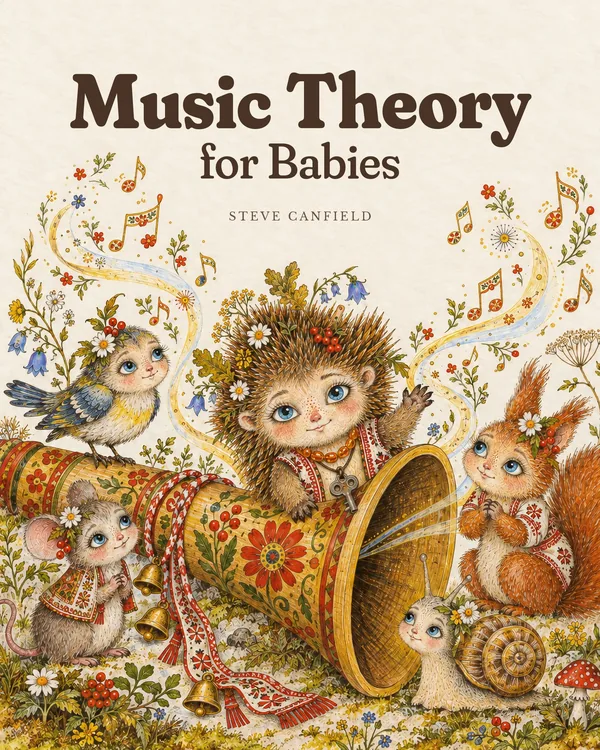
Music Theory for Babies turns the first ideas of music into one short line each: high and low, loud and quiet, long and short, then rhythm, the beat, melody, the scale, the octave, harmony and chords. It pairs with any song on this page. After Twinkle, you can point out that the tune jumps up high on the second "twinkle" and walks back down.
Guitar for Babies
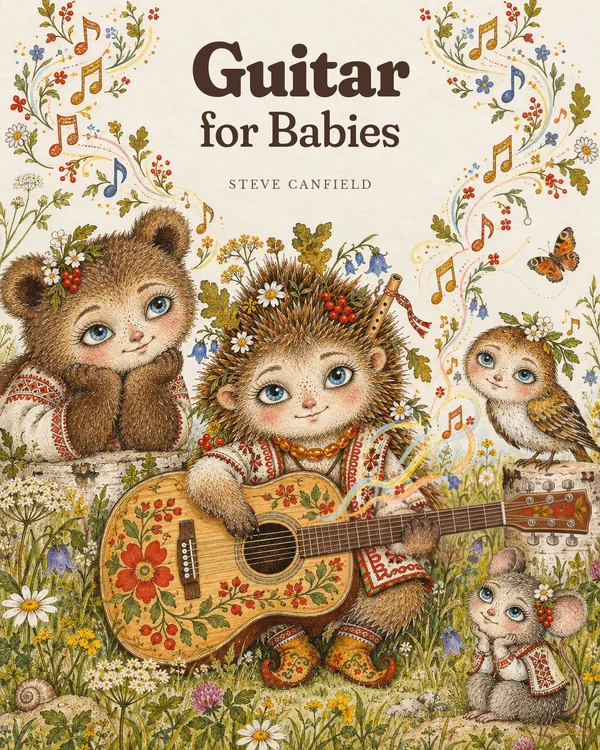
Guitar for Babies gives you something to play on every page: one string, then all six, thick strings and thin, loud and quiet, a string pressed down so the note goes up, tuning, a knock on the body like a drum, and a chord. Its second-to-last page says "G, C and D. Three chords make a song!", the same three chords as the charts above, and the last page ends "Let's play your song."
Piano for Babies
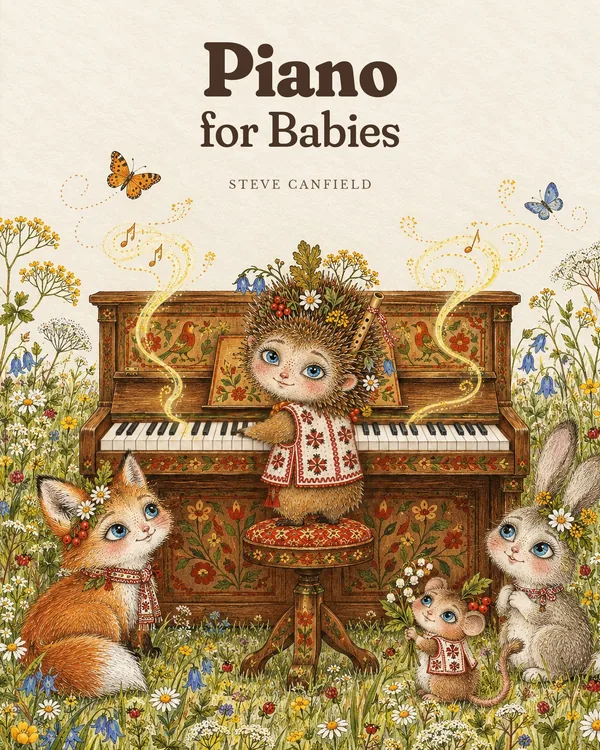
Piano for Babies is for reading at the piano with your baby on your lap: one key, white keys and black, the black keys in twos and threes, low and high, soft and loud, the little hammers inside, the pedal, a walk up the white keys, finding C, and the chord C, E and G. Then "One hand plays the tune. One hand plays the chords," which is the piano method on this page in two lines.
How do you write your own lullaby?
Hum a short phrase, keep it slow and in a narrow range, and repeat it. Then answer it with a second phrase that comes home to the note you started on. Put it over the same 1, 4 and 5 chords as the songs above, and you have a lullaby nobody else has sung to your baby.
The answer phrase is call and response at its smallest: the first phrase stops somewhere unfinished, over the 5 chord, and the second lands on the home note over the 1. Hush, Little Baby works exactly this way. Your baby's name makes a good first line, and the same tune with new words every night is still the same lullaby.
If the tune comes to you in the middle of the night, sing it into your phone before it's gone. Song Cage's capture app for iPhone and Android is free and needs no account. On a computer, Song Cage writes a hummed tune down as notes and suggests chords that fit them, free for one song.
Or let your baby write it. I also make Serinette, an iPhone app built on that idea. A little bird listens to your baby, answers a moment after they stop, and learns the note their voice keeps coming back to. Then it sings a melody made from those sounds alone, and every week it learns again, so the song changes as your baby does. There's no generative AI in it: the songs are built by musical rules from your baby's sounds, and the bird listens on the phone, so nothing your baby says is sent to us. The first melody is free. If you subscribe, you can save any version as sheet music to print, or as MIDI. It runs on iPhone and iPad with iOS 17 or later; serinette.app has the rest.
Made up a lullaby? Keep it
Hum it before it's gone. Song Cage turns the hum into notes under your words and shows you chords that fit, so you can play it again tomorrow night.
Frequently Asked Questions
What are the easiest lullabies to play on guitar?
Frère Jacques (Are You Sleeping?) is the easiest, because the whole song fits over one G chord. Next come the two-chord songs, all on G and D7: Hush, Little Baby; Rock-a-bye Baby; Row, Row, Row Your Boat; and Mary Had a Little Lamb. Twinkle, Twinkle, Little Star and Brahms' Lullaby add C for a third chord.
What chords are in Twinkle, Twinkle, Little Star?
Three: the 1, 4 and 5 chords of the key. On guitar in G that's G, C and D. On piano in C it's C, F and G. The first line goes G, C, G, then C, G, D, G, and the middle lines go G, C, G, D twice.
What are the piano notes for Twinkle, Twinkle, Little Star?
In C, with the right hand: C C G G A A G, F F E E D D C, G G F F E E D, G G F F E E D, then the first two lines again. Every note is a white key, which is why it's often the first song taught on piano.
Is Twinkle, Twinkle, Little Star the same tune as the ABC song?
Yes. Twinkle, Twinkle, Little Star, the ABC Song and Baa, Baa, Black Sheep are all sung to the French melody "Ah! vous dirai-je, maman," first published in 1761. Mozart wrote twelve piano variations on it. The same G, C and D chords play all three songs.
What is a good music book for a baby?
Look for one short line a page and pictures worth talking about. I wrote three for ages 0 to 3: Music Theory for Babies (high and low, loud and quiet, rhythm, melody and chords), Guitar for Babies and Piano for Babies, which give you something to play on the instrument on every page. All three are on Amazon in paperback and Kindle.
Can you make a lullaby from your baby's own sounds?
Yes. You can hum back the note your baby keeps returning to and build a short phrase on it. Serinette, an iPhone app I make, does this with a little bird that listens to your baby and sings a melody made only from their sounds, and learns again every week. The first melody is free.