Table of Contents
- Why did it feel fine at home and fall apart at soundcheck?
- You sang it quietly, so you sang it lower
- You sang it once, not eight times
- Why does a band swallow your low notes?
- Your ceiling moves day to day
- You never chose the key. Your hands did
- Robert Plant sang in E for a decade because of a guitar
- The Eagles re-recorded an entire song to fix it
- Is it your range that is wrong, or your tessitura?
- Titze: the song has a tessitura too, and it can miss yours
- Three different problems, three different repairs
- The three-pass test
- How do you find the highest note in your own song?
- Sing it in, and read the pitch back
- The three numbers to write down
- How far do you actually need to move it?
- What happens to your verse when the key moves?
- What if no key fits?
- How do you change key without wrecking the guitar part?
- Going up: the capo, used the way James Taylor uses it
- How do you go down when a capo only goes up?
- Which key should you land on?
- Leave headroom on purpose
- Should you just pick the lowest key that works?
- Voice-type charts are a starting point, not an answer
- Minor keys sit differently
- How do you check it before the room checks it for you?
- Doing this in Song Cage
- Frequently Asked Questions
You find out at the soundcheck. First chord, first line, and you already know. A songwriter on r/Songwriting described it exactly: they had played the song in G at home for weeks, and then, in front of a room, "I realized right then should put a capo on and play it in A. It was much easier for my voice." Somebody replied underneath: "nothing worse than starting a song and immediately knowing you picked wrong but being stuck with it for the whole performance."
This happens to people who have been doing it for fifty years. Robert Plant, speaking on the Rolling Stone Music Now podcast about the first time he worked with Alison Krauss, said the thing out loud: "It was quite weird to actually sit there and say, 'Right, here's a song. What key shall we play it in?' I'd never thought about what key things should be in."
So this is a guide to the decision nobody made: how a song key actually gets chosen, and what to do when you find yourself in the wrong key for your own voice. How to tell whether the problem is the top note or the whole chorus, how to find the pitches of a song that only exists in your hands, how far to move it, and how to move it without losing the ringing guitar part you wrote it on.
The short version
You are in the wrong key because it came from your chord shapes, not your voice. Test it standing, at gig volume, on the third pass through the chorus. Set the peak about two semitones under your best-day ceiling, then check the verse floor before you commit. If fixing the chorus breaks the verse, the melody is too wide, and no key will save it.
Why did it feel fine at home and fall apart at soundcheck?
Because you were not doing the same thing. At home you are sitting down, singing at conversational volume, running the chorus once before you go back to fiddling with the second verse. On stage you are standing, at full voice, over a room, singing that chorus for the third or fourth time in the song and the eighth time in the set. It's also why words you knew on the sofa can go missing on stage, and why memorizing your lyrics works best standing, at full voice.
Every one of those changes pushes your comfortable ceiling down.
You sang it quietly, so you sang it lower
The songwriter, producer and bass player Tony Conniff describes the mechanism from the inside: he writes by singing and humming to himself, "not too loud," and gets comfortable with the song in a low register. "But it's a mistake to think that's automatically the key where the song belongs." He found out with his own band. For years he brought chord charts to rehearsal in the original key and went home to rewrite them higher, because "when I sang it in the original key the low-register vocal got completely lost in the band's roar and rumble."
There is a measurement behind it. Ingo Titze's acoustic account of the voice range profile, the plot of how loud you can get at each pitch, explains a long-observed fact: the intensity range available to a singer is reduced at the extremes of the pitch range. Near the top you do not just have fewer notes. You have fewer volumes to sing them at, which is a problem when the room needs the loud one.
You sang it once, not eight times
Geddy Lee said this better than any vocal coach. Talking to Prog about the R40 tour and the argument over dropping "Lakeside Park" a step: "I kept wanting to transpose the song down and Alex kept saying, 'No, you can do it!' ... yeah, I could hit those notes and I managed to do it for the whole tour, so I can do it if I rehearse properly and take care of my voice. But I couldn't do it night after night."
That is the whole distinction in one sentence, from someone with nothing to prove. Having the note and having the note repeatedly are two different questions, and only the first one gets tested in your bedroom.
Why does a band swallow your low notes?
A key that sits low enough to feel safe when it is just you and an acoustic can vanish once there are drums in the room. You compensate by pushing, which costs you at the top of the chorus later in the song. Check the floor with the band that is actually going to play it, not alone.
Your ceiling moves day to day
Sleep, a cold, how much you talked that afternoon. Set the key so that it works on a mediocre voice day, because 9pm in a loud room is not your best day.
You never chose the key. Your hands did
Standard tuning is E A D G B E, and the first chords most guitarists learn are the ones that let those open strings ring: E, A, D, G and C, plus B7. That set hands you the I, IV and V of G, D and A major outright, and of E major too once you take B7 as the V, which is why the method books teach it alongside the other five. Only one chord in that whole neighbourhood has no open shape at all: F, the IV chord of C major, which is why C is the key where beginners meet their first barre. The flat keys give you almost none of it. That is not a taste. It is the geometry of six strings, and it settles the key of an enormous number of songs before anyone has sung a note.
The corpus work backs it up. Nicholas Shea's study of 257 rhythm-guitar parts spanning 1954 to 2019 found 88.7% of them in standard tuning, with roughly 24.2% of all bass-note pitches articulated on open strings. That, he suggests, makes open strings "a fundamental component of guitar thinking." Trevor de Clercq and David Temperley put it more bluntly in their own rock corpus analysis: the roots of the standard first-position open-string voicings form a pentatonic collection, and "because they are particularly easy to play, these open chord voicings may be preferred harmonic choices irrespective of the tonic of a particular song."
Irrespective of the tonic. The shapes pick first and the key comes along afterwards.
Robert Plant sang in E for a decade because of a guitar
Plant, on the same podcast, as Rolling Stone reported it: "Quite often everything was in E because you got much more out of the bottom of the guitar. I should have gone to one of those castrati schools in Northern Italy trying to get it right."
Quite often, not always. But often enough that Led Zeppelin's keys were a guitarist's decision and the singer lived with the consequences. There is no reason on earth for the keys your hands like and the keys your voice likes to be the same keys. They are answering different questions.
The Eagles re-recorded an entire song to fix it
Don Felder demoed and recorded "Hotel California" in E minor, as he told MusicRadar in 2012, "which is a good key for the guitar." Then Don Henley sang it: "he sounded like Barry Gibb in this high voice. I went, 'Wait, wait! That just doesn't work.'"
They went down to D minor. Still too high. C minor, still too high. A minor was too low. "So we wound up having to play it in the key of B minor, which is not a particularly guitar-friendly key, but it was perfect for his voice. And then we went back in and recorded the whole thing in B minor."
Felder's own verdict on the process is the part worth pinning up: "It was a screw-up that we never figured out what key would be best for Don to sing it in, but we never heard him do it until we got in the studio."
The same mistake, one album at a time
Rush wrote and recorded the whole of Hemispheres before Geddy Lee cut a single vocal. He had sketched the melodies while writing, humming them in a room; what he never did was sing them full voice against the finished tracks. "When I actually got to record vocals," he told Rolling Stone, "I came to realize that we'd written the whole album in an awkward key for me." His diagnosis is the useful bit: "We never did demos in those days. We just wrote it and then recorded it. If you were doing a demo, that would have revealed itself, that this key was mental to sing in. So we would have changed it." Asked whether they change keys now: "Oh, yeah, we do that all the time now. That's the way you're supposed to do it!"
Is it your range that is wrong, or your tessitura?
Your range is every note you can reach. Your tessitura is the part of the range where you can sit and stay, comfortably, for a long time without tiring. They are different numbers, and the key of your song is set by the second one, not the first. A key can be inside your range and still be the wrong key.
If you do not know your range yet, start there: the free vocal range test measures your lowest and highest notes and ranks the keys that fit, keeping the same two-semitone margin under your ceiling that this article recommends for a chorus peak.
The voice literature has kept these apart for a long time. Irvin Cooper, writing for choral teachers in 1970, called tessitura "that portion of the vocal range in which it is comfortable to sing for a considerable time without tiring." The Harvard Dictionary of Music defines it as "the general 'lie' of a vocal part, whether high or low in its average pitch," and adds that it "differs from range in that it does not take into account a few isolated notes of extraordinarily high or low pitch." Both are collected in a 1996 University of North Texas dissertation on pitch range and tessitura.
A few isolated notes. Your chorus peak is one of them, and it is the note the whole internet tells you to measure.
Titze: the song has a tessitura too, and it can miss yours
Ingo Titze made the crucial move in a 2008 paper for the Journal of Singing, Quantifying Tessitura in a Song. A song has a tessitura, the region where its notes pile up, and a singer has one, and they can fail to meet even when the range fits. His conclusion, verbatim: "We conclude that the tessitura of a singer may not match the tessitura of the song, even though the range is appropriately matched."
Better still, he shows the tessitura of a song is not defined by which notes appear most often but by which notes accumulate the most time. In the aria he analyses, C4 is the most frequent note, but F4 carries the greatest accumulated duration, and F4 is the note that makes the piece notorious.
And then the warning, which is aimed squarely at what most people do next: "What is too often done is simply to change the key signature of the song, but unless the accumulated duration and cycle doses are quantified on various pitches within the song, singer-song adaptation still may not be complete."
Three different problems, three different repairs
Take your chorus apart into three separate questions, because they do not have the same answer.
| The problem | What it sounds like | What fixes it |
|---|---|---|
| The peak is too high | One note in the chorus that you grab at and miss | A key change. Move the song down and the peak comes down with it. |
| You hold it too long | The note arrives fine and falls apart halfway through | Shorten the note, or move the key. Both work. |
| The chorus lives up there | Nothing is unreachable, but you are cooked by the last chorus | Not a key change on its own. The whole floor moves with the ceiling. |
The third row is the one people transpose their way into instead of out of.
Titze's account of why the third one wears you out is worth quoting because it is mechanical rather than mystical. Looking at his own voice range profile, where roughly 30 dB of dynamic range is available around F3 to C4 but only 10 to 15 dB in the D4 to G4 band (his numbers, his voice, not a general tenor figure), he writes that up there "the singer may wear out (fatigue) because he is not able to take the pressure off and 'coast' on some of the repeated long duration notes with lower dynamics." You cannot back off, so you never rest.
There is one more piece of arithmetic hiding in the vocal dose literature. Švec, Popolo and Titze formalised the cycle dose as fundamental frequency multiplied by time: a count of the oscillation cycles your vocal folds complete. Because pitch simply is cycles per second, singing the same phrase an octave higher doubles the cycles you accumulate over the same duration. Elapsed minutes alone will not tell you what a set costs you.
The three-pass test
Sing your chorus three times through, standing, at the volume you will actually use. Not once. Not sitting. The place it breaks on the third pass is your real ceiling, and it is usually a semitone or two below where the first pass suggested.
How do you find the highest note in your own song?
Every method online for choosing a key starts with the same instruction: name your chorus peak as a pitch. Then it assumes you have sheet music, or a recording, or a track you can upload. For a song that exists only in your hands and your head, none of those are true.
Singing the melody into a tuner is not the fix either, for the reason Conniff describes: alone and quiet, you get comfortable with the song in a low register, and that is not where you will sing it. The tuner faithfully reports a number you will not be able to use.
Sing it in, and read the pitch back
The reliable version is to capture the melody at performance volume once, then read the note names off it instead of guessing. In Song Cage, holding the Hold to sing button under a lyric block (or just holding M) and singing lands that pitch on the syllable, and while you are still holding, the button displays the note it is hearing. On the timeline, every melody note shows as a small pitch badge under its lyric block: E4, E4, A4. Your melody stops being a feeling and becomes a list of pitches you can look at.
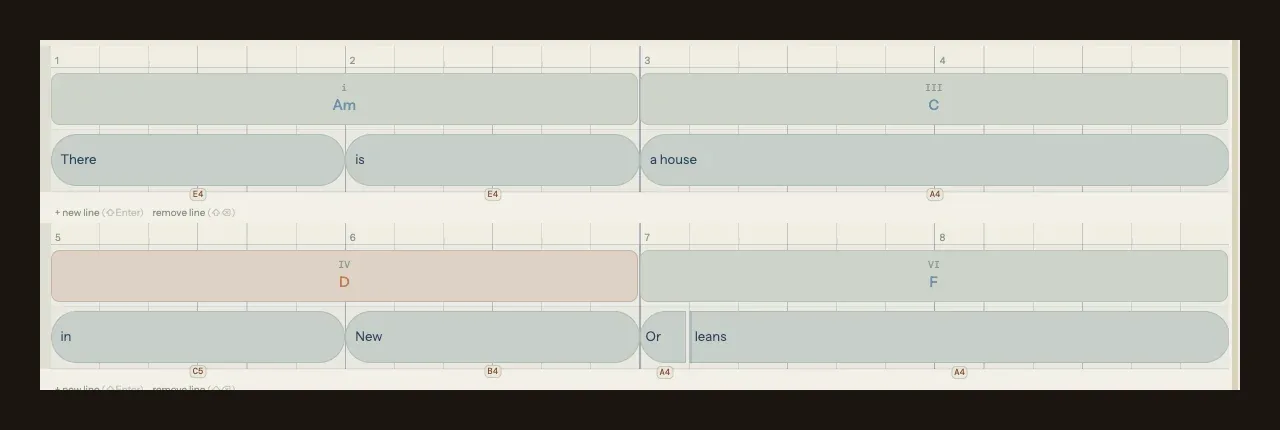
If you would rather sing the whole phrase than one note at a time, record a take into the section and run detection on it, which turns the sung take into draggable notes. That path is desktop only today.
The three numbers to write down
Your chorus peak, the highest note in the song. Your verse floor, the lowest. And the note your chorus actually sits on, the one that comes round again and again, which is the one Titze would tell you matters most. Write all three down. You are going to move all three at once.
How far do you actually need to move it?
Subtract. If your chorus peak is a G4 and the three-pass test says your comfortable ceiling tonight is an E4, that is three semitones. Move the song down three semitones and the peak lands on E4.
Most of the time the answer is one to three semitones, which is why it feels so annoying: the song is not badly wrong, it is slightly wrong, and slightly wrong is enough to ruin a chorus. Mike Campbell told Songfacts in 2003 that Don Henley redid the entirety of "The Boys of Summer" over one: "We actually cut it in one key, did the whole record with overdubs and everything, and then he decided to change the key like a half step up or something, we had to do the whole record again, but it turned out pretty good."
What happens to your verse when the key moves?
This is the trap. Transposing a song is a rigid operation. Take three semitones off your chorus peak and you have taken three semitones off your verse floor as well, and a verse that was already sitting low is now under the room. Check the bottom before you commit to the top. A key that fixes the chorus and buries the verse has not fixed anything, it has moved the problem to a place you will not notice until the take.
What if no key fits?
Then your melody is wider than your comfortable range, and that is a melody problem wearing a key problem's clothes. If your song spans more than your voice can sit inside, transposition will not conjure the missing semitones. It only slides the whole thing up and down.
Four repairs, in the order I would try them.
Repairs that are not a key change
- Lift the verse instead of dropping the song. Rewrite the verse melody a third higher and leave the chorus where it is. Now the spread is narrower and the chorus still lands.
- Move the one note, not the whole song. Writing for Berklee Online, Gabrielle Goodman gives the singer's version: when a song sits well except for one note that is too high or too low, "I recommend changing the note and not the key." In pop and R&B, she says, there is room to substitute something like a neighbour tone and simply own it. Jason Blume works the same seam from the writer's side in a BMI piece, calling it "deranging" a song: the lowest note usually sits in the verse and can often be raised without weakening the melody, while the highest note is usually load-bearing and only gets replaced when it has to be.
- Let the peak be a peak. Hit it once, at the last chorus, and stop camping on it. This is the fix for a tessitura problem that a key change cannot touch.
- Change register, not pitch. Take the low verse up an octave and sing it in a lighter register on purpose, rather than growling at the bottom and hoping.
Paul Waaktaar-Savoy of a-ha described the writing problem from the other side, on Song Exploder. Writing for Morten Harket changed what he could ask for: "Because before that, I would be writing to my own voice. So I had to be sort of limiting the octaves. But with Morten, it's like writing for a totally different instrument." The chorus of "Take On Me" was then built deliberately to use that instrument: "maybe we should start it with the lowest notes and then bring it up to the falsetto." Harket told the Guardian the same thing from the singer's chair: "Paul had the idea of really using my vocal range in the chorus, having notes rising in octaves like Strauss's Also Sprach Zarathustra."
That chorus was designed around a specific voice. Yours can be too, and the voice in question is yours.
How do you change key without wrecking the guitar part?
Here is the honest constraint, stated by Paul McCartney in his book The Lyrics while explaining why he detuned his guitar for "Yesterday": "If you want to go higher, you can use a little device called a capo. But if you want to go lower, it's not always so easy; you can run out of room."
A capo only raises. That is the entire difficulty, because the direction people usually need is down.
Going up: the capo, used the way James Taylor uses it
James Taylor told Paul Zollo at American Songwriter that he treats playing key and singing key as two separate decisions: "With me the key is only relevant in terms of where it will be relative to my vocal range." And then the mechanics: "I like to sing in E but I like to play in D. So it's natural for me to put a capo on the second fret."
He plays a D-shaped song and sings an E-keyed song. The capo is the hinge. If your maths on capo positions is rusty, our capo chart has the full grid of shape plus fret to sounding key.
How do you go down when a capo only goes up?
Move from C shapes to G shapes to E shapes and you drop the sounding key while keeping open strings ringing. The voicings change character, which is sometimes an improvement.
A semitone or a whole step down is the capo that goes the other way. Every shape survives intact. You need a second guitar or a patient audience if you are switching mid-set.
Any key you want, immediately, and no drone. You lose the ringing open strings that probably made you like the part in the first place. Worth knowing what you are trading.
Whichever route you take, changing the key of a song is a different operation from modulating inside one, and it is worth keeping the two apart in your head.
Which key should you land on?
The key that puts your chorus peak about two semitones under your best-day ceiling, keeps your verse floor audible over the band, and still leaves the chorus somewhere to climb to. Work from the peak pitch, not from the key name and not from a voice-type chart.
Leave headroom on purpose
Do not set the peak at your ceiling. Set it about two semitones under, because the ceiling you measured this afternoon is not the one you will have at the gig. This single rule prevents most of the pain in this article.
Should you just pick the lowest key that works?
A song sung comfortably at the bottom of your voice loses the thing that makes a chorus lift. If the only criterion is "no strain," you will end up under the band and under the song. The chorus needs somewhere to go, and a key that flattens the difference between verse and chorus has cost you the arrangement.
Voice-type charts are a starting point, not an answer
The tables are everywhere: soprano C4 to C6, tenor C3 to C5, baritone F2 to F4. A 2023 paper in Logopedics Phoniatrics Vocology lists them and immediately qualifies them, noting that "the pitch limits of each voice type overlap, making precise classification challenging."
If you want a better indicator than your extremes, it is your gear change. A cluster analysis of the voice range profiles of 256 male conservatory students and professional singers found that the parameter yielding the best separation of the three basic male voice types was the frequency dip at the register transition zone: a boundary in the middle of the range, not at its outer limits. Where your voice changes gear tells you more about where your song should sit than how high you can shout.
Minor keys sit differently
Every "best key for your voice" table you will find is major-only. In a minor key the chorus peak often lands on the flat third or the fifth rather than the tonic, so the same nominal key puts your top note somewhere else entirely. Work from the peak pitch, never from the key name.
How do you check it before the room checks it for you?
The pre-gig check
- Standing, loud, and last. Run the key test at the end of a rehearsal, not the start, when your voice is where it will be at song three.
- Sing the whole song. Verse floor included. Half the failures are at the bottom.
- Record all three candidate keys and listen tomorrow. Your ears at the moment of singing are the least reliable judge you have.
- Play it with whoever is going to play it. A band changes the floor.
- Spread the peaks across the set. Three songs that all top out at the same note is one song's worth of damage, three times.
- Keep a lower alternate key written down. For the night your voice is not there.
Even a settled key does not stay settled forever. Jetro Da Silva, one of three keyboard players in Whitney Houston's touring band, described the ordinary reality of this to Australian Musician in 2010: "tunes like 'I Will Always Love You', used to be in a different key. I'm not sure if it was B flat or A, but we are in G right now. Because we are not dealing with Whitney Houston from 1986." He also remembers arriving late at the hotel before a TV appearance and finding that "everything we were going to play, was now a half step lower." Keys move. That is normal, and it is not a defeat.
Doing this in Song Cage
Song Cage was built around the assumption that a song changes shape after you have written it. Moving the key of a finished draft is a first-class operation rather than a rewrite.
Pick a new key from the toolbar key chip and, when the move is well defined, it stops and asks instead of guessing: Move song, which carries every chord over, or Relabel only, which leaves the chords where they are and changes what they are called. Choose Move and every chord transposes by the interval, the melody notes move with them, guitar and piano voicings are rebuilt for the new chords, and any per-section key overrides travel along so a song with a modulation in it keeps its internal relationships. The changing keys chapter has the full behaviour.
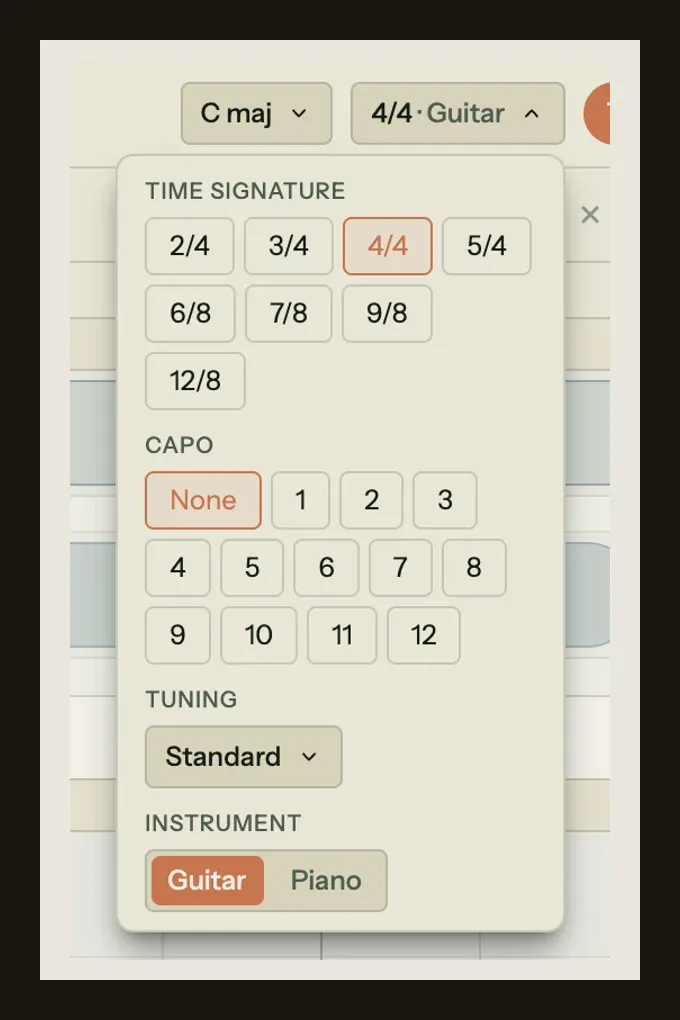
On the guitar side there is a capo control from 0 to 12 that transposes the shapes without moving the sounding pitch, so you can find the fingering that keeps your open strings while the song stays where your voice wants it. Change the capo and every chord block gets a new default voicing for its transposed shape.
Two honest limits. Transposition does not touch audio, so recorded takes keep their original pitch and will disagree with a transposed song until you re-record them. And detecting a whole sung phrase into notes runs on desktop, not on the phone.
Move the key, keep the song
Write the song once, then try it in three keys before Thursday. Chords, melody notes and voicings all come with you.
Frequently Asked Questions
Is changing the key of my own song cheating?
No, and the people who treat it as a compromise tend to regret it. Geddy Lee refused to transpose Hemispheres in 1978 because "that would have felt like too big of a compromise," and his verdict forty years later, asked whether he changes keys now, was: "Oh, yeah, we do that all the time now. That's the way you're supposed to do it!" The key is a setting, not a fact about the song.
Can I just sing the chorus an octave lower?
Sometimes, but it is a bigger change than it sounds. An octave down usually puts the chorus below the verse, which inverts the shape of the song and removes the lift. If the peak is only two or three semitones out of reach, move the key instead. Save the octave drop for when the melody genuinely sits in the wrong part of your voice.
Will transposing change how the song feels?
On guitar, yes, and mostly through the voicings rather than the pitch. A song in G rings with open strings, and the same song in B flat played with barre chords does not. Instrument timbre also shifts: the same progression sits differently on a low guitar string than it does higher up the neck. The chord relationships are identical, but the texture is not.
My capo is on the 7th fret and it sounds thin. What now?
Switch shape family instead of climbing. If C shapes at capo 7 sound brittle, the same sounding key is reachable with G shapes lower down, or with E or A shapes lower still. High capo positions shorten the strings and lose the low end, which is exactly the register a voice needs support from.
What if I am writing it for somebody else to sing?
Then find out their comfortable range before you finish, not after. Paul Waaktaar-Savoy said that writing for Morten Harket rather than himself was "like writing for a totally different instrument," and the chorus of "Take On Me" was shaped around that instrument on purpose. Ask for their chorus ceiling and their verse floor and write inside them.
Should I sort the key out before or after I record the demo?
Before. That was Geddy Lee's own diagnosis of what went wrong: "We never did demos in those days. We just wrote it and then recorded it. If you were doing a demo, that would have revealed itself." Even a phone recording of one chorus, sung standing at full voice, will tell you what you need to know for the cost of two minutes.
Do singers permanently lower their keys as they get older?
Not automatically, and the most famous example says the opposite. Answering reviewers who said he had lost his falsetto after throat surgery, Elton John told Billboard in 2004 that he still sang much of his catalogue in the original key: "I haven't taken them down, but I just have more resonance in my voice and I'm much happier with that" (quoted in Ultimate Classic Rock). Two years later he was blunter: when critics say he cannot hit the high notes in "Rocket Man," he answered, "it's the same key as I've always sung it but the falsetto has gone." The sound changed. The key did not.