Table of Contents
- What makes a song sound country?
- Is country really three chords and the truth?
- Why does my country song sound like sad pop?
- Why does a minor key push a song toward pop?
- Is the four-chord loop banned in country?
- Which chords make a song sound country?
- How much does the V chord matter?
- What is a II7 chord, and when should you use one?
- Where does a dominant seventh go?
- Can a country song be in a minor key?
- Which rhythm makes a song feel country?
- What is the train beat?
- What is a country shuffle?
- When should you write a country waltz?
- How should a country melody move?
- How do you keep the melody on the chord?
- How do you write a country lyric?
- How do you write a title that turns?
- What kinds of twist work in a country song?
- What should the second verse add?
- How do Nashville songwriters work?
- How do you capture a country song before it's gone?
- Worked example: turning a sad-pop draft into a country song
- Does your song sound country yet? A rewrite checklist
- How does Song Cage help you write a country song?
- Frequently Asked Questions
A songwriter on r/Songwriting put the problem in one sentence: they kept trying to write country songs on guitar, "but everything I come up with just sounds like sad pop music." They had already looked up the country chords. It hadn't helped.
That is the trap in most advice on how to write a country song. It hands you three chords, tells you to write about a truck, and stops. The chords matter, but a song reads as country because several signals line up at once: a lyric built on specific detail and a title that turns, harmony that lives in a major key and resolves from V to I, a feel you could dance a two-step or a waltz to, and a melody you could almost speak.
This guide takes those signals one at a time, with the research behind each and real songs from Hank Williams to Chris Stapleton. It ends with a worked rewrite of a sad-pop draft and a checklist you can run on your own song.
The short version
Put the song in a major key and let at least one phrase end on V to I. Try one II7 or I7 where the melody allows it. Pick a country feel: a two-beat, a shuffle, a train beat or a waltz. Build the lyric on one real moment, get the title in early, and make the last verse change what the title means.
What makes a song sound country?
A song sounds country when several signals agree: a major key, phrases that resolve from V to I, a two-beat, shuffle or waltz feel, a conversational melody, and a story told through specific detail. No single signal does it alone. Most writers reach for chords first, though chords alone separate country from pop less than you'd expect.
The best measurement of country harmony comes from music theorist Trevor de Clercq. He transcribed 200 famous country songs, dating from 1933 to 2014, for his book The Nashville Number System Fake Book (Hal Leonard, 2015), then analysed them as a corpus and compared them with 200 rock songs. The study was presented at the International Country Music Conference in 2018 and later published in The Oxford Handbook of Music and Corpus Studies.
Three findings matter for writers. First, 98% of the country songs use major home chords exclusively, against about 78% of the rock songs. Second, in country the V chord is more common than the IV chord, while rock has it the other way round. Third, country shows "a greater preponderance of traditional cadential gestures," such as ii to V to I and IV to V to I, "than the retrogressive 5 to 4 blues gesture endemic to rock." In practice, country music is almost always in a major key, and its phrases still come home.
Here are his headline numbers for the two corpora:
| Measure | 200 country songs | 200 rock songs |
|---|---|---|
| Songs using only major home chords | 98% | About 78% |
| More common of IV and V | V | IV |
| Songs with three chords or fewer | 26.5% | 28.5% |
| Songs with seven chords or fewer | 94% | 86% |
| Chord changes that are I, IV or V | About 82% | About 79% (major-key songs) |
| Bars spent on I, IV or V | About 86% | About 85% (major-key songs) |
Is country really three chords and the truth?
Not as often as the saying suggests. In de Clercq's 200 famous country songs, 53, or 26.5%, use three chords or fewer. The rock corpus he built with David Temperley came in at 28.5%. What country does have is a ceiling: few of its famous songs use more than seven different chords.
"Three chords and the truth" is the line usually credited to Harlan Howard, who co-wrote "I Fall to Pieces" and wrote "Busted." The chords I, IV and V do carry the genre: they account for about 82% of the chord changes in de Clercq's country corpus and about 86% of its bars. But major-key rock sits at 79% and 85%, a gap de Clercq calls statistically significant, though it "does not seem like a very big difference."
The limit used to be enforced. Willie Nelson told Fresh Air in 1996 that "the country songs weren't supposed to have over three chords, according to executive decisions." He also said he "had problems immediately" with "Crazy" because it had "four or five chords in it". Patsy Cline's 1961 recording reached No. 2 on the country chart anyway.
Why does my country song sound like sad pop?
Usually because it uses pop's tools: a four-chord loop that never lands on V to I, a minor home key, a slow and even strum, and a lyric that names a feeling instead of showing one. Any one of those can live in a country song. All four together sound like the last decade of pop radio.
Country radio drifted the same way. Musicologist Jocelyn Neal writes in the Journal of Popular Music Studies (2020) that tonal harmony, the kind built on V to I, "was a firmly established characteristic of the mainstream country genre, particularly as distinct from other pop music genres." Then, in the decade before 2015, "many country songwriters shifted to the chord loops that had already become ubiquitous in pop music: I-V-vi-IV, for instance." In one brief sample Neal cites, from late 2018, seven of Billboard's top ten country songs used some permutation of that one progression.
A thesis Neal supervised at UNC, Mason Allen's study of the 67 songs that reached the country top ten in 2015, found that about one in five of them never use a V chord at all. Nashville writer Rivers Rutherford told Allen that a V to I cadence can feel "too buttoned up."
Why does a minor key push a song toward pop?
Because pop moved toward minor keys over the last few decades, while almost every famous country song is in a major key. A minor loop at a slow tempo borrows two of pop's strongest habits at once. Moving the same song into its relative major is one of the quickest ways to pull it back toward country.
Pop went minor. A study of five decades of the Top 40 found pop became more sad-sounding over time, with more minor keys and slower tempos. De Clercq's country canon, by contrast, is 98% major. So a minor loop at a slow tempo is a quick route to sad pop, and the tempo is doing part of the work: a minor key does not make a song sad on its own.
Is the four-chord loop banned in country?
No. "Wagon Wheel" runs on the same I–V–vi–IV loop as many pop hits, and Darius Rucker took it to No. 1 on the country chart in 2013. When the loop is there, something else has to carry the country sound: the story, the instruments, the feel and the voice.
Old Crow Medicine Show's original, written by Ketch Secor around a chorus sketch by Bob Dylan, uses the pattern in A major in a swinging two-beat. Rucker's cover won the Grammy for Best Country Solo Performance.
"Strawberry Wine," written by Matraca Berg and Gary Harrison and a No. 1 for Deana Carter in 1996, does something similar. Chord charts give its chorus the same I–V–vi–IV loop, yet it doesn't read as pop, because it is a waltz and a woman looking back on one summer.
Researchers who built a dataset of chord progressions from more than 666,000 songs found the same thing from the other side. After comparing the four-chord progressions of 12 genres, they wrote that genre classification is "challenging when relying solely on the chords of music tracks," and their baseline genre classifier, working from the progressions, scored 26.6% on the 12-genre task. Chords are a weak genre signal on their own. A draft sounds like pop when the loop is carrying everything and nothing else pulls toward country.
Which chords make a song sound country?
Start with I, IV and V in a major key, and end some phrases on V moving to I. Add a dominant seventh where a chord should pull harder: V7 into I, or I7 into IV. Save the II7, a major chord on the second degree, for an occasional color. These are the core of classic country chord progressions.
This is the piece of music theory for songwriters that can change a country draft quickly. "Mama Tried," which Merle Haggard wrote and took to No. 1 in 1968, is a good model. Chord charts show I, IV and V, mostly as V7, almost all the way through, with one vi in each chorus for contrast. The story does the rest.
Neal points to a common country cadence: a V to I with an extra IV slipped in between, so the phrase closes V–IV–I. Her example is Bill Anderson's "Still."
How much does the V chord matter?
Enough that removing it changes what a song sounds like. One song in two famous versions shows it: George Jones's "Tennessee Whiskey," full of V to I cadences, and Chris Stapleton's, which has none.
To hear how much the V chord carries, compare the two records. George Jones took "Tennessee Whiskey," by Dean Dillon and Linda Hargrove, to No. 2 on the country chart in 1983 with a record that had, in Neal's words, "three chords, lots of V-I cadences, and a predictable modulation before the final chorus." Chris Stapleton's 2015 version moved it to a slow compound meter over a two-chord pattern. "Simply put, Stapleton threw out all of the song's V chords." The lyric stayed the same. Listeners, Neal notes, pointed out that the new chords and groove were nearly identical to Etta James's "I'd Rather Go Blind."
What is a II7 chord, and when should you use one?
A II7 is a dominant seventh built on the second degree of the key: D7 in the key of C. Its F sharp pulls up to G, so it points at the V chord. Music theorists call it a secondary dominant, the V of V. It shows up in classic country as a lift just before a phrase comes home.
The textbook case is Hank Williams's "Hey, Good Lookin'" (1951). As Jim D'Ville put it in Ukulele magazine, "The verses to 'Hey, Good Lookin'' are a prime example of the I–II7–V7–I progression." In C, that is C, D7, G7, C.
Use it sparingly. In de Clercq's 200 songs, a major II chord accounts for about 1.3% of chord changes, fewer than the minor ii at 5% and the flat VII at 1.6%. Part of its pull is that it is rare. The full theory, with the other four secondary dominants in a major key, is in our guide to secondary dominants.
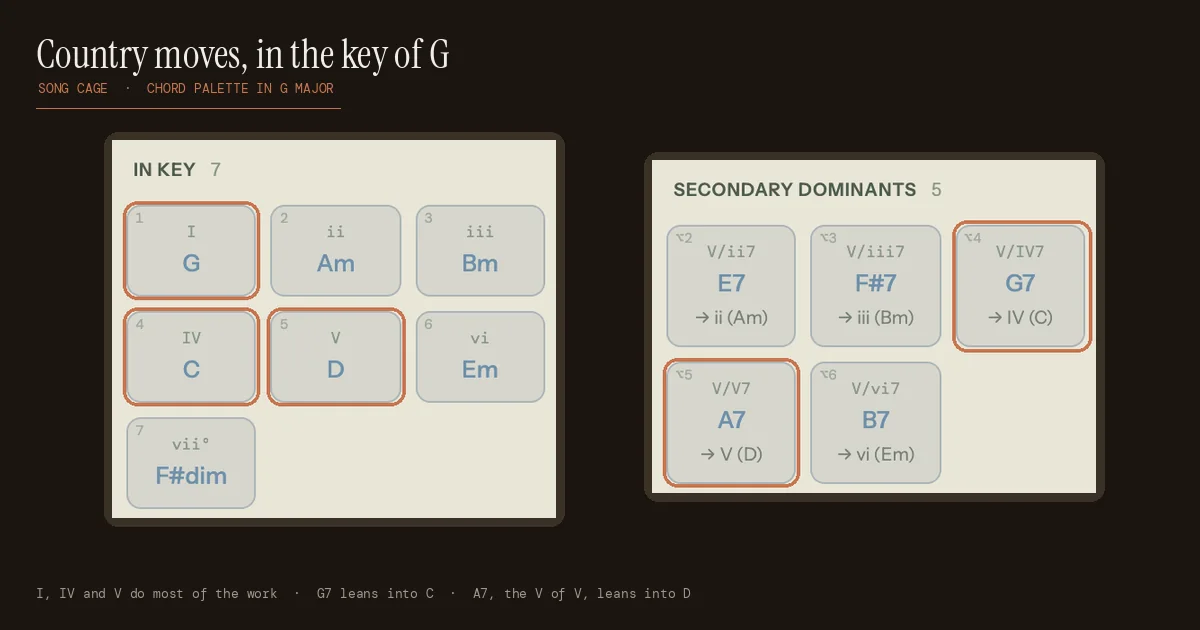
In Song Cage, the chord palette lists these under their own Secondary Dominants heading, worked out from your key. In G, the key of the worked example below, A7 sits there marked as the V of V with an arrow to D, and G7 points to C, next to E7, F#7 and B7. Song Cage will not add a II7 for you to make a song sound country. It is a chord you choose, and the palette shows you where it leads before you commit.
Where does a dominant seventh go?
A dominant seventh wants to move up a fourth. V7 goes to I, which is the cadence that closes a country phrase. I7 goes to IV, a move Stoia finds often in early country and blues. III7 goes to vi, although songs such as "Tennessee Waltz" send it up to IV instead.
Nicholas Stoia, writing about 1920s to early 1940s country and blues recordings in Music Theory Online, notes that "minor sevenths often transform the tonic into V7/IV before it moves to the subdominant," and turn the dominant into V7 "before it moves to the tonic, following classical norms."
"Hey, Good Lookin'" uses the I7 move too. Its last verse phrase before the bridge goes C to C7, and the bridge opens on F. "Tennessee Waltz," written by Pee Wee King and Redd Stewart and one of Tennessee's official state songs since 1965, does the same in its verse, and its refrain moves I to III7 to IV: in C, that is C, E7, F.
Bluegrass takes the idea further. "Salty Dog Blues," a traditional song that Flatt and Scruggs recorded in 1950, runs I–VI–II–V–I with major chords: G, E, A, D, G. After the jump to E, each chord is the V of the next: E to A, A to D, D home to G.
Can a country song be in a minor key?
Yes, but it is rare. Only about 2% of the songs in de Clercq's country corpus use a minor home chord at all. Two famous examples stay quick and tell a tense story, rather than slowing down to sound sad.
Dolly Parton's "Jolene" (1973) is the famous case. It is published in C sharp minor at about 110 beats per minute, felt in two, and lives almost entirely on i, flat III and flat VII. Lydia Hamessley's 2025 book on the song for Oxford University Press ties its "spooky" reputation to that natural minor mode. It sounds urgent.
"The Devil Went Down to Georgia" (1979) is another. The Charlie Daniels Band set it in D minor at a fast tempo, with verses closer to spoken than sung. If your minor-key draft keeps sliding toward sad pop, try speeding it up before you change a single chord.
Which rhythm makes a song feel country?
Country has a small set of classic grooves: the two-beat, the shuffle, the train beat and the slow waltz. Country Music Hall of Fame historian John Rumble named three, and "between those three," he said, "that covers a whole lot of ground in country music." Pick one on purpose rather than strumming whatever your hand falls into.
Rumble's list, quoted by the AP in 2011, was "the standard 2/4 beat, the Ray Price shuffle and the Johnny Cash beat." A Percussive Arts Society article by Aaron Graham gives three classic drum grooves: the train beat, the slow country waltz and the shuffle.
On guitar, the two-beat usually means a boom-chick: a single bass note, then a strum of the rest of the chord, with the bass note often swapping between the root and the fifth. It is the first thing to try when a draft is strummed as a flat wall of eighth notes. On piano, play the root low on the strong beats and the rest of the chord higher in between.
The feel changes how the words sit, so try the same verse in two or three of these before you decide. A line that drags as a slow strum can come alive as a two-beat, and a line that feels rushed may want to be a waltz.
What is the train beat?
The train beat is a steady flow of eighth notes with an accent that drives forward like wheels on a track. Johnny Cash's "Folsom Prison Blues" is the famous example. On guitar you can get close by muting the strings and alternating a bass note with a short, scratchy strum.
The Percussive Arts Society article puts the train beat first among its "three classic country drum set grooves" and says "the most vital aspect of this groove is maintaining a steady flow of eighth notes with no inconsistencies in the pulse."
The Cash sound started without a drummer. "Folsom Prison Blues" was recorded at Sun in July 1955 by Cash, guitarist Luther Perkins and bassist Marshall Grant, the Tennessee Two. Rosanne Cash told the AP, "There was none of that 'boom chicka boom' without Marshall," whose slapped bass stood in for percussion. On "I Walk the Line," Cash told Fresh Air in 1997 that Sam Phillips wanted it faster: "And I put paper in the strings of my guitar to get that" sound.
What is a country shuffle?
A shuffle swings each beat, long-short, over a walking bass. In country it is often called the Ray Price beat, after "Crazy Arms" (1956). Price once described it, according to Mel Tillis, as "a beat that makes a slow song feel fast."
The Country Music Hall of Fame credits "Crazy Arms," written by Ralph Mooney and Chuck Seals, with "Buddy Killen's driving 4/4 bass line," and says "many artists adopted the 4/4 shuffle, calling it the 'Ray Price Beat.'" The record spent 20 weeks at No. 1.
Price told Rolling Stone the idea came from playing dances: "we'd just stop the music all of a sudden and you'd hear their feet shuffle." The Tillis line comes from PBS's companion to Ken Burns's Country Music, which also notes the walking bass was "perfect for dancing the Texas two-step." The Percussive Arts Society lists Buck Owens's "Under Your Spell Again" and Loretta Lynn's "Coal Miner's Daughter" as classic shuffles.
When should you write a country waltz?
Write a waltz when the song looks back: a memory, a first dance, a place you can't return to. Three beats to a bar slows the lyric down and makes it sway. "Tennessee Waltz" and "Strawberry Wine" are two of the Percussive Arts Society's examples of the slow country waltz.
Matraca Berg said it plainly about "Strawberry Wine": "It was a waltz." Billboard called the record "a four-minute ballad in waltz time," and it won Song of the Year at the 1997 CMA Awards. The third example on the Percussive Arts Society's list is Hank Williams's "The Alabama Waltz."
Waltzes can be scarce at the top of the chart. When Ralph Murphy, then an ASCAP membership executive in Nashville, studied the country No. 1s of 2002, he found all 21 were in 4/4. That is a good reason to write one, since a waltz stands out.
Song Cage can play a song back with a feel under it, so you can hear whether the rhythm suits the words. In 4/4 there is a folk strum and a Travis-style pick, named for Merle Travis, who learned his thumb-picking style from coal miners in Muhlenberg County, Kentucky. In 3/4 there is a waltz strum on guitar, and on piano a waltz that plays the lowest note of the chord first and the upper notes after it. Playback is for hearing the song out loud, not for producing it.
How should a country melody move?
Keep it singable and close to speech. Put chord tones on the strong beats, move mostly by step, and save the leap for the word that matters most. A country melody usually sounds like someone telling you something, only a little higher.
Stoia found that in early country and blues, the notes of the home chord are the most stable, and that musicians most often preferred to end a verse on the key note over the home chord. It is the melodic twin of the V to I cadence. Allen notes that even Luke Bryan's "Strip It Down," a 2015 hit with no V chord, has a melody centred on scale degrees 1, 3 and 5, which confirms its key.
The speech connection is measurable. Voice scientists who studied five leading male country singers found their speaking and singing spectra were similar, with no sign of the singer's formant, the strong resonance peak found in classically trained voices. Lori McKenna, who wrote "Humble and Kind," wants the words to work the same way: "I like songs that sound like conversations."
The famous break in a country voice works one word at a time. In 31 country recordings, Brandon Paul and David Huron found that voice breaks tended to fall on words with more grief-related content, while the full lyrics of those songs were no more grief-related than other songs from the same albums. Write the melody so the break has somewhere to go: a long note on the word that hurts.
How do you keep the melody on the chord?
Sing the line, then check what each strong-beat note is doing in the chord underneath. A melody note that is the root, third or fifth of its chord sounds settled and plain, which is what much of classic country wants. A seventh or ninth leans more toward soul or indie.
Song Cage makes that choice visible. In a section with a key, when you pick a chord for a spot that has melody over it, a three-way switch sits above the suggestions: Support, Color and Reharm. Support keeps your melody note as the root, third or fifth of the chord, so the chord holds the note up. Song Cage's own description of that setting names folk, country and straight pop, and it is the default. Color lets the note become a seventh, ninth or sixth. Reharm opens up borrowed chords and secondary dominants.
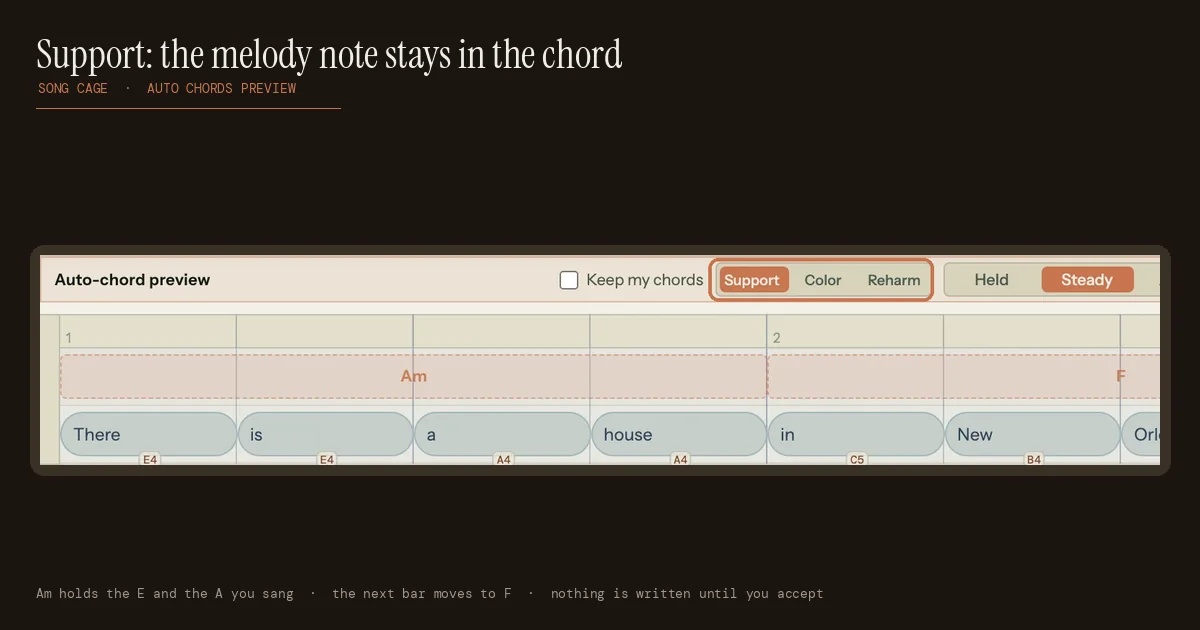
The same switch appears in Auto Chords, which suggests chords for a section once it has at least three melody notes and writes nothing until you accept. To get the notes in on a computer, select a word and hold Hold to sing, or the M key, while you sing the note. A small keyboard lights up the tones of the chord at that beat, so you can see when your melody lands on one.
How do you write a country lyric?
Tell one real moment in specific, concrete detail, in words you would actually say. Let the title do more work than any other line: get to it early, repeat it, and make it mean something new by the end. Every verse should move the story forward.
Specific detail is a long-standing rule in country songwriting, and it holds up in the data. A 2024 study in PLOS One found that among hit songs in four genres, country lyrics used the most scene-setting words, which the authors say supports the idea that country tells relatively specific, detailed stories. Craig Wiseman, who had 22 No. 1s when he spoke to Rolling Stone, put it plainly: "Country is kind of literal, but I like that."
J.T. Harding calls "show, don't tell" the motto in Nashville, and he gives a clear example of it: "Don't say, 'I'm sad over this girl.' You say, 'Her jean jacket is still on the couch and it smells like her perfume.'" Jason Isbell compares the job to a crossword: "you have a certain amount of space that you have to get a detail into."
Writing it conversationally also protects you from cliché. Isbell told Fresh Air that when a lyric scans right, sounds conversational and doesn't sound forced, "you'll cut out a whole lot of your potential for cliché."
How do you write a title that turns?
Start with a title that can mean two things, or that the last verse can change. Then build the verses so the chorus lands differently each time it comes back. The classic twist saves the real meaning of the title for the end.
Many Nashville writers begin there, though not all do. Lori McKenna told Entertainment Focus that her process varies from song to song, "but for the most part, I like to start with a title. I'm a word person." Nicolle Galyon describes the usual method as writing the song "more like an essay where you have a thesis, which is the hook," and working backwards from it. Ralph Murphy found that 19 of the 21 country No. 1s of 2002 used the title within the first 60 seconds, intro included.
What kinds of twist work in a country song?
Three kinds show up often: a title that only makes sense at the end, a common phrase flipped inside out, and a conversation that reveals its real purpose in the last line. Each makes the listener hear the title differently the second time.
Dierks Bentley calls the twist "a good knife-stab in there somewhere that twists the whole story around at the end." One of the most famous is "He Stopped Loving Her Today," by Bobby Braddock and Curly Putman, a No. 1 for George Jones in 1980. Braddock told Fresh Air it is "the story of a man whose love was so strong that the only way he could get over this woman was to die."
A twist can also be a flip of a common phrase. "The House That Built Me" started, co-writer Tom Douglas said, when Allen Shamblin turned "the house that I built" around (The Tennessean, 2014). And "The Chair," by Dean Dillon and Hank Cochran for George Strait, has no conventional chorus at all. "We just decided it would be a conversation song," Dillon told Texas Monthly, and its last line reveals what the first one was really for.
What should the second verse add?
Time. Verse two should answer "and then what happened?", not restate verse one in new words. Some of country's best-loved songs jump years between verses, so the same chorus means something different each time it returns.
Marty Dodson of SongTown sums up the order: "First Verse says 'This happened' Chorus says 'Because…' Second Verse answers 'And then…'" Of the "very common mistakes" he warns about, the biggest, he writes in American Songwriter, is "the second verse that is just a re-written first verse."
Jocelyn Neal named this structure the Time-Shift narrative in Music Theory Spectrum (2007). Its verses are, in her words, "snap-shots from the characters' lives," and the chorus's meaning is "enhanced, inflected, or even dramatically changed" by the verse before it. "Don't Take the Girl," by Craig Martin and Larry W. Johnson, jumps from a boy of eight to ten years later and then five more, and its title works three different ways.
Jordan Davis's "Next Thing You Know" (2022) follows one man from bachelor to grandfather, with different words in each of its three choruses. Co-writer Chase McGill told Billboard, "if we spend 47 seconds of the song being 21, then we're not going to get a lot of life in there." One warning from Tom Douglas: the early "House That Built Me" had, in his words, "too much story," and it only worked once the writers cut it down. Pick a few moments and leave the rest of the biography out.
How do Nashville songwriters work?
Mostly in scheduled co-writes, often with two or three writers in the room, and usually starting from a title or an idea. When the song is done, they record a simple work tape, often just a voice and a guitar or piano, before anyone thinks about a demo. Nashville songwriting is a daily routine more than a spark.
The routine is real. A 2017 guide on the Nashville Songwriters Association International's site says the average signed writer writes "anywhere from 4-7 times per week," that "most pro writers write from 10am to about 1pm," and that a finished song goes to the publisher as "the work-tape and lyric sheet." The rooms have grown: Chartmetric counted 1.8 credited writers per country song in 2000 and 2.9 in 2022.
The work tape is the capture step, and it can be as simple as a phone. NPR describes writers who, "when a song is done," gather around a recorder "and make what's called a work tape." "Girl Crush" never got a demo. "We wrote the entire song in an hour and a half and taped it on our phone," Lori McKenna told American Songwriter.
Nashville recording sessions have used charts written in numbers rather than chord names since the late 1950s, de Clercq notes. Because a number chart names each chord by its place in the key, the same chart works in whatever key suits the singer. If you want to write your own that way, start with the Nashville Number System.
How do you capture a country song before it's gone?
Record the idea the moment it arrives, even if it's only a hummed line and a title, and write the chords down while you still remember them. The recording can be rough. What matters is that it exists.
The free Song Cage app for iPhone and Android is built for that step. Hum the idea on the Record tab, write the lines on the Lyrics tab and tap the chords in on the Chords tab. You don't need an account to use it.
Sign in and your captures sync to your account. With the Song Cage licence, or during the 14-day trial of the desktop app or plugin, they turn up in the Ideas inbox on your computer, ready to drag into a song. There you can set a capo, move the whole song to the singer's key, and export a PDF chord sheet with the chord names above your lyrics and a diagram of each shape, ready for the players in the room.
Worked example: turning a sad-pop draft into a country song
Here is a draft that sounds like sad pop, and the same idea rewritten with the country signals from this guide. The lyrics are invented for this example. Every change is one you can make to your own song in an afternoon, and rewriting a draft like this is a practical way to learn how to write a country song.
The draft sits in E minor on a loop of Em, C, G and D for every section, strummed evenly at a slow tempo. The verse says "I've been lonely since you left." The title, "Since You Left," means the same thing every time it comes back.
| Signal | Sad-pop draft | Country rewrite |
|---|---|---|
| Key | E minor | G major, the relative major, so the same open chords still work |
| Verse chords | Em, C, G, D, looped | G, C, G, D7, then G, G7, C, G, D7, G (I, IV, I, V7; I, I7, IV, I, V7, I) |
| Chorus chords | The same loop | C, G, A7, D7, G (IV, I, II7, V7, I), with the II7 under the title line |
| Feel | Slow, even strumming | A slow waltz in 3/4, or a two-beat with bass on the strong beats |
| Detail | "I've been lonely since you left" | "Your boots are still by the kitchen door" |
| Title | "Since You Left," same meaning every time | "Leave the Porch Light On," a different meaning in each verse |
| Story | One feeling, stated three ways | Three moments, years apart |
The new title gives each verse its own time. In verse one, she asks him to leave the porch light on when she works late. In verse two, years later, he leaves it on after she has gone. In verse three, he is the one who is gone, and their daughter leaves it on for him. The chorus words never change. What they mean does.
For the melody, land "on" on the root of G on a strong beat, move by step through the verse, and save the highest note for the word that carries the twist in the last chorus. Then sing the whole thing as if you were telling it to someone across a kitchen table.
Does your song sound country yet? A rewrite checklist
Run these seven checks on any draft. If most of them pass, the song has the bones of a country song, whatever instruments end up on the record. If several fail, fix those before you touch the arrangement.
The country checklist
- Can you say the song's moment in one sentence, with a place and a time in it?
- Does the title arrive within the first minute, and does it change meaning by the end?
- Does verse two move the story, rather than repeat verse one?
- Is the home key major, and does at least one phrase end with V moving to I?
- Have you tried one II7 or I7 where the melody allows it?
- Have you chosen a feel on purpose: two-beat, shuffle, train beat or waltz?
- Does every line sound like something a person would actually say?
Billboard's 2019 decision about "Old Town Road" is a reminder that the record matters too. When it determines genres, the company said, "a few factors are examined, but first and foremost is musical composition," and the song "does not embrace enough elements of today's country music" (CNN, via the Internet Archive). The checklist covers the composition. Fiddle, steel and banjo come later.
How does Song Cage help you write a country song?
Song Cage is a songwriting app for capturing an idea and building it into a song: chords that know your key, a melody lane over the chord grid, lyrics on the same timeline, and playback so you can hear it. It contains no generative AI, so the song stays yours.
What it does for a country song
- Chords in context: the palette shows your key's chords, the borrowed chords and the secondary dominants, so D7 in the key of C is right there, marked as the V of V.
- Melody that sits on the chord: the Support setting keeps your melody notes as the root, third or fifth of each suggested chord.
- The feel, out loud: a folk strum or Travis-style pick in 4/4, or a waltz in 3/4.
- A capo and a key change: move a finished song to the singer's key in one step.
- A chart for the room: a PDF chord sheet with the chords above your lyrics.
- Capture on your phone: free iPhone and Android apps for the work tape, the words and the chords.
Write it like you'd say it
Capture the idea, find the chords that fit your melody, and hear it as a waltz or a two-beat before you play it for anyone.
Frequently Asked Questions
What are the three cowboy chords?
There is no official set. "Cowboy chords" is guitar slang for the open chords near the nut that ring with open strings, such as G, C, D, A and E, and when someone names just three, G, C and D is a common pick. They are the I, IV and V of the key of G, which is enough to play a great many country songs. Add D7 for a stronger pull back to G.
What key are most country songs in?
A major key, almost always. In Trevor de Clercq's corpus of 200 famous country songs, 98% use major home chords exclusively. No study we found measures which major keys are most common, although guitar-friendly keys such as G, C, D, A and E are easy to play with open chords, and a capo moves any of them to suit the singer.
Do country songs need a bridge?
Not always. In Mason Allen's study of the 67 songs that reached the country top ten in 2015, 46 (69%) had a bridge or a bridge-like section, and 60 had three choruses. George Strait's "The Chair" has no conventional chorus at all. If your song does need a change of view before the last chorus, here is how a bridge works.
What is the 80/20 rule in songwriting?
It has no official definition. It is the business idea that a small share of the effort produces most of the result, borrowed by songwriting teachers in different ways. Andrea Stolpe, for example, writes that "80% of the song is established by 20% of my initial efforts." In a country song, the title and the moment the song is about are good places to spend that 20%.
How long should a country song be?
Around three minutes has long been typical. A study of the 63 Billboard country songs of the year from 1946 to 2008 found they averaged 181.6 seconds, at an average tempo of about 95 beats per minute. Write the story first, then cut anything that doesn't move it.
How much do country songwriters make?
Most make very little from songwriting, and a few make a great deal. "New people in this town will tell you they moved here to become a professional songwriter, artist or musician," NSAI executive director Bart Herbison told The Tennessean in 2026. "Less than 1% will ever pay their bills as one." He estimated that a No. 1 on the country radio charts could net $600,000 to $1.2 million on average, split among its writers and publishers.
Can I write a country song if I only play piano?
Yes. Play the root of each chord low on the strong beats and the rest of the chord higher in between, which gives you the same two-beat feel a guitarist gets from a boom-chick. For a waltz, play the root on beat one and the chord on beats two and three. Everything else in this guide, from the V to I cadence to the title that turns, works the same on any instrument.