Table of Contents
- What makes a song a pop song?
- How do you write a pop song, step by step?
- Should you start a pop song with the beat or the melody?
- What is a topline?
- When should the chorus come in a pop song?
- Does a pop song have to hit the chorus in 30 seconds?
- Should a pop song start with the chorus?
- What does the chorus change in a pop song?
- What is a pre-chorus for?
- What chord progressions do pop songs use?
- How do you write a pop hook?
- What is a post-chorus?
- How do you fit words to a pop melody?
- What is the structure of a pop song?
- How do you know when your chorus will land?
- How do you write a pop song in Song Cage?
- Frequently Asked Questions
Pop songwriting advice keeps coming back to one rule: reach the chorus within 30 seconds. There's a real number behind it. Spotify counts a stream once someone has listened for 30 seconds. The songs at the top of the chart don't keep that clock, though. The 2024 number ones took 45 seconds on average to reach their first chorus, according to Hit Songs Deconstructed, and a quarter of them took more than a minute.
What the hits keep is a shape: a hook early, a verse that holds something back, a chorus that changes at least one thing, and words that sit exactly on the melody. Each step below comes with the numbers behind it, including our own count of 739 Billboard songs from 1958 to 1991.
Quick Summary
To write a pop song, start from the hook, build the chorus around the title, keep the verse smaller than the chorus, and make the chorus change at least one thing: a chord, the range, the rhythm of the words or the size of the arrangement. In Song Cage's count of Hot 100 songs from 1958 to 1991, about half reached the first chorus between 30 and 60 seconds in, and most current hits follow the chorus with a post-chorus. Fit every syllable to the melody exactly.
What makes a song a pop song?
A pop song is built to be remembered after one or two plays. In practice that means a short form, a chorus that carries the title, hooks that come back, and sections that contrast. Pop's sound changes with whatever is charting, but the repetition stays, and chart hits are measurably more repetitive than the songs below them.
Colin Morris measured that last part. For The Pudding, he ran the lyrics of 15,000 songs from the Billboard Hot 100, 1958 to 2017, through a compression algorithm: the more a lyric repeats itself, the smaller it gets. The songs that reached the top 10 were, on average, more repetitive than the rest of the chart in every year from 1960 to 2015, and 2014 was the most repetitive year in his data.
Pop also lends its tools to everyone else. Of the 16 non-holiday songs that went to number one in 2024, Hit Songs Deconstructed filed just under a fifth under pop as the main genre, but heard pop's influence in three quarters of them. So "how to write a pop song" is really a question about a set of tools: the hook, the chorus, contrast and repetition. They work in any genre, and the rest of this guide takes them one at a time.
How do you write a pop song, step by step?
Start with the hook, not the first line. Write the chorus around the title, then build a verse that sets it up without giving it away. Choose chords that leave the melody room, decide when the chorus lands, and make every syllable fit the tune. Add a post-chorus if the hook can carry one.
- Capture the hook first. The title on its melody, a riff, a chant. Everything else in the song exists to deliver it, so get it recorded before you work on anything else.
- Write the chorus around the title. Put the title where the melody lands hardest, often the first or last line of the chorus, and repeat it. Half of 2024's number ones sang their title 6 to 10 times.
- Pick chords that leave room. In our count of older hits, two thirds of first choruses used four chords or fewer. The melody is the part people remember, so the chords can be plain.
- Make the verse smaller. Lower and sparser, with fewer held notes. The chorus lifts by contrast.
- Time the road to the chorus. Count the bars before it and do the arithmetic at your tempo. About half the songs we counted land between 30 and 60 seconds.
- Do the melodic math. Lines sung to the same melody get the same number of syllables, with the stresses on the strong beats.
- Decide on a post-chorus. A short section after the chorus built on one hook. Most current hits have one.
Should you start a pop song with the beat or the melody?
Either. Much of current pop starts from a track, a beat and a chord loop, and a topliner writes the melody and words over it. Songs written at a piano or guitar usually start from the melody and words together. In both cases the first thing worth keeping is the hook, so that's what to get down first.
John Seabrook, in his book The Song Machine, calls the first method "track-and-hook." In Jon Pareles's summary of the book, producers supply the track, and then topliners "fill in the blank spaces with melodies and the outlines of lyrics." Hook writers like Ester Dean improvise over premade beats and chords, throwing out dozens of good tries, as Bookforum's review describes it.
"Shape of You" also started from the music rather than the words. According to Ed Sheeran, Steve Mac opened the writing session by playing the song's opening notes on a keyboard, and Sheeran joined in by tapping percussion on his guitar. The chorus line changed during the session, too: co-writer Johnny McDaid thought "I'm in love with your body" sounded objectifying, so it became "the shape of you."
Writing at an instrument is the older way and it still works. The melody and the words arrive together, and the chords follow them. If you don't play or produce, the topline method is the one that's open to you.
What is a topline?
The topline is the vocal melody and its lyric, the part a listener sings back. The term comes from track-and-hook writing, where the melody sits on top of a track that's already built. A topliner's job is the tune and the words, so you can do it without touching an instrument, as long as you can sing or hum the idea and get it recorded.
When should the chorus come in a pop song?
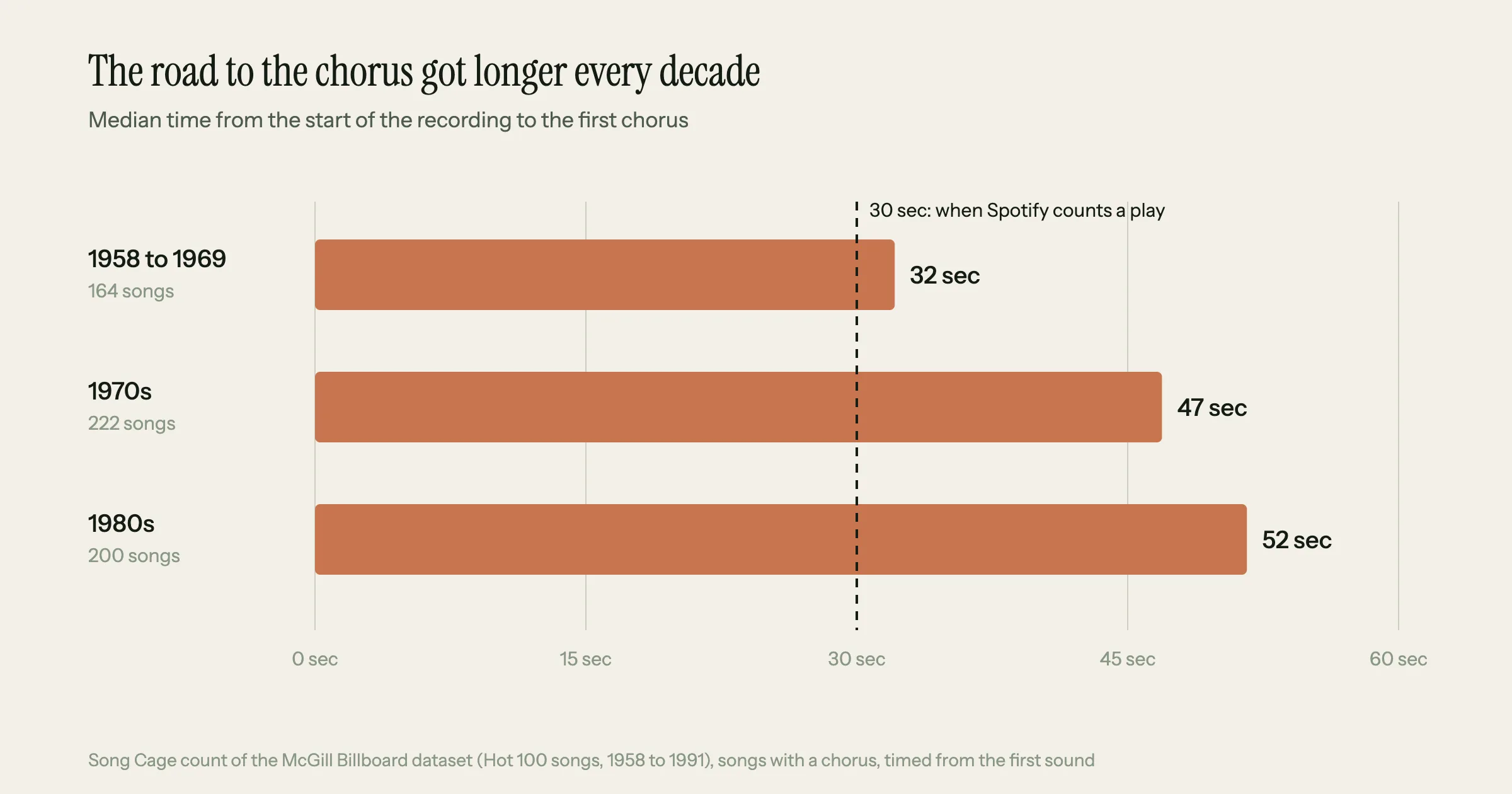
There's no fixed time, but the middle of the range is about 45 seconds. Hit Songs Deconstructed found 2024's number-one hits took 45 seconds on average, up from 33 in 2021. In Song Cage's count of the McGill Billboard dataset (Hot 100 songs, 1958 to 1991), the median first chorus also arrived at 45 seconds, later with each decade.
We timed it in the McGill Billboard dataset, the same hand-annotated set of Hot 100 songs behind our count of verse lengths. Of its 739 songs, 612 have a section the annotators marked as a chorus. We measured from the first sound on the recording to the start of the first chorus.
| Chart years | Songs | Have a chorus | First chorus (median) | Within 30 sec | After 60 sec |
|---|---|---|---|---|---|
| 1958 to 1969 | 237 | 69% | 32 sec | 47% | 11% |
| 1970s | 260 | 85% | 47 sec | 22% | 26% |
| 1980s | 213 | 94% | 52 sec | 10% | 39% |
Song Cage's count from the McGill Billboard dataset. The last three columns are shares of the songs that have a chorus. The 29 songs from 1990 and 1991 ran later still (a 56-second median), too few for a row of their own.
Both numbers grew. More songs had a chorus at all, 69% of the 1958 to 1969 songs against 94% of the 1980s ones, and the road to it got longer: among songs with an intro, the median intro grew from 9.5 seconds to 15.
Then it turned around. Hubert Léveillé Gauvin, studying 303 US top 10 singles from 1986 to 2015, found that instrumental intros shrank from an average of 23 seconds to 5, and that the title arrived earlier than it used to, as his 2018 dissertation sums up. The chorus itself still doesn't arrive in 30 seconds: in 2017, Hit Songs Deconstructed clocked pop hits at 39 seconds to the first chorus on average, against 30 for hip hop.
Does a pop song have to hit the chorus in 30 seconds?
No. Ed Sheeran's "Perfect" and Taylor Swift's "Look What You Made Me Do" both take about a minute to reach the chorus, and both were number ones in 2017. The 30 seconds matters for a different reason: it's when Spotify counts the play. What a listener needs by then is a reason to stay, and the hits mostly give it with something other than the chorus. The intros of 2024's number ones averaged 14 seconds, and their most common job was to set up a hook, an instrumental one in 56% of the songs and a vocal one in 6%.
Should a pop song start with the chorus?
It can, though it's become less common lately. Hit Songs Deconstructed found that 38% of 2022's number ones put a chorus before the first verse, and only 19% of 2024's. It was common a decade ago, too: in the first quarter of 2015, a quarter of the top 10 reached the chorus at once or straight after the intro, Meghan Trainor's "All About That Bass" and "Lips Are Movin" among them. A chorus-first opening works when the chorus makes sense with no verse to set it up, which usually means a title hook strong enough to open a song on.
What does the chorus change in a pop song?
At least one thing you can hear at once: a chord, the register, the rhythm of the words or the arrangement. In Song Cage's count of Hot 100 songs from 1958 to 1991, 61% of first choruses used a chord the verses never did. When the chords stay put, as in "Shape of You," melody and arrangement carry the change.
We checked every song in the dataset with chords marked in both a verse and a chorus. In 359 of 588, the first chorus brought in at least one chord no verse used. The other 39% kept the verse's chords and changed something else.
"Shape of You" is the far end of that 39%. Hooktheory's analysis puts the same progression under the intro, the verse and pre-chorus, and the chorus: C♯m, F♯m, A, B in C♯ minor (the verse makes the B a sus4), which Wikipedia gives as the song's basic progression. Only the bridge moves off it. The chorus lifts on the melody, the rhythm of the words and the arrangement.
So if your chorus and verse share their chords and the chorus still sounds flat, look at what else stayed the same. Does the melody sit in the same range? Do the words move at the same speed? Is the backing the same size? Our guide to what a chorus is covers each of these levers, and why "make the chorus bigger" is often really "make the verse smaller."
What is a pre-chorus for?
A pre-chorus is a short section between the verse and the chorus that builds toward the chorus, often by climbing in pitch or speeding up the words. It's optional: 38% of 2024's number ones had one. Pareles credits Max Martin with a "meticulous sense of structure and drama, of how to lift a song from verse through pre-chorus through triumphal chorus." If your verse already climbs into the chorus on its own, you probably don't need one.
What chord progressions do pop songs use?
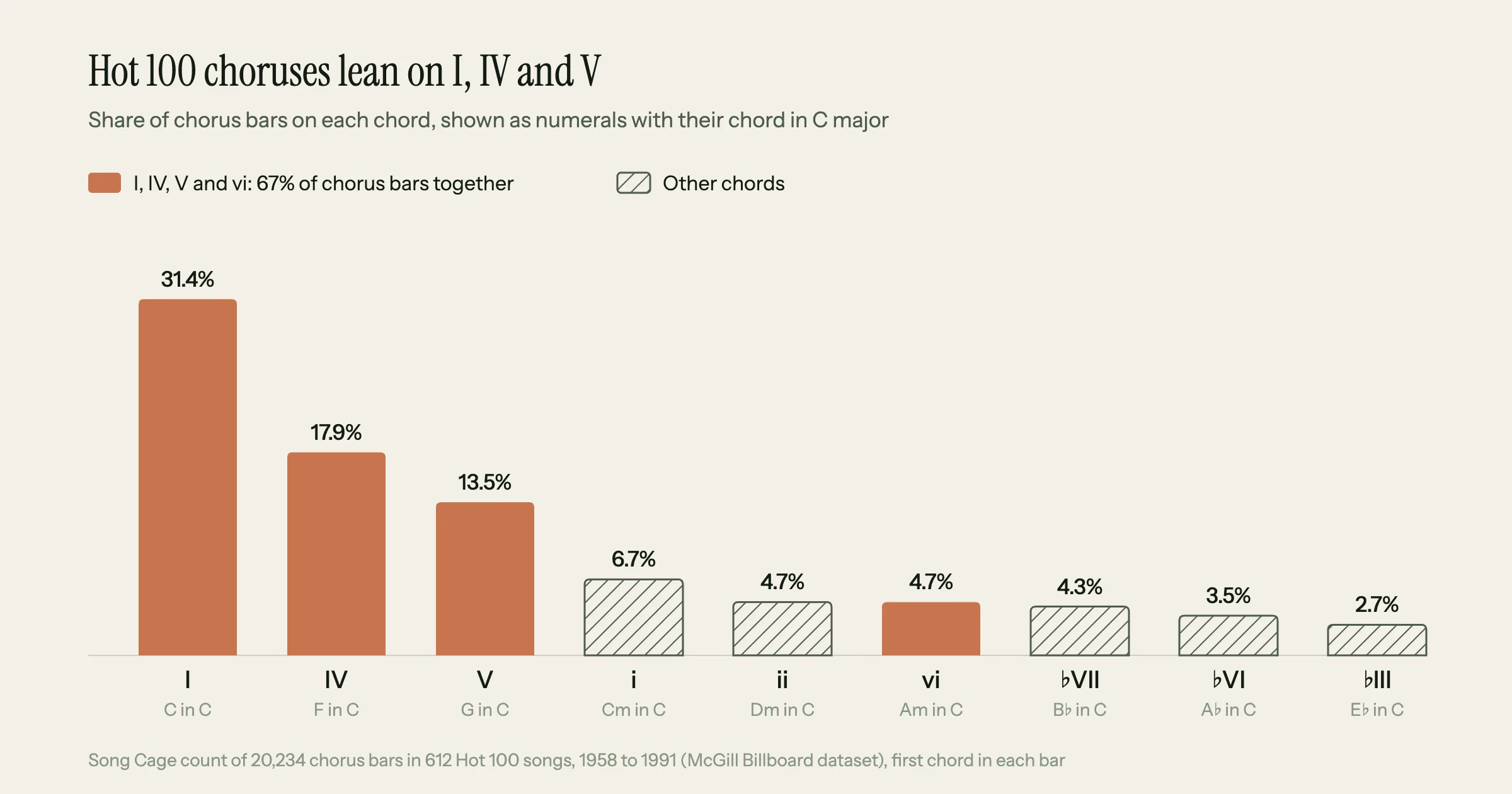
Pop chord progressions lean on the I, IV and V of the key. In Song Cage's count of the choruses of 612 Hot 100 songs from 1958 to 1991, I, IV, V and vi filled 67% of all bars, and the most common four-chord runs rocked between I and IV. The famous I–V–vi–IV loop appeared in only 15 of those choruses.
Here's how the chorus bars split, with each numeral shown as its chord in C major:
| Chord | In C | Share of chorus bars |
|---|---|---|
| I | C | 31.4% |
| IV | F | 17.9% |
| V | G | 13.5% |
| i | Cm | 6.7% |
| ii | Dm | 4.7% |
| vi | Am | 4.7% |
| ♭VII | B♭ | 4.3% |
| ♭VI | A♭ | 3.5% |
| ♭III | E♭ | 2.7% |
Song Cage's count of 20,234 chorus bars from the McGill Billboard dataset, by the first chord in each bar, relative to the key the annotators marked at that point in the song.
Two things stand out. The vi chord, the minor chord at the heart of the modern four-chord loop, fills under 5% of chorus bars, level with ii and barely ahead of ♭VII. And ♭VII, ♭VI and ♭III, chords from outside the major scale, together fill about 10% of chorus bars, a little more than vi and ii combined. Some of that comes from minor-key songs, where those are the natural chords of the key. The rest are borrowed chords in major keys.
The I–V–vi–IV loop turns up in the choruses of only 15 of the 612 songs, under 3%, counting every rotation of it and every chord change within a bar. Two are Cheap Trick's "I Want You to Want Me" (the live version, a hit in 1979) and U2's "With or Without You" (1987), both on Wikipedia's list of songs that use it. By 2008 it was common enough for the Australian comedy group the Axis of Awesome to build a medley, "Four Chords," out of it, and Rihanna's "Umbrella" runs it starting from IV.
None of this argues for or against the loop. A progression this plain leaves the melody all the room it wants, which is why so many hits use one. Choose chords for what your melody is doing rather than for the genre. Our piece on the most useful chord progressions explains what each common loop does under a tune.
How we counted
The McGill Billboard dataset is a set of expert transcriptions of songs sampled from across the Billboard Hot 100 between 1958 and 1991, each marked bar by bar with its sections and chords, described by Burgoyne, Wild and Fujinaga at ISMIR 2011. After removing repeats, by our count, it holds 739 songs. We dated each song by the chart it was sampled from, timed the first chorus from the first sound on the recording, and read chords as major or minor on their root, in the key marked at that point. The chord shares use the first chord in each bar; the I–V–vi–IV count reads every chord change.
The sample covers every chart position, not only the top 10. Section names are the annotators' own. A chord counts as new in the chorus when its root and quality appear in no verse of the same song.
How do you write a pop hook?
Keep it short, put it where the melody lands hardest, and repeat it. Most pop hooks are the title sung on the chorus melody, but an intro riff, a chant or a wordless vocal can be a hook too. Current pop stacks several: one in the intro, one in the chorus, often one more after it.
"It's not enough to have one hook anymore," Jay Brown, a co-founder of Roc Nation, told Seabrook for The Song Machine, as The Atlantic's review quotes it. "You've got to have a hook in the intro, a hook in the pre, a hook in the chorus, and a hook in the bridge, too."
The title is the hook most hits lean on, and they say it a lot. Half of 2024's number ones sang their title 6 to 10 times, up from 2023, when 1 to 5 times was the most common range. "Like That," by Future, Metro Boomin and Kendrick Lamar, said its title 36 times; Megan Thee Stallion's "Hiss" never said its title at all. Léveillé Gauvin's study found the title arriving earlier in the song between 1986 and 2015, too.
A quick test for a hook: leave the song alone for a day, then try to sing the hook from memory before you play the recording. If you can't, it probably needs to be shorter or to come back more often. Our hook guide separates the hook from the chorus, with examples of hooks in every part of a song.
What is a post-chorus?
A post-chorus is a short section straight after the chorus, built around one hook: often a repeated word, a chant or the riff from the intro. Hit Songs Deconstructed counts it as a section of its own, and it's now the norm. Post-choruses were in 63% of 2025's top 10 hits, their highest share in over a decade, rising for a third straight year. "A Bar Song (Tipsy)," 2024's longest-running number one at 19 weeks, follows each of its first two choruses with one.
If your chorus ends and the song drops straight into verse 2, try four bars of the hook on its own there. It gives the listener the chorus's best moment once more without repeating the whole chorus.
How do you fit words to a pop melody?
Exactly. Pop writers match the syllable count and stress of each line to the melody, even when the grammar suffers. Max Martin calls it "melodic math": a line in the second half of a chorus repeats the syllable pattern of its partner in the first half, so the tune repeats without an extra or missing note.
Bonnie McKee, who has written lyrics with Martin, explained it to Seabrook: "The syllables in the first part of the chorus have to repeat in the second part. If you add a syllable, or take it away, it's a completely different melody to him." That's from Pareles's review, which hears the same symmetry in "Oops!... I Did It Again," "Since U Been Gone" and "Blank Space." Bookforum's reviewer put the cost plainly: melodic math "requires every syllable of a hit to mirror the tune, even at the expense of grammatical sense."
You don't need Martin's ear to do the math. Write each chorus line out, count its syllables, and check that lines sung to the same melody have the same count. Then mark the stressed syllables and check they fall on the strong beats.
Melodic math on two lines
- I kept your jacket on the chair: 8 syllables, stress on kept, jack, on, chair
- And I still haven't moved it anywhere: 10 syllables, two more notes than the melody has
- I never moved it anywhere: 8 syllables, stress on nev, moved, an, where, and the melody repeats untouched
A line with one syllable too many forces an extra note or a crushed word, and a listener hears the seam even if they can't name it. Our guide to fitting lyrics to a melody goes further into stress and prosody.
What is the structure of a pop song?
The usual pop song structure is an intro, a verse, a pre-chorus and a chorus, then the same again, a bridge or another pre-chorus, and a last chorus, often with a post-chorus after each chorus. Of 2024's 16 non-holiday number ones, Hit Songs Deconstructed found 14 opened with an intro, 10 had a post-chorus, 7 a bridge and 6 a pre-chorus.
Most had three choruses: 69% of 2024's number ones did, according to the Hit Songs Deconstructed report, while songs with two fell from 46% of number ones in 2022 to 19% in 2024, among them "Fortnight," "Not Like Us" and "Please Please Please." Three in four (75%) ended with an outro. The average number one ran 3 minutes 30 seconds.
"A Bar Song (Tipsy)" is a clean example of the current shape. Hit Songs Deconstructed maps it as intro, verse, pre-chorus, chorus, post-chorus, verse, pre-chorus, chorus, post-chorus, pre-chorus, chorus, outro. It has no bridge. The first chorus lands at 48 seconds, 28% of the way into a song that runs 2 minutes 50 seconds.
A common pop form
- Intro (a hook, about 10 to 15 seconds)
- Verse 1, pre-chorus, chorus, post-chorus
- Verse 2, pre-chorus, chorus, post-chorus
- Bridge, or a pre-chorus on its own
- Last chorus, often with the post-chorus again, then an outro
How do you know when your chorus will land?
Do the arithmetic from your bar counts. In 4/4, one bar lasts 240 divided by the tempo, in seconds: 2.4 seconds at 100 BPM, the average tempo of 2024's number ones. An 8-bar intro, a 16-bar verse and a 4-bar pre-chorus put the first chorus 28 bars in, at 67.2 seconds. Halve the intro and the verse, and the same three sections get there in 16 bars, at 38.4 seconds. That moves the chorus almost half a minute earlier without a new section, just by deciding how much intro and verse to keep.
How do you write a pop song in Song Cage?
Song Cage is built for step one: getting the hook down before it's gone. Click a syllable, then hold Hold to sing (or hold M) and sing its note in, one syllable at a time. Or record a take of the whole hook and detect the notes from it. The melody chapter of the docs covers both.
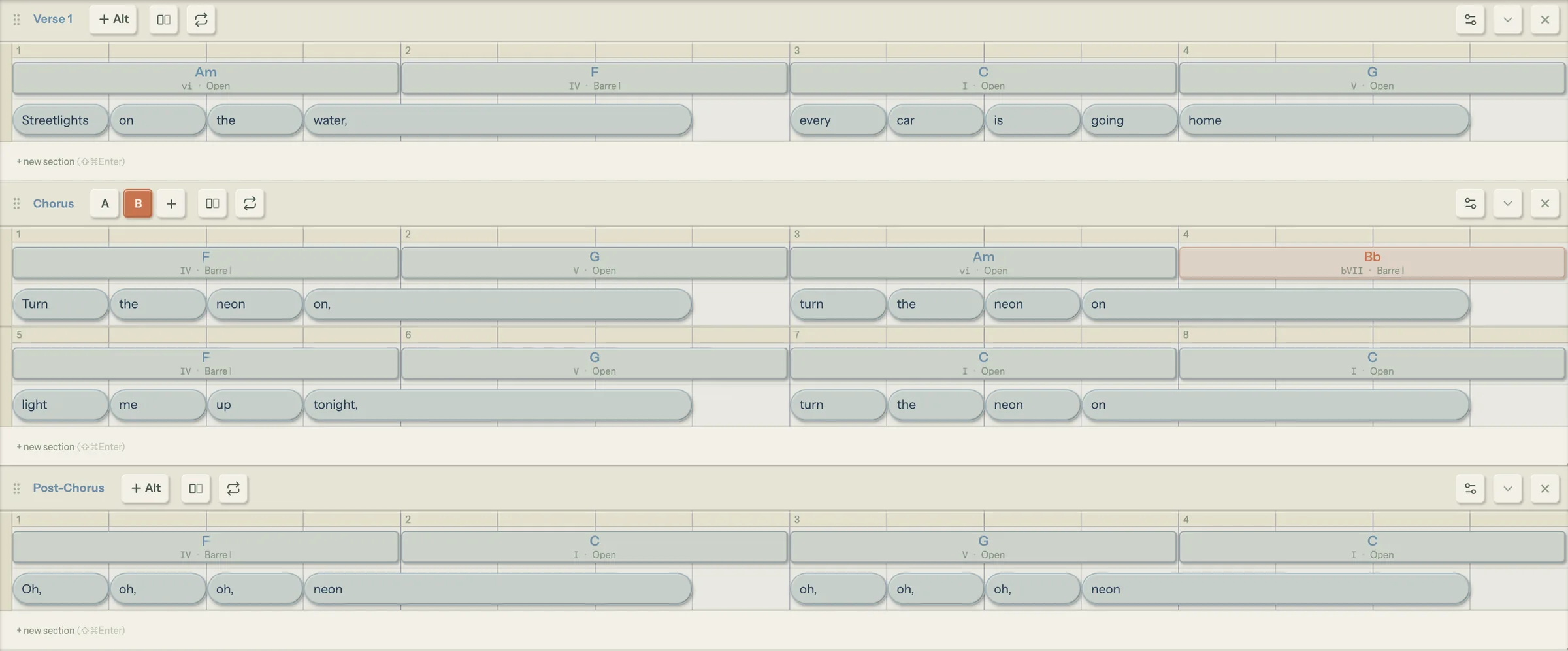
With the melody in place, Auto Chords in the section header puts a chord progression under it in one click, and the palette's Fits Melody list ranks chords by how well their notes match the melody over that slot. That's a quick way to hear whether your chorus wants a chord the verse doesn't use.
Sections come in seven types, Pre-Chorus among them. For a post-chorus, add a section after the chorus, tag it Chorus, then double-click its name and type "Post-Chorus." To compare two choruses, one with a new chord and one on the verse's loop, click + Alt after the section's name. Song Cage keeps both versions as tabs, A and B, and the one showing is the one that plays (in the web app, the desktop app and the plugin). Set the tempo, count the bars, and you know when the chorus lands. The sections chapter has the rest.
Frequently Asked Questions
How long should the intro of a pop song be?
Short. The intros of 2024's number-one hits averaged 14 seconds, according to Hit Songs Deconstructed, and half ran 10 to 19 seconds. Hubert Léveillé Gauvin's study of US top 10 singles found instrumental intros fell from an average of 23 seconds to 5 between 1986 and 2015. Use the intro to set up a hook rather than to wait for the vocal.
What is the most common chord progression in pop music?
It depends on the era. In our count of 612 Hot 100 songs from 1958 to 1991, the most common four-chord run in a chorus just alternated I and IV, and I–V–vi–IV appeared in only 15 choruses, under 3%. By 2008 that loop was common enough for the Axis of Awesome to build a comedy medley from songs that use it. Pick chords for your melody, not for the genre.
How many choruses does a pop song have?
Usually three. Hit Songs Deconstructed found 69% of 2024's number-one hits had three choruses, and songs with two fell from 46% of number ones in 2022 to 19% in 2024. In our count of older Hot 100 songs, the typical song with a chorus had three in every decade from the 1960s to the 1980s.
Do pop songs need a bridge?
No. Fewer than half of 2024's number-one hits had one (44%), per Hit Songs Deconstructed. "A Bar Song (Tipsy)," the year's longest-running number one, goes from its second post-chorus to a pre-chorus, a last chorus and the outro. If the song sounds the same by the last chorus, a bridge is one fix. If it doesn't, you can leave it out.
Can you write a pop song without playing an instrument?
Yes. In track-and-hook writing, the topliner's job is the melody and the lyric, written over a track someone else built. What you need is a way to get the melody recorded, by singing or humming it. From there a collaborator can find the chords, or Song Cage's Auto Chords can put a progression under a melody you sing in.
Capture the hook before it's gone
Song Cage keeps your melody, chords and words together in sections. Sing the hook in, let Auto Chords put chords under it, and keep two versions of the chorus until you know which one lifts.