Table of Contents
- What is a vocal harmony?
- How is a harmony different from a double or a countermelody?
- Why does "just sing a third above" go wrong?
- Why does a harmony that works in one bar fail in the next?
- Is a third above always the same size?
- What happens when the song uses a borrowed chord?
- Should the harmony go above or below the melody?
- Should you use thirds or sixths?
- How do you write a vocal harmony, step by step?
- Which kind of motion should a harmony use?
- Can a harmony move in parallel fifths?
- How many harmony parts does a song need?
- When should you not harmonize?
- Why does your voice keep sliding back to the melody?
- How do you learn to sing a harmony part?
- Can software write the harmony for you?
- Frequently Asked Questions
Most advice on vocal harmony comes down to one line: sing a third above the melody. It works for a bar or two, and then the chord changes and the harmony sours, and nobody explains why. This post does. It covers how to write harmonies that survive the changes: what a vocal harmony is, why a fixed third breaks, how to decide between above and below, how to write a harmony line chord by chord, how many parts a song needs, and when to leave the lead alone. The examples come from records where the singers or a published analysis say what each voice is doing.
Quick Summary
A vocal harmony is a second line that sings the lead's words in the lead's rhythm on different notes, usually a third or a sixth away. Whether a third above fits depends on which note of the chord the melody is on: over the root or the chord's third it works, over the fifth it lands on a seventh. Check every chord change, not just the key.
What is a vocal harmony?
A vocal harmony is a second vocal line sung at the same time as the lead, on the same words and in the same rhythm, but on different notes. It is usually a third or a sixth above or below the melody, and each of its notes should fit the chord underneath, not just the key of the song.
Wikipedia's overview of vocal harmony puts it the way most arrangers would: the harmony is "often in thirds or sixths which fit in with the chord progression used in the song." Both halves of that sentence matter. The intervals are thirds and sixths because classical theory counts them as imperfect consonances, sweet but not hollow, as Open Music Theory sets out. The chord progression matters because the same interval that fits one chord can sit wrong on the next.
The harmony can sit above the lead or below it. In barbershop the melody is in the middle, with a part above it and supporting parts below. In a bluegrass trio the tenor sings above the lead and the baritone usually below. In a pop duet it's whichever voice suits the singer's range.
How is a harmony different from a double or a countermelody?
Three things get called "harmony" that aren't the same job.
- A double is the same part sung again. Double tracking thickens the lead without adding a note. An octave above or below is still a double: it's the same line, not a second voice.
- A harmony moves with the lead: same words, same rhythm, different notes.
- A countermelody has its own rhythm, often its own words, and usually moves while the lead holds. Simon & Garfunkel's "Scarborough Fair/Canticle" (1966) sets the traditional tune against "Canticle", a separate line with separate words, sung in counterpoint against it.
This post is about the middle one. If you want a line that answers the lead in its gaps, that's a different craft, covered in how to write a countermelody.
Why does "just sing a third above" go wrong?
A third above only fits when the melody is on the root or the third of the chord underneath. When the melody sits on the chord's fifth, a third above lands on the seventh, which rubs against the root. The melody moves between chord notes as the chords change, so a harmony that never changes its interval will clash somewhere.
A chord has three notes: root, third and fifth. C major is C, E and G. Whichever of those the melody is on decides where the harmony can go.
| Melody is on the chord's... | Third above lands on | Third below lands on | Safe choice |
|---|---|---|---|
| Root (C over a C chord) | The chord's third (E) fits | A note outside the chord (A) outside | Above |
| Third (E over a C chord) | The chord's fifth (G) fits | The root (C) fits | Either |
| Fifth (G over a C chord) | The seventh (B) rubs | The chord's third (E) fits | Below |
Fits: a note of the chord. Outside or rubs: a note that isn't in the chord, heard against it.
That table explains a rule Gary Ewer gave in The Essential Secrets of Songwriting without saying why: harmonize a third above when the melody is near the tonic, and a third below when it is near the dominant. Near the tonic, the melody is on the root of the I chord. Near the dominant, it is on the I chord's fifth, where a third above turns into a seventh.
The seventh is not always wrong. A B held over a C chord makes Cmaj7, and in a soft ballad that can be a colour you want. The trouble is that you didn't choose it. It arrived because the melody moved and the harmony didn't think.
Why does a harmony that works in one bar fail in the next?
Here is a four-bar melody over one of the most common loops in pop, C, G, Am and F, with one long melody note per bar.
One melody, two harmonies
Chords: C | G | Am | F
Melody: G | B | C | C
A third above: B | D | E | E. Bar 1 puts B on a C chord (a major seventh). Bar 4 puts E on an F chord (another major seventh). Two bars out of four rub.
A third below: E | G | A | A. Every note is in the chord it sits on, and the line moves by step.
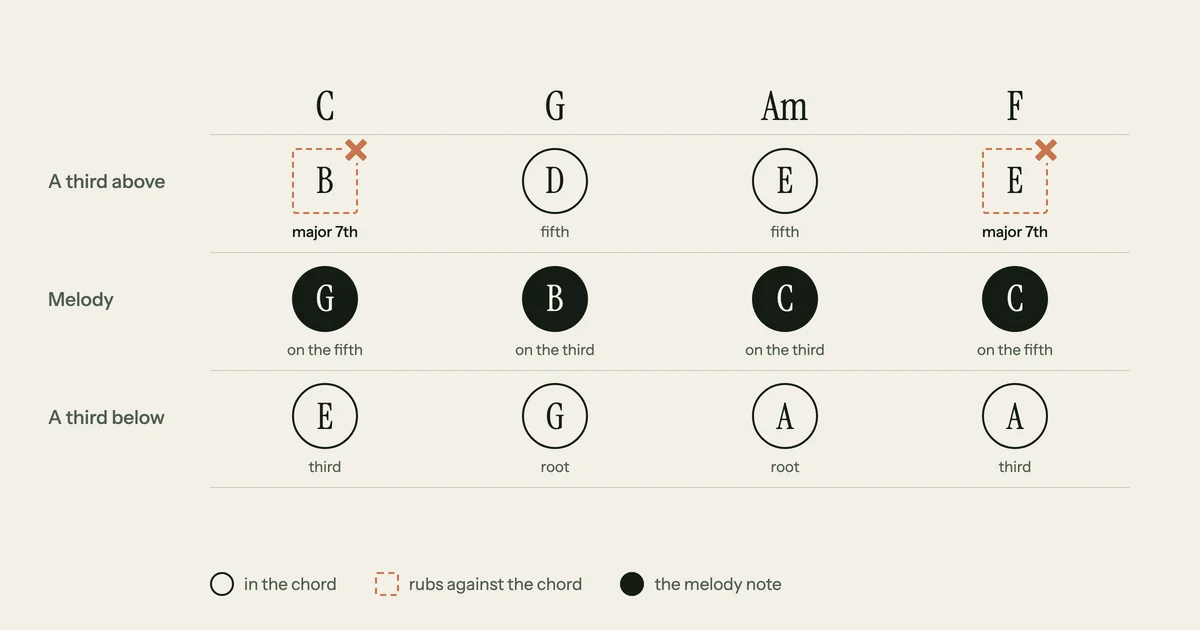
The melody in bars 1 and 4 is on the fifth of its chord, so a third above lands on a seventh both times. In bars 2 and 3 the melody is on the chord's third, so either direction works. Going below solves every bar at once. On a different melody it might be the other way round. Checking which chord note the melody is on, bar by bar, is the whole method.
This is the complaint that turns up again and again on forums. One poster on r/WeAreTheMusicMakers hit bar 1 of this example exactly: a G melody over a C chord, a B harmony a third above, and a C that "would feel more appropriate." Their conclusion was that a set interval "always creates dissonance somewhere." That's right, and the table is why.
Is a third above always the same size?
No, and this is the second thing a "shift it up four semitones" harmony gets wrong. In a major key, the third above scale degrees 1, 4 and 5 is a major third, and the third above degrees 2, 3, 6 and 7 is minor. In C major that means C to E, F to A and G to B are major thirds, while D to F, E to G, A to C and B to D are minor, as the Open Music Theory intervals chapter lays out.
A harmony that stays in the key alternates between the two sizes as the melody moves. A harmony that keeps the same number of semitones (a harmonizer set to +4, or a MIDI part dragged up four half steps) will be out of the key on every note where the diatonic third should have been minor. Sung by ear, this sorts itself out: you hear the key and pick the note that belongs. Programmed, it doesn't.
What happens when the song uses a borrowed chord?
"Stick to the notes of the scale" is standard harmony advice, and it breaks the first time the song borrows a chord from outside the key. Take a B♭ chord in C major, the ♭VII that rock uses constantly. If the melody sings D (the chord's third), a diatonic third below is B natural, a half step from the B♭ in the chord. The harmony has to sing B♭ instead, a note that isn't in the key at all.
The fix is the same as before: look at the chord, not the scale. Any chord from outside the key changes which notes the harmony may use for as long as it lasts. If you're not sure which chords in your song are borrowed, modal interchange explained covers the ones you're most likely to meet.
Should the harmony go above or below the melody?
Go above when the melody is on the root of the chord, below when it is on the fifth, and either way when it is on the chord's third. Then weigh two practical things: the harmony singer's range, and the fact that listeners tend to hear the highest line as the tune, so a harmony above has to stay quieter than the lead.
Real records go both ways. On the Everly Brothers' records Phil sang the tenor part above Don's baritone. The Denver Post's appreciation of Phil Everly notes that the two "hardly ever sang more than a third apart," and points to "When Will I Be Loved" (1960) as the example: "Either vocal part can stand alone as a melody."
Simon & Garfunkel's "The Sound of Silence" goes the other way. Art Garfunkel told American Songwriter: "I sing the melody. We pitched the song fairly high because I'm a tenor. That left Paul below me, looking for a harmony part." The key was set for the lead singer's range, and the harmony went where there was room.
The Beatles' "If I Fell" (1964) puts Paul McCartney on the lead, on top, with John Lennon below. Alan W. Pollack's Notes on "If I Fell" describe Lennon's part as mostly thirds with "open fourths and fifths where you least expect them." Those fourths are what the table above predicts: when the melody sits on a chord's fifth, the nearest chord note above it is the root, a fourth away.
Should you use thirds or sixths?
They're the same note choice, an octave apart. A sixth is an inverted third: take a third above the melody and drop it an octave, and it becomes a sixth below. A major third turns into a minor sixth and a minor third into a major sixth, as Open Music Theory shows.
So "a third above or a sixth below" is really one decision (which chord note to sing) and a second one about register (where the harmony singer is comfortable). Thirds sound close and blended, which is the Everly sound. Sixths open the voices up and leave more room between them. Walking through the verse harmony on "America" (1968) in a conversation with American Songwriter, Garfunkel put it in three words: "It's a sixth."
If the harmony singer is the same person as the lead, which is most home recordings, range decides for you. A third above the top of your melody might be out of reach. A sixth below the same note might be comfortable. If the lead itself is already strained, fix that first: your song might be in the wrong key for your voice.
How do you write a vocal harmony, step by step?
Write out the chord under every melody note, find which chord note the melody is on at each change, and pick a harmony note from that chord a third or sixth away. Connect those notes by the smallest steps you can, then leave short passing notes single. Sing it on its own before you record it with the lead.
- Mark every chord change under the melody. You can't check a harmony against chords you haven't written down. If the song doesn't have chords yet, how to harmonize a melody comes first.
- Find the landing notes. These are the long notes, the stressed syllables and the notes that fall right on a chord change. They're what the ear checks against the chord.
- For each landing note, name the chord note the melody is on. Root, third or fifth. Use the table: root means go above, fifth means go below, third means either.
- Pick one direction for the phrase if you can. A harmony that stays on one side of the lead is easier to sing and easier to hear as a line. Switch sides only at a phrase break.
- Connect the landing notes by step. Between them, a parallel third or sixth in the key is usually fine. The ear forgives a passing note that doesn't match the chord if it's short.
- Leave the fast notes alone. A run of sixteenth notes harmonized note for note turns to mud. Let the harmony hold, or rest, and rejoin on the next landing note.
- Sing the harmony as its own melody. If it doesn't make sense alone, it'll be hard to hold against the lead. The Everly test ("either vocal part can stand alone as a melody") is a good one.
Then sing both parts together, or play the lead on a keyboard while you sing the harmony, before you commit to a take. A harmony written on paper can still sit badly against the particular vowel or the particular note the singer bends.
Which kind of motion should a harmony use?
Most pop harmony moves in parallel with the lead, a third or sixth away. When a parallel note would leave the chord, hold the previous harmony note instead (oblique motion) or move against the lead (contrary motion). Those two moves add independence and give you somewhere to go when the third breaks.
Classical counterpoint names four ways two voices can move against each other: parallel (same direction, same interval), similar (same direction, different interval), contrary (opposite directions) and oblique (one voice holds while the other moves). Contrary motion gives the voices the most independence, and parallel motion the least.
Parallel thirds are the sweet, blended sound of country and folk duets, and there's nothing wrong with them. Oblique motion is the simplest fix when a parallel third runs into a seventh: hold the harmony note you're on, if it's still in the new chord, and let the melody move away from it. It's also the easiest part for a nervous harmony singer, since one of their notes simply doesn't move.
Contrary motion and held notes are where harmonies start to sound written. On "America", Garfunkel describes a moment where he "holds the top note beyond the beat. It's the suspension. And it's a dissonance with his partner Paul." David Crosby described the same move in Crosby, Stills & Nash's harmonies to MusicRadar: the groups who came after them sang "the root, the third and the fifth," while "I would be creating suspensions and resolves." A held note that clashes on purpose, then steps into the chord, is a different thing from a third that clashes by accident.
Can a harmony move in parallel fifths?
Classical voice leading forbids parallel fifths and octaves because they make two voices sound like one: the parts lose their independence, as the Wikipedia article on consecutive fifths explains. Rock ignores the rule all the time, since a power chord is a fifth moving in parallel. For a vocal harmony, though, the classical reason is the practical one: a harmony in parallel fifths sounds hollow and thin next to the lead. A fifth is fine as one note of a stack. As the whole line, stick with thirds and sixths.
How many harmony parts does a song need?
One harmony makes a duet, two harmonies plus the lead make a full triad, and more than three parts is usually doubling rather than new notes. Add parts section by section, so the song gets fuller as it goes, rather than stacking everything from the first verse.
The Eagles' "Take It Easy" (1972) is a clean model of building by section. Wikipedia's account of the recording notes that bassist Randy Meisner sings the harmony with Glenn Frey in the second verse, with drummer Don Henley harmonizing in the chorus. One voice, then two, then three.
With three voices, the parts cover the whole chord. Crosby described the usual CSN arrangement in an interview with Record Collector: "Usually when we arrange the vocals, it is Stephen at the bottom, me in the middle and Graham on top, but actually we do it every which way." The lead doesn't have to be on top. On the Beatles' "This Boy" (1963), Pollack's Notes on "This Boy" point out that John sings what is "ostensibly the main melody" in the bottom part, which makes his solo in the bridge, soaring "clearly above the range of the others," land harder.
Fleetwood Mac's "Dreams" (1977) shows the practical way to find three parts. Lindsey Buckingham worked out the chorus harmonies "by playing triads on a piano," with Stevie Nicks and Christine McVie gathered round, according to Wikipedia's history of the song. Each of the three parts was then doubled. That's the answer to "how do big harmonies get so big": three notes of the chord, each sung more than once. The Beatles' "Because" (1969) does the same with a three-part harmony recorded three times, nine voices in all.
When should you not harmonize?
Leave the verse single, leave fast runs and bent notes single, and bring the harmony in where the song needs to lift, usually the chorus or the last line of a section. A harmony on every line stops sounding like an event, and a single harmonized word can draw more attention than a whole harmonized verse.
Ewer's advice is blunt: "Constant vocal harmony becomes tiring; Use your discretion when adding harmonies, and save them for moments where you need to increase energy, like the chorus of your song." He also suggests putting a harmony on one isolated word, which works because the listener notices the change.
A few places where a harmony usually hurts:
- A verse that tells a story. One voice reads as one person talking. Two voices on a narrative line blur whose story it is.
- Fast melodic runs. Every note of a run harmonized note for note turns into a smear. Harmonize the note the run lands on.
- Bent and blue notes. If the lead slides into a note or sings a flattened third on purpose, a harmony on the "correct" note fights it.
- The first chorus, sometimes. Holding the harmony back until the second or last chorus gives the song somewhere to go. The chorus post covers the other ways a chorus lifts.
A harmony is an arrangement choice as much as a melodic one. The question is not only "what note?" but "does this line need a second voice at all?"
Why does your voice keep sliding back to the melody?
Singing a harmony against a lead is measurably harder than singing in unison. In a study of duet singing, pitch error rose by about 12 cents and error in the interval between the singers by about 38 cents compared with unison. Singers also bend their own notes toward the other voice, which is why a new harmony drifts back to the tune.
The numbers come from Jiajie Dai and Simon Dixon at Queen Mary University of London, who recorded eight pairs of singers (a soprano and an alto in each) singing in unison and in two-part harmony, published in the Journal of the Acoustical Society of America in 2019 (an open-access copy is on Dixon's university page). They put the higher error down to "the distraction of someone singing a different note." They also found that singers who could hear their partner adjusted their own pitch to keep the interval between them in tune. In a related four-part study, hearing the other voices made each singer's own notes less accurate but the intervals between them more accurate.
In other words, the pull toward the other voice is normal, and it's how ensembles stay in tune with each other. It becomes a problem only when the harmony singer doesn't know their part as a line of its own. Forum posters describe it the same way. A singer-songwriter of 30 years wrote: "My brain hears the main vocal melody and wants to sing those same notes."
How do you learn to sing a harmony part?
To learn to sing a harmony part, sing it alone over the chords until it feels like its own tune. Then hold only its long landing notes against the lead, with the lead turned down in your headphones, and add the shorter notes once those landings stay put.
Three things help:
- Learn the harmony alone first. Sing it with just the chords until it feels like its own tune.
- Start with the landing notes. Hold only the long harmony notes against the lead, and fill in the rest once those are secure.
- Keep the lead quieter while you learn. Turn it down in your headphones, or play it on a keyboard instead of singing it.
Can software write the harmony for you?
Software can write a harmony that fits, but only if it knows the chords under the melody. Melody Rack, a MIDI effect plugin sold separately from Song Cage, does this with its Harmony effect: it picks a third or sixth in the key, then moves each note onto the chord underneath.
A harmonizer that shifts every note by the same interval does exactly what this post warns against: the line goes sour on every chord where the melody moves to the fifth. What helps is a tool that knows the chords under the melody.
Melody Rack is a separate product from Song Cage: a MIDI effect plugin (AU and VST3, Mac and Windows) that sits in front of the instrument on a DAW track. You sing a line into it and a rack of effects turns that take into new melodic ideas, all working from the chords under what you sang. Its Harmony effect writes the second voice. Interval picks a sixth below, a third below, a third above or a sixth above, counted in steps of the key, so the third comes out major or minor as the key requires. With Land on chord tones on (it reads the chords from the Chords effect), each harmony note moves to a note of the chord underneath, preferring the one the harmony line has to move least to reach. Motion runs the line with the tune or against it, and Skip notes under leaves short passing notes single. It never lands the harmony on the lead's own note, and it needs a key before it does anything, because "a third above" means nothing without one.
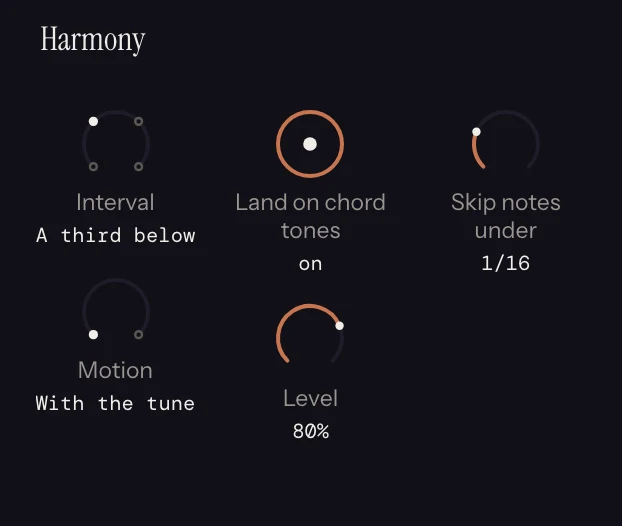
The harmony comes out as MIDI on its own voice, so you can play it through a synth to learn it, or drag it out and sing it yourself.
Frequently Asked Questions
What interval is a vocal harmony?
Usually a third or a sixth above or below the melody, counted in the key, so some of the thirds are major and some are minor. Where a third would land outside the chord, the harmony moves to the nearest chord note instead, which is often a fourth. Fifths and octaves are mostly used as one note of a bigger stack, not as the whole line.
How do I know if my harmony should be above or below?
Look at which note of the chord the melody is on. On the root, go above. On the fifth, go below, because a third above lands on the seventh. On the chord's third, either works. After that, pick the side that suits the harmony singer's range, and keep a harmony above quieter than the lead so the tune still reads.
Why does my harmony sound wrong even though it's in key?
Being in the key isn't enough. Each harmony note has to fit the chord it is sung over. In C major, a B is in the key, but held over a C chord it is a major seventh and rubs against the root. Check the harmony against every chord change, and move any note that isn't in its chord to one that is.
How many harmony parts should a song have?
One harmony is a duet and two harmonies plus the lead cover a full triad. Beyond three parts you're mostly doubling notes that are already there, which makes the sound bigger rather than richer. Many songs add parts by section: the Eagles' "Take It Easy" adds a second voice in the second verse and a third in the chorus.
What's the difference between a harmony and a countermelody?
A harmony follows the lead's words and rhythm on different notes. A countermelody is its own line, with its own rhythm and often its own words, and it tends to move when the lead holds. "Scarborough Fair/Canticle" is the classic example of the second: two melodies with different words sung against each other.
Sing the lead. Hear the harmony that fits.
Melody Rack writes a second line under or over the one you sang, checked against the chord in every bar, so it stays right when the progression moves.