Table of Contents
- What does a capo actually do?
- Guitar capo chart: what your shapes sound like
- Where do you put the capo for a specific key?
- Shape chord or sounding chord: which one goes on the chart?
- Why do two chord sites list Wonderwall in different keys?
- How do professional transcriptions handle it?
- Why do songwriters reach for a capo?
- Does a capo change the tone, not just the pitch?
- How do you pick a capo position for your own song?
- What happens to slash chords under a capo?
- Why does my guitar go out of tune when I clamp the capo?
- Keeping the capo straight in Song Cage
- Frequently Asked Questions
Quick Summary
A capo raises every string by one semitone per fret, so your chord shapes stay identical while the sounding pitch moves up. This page has both charts you need: what each open shape sounds like at every fret, and the reverse lookup for when you know the key and need the capo position. It also answers the question the other charts skip, which is whether to write the shape name or the sounding name on your chart.
What does a capo actually do?
A capo clamps across every string at one fret, shortening the vibrating length of all six strings at once and raising each one by one semitone per fret. Your fingering does not change. The chord shape you play stays the same shape, but the pitch that leaves the guitar moves up by however many frets the capo sits at.
That single fact is the whole device. Put a capo on fret 2 and finger a G shape, and the room hears an A. Move it to fret 5 and the same G shape sounds a C. Nothing about your left hand changed.
The word comes from the Italian capotasto, literally "head of the fretboard," and it originally meant the nut of a stringed instrument rather than a movable clamp. According to Wikipedia's history of the device, the earliest known written use of capotasto is by Giovanni Battista Doni in his Annotazioni of 1640, describing the nut of a viola da gamba. The first patented capo came much later: Kyser's history of the capo credits James Ashborn of Wolcottville, Connecticut, whose 1850 design used a wooden cylinder and a brass thumbscrew to apply pressure from under the neck.
Guitar capo chart: what your shapes sound like
Read this one when you know the shape you are fingering and need the real chord name. Find your capo position in the left column, then read across to the shape you are playing. The cell is what the audience hears.
| Capo | C shape | A shape | G shape | E shape | D shape | Am shape | Em shape | Dm shape |
|---|---|---|---|---|---|---|---|---|
| None | C | A | G | E | D | Am | Em | Dm |
| Fret 1 | Db | Bb | Ab | F | Eb | Bbm | Fm | Ebm |
| Fret 2 | D | B | A | F# | E | Bm | F#m | Em |
| Fret 3 | Eb | C | Bb | G | F | Cm | Gm | Fm |
| Fret 4 | E | Db | B | Ab | F# | C#m | G#m | F#m |
| Fret 5 | F | D | C | A | G | Dm | Am | Gm |
| Fret 6 | F# | Eb | Db | Bb | Ab | Ebm | Bbm | G#m |
| Fret 7 | G | E | D | B | A | Em | Bm | Am |
| Fret 8 | Ab | F | Eb | C | Bb | Fm | Cm | Bbm |
| Fret 9 | A | F# | E | Db | B | F#m | C#m | Bm |
| Fret 10 | Bb | G | F | D | C | Gm | Dm | Cm |
| Fret 11 | B | Ab | F# | Eb | Db | G#m | Ebm | C#m |
| Fret 12 | C | A | G | E | D | Am | Em | Dm |
Every chord in a family moves by the same interval, so the whole progression transposes together. Fret 12 returns you to the open names one octave up.
The rule underneath the grid is simple enough to do in your head once you trust it: count the capo fret in semitones and move the chord name up that far. Capo 2 is a whole step. Capo 5 is a fourth. Capo 7 is a fifth, which is why fret 7 turns a D shape into an A and an Em shape into a Bm.
Where do you put the capo for a specific key?
This is the lookup most charts leave out, and it is the one a working musician actually needs. Someone calls a song in Bb. You do not want to spend the night on barre chords. Find Bb in the left column and read across for the capo position that turns a comfortable open family into that key.
| Key you need | C shapes | A shapes | G shapes | E shapes | D shapes |
|---|---|---|---|---|---|
| C | no capo | capo 3 | capo 5 | capo 8 | capo 10 |
| Db | capo 1 | capo 4 | capo 6 | capo 9 | capo 11 |
| D | capo 2 | capo 5 | capo 7 | capo 10 | no capo |
| Eb | capo 3 | capo 6 | capo 8 | capo 11 | capo 1 |
| E | capo 4 | capo 7 | capo 9 | no capo | capo 2 |
| F | capo 5 | capo 8 | capo 10 | capo 1 | capo 3 |
| F# | capo 6 | capo 9 | capo 11 | capo 2 | capo 4 |
| G | capo 7 | capo 10 | no capo | capo 3 | capo 5 |
| Ab | capo 8 | capo 11 | capo 1 | capo 4 | capo 6 |
| A | capo 9 | no capo | capo 2 | capo 5 | capo 7 |
| Bb | capo 10 | capo 1 | capo 3 | capo 6 | capo 8 |
| B | capo 11 | capo 2 | capo 4 | capo 7 | capo 9 |
Minor keys follow the same frets: for A minor with G-family shapes, use the Em-shape column in the chart above.
Notice that every key has five answers, not one. Bb is reachable with A shapes at capo 1, G shapes at capo 3, E shapes at capo 6, C shapes at capo 10, and D shapes at capo 8. They all sound in Bb, and they do not sound alike. Low positions keep the guitar dark and full. Capo 7 and above shortens the strings enough to give that bright, chiming quality, which is a tonal decision as much as a practical one.
The three-flat rescue
Flat keys are where the capo earns its place in the gig bag. Eb, Ab and Bb are ordinary keys for horns, piano and most singers, and miserable keys for open-position guitar. Every one of them is one capo move away from a shape family you already know: Eb with D shapes at capo 1, Bb with A shapes at capo 1, Ab with G shapes at capo 1.
Shape chord or sounding chord: which one goes on the chart?
Two different chord names describe the same moment when a capo is on. The shape chord is what your fingers make. The sounding chord is what everyone hears, and it is the real chord. Charts break down when a writer records one and a reader assumes the other, which is the single most common capo mistake.
Play an Em shape with a capo on fret 2. Your hand is doing Em. The pitch in the room is F#m. Both statements are true, and if you write "Em" on a chart and hand it to a piano player with no capo, they will play the wrong chord and the band will be a whole step apart.
Why do two chord sites list Wonderwall in different keys?
Oasis recorded "Wonderwall" with a capo on the second fret, fingering Em7, G, Dsus4, A7sus4 and Cadd9. Those shapes sound in F# minor. Look up the song on two of the largest chord sites and you get two different answers: the Ultimate-Guitar chord sheet heads its tab "Key: Em, Capo: 2nd fret," while GuitarTuna's chart for the same recording lists "Key: F# minor."
Neither is lying. Ultimate-Guitar is naming the shape key, the one your fingers are in. GuitarTuna is naming the sounding key, the one the record is in. The tab is still playable either way, because the capo instruction is right there. The problem starts when the chord names travel without the capo instruction attached, which is exactly what happens when someone copies a progression into a notes app or texts it to a bandmate.
How do professional transcriptions handle it?
The published sheet music answer is to print both. The Warner Bros. transcription of the Eagles' "Hotel California" by Paul Robinson and Jeff Perrin notates the 12-string acoustic with a capo at the seventh fret and states plainly that "all chord shapes and tablature positions are relative to the capo" and that everything "sounds three and one half steps higher than written." It then prints the concert chords above the staff and the capo shapes in parentheses beneath: Bm with (Em) underneath, F#7 with (B7), Asus2 with (Dsus2).
That convention is worth stealing. Write the sounding chord as the chord, and put the shape in parentheses. Anyone who reads only the top line gets the real harmony. Anyone holding a capoed guitar reads the parentheses. The alternative convention, used by most player charts, is to write the shapes only and put "Capo 7" at the top of the page, which works as long as that header never gets separated from the chords.
A useful habit
- Say the sounding key out loud when you count the band in. "This one's in Bb" beats "this one's in G, I'm capo 3."
- Put the capo position in the chart header, never only in your memory.
- If the chart is going to anyone who does not play guitar, give them the sounding names.
Why do songwriters reach for a capo?
The reasons divide cleanly into three, and only one of them is about laziness.
The first is vocal range. A song written in G because G was comfortable to play is not necessarily in the right key for the voice singing it, and moving the capo is the fastest range test that exists. You keep the shapes, you keep the muscle memory, and you audition four or five keys in under a minute. If you do not know your range yet, the free vocal range test measures it and gives the capo fret for each key that fits.
The second is reaching a key that open shapes cannot. This is the flat-key rescue above.
The third is tone, and it is the one guitarists underrate. A capo high on the neck shortens the strings and produces a brighter, more compressed, more chiming sound that you cannot get by playing barre chords in the same key. George Harrison built "Here Comes the Sun" on it. According to Wikipedia's entry on the song, Harrison spent an hour re-recording his acoustic part with the guitar capoed at the seventh fret, which put the finished track in A major, and the recording was then varispeeded slightly higher still. He is fingering D shapes. The record sings in A.
Does a capo change the tone, not just the pitch?
Yes, and this is the part the pitch charts cannot show you. Two guitars playing in A sound different if one is fingering A-family barre chords in open position and the other is fingering D shapes at capo 7. The capoed guitar has shorter strings, so its overtones sit higher and its open ringing strings land in different places within the chord.
That is why capo choice is an arrangement decision in a band. Two guitarists playing the same song in the same key at different capo positions is a standard acoustic trick: one holds the low, full voicings while the other chimes above, and the two parts occupy separate registers without either player learning a new part. "Hotel California" is a useful reference here, since the Eagles' 12-string acoustic sits at capo 7 while the song itself lives in B minor.
How do you pick a capo position for your own song?
The chart above answers the cover player's question, which is where to put the capo for a key someone else chose. Writing your own song inverts the problem: you do not have a key yet, and the capo is how you find one.
The four-step range test
Work in whichever open family is comfortable, then move the capo until the song sits right in your voice. The key is the answer you arrive at, not the one you started in.
Test on the highest note in the chorus. A key that feels fine in the verse and strangles the chorus is the wrong key.
Step two is where most people go wrong. Singers audition a key by singing the comfortable part, settle on it, and then discover the chorus is out of reach. The peak note of the song decides the key. Everything else follows.
Step four matters more than it looks. Once you land on capo 3 with G shapes, the song is in Bb. That is what goes in the file name, on the chart, and in the message to whoever is playing bass. It is also worth knowing the difference between this kind of transposition and a key change inside the song, which is a separate technique with separate rules. We covered that in how to change key in a song.
What happens to slash chords under a capo?
A slash chord has two notes to move, not one. Both the chord and its bass note transpose by the capo interval. Finger a G/B shape at capo 2 and the sounding chord is A/C#, not A/B. Getting the top half right and leaving the bass note alone produces a chord that does not exist in the song.
This is the failure that survives in a surprising number of hand-made capo charts, because it is easy to build a chart of plain triads and never test it against a slash chord. The arithmetic is not hard, it is just a second operation people forget: move the root up by the capo fret, then move the bass note up by the same amount.
Worked through at capo 2, a common descending line becomes: C becomes D, G/B becomes A/C#, Am becomes Bm, and F becomes G. The bass walks D, C#, B, G in the sounding key, which is the same shape of descent you fingered, moved up a whole step. If you had left the bass letters alone you would have written D, C#, B, G as D, B, B, G, and the walkdown would be gone.
Slash chords and inversions are worth understanding on their own terms if this is unfamiliar territory. We wrote a full guide to chord inversions and slash chords, and the Nashville Number System solves the same problem from a different direction by removing letter names from the chart entirely.
Why does my guitar go out of tune when I clamp the capo?
A capo presses harder than your fingers do, and pressing a string harder stretches it slightly sharp. Because each string has a different gauge and tension, they do not all go sharp by the same amount, so the guitar ends up out of tune with itself rather than uniformly high.
The explanation is mechanical rather than mysterious. DrKevGuitar's write-up on capos and tuning puts it directly: we are fretting every string at once, usually with more pressure than a finger would use, and lower-tension strings shift further in pitch than higher-tension ones under the same added load. Light gauge sets suffer more than heavy ones. Tall or jumbo frets make it worse, because there is more distance for the string to travel before it meets the fretboard. A high nut makes capo 1 and capo 2 the worst offenders of all.
Four fixes that actually work
- Place the capo just behind the fret wire, not on top of it and not halfway back toward the previous fret.
- Use the least pressure that gives you clean, buzz-free notes. Adjustable capos exist for this reason.
- Tune after the capo is on, not before. This is the single highest-value habit on the list.
- Put the capo on square, and do not slide or angle it once it is clamped, or you will drag the strings sideways.
Keeping the capo straight in Song Cage
If you write with a capo, the bookkeeping is the annoying part: remembering which name is the shape, which is the sounding chord, and what to hand the rest of the band. Song Cage is a songwriting app that keeps both names at once, so you never have to decide which one to trust.
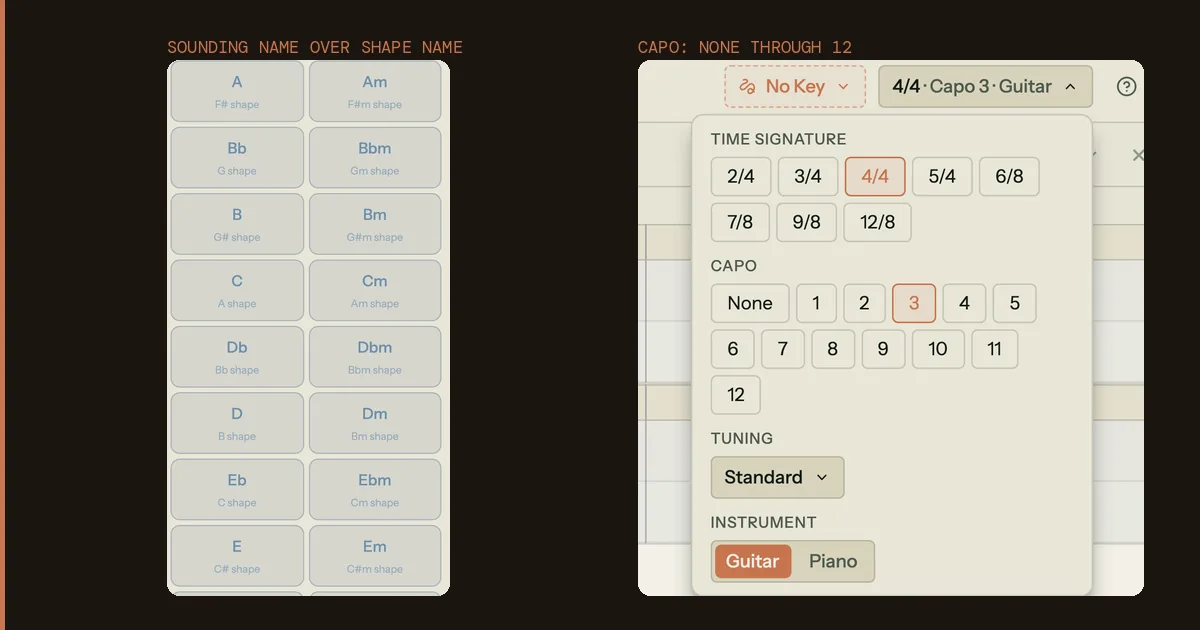
Set the capo from the song settings chip in the toolbar, anywhere from none to fret 12. The chip label updates to show it, and the capo control only appears in Guitar mode, since it is a guitar concept. From there the app splits the two names the way the professional transcriptions do. Chord blocks on the timeline keep the sounding chord name, because that is the real harmony and the real key. The fretboard panel shows the shape you actually finger, with a small marker at the nut telling you where the capo sits.
Slash chords transpose correctly, bass note included, which is the detail that catches hand-made charts. Exported PDF chord sheets print the shapes with the capo position in the header, matching the convention players expect on paper. The guitar and piano documentation walks through the whole panel, and there is more on the guitar side of songwriting in our guide to writing a song on guitar.
Song Cage runs in the browser on Mac, Windows, iOS and Android, with free native mobile apps, a native desktop app, and a 14-day trial of everything when you first sign in to the desktop app or plugin, with no card required.
Stop guessing what key you're in
Set the capo once and let the app track the shape and the sounding chord together.
Frequently Asked Questions
What key am I in with a capo on the 2nd fret?
Move your shape key up two semitones. G shapes at capo 2 sound in A, C shapes sound in D, D shapes sound in E, and Em shapes sound in F# minor. Capo 2 is a whole step, so every chord in the progression moves by the same distance and the relationships between them are unchanged.
Does a capo change the key of a song?
Yes. A capo transposes the entire song up by one semitone per fret, which changes the sounding key while leaving your chord shapes and fingering identical. It is different from a key change inside a song, where the music modulates from one key to another mid-performance. A capo moves the whole piece at once.
Where do I put the capo to play in Bb?
Five positions reach Bb. A shapes at capo 1, G shapes at capo 3, E shapes at capo 6, D shapes at capo 8, or C shapes at capo 10. Capo 1 with A shapes and capo 3 with G shapes are the two most common choices, because both keep you in comfortable open positions low on the neck.
Should I write the shape chord or the sounding chord on my chart?
Write the sounding chord if the chart is going to anyone who is not playing a capoed guitar. Published transcriptions print both: the concert chord above the staff and the capo shape in parentheses beneath it. If you write shapes only, put the capo position in the header, and make sure it stays attached to the chords.
What does a capo do to slash chords?
Both halves transpose. A G/B shape at capo 2 sounds as A/C#, not A/B, because the bass note moves up by the same two semitones as the root. Forgetting to move the bass note is a common charting error, and it flattens out any descending bass line the progression was built around.
Why does my guitar sound out of tune with a capo on?
The capo presses harder than a finger, stretching the strings slightly sharp. Strings of different gauges shift by different amounts, so the guitar goes out of tune with itself. Place the capo just behind the fret, use the lightest pressure that avoids buzzing, and tune after the capo is on rather than before.