Table of Contents
- What are musical modes?
- Where did the modes come from?
- How do the seven modes relate to the major scale?
- The relative method: same notes, different home
- The parallel method: same root, change a note or two
- Relative or parallel: which should you use?
- What is the easiest way to order the modes?
- The brightness spectrum
- The flip-one-note trick
- What is each mode's characteristic note, and what does it sound like?
- Lydian: the raised 4th
- Ionian: the major baseline
- Mixolydian: the flat 7th
- Dorian: the natural 6th
- Aeolian: the natural-minor baseline
- Phrygian: the flat 2nd
- Locrian: the flat 5th
- What songs are actually written in each mode?
- Why are so many "mode" song examples online wrong?
- How do you actually write a song in a mode?
- Why does my mode keep collapsing into major or minor?
- Anchor the modal home with a drone or pedal
- Put the characteristic note in your melody and chords
- Modal chord recipes you can try
- How can you tell what mode a song is in?
- Is the Locrian mode ever actually used?
- How does Song Cage help you write modal ideas?
- Musical modes at a glance
- Frequently Asked Questions
Play a C major scale from C to C and you get the familiar bright major sound. Now play the very same seven white keys, but start and end on D instead. Nothing changed except your sense of home, yet the scale suddenly sounds minor, cool, and a little wistful. Start on E and it turns dark and Spanish. Start on F and it floats. Those are modes: seven different emotional worlds hiding inside one set of notes.
Modes are the most useful piece of theory most songwriters skip, because they are usually taught as dry scale trivia instead of as colors you can write with. This guide fixes that. You will learn what each mode actually sounds like, the one note that gives it its flavor, a real song that proves it, and the practical trick for writing in a mode without it collapsing back into plain major or minor.

What are musical modes?
A musical mode is a scale built from the seven notes of a parent scale but treated as if a different note were home. The major scale yields seven modes, one starting on each degree: Ionian, Dorian, Phrygian, Lydian, Mixolydian, Aeolian, and Locrian. Each uses the same notes but reorders the steps, giving it its own mood.
The reason a mode sounds different from its parent major scale is that "home" changes which intervals land in the important places. When D is home, the distance from the home note up to the third and sixth shifts, and your ear reads the whole scale as a new color. Two of the seven modes are old friends in disguise: Ionian is just the major scale, and Aeolian is the natural minor scale. The other five sit between those two poles, each leaning a little brighter or a little darker.
Where did the modes come from?
The names are ancient Greek (Dorian, Phrygian, and Lydian were regions of the classical world), though the Greek system organized pitch differently than ours does. The modes we use today were codified in medieval Europe as the "church modes" that governed Gregorian chant, where each mode carried its own expressive character. The Renaissance theorist Glarean named the Ionian and Aeolian modes in his 1547 treatise Dodecachordon, the direct ancestors of our modern major and minor; treating all seven scale degrees as equal modes (Locrian included) is a later convention. The takeaway for a songwriter is simpler than the history: a mode is a scale with a distinctive flavor, and that flavor is what you are really reaching for.
How do the seven modes relate to the major scale?
There are two ways to find a mode, and you need both. The relative method finds the right notes quickly; the parallel method lets you actually hear what makes a mode special. Most explanations teach one and leave out the other, which is why modes stay confusing.
The relative method: same notes, different home
The relative method says every mode of C major uses only the white keys; you just choose a different starting note. D to D is D Dorian, E to E is E Phrygian, F to F is F Lydian, and so on through G Mixolydian, A Aeolian, and B Locrian. All seven share the exact same seven notes. This view is fast for finding the notes of a mode: if you can spell one major scale, you can spell all seven of its modes instantly. Its weakness is that it hides the flavor. Played as white keys against no other context, D Dorian just sounds like C major starting in an odd place, because nothing is anchoring D as home.
The parallel method: same root, change a note or two
The parallel method keeps the home note fixed and changes the notes around it. Compare everything to the same root, say C. C Ionian is the plain major scale. C Mixolydian is that major scale with one note lowered, the flat 7th. C Dorian is a minor scale with a raised 6th. Lined up over the same root, the single altered note jumps out, and that note is the mode's entire personality. This is how you hear a mode rather than just spell it. Songwriters should think in parallel when choosing a sound and switch to relative only to locate the notes on the instrument.
Relative or parallel: which should you use?
Use the relative view to find notes fast and the parallel view to understand sound. They describe the same seven scales from two angles, and fluent musicians flip between them without thinking. A quick rule: when you are working out where to put your fingers, think relative ("D Dorian is the white keys"). When you are deciding how a section should feel, think parallel ("I want minor but with that one bright note, so Dorian"). The parallel view also connects directly to chords, because the altered note usually shows up as one specific non-diatonic chord. That chord is your shortcut to the sound, which is the idea behind modal interchange and borrowed chords.
What is the easiest way to order the modes?
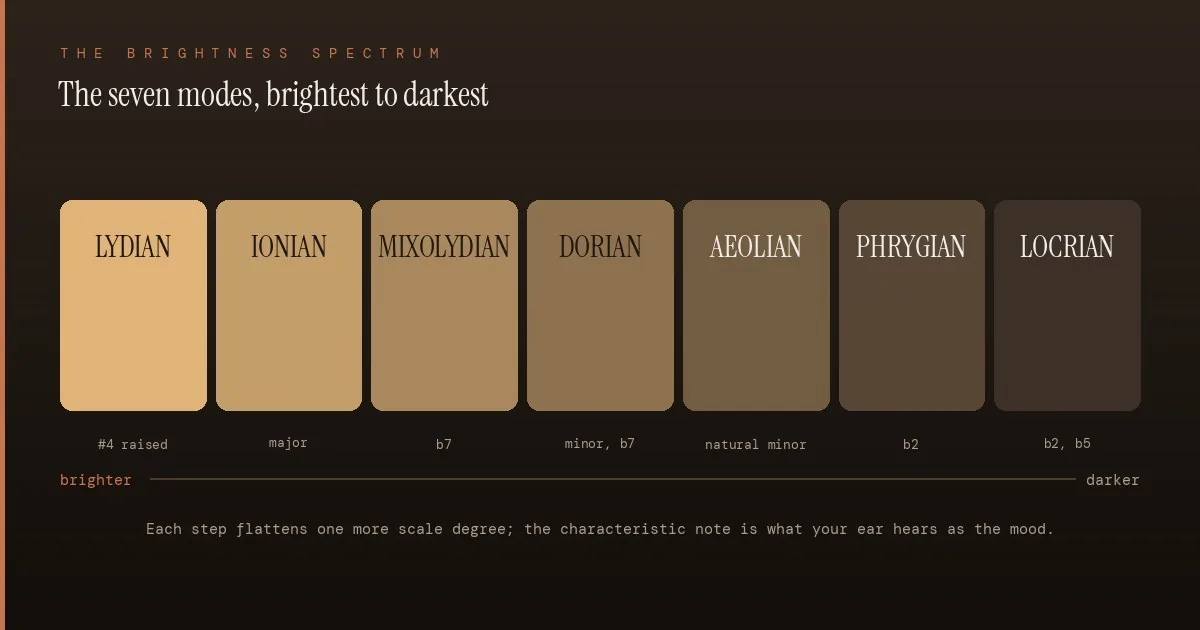
Forget the traditional Ionian-to-Locrian order. The clearest way to organize modes is by brightness, from the lightest, most lifted sound to the darkest, most unstable one. Ordered that way, each mode differs from the next by exactly one note moved down a half step, which makes the whole system a single sliding scale of mood.
The brightness spectrum
From brightest to darkest, the seven modes run: Lydian, Ionian, Mixolydian, Dorian, Aeolian, Phrygian, Locrian. Lydian is the brightest because it has a raised note (the ♯4) that major doesn't. Locrian is the darkest because it flattens the most notes, including the 5th, which is what removes its sense of home. Major (Ionian) and natural minor (Aeolian) sit where you'd expect, with the exotic modes fanned out around them.
The flip-one-note trick
Walking down the brightness spectrum, you lower exactly one scale degree at each step, in a fixed order: ♯4, then natural 4, then ♭7, then ♭3, then ♭6, then ♭2, then ♭5. Start at the brightest mode and lower the raised 4th and you get Ionian; lower the 7th and you get Mixolydian; lower the 3rd and you get Dorian, and so on down to Locrian. You do not have to memorize seven separate scales. You memorize one starting point and the order in which notes drop away.
What is each mode's characteristic note, and what does it sound like?
This is the heart of it. Each mode has one defining note, the single degree that separates it from plain major or plain minor, and learning that one note is how you learn to recognize and use the mode. Below, each mode is listed brightest first, with its formula, its characteristic note, the chord built on its home note, its mood, and a verified song that puts the sound on display.
Lydian: the raised 4th
Lydian is the major scale with a raised 4th (♯4), and that single sharpened note gives it a floating, dreamy, slightly magical lift. The home chord is a major 7th. Because the ♯4 sits a tritone above the root, Lydian sounds like major straining gently upward, which is why film and game composers reach for it to score wonder and sky. You can hear it in Joe Satriani's "Flying in a Blue Dream," a sustained C Lydian piece where the F♯ (the ♯4) rings as the hook. To write it, vamp between your I and a major II chord (in C, that is C to D) and let the ♯4 sing on top.
Ionian: the major baseline
Ionian is simply the major scale, the brightest stable sound and the reference point for everything else. Its home chord is a major 7th, and it carries no exotic altered note, which is exactly why it feels resolved and at rest. Most mainstream pop lives here: the familiar I, IV, V, and vi chords and the progressions built from them are Ionian by default. If you have ever written a song that felt happy, anthemic, or "normal" in the best sense, you were almost certainly in Ionian. It is the baseline you depart from when you want one of the more characterful modes, and the home you keep collapsing back into when a mode is not anchored. For the workhorse patterns, see the most useful chord progressions.
Mixolydian: the flat 7th
Mixolydian is the major scale with a lowered 7th (♭7), and that one flattened note trades major's polished resolution for an earthy, bluesy, rootsy swagger. The home chord becomes a dominant 7th, and the signature move is the major ♭VII chord a whole step below home. Lorde's "Royals" is a clean example: a D tonic over a D, C, G (I, ♭VII, IV) bed, with the vocal repeatedly landing on the ♭7. The Grateful Dead's "Fire on the Mountain" is even purer, a two-chord B-to-A vamp that never leaves I and ♭VII. To write Mixolydian, lean on that I to ♭VII shuttle and avoid the leading-tone pull of a normal V chord.
Dorian: the natural 6th
Dorian is a minor scale with a raised 6th (a natural 6 where natural minor has a ♭6), and that brighter sixth makes it sound minor but hopeful, soulful, and cool rather than sad. The home chord is a minor 7th, and the tell is a major IV chord living inside an otherwise minor world. Santana's "Oye Como Va" rides a static Am7 to D9 (i to IV) vamp where the D chord sounds F♯, the raised 6th, on half of every bar. Miles Davis built the entire A-section of "So What" on D Dorian. To write Dorian, set up a minor i and reach for that bright major IV.
Aeolian: the natural-minor baseline
Aeolian is the natural minor scale, the darker of the two reference modes and the default sound of sad, somber, or dramatic music. Its home chord is a minor 7th, and where Dorian lifts its 6th, Aeolian keeps the lowered 6th (♭6) that deepens the gloom. The classic gesture is the minor "Aeolian shuttle," a loop of i, ♭VII, and ♭VI, as in Bob Dylan's "All Along the Watchtower," where the ♭VI chord plants the ♭6 at the center of the song. R.E.M.'s "Losing My Religion" is another textbook case, entirely diatonic to natural minor with no raised leading tone. If a minor idea already sounds finished and you didn't add anything exotic, you are in Aeolian.
Phrygian: the flat 2nd
Phrygian is a minor scale with a lowered 2nd (♭2), a half step right above the home note, and that crushing-close interval gives it a dark, tense, unmistakably Spanish or metal flavor. The home chord is a minor 7th, and the signature move is sliding from the minor i up to a major ♭II and back. Megadeth's "Symphony of Destruction" opens on exactly that i to ♭II riff (E5 to F5), with the F a half step above the E tonic. Flamenco's Andalusian cadence is built on the same ♭2 pull. To write Phrygian, drone your root and put that flat second in the melody and in a ♭II chord above it.
Locrian: the flat 5th
Locrian is the darkest and strangest mode, a minor scale with both a ♭2 and, crucially, a lowered 5th (♭5). That flattened fifth is the problem: it turns the home chord into a half-diminished chord with no stable perfect 5th to anchor it, so the scale never quite settles into a home key. The mood is unstable, dissonant, and ominous, useful for tension but almost impossible to rest on. Genuine full-song Locrian is vanishingly rare, which is why it gets its own honest discussion further down. For now, just file it as the theoretical end of the brightness line, the mode that flattens one note too many.
What songs are actually written in each mode?
Naming a song for each mode is where most guides go wrong, because they repeat attributions nobody checked. Every example below was verified against the song's actual tonal center and its characteristic note, with the specific harmonic "tell" that proves the label rather than a vague vibe.
| Mode | Song | The tell that proves it |
|---|---|---|
| Lydian | "Flying in a Blue Dream" (Joe Satriani) | A fixed C home with F♯, the ♯4, ringing as the hook of the main vamp. |
| Mixolydian | "Royals" (Lorde) | D home over D, C, G (I, ♭VII, IV); the melody keeps landing on C, the ♭7. |
| Mixolydian | "Fire on the Mountain" (Grateful Dead) | A two-chord B-to-A vamp is I to ♭VII, with no V to pull it back to major. |
| Dorian | "Oye Como Va" (Santana) | A static Am7 to D9 (i to IV) loop; the D chord sounds F♯, the raised 6th, every bar. |
| Dorian | "So What" (Miles Davis) | The whole A-section sits on D Dorian; the famous voicing spells the natural 6th. |
| Aeolian | "All Along the Watchtower" (Dylan / Hendrix) | A i, ♭VII, ♭VI "Aeolian shuttle"; the ♭VI chord plants the ♭6. |
| Phrygian | "Symphony of Destruction" (Megadeth) | The riff moves i to ♭II (E5 to F5); the F is the ♭2 a half step above home. |
| Locrian | "Army of Me" (Björk) | The bass ostinato carries the ♭5, giving a half-diminished home chord with no resolution. |
Ionian is left off because nearly any major-key pop song demonstrates it. Each "tell" is the structural chord or melody note that makes the mode label hold up.
Why are so many "mode" song examples online wrong?
Most wrong labels come from confusing a song's parent key with its true home. If a song uses the white keys and feels centered on C, it is C major, not D Dorian, even though both use the same notes. The mode only counts when the music actually rests on that modal home and features the characteristic note. Fleetwood Mac's "Dreams" is endlessly miscalled F Lydian, but its melody is essentially A minor and the supposed Lydian note appears once in the whole song. Green Day's "Boulevard of Broken Dreams" is widely tagged Aeolian, yet its major IV chord makes it Dorian. The fix is always the same: find the real home note, then check the one color note.
How do you actually write a song in a mode?
Knowing the scales is the easy part. The hard part, and the thing almost no guide explains, is keeping a mode from quietly turning back into ordinary major or minor while you write. Three habits solve it.
Why does my mode keep collapsing into major or minor?
Because the ear is lazy in a useful way: it wants to hear the simplest possible home. If you write D Dorian but keep landing on C chords and C bass notes, your listener hears C major with D as a passing idea, and the Dorian flavor evaporates. The same trap catches every mode. The notes alone do not create the mode; where you put weight does. A mode survives only when the music repeatedly insists that the modal note, not its parent major or relative minor, is home. Everything below is a way of insisting.
Anchor the modal home with a drone or pedal
The single most reliable trick is to nail down the home note so the ear cannot drift. Hold a drone or a repeating pedal tone on the modal root underneath everything, the way folk and metal both do, and the mode stays put. Start the song on the modal home chord and end phrases on it. Loop a vamp that always returns to that root rather than wandering to the parent key's I chord. A drone on D under D Dorian, or on E under E Phrygian, forces every other note to be heard in relation to that home, which is exactly what makes the mode read as the mode.
Put the characteristic note in your melody and chords
A mode is its characteristic note, so feature that note instead of hiding it. Write melodies that hit and hold the ♯4 in Lydian, the ♭7 in Mixolydian, the natural 6 in Dorian, or the ♭2 in Phrygian, especially on strong beats. Then harmonize it with the one chord that contains it: the major ♭VII for Mixolydian, the major IV for Dorian, the major ♭II for Phrygian. That borrowed chord is the sound, and reaching for it deliberately is the whole craft of modal writing. Land the color note where it is exposed, and put a structural chord under it, and you can capture the mode you hear in your head before it slips away.
Modal chord recipes you can try
These are not formulas to paste in; they are the moves the verified songs above actually make, so you can hear how each mode behaves and then write your own.
One recipe per mode
- Lydian: vamp I to II, both major (C to D), with the ♯4 on top.
- Mixolydian: shuttle I to ♭VII (G to F), or add IV for the I, ♭VII, IV loop.
- Dorian: set a minor i against a bright major IV (Am to D).
- Phrygian: drone the root and slide i to ♭II (Em to F) and back.
- Aeolian: loop the minor shuttle i, ♭VII, ♭VI (Am, G, F).
How can you tell what mode a song is in?
You can identify almost any mode by ear with a simple three-step check. It works because every mode is defined by just two things: whether it leans major or minor, and which single color note it carries.
The three-step mode check
- Find the home note. Hum along until you find the note that feels like rest, the one the song keeps returning to. That note is the mode's tonic, regardless of what key signature is written.
- Major or minor third? Check the third above that home note. A major 3rd means you are in Lydian, Ionian, or Mixolydian. A minor 3rd means Dorian, Phrygian, Aeolian, or Locrian.
- Check the one color note. Among the major modes, a ♯4 is Lydian and a ♭7 is Mixolydian (neither, it's Ionian). Among the minor modes, a ♭2 is Phrygian, a natural 6 is Dorian, a ♭5 is Locrian (none of those, it's Aeolian).
Most of the work is step one, because once you truly know where home is, the third and the color note are quick to test. This is the same scale-degree listening covered in our music theory for guitarists guide, and it sharpens fast with practice.
Is the Locrian mode ever actually used?
Locrian is the mode everyone lists and almost nobody writes a whole song in, and the reason is structural, not stylistic. Its lowered 5th means the chord built on its home note is a diminished, half-diminished chord with no stable perfect 5th, so the tonic can never sound settled. The scale is built to be tense, which makes it nearly useless as a place to rest and live for three minutes.
It does appear, just rarely and deliberately. Björk's "Army of Me" centers a bass ostinato on a Locrian home with the ♭5 baked in. Folk musician John Kirkpatrick wrote "Dust to Dust" in Locrian on purpose as a one-off experiment, often cited as the only true whole-song example in the popular canon. King Gizzard and the Lizard Wizard composed "Gliese 710" in Locrian for a concept album with one mode per track. Far more often, Locrian shows up for a few bars inside metal riffs or over a half-diminished chord in jazz. The honest advice: learn it so the set is complete, but do not expect to need it.
How does Song Cage help you write modal ideas?
A modal idea usually lives or dies on one non-diatonic chord: the major ♭VII that makes Mixolydian, the major IV that makes Dorian, the ♭II that makes Phrygian. That is exactly what Song Cage is built to make easy. When you write a progression, the palette holds your in-key chords plus the borrowed chords from parallel modes, and each borrowed chord is labeled with the mode it comes from, so the ♭VII shows up tagged "Mixolydian" and the ♭II tagged "Phrygian." You reach for the color you want by name and hear it instantly in real guitar and piano voicings.
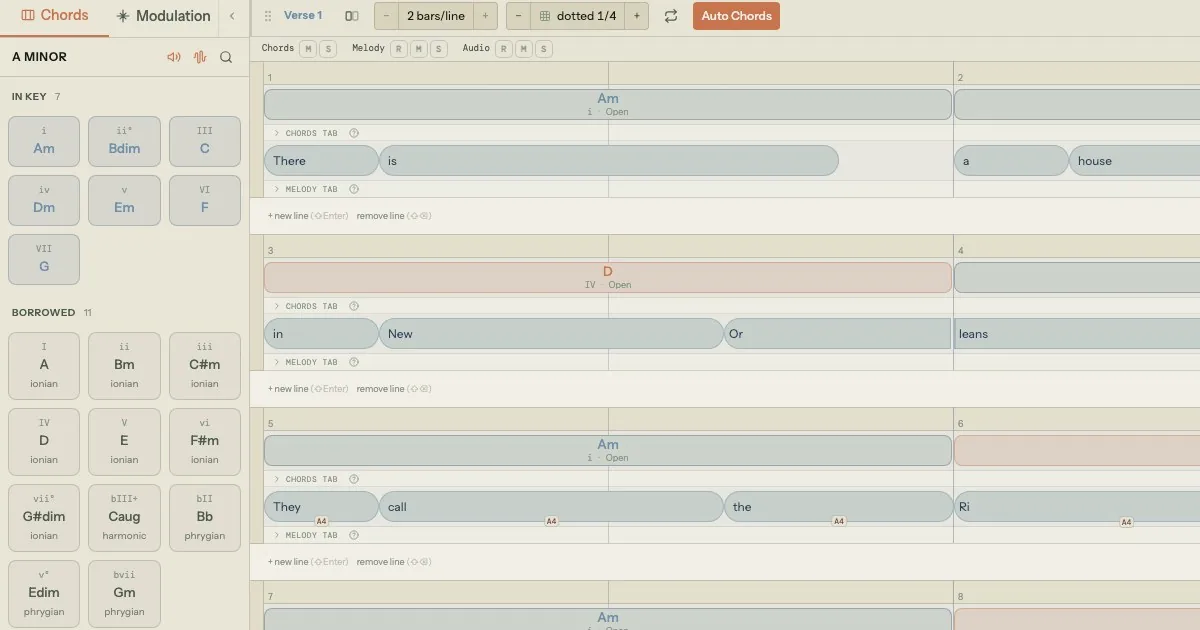
Every chord is labeled by its function, so you see the modal logic while you write instead of guessing, and you can capture the melody that features the characteristic note in the same place. Nothing is generated for you and there are no canned progressions: you make every call by ear, and the app just lets you hear the consequence. When a singer needs the whole idea higher or lower, one-click transpose moves it without disturbing the mode. If you work in a DAW, the Song Cage plugin runs the same workspace as an AU or VST3 inside Logic Pro, Ableton Live, FL Studio, Cubase, Studio One, and REAPER.
Musical modes at a glance
Here is the whole system on one card. Read it top to bottom and you are reading brightest to darkest, with each mode's formula, its one characteristic note, the chord on its home note, its feel, and a verified song.
| Mode | Built on | Formula | Color note | Home chord | Feel |
|---|---|---|---|---|---|
| Lydian | 4th degree | 1 2 3 ♯4 5 6 7 | ♯4 | maj7 | Dreamy, floating |
| Ionian | 1st degree | 1 2 3 4 5 6 7 | none (major) | maj7 | Bright, resolved |
| Mixolydian | 5th degree | 1 2 3 4 5 6 ♭7 | ♭7 | dom7 | Bluesy, rootsy |
| Dorian | 2nd degree | 1 2 ♭3 4 5 6 ♭7 | natural 6 | m7 | Hopeful "cool minor" |
| Aeolian | 6th degree | 1 2 ♭3 4 5 ♭6 ♭7 | ♭6 | m7 | Sad, somber |
| Phrygian | 3rd degree | 1 ♭2 ♭3 4 5 ♭6 ♭7 | ♭2 | m7 | Dark, Spanish |
| Locrian | 7th degree | 1 ♭2 ♭3 4 ♭5 ♭6 ♭7 | ♭5 | m7♭5 | Unstable, no home |
Formulas use the parallel view (compared to the major scale on the same root). Ionian is the major scale and Aeolian is the natural minor scale, the two reference points the other modes brighten or darken.
Frequently Asked Questions
Are modes the same as scales?
A mode is a type of scale, so every mode is a scale, but not every scale is one of the seven diatonic modes. The seven modes are specifically the scales you get by treating each note of the major scale as home in turn. Other scales (pentatonic, harmonic minor, whole tone) are built on different rules. When people say "modes," they almost always mean these seven.
What is the difference between a key and a mode?
A key tells you which notes are in play and where home is; a mode tells you the flavor of the scale around that home. "C major" names a key, and Ionian is its default mode. You can stay in the notes of C major but make D the home and feature D's color note, and now you are in D Dorian. The mode is the personality; the key is the note pool and the home.
How many modes are there?
The major scale has seven notes, so it produces seven modes: Ionian, Dorian, Phrygian, Lydian, Mixolydian, Aeolian, and Locrian. Other parent scales generate their own modes too (the melodic minor scale yields seven more, including Lydian dominant and the altered scale), but when songwriters say "the modes" they mean the seven diatonic modes of the major scale covered here.
What is the happiest mode and the darkest mode?
Lydian is the brightest, happiest-sounding mode, because its raised 4th lifts the major scale even higher. Locrian is the darkest and least stable, because its lowered 5th removes any solid sense of home. In between, Mixolydian is a sunnier major, Dorian is a hopeful minor, Aeolian is plain sad minor, and Phrygian is dark and tense. The whole set runs Lydian, Ionian, Mixolydian, Dorian, Aeolian, Phrygian, Locrian from bright to dark.
What is the easiest mode to start writing with?
Dorian and Mixolydian are the friendliest first modes. Both differ from a scale you already know by just one note, and both have a clear, satisfying signature chord that does the work for you: the bright major IV in Dorian and the major ♭VII in Mixolydian. Pick a one-chord drone or a two-chord vamp, feature that signature chord, and you will hear the mode immediately without fighting the theory.
Do you need to know modes to write good music?
No. Countless great songs never leave plain major and minor, and modes are a tool, not a requirement. What modes give you is a vocabulary for sounds you may already hear in your head: that hopeful-minor color, that bluesy major, that Spanish edge. Learning them turns a happy accident into something you can summon on purpose, which is the real payoff for a songwriter.
Hear the mode before it slips away
Song Cage keeps every borrowed chord one tap from your in-key palette, each labeled with the mode it comes from, so the ♭VII that makes Mixolydian or the major IV that makes Dorian is right there in real guitar and piano voicings. Capture the idea by ear, with every chord labeled by function. No AI, no canned progressions. You write it.