Table of Contents
- What is a chorus in a song?
- Chorus vs verse: what actually changes?
- Is "the lyrics stay the same" a real rule?
- What can differ between a verse and a chorus?
- Is the chorus where the song lands on its home chord?
- So what is the harmonic signature of a chorus?
- Can a chorus withhold the home chord on purpose?
- Why is "make the chorus bigger" the wrong instruction?
- What does lowering the verse actually mean?
- How do you diagnose a chorus that doesn't lift?
- Why do checks 3 and 5 matter most?
- Change one dial at a time
- Can the chorus use the same chords as the verse?
- Which repeating sections are not choruses?
- Does every song need a chorus?
- How do you write a chorus, function first?
- Writing a chorus in Song Cage
- Frequently Asked Questions
Almost every guide tells you the same four things about a chorus. It repeats. Its lyrics stay the same. It carries the title. It is the biggest part of the song.
All four describe a typical chorus. None of them tells you why yours sits there sounding like more verse. That question, "my verse and chorus sound the same, how do I separate them," is the one songwriters actually ask, and it is the one nobody answers. Here is what a chorus is defined by, what genuinely changes between a verse and a chorus, what the research says about the harmony (it is the opposite of what you have been told), and a five-check diagnostic you can run on a song you already have.

What is a chorus in a song?
A chorus in a song is a self-contained section that returns with the same words each time, carries the song's title or central line, and functions as the destination the rest of the song is aimed at. It is defined by the job it does in its own song, not by being loud, high or catchy.
The formal definition is narrower than the folk one. Ralf von Appen and Markus Frei-Hauenschild, surveying roughly 3,000 songs, describe the chorus as "the independent section within the verse/chorus form, which is usually repeated with identical lyrics as well as harmonic and melodic structure and often ends harmonically closed." Note "often," not "always." Every hedge in that sentence is doing work.
Jay Summach puts the functional half best. Once a song builds toward its chorus, the chorus "becomes something other than the loudest or most memorable part of the song: it is raised to the status of destination towards which the whole succession of modules is directed." That is the test. Not how big the section is, but whether the song is going there.
For how the chorus sits among the other parts, see our guide to song structure.
Chorus vs verse: what actually changes?
The verse asks and the chorus answers. Every chorus vs verse comparison bottoms out there, and that functional pair is the part that holds across genres: the verse supplies situation, detail and narrative, and the chorus supplies the response, the claim, the thing the song is actually about. Verses are stories; choruses are statements.
Everything underneath that is negotiable, and this is where most chorus advice goes wrong. It hands you one contrast setting (sing higher, add instruments) as though it were the mechanism, when it is one of about ten, and your song may well need a different one. Knowing the full set is what lets you diagnose a section instead of guessing at it.
Is "the lyrics stay the same" a real rule?
Lyric invariance is the closest thing to a real rule, and it is still a tendency rather than a law. Verses change their words to move a story forward; choruses hold their words still so the section becomes a fixed point the listener can return to. Summach treats degree of lyric invariance as the discriminator when a label is unclear.
It is also the criterion most people over-apply. A repeated line is not automatically a chorus, and we will get to the three things it might be instead. Summach's own working test pairs invariance with two other measures: length and completeness. A passage that repeats its words but runs only four bars is usually too short to stand as its own section, and formal modules in this repertoire typically span eight to twenty-four bars.
So the rule is real, and on its own it is not enough. Which is why the interesting question is not what stays the same but what changes.
What can differ between a verse and a chorus?
Ten things, and a chorus needs only two or three of them working:
The contrast dials
- Melodic register: where the tune sits, and where its top note lands
- Phrase length: how long each sung line runs before it breathes
- Syllable density: how many syllables you fit per bar
- Melodic rhythm: the pattern of long and short notes
- Downbeat placement: where each line starts relative to beat one
- Harmonic rhythm: how often the chords change
- Loop length: how many bars before the progression comes round
- Tonic weight: how much of the section sits on the home chord
- Lyric mode: narrative detail against direct statement
- Texture: how many things are playing, and how hard
There are numbers behind the first four. The Billboard Melodic Music Dataset transcribed 380 verse melodies and 325 chorus melodies from 371 songs that reached the top five of the Billboard year-end charts between 1950 and 2022. Chorus melodies came out about 2.5 seconds shorter than verse melodies, with ten fewer note events and roughly 0.25 fewer notes per second, while their average melodic interval ran 0.15 semitones larger. All at p < 0.01. In plain terms: choruses say less, more slowly, in bigger jumps. For the harmonic-rhythm dial specifically, see why chord progressions sound boring.
Is the chorus where the song lands on its home chord?
No, and this is the most widely repeated wrong answer about choruses. Across a 200-song rock corpus analysed independently by two theorists, chorus sections spent less time on the tonic than verse sections did: 38.8% against 47.3% in one analysis, 39.1% against 47.2% in the other. The verse is the section that sits at home.
Trevor de Clercq, who ran that study, states it flatly: "Chorus sections in the corpus, generally speaking, tend to spend less time on tonic than do verse sections. Both my analyses and Temperley's offer strong evidence of this trend." The opening chords lean the same way. Verses in that corpus begin on I 88% to 89% of the time, choruses only 56% to 63%.
Read that second figure carefully, because de Clercq does. His own gloss is that "tonic is somewhat less frequent as an opening chord than in verse sections, although most chorus sections still begin with tonic," and that overall the two sections "seem to be rather similar in terms of the distribution of opening and closing chords." A majority of choruses do open at home. They just open at home less often than verses do, and they stay there for less of the section.
So what is the harmonic signature of a chorus?
Not where tonic sits, but how often it arrives and leaves.
De Clercq measured that too: "the harmonic rhythm of a chorus tends to be faster than that of a verse. However, this effect seems primarily due to differences in the average duration of tonic chords; verse and chorus sections do not significantly differ in average duration of nontonic chords." The chorus moves more because home keeps getting shorter. It is a section of arrivals rather than a section of rest.
Closure is contested, and worth knowing that it is. Summach's era-by-era counts have choruses ending on tonic more reliably than verses in every period from 1960 on, with the gap widening hard: by the late 1980s only 29% of verses ended on tonic while 55% of choruses still did. De Clercq's own corpus does not reproduce that. There, final chords in choruses "look almost identical" to verses, 46% against 47%. Take the safe reading: a chorus tends to close more firmly than the verse before it in your song, and that is a local comparison, not a law.
Where the arrival lands does have a rule. Drew Nobile: in a plain verse-chorus song "any teleological goal generally arrives at the end of the chorus," while with a pre-chorus in place "the goal is the beginning of the chorus."
Can a chorus withhold the home chord on purpose?
Yes, and there is a body of theory about songs that do. Mark Spicer calls it the emergent tonic. In Prince's "Little Red Corvette" the verse cycles IV, V, vi, IV7 in D♭ major, and Spicer hears the tonic as "deliberately withheld by Prince for its climactic arrival in the chorus," landing on the last syllable of the title.
Sia's "Chandelier" runs the opposite play. Verse and pre-chorus state B♭ minor plainly, then the chorus (G♭, A♭, D♭/F, G♭) sets you up for the tonic and hands you the relative major in first inversion instead. David Heetderks has a name for the harder version of that move, the rebuff chorus, where a pre-chorus fires every cue for a tonic arrival and the chorus refuses to deliver one, holding a pedal on the dominant that does not resolve until the next verse begins.
Either design still reads as a chorus, which is the point. Harmony is one dial among ten, and choruses win on it in both directions.
Why is "make the chorus bigger" the wrong instruction?
Because contrast is a difference between two sections, not a level in one of them. You cannot raise a chorus in isolation, because "raised" is only meaningful against what came immediately before it.
Every ranking page gives the one-directional version: sing higher, add instruments, thicken the harmonies, simplify the lyric. That advice has a ceiling, and it is a low one. Once the chorus is loud, wide and stacked, the next increment does nothing, and the song ends up shouting in a room where nothing else is quiet.
The Nashville pros know the other half. SongTown, in a five-point list on improving choruses, includes the line that the rest of the field skips: "A big part of writing a better chorus is learning to not over-write your verses." Gary Ewer makes the same case for lyrics, describing a verse that "limits its emotional involvement so as to not upstage the chorus." Both are one sentence in the middle of a list. Neither gives you a method.
What does lowering the verse actually mean?
It means taking your ten dials and moving the verse down each one instead of moving the chorus up.
| Dial | Lower the verse by | Instead of |
|---|---|---|
| Register | Dropping the verse tune an octave, or into the bottom of your range | Belting the chorus higher |
| Phrase length | Breaking verse lines into shorter fragments with air between them | Sustaining chorus notes longer |
| Syllable density | Adding words to the verse so it patters | Cutting chorus words |
| Downbeat | Starting verse lines on the beat, squarely | Displacing the chorus |
| Harmonic rhythm | Holding verse chords for two bars each | Speeding the chorus up |
| Tonic weight | Keeping the verse off the home chord | Hammering I in the chorus |
| Texture | Stripping the verse to voice and one instrument | Stacking the chorus |
Tom Petty's "Free Fallin'" is the proof that this works with no harmonic help at all. One four-bar loop (I, IV, IV to I, V in F major, played capo 3 as D, G, G to D, Asus4) runs the entire song, verses and choruses alike. Jeff Lynne's instruction to Petty was purely a register move: "Go up on the chorus, take your voice up a whole octave." Nothing else in the harmony changes.
How do you diagnose a chorus that doesn't lift?
Strip the song to one voice and one instrument first. Production can fake a lift, and if you diagnose over a full arrangement you will find out in six months that the lift belonged to the drums.
Five checks
- The cold join. Play the last line of the verse straight into the first line of the chorus, with no build, no fill and no pre-chorus. If the join goes flat, the problem is the pair, not the chorus.
- Count syllables per bar. Do it for both sections and write the two numbers down. If they are within one of each other, your sections are saying words at the same speed, and no amount of arrangement will separate them.
- Find each section's top note. If the chorus never goes above the verse's ceiling, the audible effort that makes a chorus sound bigger is not there to hear.
- Mute the pre-chorus. If the lift disappears, the ramp was doing the work and the chorus was riding it.
- Mark where each line starts. Note the beat each vocal phrase enters on in both sections. If every line in the song starts on beat one, you have no rhythmic contrast anywhere.
Why do checks 3 and 5 matter most?
Because they target the two things that are doing the work while everyone argues about arrangement.
De Clercq describes the chorus melody as "significantly higher in range than the melody of the verse," and points at why that reads as size: "we are drawn to the increased energy and effort that the singer has to impart in order to sustain this higher tessitura." Height is audible as effort. That is the mechanism behind "the chorus sounds bigger," and no amount of doubling replaces it.
Tony Conniff, who coaches songwriters one to one, calls predictable melodic rhythm "the single most glaring area of weakness I hear," and is blunt about the diagnosis: "just repeating the same rhythm line after line is a sure sign of a non-professional-level songwriter." On choruses specifically he names the exact failure this post is about. "When the ear hears the first big note of the Chorus, and it's the same note that's been emphasized throughout the Verse, we think we're about to hear more Verse."
Change one dial at a time
The reason most chorus advice fails is that it stacks. Raise the melody and add instruments and add harmonies and simplify the lyric, all at once, and you cannot tell which move fixed it or whether any of them did. Run a check, move one dial, listen, then decide. If the fix was register, you will hear it on voice and guitar alone.
There is a second failure that sounds identical from the inside and needs the opposite treatment. A chorus that never lifts is a contrast problem, and you fix it in the verse. A chorus that lifts cleanly and still does not stay with anyone is a memorability problem, and you fix it in the chorus: fewer words, more repetition, a line that says the one thing. Check 1 tells them apart. If the cold join works and you still cannot hum it back an hour later, stop rewriting the verse.
Can the chorus use the same chords as the verse?
Yes, and it is common enough to have a name. Robert Hutchinson's open textbook calls it simple verse-chorus form, defined as one that "has the same harmonic progression for the verse and chorus," with Meghan Trainor's "All About That Bass" as the worked example. If harmony were what defines a chorus, none of these songs would have one, and every listener can hear that they do.
Nirvana's "Smells Like Teen Spirit" runs the same F5, B♭5, A♭5, D♭5 loop in F minor through verse and chorus. What moves is dynamics, texture, section length (an eight-bar verse against a twelve-bar chorus built from three four-bar phrases), register (the verse tops out around F4 and the chorus climbs past it), and one detail worth stealing: the chorus displaces its second and fourth chords off the beat while the verse plays them square. Same chords, different placement.
The Cranberries' "Zombie" carries Em, C, G, D/F♯ under every section of the song. Dolores O'Riordan's chorus lifts on distortion, a break from chest into head voice, and a lyric that collapses from full sentences to one repeated word. Billy Joel wrote "We Didn't Start the Fire" the same way, borrowing a progression from an unfinished country song ("I sandwiched the words into those chords") and letting the chorus arrive purely as a collapse in syllable count after verses that pack in 118 or 119 historical references.
Which repeating sections are not choruses?
Three of them, and mislabelling any one will send you rewriting the wrong part of your song.
A refrain is a line, not a section. Open Music Theory is precise about it: "refrains are a lyric within a section, whereas a chorus is an entire standalone section," and a refrain is "too short to form its own section", typically a phrase or less. Bob Dylan's "Tangled Up in Blue" is strophic, seven times through the same music with new words and a recurring title line. Elizabeth Randell Upton, writing on the song in postmedieval in 2019, draws the line explicitly: "what makes a section a chorus is the repetition of words as well as music."
A coda sits after the song is over. The Beatles' "Hey Jude" ends with nineteen rounds of the same four-bar phrase (I, ♭VII, IV, I in F major), the last of them faded out midway. It is the most-repeated passage in the song and it is not the chorus.
A post-chorus attaches behind a chorus that already happened. Cara Stroud, surveying 1,335 Top-40 songs released from 2010 to 2015, found post-choruses in 13.3% of them, and files Katy Perry's "Roar" as a codetta type. For where these sit in a full arrangement, see our guides to the bridge and the hook, which is a different thing again: a chorus is a place in the form, a hook is an effect on a listener.
Does every song need a chorus?
No, and the canon is less chorus-bound than the advice suggests. When de Clercq and Temperley independently analysed 200 songs drawn from Rolling Stone's greatest-songs list, one analyst identified a chorus in 68% of them and the other in 59%. Roughly a third of those songs have no chorus at all, while verses turned up in 90% to 99%.
Queen's "Bohemian Rhapsody" is the standing example, described by Wikipedia as "notable for its lack of a refraining chorus" and taught that way by AQA's own GCSE materials, whose structure table runs introduction, ballad, guitar solo, operatic section, rock section, outro with no chorus row anywhere. Careful with the wording, though: no chorus is not the same as nothing repeats. The song has two ballad verses on the same music and a lyric that recurs three times.
Radiohead's "Paranoid Android" is the deliberate version. The band told interviewers that "Bohemian Rhapsody" was a reference point for the form, and Guitar World reported that its three-part shape was inspired by "Happiness Is a Warm Gun." Both are songs without choruses. Sometimes the answer to "why doesn't my chorus lift" is that the song does not want one.
How do you write a chorus, function first?
Most advice on how to write a chorus starts with the sound. Start with the function instead. Write the answer before you write the tune. If the verse is the situation, the chorus is what you say about it, and a section that has nothing to answer will sound like more verse no matter how you arrange it.
Then say the one thing and say it again before you elaborate. The corpus numbers point the same way: fewer notes, spread more thinly, in bigger leaps, over shorter phrases. Choruses are made of less material, repeated.
Give the title line its own rhythm, distinct from anything in the verse, and check it does not open on the pitch the verse has been leaning on. Then write it so you can walk back into it three times without the third pass sounding like an obligation, and go back and take something out of the verse to make room.
Finally, stop worrying about the label. Hutchinson's textbook says it plainly: "There is ambiguity in naming sections and disagreement is to be expected." One person's pre-chorus is another's first chorus. If two listeners disagree about which of your sections is the chorus, that is not a failure of your song. Ask whether the song is going there instead.
Writing a chorus in Song Cage
The useful part is the join. Put a verse and a chorus on the same timeline and click the first, still-empty slot of the chorus, and the suggestions rank themselves against the chords on both sides of the section boundary. In a C major song whose verse ends on G, the header over the suggestions reads between V → ? → vi: it has reached back into the verse for the chord you are coming from and forward into the chorus for the chord you are going to, and it re-ranks the moment either one changes.
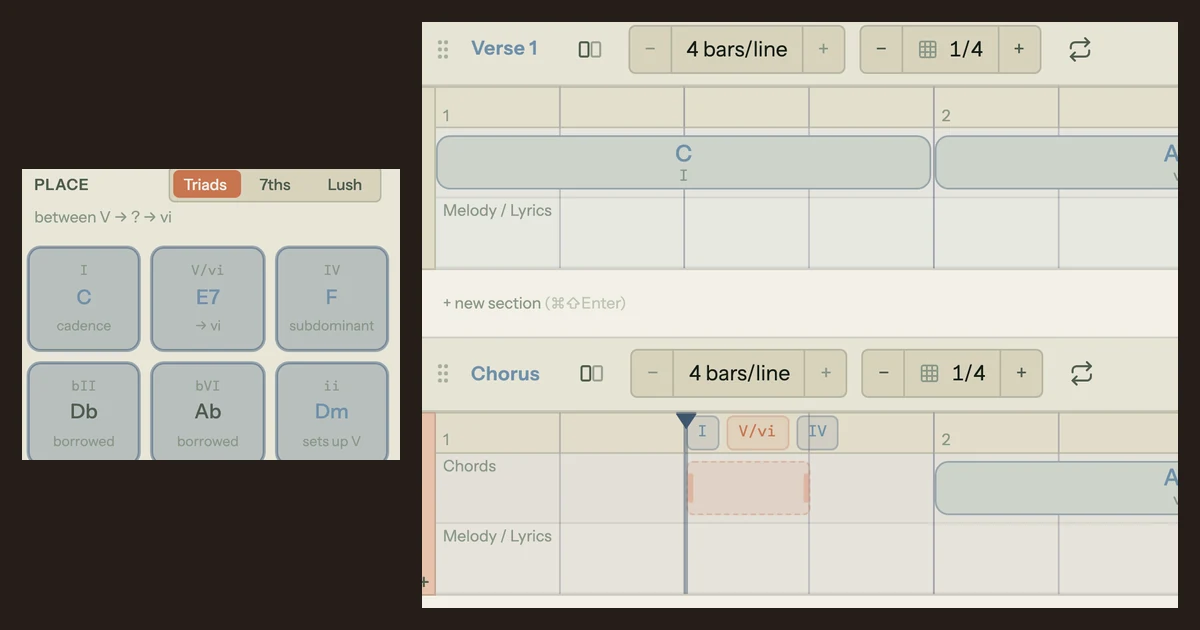
Each chip carries its function and its reason, so you can see why it is being offered: C is labelled I and "cadence," E7 is V/vi and "→ vi," F is IV and "subdominant," D♭ and A♭ come through as ♭II and ♭VI and "borrowed." A separate bass-line strip reads the same join a different way, "bass: G → ? → A," and proposes the slash chords that walk you across it stepwise.
Give the chorus its own key or its own time signature and the palette rebuilds for that section alone with the Roman numerals relabelled to match, which is how you try the minor-verse-to-major-chorus move without rewriting anything. Where you have sung a melody in, a Fits Melody strip ranks chords by how they sit against the notes you actually sang.
One honest limit, worth saying plainly: tagging a section "Chorus" is a label, exactly as the sections documentation puts it. Nothing in the app decides a chorus should be brighter, higher or busier, and nothing plots your melody's register for you. Which section is the chorus, and whether it lifts, stays your call.
Put the verse and the chorus side by side
Tag the sections, click the slot where the chorus starts, and see which chords actually get you there from the verse you already wrote.
Frequently Asked Questions
How long should a chorus be?
Eight to sixteen bars covers most cases, and de Clercq's prototype description of a chorus specifies exactly that range, along with being shorter than the verse. Treat it as an observation rather than a target. The more useful measure is that a lyric-invariant passage under about eight bars is usually too short to work as a section at all, and is more likely a refrain or a tag.
Should the chorus start on the tonic chord?
Usually, and less reliably than the verse does. Counting songs that have a pre-chorus, David Heetderks found 76% of their choruses begin with I, with another 14% repeating a cadential progression where I turns up quickly, because the ramp has aimed everything at that downbeat. Across rock generally, de Clercq's corpus has choruses opening on I 56% to 63% of the time against the verse's 88%. A majority still start at home.
What is the difference between a chorus and a refrain?
A chorus is a whole section; a refrain is a repeated line inside one. Open Music Theory puts the size test plainly: a refrain is "too short to form its own section", typically a phrase or less. So a title line that comes back at the end of every verse is a refrain, and the song is verse-refrain form rather than verse-chorus form. It changes what you rewrite when the song is not landing.
Can a chorus be quieter than the verse?
Yes. Christopher Doll named the loud kind a "breakout chorus" precisely because it needed a name, and is explicit that "not all choruses are breakout choruses." What a chorus needs is difference from the section before it, and difference runs in both directions. A sparse, low, slow chorus after a busy verse reads as arrival just as clearly as the reverse.
Why does my chorus sound like more verse?
Usually because the two sections share too many settings at once: the same syllable density, the same phrase lengths, lines starting on the same beat, and a chorus tune that opens on the note the verse has been leaning on. Run the five checks above on voice and one instrument. In most cases the repair is in the verse, not the chorus.
Does the title have to be in the chorus?
It usually is, and it is a tendency rather than a requirement. Von Appen and Frei-Hauenschild note that chorus lyrics "often contain the song's title or another lyrical hook," using the same hedge they apply to every other chorus property. Plenty of songs put the title in a refrain at the end of each verse instead, which is a different form rather than a mistake.
Is the chorus the same as the hook?
No. A chorus is a place in the form; a hook is whatever element grabs and stays, wherever it happens to sit. Hooks turn up in intros, in riffs under a whole song, and in post-choruses. Our guide to what a hook is covers the distinction and the cases where the two words genuinely do mean the same thing.