Table of Contents
- What is a verse in a song?
- Why does "verse" mean something else in old standards?
- What does a verse do in a song?
- How is a verse different from a chorus?
- How long is a verse in a song?
- How many bars are in a verse?
- How many bars is a rap verse?
- How many lines are in a verse?
- How long is a verse in seconds?
- How many verses does a song have?
- What should the second verse do?
- How do you get past second verse hell?
- Does verse 2 have to be the same length as verse 1?
- How do you write a verse?
- Should verses rhyme the same way?
- How do you build verses in Song Cage?
- Frequently Asked Questions
Search "how many bars in a verse" and most of the top results are about rap: write a 16, and you're done. That's good advice for a rap verse. For a sung pop or rock verse it's half the answer, because when we counted the verses in 635 Billboard hits, 16 bars only just beat 8, and verse 2 kept verse 1's length in nearly nine songs out of ten.
The harder question is what to put in verse 2, which has to fit verse 1's melody, length and rhyme spots while saying something new. The hits have an answer for that too.
Quick Summary
A verse is the section of a song whose music comes back each time while its words change. Verses carry the story and the detail; the chorus says what it all means. Most verses run 8 or 16 bars. In our count of first verses from Billboard hits of 1958 to 1991, 16 bars and 8 bars together covered almost two thirds, the typical verse lasted under half a minute, and the second verse almost always matched the first one's length. Its job is to move the story on.
What is a verse in a song?
A verse is the section of a song whose music repeats while its words change. Each verse tells the next part of the story and sets up the chorus, which keeps the same words every time. Most songs have two or three verses on the same melody and chords, and the verse usually sits lower and quieter than the chorus.
The word is older than the pop song. It comes from the Latin versus, a line or row of writing, from vertere, "to turn." Etymonline traces the picture to plowing: a plowman turns at the end of one furrow and starts the next, the way a reader turns from one line to the next.
In poetry, "verse" can still mean a single line, or poetry in general. The songwriting sense, the part of a song that doesn't repeat between choruses, is recorded by 1918, when Natalie Curtis-Burlin reported that Black American singers called their old songs "chorus and verses": the chorus sung by everyone, then a verse sung solo, then the chorus again.
That is still the arrangement in most songs on the radio. The verse is where the new information goes. If you can swap the order of your verses and nothing in the song changes, the verses aren't doing their job yet.
Why does "verse" mean something else in old standards?
In many Tin Pan Alley and Broadway songs of the 1920s to the 1950s, the verse was something else: a sung introduction before the main tune. The Wikipedia entry on thirty-two-bar form calls it the "introductory verse" or "sectional verse," usually 16 bars, setting the scene in speech-like rhythm before the 32-bar refrain. The refrain was the song people remembered, and the intro verse was often dropped.
You've heard plenty of songs with their verse removed. "Over the Rainbow" opens with a verse that begins "When all the world is a hopeless jumble," which was omitted from the 1939 film. Irving Berlin cut the verse of "White Christmas" himself, a Beverly Hills scene of orange trees and palms on December 24th, according to the Parlor Songs Academy. Cole Porter joked about the whole convention in the verse of "It's De-Lovely" (1936), which ends: "I'll skip the darn thing and sing the refrain."
So if you're reading about jazz standards and "the verse" sounds like an intro, it is one. In a modern song, what used to be called the A sections of the refrain are what we'd call verses. The song structure guide covers AABA form.
What does a verse do in a song?
A verse delivers the specifics: who, where, when and what happened. The chorus then states the feeling or the idea those specifics add up to. Because the verse music repeats, each new verse has to earn its place with new information, or the song stands still until the chorus comes back.
"Cat's in the Cradle," Harry Chapin's 1974 number one, written with his wife Sandra, is the textbook case. In the first verse the narrator becomes a father and is too busy to be around. In a later verse his son graduates from college and asks for the car keys. In the last, the father has retired, calls his grown son, and finds he's too busy too. The chorus keeps returning to the same picture, but it hits harder each time because the verses have moved the clock forward.
Not every song tells a story with a timeline, and a verse doesn't need one. A verse about a feeling can still move: from the first sign of it to what it costs, or from your side to theirs. What a verse can't do is stay put.
Verses also hold back. Songwriter and teacher Susan Cattaneo, writing in Guitar World in 2014, put it simply: "Try keeping your verse melody low and your chorus melody high." The verse leaves somewhere for the song to go.
How is a verse different from a chorus?
The short version: the verse changes its words and the chorus keeps them. The verse sets things up, and the chorus pays off. The chorus usually has the title, the higher notes and the bigger arrangement, though it doesn't have to have all three. Cattaneo's checks for a verse and chorus that sound too alike are worth running: is the melody in the same range, are the chords the same, do the chords change in the same places?
There's more to it than lyrics, and most of the musical difference is about what the chorus does with harmony and range. We wrote that up separately in what is a chorus in a song, including why "make the chorus bigger" is often really "make the verse smaller."
One thing worth knowing before the numbers below: a verse is often the longest section in the song. In our count, the first verse ran longer than the first chorus in about half the songs.
How long is a verse in a song?
Most verses run 8 or 16 bars. In Song Cage's count of first verses from 635 Billboard hits of 1958 to 1991 in 4/4, 33.2% ran 16 bars, 30.6% ran 8 and 9.3% ran 12. The median first verse lasted 26.5 seconds, and only 1.5% went past a minute.
Advice on verse length tends to be a single number. eMastered's guide calls 16 bars "probably the most common structure found in verses," and The Song Foundry's 2015 primer says verses are typically the same length as choruses, with 8 or 16 measures "really common" for each. We wanted to know how real songs split, so we counted.
How we counted
The McGill Billboard dataset is a set of expert transcriptions of songs sampled from the Billboard Hot 100 between 1958 and 1991, each one marked bar by bar with its sections named (the same set behind our count of time signatures), described by Burgoyne, Wild and Fujinaga at ISMIR 2011. After removing repeats, it holds 739 songs. We took every section the annotators labeled "verse," counted its bars, and timed it from its start to the next section. Bar counts use songs in 4/4 whose verse has no bar in another meter, which leaves 635 first verses. These are hits from three decades, so they say what has worked on the radio, not what your song must do.
Section labels and bar lines are the annotators' judgment. The counts are Song Cage's own, run by script over the dataset's annotations.
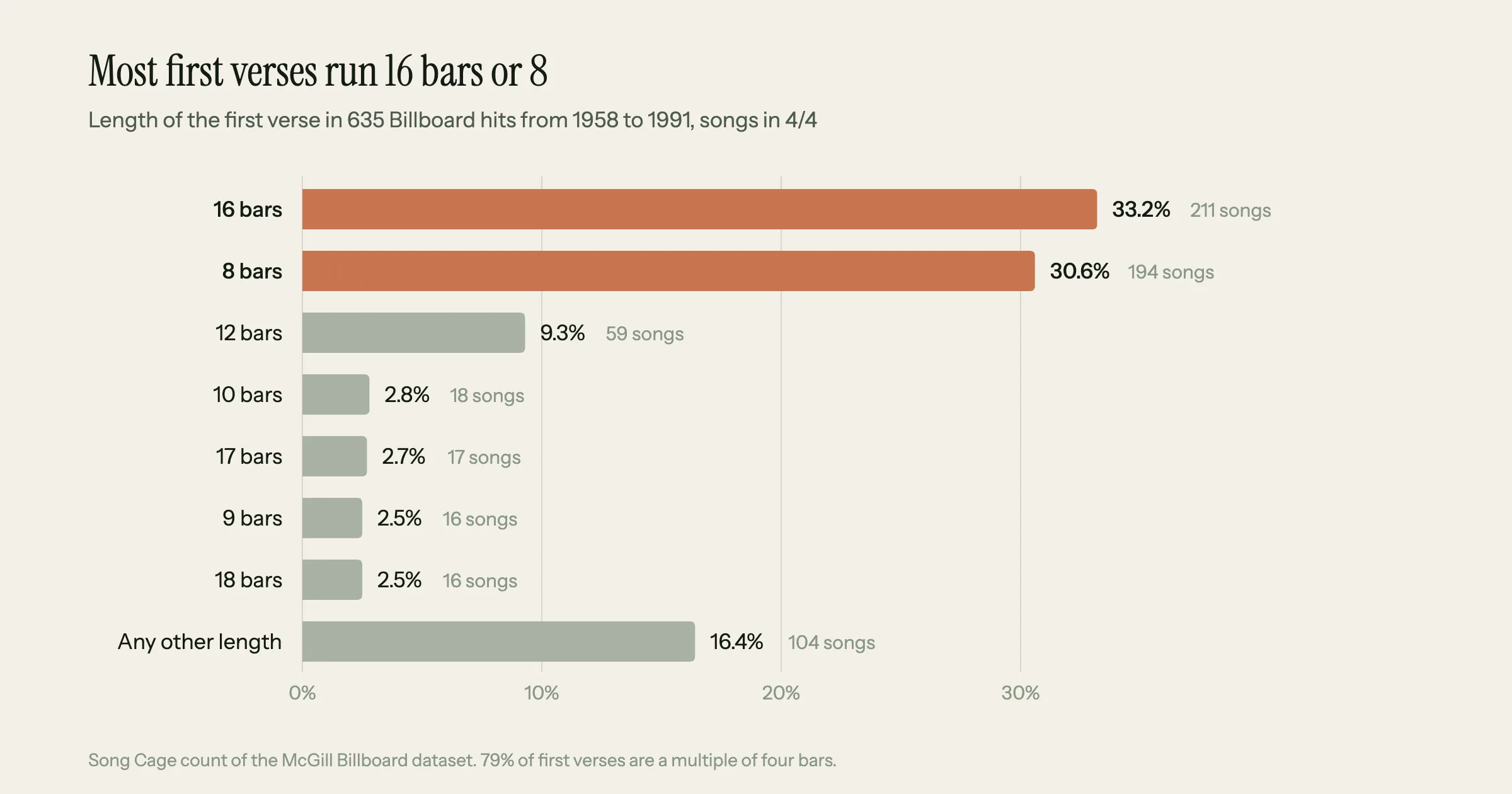
| First verse length | Songs | Share |
|---|---|---|
| 16 bars | 211 | 33.2% |
| 8 bars | 194 | 30.6% |
| 12 bars | 59 | 9.3% |
| 10 bars | 18 | 2.8% |
| 17 bars | 17 | 2.7% |
| 9 bars | 16 | 2.5% |
| 18 bars | 16 | 2.5% |
| 4 bars | 8 | 1.3% |
| Any other length | 96 | 15.1% |
First verses of 635 Billboard hits from 1958 to 1991 in 4/4. Song Cage count of the McGill Billboard dataset.
So 16 bars is the most common first verse, but only by a few songs. Taken together, the two lengths covered 63.8% of first verses, and the next most common, 12 bars, was a distant third.
Across every verse in those songs, not just the first, 8 bars edges ahead: 32.3% against 29.4% for 16, out of 1,854 verses. Later verses get shortened more often than they get stretched, which tips the balance.
How many bars are in a verse?
A verse usually has a multiple of four bars. In our count, 79.2% of first verses had a bar count divisible by four, and 66.3% were divisible by eight. That leaves about one first verse in five at a length that isn't a multiple of four: 17 bars (2.7%), 10 (2.8%), 9 (2.5%) or 18 (2.5%) were all more common than a 4-bar verse (1.3%). An extra bar at the end of a verse is common: a beat to breathe, a held chord before the chorus, a turnaround that won't fit in the last bar. If your verse comes out at 17 bars and sounds right, it's in good company.
The Song Foundry's rule of thumb that verses match their choruses held for fewer songs than you'd think. Of 511 songs with a counted first verse and first chorus, the two were the same length in 30.9%. The verse was longer in 51.1%, and the chorus in 18.0%. The most common first chorus was 8 bars (221 of 563), so the classic shape is a 16-bar verse into an 8-bar chorus as often as two equal halves.
How many bars is a rap verse?
A rap verse is usually 16 bars, and the count works differently there, because "bar" usually means a line of lyrics. Paul Edwards, who interviewed 104 rappers for his book How to Rap (2009), told Rap Analysis that "most wrote out their lyrics with one line equal to one bar." A rap 16 is sixteen lines over sixteen bars of beat. In a sung verse, a line usually takes more room than that.
How many lines are in a verse?
There's no fixed number, but you can work it out from your bars. Count how many bars one lyric line takes, then divide. If each line takes two bars, an 8-bar verse is four lines and a 16-bar verse is eight. At a fast tempo, or in a wordy style, a line may fit in one bar, and the same 16 bars hold sixteen lines, the way a rap verse does.
That's why four-line and eight-line verses are so common: they're what 8 and 16 bars come to when lines take two bars each. A four-line verse also suits the common rhyme schemes (AABB, ABAB, XAXA), all built on pairs of lines. Our guide to rhyme schemes covers the patterns and why a verse and a chorus often want different ones.
If your verse has an odd number of lines, check whether one line is really two, or whether the last line wants a bar of its own.
How long is a verse in seconds?
Fender's guide to song parts suggests keeping verses "under 1 minute, or just a few lines." The hits clear that easily. The median first verse in our count ran 26.5 seconds, and nine in ten were 43 seconds or shorter. Only 1.5% passed a minute.
Seconds follow from bars and tempo. Sixteen bars of 4/4 at 120 BPM is 32 seconds; at 80 BPM it's 48. If a slow song's verse is pushing a minute, it's probably 16 bars at a ballad tempo, which is a fine thing to be, but it's worth asking whether the second half of it is saying anything the first half didn't.
Length also adds up. A song with three 16-bar verses at a slow tempo will be long before you've written a bridge. How long should a song be has the numbers on whole songs.
How many verses does a song have?
Most songs have two or three verses, in roughly equal measure. Of the 712 songs in our count with a section labeled verse, 37.1% had two and 38.5% had three. Another 20.2% had four or more, and 4.2% had just one.
Those numbers include songs that put two verses back to back before the first chorus: 17.3% of songs with a chorus had at least two verses before it arrived. Starting with two verses buys time to tell more story before the payoff, at the cost of a longer wait for the hook.
Only 27 of the 739 songs had no section labeled verse at all, and most of those call their repeating section the chorus instead, often in AABA songs with a bridge. A few are instrumentals. The opposite case exists too: songs made only of verses, with no chorus. Music theorist John Covach calls that simple verse form, and lists blues-based rock and roll like "Heartbreak Hotel" and "Hound Dog" among the examples, as summarized in Wikipedia's verse–chorus form article. In a song like that, the verses carry everything.
What should the second verse do?
The second verse should take the song further than the first: the next event in the story, a new angle on the feeling, or a different point of view. It shouldn't restate verse 1 in new words. It usually keeps verse 1's melody, chords and length, so all the change has to come from the words and the arrangement.
Songwriters have a name for getting stuck here: second verse hell, also called the second verse curse. You've written a first verse and a chorus you love, and the song stops. Marty Dodson, writing for American Songwriter in 2020, names the biggest of the common mistakes: "the second verse that is just a re-written first verse." His version of the job: "The job of verse two is to take the big idea farther."
The reason it's hard is structural. Verse 2 usually has to fit the same melody, the same number of syllables per line and the same rhyme spots as verse 1, while saying something new. Every other section either repeats its words, like the pre-chorus, or gets new music, like the bridge.
Often the trouble starts in verse 1. Cattaneo's diagnosis is that writers sometimes fit the whole story into the first verse, so there's nothing left: "Don't give away the farm in the first verse." If verse 1 already covers meeting, falling out and the aftermath, verse 2 has nothing left to tell.
How do you get past second verse hell?
Songwriter and author Andrea Stolpe suggests three tools. The first is vantage point: decide when verse 1 is being told from, whether in the middle of the problem or looking back on it, and use that to choose when verse 2 happens. The second is expanding on the chorus message: if the chorus states the big truth, verse 2 can show another example of it. The third she calls flipping the coin: if verse 1 is the problem, verse 2 can imagine the opposite, even as a fantasy.
Cattaneo adds one more: write backwards. She was stuck on a song for months with a first verse and a pile of choruses, until her co-writer, Scarlet Keys, suggested she try writing backwards. She wrote about what happened before the first verse, moved the old verse 1 to the end, and wrote the whole song in about half an hour.
Then test it the way Gary Ewer of The Essential Secrets of Songwriting recommends: read verse 1 and verse 2 in a row, with no chorus between them. They should read like a story you'd want to keep reading. If verse 2 could just as well come first, it isn't moving the song yet.
Does verse 2 have to be the same length as verse 1?
Verse 2 doesn't have to match verse 1's length, but it almost always does. In our count, verse 2 had exactly as many bars as verse 1 in 86.7% of the 608 songs where we could compare the two. It was shorter in 8.1%, and longer in 5.3%.
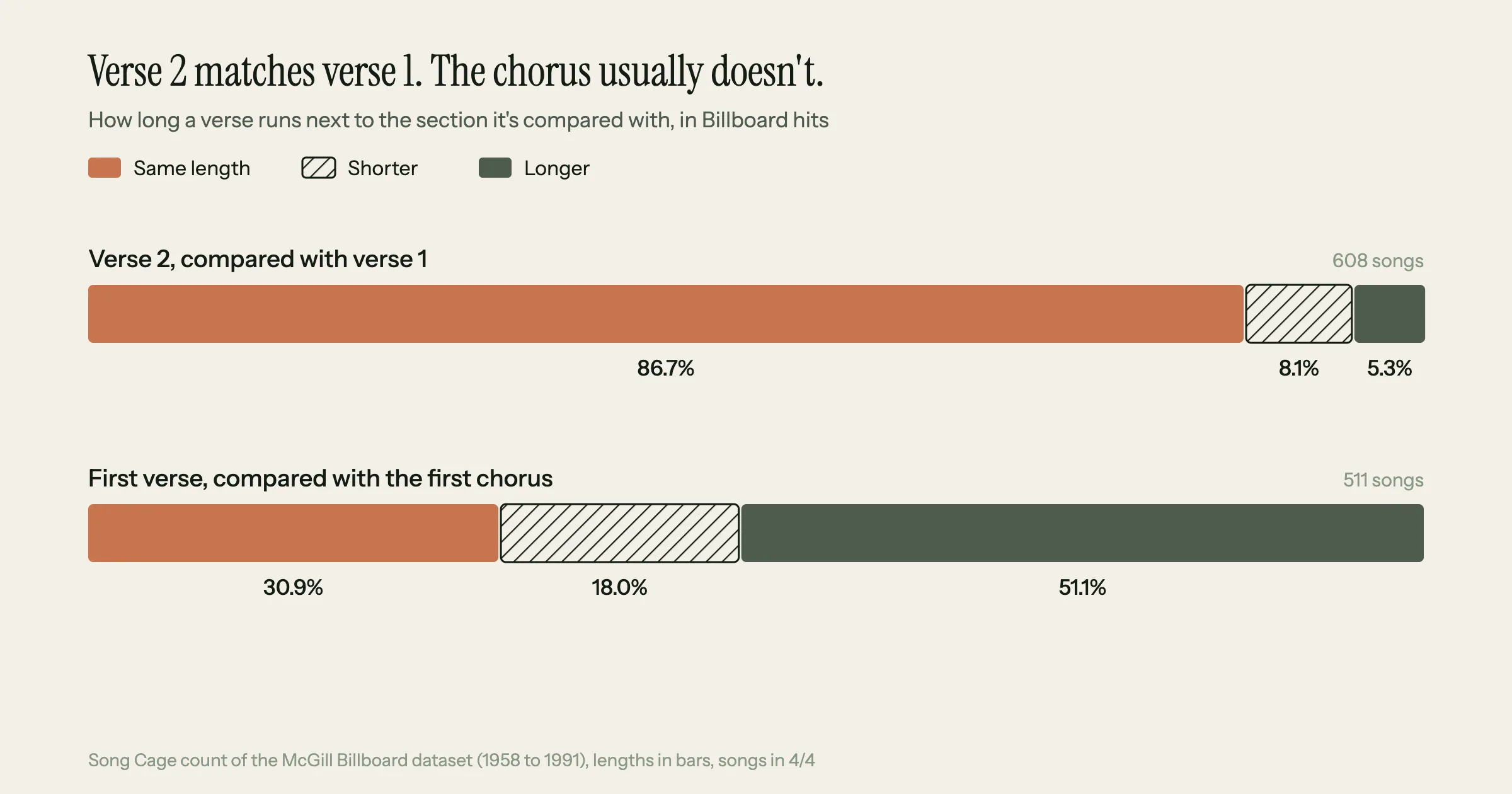
When verse 2 shrinks, it often shrinks by a lot. In 16 of those 49 songs, the second verse was exactly half the first. In the dataset's transcription, Sly and the Family Stone's "Hot Fun in the Summertime" runs a 20-bar first verse and a 10-bar second, and Bobby Womack's "That's the Way I Feel About Cha" goes from 16 bars to 8.
The Song Foundry calls a half-length verse 2 "one common trick" for keeping a song moving. In these hits it was a rare one, 16 songs out of 608, but it works for the same reason: it gets you back to the chorus sooner, after the listener already knows the setup and is waiting for the hook again. It's a fair fix when verse 2 has run out of things to say halfway through: cut it at the point where it has said them, rather than filling the rest.
Changing the melody is less common, but small changes help. Ewer points to verse 2 as a place to reach a higher note or two for a bigger moment, using Chicago's "You're the Inspiration" as his example. Keep the shape recognizable, so the listener still hears it as the verse.
How do you write a verse?
Write the verse after you know what the chorus says, or at least what it's about. Pick a time and place for the verse, fill it with concrete detail rather than conclusions, keep the melody lower or narrower than the chorus, and decide early what verse 2 will add so verse 1 doesn't use it up.
Here's how to write a verse, in the order that works for most songs.
- Know the destination. If you have a chorus, write the verse to arrive at it. If you don't, write one sentence for what the song is saying. The verse is the evidence for that sentence.
- Choose a vantage point. Stolpe's question: are you telling this from inside the moment, or looking back? Keep verse 1 in one timeframe.
- Show, then let the chorus tell. Put the people, the place and what happened in the verse. Save the big statement about how it feels for the chorus.
- Set the length before you fill it. Decide on 8 or 16 bars, or whatever your melody wants, then count how many lines that gives you at your tempo.
- Keep the melody below the chorus. A lower or narrower range in the verse gives the chorus somewhere to lift to.
- Plan verse 2 before you polish verse 1. Write one line for what verse 2 will add. If verse 1 already says it, move that material down.
- Read the verses in a row. Skip the chorus and read verse 1 into verse 2. They should move forward like a story.
None of these are rules. Plenty of great songs open on the title or put the feeling in the first line. They're a way to get from a blank page to a verse that leaves the second one something to do.
Should verses rhyme the same way?
Verses usually rhyme the same way. Because they share a melody, they tend to share a rhyme scheme too: the rhymes fall on the same notes each time, and a listener who learned the pattern in verse 1 hears it again in verse 2. That's also what makes verse 2 hard to write, since it has to fit the same rhyme spots. A slant rhyme gives you far more words to choose from than a perfect one, which is often the way out. The rhyme scheme guide covers slant rhyme and which patterns verses use.
How do you build verses in Song Cage?
In Song Cage a new song opens with a verse and a chorus. Add another verse and it's named Verse 2 automatically. You can set how many bars each lyric line takes, double a section to turn 8 bars into 16, copy verse 1's chords into verse 2, and keep two versions of a verse side by side with + Alt.
Each section on the Song Cage timeline holds your chords, lyrics and melody on one beat grid. Pick Verse from the section's tag when the song already has one, and it becomes Verse 2. The tag is a label, so a verse and a chorus behave the same way; it's there to keep you oriented.
Bars per line is a song setting (click the time-signature chip in the toolbar), from one to eight bars, with two as the default. At two bars a line, a lyric line that takes two bars fills one row, and an 8-bar verse is four rows. Add a row with the + at a line's bottom-left corner or Shift+Enter. The double icon in the section header doubles a section and its contents, the quick way from an 8-bar sketch to a 16-bar verse.
For verse 2, select verse 1's chords (Cmd/Ctrl+A in the section), copy, click into verse 2 and paste. A shorter section grows to fit. Then write the new words over the same chords.
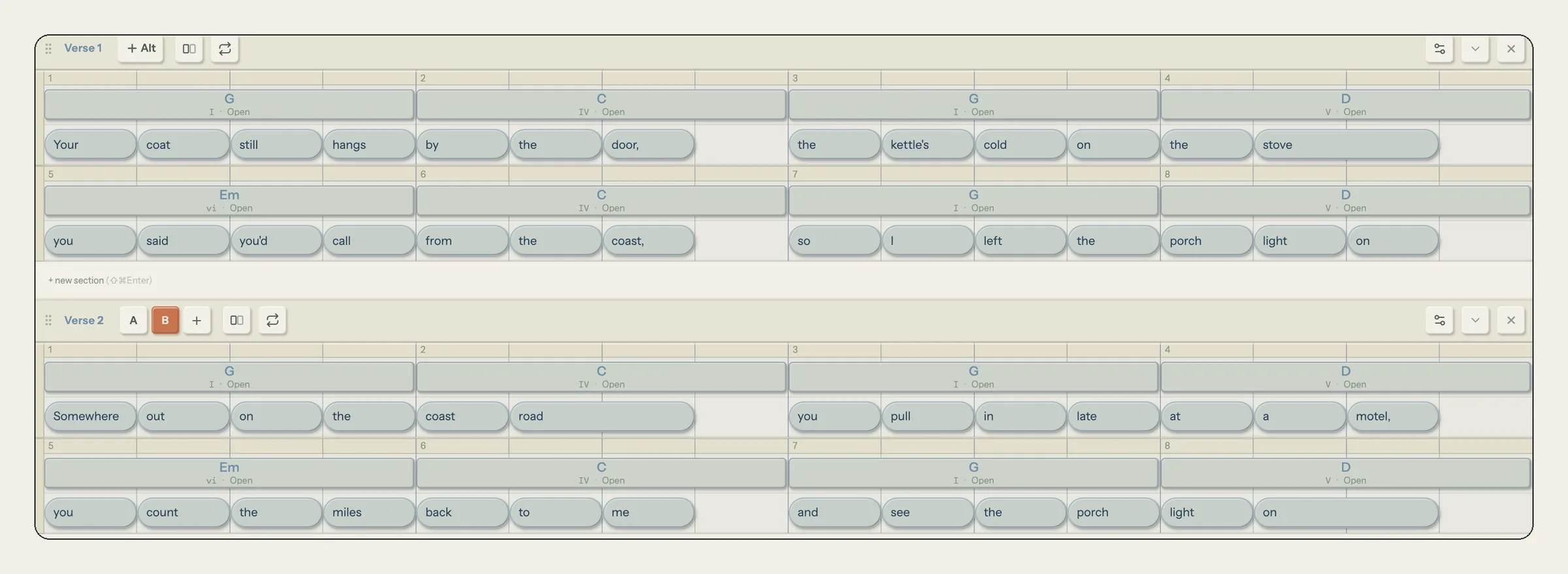
When you can't decide between two second verses, click + Alt in the section header. Song Cage keeps both versions as tabs, A and B, and the one showing is what plays. Sheet view has the same tabs (in the web app, the desktop app and the plugin), so you can read verse 1 straight into either version of verse 2 and keep the one that moves the story. The sections and the grid chapter of the docs covers all of it.
Frequently Asked Questions
How many bars is a verse in a pop song?
Usually 8 or 16. In Song Cage's count of 635 first verses from Billboard hits of 1958 to 1991, 33.2% were 16 bars, 30.6% were 8 bars and 9.3% were 12. About four in five had a bar count divisible by four. An extra bar at the end, making 9 or 17, is common and nothing to fix if it sounds right.
Why are rap verses 16 bars?
Sixteen bars is the standard length a rapper is asked for, long enough to build an idea with room left for a hook and more verses. In rap a bar usually means one line of lyrics over one bar of the beat: Paul Edwards, who interviewed 104 rappers for How to Rap, said most wrote out their lyrics with one line per bar. So a 16 is sixteen lines.
Can a verse be longer than the chorus?
Yes, and it usually is. In our count of 511 Billboard hits, the first verse was longer than the first chorus in 51.1% of songs, the same length in 30.9% and shorter in 18.0%. A 16-bar verse into an 8-bar chorus is a classic shape. The chorus is the part people remember, not necessarily the biggest part.
What is the difference between a verse and a stanza?
In a song lyric they're close to the same thing. "Stanza" comes from poetry and means a group of lines set off as a unit. "Verse" in songwriting means a section whose music repeats while its words change. A song's verse is usually written as a stanza on the lyric sheet, but a stanza in a poem has no melody to repeat.
Should every verse have the same melody?
Mostly. The repeated melody is what tells a listener they're back in the verse, and it's why the verses share a rhyme scheme. Small changes are common, though: a higher note in verse 2 for a bigger moment, or a line that holds longer before the chorus. Keep the shape recognizable and change the details.
Write verse 2 before the song goes cold
Song Cage keeps your chords, words and melody together in sections, so verse 2 starts on verse 1's chords and you can keep two versions of it until you know which one moves the story. Start with the verse you have.