A rhyme scheme is the cheapest structural decision in songwriting and the one most writers never actually make. You write a verse, the rhymes fall where they fall, and the shape of the section gets decided by whichever words happened to arrive first.
That is a shame, because the pattern is doing real work. It tells a listener when a thought is finished, when to expect more, and which line to lean on. Pat Pattison, who has taught lyric writing at Berklee for decades, puts it about as directly as it can be put: rhyme "creates the ear's roadmap through the lyric ideas. It tells your ear where to go next, what's connected to what, and when to stop."
This guide covers the notation, the patterns worth knowing, how the verse and the chorus should differ, and the five degrees of rhyme between "perfect" and "no rhyme at all." Then it gets to the part nobody has published: we counted every rhyme in the dictionary that ships inside Song Cage, and the results explain a frustration most writers assume is their own fault.

What is a rhyme scheme?
A rhyme scheme is the pattern of end rhymes in a section of a song, written as letters. Every line that rhymes with a previous line gets that line's letter, and every new rhyme sound gets the next letter of the alphabet. Lines that rhyme with nothing get an X. So a four-line verse whose second and fourth lines rhyme is ABCB, and one that rhymes in pairs is AABB.
The convention comes from poetry, where it describes a stanza. Songs use it slightly differently, and the difference matters. A song is not one continuous scheme running from first line to last. Each section starts fresh at A, because each section is expected to behave differently from the one before it. Your verse can be ABCB and your chorus AABB, and in a well built song it usually is.
The letters are not a description of what you wrote. They are a choice you can make before you write it.
How do you write a rhyme scheme down?
Four conventions carry almost all of the weight, and they are worth getting right because the reference sites disagree with each other.
Notation that songwriters actually use
- A, B, C: one letter per rhyme sound, assigned in the order the sounds first appear.
- X: a line that rhymes with nothing. Standard on the songwriting side, largely absent from the poetry references, and the one songs need most, because unrhymed lines are common and deliberate.
- A section break: label each section separately rather than running letters across the whole song.
- Capitals for a repeated line: a line repeated word for word, which is not the same as a rhyme.
Two genuine ambiguities are worth knowing about. Whitespace is load bearing: Wikipedia distinguishes ABAB (one four-line stanza) from AB AB (two two-line stanzas). And uppercase versus lowercase carries no agreed meaning in general use, although in fixed poetic forms with refrains the convention inverts, and a capital marks the repeated line rather than the rhyme.
What counts as a rhyme when you are labelling?
Most articles label real songs without ever saying what their rules are, which is why their labels often fail to scan. Here are the three rules used everywhere in this guide.
Slant rhymes count. If the ear hears a rhyme, it gets a letter. LitCharts is blunt about it: "poems that use imperfect rhymes are no different from poems that use perfect rhymes" when it comes to writing the scheme out. Its own example is a Yeats stanza labelled ABAB whose A rhyme is the slant pair on and moon.
A repeated word is not a rhyme. Ending two lines on the same word creates a sonic link, and it is a real technique, but it is repetition rather than rhyme. Give it its own notation rather than pretending the pattern rhymed.
Label what the ear hears, not what the page shows. Songs are written for listening. "Love" and "move" look like they rhyme and do not. "Home" and "alone" look like they do not and, sung, very nearly do.
Which rhyme schemes do songwriters actually use?
Seven patterns cover nearly everything songs do: AABB, ABAB, ABCB, XAXA, ABBA, XXAA and AAAA. Each puts the stops in a different place, and where a rhyme stops the ear is what decides whether a section drives forward or settles where it is.
Poetry references will hand you sixty named forms, most of which will never survive contact with a chorus. In songs the working set is small, and each pattern has a distinct effect on how the section moves.
Pattison frames the whole thing in terms of motion, which is the most useful lens available: a rhyme stops the ear, and where you put the stops determines how the section travels.
| Scheme | Name | What it does | Reach for it when |
|---|---|---|---|
| AABB | Couplet | Stops twice in four lines. Very stable. Each pair is a self-contained statement. | You want momentum and clean, direct ideas |
| ABAB | Alternating | One four-line unit rather than two two-line units. Moves without stopping in the middle. | You want the verse to travel as one thought |
| ABCB | Ballad | Only one rhyme lands. Lines 1 and 3 are free to say anything. | The words matter more than the sound |
| XAXA | Open ballad | Same as ABCB, notated to show the free lines are genuinely unrhymed. | Storytelling, conversational verses |
| ABBA | Enclosed | Holds the outer rhyme open across two lines. Unstable and suspended. | Longing, unresolved feeling |
| XXAA | Delayed | No rhyme at all until the last two lines, which arrive as a surprise. | You want the payoff at the bottom of the section |
| AAAA | Monorhyme | Relentless. Stops at every line and keeps going anyway. | Chants, hooks, driving hip-hop |
The four-line default is worth resisting occasionally. An odd-numbered section, five lines or seven, refuses to balance, and that refusal pushes the listener forward into whatever comes next.
Why do the verse and the chorus want different schemes?
Because a verse and a chorus do different jobs, and form should follow function. A verse develops the story. A chorus comments on it. If both sections use the same rhyme scheme, the same line lengths, and the same number of phrases, the song stops contrasting and the chorus stops feeling like an arrival.
Pattison teaches this with a worked example built to fail, a song called "Southern Comfort" whose verse and chorus are almost identical in shape. The verse rhymes alternate lines and then accelerates into a couplet at the bottom. The chorus rhymes alternate lines throughout, with no acceleration.
One song, mapped section by section
- Verse: X A X A X A B B, over stressed-syllable counts of 4-3-4-3-4-3-4-4. Three unrhymed lines alternate against a single A rhyme, then a couplet closes it.
- Chorus: X A X A X A X A, over 3+ 3 3 3 3 4 3+ 3. The plus marks a three-stress line ending on a weak syllable, which implies a fourth stress the ear supplies for itself.
Same phrase count, nearly the same line lengths, the same alternating rhyme, and the two plussed lines sit exactly where the four-stress lines sat in the verse. Pattison's verdict is that by the end of the chorus you have been through four systems of the same meter, and the bridge arrives with its contrast far too late.
His fix is not a better rhyme. It is a different shape: rebuild the verse so six lines balance against two rather than splitting into two identical four-line halves.
How does the melody choose the rhyme scheme?
There is a second reason the sections should differ, and it is easy to miss. Rhyme and melody negotiate with each other. As Pattison describes it, "when melodic phrases create a sequence, for example, long/short/long/short, they invite an abab rhyme scheme." You can accept that invitation and reinforce the melody, or decline it and create tension on purpose. Either is a decision. Neither happens by accident.
What does changing the scheme actually do?
The strongest demonstration of a rhyme scheme as an expressive tool comes from a master class Pattison ran in Perth with the songwriter Rachel Dillon, working on her song "Bellbird Hill." They kept the words and changed only the arrangement of the rhymes.
The verses arrived as AABB. His reading: "Her aabb verse rhyme scheme, carried for two verses, actually creates four sections, not two. It stops motion four times. A very stable feeling: lots of stops."
They tried three alternatives on the same two verses, mostly by reordering the lines. ABAB produced two units of four lines instead of four units of two, so the verse moved through without stopping in the middle. XXAA withheld the rhyme until the final syllable of each verse, landing as a surprise. ABBA opened the motion out into something more wistful.
Four schemes, essentially one set of words, four different songs. That is the argument for treating the pattern as a decision rather than a residue, and it is also the cheapest revision available to you: you are not writing new lines, you are reordering the ones you have.
What is the difference between perfect rhyme and slant rhyme?
A perfect rhyme matches the stressed vowel and everything after it, so "cat" and "hat" rhyme perfectly. Slant rhyme covers everything that gets close without matching, and it is not a lesser version of the real thing. It is a dial that controls how completely a line closes.
The scale runs perfect, family, additive and subtractive, assonance, consonance, in decreasing order of resolution, and it belongs to Pat Pattison. He works through the types in Songwriting: Essential Guide to Rhyming (Berklee Press, 2nd edition 2014) and ranks them as a scale in Writing Better Lyrics. Perfect, assonance and consonance are old prosody terms he inherited. Family, additive and subtractive rhyme are his, and so is the idea of ordering them by how finished they sound. He deserves the credit, because a great many articles publish the scale without offering any.
His analogy is the clearest thing written on the subject. A perfect rhyme, he says, is "fully resolved, like putting the root on the bottom. It stops motion fully and slams the gate shut." He then steps down a rung to a pair like cat and hack, where the t and the k are phonetic relatives, which stays "pretty stable" while opening the options up. Past that:
Why is rhyming harder in English?
He is equally blunt about the belief that rhymes ought to be perfect: "That's like saying that every section should end on the tonic chord, voiced in root position." His supporting point is a fact about the language, which he puts as "English has 17 vowel sounds. Italian, Spanish, Japanese and many other languages have only 5." The exact counts are rougher than that: published figures for English run from about fourteen to twenty depending on the accent and on how you count diphthongs, and standard Italian has seven. The direction is not in doubt. English carries one of the larger vowel inventories in the world, where five or six is the global norm, and that spreads its perfect rhymes thin.
Do songwriters actually agree about slant rhyme?
No, and the argument is old enough to be useful. Songwriters have been having it for as long as there have been songs. Irving Gordon, who wrote both the words and the music of "Unforgettable", told the interviewer Paul Zollo he was always ashamed of rhyming "unforgettable" with "incredible" in it, on the grounds that one word carries a "t" sound and the other a "d." Under Pattison's system that is a textbook family rhyme, since t and d are both plosives, and it is a large part of why the line sings. Zollo's reply was that it would be a good rhyme for most songwriters today.
Warren Zevon took the opposite view outright. "Nothing is perfect," he told Zollo, "and imperfect rhymes reflect that imperfection closer to reality." His practical conclusion, a few sentences later: "Often a non-rhyme will focus the listener on a word more than a comfortable perfect one."
Why can't you rhyme the word you actually mean?
Because a large part of English has no rhyme to give you. Of the 3,000 commonest English words, 424 have no perfect rhyme at all, and three quarters of the distinct rhyme sounds in the dictionary contain exactly one word. The shortage is in the language, not in your vocabulary.
Every article on rhyme treats this as a matter of taste. It is substantially a matter of arithmetic, and as far as we can tell nobody has counted.
So we counted. Song Cage ships a pronunciation dictionary so the Words panel works with no connection, which means the whole rhyme space sits in a file we can measure.
The rhyme census
Every word in the dictionary Song Cage ships, grouped by the sound it rhymes on.
Counts are of this dictionary, not of English in the abstract. A word with no listed rhyme may still have one in a regional accent or a proper noun.
That first number is the shape of the problem. Of 19,359 distinct rhyme sounds, 14,494 contain exactly one word. Three quarters of the ways an English word can end are dead ends occupied by a single occupant.
Which common words have no perfect rhyme at all?
Not the ones in the trivia lists. Everybody knows about "orange," "silver" and "purple," and none of them turn up in a lyric very often.
The words that actually strand you are the ones you reach for when the song gets serious. Of the 3,000 commonest words in English, 424 have no perfect rhyme, and they include music, woman, family, beautiful, silence, breathe, whisper, secret, empty, husband, nothing, something, someone, everything and anyone.
Look at the tail of that list. The entire -thing, -one and -body family is unrhymable, which means the most natural way in English to say "I have lost all of it" cannot be landed at the end of a line. That is not your vocabulary failing you. It is the language.
What is the one-rhyme trap?
Worse than a word with no rhyme is a word with exactly one, because your rhyming dictionary shows you a hit and the hit is unusable.
Words in the 5,000 commonest with exactly one perfect rhyme
- promise / thomas
- shadow / colorado
- always / hallways
- people / steeple
- only / lonely
- father / bother
- listen / christen
- future / suture
- wants / croissants
- important / unimportant
There are 393 of these in the 5,000 commonest words, and 47 in the top 1,000. Several are the same word with a prefix stuck on it, which is a rhyme on paper and an embarrassment in a chorus. "Only" and "lonely" is the one real gift in the set, and it has been used enough times that it now carries its own weather.
How did we count?
The pronunciations come from the CMU Pronouncing Dictionary, the long-standing open pronunciation database for American English, and the ranking by commonness comes from an open frequency list built from film and television subtitles. Two words count as a perfect rhyme when everything from the primary stressed vowel to the end of the word matches. A slant rhyme is scored on the vowel sequence alone.
The honest limits: this measures one dictionary, it uses one American pronunciation per word, and it excludes multi-word rhymes, which are exactly how a good lyricist escapes half the traps above. Treat the numbers as a floor on the problem rather than a ceiling.
One bug is worth admitting, because we found it while writing this. The word "fine" was returning no rhymes at all, having been filed under a stray pronunciation of the Irish political party Fine Gael instead of the one everybody uses. It has 48 rhymes. It has them again now.
What do you do when the word will not rhyme?
Four moves, in the order worth trying them.
Take the slant rhyme. Of the 424 dead-end words in the 3,000 commonest, 240 have more than one near rhyme available, and some are rich: "woman" and "silver" both have dozens. This is the normal answer, and the entire preceding section on rhyme types exists to tell you it is not a compromise.
Move the word off the line end. This is the professional move, and the best illustration of it belongs to Sammy Cahn, who wrote the lyrics for some eighty-seven songs Sinatra recorded. Handed Chicago as a subject in 1964, for the film Robin and the 7 Hoods, he and composer Jimmy Van Heusen put the city in the title and never once in a rhyme. They called it "My Kind of Town (Chicago Is)" and hung the rhymes on town.
Cahn refused the idea that he was stuck, which is the instructive part. "It's not that I can't rhyme 'Chicago,' I can," he told Zollo. "I know all the rhymes for Chicago; there's embargo, Wells Fargo… but they don't make it." The rhymes existed. They were simply not worth the line. So he built a title he could rhyme instead, and the awkward word never had to carry anything.
What if the word has to end the line anyway?
Two moves are left, and both accept the word where it is rather than moving it.
Rhyme the line before it. If the word has to close the section, shift the rhyme pair earlier so the last line can sit unrhymed against a pattern the ear has already accepted.
Leave it unrhymed on purpose. An unrhymed line inside a rhymed section is a spotlight, not a gap. Pattison has a name for the technique, sonic targeting, which he has been teaching since at least 1999: you leave a line unrhymed so its vowel sound sets up an expectation of a rhyme that never arrives, then satisfy that sound later on the word you most want heard, often a word sitting inside the title. "Targeting is a spotlighting technique," as he puts it.
And plenty of well known songs carry no rhyme at all. Paul Simon's "America" is the standard example, written in blank verse from end to end. Gerry Beckley put it well to Songfacts: "The entire song is prose. There's not one line that rhymes and I will tell some of the best songwriters you've ever met that particular element and you can see them stop and go through it in their head."
A hard residue
A few words have neither a perfect rhyme nor a near one. Something, someone, everything, anyone, secret and husband return nothing at all on either measure. For those there is no clever fix. Rewrite the line so the word lands somewhere other than the end.
How do you find the rhyme scheme of a song?
Play the record and write the last word of each line down the margin. Give the first one an A. For every line after it, ask whether the ending sound has already appeared: if it has, reuse that letter, and if it has not, take the next one. Mark the lines that rhyme with nothing as X. Stop at the section boundary and start again at A for the chorus.
Do it by ear rather than from a lyric sheet, because a singer's phrasing routinely rhymes things the page does not, and occasionally fails to rhyme things the page insists on. Do it to three songs you love and the useful pattern is not any individual scheme. It is how far apart the verse and the chorus turn out to be.
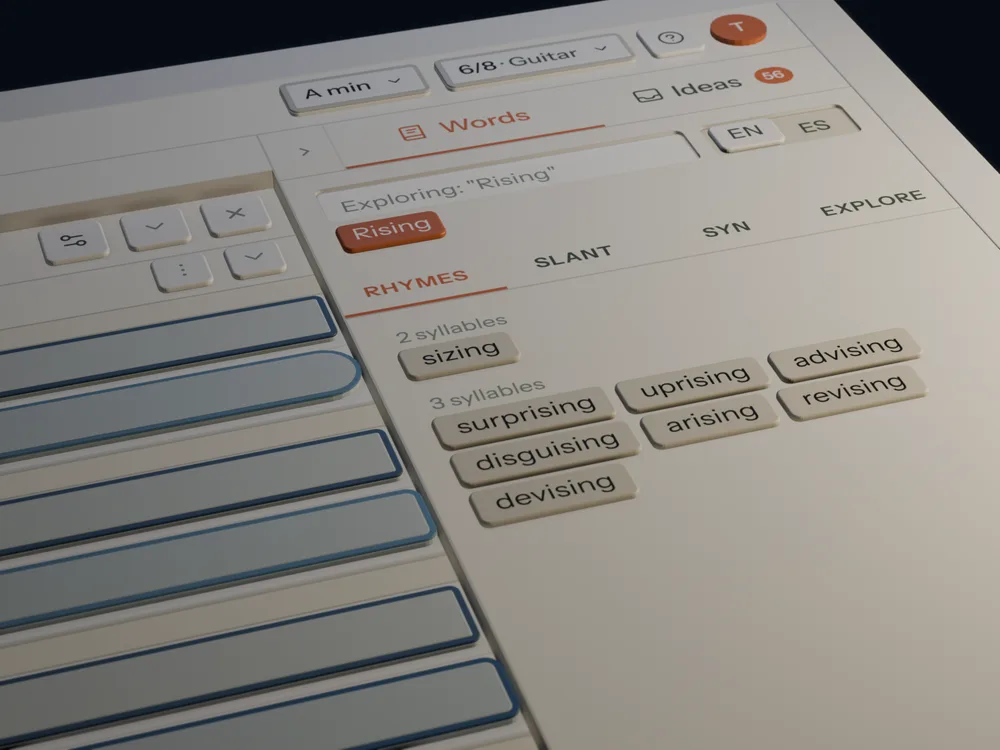
In Song Cage, the Words panel sits beside your lyrics and follows your cursor, so clicking a word shows its rhymes grouped by syllable count, with slant rhymes on their own tab. The syllable grouping is the part that matters when you are fitting a line, because a two-syllable rhyme lands in a different rhythmic slot than a four-syllable one. It works with no connection. What it will not do is rank the options for your particular line, or know what your song is about. Choosing is still the job.

Write the lyric where the rhymes live
Song Cage keeps your lyrics, your chords and the melody you captured in one place, with rhymes and slant rhymes a click away from the word your cursor is on.
Frequently asked questions
What is the most common rhyme scheme in songs?
ABCB and AABB are the workhorses of popular song, with ABAB close behind. ABCB rhymes only the second and fourth lines, which leaves lines one and three free to carry information, and that is why it dominates country, folk and storytelling songs. AABB moves fastest because each rhyme resolves immediately.
Should a song's verse and chorus have the same rhyme scheme?
Usually not. A verse develops the story and a chorus comments on it, and a change of rhyme scheme is one of the cheapest ways to signal that the job has changed. Keep the scheme consistent between verse one and verse two, then change it at the chorus. If the two sections share a scheme, share line lengths and share a phrase count, the chorus will not feel like an arrival.
Do slant rhymes count as rhymes in a rhyme scheme?
Yes. When you are labelling a scheme, a rhyme the ear accepts gets a letter regardless of how exact it is. This is standard in poetry analysis as well as songwriting. Slant rhyme is better understood as a lower degree of resolution than a failed perfect rhyme, and it is often the more natural choice in a conversational lyric. See our guide to internal rhyme for the related technique of rhyming inside the line.
Which words have no rhyme in English?
Far more than the famous three. In the dictionary Song Cage ships, 424 of the 3,000 commonest English words have no perfect rhyme, including music, woman, family, beautiful, silence, breathe, secret and the whole something/someone/everything family. Orange, silver and purple get the attention, but they are rarely the words a lyric actually needs.
Is it bad if my lyrics don't rhyme?
No, though it changes what the section does. Rhyme is what tells a listener a thought has closed, so removing it leaves the section open and moving. Some well known songs carry no rhyme at all, Paul Simon's "America" among them, which runs to the end in blank verse. The risk is not the absence of rhyme, it is an accidental absence: an unrhymed line reads as deliberate when the rest of the pattern is deliberate.
How many rhyme schemes are there?
For a four-line section there are fifteen mathematically possible arrangements, and only four in which every line rhymes with at least one other. Poetry adds dozens of named fixed forms such as the sonnet, villanelle and terza rima. Songwriters use perhaps seven patterns with any regularity, and the useful skill is choosing between them rather than memorising the catalogue.
Where to go next
The rhyme scheme is one of five things that decide how a section moves. The others are the number of lines, the length of each line, the rhythm of the phrases, and the rhyme type. Change any one and the section travels differently.
If you want the next lever, it is prosody: how the syllables sit against the melody, which is covered in fitting lyrics to a melody. For the pattern inside the line rather than at the end of it, see internal rhyme in songwriting. And if you are earlier in the process than any of this, how to write song lyrics covers the whole arc from subject to final edit, with song structure for the sections the schemes are sitting inside.
Sources worth reading directly: Pat Pattison's Q&A on rhyme for American Songwriter, his master class on rhyme schemes, and Paul Zollo's interviews with songwriters on rhyme, where the Cahn and Gordon accounts come from.