Table of Contents
- Why does everyone just say "sounds great"?
- Why can't you just judge it yourself?
- What should you send: a demo, a lyric sheet or a chord chart?
- What do you actually want to know about this song?
- Which questions get answers you can use?
- Should you explain the song before they hear it?
- Who should you ask which question?
- How do you let a listener point at the exact line?
- What do you say when they still just say it's great?
- How do you tell a real problem from one person's taste?
- How do you test a fix without starting over?
- Where can you get honest feedback for free?
- How much does paid song critique cost?
- Can listeners leave notes on a specific line in Song Cage?
- Frequently Asked Questions
You played it for three people. One said it was great, one said it was really good, and one asked if you'd written it yourself. You have learned nothing, and the second verse still feels wrong in a way you can't name.
Feedback requests are the most common kind of post on r/Songwriting, and the frustration shows in the titles. One from August 2026 reads "My friends don't seem to care much but this is the best song I've written in a long time." The problem underneath almost every one of those posts isn't the listeners. It's the question. "What do you think?" asks a friend to grade a whole song out loud, to your face, and the only safe grade is "great".
This post is about asking better. What to send, what to ask, who to ask which question, how to get people to point at the exact line, and where to find honest listeners when your friends have run out of new ways to say "nice".
Quick Summary
To get honest feedback on a song, ask about one line, not the whole song. Vague questions get polite answers. Send the roughest version that still carries the song, say nothing about it before the first listen, then ask about one moment at a time, matched to what that listener can actually hear. Get people to mark the exact line where they drifted or the line that stuck. One listener is taste. Two listeners who never spoke, naming the same line, is a problem worth fixing.
Why does everyone just say "sounds great"?
Friends say "sounds great" because "what do you think?" is a question about the whole song, and nobody wants to deliver a verdict on a friend's whole song to their face. People also misjudge how honesty will land: in a 2018 study, people who shared honest negative feedback overestimated how badly the other person would take it.
That study is Emma Levine and Taya Cohen's work on honesty, published in the Journal of Experimental Psychology: General. When they asked people to be completely honest in every conversation for three days, honesty turned out to be more pleasant and more connecting than people expected, and less damaging to their relationships. In their words, communicators "overestimate how negatively others will react to their honesty." Your friend isn't lying to you because they think the song is bad. They're protecting you from a reaction you probably wouldn't have.
The other half of the problem is that "do you like it?" and "does it work?" are different questions, and only one is useful. Keppie Coutts, who has taught songwriting at Berklee, made that split the first rule of giving song feedback in a piece for ASCAP. A listener who doesn't like country can still tell you exactly where a country song lost them. You just have to ask about that, and not about whether they like it.
HOME, a Nashville music nonprofit, puts the rule in one line in its own guide to feedback: "Specific questions get specific answers. Vague questions get vague answers."
Why can't you just judge it yourself?
You can't judge your own demo because you hear the song you meant, not the one you recorded. In Elizabeth Newton's 1990 Stanford study, people tapped the rhythm of a well-known song and guessed listeners would name it about half the time. Listeners named 3 songs out of 120. The tappers could hear the melody in their heads. The listeners heard knocking.
The dissertation is worth knowing in detail because it's the best model there is of a songwriter playing their own demo. Forty tappers each picked three songs from a list of 25 well-known tunes and tapped them on a table. Asked how likely their listener was to get it, they averaged 50%. The real rate was 2.5%, which fell outside every tapper's estimate. The tune they were hearing in their heads made the knocking sound obvious to them. Psychologists call this the curse of knowledge: once you know the tune, you can't hear the tapping the way a stranger does.
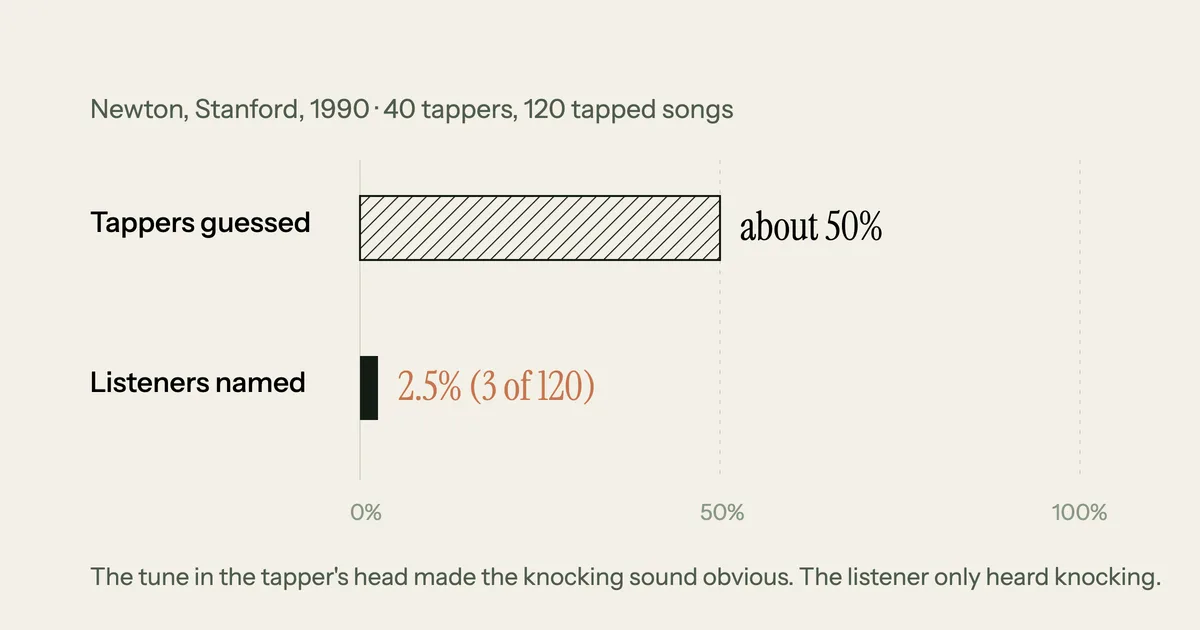
Your phone demo is a version of the knocking. You hear the arrangement you imagine, the lyric you know by heart, and the meaning you put into the bridge. A first-time listener hears a voice and a guitar and has to work the rest out.
Repetition makes it worse. Producers call it demo-itis: the producer Ryan McCambridge describes it as "favouring a recording because it's familiar to you," and warns that over-listening can convince you "that you have a great song on your hands when you in fact don't." That's a studio term from working producers, not a lab finding, but anyone who has played a rough mix forty times knows the feeling. Justin Berg's research on creative forecasting found that creators predict how other people's new ideas will land better than managers do, but lose that edge when the idea is their own, which is a large part of why we argued in what to do with 200 voice memos that you shouldn't delete on instinct.
What should you send: a demo, a lyric sheet or a chord chart?
The roughest version that still carries the song, plus the words on a page with every line numbered. A voice and one instrument is enough. A produced demo invites notes about the snare sound and makes the writer defensive about changes, because the rewrite now costs money.
Marty Dodson, a Nashville hit writer who co-founded SongTown, makes the money point bluntly in his post on getting better critiques: "If you've already spent $800 on the demo, it breaks my heart to tell you that your second verse is ALL messed up." The Nashville Songwriters Association International says the same thing from the other side of the desk. Its evaluation service tells members a simple instrument and vocal is enough, and that "Evaluators do not judge the production."
What you send with the recording matters more than the recording.
The feedback pack
- The recording. A phone memo is fine. Start it at the first note, not after ten seconds of tuning.
- The lyric, with numbered lines. Number every line straight through the song, 1 to 40, not restarting per verse. "Line 17" is something a listener can say. "That bit near the end" isn't.
- Section labels. Verse 1, Pre-chorus, Chorus, Verse 2, Bridge. The listener should never have to guess where they are.
- Timestamps for each section, if you're sending audio. "Chorus 0:48" lets someone tell you where they drifted without describing it.
- One or two questions. Written down, specific, and covered in the next sections.
Chords above the lyric are worth adding if the listener plays. They let a guitarist say "the IV in the pre-chorus is doing the same job as the IV in the verse," which is a note you can act on.
What do you actually want to know about this song?
Before you ask anyone anything, decide which decision you're trying to make. "Is the song good?" isn't a decision. "Do I keep the bridge or cut it?" is. "Is verse 2 moving the story on, or repeating verse 1?" is. Feedback is useful in proportion to how narrow the question is.
The best-documented example of this is from the making of The Wizard of Oz. Harold Arlen had the tune for "Over the Rainbow" and Yip Harburg, who was writing the words, doubted a Kansas farm girl would sing something so elaborate and ornate. According to Walter Rimler's essay for the Library of Congress, when the two of them were stuck they would take the disagreement to George and Ira Gershwin. George had died the year before, so this time it was Ira, who listened and asked one thing: "Harold, will you play that tune with a little more rhythm?" Arlen had been playing it grandly, with flourishes. Played simply and with a beat, Harburg heard a song a child could sing.
That's a feedback session at its most efficient. One specific disagreement, a listener both writers trusted, and a note small enough to try on the spot. (MGM still tried to cut the song from the film later. That's a different kind of note.)
Write your question down before you send anything. If you have three, rank them and ask the first one. You can ask the others next time, and the listener will be fresher for it.
Which questions get answers you can use?
The feedback questions that work ask about a moment, with an answer smaller than a verdict. "Where did you stop listening?" works. "Which line stuck with you?" works. "Is this good?" never does. Either/or questions are especially useful, because choosing between two options is easier than inventing a criticism.
The I Heart Songwriting Club's guide to getting feedback makes the same point with a nice example of the bad version: "What do you think of this song?" is "not specific and may lead to all sorts of input on the song that may be quite irrelevant and unhelpful." The subreddit r/WeAreTheMusicMakers writes it into its weekly feedback thread as a tip: "Ask for feedback on specific things."
Here are questions sorted by the part of the song they're about. Pick one or two, not the whole list.
Questions by moment
- The first line: "After line 1, did you want to hear line 2? What did you think the song was going to be about?"
- Verse 2: "Did verse 2 tell you anything verse 1 didn't?" This is the one most songs need asked.
- The pre-chorus: "Could you feel the chorus coming before it arrived?" Our post on what a pre-chorus is for explains why that's the whole job.
- The chorus: "When the chorus came in, did anything change, or did it feel like more of the verse?" See why a chorus doesn't lift.
- The title line: "What's the song called?" Ask it after one listen, without telling them. If they can't guess, the title isn't landing where you think it is.
- The melody: "Can you sing me any of it?" Ask five minutes later, about something else first.
- The bridge: "Did the bridge take you somewhere, or did it feel like a detour?"
- The ending: "Did it feel finished, or did it just stop?"
- Either/or: "Which is stronger, line 12 or line 28?" "Would you rather lose the bridge or the third verse?"
The melody question comes from Coutts's ASCAP checklist, which asks whether there's "a single melody that you can sing from the song 5 minutes after hearing the song." It's the closest thing songwriting has to a test with a pass mark, and it works on anyone, musician or not. Whatever they hum back is your hook, whether or not it's the part you meant to be the hook.
Should you explain the song before they hear it?
No. Play it cold, then ask what happened in the song before you ask anything else. Anything you say first becomes part of what they hear, and then you can't find out whether the song says it on its own. The explanation won't be in the room when a stranger hears it on a playlist.
Coutts goes further in her ASCAP piece: when you're receiving feedback, "you are not allowed to explain your own song." That's harder than it sounds. Every songwriter's instinct, the moment a listener looks puzzled, is to say "it's about my dad" or "the second verse is meant to be from her side". Don't. The puzzlement is the information.
There's a well-tested structure for this from outside music. The choreographer Liz Lerman devised the Critical Response Process in 1990 for giving feedback on work in progress, and its order of steps fits a song session closely:
Critical Response Process, adapted for a song
- Statements of Meaning. Listeners say what was meaningful, evocative or striking. For a song: what stuck, and what they think it's about.
- Artist as Questioner. You ask your specific questions, the ones from the section above.
- Neutral Questions. Listeners ask you questions with no opinion hidden in them. "What made you go to the minor chord there?" is neutral. "Why is the bridge so long?" isn't.
- Permissioned Opinions. Opinions come last, and only with permission, in the form "I have an opinion about the chorus, would you like to hear it?" You're allowed to say no.
The second step is the one that changes songwriting sessions. In most feedback, the listener decides what gets talked about. In Lerman's order, you do, and opinions arrive only after you've heard what landed and asked what you came to ask.
Who should you ask which question?
Ask each person the question they can actually answer. Non-musicians are the best judges of attention, memory and story, because that's all a listener has. Other songwriters can hear prosody and structure. Players can hear the chords. Asking a friend who doesn't play about your voicings wastes their time, and so does asking a session guitarist whether the story moved.
| Listener | Ask them | Don't ask them |
|---|---|---|
| Friend who doesn't play | Where did you drift? What's it about? Can you sing any of it back? | Is the progression too simple? Is the bridge in the right key? |
| Another songwriter | Does verse 2 move? Do the words sit naturally on the melody? Is the title in the right place? | Do you like the genre? |
| Someone who plays your instrument | Is the pre-chorus chord doing anything? Does the strum fight the vocal? | Does the story land? (They'll be listening to your hands.) |
| A singer | Can you sing the chorus at full voice? Where does it sit uncomfortably? | Is the guitar part interesting? |
| Your target audience | Would you play it twice? What does it remind you of? | Anything technical |
The second column is what each listener is equipped to hear. Questions from the third column get guesses.
The songwriter row deserves its own note. "Do the words sit naturally on the melody?" is a prosody question, and it's the one non-songwriters notice only as a vague feeling that something is off. Another writer can usually point at the syllable. Our post on fitting lyrics to a melody covers what they'll be hearing. The singer row matters too: a melody that sits wrong for a voice reads as a weak song to a listener, when the real fault is the key.
How do you let a listener point at the exact line?
Give them a way to mark lines without writing a review. Hand over the numbered lyric and ask for two marks: circle the line where your attention went somewhere else, underline the line you remember. Two marks from three people tell you more than three paragraphs of "I liked the vibe."
One of the best-known notes in pop history was about a single line. Paul McCartney has told the story many times of playing "Hey Jude" to John Lennon with a placeholder he meant to replace. As he told it to Barry Miles for Paul McCartney: Many Years From Now (1997): "when I got to the line, 'The movement you need is on your shoulder,' I looked over my shoulder and I said, 'I'll change that, it's a bit crummy. I was just blocking it out,' and John said, 'You won't, you know. That's the best line in it!'"
Notice what made that note useful. It was about one line. It was specific enough to act on. And it was a "keep", not a "fix". Half of what you want from a listener is to know which lines are already doing their job, so you don't sand them off in a rewrite.
If you're there in person, watch as well as listen. Look for where they look away, where they nod, the line where they glance at the page to check a word. Those are the same marks, made without a pen. HOME's guide suggests asking to record the session, audio rather than video because people are more honest off camera, since you won't remember everything that was said, especially if you're nervous.
What do you say when they still just say it's great?
Narrow the question until "great" stops being an answer. "If you had to cut one line, which one?" "Which part would you skip if you heard it on the radio?" "What's one thing you'd change, even if it's small?" A forced choice gives a polite listener permission to be honest without it feeling like an attack.
Some follow-ups that work:
When you get "sounds great"
- "Thanks. Which line stuck with you?"
- "If you had to cut one line, which would it be?"
- "Was there any moment you were waiting for the next bit?"
- "What did you think the second verse was about?"
- "Can you sing me the chorus?"
Then the hard part: take the answer without arguing. If they say line 23 lost them and you start explaining what line 23 means, the session is over. They'll go back to "great" because it's the only answer that doesn't start a debate. Write it down, say thanks, and argue with it later, alone.
Pat Pattison, the Berklee lyric-writing professor, put the attitude plainly in an interview with Unpaved: "Your songs are not your children. Get over that." He tied it to having the craft to act on notes: once you know there are tools and techniques that make songs better, "you're eager to have different viewpoints on your songs."
How do you tell a real problem from one person's taste?
Look for agreement between listeners who didn't hear each other. One person saying the bridge is long is a data point. Two people who never spoke both circling line 23 is a pattern. Agreement only counts if it's independent, so don't run a group session where the first opinion spoken becomes everyone's.
The common rule in feedback guides is a version of majority vote. HOME's version is "If three different people point to the same issue, it's an issue." The Atlanta Institute of Music and Media's critique guide says "trust the majority." Both are right, but most songwriters don't have ten listeners. They have three, and what makes three useful is that they reached their answers separately.
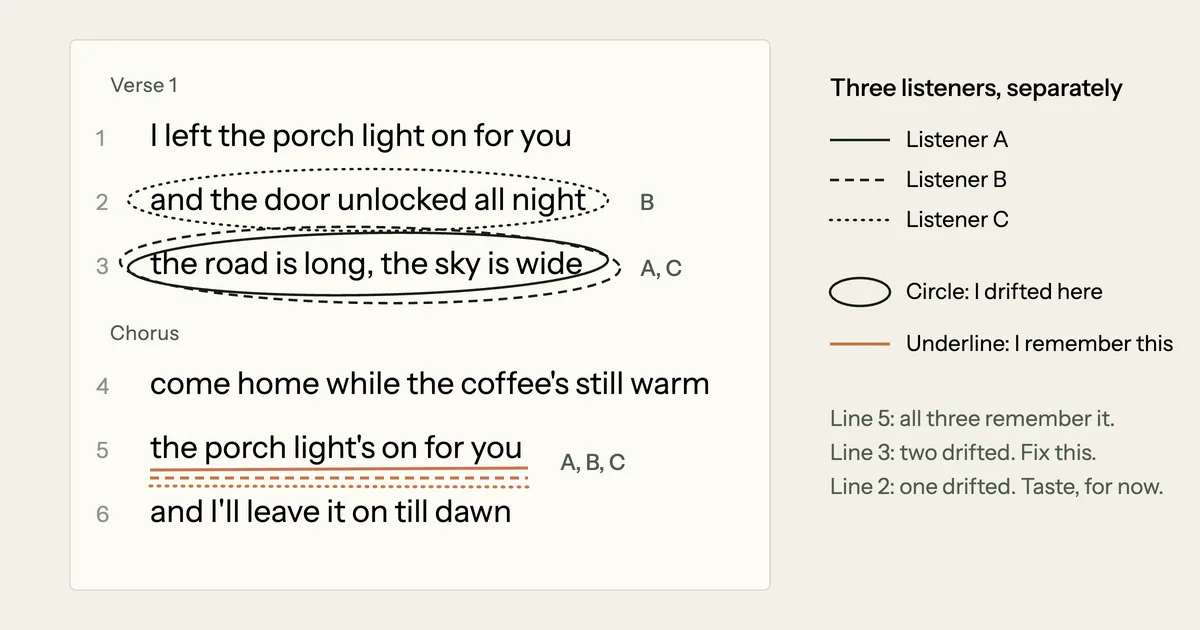
That's the case for asking one at a time and not telling the second listener what the first one said. It's also why the line-marking method beats a conversation: a circle on line 23 is the same mark whether or not anyone else made it.
Two cautions. First, a specific note beats a popular one. "The chorus doesn't lift" from three people tells you less than "the chorus melody starts on the same note the verse ended on" from one. Second, disagreement is information too. If one listener circles the bridge as the best part and another as the worst, the bridge is doing something. It may be exactly what the song needs, and it just isn't for everyone.
How do you test a fix without starting over?
Change one thing and ask the same listener the same question. If someone circled line 23, rewrite line 23 and play them the section again, not the whole song. Better still, play two versions back to back and ask which one works. Hearing the two side by side is much easier than judging a new version on its own.
The same-listener part matters. A new listener hearing your fixed version has nothing to compare it to, so they can't tell you whether the fix worked, only whether they like the song. The person who flagged the line knows what the problem sounded like.
Keep the version you're replacing. Rewrites aren't always improvements, and the original is the only control you have. If you work in Song Cage, the section versions described at the end of this post let you keep a chorus A and a chorus B in the same song and flip between them.
Where can you get honest feedback for free?
Songwriting communities that make you give feedback to get it, and writers' nights. r/Songwriting expects you to review three other songs when you post one. Writers' rounds put you in front of other writers. Paid services exist, but the most useful of them review the song, while the better-known ones review the record for playlist and placement decisions.
The rules of each place shape the feedback you'll get there, so read them first.
- r/Songwriting needs at least 5 comment karma before you can post a feedback request, and AutoModerator replies to every request asking you to find "THREE other songs requesting feedback and post substantive (eg. 2-3 sentences) of feedback." Feedback posts need audio or video. Lyrics with no music go in a weekly Lyrics-Only thread that renews every Monday, which is a better bet than a "rate my lyrics" site because a person there can tell you which line lost them.
- r/WeAreTheMusicMakers allows feedback only in its weekly thread: post one song and write at least three constructive comments on other people's. It leans towards mixing and production.
- Writers' nights and rounds. The Bluebird Cafe in Nashville dates its "In The Round" format to 1985: four songwriters seated in the center of the room, taking turns. Most cities have a smaller version of it. Playing a song to a room of strangers is the purest attention test there is.
- A swap with one other writer. Trade a song a month with someone at your level. Same questions each time, same format. This builds the kind of listener who can tell you whether verse 2 got better since last month.
How much does paid song critique cost?
Paid song critique runs from about €2 for one curator's comment to a few hundred dollars a year for a membership. The useful split isn't price, it's whether the service judges the song or the record. NSAI and SongTown review the songwriting; SubmitHub, Groover and TAXI mostly judge whether a recording fits a playlist, a blog or a placement.
Searching "rate my song" mostly turns up services that score a track, not people who'll tell you which line lost them. If you do pay, know what you're buying. These were the prices on each service's own pages in October 2026.
| Service | What you get | Price | Judges |
|---|---|---|---|
| NSAI | Written or audio evaluation from an anonymous professional songwriter. A rewrite goes back to the same evaluator. | 12 evaluations with an annual membership ($225 for the first year); extra ones $25 | The song |
| SongTown | One song a month in a pro feedback forum, plus member forums | $240 a year or $30 a month | The song |
| TAXI | Screeners decide whether to forward a submission to an industry listing, with a critique on most submissions | $299.95 first year, $199.95 renewal, plus $5 per song | The record, for placement |
| Groover | A blog, radio show or label must give at least 15 words of feedback within 7 days, or you get the credits back | About €2 per contact | The record, for coverage |
| SubmitHub | With premium credits a curator must listen at least 60 seconds, then approve or give at least 20 words | 1 to 4 credits per curator, from $1 a credit | The record, for playlists |
Prices from each service's own pricing or help pages, October 2026. "The record" means the recording and its fit for a release decision, not the songwriting.
The last column is the one to read. A playlist curator passing on your track in twenty words is telling you whether it fits their playlist. That's useful if you're releasing. It won't tell you that verse 2 repeats verse 1.
Can listeners leave notes on a specific line in Song Cage?
A listen link lets anyone hear your song and leave a note on a specific line, with no account. You make the link from the Share dialog, send it, and the listener sees your chord sheet, presses Play, taps the line they mean and writes. Their notes come back in a Notes tab next to the song.
Here's what it does and where it stops. In Song Cage, open File › Share… (or the Invite button in the toolbar, which reads Invite a co-writer on a wide screen) and choose Create listen link. The link is copied straight away. It works for 30 days, and Turn off kills it at once.
The listener opens it in any browser, including on a phone, without signing up. They see the song as a chord sheet: the sections by name, the chords above the lyric, the key and tempo. One Play button plays your chords and melody back, highlighting the line being played. To leave a note they tap a line, type, and send. A note can also be about the whole song.
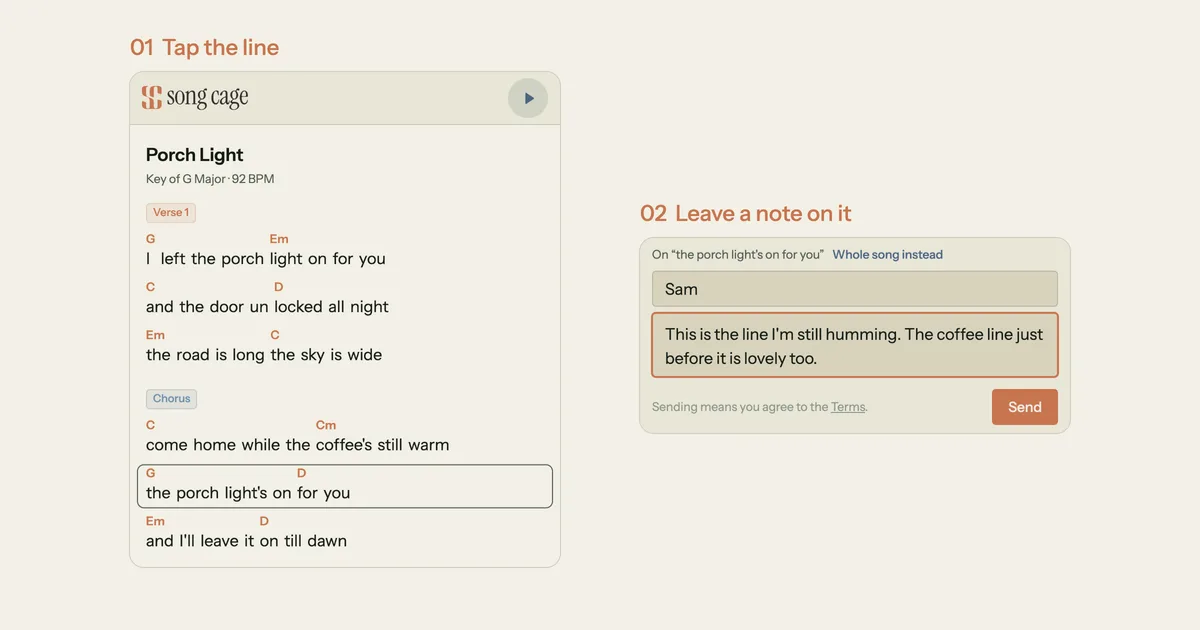
Two details make it fit this post's method closely. Notes are attached to a line, so "line 23 lost me" arrives already pointing at line 23. And each listener sees only their own notes and the replies to them, never another listener's notes, so three listeners give you three independent reactions.
What it doesn't do
- It plays Song Cage's playback of your chords and melody, not a recording. A phone memo can't be sent this way, so for a recorded demo use the numbered-lyric method above.
- Notes go on a line or on the whole song, not on a single chord or a moment in time.
- You make and read links in the web app or the desktop app. The phone and iPad apps and the plugin don't have it.
On the web it's free, including on the free account, which covers one song. In the desktop app it needs the licence or the 14-day trial, because only songs that sync can be shared. When a note arrives you get an email (at most one a day), and the song gets a filled speech bubble in your song list. In the Notes tab you can reply, which the listener sees when they come back, delete a note, or block someone.
For the fix-testing step, section versions help. Pick New alt of this section in a section's settings and you get tabs (A, B, +) next to the section name, each a full version you edit normally. While the song plays, switching tabs lands on the next bar line, so you can flip between two choruses in time. A listener on the listen link hears whichever version is showing when the page loads, and the page refreshes when they come back to it, so switch the tab between listeners if you want each to hear a different one.
For working on a song with someone rather than collecting notes on it, the collaboration features and the collaboration chapter of the docs cover co-writer invites, which are separate from listen links.
Ask about a line, not the song
Write the song in Song Cage, send a listen link, and get notes pinned to the exact line. Free on the web for your first song.
Frequently Asked Questions
How many people should I ask for feedback on a song?
Three is usually enough if they listen separately. What makes a note trustworthy is two people who didn't talk to each other naming the same moment, and three listeners give that a fair chance to happen. More people help only if you keep them independent, because a group in one room tends to settle on whichever opinion was spoken first.
Is feedback from non-musicians worth anything?
Yes, for the right questions. A non-musician can tell you exactly where their attention drifted, what they think the song is about, and which part they can sing back five minutes later, and those are the things the eventual audience will experience. Don't ask them about chords, keys or structure, because they'll guess.
When is a song too early to share for feedback?
When you can't yet name the question you want answered. A song with a finished chorus and one verse is ready for "does the chorus land?" It isn't ready for "is this good?" Earlier is cheaper: a rough voice-and-guitar take costs nothing to rewrite, while a paid demo makes every note feel expensive.
Is paid song critique worth it?
It can be, if it critiques the song. NSAI's evaluations and SongTown's pro forum are written by songwriters about songwriting. Services like SubmitHub, Groover and TAXI are mainly about whether a recording fits a playlist, a blog or a placement, which matters when you release and not much while you're still writing. Try the free routes first; they also train you to give feedback, which is half of learning to use it.
Should I tell people what the song is about before they listen?
No. Play it first and ask what they think it's about. If their answer matches yours, the song is doing its job without you. If it doesn't, you've learned the most useful thing a listener can tell you, and you'd have hidden it by explaining first.
How do I give useful feedback on someone else's song?
Say what stuck before anything else, then answer the question they asked rather than the one you'd have asked. Point at lines by number. Separate "I don't like it" from "it isn't working", and offer opinions only when invited. Liz Lerman's Critical Response Process puts this into four steps, and it works for songs as well as dance.