Table of Contents
- What is song structure?
- What are the parts of a song?
- What does a verse do?
- What is a pre-chorus?
- What is a chorus?
- What is a post-chorus?
- What is a bridge, or middle 8?
- What about intros, solos, and outros?
- Hook vs chorus vs refrain: what is the difference?
- How does structure shape a song's energy?
- The most common song structures (with maps and real songs)
- Verse-Chorus and Verse-Pre-Chorus-Chorus
- Verse-Chorus-Bridge (the modern default)
- AABA (the 32-bar song form)
- Strophic and verse-refrain (AAA)
- 12-bar blues
- Through-composed and songs with no chorus
- How does song structure change by genre?
- Writing for streaming and TikTok: front-load the hook
- How do you choose a structure for your song?
- Common song-structure mistakes (and how to fix them)
- How to build your song structure in Song Cage
- Frequently Asked Questions
You have a verse and a chorus. They sound good on their own. Then you try to turn them into an actual song and everything stalls: you do not know what comes next, the chorus stops feeling like a payoff, and the whole thing flattens out around the two-minute mark. That is almost never a melody problem. It is a structure problem.
Song structure is the part of songwriting nobody teaches you first, even though it decides whether your ideas land. The good news is that the toolkit is small. A handful of section types, a handful of common forms, and a few rules about contrast and energy cover almost every song you have ever loved. This guide walks through all of them, with scannable section maps and real songs you can pull up and hear, so you can stop guessing and start arranging on purpose.

What is song structure?
Song structure is the arrangement of a song's sections: the order in which its verses, choruses, bridges, and other parts unfold over time. It is the blueprint that tells a listener what to expect and when, turning a handful of musical ideas into a journey with a beginning, a build, a payoff, and an ending.
Think of sections as the rooms of a house and structure as the floor plan. The same rooms in a different order make a completely different home. A verse that arrives after the chorus hits differently than one that sets it up. Structure is also a contract with the listener: once you establish a pattern, every repeat builds trust, and every break from it (a bridge, a key change, a dropped beat) creates surprise. Most of the craft is managing that balance between the familiar and the new.
What are the parts of a song?
Most songs are assembled from a small set of named sections. Core sections (verse, chorus, bridge) carry the main musical and lyrical content. Auxiliary sections (intro, outro, solo) frame the core by setting it up, relieving it, or winding it down. Here is the working cheat sheet:
| Section | What it does | Typical length | Lyrics |
|---|---|---|---|
| Intro | Sets the scene, establishes groove and key | 2 to 8 bars | Usually none |
| Verse | Tells the story, moves it forward | 8 to 16 bars | Change every time |
| Pre-chorus | Builds tension into the chorus | 2 to 8 bars | Repeat |
| Chorus | The emotional payoff and main message | 8 bars | Repeat (hold the title) |
| Post-chorus | Extends the high, adds a second hook | 2 to 8 bars | Repeat |
| Bridge | Contrast, a new angle before the last chorus | 4 to 8 bars | New, used once |
| Outro | Brings the song to a close | 4+ bars | Often a repeat or fade |
Bar lengths are conventions, not rules. The point is the role each section plays.
What does a verse do?
The verse is the storytelling engine of a song. Its music repeats with each occurrence, but the lyrics change every time, delivering new information and building toward the chorus. Verse one introduces the situation; verse two raises the stakes or shifts perspective. Because the verse keeps the same melody and chords while the words move, it is where most of a song's actual content lives.
A verse usually sits lower in energy than the chorus on purpose. It leaves somewhere to go. If your verse is already at full intensity, the chorus has nothing to lift into, and the song feels flat the whole way through. Many writers draft the chorus first, then write verses that aim at it. Either order works, as long as the verse leaves room for the payoff. For more on the words themselves, see how to write song lyrics.
What is a pre-chorus?
A pre-chorus is a short transitional section between the verse and the chorus, also called the climb, the ramp, or the lift. Its job is to leave the tonic and land on the dominant, so the chorus arrives as a resolution rather than just a louder part. It is optional, it usually repeats each time it appears, and it sounds different from both the verse and the chorus.
We wrote a full guide to what a pre-chorus is, covering which chord it should land on, how long it should run, and how to tell whether your song needs one at all.
What is a chorus?
The chorus is the core of the song: it carries the central message, the most memorable melody, the hook, and usually the title. Unlike the verse, it keeps the same lyrics every time it returns, and it delivers the emotional release the verses build toward. If a listener remembers one part of your song, it is almost always the chorus.
The chorus is also the test of your structure. It should feel like an arrival, which means it needs contrast: more energy, a wider melody, a fuller arrangement, or a lyric that finally says the thing. When people complain that a chorus "does not hit," the fix is rarely a better melody. It is more separation from the verse that precedes it. For the checks that tell you which of the two to move, see our guide to what a chorus is in a song. The chorus is where your chord progression usually opens up to its brightest, most resolved shape.
What is a post-chorus?
A post-chorus is a section that follows immediately after the chorus, holds or raises its energy, and carries its own hook (vocal or instrumental). It is distinct from a bridge, which drops energy, and from a plain transition, which has no hook of its own. It is everywhere in modern pop.
Lady Gaga's "Poker Face" builds its post-chorus around the recurring "Mum-mum-mum-mah" hook, the same phrase that opens the song. Many dance-pop songs put the biggest instrumental moment, the "drop," in the post-chorus slot rather than the chorus itself. The post-chorus gives you a second memorable hook per cycle and a clip-ready moment, which is part of why it exploded in the streaming era. You do not need one. But if your chorus ends and the energy sags before the next verse, a post-chorus is often the missing piece.
What is a bridge, or middle 8?
A bridge is a contrasting section that usually appears once, after the second chorus. It departs from the verse and chorus in melody, harmony, and often lyrical perspective, breaking the song's repetition and creating fresh expectation before the final chorus. In the United Kingdom it is often called the middle 8, after the contrasting 8-bar section of older song forms.
For the harmony that makes a bridge work, the three different things the word "bridge" means, and a table of real songs taken apart, see our full guide to what a bridge is in a song.
What about intros, solos, and outros?
Intros, instrumental solos, and outros are auxiliary sections: they frame the core without carrying the main message. An intro establishes the groove, key, and mood, and often previews a melodic motif you will hear again. Keep it short. In the streaming era, a long intro is the fastest way to lose a listener before the song begins.
A solo (guitar, synth, sax) usually sits after the second chorus, in the same slot a bridge would occupy, and gives the song an instrumental peak. An outro, or coda, closes the song: a repeated chorus to a fade, a stripped-back tag, or a uniquely written ending. The Beatles' "Hey Jude" is the extreme case, where the "na-na-na" coda runs over four minutes, more than half the record. Most outros are far shorter, but the principle holds: give the listener a clear way out.
Hook vs chorus vs refrain: what is the difference?
These three words get used interchangeably, and they should not be. A refrain is defined by lyrical repetition (a repeated line, often the last line of a verse). A chorus is defined by structural role (a complete, contrasting section that recurs). A hook is defined by impact (whatever element is most memorable). Different criteria, not synonyms.
The short version: all choruses are refrains, but not all refrains are choruses, and a hook can live anywhere. For the full breakdown, including a criteria table and verified songs whose hook sits outside the chorus, see our guide to what a hook is and how it differs from the chorus.
How does structure shape a song's energy?
The deepest way to understand structure is as a map of tension and release across the whole song. Verses build, pre-choruses tighten, choruses release, bridges reset, and the final chorus pays everything off. Every section is a step up or down on an energy curve, and a song that lands is usually a song whose energy curve makes sense.
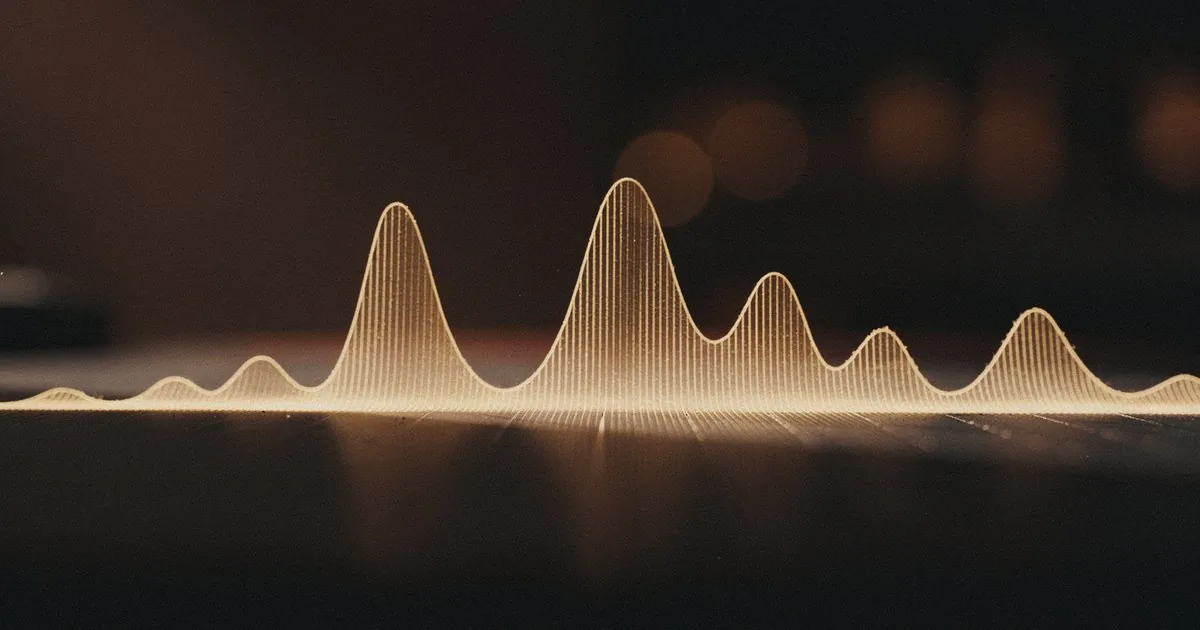
This is why contrast matters more than any single section. A chorus only feels big if the verse before it felt smaller. A bridge only resets the song if the choruses before it built real pressure. When a song feels monotonous, the sections are usually all sitting at the same energy level, so there is no curve to follow. When you sketch a structure, do not just ask "what section comes next." Ask "is the energy higher or lower than the section before it, and is that what the lyric wants." Arranging is mostly the art of deciding where the peaks and valleys go.
The most common song structures (with maps and real songs)
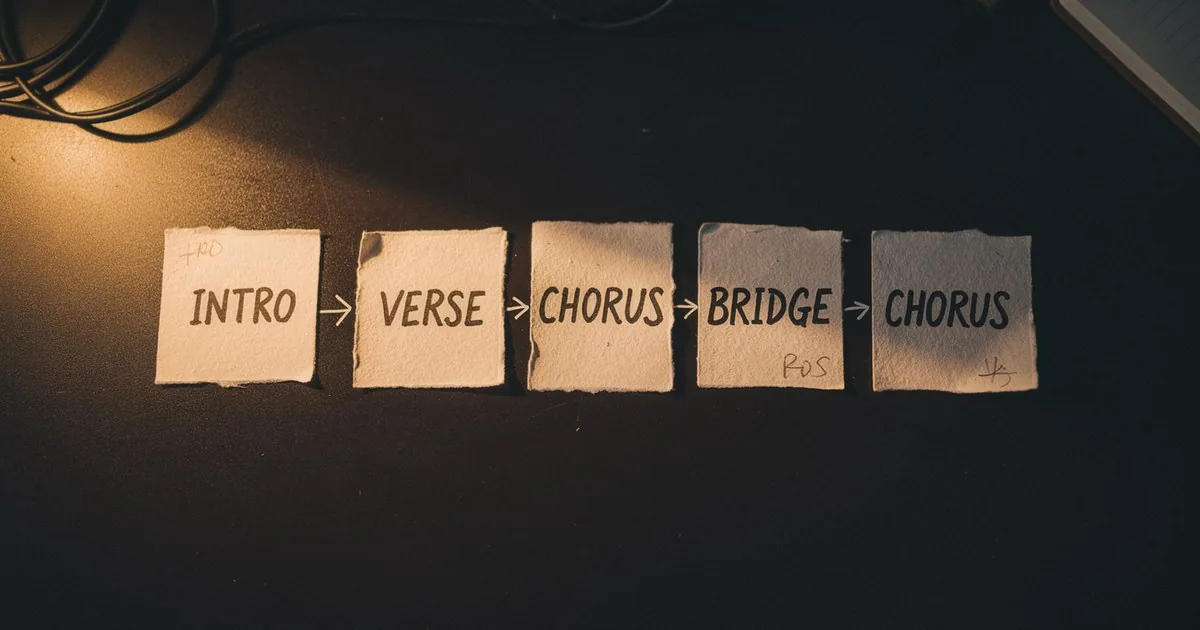
Almost every popular song is built on one of a few forms. Below, each form gets a section map you can scan, a plain definition, and at least one real song with its actual top-level layout. In the maps, the filled gold block is the chorus (the recurring payoff), the gold outline is a pre-chorus (the build), the green outline is a bridge (the contrast), and neutral blocks are verses and framing sections.
Verse-Chorus and Verse-Pre-Chorus-Chorus
Verse-chorus form is the dominant structure in popular music since the 1960s: verses with changing lyrics alternate with a chorus that keeps the same words and carries the title and hook. Add a pre-chorus between them and you get the modern pop default, verse-pre-chorus-chorus.
Rolling in the Deep, by Adele (verse-pre-chorus-chorus)
Nirvana's "Smells Like Teen Spirit" is the rock version of the same idea, using a quiet verse and a loud chorus (the soft-loud-soft dynamic it borrowed from the Pixies) plus a pre-chorus and a post-chorus tag. The lesson is the same in pop and rock: the chorus is only as big as the contrast you build into it.
Verse-Chorus-Bridge (the modern default)
Verse-chorus-bridge form expands verse-chorus by inserting a contrasting bridge, usually after the second chorus, to break the cycle and add variety before a final chorus. This is the single most common full-length structure in modern songwriting.
Someone Like You, by Adele (verse-chorus-bridge)
The bridge in "Someone Like You" strips the arrangement down so the final pair of choruses lands harder. The Backstreet Boys' "I Want It That Way" uses the same skeleton but adds a classic "truck-driver" key change, bumping the last choruses up a whole step (A major to B major) for one more shot of lift. A key change is a structural move, not just a harmonic one: it resets the listener's ear right when repetition would otherwise set in. If you want to go deeper on that, see modal interchange and borrowed chords.
AABA (the 32-bar song form)
AABA, also called the 32-bar or American popular song form, repeats a main strophe twice (AA), moves to a contrasting bridge or "middle eight" (B), then returns to a final strophe (A). Classically each section is 8 bars, 32 in total. It dominated pop before the 1960s and still anchors jazz standards.
Over the Rainbow, by Harold Arlen (AABA, 32-bar)
"Over the Rainbow" is the form's textbook case, cited as the exemplar on Wikipedia's own page for 32-bar form. The Beatles' "Yesterday" shows that the form bends: its A sections run an irregular 7 bars instead of 8, and the song still feels complete. The takeaway is liberating. Great form is about the shape of repetition and contrast, not about hitting a bar count. Notice there is no chorus here at all. The "A" strophe carries the title and the hook, the way a chorus would in a newer song.
Strophic and verse-refrain (AAA)
Strophic form, also called AAA or one-part form, repeats a single section for every stanza, changing only the lyrics, with no chorus and no bridge. The verse-refrain variant ends each verse with the same repeated line. It is the oldest sectional form and the backbone of folk and traditional song.
Blowin' in the Wind, by Bob Dylan (strophic, verse-refrain)
Dylan's "Blowin' in the Wind" is three near-identical verses, each closing on the same refrain line ("the answer is blowin' in the wind"), with a harmonica break and no chorus in sight. Strophic form lives or dies on the lyric, because the music barely changes. That is exactly why it suits storytelling: nothing distracts from the words. If your song is a narrative and a big repeating chorus would interrupt it, strophic form is often the honest choice.
12-bar blues
The 12-bar blues is a 12-measure form built mainly on the I, IV, and V chords across three four-bar phrases, with lyrics often in an AAB pattern: a line, the same line repeated, then a answering line with a twist. It underpins blues, early rock and roll, and countless rock songs.
12-bar blues: the harmonic grid
Chuck Berry's "Johnny B. Goode" is the classic case: the intro, every verse, every chorus, and both guitar solos are each a strict 12-bar blues, so you can hear how the same 12-bar grid stacks into a full verse-chorus song. Elvis Presley's "Hound Dog" is another straight-ahead example. Once you can feel the 12-bar cycle and its turnaround (the V chord that pulls you back to the top), you have a complete song engine that needs almost no other structure.
Through-composed and songs with no chorus
Through-composed form keeps introducing new material and never repeats a section unchanged, so there is no chorus to return to. It is rare in popular music and demands strong momentum to hold together, because the listener gets no familiar anchor to grab.
Bohemian Rhapsody, by Queen (through-composed)
"Bohemian Rhapsody" runs through six contrasting sections that never repeat as a unit and never resolve into a chorus. It works because each section is a complete idea and the momentum never stops. You almost certainly will not write your first single this way, but it is worth knowing the rule you would be breaking. Most "no chorus" songs are not through-composed at all; they are strophic or AABA, where a repeated strophe quietly does the chorus's job.
How does song structure change by genre?
Forms are shared across genres, but each style leans on different defaults and different signature sections. Knowing the conventions of your genre gives you a sensible starting point you can then break on purpose.
| Genre | Typical structure | What is distinctive |
|---|---|---|
| Pop | Verse - pre-chorus - chorus - bridge | Pre-chorus and post-chorus do heavy lifting; hook front-loaded |
| Hip-hop | Intro - verse - hook - verse - hook | 16-bar verses, a repeated hook instead of a sung chorus |
| R&B | Looser verse-chorus with vamps | Extended outros, ad-libs, repetition over a groove |
| Country | Verse - chorus - verse - chorus - bridge | Story-first lyrics; strong, plain-spoken choruses |
| Rock / metal | Intro riff - verse - chorus - solo | Riff as a hook; instrumental solo in the bridge slot |
| Folk / singer-songwriter | Strophic or verse-refrain (AAA) | Minimal repetition, the lyric carries the song |
| EDM / dance | Intro - build - drop - breakdown - build - drop | Energy curve replaces verse-chorus; the drop is the hook |
Starting points, not rules. The best songs in every genre bend these constantly.
Writing for streaming and TikTok: front-load the hook
Listening habits have reshaped structure. On Spotify a stream only counts as a play once the listener stays past the first 30 seconds, and short-form video rewards an instantly recognizable moment. The practical result is that modern songs tend to get to the point faster than songs from twenty years ago.
That shows up as shorter intros or none at all, choruses or hooks that arrive within roughly the first 10 to 15 seconds, and post-chorus "moments" engineered to be clip-ready. Some writers open cold on the chorus, then drop into verse one. None of this requires abandoning the forms above. It is a matter of ordering and trimming: lead with your strongest idea, cut the four-bar throat-clearing intro, and make sure there is a memorable hook early enough that a scroller stops. The underlying sections are the same. You are just spending the listener's attention sooner.
How do you choose a structure for your song?
Pick a structure by asking what the song is mainly doing: telling a story, selling a hook, or setting a mood. Each goal points to a different default form. You do not have to decide before you write a note, but naming the goal saves you from fighting your own song later.
A quick chooser
- Story-driven? Lean strophic or AABA. Let the lyric move; keep musical interruptions minimal.
- Hook-driven? Use verse-pre-chorus-chorus and front-load the chorus. Build everything toward the payoff.
- Mood or groove-driven? Consider a loop-based or EDM build-and-drop shape, where energy, not lyrics, carries the form.
- Feeling repetitive? Add a bridge or a key change after the second chorus for contrast.
In practice, most writers go back and forth: you draft a chorus, realize the song wants to breathe, and add a pre-chorus, or you cut a second bridge that was killing momentum. Structure is a draft, not a cage. The fastest way to find the right one is to lay your sections out where you can see them and try reordering.
Common song-structure mistakes (and how to fix them)
Most structural problems are a handful of recurring patterns. Once you can name them, they are easy to fix.
If your "bridge" uses the same melody and energy as a verse, it is not contrasting. Change the chords, the melody, or the lyric angle so it genuinely departs.
Usually a contrast problem, not a melody problem. Pull the verse down in energy, or add a pre-chorus, so the chorus has somewhere to rise from.
A long instrumental open loses modern listeners before the song starts. Trim it to a few bars, or cut straight to verse one or the hook.
If nothing repeats, nothing sticks. Choose your best section and bring it back. Listeners bond with the parts they hear more than once.
How to build your song structure in Song Cage
Everything above is easier to do when you can see your sections instead of holding them in your head. That is the idea Song Cage is built around. In Song Cage, a section is the top-level container for your song: you create named sections for the verse, chorus, bridge, intro, or any custom part, and their order on the timeline is your arrangement. Reorder the blocks and you reorder the song.
Each section holds its chords, lyrics, and melody together as views of the same part, so a verse you capture on your phone is the same verse you arrange later on your computer. You can start anywhere, with a chord idea, a lyric line, or a hummed melody, and let the structure assemble around it. When a bridge wants a different key, a section can carry its own key override, which makes that "key change after the second chorus" a two-second move rather than a rewrite. The sections and the grid guide covers the mechanics, and the chord progression builder handles the harmony inside each block.
Build your structure section by section
Lay out verses, choruses, and bridges as blocks you can reorder, with chords, lyrics, and melody captured inside each one. Start free in your browser, no install.
Frequently Asked Questions
What is the most common song structure?
The most common full-length structure in modern songwriting is verse-chorus-bridge, usually expanded to verse, pre-chorus, chorus, verse, pre-chorus, chorus, bridge, chorus. The pre-chorus builds tension into the chorus, and the single bridge after the second chorus adds contrast before the final payoff.
What are the parts of a song?
The core sections are the verse (changing lyrics, tells the story), the chorus (repeated lyrics, carries the title and hook), and the bridge (a one-time contrasting section). Common supporting parts include the intro, pre-chorus, post-chorus, instrumental solo, and outro or coda.
What is the difference between a verse and a chorus?
A verse keeps the same music but changes its lyrics every time, moving the story forward. A chorus keeps the same lyrics every time it returns, carries the title and the most memorable melody, and delivers the emotional payoff the verses build toward. The chorus is the part listeners remember.
What is a bridge in a song?
A bridge is a contrasting section that usually appears once, after the second chorus. It differs from the verse and chorus in melody, harmony, or lyrical perspective, breaking the song's repetition and setting up the final chorus. In the United Kingdom it is often called the middle 8.
How long should each section of a song be?
By convention, a verse runs 8 to 16 bars, a chorus around 8 bars, a pre-chorus 2 to 8 bars, and a bridge 4 to 8 bars. These are starting points, not rules. "Yesterday" famously uses irregular 7-bar verses and still feels complete. Serve the song, not the bar count.
Does every song need a chorus?
No. Strophic folk songs like "Blowin' in the Wind" use a repeated verse with a short refrain and no chorus. AABA standards like "Over the Rainbow" let the repeated A strophe carry the hook. Through-composed songs like "Bohemian Rhapsody" avoid a returning chorus entirely. A chorus is common, not mandatory.