Table of Contents
- How long should a song be?
- What is the average song length in 2026?
- Are songs still getting shorter?
- Why can't you just write "three minutes"?
- What is a bar worth at your tempo?
- Where does the time actually go?
- How fast should the first chorus arrive?
- How long should each section be?
- Does song length change your streaming royalties?
- How do you cut a minute out of a song?
- Writing to a runtime in Song Cage
- Frequently Asked Questions
"How long should a song be?" gets you a number back. Three minutes. Three and a half. Under four for radio. Every one of those answers is true, and not one of them helps you at the moment you need it, because you are not writing minutes. You are writing bars.
A verse is eight bars or sixteen. An intro is four or eight. Nobody sits down and writes forty-three seconds. So the runtime you keep reading about is an output, and the two things that produce it are the number of bars you wrote and the tempo you set. Change either and the same arrangement becomes a different length.
Here is what the data actually says about average song length right now, why the trend everybody quotes reversed five years ago, and how to convert a target runtime into the only unit you can act on while the song is still open in front of you.
The short version
The commercial centre of gravity is roughly three to three and a half minutes, and it has been drifting back up since 2019. But a runtime target only becomes useful once you convert it into bars at your tempo, because that is the unit a song is actually built from.
How long should a song be?
Most songs should run between two and a half and four minutes, with three to three and a half minutes as the commercial centre. That range is a starting point, not a target. The number that matters while you write is bar count at your tempo, because a runtime is what those two things add up to.
The range is wide for a reason. How long a song should be depends on how much you have to say and how long the listener will stay for it, and neither of those is a constant. Pop averages 3:40 and hip hop 3:52, while progressive rock runs 5:21 and lo-fi 2:30, according to Chosic's analysis of the top thousand tracks in each of more than 140 Spotify genres.
What has changed is that the answer stopped being fixed by the format. A 78 rpm side held three to five minutes. A vinyl single held rather less. Streaming holds anything. When the container stopped setting the limit, the limit became editorial, which is to say it became yours.
What is the average song length in 2026?
The broadest catalogue benchmark is 3 minutes 17 seconds, measured across a 160,000-track Spotify dataset for songs released in 2020. Chart hits run slightly longer: the UK Top 40 averaged just under three and a half minutes in the first half of 2025.
Those two figures answer different questions, and the average song length you should care about depends on which one you mean. Treating them as the same number is where most advice goes wrong. A catalogue average includes everything ever uploaded. A chart average describes the competitive market you are probably writing for.
The historical shape is consistent across sources. Mean duration climbed from about 3:15 in 1930 to 4:19 in 1990, then fell back to 3:17 by 2020, according to a Kaggle-based analysis published by the DataRes student group at UCLA. UK number ones tell the same story faster: the Manchester label Ostereo found they averaged 4:16 in 1998 and 3:03 in 2019. And Chartmetric reported that the average Spotify charting song in its 2024 Year in Music data ran around three minutes, roughly 15 seconds shorter than 2023 and 30 seconds shorter than 2019.
One number, three provenances
The 3:17 figure gets attributed across the web to "UCLA data scientists analysing the Spotify API." It is worth being precise: it comes from a student data-science club at UCLA, working from a public Kaggle dataset of Spotify tracks, published as a blog post rather than peer-reviewed research. The number itself is consistent with every other source here. The credential attached to it in most write-ups is not.
Are songs still getting shorter?
No. The shrinking trend that dominates most advice on this topic bottomed out in 2019 and has been reversing since. BBC News chart analysis found the UK Top 40 average fell to 3 minutes 12 seconds in 2019, then climbed back to almost three and a half minutes across the first six months of 2025.
This is the part where the field contradicts itself and nobody says so. Pages telling you to cut everything under three minutes are describing a trend that ended before they were written. The BBC's own data shows the reversal plainly, and the examples are not obscure: Lola Young's Messy runs 4:44, Chappell Roan's Pink Pony Club 4:18, Sam Fender's People Watching 5:11.
The compression was real while it lasted. Hit Songs Deconstructed found that 37 percent of US Hot 100 top ten hits in the first three quarters of 2021 ran under three minutes. But a trend is not a rule, and this one has already turned. Write to the song, then check the clock.
Why can't you just write "three minutes"?
Because minutes are a unit of playback and bars are a unit of composition. You can decide a verse is sixteen bars. You cannot decide it is thirty-eight seconds, because how long sixteen bars takes depends entirely on how fast you count.
This is the step every page on this topic skips. It hands you a runtime benchmark and stops, as though the benchmark were actionable on its own. It is not. Two songwriters can write structurally identical arrangements, eight-bar intro, sixteen-bar verse, eight-bar chorus, and end up nearly a minute apart, purely because one wrote at 80 BPM and the other at 120.
The conversion is simple arithmetic and worth internalising. In 4/4, one bar is four beats, so a bar lasts 240 divided by your tempo, in seconds. At 120 BPM that is two seconds flat. At 80 BPM it is three.
What is a bar worth at your tempo?
| Tempo | One bar (4/4) | 8-bar section | 16-bar section | Bars in 3:30 |
|---|---|---|---|---|
| 70 BPM | 3.4s | 27s | 55s | ~61 |
| 80 BPM | 3.0s | 24s | 48s | 70 |
| 100 BPM | 2.4s | 19s | 38s | ~88 |
| 120 BPM | 2.0s | 16s | 32s | 105 |
| 140 BPM | 1.7s | 14s | 27s | ~123 |
Seconds per bar in 4/4 = 240 ÷ BPM. A three-and-a-half-minute song is about 88 bars at 100 BPM but 105 bars at 120.
Work an example. An eight-bar intro followed by two sixteen-bar verses before the first chorus is forty bars. At 120 BPM that is eighty seconds. At 80 BPM the identical arrangement takes two minutes. Same song on paper, and only one of them gets to the chorus while anyone is still listening.
Where does the time actually go?
The runtime debate focuses on the total, but the total is rarely the problem. The problem is distribution, and the research on that is unusually clear about which section absorbed the cuts.
Hubert Léveillé Gauvin analysed 303 US top ten singles released between 1986 and 2015 and found that instrumental introductions collapsed. Intros averaging more than 20 seconds in the mid-1980s were down to around 5 seconds by 2015, a drop he measured at 78 percent. Over the same period average tempo rose about 8 percent, and the time before the title first appears in the lyric fell by roughly 18 percent. The work was published in Musicae Scientiae (2018, vol. 22 no. 3, 291–304, DOI 10.1177/1029864917698010), and Ohio State summarised the findings when it appeared.
Read that as a set of instructions rather than a set of statistics. Songs did not mostly get shorter by losing verses. They got shorter at the front, and faster throughout, and quicker to the point.
How fast should the first chorus arrive?
Aim to reach the title inside the first minute. Ralph Murphy's long-running ASCAP analysis of number one records found intros averaging 8 seconds and the title arriving at an average of 54 seconds including the intro, with most records hitting a structural turn between 2:00 and 2:30.
Murphy's numbers, summarised for the Nashville Songwriters Association, are the most useful benchmark on this topic precisely because they are stated in seconds against a fixed structural landmark. That makes them convertible. Sixty seconds is thirty bars at 120 BPM, but only twenty bars at 80.
So the same instruction, "get to the title in a minute," licenses a sixteen-bar verse plus an eight-bar intro at a bright tempo, and forbids it at a ballad tempo. The advice never changes. What it costs you in bars changes constantly.
How long should each section be?
Section conventions are steady enough to be worth knowing: verses commonly run 8 to 16 bars, choruses around 8, pre-choruses and bridges 2 to 8. Our song structure guide covers the full table and where each section earns its keep, so this section is about what those bar counts cost you in time.
At 100 BPM, that conventional layout produces roughly the following: an 8-bar intro is 19 seconds, a 16-bar verse is 38, an 8-bar pre-chorus is 19, an 8-bar chorus is 19. You have spent 96 seconds and the first chorus has only just finished. Add a second verse, pre-chorus and chorus and you are at 2:53 before you have written a bridge.
That is the arithmetic that makes long songs happen. Not indulgence, just conventional section lengths at a moderate tempo, added up honestly for the first time.
Does song length change your streaming royalties?
Only indirectly. Spotify counts a stream once a listener plays 30 seconds of a track, and there is no additional payment for the seconds after that. A two-minute song and a six-minute song generate one identical stream each.
The practical consequence is about listening windows, not per-second rates. In a fixed half hour, a listener can complete more short songs than long ones, and every completion is a countable stream. That is the real mechanism behind "shorter songs earn more," and it only operates if people actually replay you.
Two details are worth knowing before you let any of this near your arrangement. Spotify pays on streamshare, your proportion of total streams in a market, not a fixed per-stream rate. And since April 2024 a track needs at least 1,000 streams in the previous twelve months to generate recording royalties at all. For almost every songwriter reading this, the binding constraint is whether the song is good enough to replay, not whether it is 3:05 or 3:45.
How do you cut a minute out of a song?
Time hides in five places, and they are almost always the same five. Work through them in order before you touch a verse lyric you like.
Where the minute is hiding
- The intro. Halve it. Eight bars to four is 10 seconds at 100 BPM, and the research says the field made this cut decades ago.
- The second verse before the first chorus. The single most expensive structural choice available. Cutting it saves 38 seconds at 100 BPM.
- The instrumental solo. Sixteen bars is a long time to ask for. Eight usually says the same thing.
- Repeated final choruses. Three passes of an 8-bar chorus is a minute at moderate tempo. Two passes plus a strong ending is not worse.
- The outro. Optional by definition. If it is not doing something, it is costing something.
There is a public worked example of exactly this diagnosis. On the TAXI songwriting forum in 2019, a writer posted a structure of an 8-bar intro, two 16-bar verses, then a chorus, and a veteran member converted it to the clock on the spot: the first chorus would not arrive until 1:20. The arithmetic checks out at 120 BPM, and the writer cut the second verse. Nothing about that exchange required hearing the song.
If cutting length does not fix a section that drags, the problem may be pacing rather than duration. A slow harmonic rhythm makes eight bars feel like sixteen, which we cover in why chord progressions sound boring.
Writing to a runtime in Song Cage
Song Cage does not display a runtime, and it is worth saying so plainly rather than implying otherwise. What it gives you is the two inputs the runtime is made of, in front of you while you write.
Every section on the timeline is a whole number of bars, shown on a beat grid with a bars-per-line control, and the tempo field in the toolbar accepts anything from 20 to 300 BPM. So the conversion in this article is a reading exercise, not a calculation you have to reconstruct: count the bars in the section, multiply by 240 over your tempo. The sections and the grid chapter covers how sections and lines relate.
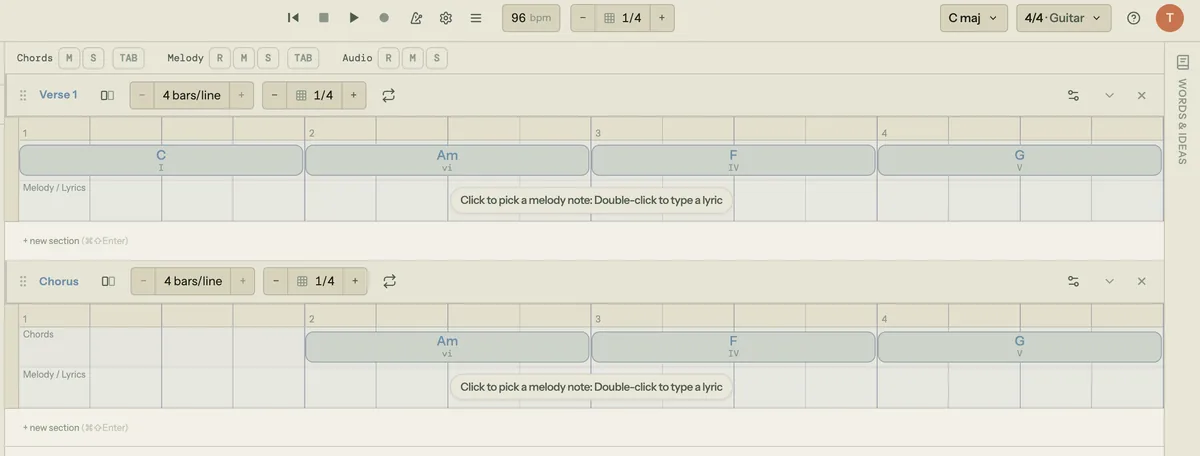
Two things make the edit fast once you know where the time went. Each section carries a double-section control that doubles its length and duplicates its chord blocks, lyric blocks and melody notes, which is the one-click version of "this verse needs to be sixteen, not eight." And changing the tempo rescales the whole song's runtime without touching a single bar, which is the cheapest length edit there is.
Count the bars while you write, not after
Sections on a beat grid, a tempo you can change at any point, and chord suggestions ranked against what your melody is doing.
Frequently Asked Questions
What is the ideal song length for Spotify?
There is no platform-imposed ideal. Spotify counts a stream once a listener reaches 30 seconds, and pays nothing extra for the time after that, so the only length effect is that shorter songs let a listener complete more of them in a given sitting. Chart data puts the practical centre near three and a half minutes. Since April 2024 a track also needs 1,000 streams in the previous twelve months before it earns recording royalties at all, which matters far more than a thirty-second difference in runtime.
How many bars is a three-minute song?
It depends entirely on tempo. In 4/4, one bar lasts 240 divided by your BPM, in seconds. Three minutes is 180 seconds, so that is 75 bars at 100 BPM, 90 bars at 120 BPM, and 60 bars at 80 BPM. This is why bar count, not runtime, is the number to work with while writing. See song structure for how those bars are usually distributed across sections.
Is a two-minute song too short?
No. Lil Yachty's Poland ran 83 seconds and reached number 40 on the Billboard Hot 100. Hit Songs Deconstructed found 37 percent of US Hot 100 top ten hits in the first three quarters of 2021 came in under three minutes. A short song is only a problem if it feels unfinished, which is a structural question rather than a duration one.
How long should the intro be?
Short, and shorter than you think. Léveillé Gauvin's analysis of 303 top ten singles found intros fell from over 20 seconds in the mid-1980s to about 5 seconds by 2015. Ralph Murphy's ASCAP study of number ones measured an average of 8 seconds. At 100 BPM, 8 seconds is between three and four bars, so a conventional eight-bar intro is already double the current norm.
Are songs getting longer again?
Yes. BBC News chart analysis found the UK Top 40 average hit a low of 3 minutes 12 seconds in 2019 and rose to almost three and a half minutes over the first half of 2025, a level last seen in 2018. Hits well over four minutes are common again. Advice telling you to compress everything under three minutes is describing a trend that has already reversed.
Does changing the tempo change my song's length?
Yes, proportionally and immediately, without altering a single bar. A 96-bar song runs 3:50 at 100 BPM and 3:12 at 120 BPM. That makes tempo the cheapest length edit available, and it is worth trying before you cut a section you like. It is not free musically, since tempo changes the feel, but it costs you no material.