Table of Contents
- What is a bridge in a song?
- Where does the bridge go in a song?
- What chords does a bridge use?
- How do you leave the tonic?
- A real bridge, taken apart
- Bridge, middle eight, or pre-chorus: why the word means three things
- Does a bridge need new lyrics?
- Why are Taylor Swift's bridges so famous?
- Real songs with bridges worth studying
- Does your song even need a bridge?
- How do you write a bridge?
- How to build a bridge in Song Cage
- Giving the bridge its own key
- Frequently Asked Questions
You have two verses, two choruses, and a problem. Play them again and the song sags. Everyone tells you to add a bridge. Nobody tells you what actually goes in one.
Search the term and you get the same paragraph eight times: a bridge provides contrast, it usually comes after the second chorus, it's often eight bars. All true, and none of it tells you which chords to play. This guide fixes that. It covers what a bridge is, where it goes, the harmonic move that makes one work, why the word means three different things, and the real songs that show each idea in action.
What is a bridge in a song?
A bridge is a contrasting section that appears once, usually after the second chorus, and withholds the song's main material so the final chorus lands harder. It differs from the verse and chorus in melody, harmony, or lyrics, and its job is to make you want the familiar part back.
That last clause is the part most definitions skip, and it's the one that matters. A bridge is not just "a different bit." Music theorist Jay Summach puts the demand precisely: a bridge "must be followed by [the primary module] in order for its function to be satisfied," as Open Music Theory documents. A section that could end the song is not a bridge. A section that leaves you stranded, waiting for the chorus to rescue you, is.
The word itself is older than pop music. It's a translation of the German Steg, a term the Meistersingers used for the transitional part of medieval bar form, and it reached English in the 1930s through composers who fled Nazi Germany and went to work in Hollywood and on Broadway.
Where does the bridge go in a song?
In a verse-chorus song, the bridge almost always sits after the second chorus, roughly two-thirds of the way in, and hands off to a final chorus. Berklee's Andrea Stolpe lays out the standard running order in her guide to writing bridges: verse, chorus, verse, chorus, bridge, chorus.
That position is doing real work. By the time listeners reach it, they have heard the chorus twice and know exactly what to expect. The bridge is the only place in the song where breaking the pattern is a payoff rather than a confusion.
Length is conventional rather than fixed. Eight bars is the common default, which is where the British name middle eight comes from. Four bars is enough when the contrast is sharp. Much beyond eight and you risk the listener forgetting the chorus you're setting up.
For where the bridge sits among the other parts, see our full guide to song structure.
What chords does a bridge use?
Here is the rule the ranking pages leave out, and it is the most useful thing on this page.
A bridge works by moving away from the tonic and ending on tension rather than resolution. Start somewhere other than the home chord, and finish on the V chord so the return to the chorus feels inevitable. Open Music Theory states it plainly: bridge modules "tend to emphasize non-tonic harmonies and commonly end on dominant harmony."
Music theorist Robert Hutchinson frames the same idea as harmonically open and closed sections. A closed section ends on I and feels finished. An open section ends on V and feels like a question. In AABA songs the A sections are closed and the bridge is open. His worked example is "We Are the World," where the verse and bridge both end on V while the chorus closes on the tonic.
How do you leave the tonic?
Three bridge departures that work
- Start on IV or vi. The two chords closest to home that are not home. Least effort, reliable contrast.
- Borrow from the parallel minor. Stolpe suggests reaching for ♭III, ♭VII, or II major. In D major that gives you F, C, or E.
- Run a dominant chain. The jazz standard bridge: III7–VI7–II7–V7, the secondary dominant ladder that walks back to I.
That last one is worth knowing by name. The ragtime progression E7–A7–D7–G7 is the bridge of a huge number of jazz standards, and its trick is that it leads firmly back to C major while being, in itself, indefinite in key. You are lost for eight bars and then you are home.
A real bridge, taken apart
Johnny Nash's "I Can See Clearly Now" sits in D major. The verse is I–IV–V. The bridge steps outside the key onto F, a ♭III borrowed chord from D minor, and the whole tonal floor moves under you before the song hands back to the final verse.
It is worth noting what this example is not. MasterClass presents it as "modulating by a minor third" and advises writing your bridge a minor third above your key. That framing is contested: a music theory assignment on the same song instructs students to analyze it without assuming it modulates, and to circle the Roman numerals showing mode mixture instead. Borrowing chords and changing key are different moves. If you do want the bridge in a genuinely new key, that is a key change, and it has its own mechanics.
Bridge, middle eight, or pre-chorus: why the word means three things
Half the confusion around bridges is that the field never agreed on the term. Ralf von Appen and Markus Frei-Hauenschild's survey of song forms and their historical development documents three separate meanings in active use, and notes that the terminology "contains countless internal contradictions."
| Usage | What it names | How often it appears | Also called |
|---|---|---|---|
| AABA B-section | The contrasting third eight bars of a 32-bar standard | Twice per full cycle | Release, channel, middle eight |
| Verse-chorus bridge | A one-time contrast section late in the song | Once | Middle eight |
| Verse-to-chorus link | The ramp between verse and chorus | Every cycle | Pre-chorus |
Berklee songwriting department founder Jack Perricone proposed "transitional bridge" and "primary bridge" to separate the third usage from the second. The terms never caught on.
This is not pedantry, because the two main usages behave differently. In an AABA song the bridge recurs and its dominant ending is essential, since it has to hand back to the A section. In a verse-chorus song the bridge happens once and is freer, because the chorus does not need as much setting up.
You can watch the confusion happen in the wild. Yousician's explainer defines the bridge as the section between the second and third chorus, then adds that it "can also act as a transition between the verse and the chorus." Those are two different sections. The second one is a pre-chorus.
Does a bridge need new lyrics?
No, and the most famous bridge in soul music proves it.
In Bill Withers' "Ain't No Sunshine," the bridge is the phrase "I know," repeated 26 times. It was never meant to be there. Withers had not finished the lyric and was improvising a placeholder, intending to write real words later. Producer Booker T. Jones told him to leave it. Withers told Songfacts: "I wasn't going to do that, then Booker T. said, 'No, leave it like that.' I was going to write something there, but there was a general consensus in the studio."
Every guide to bridges opens with the same instruction: write new lyrics, offer a fresh perspective, deliver the plot twist. That advice is fine, and a 1971 number three hit ignores it completely. What Withers' bridge does have is contrast: the arrangement strips back, the harmony sits still, and the vocal does something it has not done anywhere else in the song.
The lesson is that contrast is the requirement. New lyrics are one way to get it, not the definition of the thing.
Why are Taylor Swift's bridges so famous?
Because she treats the bridge as the point of the song rather than a box to tick, and in 2026 she explained exactly how she builds one.
Speaking to the New York Times, Swift said she and collaborator Jack Antonoff have a name for the technique: the rant bridge. "We love these rant bridges where it's basically stream of consciousness, endless pouring out of emotion, intrusive thoughts blended with metaphor, with discussion, with shouting," she said, naming "Out of the Woods," "Is It Over Now?" and "Cruel Summer."
Her account of what the section is for is the sharpest short definition anyone has offered: "You can start painting the picture in the verse. You can get to the heart of it at the chorus. But then the bridge can be where you zoom back, you walk 20 feet back, and you see what this entire painting was supposed to be."
That is withholding used as craft. "Cruel Summer" goes further and carries two bridges, the second returning after the final chorus, which Hit Songs Deconstructed calls an anomaly in her catalogue and in hit songs generally.
Real songs with bridges worth studying
| Song | Form | What the bridge does |
|---|---|---|
| The Beatles, "I Want to Hold Your Hand" | AABA | Bridge at 0:52 builds tension and withholds the main theme until it returns at 1:11 |
| Frank Sinatra, "Strangers in the Night" | AABA | Textbook 32-bar standard: two strophes, contrasting B, strophe back |
| Dexys Midnight Runners, "Come On Eileen" | Verse-chorus | Bridge at 2:55 climbs on material borrowed from the verse, arriving at the chorus at 3:34 |
| "We Are the World" | Verse-chorus | Bridge ends open on V while the chorus closes on I |
| Bill Withers, "Ain't No Sunshine" | Verse-refrain | Two words, 26 times, over a stripped-back arrangement |
| Johnny Nash, "I Can See Clearly Now" | Verse-chorus | Steps outside the key onto a borrowed ♭III before handing back |
Timestamps for "I Want to Hold Your Hand" and "Come On Eileen" follow the section maps in Open Music Theory.
Does your song even need a bridge?
Plenty of great songs do not have one. Dolly Parton's "Jolene" runs chorus, verse, verse, chorus, verse, chorus and never departs from that material. A bridge is a tool for a specific problem: a song that has said everything it has to say and still has a minute to fill.
The honest context is that bridges have been in retreat. The Guardian covered the trend in 2022 under the headline "Is TikTok killing off the pop music bridge?", noting that everyone from Sting to TikTok musicians had spotted it. The BBC's 2025 analysis of chart data found the same thing: as songs got shorter through the streaming era, the bridge became less common and the outro largely vanished.
Set that against the fact that the most commercially dominant songwriter of the same period built her signature on bridges, and the trend looks less like a verdict on the section and more like a gap worth exploiting.
Write a bridge when
- Your second chorus lands weaker than your first, and you need to earn the third
- The lyric has a turn left in it: a decision, a consequence, a change of mind
- The song is harmonically static and needs one moment away from home
- You have a strong final chorus that deserves a running start
Skip it when the song is already short and moving, when the chorus is the whole point, or when your bridge idea is really just a third verse.
How do you write a bridge?
Work in this order. It is faster than staring at the section waiting for inspiration.
Start with the destination. You are writing back into the final chorus, so name the chord that chorus starts on and get yourself onto its V. Everything else in the bridge is the route.
Then choose the departure. Pick a first chord that is not the tonic. IV and vi are the safe openings, a borrowed ♭VII or ♭III is the bolder one. Play the last bar of your chorus straight into your candidate and listen for whether the floor moves.
Then set the pace. Stolpe's point is that contrast is relative to what came before: if the chorus was busy, hold the bridge on fewer chords; if the song has been static, change chords more often. This is the same lever behind songs that sound boring despite good chords.
Then write the lyric, if the bridge wants one. Stolpe's prompts are good ones: "someday," "maybe when," "even though I know that." They push the lyric into the future or the concession, which is where a bridge usually lives.
Then cut it. Bridges are the most over-written section in songwriting. If eight bars says it, do not use sixteen.
How to build a bridge in Song Cage
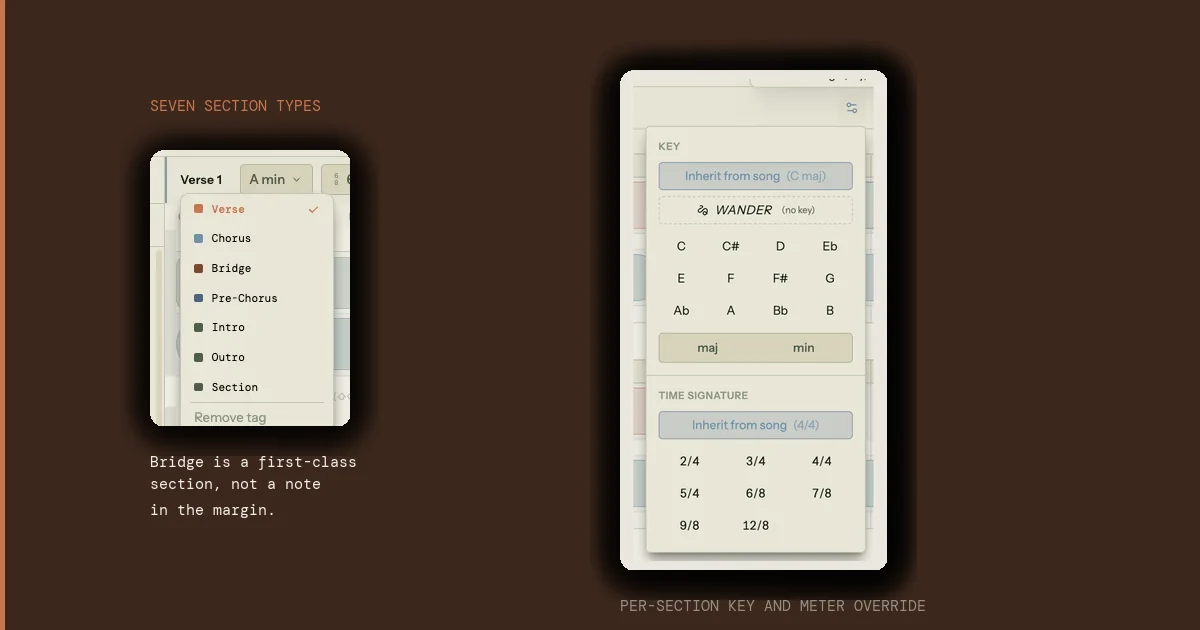
Song Cage is built around sections, so a bridge is a real object in your song rather than a note in the margin. Add a section, click + section tag, and pick Bridge from the seven section types. It takes a color swatch so you can find it while scanning a long arrangement, and if the song already has one it auto-names the next Bridge 2. The type is a label rather than a behavior: a Bridge section holds chords and lyrics on the same grid as a Verse.
Giving the bridge its own key
The part that matters for this article is the section settings gear. Open it and you can override the key and mode for that section alone, without touching the rest of the song. Set your bridge to a different key and three things happen inside that section: the chord palette re-ranks its suggestions for the new key, borrowed chords shift to the parallel modes of the new key, and the Roman numeral labels on chords you have already placed update to show their function in the new key. A highlighted badge appears in the section header so you can see at a glance which sections diverge.
There is a time signature override in the same popover, with 2/4 through 12/8 available, so a bridge that drops into 6/8 or 3/4 stays inside the same song. When you export a PDF chord sheet or MIDI file, section order determines the output. The sections and the beat grid chapter covers the full workflow.
Give your bridge its own key
Add a Bridge section, override its key, and watch the chord suggestions and Roman numerals reorient around it. No setup, nothing to install.
Frequently Asked Questions
What is a bridge in a song?
A bridge is a contrasting section that appears once, usually after the second chorus, and differs from the verse and chorus in melody, harmony, or lyrics. Its function is to withhold the song's main material so the final chorus feels earned. A section that could satisfyingly end the song is not doing a bridge's job.
Where does the bridge go in a song?
In a verse-chorus song, after the second chorus and before the final chorus, roughly two-thirds of the way through. In a 32-bar AABA standard the bridge is the B section, the third eight bars, and it recurs each time the cycle repeats rather than appearing once.
How long should a bridge be?
Eight bars is the convention, which is where the British term "middle eight" comes from. Four bars works when the contrast is strong. Going much past eight bars risks the listener losing the thread of the chorus you are setting up, so cut before you extend.
What chords should a bridge use?
Start on a chord that is not the tonic, and end on the V chord. Open Music Theory notes that bridges tend to emphasize non-tonic harmonies and commonly end on dominant harmony. Common departures are IV, vi, a chord borrowed from the parallel minor such as ♭VII or ♭III, or a chain of secondary dominants.
Is a bridge the same as a middle 8?
Usually yes. "Middle eight" is the common British name for the same section, from the typical eight-bar length. The word "bridge" is also used for the B section of an AABA standard and, confusingly, by some musicians for the verse-to-chorus link most people now call a pre-chorus.
Does every song need a bridge?
No. Dolly Parton's "Jolene" does without one entirely, and bridges have become less common as songs shortened through the streaming era. Write one when a second chorus lands weaker than the first, when the lyric still has a turn in it, or when a strong final chorus deserves a running start.