Table of Contents
- What is a non-chord tone?
- Is a non-chord tone the same as a note out of key?
- Why can a note outside the chord still sound right?
- Does it land on a strong beat or a weak one?
- How do you get into the note, and how do you get out?
- What are the 8 kinds of non-chord tones?
- What is a passing tone?
- What is a neighbor tone?
- What is an appoggiatura?
- What is an escape tone?
- What is a suspension?
- What is a retardation?
- What is an anticipation?
- What is a pedal point?
- Did "Someone Like You" really use an appoggiatura?
- What did the 1991 study actually find?
- What's the difference between a suspension and an appoggiatura?
- Is a suspension the same as a sus chord?
- Wrong note or non-chord tone: how can you tell?
- What four questions sort a clash from a non-chord tone?
- When is the outside note really part of the chord?
- Why do rock verses get away with notes that never resolve?
- How do you fix a note that clashes?
- How do you write non-chord tones on purpose?
- Join and decorate: passing and neighbor tones
- Add weight on the beat: suspensions and appoggiaturas
- Push and hold: anticipations and pedal notes
- How does Song Cage handle notes outside the chord?
- How does Song Cage show whether a note is in the chord?
- What about a melody you sing into a DAW?
- Frequently Asked Questions
In February 2012 the Wall Street Journal explained why Adele's "Someone Like You" makes people cry, and a large part of its answer was a note outside the chord. The article pointed to a device called an appoggiatura and to a 1991 study in which 18 of 20 tear-jerking passages contained one. The song's co-writer, Dan Wilson, told NPR he had never heard the word before that article. Then listeners wrote in to NPR to say the note people kept pointing to isn't an appoggiatura at all.
They were all talking about the same thing. Melodies don't stay inside their chords, and a lot of the feeling in a tune lives in the notes that step outside. Theory calls them non-chord tones. This guide covers what they are, the eight kinds with a recorded song for each, why some outside notes sound deliberate while others sound like mistakes, and how to write them into a melody on purpose.
Quick Summary
A non-chord tone is a melody note that isn't in the chord sounding under it. Over C major (C E G), a D, F, A or B in the melody is a non-chord tone. Most are short, fall between beats and step to a chord tone, so the ear hears movement rather than a clash. The ones that land on the beat and lean into the next note are the expressive ones. Whether an outside note sounds intended or wrong comes down to the beat it lands on, how long it's held, where it goes next, and whether it sits a half step from a note in the chord.
What is a non-chord tone?
A non-chord tone is a melody note that doesn't belong to the chord sounding underneath it. Over a C major chord (C, E and G), any D, F, A or B in the melody is a non-chord tone. It's also called a non-harmonic tone or an embellishing tone, and British teaching calls the common ones passing notes and auxiliary notes.
Nearly every melody has them. In a 2021 study of 27 sets of themes and variations by Mozart and Beethoven, Hu and Arthur report that 81% of the melody notes in the plain themes were chord tones and 19% weren't. Across the whole collection, busier variations included, the outside share was 28%. I couldn't find the same count published for pop melodies, but our guide to melody vs harmony covers how loosely the two layers can fit in a song.
The usual shape is a three-note figure: a chord tone, the outside note, then another chord tone. Open Music Theory puts it this way: in nearly all cases the embellishing tone is "the middle note of a three-note gesture," and the first and last notes are consonant with the bass. The outer notes hold the chord steady and the middle one gives the line somewhere to go. Every type below is a different way into that middle note and a different way out.
Is a non-chord tone the same as a note out of key?
No. Most non-chord tones are in the key; they just aren't in the chord playing at that moment. In C major, an F sung over a C chord is in the key and outside the chord. A chromatic non-chord tone also leaves the key, like a C# slipped between C and D. Both follow the same rules, which is why a chromatic passing note can sound smooth while an in-key note held over the wrong chord can sound sour.
Why can a note outside the chord still sound right?
A note outside the chord sounds right when the ear hears it on its way somewhere. Three things decide that: which beat it lands on, how the melody moves into it, and how it moves out. A short note between beats that steps to a chord tone barely registers as a clash. A long one on the downbeat is felt, and needs somewhere to go.
The rule textbooks keep coming back to is resolution by step. In his 2007 paper on rock melody, music theorist David Temperley writes that the vast majority of non-chord tones in classical music "resolve by step", moving to the next note up or down the scale. That covers passing tones, neighbor tones, appoggiaturas and suspensions alike. The step tells the listener the clash was temporary.
There's a reason it feels good rather than merely acceptable. Music psychologist John Sloboda described the effect to NPR as "like a little upset which then gets resolved or made better in the chord that follows." The tension only pays off because the release arrives.
Does it land on a strong beat or a weak one?
Theory calls a non-chord tone on the beat accented and one between beats unaccented. An unaccented one is nearly free: a quick note on the "and" of a beat, stepping between two chord tones, goes by before the ear weighs it against the chord. An accented one sits exactly where the listener checks the melody against the harmony, so the clash is heard and the resolution matters.
That splits the family in two. The appoggiatura, the suspension, the retardation and the accented passing tone all land on the beat, and they're the expressive ones. Passing tones, neighbor tones, escape tones and anticipations usually fall between beats, and they're what keep a line moving. When you're writing, that's the first decision: is this outside note there to move the tune along, or to make the listener feel the chord?
How do you get into the note, and how do you get out?
Each type is defined by two moves: the approach and the departure. You can reach the outside note by step, by leap or by staying on the same note, and leave it the same three ways. Step in and keep stepping the same way, and it's a passing tone. Step out and step back, and it's a neighbor. Leap in and step out, and it's an appoggiatura. Step in and leap out, and it's an escape tone. Hold a note while the chord changes under it, and it's a suspension.
Hutchinson's open textbook Music Theory for the 21st-Century Classroom sorts nine types exactly this way, by "same tone, step, or leap" in and out, and adds qualifiers such as accented, unaccented and chromatic. This guide folds the double neighbor in with the neighbor tone, which leaves eight.
What are the 8 kinds of non-chord tones?
The eight common non-chord tones are the passing tone, neighbor tone, appoggiatura, escape tone, suspension, retardation, anticipation and pedal point. They differ in how the melody gets into the outside note, how it leaves, and which beat it usually lands on. The table sorts them, and each section after it points to a recorded song that uses one.
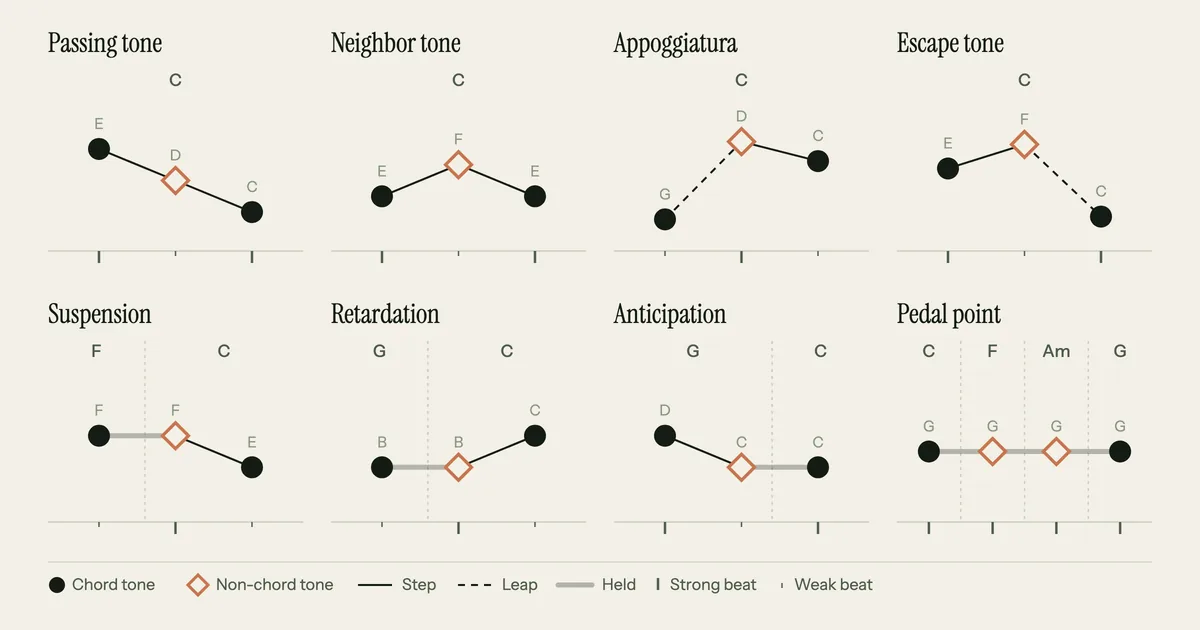
| Type | Into it | Out of it | Usual beat | What it does |
|---|---|---|---|---|
| Passing tone | Step | Step, same direction | Between beats | Fills the gap between two chord tones |
| Neighbor tone | Step | Step back to the same note | Between beats | Decorates one held note |
| Appoggiatura | Leap | Step, usually the other way | On the beat | Leans on the chord, then gives way |
| Escape tone | Step | Leap, the other way | Between beats | Slips off a note before a jump |
| Suspension | Same note, held over | Step down | On the beat | Holds the last chord's note into the new one |
| Retardation | Same note, held over | Step up | On the beat | A suspension that rises to resolve |
| Anticipation | Step or leap | Same note | Just before the beat | Arrives on the next chord's note early |
| Pedal point | Same note | Same note | Across several chords | Stays put while the chords move |
Approach and departure follow Open Music Theory and Hutchinson. Textbooks disagree on a few details, noted in the sections below.
What is a passing tone?
A passing tone fills the gap between two chord tones, approached by step and left by step in the same direction. Over a C chord, a melody that runs E, D, C passes through D on the way down. It usually falls between beats, and Temperley names it, with the neighbor tone, as one of the two most common kinds.
Bill Withers' "Lean On Me" (1972) is the textbook-clean example. As Ethan Hein points out, the chorus opens over a C chord with a melody that steps E, D, C. E and C are in the chord, and the D in between is a passing tone you'd never think to question.
Three variations come up constantly. Two passing tones in a row fill a fourth, so C, D, E, F connects C to F. A chromatic passing tone fills a whole step with two half steps, as in C, C#, D, and leaves the key without sounding wrong because it never stops moving. And an accented passing tone lands on the beat instead of between beats, which gives the same stepping line far more bite.
Hutchinson's textbook shows both kinds in a three-bar excerpt of Jason Derulo's "Want to Want Me" (2015), in E♭. In the first bar an F slips between E♭ and G off the beat, over an E♭ chord. In the third bar the chord changes to C minor and the F lands right on the downbeat before stepping down to E♭: the same note, now accented, and you hear the difference.
What is a neighbor tone?
A neighbor tone steps away from a chord tone and steps straight back to it. It can sit a step above (an upper neighbor) or a step below (a lower neighbor). Where a passing tone connects two different notes, a neighbor decorates one note that stays put.
The Beatles' "Dear Prudence" (1968) is built on this. From about 0:43, as Hein describes it, the vocal centres on D and each short phrase flicks up to E for a single syllable before dropping back, an upper neighbor repeated phrase after phrase. It's a way to make one note feel alive without changing it.
A double neighbor visits both sides before coming home: D, E, C#, D, for instance. Hutchinson's textbook also calls it a neighbor group, and some books call it changing tones.
The difference between a passing tone and a neighbor tone is just direction. A passing tone keeps going the same way and lands on a new chord tone. A neighbor turns around and comes back to the note it left.
What is an appoggiatura?
An appoggiatura is a non-chord tone reached by a leap and left by step, usually in the opposite direction, and it usually lands on the beat. The word comes from the Italian appoggiare, "to lean", and that's the sound: the melody leans on a note that doesn't fit, then gives way to one that does.
The Beatles used them heavily. In his note-by-note analysis of "In My Life" (1965), Alan W. Pollack points to a B over the A chord on the very first downbeat of the verse, resolving down to A, and says the melody carries an unusually large amount of free dissonance against the chords. In "We Can Work It Out" (1965) he hears an appoggiatura E over the D chord that isn't allowed to resolve until the next bar. By then the chord has moved to C, so the D it falls to is itself a clash.
The resolution can go up, too. "Rainbow Connection" (1979) has one near the end of its chorus that a Cassette Theory explainer calls a bona fide appoggiatura: as the harmony moves from C#m7 to F#, the melody drops from B to G#, a note outside the F# chord, on the downbeat, then steps up to A#.
Definitions vary more here than anywhere else. Open Music Theory requires the step out to go the opposite way from the leap in; Hutchinson allows any direction. Some UK teaching uses "appoggiatura" for any accented note that resolves by step. If you've seen the word used loosely, that's why.
What is an escape tone?
An escape tone steps away from a chord tone and then leaps off in the other direction, usually between beats. It's the mirror image of the appoggiatura. The French name, échappée, describes it well: the note slips out of the line just before the jump.
Hutchinson's textbook uses Paul and Linda McCartney's "Silly Love Songs" (1976) as its pop example. Over a progression of C, Em7 and Fmaj7, the melody steps up from G to A over the Em7, and A isn't in that chord. Then it leaps down to C as the Fmaj7 arrives. The A sounds like a small lift before the drop.
Escape tones are uncommon. Temperley names them as the one exception to resolution by step in classical music and says they're "rare and generally confined to certain highly stylised situations." Pop has more of them than that suggests: Hein hears several in the pre-chorus of David Bowie's "Life On Mars?" (1971), from about 0:42, where the vocal steps down to a note and then leaps up away from it.
What is a suspension?
A suspension holds a note from one chord into the next, where it no longer fits, then resolves down by step. It has three stages: the preparation, where the note belongs to the chord; the suspension, where the chord changes under it on a strong beat; and the resolution, where it drops a step to a note of the new chord.
Suspensions are named by the intervals above the bass. The 4-3 is the most common: over a C chord, an F held from the previous chord clashes with the new harmony, then falls to E, the chord's third. A 9-8 falls from the ninth to the octave, a 7-6 from the seventh to the sixth, and a 2-3 is a suspension in the bass itself, measured against a voice above it.
Bob Dylan sings a textbook one in "It's Alright, Ma (I'm Only Bleeding)" (1965). At about 1:28, as Ethan Hein explains, he holds an A over a B7 chord, where A belongs as the seventh. The chord moves to E, he stays on A for one more syllable, now a fourth above the bass and clashing, then drops a half step to G#, the third of E. Preparation, suspension, resolution.
Bands do it in the accompaniment too. "Lady Madonna" (1968) ends its bridge on a long E major chord, and Pollack points to the dramatic 4-3 suspension over it. If that sound reminds you of a sus4 chord resolving to a major chord, it should: a sus4 is that suspension frozen into a chord shape. Our guide to suspended chords covers the chord side.
What is a retardation?
A retardation is a suspension that resolves up instead of down. The note is held over from the previous chord, clashes on the beat, then rises a step to a note of the new chord. It's the least common type, and most textbooks show it at a classical cadence, such as the slow movement of Mozart's Piano Sonata K. 545.
It does turn up in pop. In a 2022 Music Theory Online article, Reed analyses the moment in a-ha's "The Living Daylights" (1987) where the second chorus turns into the bridge, at about 2:29. The chords go from C to E♭ with an added ninth, and the melody's arrival is delayed by an eighth-note retardation: E, carried over from the C chord, clashes against the E♭ chord and then rises a half step to F.
Retardations are worth knowing mostly so you recognise one. To my ear, a held note that rises into the new chord sounds brighter than one that falls, and it's an easy alternative when a 4-3 suspension feels too familiar.
What is an anticipation?
An anticipation is a note of the next chord sung early, just before the chord arrives, then held or repeated when it does. It's the reverse of a suspension: instead of the melody lagging behind a chord change, it gets there first. In pop it's usually the result of syncopation.
Hutchinson's textbook uses Blondie's "Call Me" (1980) as its pop example. In the textbook's excerpt, the melody pushes ahead of the bar line at the ends of three bars in a row, each time landing on a note of the chord that hasn't arrived yet. When the chord arrives, the note that sounded slightly early becomes the right one.
If you write any pop melody with pushed phrasing, you're already writing anticipations. The guide to syncopation covers the rhythm side. The harmony side is just this: the early note belongs to the chord that's coming, not the one that's playing.
What is a pedal point?
A pedal point is one note held or repeated while the chords change around it. It starts as a chord tone, becomes a non-chord tone when the harmony moves, and often fits again when the chords come back round. The name comes from the organ's foot pedals, and the held note is usually in the bass.
"Dear Prudence" does this too. Pollack hears most of the song over a pedal on D while an inner line walks down D, C, B, B♭, A, so chords that would otherwise move feel anchored to one spot.
The pedal can also sit on top, where it's called an inverted pedal. For a songwriter, that's a melody that repeats or holds one note while the chords change underneath it. Hold a G over C, then F, then Am, then G: it's the fifth of C, a ninth over F, the seventh of Am and the root of G, so the same note changes meaning with every chord without the singer moving at all.
Textbooks disagree about whether a pedal belongs on this list at all. Some leave it out, and Wikipedia's pedal point article says a pedal that clashes with every chord is "almost more like an added tone than a nonchord tone."
Did "Someone Like You" really use an appoggiatura?
Probably not in the strict sense. The Wall Street Journal said Adele's "Someone Like You" (2011) was "sprinkled with ornamental notes similar to appoggiaturas." Theory writers pointed out that the most-cited note, a quick dip in the chorus, steps in and steps back, which makes it an accented neighbor tone. The label matters less than the effect.
The article, Michaeleen Doucleff's "Anatomy of a Tear-Jerker" (February 11, 2012), leaned on research by Sloboda and by psychologist Martin Guhn. Co-writer Dan Wilson told NPR he first came across the term in that article: "I didn't know what that was." A day later, after listeners wrote in about its definition, NPR aired a second take, and composer Rob Kapilow summed the device up as, at heart, "a dissonance that resolves to a consonance."
A 2012 explainer on Cassette Theory ran the note through the definition and found it is reached by step rather than by leap. That's the neighbor tone from earlier in this guide, landing on the chord change. Whatever you call it, an on-beat note that clashes and then steps into the chord is the kind of note Sloboda kept finding in the passages his respondents named.
What did the 1991 study actually find?
John Sloboda's paper, "Music Structure and Emotional Response: Some Empirical Findings" (Psychology of Music, 1991), was a postal questionnaire answered by 83 people: 34 professional musicians, 33 amateur performers and 16 listeners who didn't play. Sloboda kept only reactions a respondent had felt at least 20 times, to music with a published score, and the score requirement ruled out most pop. Of the 20 passages that brought tears or a lump in the throat, 18 contained melodic appoggiaturas. Sudden changes of harmony were what most reliably gave people shivers.
It's a small study, and it has critics. In NewMusicBox, composer Isaac Schankler pointed out that nobody counted the appoggiatura passages that left people dry-eyed, and that two of the tear passages had none. The safe reading for a songwriter: an accented, resolving clash is a strong tool for a moment you want felt, not a formula for one.
What's the difference between a suspension and an appoggiatura?
A suspension and an appoggiatura both land on the beat, clash with the chord and resolve by step. The difference is how the note arrives. A suspension is prepared: the note was already sounding in the previous chord and is held across the change. An appoggiatura arrives by leap with no preparation, so the clash starts fresh.
In practice they feel different. A suspension sounds like the melody lagging behind the harmony, still holding on to where it was. An appoggiatura sounds like the melody reaching past where it's meant to land. Both get their weight from the beat they sit on, which is why both turn up at the emotional peak of a phrase rather than in the run of notes leading to it.
Is a suspension the same as a sus chord?
Not quite. A sus chord replaces the chord's third with a fourth (sus4) or a second (sus2), and in pop and jazz it doesn't need to be prepared or resolved. The name comes from suspensions in counterpoint, the most common being a fourth that resolves down to the third, and a sus4 is that suspension left unresolved. A melodic suspension is a held melody note that doesn't belong to the new chord under it, which is why it clashes and has to move.
Wrong note or non-chord tone: how can you tell?
An outside note sounds like a mistake when it lands on a strong beat, holds, goes nowhere, and sits a half step from a note in the chord. Change any one of those and it usually starts to sound intended. That gives you a quick test for any note that bothers you, and four ways to fix it.
What four questions sort a clash from a non-chord tone?
- Is it on a strong beat? Between beats, almost anything passes.
- Is it held, or does it end a phrase? The longer it sits, the more it has to answer for.
- Does it step to a chord tone next? A step reads as a resolution; a leap away or a long rest reads as a dead end.
- Is it a half step from a note in the chord? This is the harshest clash. Mark Feezell's jazz theory notes use F over a C major seventh chord as the example: the F is a minor ninth above the chord's E, so jazz players treat it as a note to handle with care.
One yes is normal. When a note answers yes to three or four, it's usually the note to change.
When is the outside note really part of the chord?
Sometimes the note is fine and the chord name is wrong. A non-chord tone that never resolves can turn the chord into a seventh or an extended chord, as Wikipedia's nonchord tone article notes. A D held over C makes the chord Cadd9. A B held over C makes it Cmaj7. In bebop, an F# over C7 can count as a chord tone, the sharp eleventh.
So before you move a note that sounds good, try renaming the chord to include it. If the melody lands on B over C at the end of a phrase and you like it, write Cmaj7 and let the band play the B too. The 7th chords guide covers which sevenths fit which chords.
Why do rock verses get away with notes that never resolve?
Rock doesn't follow the classical rule, and Temperley's 2007 paper maps where it bends. He borrows Allan Moore's term for it, the melodic-harmonic "divorce": non-chord tones in rock melodies often don't resolve by step, usually in pentatonic melodies and in verses rather than choruses. He names a "loose-verse/tight-chorus" model and lists 23 well-known songs that fit it. In the three choruses he analyses closely, by Deep Purple, Oasis and the Rolling Stones, every melody note is either a chord tone or resolves by step, with one exception.
Drew Nobile took it further in Music Theory Spectrum (2015), sorting the divorce into three types and arguing that loosening and tightening the fit across a song can be expressive in itself. Pop does it too: Hein notes that the verse of Carly Rae Jepsen's "Call Me Maybe" (2011) opens by repeating B over a C chord. For your own songs, a verse melody can float a little free of its chords. The chorus is where the outside notes most need to land.
How do you fix a note that clashes?
There are four ways to fix a note that clashes, and only one of them changes the note.
- Move it off the beat. Shift the note a sixteenth or an eighth later and let a chord tone take the downbeat.
- Make it step. Change the note after it so the clash resolves by step into the chord.
- Change the chord to include it. Add the note as a seventh, ninth or sus, or drop the clashing third so there's nothing to rub against.
- Change the chord under it. If the note is the best thing in the line, find a chord that wants it.
How do you write non-chord tones on purpose?
Start from a melody that uses only chord tones, then decorate it. Each non-chord tone has a job. Passing tones join notes, neighbors decorate held ones, suspensions and appoggiaturas add weight on the beat, and anticipations push the rhythm forward. Decide the job first and the type follows.
A chord-tone-only melody is easy to write and sounds like a bugle call: it jumps between the notes of each chord. That's a good skeleton. Our guide to how to write a melody covers landing chord tones on the strong beats; the moves below are what you add once the skeleton works.
Join and decorate: passing and neighbor tones
Wherever the melody leaps a third between two chord tones, try filling it with a passing tone: C to E becomes C, D, E. A leap of a fourth takes two. Wherever the melody repeats one note, try swapping one repeat for a neighbor: D, D, D becomes D, E, D. Both work best between beats, where they add motion without disturbing the chord. Keep them short. A passing tone you hold for a whole beat stops passing and starts asking to be harmonized.
Add weight on the beat: suspensions and appoggiaturas
Look for a spot where the melody steps down just as the chord changes. Hold the earlier note across the change, then let it fall a beat later, and you've written a suspension. For an appoggiatura, pick the phrase's emotional peak, leap up to a note a step above the chord tone you were going to land on, put it on the beat, and step down. Use these sparingly. Pollack says the phrases of "Yesterday" are so full of sentimental appoggiaturas that they come very close to too much, and credits the loose, uneven phrasing of the words with saving them.
Push and hold: anticipations and pedal notes
To make a phrase feel urgent, sing the next chord's note an eighth before the bar line and let the chord arrive under it. This works best at the end of a phrase heading into a new section, where the push tells the listener something is about to change. Keep the early note short, or tie it straight into the new bar so it reads as a deliberate push rather than a rushed entry.
To make a section feel tense, do the opposite: keep the melody on one note and move the chords underneath it, so the same note goes from fitting to rubbing and back. A pre-chorus is a natural home for this. Pick a note that belongs to the chord you're heading for, hold it over two or three chords that don't contain it, and let the arrival of the chorus chord make it fit again.
How does Song Cage handle notes outside the chord?
Song Cage ranks chord suggestions against the melody you've written and the chords either side of the slot, and the ranking changes as you edit. Place, nudge or delete a melody note and the Fits Melody suggestions for that beat range reshuffle. It reads rhythm as well as pitch, so it treats non-chord tones the way this guide does.
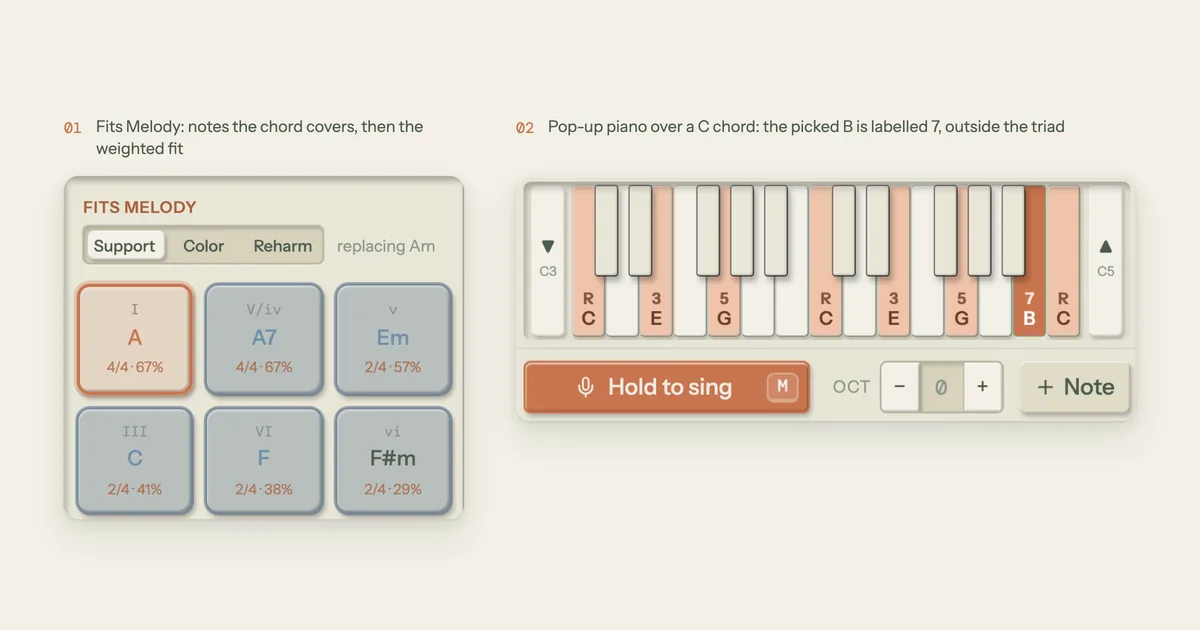
A long note on a downbeat counts for more than a quick note between beats. A note approached and left by step on a weak beat is read as a passing tone the harmony isn't expected to contain, so it only sways the ranking faintly. A note a half step from one of the chord's notes counts against that chord, which is question 4 from the test above (a major seventh over a chord with no ♭7 is exempt, so B over C doesn't count against C). Each suggestion shows a plain count next to a weighted score, so two chords covering the same number of notes can score very differently, and a chord that leaves a passing note uncovered can still come out on top. The chord progressions chapter of the docs says it plainly: "a plain chord reading 2/3 is often exactly right."
How does Song Cage show whether a note is in the chord?
When you pick a pitch for a syllable on Song Cage's pop-up piano, the keys of the chord under it light up, each labelled with its role (R, ♭3 or 3, 5, ♭7). The key you pick gets a label too, even when it isn't in the chord, so you can see whether you're writing a chord tone or an outside note before you commit. The writing melody chapter covers both, and the chord progressions chapter covers Auto Chords, which applies the same weighting across a whole section. All of this works on the timeline in the web app, the desktop app and the plugin, in any section with a key set.
What about a melody you sing into a DAW?
Melody Rack is a separate plugin from Song Cage that loads as a MIDI effect. You sing a line and its effects make new melodic ideas out of it, and two of them work along the lines of this guide.
Bones treats the long notes on strong beats as the skeleton of your phrase and the quick notes between them as decoration. It scores every sung note on its length, the strength of its beat, whether it ends a phrase and, once the Chords slot has written chords, whether it's in the chord. It keeps the strongest notes and writes a new line between them in the rhythm of your own hook, so each roll picks a different bar as the hook and builds a new line on the notes that carried yours.
In Key moves notes that are outside the key but leaves quick passing notes alone, chromatic ones included: a short note clear of the bar line and the half bar that steps through (C, C#, D) or dips off a note and straight back (G, F#, G). A note that leaps in or out gets corrected unless you sang it squarely on pitch or chose to keep it. Melody Rack's trial is 14 days with no card; you start it by signing in to a free Song Cage account inside the plugin window.
Frequently Asked Questions
What is the difference between a passing tone and a neighbor tone?
Direction. A passing tone steps between two different chord tones and keeps going the same way, like E, D, C over a C chord. A neighbor tone steps away from a chord tone and comes straight back to the same note, like E, F, E over the same C chord. Both are usually short and fall between beats.
What is the most common non-chord tone?
The passing tone and the neighbor tone. Music theorist David Temperley calls them "the most common kinds of non-chord tones" in classical music, and pop melodies are full of them too, because a line that moves by step over a triad can't help passing through notes outside it.
Can a non-chord tone fall on the downbeat?
Yes. Appoggiaturas, suspensions, retardations and accented passing tones all land on the beat. They're the most expressive non-chord tones because they clash exactly where the listener checks the melody against the chord, and they need to resolve by step to sound intended.
What is a 4-3 suspension?
A note a fourth above the bass, held over from the previous chord into a chord it doesn't belong to, that then falls a step to the new chord's third. Over a C chord, it's an F that resolves down to E. The sus4 chord is named after this kind of suspension.
Do non-chord tones have to resolve?
In classical music nearly always, by step. In rock, often not: David Temperley found unresolved non-chord tones are common in rock verse melodies, especially pentatonic ones, while choruses tend to resolve. A note that never resolves and sounds good may really be part of the chord, such as a ninth or a major seventh.
What is an example of an escape tone?
Paul and Linda McCartney's "Silly Love Songs." Over an Em7 chord the melody steps up from G to A, a note outside the chord, then leaps down to C as the next chord, Fmaj7, arrives. Step in, leap out the other way: that's an escape tone.
Write the melody and see which chords hold it
Song Cage ranks chord suggestions against the melody you've written and the chords on either side, and re-ranks as you change a note. A quick passing note between beats barely moves the list. A long note on the downbeat moves it a lot. You choose every chord by ear.