You have the words. You have a tune. Separately, both are good. Together, something is off, and you cannot name what.
This is one of the most common walls in songwriting, and it shows up in the same shape every time: a writer who can write music and can write lyrics but cannot get the two to hold hands. The usual advice is to keep humming until it clicks. That works eventually, but it is slow, and it treats a solvable rhythm problem like a mood problem.
It is almost never a mood problem. It is a rhythm problem, and it has a diagnosis and a short list of fixes.
Why do your lyrics sound wrong when you sing them?
A lyric sounds wrong when the melody stresses a syllable that speech does not. Every English word longer than one syllable carries a fixed emphasis, and every bar of music has strong and weak beats. When those two patterns disagree, listeners hear something unnatural even when they cannot explain what.
Say "guitar" out loud. The weight is on the second half: gui-TAR. Now say it the other way, GUI-tar, and it stops being a word and starts being a mistake. You did not need theory to hear that. You have been running this check your whole life without noticing.

Singing does the same thing, using different tools. A melody signals emphasis with pitch and with duration: higher notes and longer notes feel accented. Put the long note or the high note on "GUI" and the melody has argued with the language. The listener does not think "prosody error." The listener thinks the line sounds amateur, or worse, stops listening.
What is prosody in songwriting?
Prosody is the fit between what a song says and how every element says it. Berklee professor Pat Pattison, who has taught lyric writing there for four decades, defines it as the state where all elements work together to support the song's central message, and he traces the idea back to Aristotle's Poetics and its concept of unity.
Pattison is blunt about how much weight this carries. He teaches that songwriting has only tools, no rules, with exactly one exception, and prosody is the exception.
The word gets used at two zoom levels, which is part of why it confuses people. At the wide level it covers everything: a song about a broken heart built from tidy, equal, perfectly resolved four-line verses has bad prosody, because the form contradicts the content. At the close level, the level this article is about, it means the specific fit between syllable stress and musical stress. Pattison's own mantra for the close level is worth keeping on a sticky note: preserve the natural shape of the language.
The short version
A song is speech, exaggerated. If the exaggeration lands on the same syllables speech would have emphasized, the line sounds sung. If it lands elsewhere, the line sounds recited by someone who does not speak the language.
Which syllables are strong?
Two rules cover most of English, and you already obey both.
First, every word of two or more syllables has one primary stress that never moves. "Music" is STRONG-weak. "Believe" is weak-STRONG. "Insecurities" is a five-syllable word whose main weight sits in the middle, on the third. If you are unsure, a dictionary marks it, though saying the word twice with the emphasis in different places is faster and just as reliable.
Second, one-syllable words are strong when they are doing real work. Nouns, verbs, adjectives and adverbs carry meaning, so they want strong positions. Articles, prepositions, conjunctions and most pronouns are traffic signs, not cargo. Pattison's image for the split is that the working words get sweaty and the sign-holders stay dry, and you want the sweaty words on the sweaty beats.
The gray areas are real. In a line made entirely of one-syllable words, several could plausibly take the weight, and which one does is a choice you get to make. That is a feature. The words with fixed stress are constraints; the flexible ones are where you steer.
Which beats are strong?
Music has the same strong and weak alternation, and in 4/4 it is completely predictable. Beat 1, the downbeat, is strongest. Beat 3 is next. Beats 2 and 4 are weak.
The useful part is that this pattern repeats all the way down. Pattison describes 4/4 as architectonic, meaning the same strong-to-weak shape survives at every subdivision: within a beat, the eighth note on the beat is stronger than the one off it, and the same holds for sixteenths. So you are never guessing about the music side. Given any position in a bar, you can say how much weight it carries.
| Position in a 4/4 bar | Weight | What belongs there |
|---|---|---|
| Beat 1 (downbeat) | Strongest | The most important word in the line |
| Beat 3 | Strong | The second most important word |
| Beats 2 and 4 | Weak | Stressed syllables of low-value words, such as two-syllable prepositions |
| Offbeat eighths and sixteenths | Weakest | Articles, prepositions, unstressed syllables |
The same strong-to-weak pattern repeats at every subdivision, so every position in the bar has a knowable weight.
How do you find the mismatch?
Do not sing it. Singing hides the problem, because your voice will instinctively bend toward what sounds right and paper over the error you are hunting.
Instead, speak the line in the exact rhythm of the melody, flat, with no pitch. Just the timing and the emphasis the tune would impose. If the spoken version sounds like a person talking, the sung version will too. If it sounds robotic, or if a word comes out mispronounced, you have found the bar that needs work.
This test is fast enough to run on every line of a verse in about a minute, and it is far more reliable than listening to yourself sing, because it removes the one variable that was covering up the fault. Mark every line that fails. Most songs have two or three, not twenty, and fixing those two or three is usually the whole job.
Run the test
- Speak the line at normal speed. Note which syllables you naturally emphasize.
- Now speak it again in the melody's rhythm, still without pitch.
- Compare. Any syllable that changed emphasis between the two passes is your problem.
- Check where that syllable falls in the bar. On a weak beat while a sign-holder word sits on the downbeat is the classic failure.
What should you fix first?
Most writers reach straight for the melody, because the melody feels like the part that is "the song." That is backwards, and it is the expensive fix. Work up the ladder instead, cheapest first.
Change the word. If "forever" fights your line, "always" may drop straight in, because the stress sits on the opposite side. A synonym with a different stress pattern is often one thesaurus entry away, and it costs you nothing structurally. Song Cage keeps a synonym tool beside the lyric line so the swap happens without leaving the song; if you are hunting in a browser instead, Power Thesaurus is the one worth having open, because it lets you sort results by syllable count and filter by part of speech, which is exactly the constraint a line under a melody is working against. Hunting for a word that scans differently is the same muscle you use when working with internal rhyme, where the sound of a word matters as much as its meaning.
Change the rhythm. Shift the phrase by a beat or an eighth so the strong syllable lands on the strong beat. The notes stay the same; only their timing moves.
Move the whole phrase. Instead of nudging one syllable, relocate where the line starts in the bar. This is the lever most guides skip entirely, and the next section is about it.
Change the melody. Move the accent note to the strong syllable. This works, but it costs more of the song than writers expect, so it belongs last, not first.
Front-heavy or back-heavy: where should the line start?
This is the lever almost nobody teaches, and it does more work than any of the others.
Pattison divides phrases by where they begin relative to the downbeat. A phrase that starts on the downbeat, or picks up into it, is front-heavy: anchored and stable, in his image a flag attached to its pole. A phrase that starts after the downbeat is back-heavy: the flag detached, fluttering, in motion. Back-heavy feels unstable, and the later the phrase starts, the less stable it feels.
Bars alternate the same way beats do. Bar one is strong, bar two weak, and so on into four and eight-bar groups. Starting a line in a weak bar, which requires leaving the strong bar empty, feels as floaty as starting after a downbeat does.
This means placement carries emotional information on its own, before the words say anything. Pattison's summary is that motion creates emotion. A line you actually mean, a commitment or a plain fact, wants a downbeat and a strong bar. A line full of regret or uncertainty can be told the truth about itself by starting late.
When is bad prosody the right choice?
Deliberately, and knowing you are doing it.
Pattison's own worked example is Post Malone's "Circles," where the opening verse phrases sit back-heavy in the weak bars, and the effect is exactly the floaty, unsettled quality the lyric is describing. Later the phrases shift to back-heavy in the strong bar, which reads as more insistent and more solid without ever becoming stable. The song is using placement as an emotional dial.
His point about that song is worth repeating precisely, because it is easy to over-read: he does not claim Post Malone and his co-writers planned every one of those effects. He argues the phrasing has those emotional consequences whether or not anyone intended them, and that you can intend them.
So the rule is not "always align." The rule is that misalignment should be a decision. A useful working ratio is to keep most of your lines conventionally phrased so the listener has stable ground, then break it where the meaning earns it.
What does a real prosody error sound like?
It sounds like a hit song, sometimes. This is not a beginner-only failure.
The most thoroughly documented example in the songwriting-teaching literature is Pattison's line-by-line analysis of Katy Perry's "Unconditionally," the second single from her 2013 album Prism, written by Perry with Dr. Luke, Max Martin and Cirkut. His findings are specific and checkable against the recording:
What Pattison identifies
- The opening two words are set with the weight reversed, so the pair lands closer to the surname "Ono" than to the phrase as spoken.
- In "insecurities," the secondary stresses land on downbeats while the primary stress is pushed onto the weaker third beat, which he describes as turning the word upside down.
- The title word itself is set with its primary musical stress in the wrong place, and its final unstressed syllable lands on a downbeat.
- A single sentence about laundry and blinking is chopped across two melodic phrases, splitting one grammatical idea in half.
The lesson is not that the song failed commercially, because it did not. The lesson is that a sentiment nearly everyone wants to hear can be muffled by its own setting, and that no amount of production repairs it.
How do you turn a poem into a song?
Start by accepting that the poem will change. This is the step that stalls people who arrive with finished text.
A poem answers only to itself. A lyric answers to a meter, a bar count and a singer's breath. Lines that read beautifully often carry a syllable count no phrase can hold, or put their best word where the bar has no room for it. Writers who have done this report the same thing: the finished song keeps the poem's meaning and its strongest images, and rewrites a surprising amount of the rest.
Two moves do most of the work. First, contractions and elisions buy you syllables without changing meaning, and singers use both constantly. Second, reordering a line to move the important word toward a downbeat frequently fixes a phrase that resisted every melodic idea you threw at it.
Treat the text as a draft rather than an artifact, and the tune tends to arrive quickly. Hold the text sacred and you will be humming for weeks. If you would rather come at the song from the other direction, writing the melody first and fitting words afterward is an equally legitimate route, and it makes the syllable count a target instead of a constraint.
Putting syllables on a beat grid you can hear
Notice what every guide above, including this one, has asked you to do: mark the stressed syllables, count the beats, draw a grid, slot each syllable into a box, and check the alignment. It is the right method. The problem is the medium. A grid drawn on paper cannot play back, so you are still checking your work by imagining it.
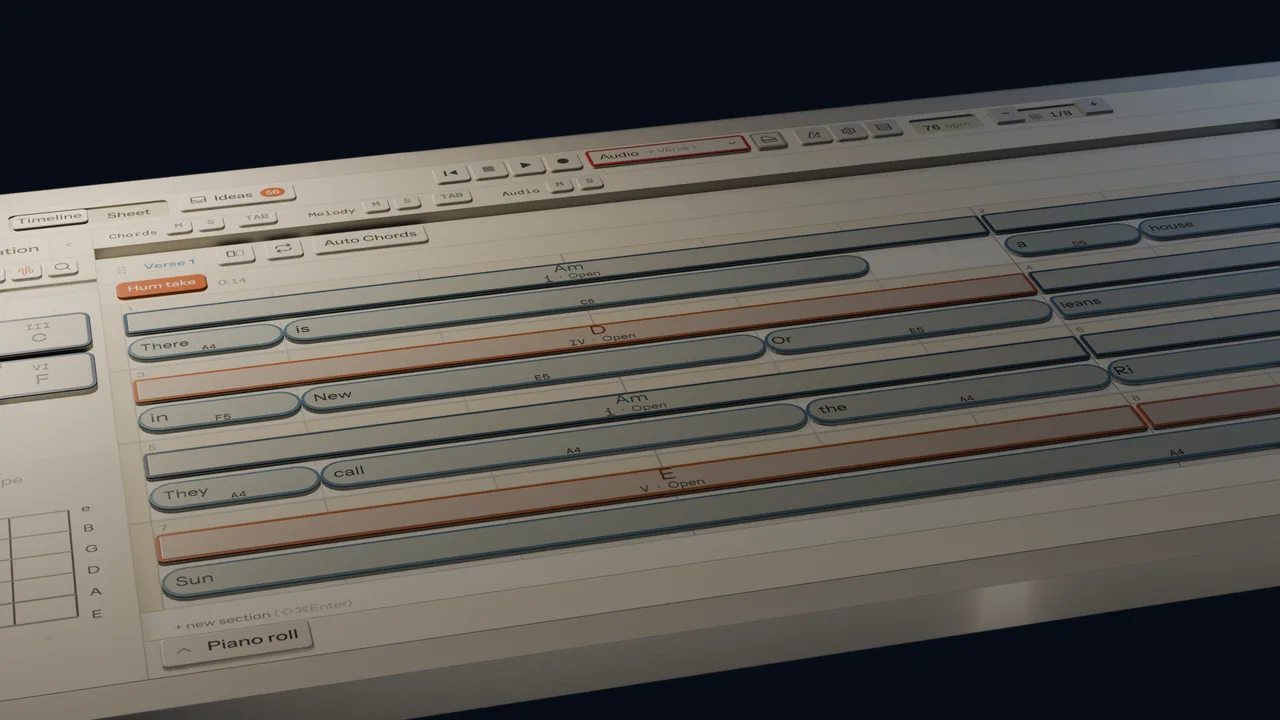
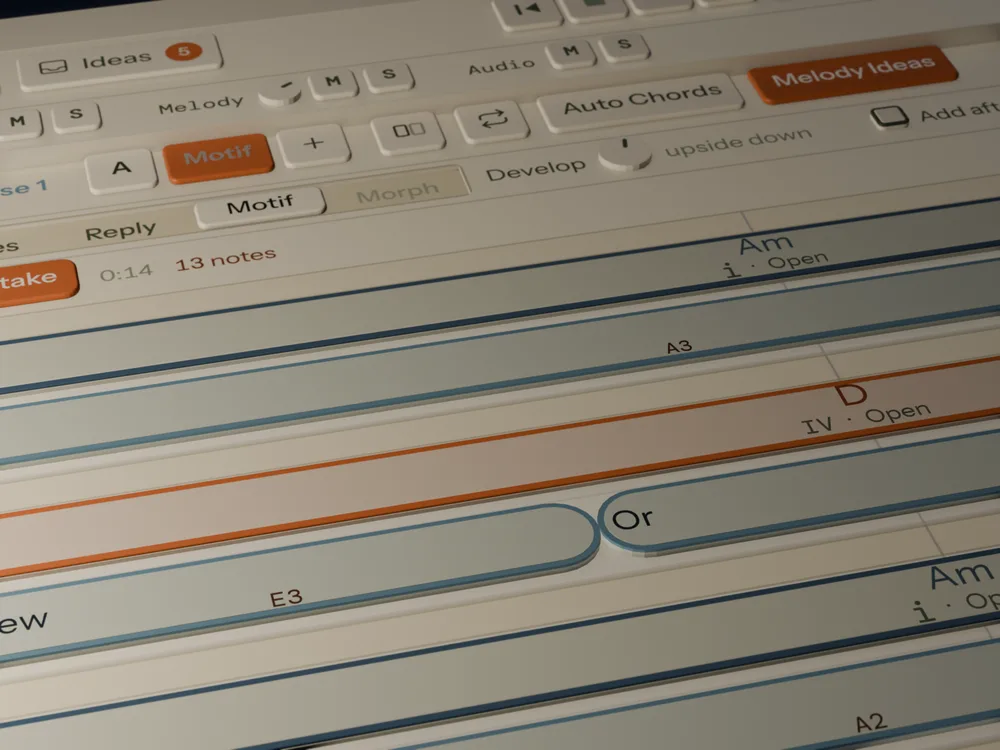
This is the specific job syllable splits in Song Cage do. A lyric block holds a word on the beat grid. Split it, and the word divides into compartments, each sitting on its own slice of the grid, each able to carry its own melody note. In Timeline view a scissors icon on the block opens split mode and marks the likely break points, so "beautiful" offers breaks after "beau" and "ti." In Sheet view, typing the word with hyphens does the same thing, and the stored lyric stays clean.

Then the dividers drag. If a syllable needs to arrive later, or hold longer before the next one lands, you move it and hear the result rather than picturing it. That is the whole difference between a scansion grid and a working one.
One honest limit, because it matters: Song Cage splits the syllables and puts them on beats. It does not tell you which syllable is stressed and it will not flag a prosody error for you. That judgment stays yours, exactly as Pattison's method assumes. What changes is that the judgment becomes testable in a few seconds instead of living in your head. Where a line's phrase begins in the bar, the front-heavy and back-heavy choice from earlier, is likewise something you can now simply try both ways, which pairs naturally with the pacing of the chords underneath.
Hear the line instead of imagining it
Put each syllable on its own beat, drag the timing until it speaks, and play it back. Song Cage is free to start, with 14 days of full access in the desktop app or plugin and no card.
Frequently Asked Questions
What does prosody mean in songwriting?
Prosody is the fit between a song's message and every element used to deliver it. Pat Pattison of Berklee defines it as all elements working together to support the central idea, tracing the concept to Aristotle. In practice, songwriters most often use it to mean the narrower fit between syllable stress and musical stress: strong syllables on strong beats.
Why do my lyrics sound awkward when I sing them but fine when I read them?
Reading imposes no rhythm, so the words carry their natural stress. Singing imposes one. If the melody puts a long or high note on a syllable that speech leaves unstressed, the word is effectively mispronounced. Speak the line in the melody's rhythm without pitch, and the mismatch becomes obvious immediately.
Should I change the words or the melody when they do not fit?
Try the word first, since a synonym with different stress is the cheapest fix. Then try shifting the phrase's timing by a beat. Then try moving where the whole line starts in the bar. Change the melody last, because it costs more of the song than writers expect and is usually not the actual problem.
Which beats are strong in 4/4 time?
Beat 1, the downbeat, is strongest, and beat 3 is next. Beats 2 and 4 are weak. The pattern repeats at every subdivision, so an eighth note on the beat is stronger than one off it. Put your most important word on beat 1 and your second most important on beat 3.
Is it ever right to put a stressed syllable on a weak beat?
Yes, when it is deliberate. Starting a phrase after the downbeat makes it feel unstable and in motion, which can be exactly right for a lyric about uncertainty or regret. Keep most lines conventionally phrased so the listener has stable ground, then break the pattern where the meaning earns it.
How do I turn a poem I already wrote into a song?
Expect to rewrite part of it. Keep the meaning and the strongest images, then adjust syllable counts to fit the bars using contractions and elisions, and reorder lines so important words reach strong beats. Poems answer only to themselves; lyrics also answer to a meter, a bar count and a singer's breath.