Search this question and you get the same answer eight times: a hook is the catchy part, and it is not always the chorus. Then the page stops. Nobody tells you how to look at a moment in your own song and say which one it is.
The confusion is not your fault, and it is not a matter of opinion. Hook and chorus are not two words for one thing, and they are not rivals. They answer different questions. A chorus is a place in the form. A hook is an effect on a listener. Once you separate those two ideas, the arguments dissolve and the craft question underneath gets much easier to work on.
What is a hook in a song?
A hook is any short musical or lyrical element that stands out from what surrounds it and is easily remembered. The definition songwriting scholarship still uses comes from Monaco and Riordan in 1980: "a musical or lyrical phrase that stands out and is easily remembered." It says nothing about where in the song the hook sits, and nothing about repetition.
That last omission is deliberate. Gary Burns adopted this definition for his 1987 study of hooks in Popular Music, and drew out the consequence in one line: repetition is not essential in a hook, but is not ruled out either. A drum fill that happens exactly once can be the hook of a record.

The industry version is blunter. Songwriters Al Kasha and Joel Hirschhorn called hooks the foundation of commercial songwriting. The trade dictionary definition, the one most blog posts are quietly paraphrasing, is narrower still: the part of a song, sometimes the title, that keeps recurring. That narrowness is exactly where the confusion starts, because it smuggles in an assumption that the hook is lyrical and lives in the chorus.
Why do songwriters disagree about what a hook is?
Because two genre conventions collided and both are correct inside their own tradition. In hip-hop and R&B, "hook" is the name of a section, the part between the verses. In rock and dance music, "hook" describes an effect, and it usually attaches to a riff or a drop rather than a sung section.
The hip-hop usage is not slang drift. Musicologist Ben Duinker, surveying 160 hip-hop songs in Current Musicology, formally codifies two principal section types, verse and hook, and writes that hook sections are somewhat analogous to choruses in other genres: the lyrics stay fixed across the song, they quote or hint at the title, and they contrast with the verse. He prefers "hook" precisely because those sections fill a chorus-like role in a different way. Vanilla Ice's 1990 single tells the listener to check out the hook just before the chorus arrives, a line often cited as an example of the section usage.
So when a producer says the hook is the chorus and a guitarist says the hook is the riff, neither is wrong. They are using a section name and a function name. A hook in music is therefore best understood as a role rather than a fixed location: it is the job of being the memorable part, and different genres hand that job to different elements. This article uses the function meaning throughout, because that is the one that lets you diagnose your own song.
Hook vs chorus vs refrain: what actually separates them?
Hook, chorus, and refrain are defined by three different criteria. A hook is defined by impact: it is whatever stands out. A chorus is defined by structural role: a complete, lyric-invariant section that recurs. A refrain is defined by lyrical repetition inside another section. Different criteria, not synonyms, which is why a song can have all three, or a hook and no chorus at all.
| Hook | Chorus | Refrain | |
|---|---|---|---|
| Defined by | Impact on the listener | Structural role in the form | Lyrical repetition |
| Answers | What stands out? | Where are we in the song? | Which line comes back? |
| Typical size | A phrase, roughly 2 to 10 seconds | A whole section, often 8 to 16 bars | One line, sometimes a couplet |
| Position | Anywhere: intro, under a verse, post-chorus, outro | A fixed slot, after the verse or pre-chorus | Usually the last line of a verse |
| How many per song | Several, often layered | One, repeated | One |
| Needs words? | No | Yes | Yes |
| Carries the title? | Sometimes | Usually | Usually |
The chorus definition here is the standard one from Open Music Theory: a chorus is lyric-invariant, carries the primary lyrical material, and runs at a heightened intensity relative to the verse. The refrain distinction comes from Ralf von Appen and Markus Frei-Hauenschild, whose survey of roughly 3,000 songs defines a refrain line as one that does not constitute a discrete, independent section within the form. The clean version: a chorus is a container, a hook is a kind of cargo. Asking whether the hook is the chorus is like asking whether the cargo is the truck.
Is every chorus a hook?
No, and the claim that every chorus is a hook is repeated all over the songwriting web. A chorus is an obligation you fulfilled. A hook is a result your listener produced. The two come apart constantly, and when they do, that is the actual problem you came here to solve.
A chorus can arrive exactly on schedule, carry the title, lift the register, return unchanged, and still be completely forgettable. That is not an exotic failure. It is the most common one in amateur songwriting, and no page that insists every chorus is a hook can even describe it, let alone fix it.
The diagnostic takes ten seconds. Can you describe your chorus but not sing it back from memory tomorrow? Then you have written a chorus and you have not yet written a hook.
How long is a hook?
Around five seconds, and there is real data behind that number. The Hooked on Music study, designed by John Ashley Burgoyne and colleagues at the University of Amsterdam and built with Manchester's Museum of Science and Industry, measured how quickly listeners recognised songs. Across more than 12,000 participants and over 1,000 clips, the average was about five seconds.
The fastest song in that dataset was the Spice Girls' "Wannabe," recognised in an average of 2.29 seconds. The underlying research paper, presented at ISMIR in 2013, places the useful hook window at roughly five to ten seconds: long enough to have a shape, short enough to be held in one grip.
That gives you a working target rather than a rule. If the thing you are calling your hook takes fourteen seconds to arrive at its point, it is probably a section with a hook somewhere inside it, and you have not found the hook yet. Keep cutting until what remains is the part you would hum to someone across a room.
What makes a hook stick?
Two forces, working together. Attention decides whether a listener notices the moment at all, and memory decides whether it survives afterward. A hook is a fragment that wins both: it separates itself from the texture around it, and it is small enough to be held whole.
The attention half is a figure-and-ground problem. The mind sorts a busy arrangement into a thing being listened to and a background it is heard against, and a hook almost always occupies the figure position. Psychologists Tim Byron and Jadey O'Regan, who wrote the 2022 book Hooks in Popular Music, make the point that a hook is not a property of the music alone. It is a product of the interaction between the music and a particular listener's attention and memory.
The craft engine sits underneath that, and Burns named it in 1987: music moves along a continuum of repetition, variation, and modulation, where modulation means a large change in a single element. A hook is what happens when one element changes sharply against a norm the song has already established. His conclusion about rhythm is the counterintuitive one worth keeping: rhythmic hooks are a result of change rather than repetition. Which inverts the usual advice. If your hook is not landing, the first thing to try is not repeating it more. It is sharpening the contrast around it.
Byron and O'Regan also explain why the biggest pop records feel over-engineered: they use compound hooks, where the melody, the rhythm, and the vocal performance are all doing something arresting at the same moment, so different listeners latch onto different layers of the same three seconds.
What are the main types of hook?
Hooks are usually sorted into four kinds, and the four-way list every page runs is incomplete. Burns' 1987 typology is wider and better: alongside the written elements of rhythm, melody, harmony, and lyric, he classifies performance elements and production elements as hook sources in their own right.
Melodic hooks work through contour and interval. Burns treats leap size as the main lever, observing that any interval larger than a perfect fifth reads as distinctive, which is why a hook that jumps stands out against a verse that steps. The short-short-short-long rhythmic shape at the top of Beethoven's Fifth is the reference case, and it is public domain, so you can study it freely. Our guide to writing a melody covers contour and range in more depth.
Rhythmic hooks pass the table test: someone can tap it and you know the song. Queen's "We Will Rock You" is the purest example on record. Two stomps and a clap, then a rest. There is no bass and no drum kit on it at all. Roger Taylor told Billboard it has only one instrument apart from the voice, and Brian May's guitar does not enter until the closing solo of a record that runs just over two minutes.
Lyrical and title hooks are what most people mean by the word. They work through concision and placement, usually landing the title at the front or back of a chorus line. Our guide to writing song lyrics covers the craft of the line itself.
Instrumental and riff hooks are figures rather than sections, and they are covered in detail below, because they are also where the hook-versus-chorus question actually gets decided.
What is a production hook?
A production hook is one that belongs to the record rather than the song. It survives no transcription and usually disappears in a cover version, because the memorable element is a sound rather than a note. It rarely gets treated as its own category, though the authority for doing so is nearly forty years old.
Burns split non-textual hooks into two tiers. Performance elements cover instrumentation, tempo, dynamics, and what he files under improvisation and accident: a studio noise left in, an unplanned scream, a solo nobody wrote down. Production elements cover sound effects, editing, the mix, channel balance, and signal distortion.
The modern flagship is "Where Are Ü Now" by Jack Ü with Justin Bieber (2015). The figure everyone remembers, the one that sounds like a flute or a dolphin, is a fragment of Bieber's own vocal pitched roughly two octaves up, distorted, and bounced repeatedly until it degraded. Skrillex described it as pitched way up, distorted, bounced, rebounded again, so it sounds worse almost. It is still a melody, a five-note figure in G major, so the accurate claim is not that it has no tune. Its identity is carried by timbre and processing rather than by a voice singing words. Mixing engineer Mike Senior notes that its reverb is narrowed, giving it a strange sense of distance against the width of everything around it.
Bieber sent that song to the producers as a slow piano ballad with no drums. Everything you remember about the record was added afterward, at the desk. That is what a production hook is.
Where does the hook live when it is not in the chorus?
Everywhere except the chorus. It is worth organising the cases by position rather than by type, because position is what the question is actually about, and each slot below has a verified example.
Can the hook arrive before the first word?
Yes, and it is the most common place to find one. "Sweet Child O' Mine" (Guns N' Roses, 1987) opens with a solo electric guitar playing alone for roughly fifteen seconds.
Slash's figure is a single-note arpeggio high on the neck that skips strings instead of walking up adjacent ones, moving by leaps where a rhythm part would move by step, so the ear files it as melody rather than accompaniment. The song has a real chorus on genuinely different chords, and the thing listeners reproduce is still the naked intro.
"Bitter Sweet Symphony" (The Verve, 1997) does the same thing with an orchestra, and is usually misremembered as riding a sample. It does loop four bars of the Andrew Oldham Orchestra's version of the Rolling Stones' "The Last Time," but engineer Chris Potter, who mixed the record, was blunt about how little is in that loop: it is a basic chord progression and a couple of bongos, not the string riff. The figure you hum was scored by arranger Wil Malone and recorded fresh at Olympic Studios by 24 players, and his instruction to the section was to make the strings tough and determined, not pretty and not poetic.
Can a hook run underneath the whole song?
Yes. "Superstition" (Stevie Wonder, 1972) runs its clavinet figure through the intro, the verses, the instrumental stretches, and the fade, so it never occupies a section because it occupies all of them.
It is a two-bar figure built on the E flat minor pentatonic scale, which on a keyboard is just the black keys. It lands its root on a sixteenth note right before the barline, an unusually weak spot for a resolution, so the phrase never quite settles and simply comes back around. Analysts disagree about what to call the sung section that follows each verse, some hearing a chorus and some a refrain, and that disagreement is itself the lesson: the hook is not in dispute, only the container.
Can a hook happen only once?
Yes, and this is the case that breaks the popular definition. "In the Air Tonight" (Phil Collins, 1981) withholds a backbeat almost to the end, then plays its famous descending tom fill a single time.
The album version runs on a drum machine pattern with the snare stripped out, and the fill does not arrive until roughly 3:40 into the 5:34 track. No live kit is heard before it. Collins improvised the fill and kept the take, telling International Musician & Recording World in 1985 that although it had apparently become a trademark of his, it could have been anything: he just decided where he wanted the drums to come in. One event, never repeated, and it is unarguably the hook. Any definition that requires repetition cannot account for it.
What is a post-chorus hook?
A post-chorus hook arrives after the chorus rather than inside it, and it is a real, measurable slot. Cara Stroud surveyed 1,335 Top-40 songs from 2010 to 2015 in Music Theory Online and found 13.3% of them had one.
The post-chorus is where a lot of modern pop puts its most memorable few seconds, which is why "the hook is the chorus" fails so often on recent records.
Where is the hook in "Crazy in Love"?
Not in the chorus, and you can time it. In "Crazy in Love" (Beyoncé featuring Jay-Z, 2003), the chanted figure arrives about fourteen seconds in, ahead of the first verse at 0:29 and the first chorus at 0:48.
Producer Rich Harrison built the record around a sample of the Chi-Lites' 1970 "Are You My Woman? (Tell Me So)." The chant then returns as a passage of its own between the first chorus and the second verse. Where the chorus rides the horn riff, the chant drops the horns entirely and runs on the percussion loop alone. That is the clearest kind of proof available: the hook and the chorus are audibly different sections, sitting at different timestamps, using different instrumentation.
The honest ambiguous cases
Three famous examples get cited as hook-outside-chorus and should not be, at least not flatly. Each is more useful as a lesson than as evidence.
- "(I Can't Get No) Satisfaction" (1965) has two hooks, not one. Keith Richards built his figure from three pitches on a single string and cut it through a fuzz pedal as a sketch, expecting horns to play the line on the finished record. He was outvoted and the sketch became the single. Mick Jagger named both hooks himself in a December 1995 Rolling Stone interview, listing a very catchy title, a very catchy guitar riff, and a great guitar sound that was original at the time.
- "Billie Jean" (1982) opens with roughly 29 seconds of instrumental before the vocal, and the bass line is unmistakable within a few notes. But the song also has a strong title chorus. This one teaches the difference between a signature, which identifies a record instantly, and a hook, which is the thing you actually sing.
- "Where Are Ü Now" sits at a genuine analytical fault line. Some theorists call the drop a post-chorus; others call it a dance chorus and therefore a chorus. In every reading, the hook is not inside a sung chorus, which is all this article needs it to be.
Does a song need a chorus to have a hook?
No, and the strongest evidence is the songwriter's own account. Jack White has said plainly that writing "Seven Nation Army" without a chorus was the exercise: he wanted to see how powerful he could make the track without resorting to having one.
In an interview with the Detroit Free Press, White explained that the melody never changes, it only repeats and gets louder and quieter, and drew the parallel himself to hip-hop tracks where a sampled melody stays fixed and only the words create the chorus. He wrote the riff at a soundcheck in Melbourne, initially filed it in his notebook as a possible James Bond theme, and both record labels declined to release it as the album's first single. It is now chanted by stadium crowds who are, as White has pointed out, not singing words at all. They are chanting a melody.
"Hey Jude" makes the same point in a gentler form. Musicologist Alan W. Pollack charts it as verse, verse, bridge, verse, bridge, verse, then a jamming phrase that repeats to the fade, with no chorus anywhere in the outline. He hears the track as an unusual binary form combining a fully developed, hymn-like song with an extended, mantra-like jam on a simple chord progression, and notes that the jam turns out to be the longer of the two major sections. The figure does not arrive unannounced either: each bridge tacks on what Pollack calls a short, two-measure syllable phrase that provides a foreshadowing, associative link with the jam.
For the full map of what a chorus, bridge, and pre-chorus each do, see our guide to song structure.
How do you build a hook?
Work in this order. Most writers try to invent a hook from nothing, which is the hardest possible entry point, and skip the step that actually makes hooks work, which is establishing the norm the hook departs from.
- Start from what you already sing. Play your draft and notice which fragment you produce without reading. That is your candidate. Hooks are usually found, not invented: Jack White wrote the "Seven Nation Army" riff at a soundcheck in Melbourne, and filed it in his notebook as a possible Bond theme.
- Name the norm. Write down what the section before your candidate does in register, rhythmic density, and phrase length. You cannot build contrast against a norm you have not identified.
- Subtract. Cut the fragment until removing one more note or word breaks it. Keith Richards' "Satisfaction" figure is three pitches on a single string. The "Superstition" clavinet figure is two bars.
- Modulate one element hard. Take the dimension with the most room and change it sharply against the norm: jump the register (Burns notes any interval wider than a perfect fifth reads as distinctive), halve the rhythmic density, or strip the arrangement outright, as "We Will Rock You" does by cutting everything except feet, hands, and a voice.
- Clear space for it. A hook competing with a busy arrangement loses. Take something away at the moment it arrives rather than adding something. "Sweet Child O' Mine" gives its riff roughly fifteen seconds alone before anything else enters.
- Place it early enough to matter. A listener deciding in the first seconds never reaches a hook that arrives at 1:40. "Crazy in Love" puts its chant at about 0:14, well ahead of the first chorus at 0:48.
- Grow it into a section only after it survives on its own. If the two-bar figure holds up looped, it will hold up as eight bars. The reverse is not true. McCartney plants the "Hey Jude" coda figure in two-measure form at the tail of each bridge before handing it the rest of the record.
The contrast principle that makes hooks land is the same one that makes chord progressions stop sounding flat, and it is worth reading alongside this.
How do you know if your hook is working?
Run these six tests against your draft. Any one you fail is a specific, fixable problem, not a verdict on the song.
The hook test
- The offline test. Can you sing it back tomorrow without the recording? This is the only test that matters, and the only one you cannot rush.
- The table test. Tap the rhythm alone, no pitch. Can someone identify it? If yes, you have a rhythmic hook underneath your melodic one, which is a strong position. "We Will Rock You" passes this test with nothing but two stomps and a clap.
- The contrast test. Name in one sentence what it does that the previous section does not. If you cannot finish that sentence, there is no hook yet.
- The subtraction test. Is anything in it removable without loss? If so, remove it.
- The figure test. In the arrangement as it stands, is the hook in the foreground or is it competing? Solo it, then play it in context, and be honest about the difference.
- The five-second test. Time it. Recognition in the Hooked on Music data averaged about five seconds, and "Wannabe" managed 2.29. If your fragment runs much longer, you are looking at a section, not a hook.
What are the most common hook mistakes?
Five failures account for most flat hooks, and each has a specific repair that is not "write a better hook."
Buried. The hook is fine, the arrangement never clears room for it. Repair: subtract at the moment of arrival.
No contrast. The verse already occupied the same register and rhythmic density, so nothing changes when the hook lands. Repair: change the verse, not the hook. Lowering the verse is often easier than raising the chorus. "In the Air Tonight" is the extreme version of this principle: it withholds a live drum kit for roughly 3:40 of a 5:34 track, so a single fill lands like an event.
Too late. Repair: move it, or move a fragment of it, into the intro. Working songwriters pitching for playlists and sync increasingly treat a front-loaded hook as a practical necessity.
Competing hooks. Three good ideas cancelling because nothing dominates. Repair: pick one lead hook and demote the others to support.
Correct but flat. The chorus does everything right structurally and nothing memorably. Repair: modulate one element hard, per step 4 above. This is the failure that the "every chorus is a hook" advice makes invisible.
Does the answer change by genre?
Yes, and knowing which convention the room is using saves a lot of pointless argument.
In hip-hop and R&B, hook names the section, so inside the genre the answer to "is the hook the chorus" is simply yes; Ben Duinker's 160-song corpus formalises that usage. In pop and country, the title hook dominates the chorus, and the verse and pre-chorus exist to make its arrival feel earned. In rock, the riff usually outranks the chorus, which is why "Sweet Child O' Mine" and "Satisfaction" are remembered as guitar figures rather than sung lines. In dance and electronic music, the drop carries the function the chorus carries elsewhere, which is exactly why analysts still argue over whether the drop in "Where Are Ü Now" is a post-chorus or a chorus.
Capturing a hook before it disappears
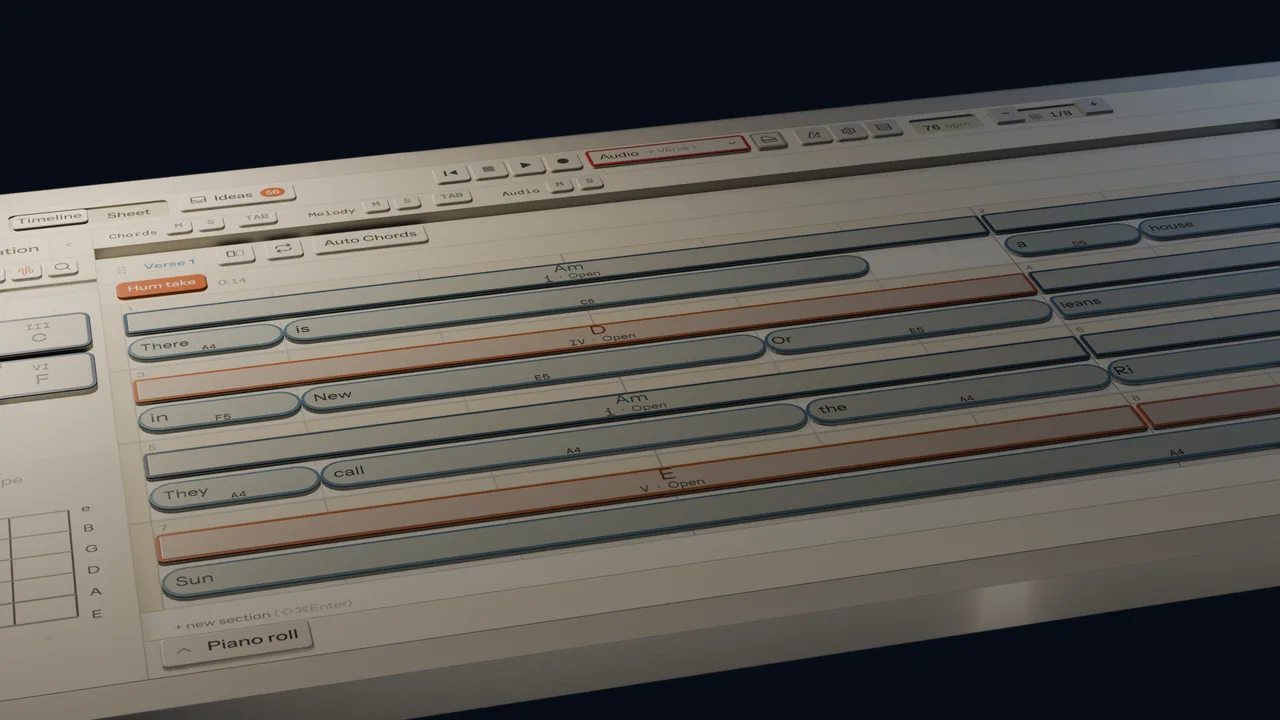
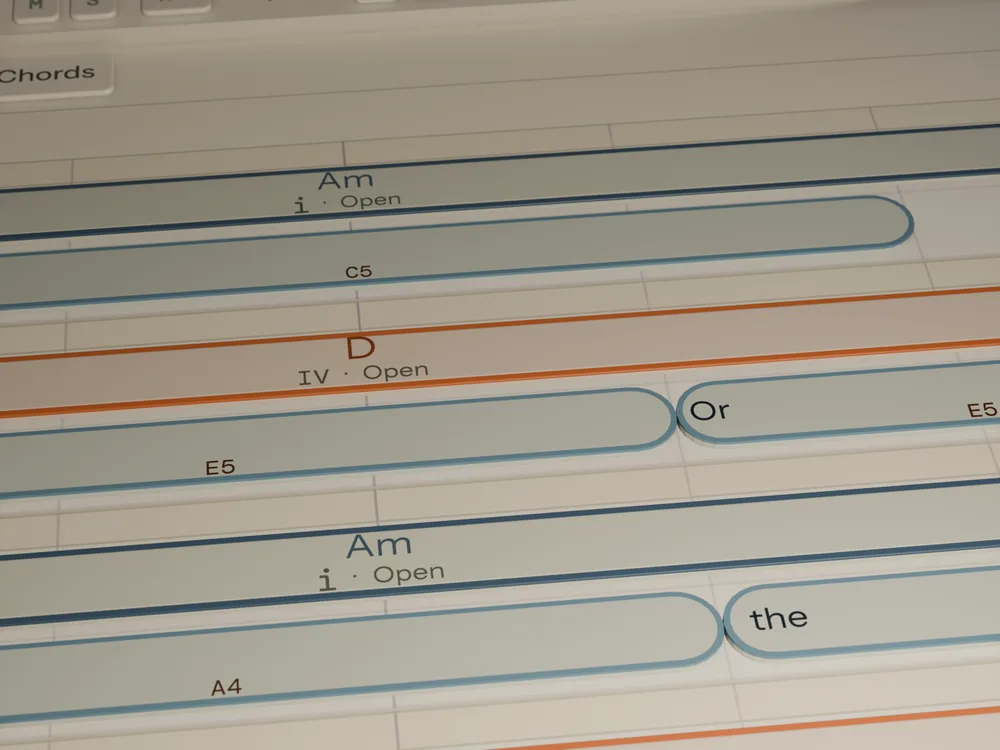
Song Cage will not write your hook. It holds the one you already have. Click an empty spot in the lyric lane and a melody note lands there with no words attached, so you can capture a figure before the line exists. Hum it into a take instead and the pitches come back as notes you drag onto the grid. Then loop the section, solo the melody track, and hear nothing but that figure until you know whether it holds.
There is a small, honest admission in that workflow. Song Cage's section tags are Intro, Verse, Pre-Chorus, Chorus, Bridge, and Outro. There is no post-chorus tag and no refrain tag, so a part like the chant in "Crazy in Love" gets tagged and then renamed by hand. The vocabulary for song parts is looser than the internet pretends, and every tool runs into it eventually.
Capture the hook while you can still hear it
Hooks arrive at soundcheck, in the car, halfway through washing up. Song Cage holds the fragment and the chords under it, on your phone or at your desk.
Frequently asked questions
Is a hook just another word for the chorus?
No, except in hip-hop and R&B, where "hook" is the standard name for the section between verses. Everywhere else the words describe different things: a chorus is a structural section, while a hook is whatever element stands out most, wherever it happens to sit.
Can a song have more than one hook?
Yes, and most big records do. "(I Can't Get No) Satisfaction" has both a guitar figure and a title line working as hooks. Researchers call it a compound hook when melody, rhythm, and vocal performance all grab attention in the same moment, so different listeners remember different layers.
What is the difference between a hook and a riff?
A riff is a short repeated instrumental figure. A hook is any element that stands out and is remembered. Many riffs are hooks and many are not: a riff that simply supports the groove without drawing attention is doing accompaniment work, not hook work.
How long should a hook be?
Roughly five seconds. The Hooked on Music study measured average song recognition at about five seconds across more than 12,000 participants, with the Spice Girls' "Wannabe" fastest at 2.29 seconds. If your hook runs much longer, you are probably looking at a whole section instead.
Does a hook have to have lyrics?
No. Hooks can be riffs, drum figures, orchestral lines, wordless vocal syllables, or studio processing. "We Will Rock You" hooks on a stomp and a clap with no drum kit at all, and the coda of "Hey Jude" is almost entirely non-lexical.
What comes first, the hook or the chorus?
Usually the hook, because it is the fragment you find yourself singing. Building the chorus around a hook you already trust is far more reliable than writing a structurally correct chorus and hoping it becomes memorable, which is the most common way songs end up flat.