Table of Contents
- What is the Nashville Number System?
- Where did the Nashville Number System come from?
- How does the Nashville Number System work?
- Which numbers are major, minor, and diminished?
- The all-keys number chart
- How do you read a Nashville number chart?
- What is a split bar?
- How is rhythm and accent marked?
- The complete Nashville number symbol glossary
- How do you write altered and out-of-key chords?
- How do minor-key songs work in the system?
- Should you chart a minor song from 6- or 1-?
- How do you transpose a song instantly?
- Famous songs as number charts
- Which number progressions show up most often?
- Nashville numbers vs Roman numerals vs letter charts
- Who actually uses the Nashville Number System?
- How do you start charting songs by ear?
- How do you put number thinking to work?
- Common mistakes to avoid
- Frequently Asked Questions
A Nashville session player can hear a song for the first time, write the whole thing on a single index card, and play it back in any key the singer wants. No sheet music, no chord letters, just a column of numbers. When the producer says "let's try it a step higher," nobody rewrites anything. They change one word at the top of the page.
That shorthand is the Nashville Number System, and it is the most practical piece of theory a songwriter can learn. It turns every progression into a pattern you can move, compare, and remember. This guide gives you the whole thing: how the numbers work, an all-keys reference grid, the complete symbol glossary, how to read and write a chart, and how to transpose a song on the spot.

What is the Nashville Number System?
The Nashville Number System replaces letter chord names with the numbers 1 to 7, one for each degree of the major scale of the song's key. In the key of C, 1 is C, 4 is F, and 5 is G, so a "1 4 5" progression means C, F, G. Change the key written at the top and the same numbers describe a different set of chords, which is why one chart works in every key.
Because the numbers are relative to the key, they describe a song's shape rather than its specific chords. A "1 5 6- 4" is the same pattern whether you play it in C or in E. That portability is the entire point, and everything below is about reading and writing it fluently.
Where did the Nashville Number System come from?
The system grew out of gospel shape-note singing. Around 1957, Neal Matthews Jr., second tenor of the vocal group The Jordanaires, needed a way to chart vocal harmony parts fast. The group was cutting three or four sessions a day with no written arrangements, and could not memorize parts for a dozen songs at a time. Matthews substituted numbers for the major-scale shape notes he knew from gospel quartets, and the singers could read their parts on the fly. His number chart for Elvis Presley's 1960 hit "Are You Lonesome Tonight" survives in the Country Music Hall of Fame archive.
Session multi-instrumentalist Charlie McCoy then adapted the idea from vocal parts to chord charts for the rhythm section, and it spread through Nashville's studio players in the early 1960s. Guitarist Chas Williams codified the conventions in his book "The Nashville Number System" in 1988, now in its 11th edition and taught at Belmont, MTSU, and other schools.
How does the Nashville Number System work?
Start with the major scale of your key and number the notes 1 through 7. In C major that is C(1), D(2), E(3), F(4), G(5), A(6), B(7). Build a chord on each of those notes using only the notes in the key, and you get the seven diatonic chords. The number names the chord built on that scale degree, so "5" in C means a G chord, and "5" in G means a D chord.
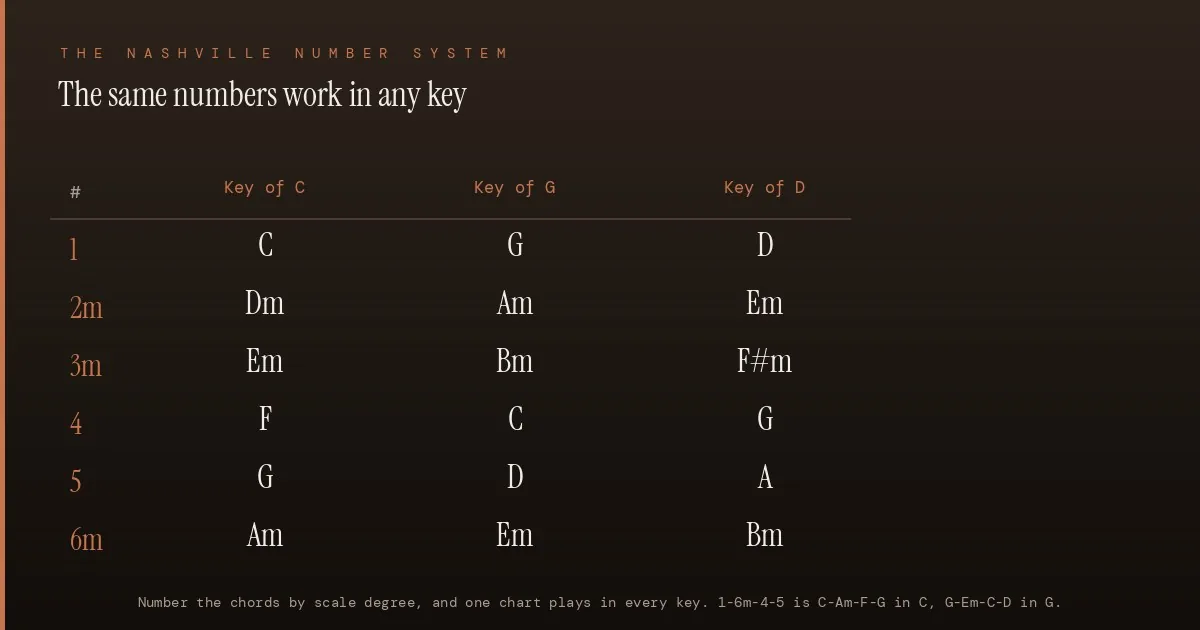
That is the whole engine. You are not memorizing chords, you are memorizing a song's position on the scale. A chorus that climbs 4, 5, 6- feels the same in any key because the relationship between the chords never changes, only the letters you happen to play.
Which numbers are major, minor, and diminished?
A bare number is always a major chord. The diatonic chords fall into a fixed pattern of qualities that holds in every major key: the 1, 4, and 5 are major; the 2, 3, and 6 are minor; and the 7 is diminished. To show those qualities, the system adds a small mark to the number.
A minor chord gets a dash after the number (2-, 3-, 6-), and some writers use a lowercase "m" instead (2m). The diminished 7 chord gets a degree symbol (7°). So the full set of diatonic chords in any major key, written out, is: 1, 2-, 3-, 4, 5, 6-, 7°. Memorize that one line and you can chart most popular songs, because the vast majority stay inside it.
The all-keys number chart
This grid maps the seven diatonic chords to the actual chords in eight common songwriting keys. Read across a row to transpose any number into letters, and read down a column to see how one number moves from key to key. The qualities never change: 1, 4, 5 are major, 2, 3, 6 are minor, and 7 is diminished, in every row.
| Key | 1 | 2- | 3- | 4 | 5 | 6- | 7° |
|---|---|---|---|---|---|---|---|
| C | C | Dm | Em | F | G | Am | B° |
| G | G | Am | Bm | C | D | Em | F♯° |
| D | D | Em | F♯m | G | A | Bm | C♯° |
| A | A | Bm | C♯m | D | E | F♯m | G♯° |
| E | E | F♯m | G♯m | A | B | C♯m | D♯° |
| F | F | Gm | Am | B♭ | C | Dm | E° |
| B♭ | B♭ | Cm | Dm | E♭ | F | Gm | A° |
| E♭ | E♭ | Fm | Gm | A♭ | B♭ | Cm | D° |
A bare number is major (1, 4, 5). A dash means minor (2-, 3-, 6-). The degree symbol means diminished (7°).
How do you read a Nashville number chart?
The default rule is simple: one number equals one measure. A chart written "1 1 4 5" means four bars, one chord each, holding the 1 for two bars before moving to the 4 and the 5. The key, time signature, and tempo are written at the top left, so you always know what the numbers mean before you read a single one.
Charts are usually laid out four or eight bars per line, grouped by section, so the verse and chorus are visually distinct blocks you can navigate at a glance. That layout is why a session player can follow a three-minute song from one page. Two things change the one-number-per-bar default: chords can share a bar (a split bar), and individual chords can carry rhythm marks. Both are covered next.
What is a split bar?
When more than one chord lands in a single measure, you underline them together to show they share that bar. So "1 4 5" is two measures: a full bar of 1, then a bar split between 4 and 5. By default an underlined group divides the measure evenly, so two chords get two beats each in common time.
If the split is uneven, small dots or tick marks above the numbers show how many beats each chord gets, for example three beats of one chord and one of the next. Some writers use parentheses or a box around the grouped chords instead of an underline, but the meaning is identical: everything tied together happens inside one bar.
How is rhythm and accent marked?
Beyond split bars, a handful of marks above a number tell you exactly how to hit a chord. A diamond around the number means strike and hold it, letting it ring through the bar like a whole note. A caret or "hat" above the number means the opposite: strike it and immediately cut it off, a short staccato stab.
A "push" is marked with a greater-than sign or a small caret before the chord, and it tells you to anticipate the downbeat by hitting the chord an eighth note early, on the "and" of the previous beat. Pushes are everywhere in country and pop, and writing them into the chart is how a whole band lands the same syncopation without rehearsing it.
The complete Nashville number symbol glossary
Most guides scatter these marks through pages of prose. Here they are in one place. Anything not on this list defaults to a plain major chord held for one measure.
| Symbol | Example | Meaning |
|---|---|---|
| Bare number | 4 | Major triad on that scale degree, held one bar. |
| Dash or "m" | 6- or 6m | Minor chord. |
| Degree sign | 7° | Diminished triad. |
| Plus sign | 5+ | Augmented triad. |
| Superscript 7 | 5⁷ | Dominant seventh chord. |
| maj7 or triangle | 1maj7 / 1△ | Major seventh chord. |
| Dash plus 7 | 2-7 | Minor seventh chord. |
| ø | 7ø7 | Half-diminished (minor seven flat five). |
| sus | 4sus4 / 5sus2 | Suspended chord (the third is replaced by a 4th or 2nd). |
| Flat or sharp prefix | ♭7, ♯4° | A chord rooted outside the key (out-of-key chord). |
| Fraction / slash | 5/7, 1/3 | Slash chord or inversion: chord degree on top, bass degree on bottom. |
| Underline | 4 5 | Split bar: the chords share one measure. |
| Diamond | ◇1 | Strike and hold (sustain through the bar). |
| Caret / hat | ^1 | Strike and choke (short, staccato). |
| Push | >4 | Anticipate: hit the chord an eighth note early. |
Conventions vary slightly between charts. The key, meter, and tempo at the top of the page set the context for everything below.
How do you write altered and out-of-key chords?
Real songs leave the key, and the system handles it with prefixes. A chord rooted on a note outside the major scale gets a flat or sharp before its number. In the key of C, a B♭ chord is written "♭7" because B♭ is a lowered 7th degree, and an E♭ chord is "♭3." Those are the most common borrowed chords in pop and rock, the same ones covered in our guide to modal interchange and borrowed chords.
Sevenths and extensions stack onto the number as you would expect: "5⁷" is the dominant seventh that pulls back to 1, "2-7" is a minor seventh, and "1maj7" is a major seventh. Slash chords and inversions use a fraction, with the chord's degree on top and the bass note's degree on the bottom, so "1/3" in C is a C chord with E in the bass. The system can notate anything a lead sheet can, just relative to the key instead of fixed to letters.
How do minor-key songs work in the system?
This is the one rule that trips people up. A song in a minor key is almost always charted from the perspective of its relative major, the major key that shares the same notes. So a song in A minor is written using the numbers of C major, because A minor and C major contain the same seven notes. The minor home chord, A minor, is therefore written "6-" rather than "1-."
It looks strange at first, but it keeps the chart clean. Writing from the relative major means most chords stay bare or take a single dash, instead of piling up flats and accidentals on nearly every number. The trade-off is that the song's true home chord is the 6-, not the 1.
Should you chart a minor song from 6- or 1-?
You can chart a minor song either way, and both are technically correct, so the question is which is easier to read. The Nashville convention is to use the relative major (home chord = 6-) because it minimizes accidentals, and that is what most session players expect to see. Charting from a minor 1 is allowed and occasionally clearer for a song that never touches the relative major, but it forces dashes and flats onto more chords.
The practical rule: default to the relative major (6-) so anyone handed your chart reads it the way they expect, and only chart from 1- if the song is so firmly minor that the major framing obscures more than it helps. When in doubt, write the key as the relative major at the top and let 6- be home.
How do you transpose a song instantly?
This is the payoff. Because every number is relative to the key written at the top, transposing a song means changing that one label and nothing else. Say you charted a song in C as "1 5 6- 4." A singer needs it in E♭ instead. You do not touch the numbers. You write "Key: E♭" at the top, and now "1 5 6- 4" reads as E♭, B♭, Cm, A♭.
Compare that to a letter chart, where moving from C to E♭ means rewriting every chord by hand and risking a mistake on every line. With numbers, the chart is already in every key at once. This is why country sessions, worship teams, and cover bands live by it: the singer's range, not the chart, decides the key, and the change takes five seconds. The all-keys grid above is really just this transposition done for you in eight keys.
Famous songs as number charts
Numbers make patterns visible. Here are progressions you already know, written the Nashville way, so you can see how a chart compresses a song.
Three songs by the numbers
- Twelve-bar blues (any key): 1 1 1 1 / 4 4 1 1 / 5 4 1 5. The same twelve bars work in every blues you have ever heard, which is why a bandleader can call "blues in G" and everyone already knows the chart.
- "Stand By Me" (Ben E. King), key of A: 1 1 6- 6- 4 5 1 1. That is A, F♯m, D, E, the classic 1 6- 4 5 doo-wop turnaround.
- "Let It Be" (The Beatles), key of C, verse: 1 5 6- 4, 1 5 4 1. In letters that is C, G, Am, F, then C, G, F, C.
Written out like this, two of the three songs share almost the same DNA: the 1, the 4, the 5, and the 6-. Once you can see that on the page, you start hearing it everywhere, and you can borrow a shape from one song into your own without copying a single chord. For a deeper tour of where these patterns lead, see our guide to the most useful chord progressions for songwriters.
Which number progressions show up most often?
A handful of number patterns account for a huge share of popular music. Learning them by their numbers, not their letters, means you recognize them in any key the moment you hear them.
- 1 4 5 is the three-chord backbone of blues, early rock and roll, folk, and country. If a song feels like it only has a few chords, this is usually why.
- 1 5 6- 4 is the modern pop loop behind countless choruses, from "Let It Be" to "With or Without You." Its cousin 6- 4 1 5 is the same four chords started on the minor.
- 1 6- 4 5 is the fifties doo-wop turnaround heard in "Stand By Me" and a generation of ballads.
These are descriptions of what writers have already done, not formulas to paste in. The point of charting them by number is recognition: when you can name the pattern, you can decide to use it, vary it, or deliberately avoid it in your own writing.
Nashville numbers vs Roman numerals vs letter charts
Songwriters meet chords written three ways, and each is built for a different job. Letter charts (G, C, D) are concrete and beginner-friendly but locked to one key. Roman numerals (I, ii, V) are the academic standard and encode chord quality in their upper and lower case. Nashville numbers are the working musician's shorthand, fastest to write and instantly transposable.
| Letter charts | Roman numerals | Nashville numbers | |
|---|---|---|---|
| Looks like | G C D Em | I IV V vi | 1 4 5 6- |
| Shows quality by | Letter + m / 7 | Upper vs lower case | A dash, °, or + |
| Transposes by | Rewriting every chord | Changing the key | Changing the key |
| Best for | Learning a specific song | Analyzing how music works | Tracking and gigging fast |
Roman numerals and Nashville numbers both think in scale degrees, so a vi and a 6- are the same chord. The difference is mostly speed and context.
The big divide is that letter charts name fixed chords, while both numeral systems name a chord's role in the key. That is why a "5" and a "V" both point at the dominant no matter what key you are in, and why neither has to be rewritten to change keys.
Who actually uses the Nashville Number System?
It started in the studio and spread to anyone who needs to move fast or move keys. Nashville session players still chart songs on first listen, because a producer might run a track in a new key or feel without warning and the numbers absorb the change instantly. The system saved real time: A-Team guitarist Harold Bradley said it shaved roughly fifteen minutes off every session.
Worship teams may lean on it hardest today. A song gets transposed constantly to suit whichever vocalist leads on a given week, and a number chart lets a whole band follow the change with one announcement. Cover bands and wedding bands use it for the same reason, learning a set as patterns rather than memorizing dozens of key-specific charts. And songwriters use it to capture an idea in a way that survives the inevitable "what if we tried it lower."
How do you start charting songs by ear?
You do not need to read music to use this. Charting by ear comes down to finding the 1, the chord that feels like home and where the song wants to rest, then hearing how the other chords move away from it and back. With practice, the common motions become instantly recognizable.
Train the big two first. The jump from 1 up to 4 and the jump from 1 to 5 are the two most common moves in popular music, and once your ear knows them, you can chart a simple song in real time. From there, learn the sound of the 6- (the minor that often follows the 1) and you can hear a "1 5 6- 4" go by without touching an instrument. This is the same scale-degree listening covered in our music theory for guitarists guide, and it gets faster every time you do it.
How do you put number thinking to work?
The Nashville Number System is a habit of mind: think in scale degrees, not fixed letters, so a progression you write once belongs to every key at the same time. That is the exact way Song Cage is built to work. You pick a key, capture your progression on the timeline, and every chord is labeled by its function in the key. Flip the Chord Names switch in the song settings from Letters to Numbers, and the timeline, the palette and the Sheet show Nashville numbers instead, counted from each section's key and written the way this guide writes them: a dash for minor (2-), fractions for slash chords (1/3), and flats for borrowed degrees (b7). A minor-key song is counted from its relative major, so its home chord reads 6-. The switch only changes what you see, so you can flip back to letters at any time, and Export PDF (Nashville Numbers) in the Song menu prints the whole song as a number chart for the band (PDF export comes with the Song Cage licence and the 14-day trial). When a singer needs the whole song higher or lower, one-click transpose moves every chord and melody note at once and updates the key.
Nothing is generated for you and there are no canned progressions. You make every call by ear; the app just lets you hear the consequence instantly in real guitar and piano voicings, and keeps your borrowed chords and secondary dominants in the same palette when a song steps outside the key. If you write in a DAW, the Song Cage plugin runs the same workspace as an AU or VST3 inside Logic Pro, Ableton Live, FL Studio, Cubase, Studio One, and REAPER, so the idea you captured by ear becomes MIDI on a track without leaving your session.
Common mistakes to avoid
Five traps
- Confusing scale-degree numbers with finger numbers. A "3" is the chord built on the third degree of the key, not your third finger or the third fret. They are unrelated.
- Forgetting to write the key at the top. Numbers are meaningless without it. The key, meter, and tempo belong at the top left of every chart before any chord.
- Charting a minor song from 1- instead of 6-. The convention is to use the relative major so most chords stay clean. Writing from a minor 1 buries the chart in accidentals.
- Spelling an out-of-key chord without its flat or sharp. A ♭7 is not a 7. The accidental in front of the number is the whole point, and dropping it changes the chord.
- Mixing conventions mid-chart. Pick the dash or the "m" for minor and stick with it. A chart that switches notation halfway is slower to read than letters.
Frequently Asked Questions
Is the Nashville Number System the same as Roman numerals?
They share the same idea, naming each chord by its scale degree, but differ in notation. Roman numerals show chord quality through case (IV is major, ii is minor), while Nashville numbers use case-less Arabic numbers and add a dash, a degree sign, or a plus for anything that is not a plain major chord. Roman numerals are mainly for analysis; Nashville numbers are a fast performance shorthand.
How do you transpose a song with the Nashville Number System?
You change the key written at the top of the chart and leave every number exactly as it is. A "1 4 5" charted in C becomes C, F, G; relabel the key as D and the same "1 4 5" is now D, G, A. The numbers describe the relationships, so the chart is already in every key at once, which is the system's biggest advantage over letter charts.
How are minor chords written in a number chart?
A minor chord gets a dash after the number, so the 6 chord in a major key is written "6-." Some writers use a lowercase "m" instead ("6m"). A bare number is always assumed to be major, and the diminished 7 chord takes a degree symbol (7°). The diatonic set in any major key is 1, 2-, 3-, 4, 5, 6-, 7°.
Who invented the Nashville Number System?
Neal Matthews Jr. of the vocal group The Jordanaires devised it in the late 1950s to chart vocal parts quickly during back-to-back recording sessions, adapting the gospel shape-note method into numbers. Session musician Charlie McCoy then extended it from vocal parts to chord charts for the rhythm section. The underlying idea of numbering scale degrees is much older, so Matthews is best described as the person who turned it into Nashville's studio shorthand.
Do you need to read music to use number charts?
No. The Nashville Number System exists precisely because many great session players did not read standard notation. You need to know the major scale of your key and the seven chords built on it, then you can read a chart, write one, and transpose on sight. Hearing the common moves (1 to 4, 1 to 5) by ear is a skill that grows with practice, not a prerequisite.
What does a number with a slash mean, like 1/3?
A slash marks an inversion or a slash chord. The top number is the chord's scale degree and the bottom number is the scale degree played in the bass. In the key of C, "1/3" is a C chord with E in the bass, and "5/7" is a G chord with B in the bass. It is the same logic as a letter slash chord (C/E), just written in numbers relative to the key.
Capture a progression once, hear it in any key
Song Cage shows every chord as a Nashville number with one switch, prints the song as a number chart, and one-click transpose moves the whole song when a singer needs it higher or lower. Borrowed chords and secondary dominants live in the same palette, in real guitar and piano voicings. No AI, no canned progressions. You write it.