Table of Contents
- What makes a chord progression sound scary?
- Does film music copy screams?
- Which chords sound the scariest?
- Why does the diminished 7th sound like a silent film?
- What does the augmented triad add?
- What is the Hitchcock chord?
- Is the tritone really the devil's interval?
- Seven scary chord progressions to build in any key
- 1. Why does the Phrygian half step sound threatening?
- 2. Minor chords a major third apart (the "Tarnhelm")
- 3. What does a held bass note do to a chord?
- 4. Harmonic minor and the augmented III
- 5. One voice creeping up
- 6. Shift the whole figure down a half step
- 7. Why does a major 7th chord sound creepy in a minor key?
- How do you make a whole song sound unsettling?
- Where should the creepy chord go?
- Why does odd meter feel threatening?
- Should the melody fight the chords?
- How do you make a major-key song sound creepy?
- Why do scary chords sometimes sound cheesy?
- How does Song Cage help you write a scary progression?
- Frequently Asked Questions
The theme to The Simpsons opens on a tritone, the interval every "scary chords" list calls the devil's interval. Classic FM's Sofia Rizzi points out that we hear it "against a dreamy scene of clouds parting." Nobody has ever been frightened by the Simpsons theme.
So a scary chord on its own isn't enough. What makes a progression sound threatening is a mix of roughness, instability and chords that don't belong to any one key, and the rest of the song has to back it up. This guide covers the chords that carry the most menace, seven moves you can build in any key, and how to keep the whole song unsettling once the first creepy chord stops being a surprise.
What makes a chord progression sound scary?
A scary progression does two things at once. It adds roughness, the harsh, beating quality of dissonant intervals that our brains treat as an alarm. It also refuses to settle, using chords that pull toward nothing or that don't belong to one key. Remove either and the effect weakens a lot.
The roughness part has hard evidence behind it. In a 2015 study in Current Biology, Luc Arnal and colleagues found that human screams occupy a narrow acoustic band that listeners hear as roughness. When eleven participants rated recorded screams, "the rougher the screams, the more fearful the induced emotional reaction." The same team measured musical intervals and found that "dissonant intervals generate stronger modulations in the lower half (30–80 Hz) of the roughness window," the same range screams use. In their brain-imaging experiment with sixteen people, the amygdala, not the auditory cortex, responded specifically to rough sounds.
So a dissonant chord gives a softer version of the signal a scream gives. The instability half is music theory, and it's where most of the chord choices in this guide come from.
Does film music copy screams?
To a measurable degree, yes. Trevor, Arnal and Frühholz tested the idea directly in the Journal of the Acoustical Society of America in 2020. They took five "scream-like" and five ordinary excerpts from each of ten horror scores released in 2010 or later, then had twenty people rate them. Scream-like music was rated more negative and more arousing, and it was rougher. The authors also note a limit: real screams were rougher still, so the music "is still a muted version of the real thing."
A decade earlier, Daniel Blumstein's lab analysed the soundtracks of 102 highly rated films and found that horror scores had "more non-musical sidebands, and noisy screams than expected." The paper lists the composing techniques that imitate the harsh sounds animals make under duress, and they include "harmonic dissonance, trills, vibrato."
That last detail matters for songwriters. The dissonance does the most work when it's also played harshly: a tremolo, a trill, a guitar pushed into distortion.
Which chords sound the scariest?
Four chords turn up again and again in scary music: the fully diminished 7th, the augmented triad, the minor-major 7th and anything built on a tritone. The first two are symmetrical, so the ear can't tell where home is. The last two put a harsh interval inside an otherwise familiar sound.
None of them is frightening in every context, and each has a different flavour of menace. The diminished 7th sounds like old-fashioned melodrama. The augmented triad sounds like a dream going wrong. The minor-major 7th sounds like suspense. The tritone sounds heavy. Pick the one that fits the story your lyric tells, not the one at the top of a list.
The sections below give each chord in a real key, because a chord name is only useful once you can find it on your instrument. Every example uses C minor unless it comes from a specific song, and every chord here transposes to any key you like.
Why does the diminished 7th sound like a silent film?
Because it spent decades as the villain's chord in stage melodrama and silent film. A fully diminished 7th stacks three minor thirds (B, D, F, A♭ in C minor), and since every note is the same distance from the next, the same four notes also spell D°7, F°7 and A♭°7. The chord can resolve four different ways, so the ear hangs.
Silent-film pianist Ben Model suggests the habit of mirroring on-screen action "may very well have its roots in vaudeville," where the pit orchestra would be "slamming into a diminished chord arpeggio when the villain in a pre-cinema stage melodrama enters the stage." Kendra Preston Leonard's analysis of the 1921 film Orphans of the Storm finds the strings and piano tremolo "outlining an F diminished seventh chord" in a market scene of begging and intimidation.
That history is also the risk. Hold a diminished 7th for a whole bar under a vocal and you sound like a moustache being twirled. Used as a passing chord, it still bites. Our guide to diminished chords covers the shapes and where each one resolves.
What does the augmented triad add?
An augmented triad stacks two major thirds, C, E and G♯, and like the diminished 7th it's symmetrical: C+, E+ and G♯+ share the same notes. Open Music Theory notes that this makes it "difficult to identify its root without proper surrounding context", and that, like the diminished 7th, it "can be a pathway to distant" keys. It's also rare, which Open Music Theory lists as part of what makes it interesting in the first place.
The augmented chord sounds less like a villain and more like something that isn't quite real. It doesn't clash as hard as a diminished 7th, but it leans. It wants to move and doesn't say where.
In a minor key there's one built in. The harmonic minor scale raises the 7th degree, and the chord on its third degree comes out augmented: in C minor that's E♭+ (E♭, G, B). Put it where a plain E♭ major would go and the song tilts. Our augmented chords guide has the shapes and more song examples.
What is the Hitchcock chord?
The minor-major 7th: a minor triad with a major 7th on top, so C, E♭, G and B. The major 7th sits a half step below the root, and that clash never settles.
It became famous through Bernard Herrmann's scores for Alfred Hitchcock. In Music Theory Online, Scott Murphy describes it as "a minor-major seventh chord that scholars recognize as a distinctive harmony in Herrmann's scores for Hitchcock's films," and notes that the film scholar Royal S. Brown gave it the nickname. Tim Summers of Royal Holloway writes that Psycho (1960) opens on it, "heard in Bb in second inversion," with "the clashing major seventh and tonic." Pearson's A-level guide calls it an "immediately unstable sound" that "does not develop, or indeed lead anywhere."
For a songwriter, the easiest way in is the minor line cliché: hold a minor chord and walk one voice down by half steps, Cm, Cm(maj7), Cm7, Cm6. The minor-major 7th is the second chord, and it lasts just long enough to unsettle.
Is the tritone really the devil's interval?
It has the nickname, but the story behind it is a myth. The tritone splits the octave exactly in half: C to F♯, or G to C♯. The popular claim is that the medieval Church banned it as diabolus in musica. Harvard musicologist Thomas Forrest Kelly told Autumn Sword of Skeptical Inquirer: "I'm not aware of any medieval references to diabolus in musica. The earliest references I know of are from the eighteenth century." The best-known citation is Johann Joseph Fux's Gradus ad Parnassum of 1725, and Wikipedia's article calls stories of singers being punished "likely fanciful." The interval was avoided because it sounded bad in that style, not because it was forbidden. Sonja Maurer-Dass, writing for Medievalists.net, points to tritones sung in Pérotin's sacred music.
What it does have is weight. Tony Iommi built Black Sabbath's "Black Sabbath" (1970) on it: in Jeremy Morse's breakdown for Last Rites, a G5 power chord, G an octave up, then D♭, and "in the key of G, D-flat is the diminished fifth." Jimi Hendrix opened "Purple Haze" (1967) with his B♭ against Noel Redding's E on bass, and Metallica's "Enter Sandman" (1991) builds its main riff on "variations of the E/B♭ tritone," per Wikipedia. Those are riffs, though, and the Simpsons shows the same interval can sound cheerful. In a song, it scares when it's played low, loud and slow.
Seven scary chord progressions to build in any key
These are moves, not a list of set progressions. Each one takes a chord you already have and pushes it somewhere unsettling: up a half step, down a major third, over a bass that won't move. Try them inside a progression you've already written rather than as a song on their own.
Each move is spelled in C minor so you can compare them. Transpose to your own key before you judge one, because register changes the result: a move that sounds eerie in the bass can sound pretty two octaves up.
| Move | In C minor | What it does |
|---|---|---|
| Phrygian half step | Cm – D♭ – Cm | The root rises a half step and falls back |
| Minor chords a major third apart | Cm – A♭m | Two voices move by half step in opposite directions |
| Clash over a held bass | Cm – D♭/C – Cm | The bass stays put while the chord above rubs against it |
| Harmonic minor with the augmented III | Cm – E♭+ – Fm – G | The raised 7th makes the III chord lean |
| One voice creeping up | C5 – Csus2 – Cm – Csus4 – C° | The root stays; one note climbs to the ♭5 |
| Shift the whole figure down | Cm figure, then Bm figure | The ground drops a half step under the listener |
| Major 7th in a minor key | A♭maj7 – Cm | The loop sits on a bright chord that isn't home |
Every move is spelled in C minor. Transpose to your own key before judging it.
1. Why does the Phrygian half step sound threatening?
In C minor, play Cm and then D♭ major, then go back. The D♭ chord is the ♭II, borrowed from the Phrygian mode, the minor-sounding mode with a lowered second degree (our guide to the musical modes covers where it comes from). The root rises only a half step, and the ear hears a thing leaning in close and pulling back.
The half step is the same interval behind one of film music's best-known threats. In an essay for the OUP blog, Williams's biographer Tim Greiving traces the composer's whole career back to the "ominous, oscillating E and F bass notes" of Jaws (1975), and notes that the motif "actually includes a third note, D." Claudia Gorbman called it the "menacing 'shark' theme," as quoted by Birger Langkjær. That's a melody, not a chord change, so treat it as a model for motion, not a harmony to copy.
One honest caveat: we found no study linking the ♭II chord specifically to fear. The case for it rests on the half step, and on how rarely pop songs use it.
2. Minor chords a major third apart (the "Tarnhelm")
Play Cm, then A♭ minor. Cm is C, E♭ and G. A♭ minor is A♭, C♭ and E♭. E♭ stays put, C slides down to C♭ and G slides up to A♭: two voices moving by half step in opposite directions between two ordinary minor chords. No single key contains both, so the ear loses its footing.
Theorists call this the Tarnhelm progression, after the magic helmet in Wagner's Ring cycle. Writing in Music Theory Online in 2017, David Forrest reports that Matthew Bribitzer-Stull showed film composers use it "to signal mystery, magic, mental instability, sinister memories, and darkly supernatural conditions," and that "the most famous example of this association is found in the 'Imperial March'" from Star Wars.
It's also unusual in pop. Forrest cites Trevor de Clercq and David Temperley's study of 99 top songs from 1950 to 2000, where only 8% of chord progressions moved by a major third, and that count includes ordinary moves like vi to IV.
3. What does a held bass note do to a chord?
Keep C in the bass and change the chord above it: Cm, then D♭ over C, then Cm again. A held bass note under changing harmony is a pedal point. The Puget Sound open textbook defines it as "a note that is held through changing harmonies, starting as a chord tone before becoming a non-chord tone." When the chord above is D♭ major, the C in the bass sits a half step under its root, and the clash grinds until the chord returns home.
Holst's "Mars, the Bringer of War" runs on the same idea. It's in 5/4 over a relentless rhythmic ostinato, and at its first big climax, as Bath Philharmonia's Jason Thornton describes it, the bass pedal finally moves from G to C while "a raw and dissonant Dflat major chord" is played over the ostinato "by full woodwind, horns and trumpets." It has a heavy-metal connection too: according to Wikipedia, the "Black Sabbath" riff started when Geezer Butler began playing a fragment of "Mars."
In a band, the pedal is easy to arrange. The bassist holds one note and the guitar or keys move.
4. Harmonic minor and the augmented III
In a minor key, most songs use the natural minor chords: in C minor, Cm, Fm, A♭, B♭ and so on. The harmonic minor scale raises the 7th from B♭ to B, and two things change. The V becomes G major, with a leading tone that pulls hard toward C. The III becomes E♭ augmented (E♭, G, B).
Try Cm, E♭+, Fm, G. The E♭+ sounds almost like the E♭ major you expected, with one note bent upward. The G major at the end resolves hard back home, and that pull is what gives harmonic minor its gothic, old-world colour.
You can hear a modern pop version in Billie Eilish's "bury a friend" (2019). Hooktheory's TheoryTab, which is user-submitted, puts the song in G harmonic minor, with V as the most-used chord in the pre-chorus: in that key, D major, the chord that only exists because the 7th was raised.
5. One voice creeping up
Hold the root and move one note up by step: C5, Csus2, Cm, Csus4, C°. The moving voice climbs from the root through the 2nd, the minor 3rd and the 4th until it reaches the ♭5, where the chord turns diminished.
That's the intro to Michael Jackson's "Thriller" (1982), in C♯. Dan Lundholm's chord chart for Spy Tunes describes the keyboard part as revolving "around a C#m chord, with a single note moving up from the root to the 2nd, m3rd, 4th, and b5," charted as C♯5, C♯sus2, C♯m, C♯sus4 and C♯dim. (Hooktheory's TheoryTab hears the key as C♯ Dorian, a minor scale with a raised 6th.)
This move works because nothing appears to change. The chord symbol barely moves, the bass doesn't move, and yet the song is plainly heading somewhere worse. It suits a verse, where the lyric is setting a scene and the listener shouldn't know yet what's coming.
6. Shift the whole figure down a half step
Write a figure over one chord, repeat it until the listener settles in, then move the entire figure down a half step. Nothing inside the pattern changes. Only the ground under it does.
John Carpenter's theme for Halloween (1978) works this way. Davidson College music professor Neil Lerner, interviewed by the college, describes the theme as "mostly three pitches that he repeats several times, and then he shifts it all down a half step." Hooktheory's TheoryTab puts the intro in F♯ minor, 5/4, at 140 BPM.
In a song, try it at the turn into a second verse or a bridge. Play the verse figure over F♯m, then move it to Fm and hold it there. The lyric can carry on as if nothing happened, and the half-step drop tells the listener what the words haven't said yet. Moving back up to the original key for the chorus gives you a release.
7. Why does a major 7th chord sound creepy in a minor key?
A major 7th chord is usually the soft, pretty chord of a ballad. Built on the sixth degree of a minor key, as A♭maj7 in C minor, it turns ambiguous. The chord looks like home, but the key says otherwise.
The theme from Stranger Things (2016), by Kyle Dixon and Michael Stein, is built on an arpeggio that outlines C major 7. Harrison Shimazu argues at Splice that the piece "is actually in E minor," so the arpeggio is "the submediant (VIM7) chord of a minor key." Kat Bein, writing for Roland, hears it the other way: "While the theme sounds ominous, its C major key hints at a ray of youthful hope shining through the darkness."
Two careful listeners disagreeing about the key is the whole effect. A progression that could be in two keys at once never lets the listener relax.
How do you make a whole song sound unsettling?
Put the scariest chord where the lyric turns dark, not everywhere. Use odd meter or an unresolved ending to keep the listener off balance, and let the melody lean on the clashing note. A song needs contrast, and one well-placed chord sounds scarier than a verse full of them.
This is the part most "scary chords" lists skip, and it's the part that matters in a song rather than a film cue. A film score only has to scare for as long as the scene lasts. A song has to hold attention for three minutes, repeat its chorus and still sound frightening the third time through.
Forrest's survey of pop songs from 1956 to 2016 makes the same point about placement. He found that "while not every PL/LP transformation evokes an uncanny experience, when the transformations are used conspicuously between adjacent or framing harmonies, the pervasive associations with the uncanny, across sub-genre and generational lines, are hard to ignore." PL/LP is his label for the chromatic major-third moves in move 2.
His opening example is Pearl Jam's "I Got Id" (1995), where D major chords alternate with B♭ major, and the move returns at the start of each verse, just as the lyric describes the singer's "most anxious and dreamy moments."
Where should the creepy chord go?
Where the lyric earns it. In a verse–chorus song, the verse and pre-chorus are where you build dread, and the chorus is where you choose between release and no release.
If the chorus resolves to a plain minor or major tonic, the song works like a ghost story told around a fire: dread, then a payoff. If the chorus keeps the chromatic move, the song never lets go. Both work, but decide on purpose.
"This Is Halloween" (1993), from The Nightmare Before Christmas, shows another option: it moves the key. Wikipedia's summary of the song's structure notes that it "starts in the key of C minor," then the chorus "is performed in the key of G minor, ending in A-flat minor," and briefly switches to 3/4 time at the end of the chorus. Each section is unsettling in a new place, so the listener never gets used to it.
Why does odd meter feel threatening?
It keeps the listener's body from locking in. Berklee Online's Michele Darling notes that the Halloween theme is in 5/4, with accents in groups of 3, 3, 2 and 2, so the pulse changes pace partway through, "making it feel as if it's pushing us forward and creating an unsteadiness."
Mike Oldfield's "Tubular Bells" (1973), whose opening was used in The Exorcist, uses 15/8. Wikipedia says Oldfield wanted a variation on a 16/8 figure, so he dropped the 16th beat, and "chose the key of A minor as it was easy to play." The key was a practical choice. The missing beat does the unsettling work.
You don't need a strange time signature for a whole song. One bar of 5/4 or 3/4 at the end of a phrase is enough to make a listener feel the floor tilt.
Should the melody fight the chords?
Sometimes, and that's where most of the fear lives in a sung melody. A melody that lands on the clashing note of a chord, the major 7th of a minor-major 7th or the ♭5 of a diminished chord, makes the listener hear the clash in the voice.
Herrmann's shower-scene cue in Psycho shows how far this can go. Summers describes the strings "building the cluster chord of E, Eb, F, Gb," then coming to rest "with lower strings on the uncomfortable C and F# tritone." That's a film at maximum volume, but the lesson scales down: melody notes a half step away from a chord tone create tension, and long notes let it build.
The reverse works as well. A sweet, simple tune sung over one of the moves above sounds wrong in a quieter way, like a nursery rhyme in an empty house.
How do you make a major-key song sound creepy?
Borrow chords from outside the key. In C major, the minor iv (F minor), the ♭VI (A♭) and the Phrygian ♭II (D♭) all sit a half step from a note the ear expected. A major-third jump between two major chords, such as C to A♭, adds a chromatic shift without leaving major.
Some of these borrowings also make songs sound sad, which is why the line between sad and creepy is thin. In our guide to sad chord progressions, the minor iv sags and the ♭VI opens out. The difference is speed and contrast. Played slowly and resolved gently, a borrowed chord sounds wistful. Arrive at it suddenly, give it a rough sound (tremolo, distortion, a cluster in the low register) and don't resolve it, and the same chord sounds threatening.
"I Got Id" is the model for major-key menace: D major and B♭ major, a major third apart, alternating with a stationary D in the top and bottom voices. Nothing in that pair is dissonant on its own. The strangeness comes from the chromatic contrary motion between two consonant chords, which Forrest says paints "the reality confusion suggested by the lyrics."
Our guide to modal interchange and borrowed chords lists every chord you can borrow and which mode each one comes from.
Why do scary chords sometimes sound cheesy?
Because the listener has heard them before, in a specific context. The "Mysterioso Pizzicato" villain cue, whose earliest known publication was in 1914 in a collection of music for silent-film accompanists, is a big part of why a tiptoeing minor line can sound like a cartoon. Use a cliché and you get the cliché's associations.
There's a subtler problem for songwriters. A 2012 follow-up study by Blumstein, Bryant and Kaye found that harsh, noise-like distortions changed how aroused listeners felt when they heard the music alone, but that effect disappeared when the same music was paired with video. A song has no picture at all, so the sound has to do all of it, which means performance matters as much as the chord symbol.
Three habits help:
- Keep the scary chord rare. One diminished 7th in a verse unsettles. Four in a row sounds like a haunted-house ride.
- Play it roughly. Blumstein's list of scream-like techniques includes trills and vibrato. Tremolo picking, a shaking synth or a distorted guitar will do more than a clean strum.
- Tie it to the words. A chromatic move under a lyric about something going wrong reads as meaning. The same move under a lyric about a sunny day reads as a mistake, unless that contrast is the point.
How does Song Cage help you write a scary progression?
Song Cage is a songwriting app for capturing an idea and building it into a song: chords that know your key, a melody lane over the chord grid, lyrics on the same timeline, and playback so you can hear it. It contains no generative AI, so the song and every dark turn in it stay yours.
What it does for a scary song
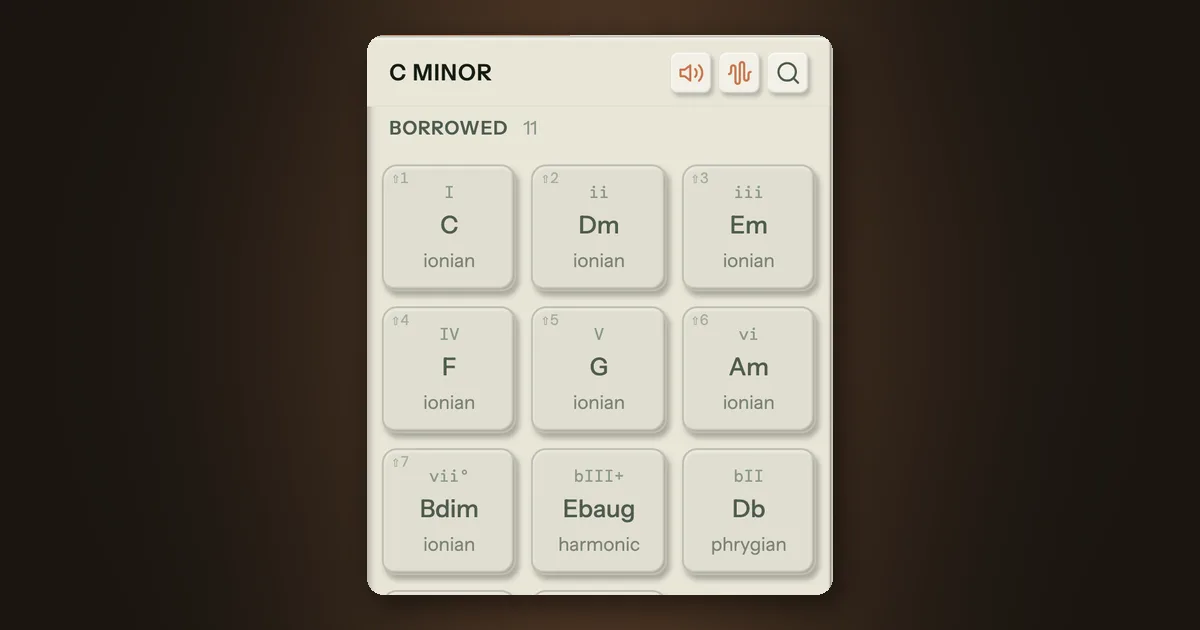
- Borrowed chords, labelled by source: in a minor key, the palette's Borrowed group includes the major V, the augmented ♭III+ from harmonic minor and the ♭II from the Phrygian mode. In a major key, it shows the minor iv, the ♭VI and the rest of the parallel minor.
- Any chord by name: chord search browses diminished, diminished 7th, half-diminished and augmented qualities, and you can type a chord outside the key, such as Abm after Cm.
- No key at all: Wander mode drops the key, so every chord is available for a progression that won't settle in one.
- A key per section: give the bridge its own key and hear the half-step drop.
- Slash chords: type Db/C to put a chord over a held bass, or use the Bass Line strip to walk the bass up or down.
- The feel, out loud: playback at your tempo in 4/4, 3/4 or 6/8.
Our chord progressions docs walk through the palette, chord search and the Bass Line strip.
Make it sound wrong on purpose
Capture the idea, find the borrowed chord that turns it dark, and hear it back before you play it for anyone.
Frequently Asked Questions
What is the scariest chord?
There isn't one, because context decides. The strongest candidates are the fully diminished 7th, the minor-major 7th (the "Hitchcock chord" that opens Psycho) and tone clusters. What they share is roughness: a 2015 study found dissonant intervals produce the same fast modulation that makes screams sound alarming. The Simpsons theme opens on a tritone and isn't scary at all.
What key is the scariest?
No key is scary on its own. A minor key helps, but the classics are spread across keys: Hooktheory puts the Halloween theme in F♯ minor, "This Is Halloween" starts in C minor, and Mike Oldfield chose A minor for "Tubular Bells" because it was easy to play. The chords and the rhythm do the work, and a capo or transpose will move any of them.
What chords are used in horror movies?
Diminished 7ths, augmented triads, minor-major 7ths, tone clusters and chromatic moves between minor chords a major third apart. Horror scores also rely on sounds that aren't chords at all: a 2010 analysis of 102 films found horror soundtracks had more noisy, scream-like sounds than expected.
What is the Halloween chord progression?
John Carpenter's 1978 theme isn't really a chord progression. It's a repeating figure in 5/4, which Hooktheory places in F♯ minor at 140 BPM, and Davidson music professor Neil Lerner describes it as "mostly three pitches that he repeats several times, and then he shifts it all down a half step." You can use the same half-step shift in a song: play a figure over one chord, then drop the whole figure a half step.
Did the Church ban the tritone?
No. Harvard musicologist Thomas Forrest Kelly told Skeptical Inquirer he knows of no medieval references to "diabolus in musica"; the earliest he knows are from the eighteenth century. Composers avoided the interval because it clashed with the style of the time, and tritones do appear in Pérotin's sacred music.
Why does the Stranger Things theme sound creepy?
Its arpeggio outlines C major 7, normally a soft, pretty chord, but analysts disagree about where home is. Harrison Shimazu at Splice argues the theme is in E minor, which makes the chord a VImaj7 rather than home. Kat Bein at Roland hears it in C major. A loop that could belong to two keys never lets the listener settle.