Table of Contents
- What is an augmented chord?
- Why are there only four augmented chords?
- Where does the augmented chord come from?
- Augmented vs diminished: what is the difference?
- How do songwriters actually use augmented chords?
- The V+ that pushes into the I
- The line cliché: I to I+ to vi
- Which songs use augmented chords?
- How do you play an augmented chord on guitar and piano?
- What about 7th chords with a raised fifth?
- How do I add an augmented chord to a song in Song Cage?
- Frequently Asked Questions
- The short version
Quick Summary
An augmented chord is a major triad with the fifth raised a half step: two major thirds stacked on top of each other. Because those thirds are equal, the chord is symmetrical, which is why only four of them exist and why they never quite sound like they have a home.
Most explanations of the augmented chord stop after the recipe. You raise the fifth, you get a spooky sound, here is a diagram. Then you sit down with your guitar and have no idea where to put it.
That gap shows up in the search results themselves. On the first page for "augmented chord," two of the seven article results are people asking a forum how to use the thing: a nine-year-old Reddit thread titled "ELI5: How to use augmented chords?" and a Stack Exchange question that was closed as a duplicate of another question asking the same thing. The pages ranking above them explain construction and stop.
So this piece is organized the other way around. Build it quickly, then spend the rest of the time on the two jobs augmented chords actually do in songs, with real recordings you can go listen to.
What is an augmented chord?
An augmented chord is a three-note chord built by stacking two major thirds. Take a major triad and raise the fifth by a half step. C major is C–E–G, so C augmented is C–E–G♯. The formula is 1–3–♯5, and you will see it written as C+, Caug, or C(♯5).
The raised fifth is the whole story. In a major triad the interval from root to fifth is perfect, which is what makes the chord sound settled. Push that fifth up one fret or one key and the chord loses its floor. Nothing is wrong with it exactly, but it will not sit still.
That instability is not a defect to be fixed. It is the reason anyone reaches for the chord. An augmented triad is a chord that has to go somewhere, and songwriters use it precisely at the moments when they want the listener leaning forward.
One naming trap worth clearing up now: an augmented triad needs a major third. A minor chord with a raised fifth is a different animal and is usually better spelled as a major triad in some inversion. If your third is minor, you do not have an augmented chord.

Why are there only four augmented chords?
Every other triad type has twelve transpositions, one per root. Augmented triads have four. The reason is symmetry, and it is the single most useful fact about them.
Build C augmented: C–E–G♯. Now build E augmented: E–G♯–B♯. B♯ is enharmonically C, so E+ contains exactly the same three pitches as C+. Build G♯ augmented and you get the same three again. The chord divides the octave into three equal pieces of four half steps each, so rotating it just gives you the chord back.
The practical consequence is that an augmented triad has no clear root to the ear. Any of its three notes can act as the bottom. That ambiguity is what composers exploit when they want to blur which key you are in.
| Group | Notes | All the names for it |
|---|---|---|
| 1 | C – E – G♯ | C+, E+, G♯+ / A♭+ |
| 2 | C♯ – F – A | C♯+ / D♭+, F+, A+ |
| 3 | D – F♯ – A♯ | D+, F♯+ / G♭+, A♯+ / B♭+ |
| 4 | E♭ – G – B | E♭+ / D♯+, G+, B+ |
Four groups cover all twelve roots. Spellings differ, sound does not.
Where does the augmented chord come from?
Here is the fact that explains why augmented chords feel like outsiders: the augmented triad is the only one of the four triad types that does not occur naturally in a major scale.
Stack thirds on each degree of a major scale and you get major, minor and diminished triads. No augmented. The one place it appears without any chromatic alteration is on the third degree of the harmonic minor and ascending melodic minor scales, written III+. In A harmonic minor that chord is C–E–G♯.
But do not over-invest in that origin story. Open Music Theory confirms III+ is the only unaltered form in the major/minor system, then calls the augmented triad "a slightly peripheral character" and notes that many textbooks skip it altogether. Standard references go further and say the chord virtually never actually turns up functioning as III+, because it is too harsh in that role.
Translation: in real songs, the augmented chord is almost never functioning as the III chord of a minor key. It is a byproduct of a moving line.
Why rarity is an asset
Arnold Schoenberg argued in his 1911 Theory of Harmony that the augmented triad's scarcity makes it "better protected against banality" than the diminished triad and seventh. Music theorist Richard Cohn observed that before 1830 the chord's behaviour was "normally well regulated and unobtrusive, tucked into the middle of a phrase rather than exposed at its boundaries, passed through quickly and lacking metric accent." Both are describing the same thing: this chord earns its effect by being uncommon.
Augmented vs diminished: what is the difference?
They are opposites built the same way. A diminished triad stacks two minor thirds and shrinks the fifth. An augmented triad stacks two major thirds and stretches it. Both are symmetrical, both are unstable, and both resolve rather than rest.
The difference songwriters care about is direction and colour. The diminished chord pulls inward and tends to sound anxious or suspenseful. The augmented chord pushes outward and tends to sound expectant, dreamy, or slightly unhinged. Diminished chords are common enough in pop that most players meet one early. Augmented chords are genuinely rare.
| Diminished | Augmented | |
|---|---|---|
| Formula | 1 – ♭3 – ♭5 | 1 – 3 – ♯5 |
| Stacked | Two minor 3rds | Two major 3rds |
| On C | C – E♭ – G♭ | C – E – G♯ |
| Unique versions | 12 triads (3 dim7 chords) | 4 triads |
| In a major key | Yes, on the 7th degree | No, never |
| Typical feel | Tense, suspenseful | Floating, expectant |
If you want the other half of that comparison in full, we covered it in diminished chords explained.
How do songwriters actually use augmented chords?
Across every verified example I could find, augmented chords in popular music do one of two jobs. Once you see the pattern you stop hunting for places to jam the chord in, because the chord tells you where it goes.
The unifying idea: the augmented chord is almost never a destination. It is one voice moving by a half step while the other two hold still. That is why it works even in simple songs. You are not really changing chords, you are walking one note.
The V+ that pushes into the I
Take the dominant chord and raise its fifth. In C major, G becomes G+ (G–B–D♯). Now look at the voice leading into C major: G stays on G, B rises to C, and D♯ rises to E. Every voice either holds or steps up a half step, and the chord lands harder than a plain V would.
This is the most common use in Anglo-American pop, and the Beatles used it constantly to get a nostalgic 1950s flavour. "Oh! Darling" is the textbook case. The song is in A and opens on a bare E+ before a word is sung. Alan W. Pollack's bar-by-bar analysis spells it E–G♯–B♯ and points out that the B♯ is what pushes up into the C♯ of the A major chord on the next downbeat. The same augmented V shows up at the end of the bridge in "From Me to You."
The line cliché: I to I+ to vi
The other job starts on the tonic and walks the fifth upward: 5, then ♯5, then 6. In A that is A, then A+, then the F♯ minor sitting underneath. John Lennon's "(Just Like) Starting Over" runs A–Aaug–F♯m/A–Aaug straight through its intro and outro, and the verse keeps alternating A and Aaug underneath the vocal.
Roy Orbison's "Crying" does the same move and then adds a twist. The verse sits on D, slips to D+ exactly on "But I saw you last night," then lands on G and immediately darkens it to G minor. That final iv chord is modal interchange borrowed from the parallel minor, stacked on top of the augmented walk-up.
The line runs downward just as well. In "All My Loving," Pollack traces an inner voice moving C♯ to C♮ to B, which produces a C augmented chord in the bridge that mediates between C♯ minor and E major.
Which songs use augmented chords?
Uncited lists of "songs with augmented chords" circulate widely, and a fair number of the entries do not survive checking. Every song below was verified against at least one analysis or chord source that actually identifies the chord, and the source is named so you can go argue with it.

| Song | Year | The chord | What it does |
|---|---|---|---|
| Oh! Darling — The Beatles | 1969 | E+ (V+ in A) | Opens the song alone, resolves up into A |
| From Me to You — The Beatles | 1963 | V+ | Ends the bridge, on the word "satisfied" |
| All My Loving — The Beatles | 1963 | C+ | Bridge; descending inner line C♯–C♮–B |
| I Want You (She's So Heavy) — The Beatles | 1969 | A+ | Hangs at the end of the intro; resolves to Dm at 2:06 |
| Crying — Roy Orbison | 1961 | I – I+ – IV – iv | D+ lands on "But I saw you last night" |
| It's My Party — Lesley Gore | 1963 | Augmented in the chorus | Sits under "cry if I want to" from 0:08 |
| Life on Mars? — David Bowie | 1971 | E+, A+, G♭+ | Chromatic voice leading through pre-chorus and chorus |
| You Are the Sunshine of My Life — Stevie Wonder | 1972 | F♯7(♯5) | Second chord; riff walks the whole-tone scale |
| Mamma Mia — ABBA | 1975 | D and D+ | The intro alternates the two |
| Baby Hold On — Eddie Money | 1977 | D and D7(♯5) | Line cliché that starts up and then stops |
| (Just Like) Starting Over — John Lennon | 1980 | A – Aaug – F♯m/A | Intro, outro and verse all ride the walk-up |
| Maybe This Time — Cabaret (film) | 1972 | C – C+ – C6 – C7 | The full rising line, one chord per step |
| Vertigo Suite — Bernard Herrmann | 1958 | D+ | Opens the cue as an arpeggio |
Sources: Alan W. Pollack's Notes On series (Beatles), published chord transcriptions (Orbison, Lennon), and analyses by Dr. Ethan Hein and Musical U.
Three corrections worth making
- "All My Loving" is not an opening-tonic embellishment. Wikipedia groups it with "(Just Like) Starting Over" as a I–I+–vi move off the first chord. Pollack's measure-by-measure reading puts the augmented chord in the bridge, between C♯ minor and E major, on a descending line. Different chord, different place, different function.
- Coltrane's "Giant Steps" does not contain an augmented chord. The tune cycles through B, E♭ and G, and those three tonics outline an augmented triad. That is architecture, not harmony you can strum.
- Not every ♯5 in a chart is an augmented triad. The famous descending "Stairway to Heaven" intro is usually written Am/G♯, and while you can hear a shadow of an augmented sonority in it, the A in the chord means it is a chromatic bass line rather than a clean augmented triad.
How do you play an augmented chord on guitar and piano?
Almost every page that ranks for this chord is written for piano players. Here is both.
On piano the symmetry does the work for you. C+ is C, E and G♯, and those same three keys are also E+ and A♭+. Learn four shapes and you have all twelve.
On guitar the symmetry pays off differently, and this is the part piano-first explanations never mention: take any movable augmented shape and slide it up four frets, and it is the same chord. Not a related chord, the same three pitch classes. Four frets up again, still the same. One shape covers three roots, which is why augmented chords are far less work on a fretboard than their reputation suggests.
| Chord | Notes | Guitar (E A D G B e) |
|---|---|---|
| C+ | C – E – G♯ | x 3 2 1 1 0 |
| E+ | E – G♯ – B♯ | 0 3 2 1 1 0 |
| A+ | A – C♯ – E♯ | x 0 3 2 2 1 |
| D+ | D – F♯ – A♯ | x x 0 3 3 2 |
| G+ | G – B – D♯ | 3 2 1 0 0 3 |
Open-position voicings. Note that C+ and E+ are the same three notes, voiced differently.
Fingering aside, the practical advice is the same on either instrument: play the chord you are leaving, play the augmented chord, then play the chord you are landing on, and listen to which single note moved. If you cannot hear one voice stepping, the augmented chord is probably in the wrong place. Our guitar and piano chapter covers reading voicings on both.
What about 7th chords with a raised fifth?
Add a seventh on top of an augmented triad and you get two chords that show up far more often than the bare triad, especially in jazz and soul.
Major 7♯5 is an augmented triad plus a major seventh: C–E–G♯–B, written Cmaj7(♯5) or C△+. It keeps the floating quality but softens it. Dominant 7♯5 is an augmented triad plus a minor seventh: C–E–G♯–B♭, written C7(♯5) or C7+. This one is a workhorse. It behaves like a dominant chord with extra push, and it is the chord in Stevie Wonder's "You Are the Sunshine of My Life" and Eddie Money's "Baby Hold On."
Both connect to the whole-tone scale, which is built entirely from whole steps and therefore produces an augmented triad on every single degree. Any two augmented triads a whole step apart contain a complete whole-tone scale between them. That relationship is why augmented harmony sounds "floaty" in a way that resembles a lot of film scoring.
If you want the foundation underneath these, start with 7th chords explained and come back.
How do I add an augmented chord to a song in Song Cage?
Worth being straight about this, because the honest answer is more useful than a sales pitch: in a major key, Song Cage will not offer you an augmented chord. It is not in the In Key palette and it is not in the borrowed-chord set. That is correct behaviour, because as we established above the chord does not occur in a major scale at all.
Set the song to a minor key and one does appear, in exactly the place the theory predicts. Alongside the borrowed chords in A minor the app lists Caug, labelled ♭III+ and tagged harmonic: the augmented triad on the third degree of the harmonic minor scale, which is the one spot it turns up without any chromatic alteration. Note where it sits. It is filed with the borrowed chords rather than the in-key seven, which is the same point made above, that nobody writes "in harmonic minor" but plenty of songs borrow a raised seventh from it. We take that apart in minor chord progressions.
For an augmented chord in a major key, and for any of the other three groups in a minor one, it is a chord you go and get on purpose, which is exactly what Chord Search is for. Open the search from the palette header, or just press /, and type #5. All twelve augmented chords come back at once as chips you can drag straight onto the timeline. Type one by name instead, Caug or C+, and you get that chord as the match with the other eleven listed underneath it.
Once the chord is in your progression, the app labels it by function like every other chord, with a + on the numeral. Put E augmented into a song in A and it reads as V+, which tells you at a glance that it wants to resolve home. The chord progressions chapter covers the palette and search in full.
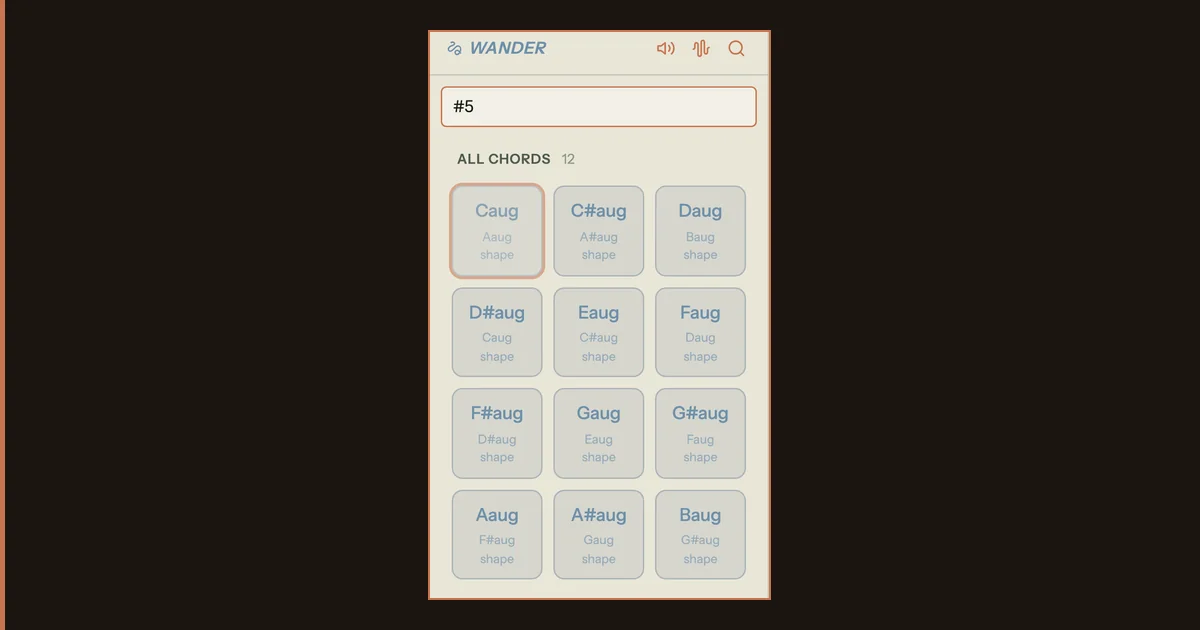
Try the walk-up in about a minute
- Set your song's key, then place the I chord.
- Press
/to open Chord Search, type#5, and place the augmented chord built on that same root. - Follow it with vi, or with IV and then a minor iv if you want the Orbison move.
- Play it back and listen for the single note climbing. That is the whole trick.
Capture the idea while the chord is still ringing
Song Cage keeps the chords, the melody and the words in one place, on every device you write on.
Frequently Asked Questions
What notes are in an augmented chord?
The root, the major third, and the fifth raised by a half step, written 1–3–♯5. C augmented is C–E–G♯, A augmented is A–C♯–E♯, and D augmented is D–F♯–A♯. Another way to build it: play a major triad and move the top note up one fret or one key.
How many augmented chords are there?
Four. Because the chord splits the octave into three equal major thirds, C+, E+ and G♯+ all contain the identical three pitches. The four groups are C–E–G♯, C♯–F–A, D–F♯–A♯ and E♭–G–B, which between them cover all twelve roots.
What is the difference between an augmented and a diminished chord?
A diminished triad stacks two minor thirds and lowers the fifth (C–E♭–G♭). An augmented triad stacks two major thirds and raises it (C–E–G♯). Diminished chords occur naturally on the seventh degree of a major scale; augmented chords never occur in a major scale at all. See diminished chords explained.
What scale is the augmented chord from?
The only place it appears without alteration is the third degree of harmonic minor and ascending melodic minor, written III+. In practice most augmented chords in songs are not functioning as III+ at all; they are chromatic passing chords over I, IV or V. The whole-tone scale also produces an augmented triad on every degree.
What songs use augmented chords?
Verified examples include The Beatles' "Oh! Darling" (an E+ opens the record), Roy Orbison's "Crying," Lesley Gore's "It's My Party," David Bowie's "Life on Mars?", ABBA's "Mamma Mia," Stevie Wonder's "You Are the Sunshine of My Life" and John Lennon's "(Just Like) Starting Over." The full table above names a source for each.
How do you write an augmented chord?
Most commonly with a plus sign or the letters "aug" after the root: C+ or Caug. You will also see C(♯5) and, in older sheet music, C+5. In Roman-numeral analysis the plus sign goes on the numeral, so an augmented chord built on the fifth degree is V+.
The short version
The augmented chord is not a mood you sprinkle on a song. It is a half step, caught in the act.
Every convincing use of it comes down to one voice climbing or falling while the rest of the chord holds: the fifth of the V pushing up into the third of the I, or the fifth of the I walking up toward the sixth. Find the moving note first, and the chord places itself.
Then go listen to the first two seconds of "Oh! Darling" and hear what one chord, played alone before anybody sings, can set up.