Table of Contents
- What is the difference between melody and harmony?
- What is melody?
- How much of a melody do you need to recognise a song?
- Is the melody the same as the chorus?
- What is harmony? The word does two jobs
- Harmony as the chords under the tune
- Harmony as a harmony part
- Why does one word mean both?
- How are the two meanings connected?
- How do melody and harmony work together?
- Can the same melody have different harmony?
- Can different melodies share the same harmony?
- What happens when one of them stands still?
- Can a melody imply its own harmony?
- What are melody, harmony and rhythm?
- What do monophony, homophony and polyphony mean?
- Is harmony harder than melody?
- How do you hear melody and harmony separately?
- Should you write the melody or the harmony first?
- Frequently Asked Questions
Ask what the difference between melody and harmony is and you'll usually get the textbook answer: melody is horizontal, harmony is vertical. That's true, but it leaves out the part that confuses people. When a guitarist says "the harmony" they usually mean the chords. When a singer says "I'll sing harmony" they mean a second tune. Both uses are correct, and most explanations slide between them without saying so. This post separates the two meanings, shows how melody and harmony depend on each other with real songs and research, and ends with a way to hear each layer on its own.
Quick Summary
Melody is one line of notes heard one after another: the tune you'd hum. Harmony is notes sounding together. The word "harmony" does two jobs: it means the chords under the tune, and it means a harmony part, a second line sung or played with the melody. Both usually come from the same chord.
What is the difference between melody and harmony?
Melody is a single line of notes heard one after another, the part of a song you can hum back. Harmony is two or more notes heard at the same time. Melody works across time and harmony works in the moment, which is why teachers call melody horizontal and harmony vertical.
That pairing goes back a long way in music teaching. The Lumen Learning music appreciation course puts it this way: harmony "is often said to refer to the 'vertical' aspect of music, as distinguished from melodic line, or the 'horizontal' aspect" (Lumen Learning). Picture written music. A melody runs left to right along the page. A chord stacks its notes on top of each other.
The definition is fine as far as it goes. The trouble starts when you use it. A songwriter who reads "harmony is the chords" and then hears a singer say "let me take the harmony" has met two different things under one word. The table below keeps them apart.
| Melody | Harmony: the chords | Harmony: a harmony part | |
|---|---|---|---|
| What it is | The main tune | The notes sounding under and around the tune | A second line sung or played with the tune |
| Notes at once | One | Usually three or more | One per part |
| Direction | Horizontal (over time) | Vertical (at the same time), changing chord by chord | Horizontal, but heard against the melody |
| Who usually carries it | Lead singer or lead instrument | Guitar, piano, keys, bass | Backing singers, a duet partner, a second instrument |
| Can it stand alone? | yes Hummed alone, it's still the song | partly It sounds like a backing track | partly Sung alone it's just another tune |
| What it gives a listener | The part they remember and sing back | Mood, key, and a sense of home and away | Thickness, lift, and a change of colour between sections |
Yes: works with nothing else playing. Partly: works, but is heard as a supporting part.
What is melody?
A melody is a sequence of pitches in rhythm that the ear hears as one line. Both halves count: the same notes in a different rhythm make a different melody. It's usually the most memorable part of a song, the part a listener remembers and can sing back.
Jack Perricone sums it up in an excerpt from his Berklee Press book Melody in Songwriting, published on Berklee Online: "The two basic elements of music that define melody are pitch and rhythm. Melody is a succession of pitches in rhythm. The melody is usually the most memorable aspect of a song, the one the listener remembers and is able to perform" (Berklee Online). Britannica adds the part about perception: a melody is "the linear sequence of musical tones perceived as a single coherent line" (Britannica).
Rhythm is the half people forget. Hum the first line of "Happy Birthday" with every note the same length and it starts to fall apart, even though the pitches haven't changed. That's also why lyrics sing best when their stressed syllables fall on the melody's strong beats, a big part of what songwriters call prosody.
How much of a melody do you need to recognise a song?
Not much. Simone Dalla Bella, Isabelle Peretz and Neil Aronoff played listeners familiar songs one note at a time, as the melody alone with no lyrics and no accompaniment. Three to six notes, about two seconds, were enough for a familiar tune to feel familiar, and listeners could sing the right tune back within five to seven notes (Perception & Psychophysics, 2003).
The ear also stores a melody by its shape rather than its exact notes. Infants familiarised with a tune for a week still recognised it on day eight when it was moved up or down by a fifth or a tritone, according to Plantinga and Trainor (Cognition, 2005). That's why you can sing a song in any key and it's still the same song. Change the chords under it and people still know the song. Change the tune and they don't.
Is the melody the same as the chorus?
No. Every section of a song has a melody: the verse has one, the chorus has one, and so does the bridge. The chorus melody is often the one people remember, because it repeats and often carries the title, but the verse melody is a melody too. If a section has nobody singing and nothing playing a lead line, it still has harmony and rhythm but no melody. That's common in intros and instrumental breaks.
What is harmony? The word does two jobs
"Harmony" has two musical meanings. The first is the chords: the notes sounding together under a tune, and the way those chords move from one to the next. The second is a harmony part: a separate line, usually sung, that moves with the melody on different notes. Dictionaries list both.
Most explanations of melody vs harmony pick one meaning and quietly switch to the other halfway through. Here they are separately.
Harmony as the chords under the tune
Harmony as chords is the meaning in music theory books. Britannica defines harmony as "the sound of two or more notes heard simultaneously", and in a narrower sense "the extensively developed system of chords and the rules that govern relations between them in Western music" (Britannica). Grove Music Online's definition, as quoted in a University of Sydney thesis, covers both directions at once: "the combining of notes simultaneously, to produce chords, and successively, to produce chord progressions" (Bartlett, 2015).
That second clause matters for songwriters. Harmony isn't one chord frozen in time. It's the progression: C to G to A minor to F, each chord lasting a bar or two. When someone says a song "has interesting harmony", they mean the chords and how they move, which is the craft covered in how to write a chord progression.
Harmony as a harmony part
Harmony as a harmony part is the meaning in a rehearsal room. The American Heritage Dictionary lists it as its own sense: "A musical line that harmonically complements the melody: You sing the lead part, and I'll sing the harmony" (American Heritage Dictionary). Cambridge's Academic Content Dictionary defines harmony as "notes that are played or sung with the main tune and that make the piece more complicated and interesting" (Cambridge Dictionary).
Wikipedia's article on vocal harmony describes the simplest version: "the main vocal melody is supported by a single backup vocal line, either at a pitch which is above or below the main vocal line, often in thirds or sixths which fit in with the chord progression used in the song." A barbershop quartet is the extreme case, which Wikipedia's harmony article captions as "a melody line (normally the lead) and three harmony parts."
A harmony part is a line in its own right. Sing it alone and it's just another tune. It only becomes "harmony" when it's heard against the melody. Writing one that stays right through the chord changes has its own post: how to write vocal harmonies.
Why does one word mean both?
Partly because of history. The word comes from the Greek harmonia, which Etymonline glosses as "agreement, concord of sounds", literally a "means of joining" that was used of fitting a ship's planks together (Etymonline). The chord sense, "using combinations of notes to form chords", only dates from the 16th century. Much earlier, Britannica notes, "melody and harmony were synonymous in classical Greek theory; the term harmony referred not to notes sounded simultaneously, but to the succession of notes, or the scale, out of which melody was formed" (Britannica).
Even modern dictionaries blur the line. Merriam-Webster's first musical sense is "the combination of simultaneous musical notes in a chord", and the example sentence printed under it is "She taught him how to sing harmony" (Merriam-Webster). The free textbook Offtonic Theory is one of the few sources to say it outright: "'Harmony' can also refer to an accompaniment line that's just playing chords with the main melody, as in 'I'll sing melody; you should sing harmony'" (Offtonic Theory).
A quick test for which meaning someone means
- "Sing harmony", "take the harmony", "the harmonies come in on the chorus": a harmony part.
- "The harmony of the song", "the harmonic rhythm", "reharmonize it": the chords.
- "Harmonize this melody": usually the chords on a piano or guitar, usually a harmony part in a choir. Ask.
How are the two meanings connected?
They come from the same place. A harmony part's notes are mostly taken from the chord underneath, which is why a third above the melody fits one chord and rubs on the next. Stack enough harmony parts and you've sung the chord. David Crosby described the usual Crosby, Stills & Nash arrangement as "Stephen at the bottom, me in the middle and Graham on top", adding that "the writer usually sings the melody" (Record Collector). Three voices on three notes are a chord. Crosby also told MusicRadar that most groups would "do the root, the third and the fifth", while he went for "suspensions and resolves" (MusicRadar). That's a chord decision made by singers.
Here is the same idea on four bars of C, G, A minor and F. The melody (G, B, C, C) and a harmony part a third below it (E, G, A, A) both land on notes of the chord in every bar, so the two lines together outline the progression.
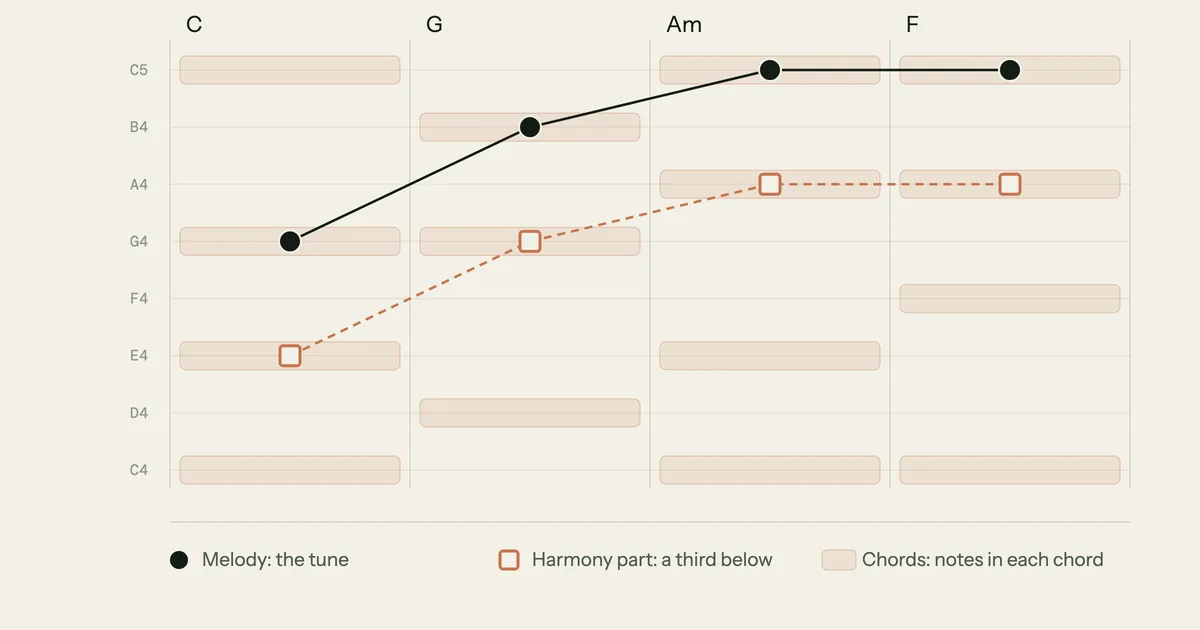
So the cleanest way to hold both meanings: the chords are the harmony as a whole, and a harmony part is one strand of it given to a voice.
How do melody and harmony work together?
Most melody notes are chord tones, notes that belong to the chord sounding underneath. The rest are non-chord notes, such as passing, neighbour or suspended notes, that move between chord tones and add tension. Which melody notes land on chord tones, and where, is what makes a tune sound settled or restless over its chords.
Open Music Theory calls the notes that don't belong to the chord "embellishing tones" because "they embellish notes that belong to the chord", and adds that "in almost all cases... the embellishing tone is a note that doesn't belong to the underlying chord" (Open Music Theory). A passing tone steps between two chord tones. A neighbour tone steps away and comes back. A suspension holds a note from the previous chord into the next and then resolves down by step.
How much of a typical melody is chord tones? It varies by style, and the numbers make the point better than a rule would:
| Music | Melody notes that are chord tones | Source |
|---|---|---|
| Mozart and Beethoven themes (TAVERN corpus) | 81% | Hu & Arthur, 2021 |
| Same corpus, themes and variations together (45,299 notes) | About 72% | Hu & Arthur, 2021 |
| Oasis, "Wonderwall" | 66% | Hooktheory TheoryTab |
| Jazz solos (Charlie Christian, Charlie Parker and five modern saxophonists) | 58% | Bunks et al., 2025 |
Each source measures this slightly differently, so read the rows as a range, not a league table.
Rock and pop add a twist. David Temperley's study of the "melodic-harmonic divorce" in rock found melodies whose non-chord notes don't resolve by step, "usually in pentatonically based melodies, and in verses rather than choruses" (Popular Music, 2007). He named the pattern the loose-verse/tight-chorus model: the verse melody floats over the chords and the chorus melody locks onto them. If your chorus feels like it lands harder than your verse, that may be why.
Can the same melody have different harmony?
Yes, and this is the clearest way to hear the difference between the two. In a 2021 WIRED video, Jacob Collier takes the opening notes of "Hey Jude", which he places in F major, and asks "what other chords go with the note A?" He puts a D chord under it, then an E-flat chord under the G. He opens the answer by saying "there are infinite ways to harmonize everything" (WIRED). The melody doesn't change, but the song feels different.
Stevie Wonder did it in the record itself. Breaking down "Sir Duke" for Vox, Collier points out that every note of the chorus melody belongs to B major, so "Stevie could very easily just have B major under the whole chorus". Instead Wonder picked out two melody notes, A-sharp and G-sharp, and gave them a different chord (Vox). As Collier puts it: "you can take a note that feels familiar in one key or under one chord and that note can stay the same. But underneath it, the chord can change."
This isn't just a feeling. In listening experiments at Ohio State, Claire Arthur found that the chords before a note significantly changed how listeners described that same scale degree (Arthur, 2016). The note doesn't change. Its role changes.
Can different melodies share the same harmony?
All the time. Wikipedia's article on the I–V–vi–IV progression lists Journey's "Any Way You Want It" (1980) and Jason Mraz's "I'm Yours" (2008) on the same four chords, Toto's "Africa" (1982) with the same chords starting from vi in its chorus, and Taylor Swift's "Anti-Hero" (2022) starting from IV. Four very different tunes over one loop. The Axis of Awesome built a comedy medley, "Four Chords", on exactly this, though the article warns that the medley "does not accurately represent the chord progressions of all the songs it depicts."
The chords set the mood and the key. The melody is what tells one song from another.
What happens when one of them stands still?
When either the melody or the chords stand still, the other one does all the work, and you can hear the split clearly.
In "One Note Samba", Antônio Carlos Jobim holds the melody on one note while the chords move. Wikipedia describes "a long series of notes of a single tone (typically D, as played in the key of G) played over a descending chord progression": eight bars on D, four on G, four more on D (Wikipedia). The one note sounds different under each chord, which is the Sir Duke trick stretched over a whole section.
The Beatles' "Tomorrow Never Knows" does the reverse. Its harmony is "mainly restricted to the chord of C" over a droning tambura, and the vocal melody moves above it (Wikipedia). The chords barely move, so any movement you hear is the tune.
Can a melody imply its own harmony?
Yes. A melody built from the notes of one chord spells that chord out with nothing playing under it. The bugle call "Taps" is the purest case. Its melody "is composed entirely from the written notes of the C major triad", because a bugle can only play the notes of its harmonic series (Wikipedia). Play it alone and you still hear one chord.
Hearing implied harmony is learned, and later than you'd think. Laurel Trainor and Sandra Trehub played melodies to children with one note changed. Five-year-olds spotted a note that left the key more easily than other changes, but an in-key note that broke the implied chord was no easier for them to spot than one that fit it. Seven-year-olds and adults found both kinds of wrong note easier to spot (Perception & Psychophysics, 1994). Trainor's later review puts sensitivity to harmony "beginning to emerge rather late, around 6 to 7 years", well after scale structure (Trainor). A feel for the key comes first, and a feel for the chords under a tune follows a few years later.
What are melody, harmony and rhythm?
Melody, harmony and rhythm are three of the basic elements of music. Melody is the tune, harmony is the notes sounding together, and rhythm is how sounds are placed in time. Melody uses rhythm too, but music can have rhythm with no pitch at all, or a melody with no harmony.
The open textbook The Basic Elements of Music lists rhythm, melody, harmony, timbre and texture as "the essential aspects of a musical performance", and adds that "music does not have to have harmony, however, and some music doesn't even have melody" (Schmidt-Jones). The Lumen course goes further: harmony "is not as basic as some other elements, such as rhythm and melody. You can have music that is just rhythms, with no pitches at all" (Lumen Learning).
For a songwriter there's a fourth part: the words. Melody, harmony, rhythm and lyrics are the four things you're actually writing, and each one constrains the others.
Melody and harmony also each carry part of a song's key, and they do it better together. In Temperley and de Clercq's study of 200 rock songs, a key-finding model working from the melody alone got the key right up to 82% of the time. From the chord roots it reached 91%. Using both, it was right 97% of the time (Journal of New Music Research, 2013). Working out a key by ear runs the same way: the tune gives you a guess, and the chords confirm it.
What do monophony, homophony and polyphony mean?
Monophony, homophony and polyphony are the textbook names for how melody and harmony are combined, a property called texture.
| Texture | What you hear | Everyday example |
|---|---|---|
| Monophony | One melody, no harmony | Someone humming alone |
| Homophony | One melody on top, chords underneath | Most songs: a singer and a guitar |
| Polyphony | Two or more independent melodies at once | A round, or a countermelody against the lead |
| Heterophony | Several versions of the same tune at once | A folk session where everyone ornaments the tune differently |
Definitions from Open Music Theory and Britannica.
Britannica's definition of homophony is the one that describes most songs: a "musical texture based primarily on chords", in which "one part, usually the highest, tends to predominate" (Britannica). Polyphony is where the second meaning of harmony gets slippery. Two melodies at once, each with its own rhythm, are counterpoint, and a line like that is a countermelody rather than a harmony part.
Is harmony harder than melody?
It depends which harmony you mean. Singing a harmony part is harder than singing the melody for most people, because the tune keeps pulling you back to it. Writing chords is usually easier than writing a good melody, because there are fewer choices and the ear forgives more.
Singers say this about themselves. In a 2010 interview, Klara Söderberg of First Aid Kit said her sister Johanna takes the harmony parts and that she herself is "very bad at harmonies" (Under the Radar). Holding a second line while someone sings the tune next to you is a skill that takes practice, and singers often learn a harmony part on its own before singing it against the tune.
Writing is the other way round. A chord progression can loop for a whole verse and sound fine. A melody that repeats one shape for a whole verse usually sounds dull, and a melody is what the listener has to remember. Psyche Loui's 2012 study used an invented musical system so that nobody started with prior knowledge. When she disrupted the melodic intervals, people stopped learning the music. When she disrupted the harmonic relationships, they still learned it, but stopped growing to like it more with exposure (Topics in Cognitive Science, 2012). One lab study in an artificial scale doesn't settle it, but it fits what songwriters find: the tune is what people learn, and the harmony shapes how they feel about it.
How do you hear melody and harmony separately?
Listen to the same song three times, each time for one layer: first hum only the tune, then follow the bass and count where the chords change, then listen for a second voice joining the lead. Hearing each layer on its own trains your ear faster than reading definitions.
- The melody. Hum along with the lead vocal and nothing else. If you can hum it back from memory afterwards, that's the melody.
- The chords. Ignore the singer and listen to the lowest note. Tap when it moves. Each move is usually a chord change. Notice whether the changes come every bar or every two bars, which is the song's harmonic rhythm.
- A harmony part. Listen for the moment a second voice joins the lead, often in the chorus. The Civil Wars' John Paul White described using harmony parts to "make things stair-step from one section of the song to the next", and said a moment "can become larger and a little more climactic when it drops down to something really simple with just one voice" (LAist). A harmony part coming in, or dropping out, is easy to spot once you're listening for it.
On your own songs it's easier still, because you can switch the layers off. In Song Cage the chords and the melody play back as separate parts, each with its own mute and solo, so you can hear the tune alone, the chords alone, then both together.
Should you write the melody or the harmony first?
Either order works, and many songwriters switch between songs. Melody-first suits singers and people who hum ideas: you capture the tune and find chords that fit it. Chords-first suits guitar and piano players: the progression sets a mood and the melody grows over it.
If the tune came first, how to harmonize a melody walks through putting chords under it. If the chords came first, the job is a tune that lands on their chord tones at the moments you want it to settle. Either way you're working on how the two fit: which melody notes are chord tones, and which ones rub.
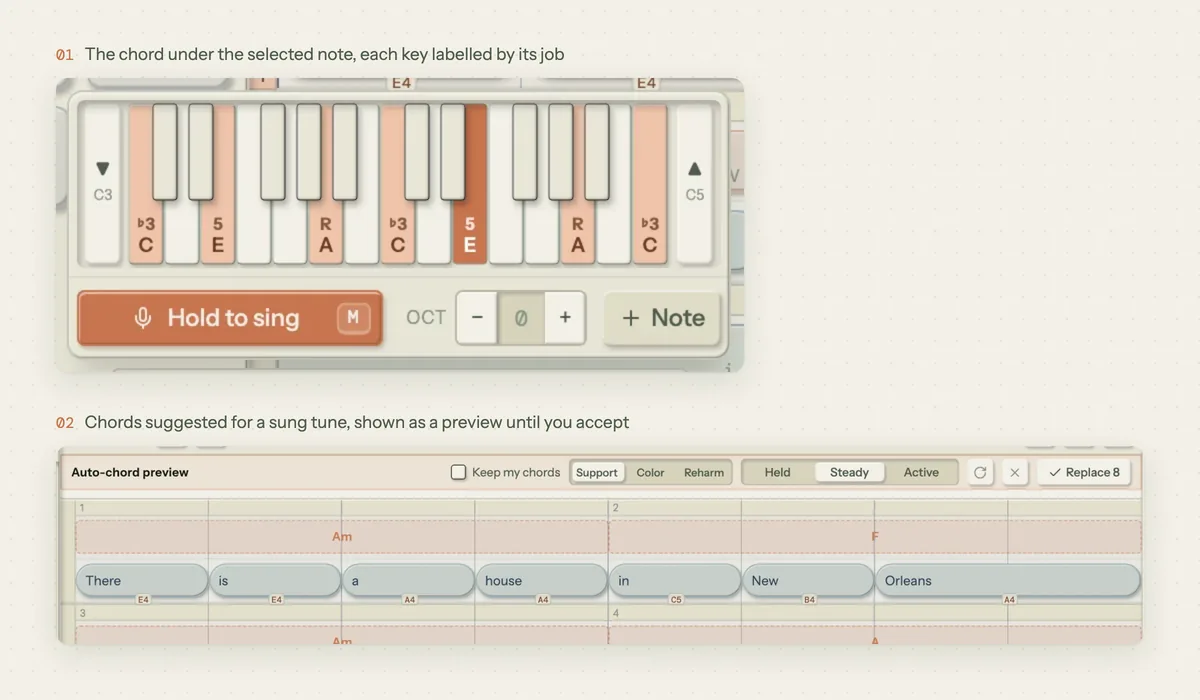
Song Cage is built around that relationship. When you pick a melody note, the piano lights the keys of the chord under that syllable and labels each one by its job in the chord: R for the root, 3, 5, ♭7 and so on. The note you selected gets a label even when it isn't in the chord, so a passing 2 or 4 is easy to spot (Writing melody).
Auto Chords works the other way: once a section has a few melody notes, it suggests a whole progression for them as a preview, and Regenerate steps through up to six progressions for the same tune, best fit first. Its Support, Color and Reharm dial decides how the chords treat your notes. Support favours chords where your notes are a root, third or fifth. Color lets the note be a seventh, sixth or ninth, so a melody D over a C chord becomes Cadd9 (Building chord progressions). It's the "Hey Jude" experiment, run on your own tune, and nothing changes until you accept it.
Song Cage writes one melody line, so it has no harmony vocal part. For that, Melody Rack, a separate MIDI effect plugin for your DAW, has a Harmony effect that writes a second line from a sung take as MIDI, and with its Chords effect on, moves each harmony note onto the chord underneath.
Hear your tune under different chords
Write the melody, see which notes sit in the chord and which pass between, then try another progression under the same tune before you commit.
Frequently Asked Questions
Can harmony exist without melody?
Yes. A strummed chord progression, a piano playing chords, or a backing track with no lead line is harmony without melody. It usually sounds like it's waiting for a tune. Many songs start this way: a songwriter finds a progression they like and writes the melody over it later.
Can melody exist without harmony?
Yes. A melody sung or played alone is called monophony, and Britannica calls it "a basic element of virtually all musical cultures". Someone humming, a solo bugle call, or unaccompanied chant are all melody without harmony. A melody can still suggest chords on its own: "Taps" uses only the notes of one major chord.
Do altos sing melody or harmony?
Usually harmony. In most four-part choir and hymn writing the sopranos carry the melody, the highest part, and the altos, tenors and basses sing harmony parts under it. Arrangers sometimes give the tune to the altos or tenors for a verse, so check the score rather than assuming.
What is an example of harmony?
For the chords meaning: a guitarist strumming C, G, A minor and F under a singer is playing the harmony. For the harmony part meaning: a backing singer singing the same words as the lead a third higher, as in many country and folk duets, is singing a harmony. Both are harmony.
Is harmony the same as chords?
Mostly. In music theory, harmony means chords and how they move from one to the next. But "harmony" also means a single harmony part sung or played with the melody, which is one line, not a chord. A harmony part's notes usually come from the chord, so the two meanings are connected.
Is a countermelody the same as a harmony?
No. A harmony part follows the melody's rhythm and words on different notes. A countermelody is a second tune with its own rhythm, often moving when the main melody holds still. Both add a second line, but a countermelody sounds like two songs fitting together, not one song sung thicker.