Table of Contents
- What does "writing the music" mean when all you have is words?
- Do you need to play an instrument or read music?
- Words first is an old and respectable order
- Which hit writers had little or no musical training?
- What if you can't sing well?
- Do more people think they can't sing than actually can't?
- How rare is true tone deafness?
- Where is the melody hiding in your lyric?
- Why does repeating a line make it start to sing?
- How do you turn spoken lines into a tune?
- 1. Tap a pulse and chant the line
- 2. Count the stresses in each line
- 3. Record the spoken line and loop it
- 4. Sing it slowly on a few steady notes
- 5. Give the verse and the chorus their own tunes
- 6. Record it over a click
- How do you get the tune out of your head and into notes?
- How do you add chords when you don't play?
- What happens to your song if an AI generator writes the music?
- Who owns a tune a generator writes?
- What do the generators' terms say?
- Which doors close?
- Should you hire a composer or co-write instead?
- Who owns the song when someone else writes the music?
- What changes if you pay someone to write it?
- What should you send a composer?
- Can you sell lyrics without music?
- Can a lyricist join ASCAP?
- Are there contests for lyrics alone?
- How do you spot a song shark?
- How do you turn a poem into a song?
- Can you set someone else's poem to music?
- How does Song Cage fit a lyrics-first writer?
- How do you sing the melody onto your lyric?
- Can you sing the whole line in one take?
- How does it suggest chords for your melody?
- How do you hand the song to a musician?
- Frequently Asked Questions
"100 songs. No band. No instrument. No idea what happens next." That is how a new lyricist opened a Join My Band ad on August 28, 2026, looking for musicians. Two days later, the same writer asked one of the people who had replied: "I'm assuming you don't use AI? Sorry, but I have to ask."
Earlier that month, a singer with a handful of lyrics posted on the same site: "I do not play any instruments and I do not want to go down the whole AI route!"
Both ads frame the same choice: find a musician, or let a generator write the tune. There is a third. You write the melody yourself, with your voice, and bring in chords afterwards. Songwriter and producer Cliff Goldmacher puts the stakes plainly: "A lyric without an accompanying melody is only half a song." This guide covers how to write music for lyrics when you don't play anything, from finding the tune in your words to handing a musician something they can play.
The short version
The part of the music you have to write yourself is the melody. Speak each line until you hear its rhythm and its rise and fall, then sing it slowly, one steady note at a time, and get those notes down before you think about chords. Chords and backing can come from a tool or a hired player. If a generator writes the tune, the tune isn't your work.

What does "writing the music" mean when all you have is words?
Mostly, it means writing the melody: the notes your words are sung on. Chords, groove, arrangement and recording all matter, but other people or software can add them once the tune exists, and in most genres, says songwriter Cliff Goldmacher, adding chords to an existing melody and lyric counts as arrangement rather than songwriting.
Goldmacher draws that line in the same post. "If, on the other hand, you can sing your lyric and melody then you've officially got an entire song," he writes. For most genres, he adds, "putting chords to a pre-existing melody and lyric doesn't count as songwriting but, rather, as contributing to the arrangement and is best done on a 'for hire' basis."
That gives you an order of work. The melody makes the song yours, so it comes first and you write it. Everything after it supports the tune. You can learn to add chords, use a tool that suggests them, or pay a player, and none of those choices changes who wrote the melody. Not everyone draws the line in the same place, though. A player who reshapes your tune while adding chords may have a fair claim to credit, which is why the paperwork section further down matters as much as the craft.
Do you need to play an instrument or read music?
No. Some of the best-known songs of the last century started as finished words, and a few hit writers could barely play or couldn't write music down at all. What they had was a tune they could sing or pick out, and someone to help put it on paper.
Words first is an old and respectable order
Richard Rodgers usually wrote the tune first with his early partner Lorenz Hart. With Oscar Hammerstein, the lyric usually came first. In a 1960 interview with Tony Thomas, replayed on NPR's Fresh Air in 2018, Rodgers said that having the lyric "in addition to the situation in the play is very helpful to me. It gives me an extra push into the solution of the problem of finding the tune."
Bernie Taupin has nearly always written the words before Elton John wrote the music, and the two mostly work apart. Taupin told Jim Farber in a 2023 Vulture interview: "I think the lyrics themselves dictated the melody ultimately."
Grateful Dead lyricist Robert Hunter described his work with Jerry Garcia in similar terms, in a 2014 interview with Alan Paul excerpted in The Hollywood Reporter: "Most of the time, it was lyrics first."
If you have a notebook of finished lyrics, you are starting where those songs started.
Which hit writers had little or no musical training?
Irving Berlin is the famous case. His 1989 New York Times obituary called him "[t]he musical giant who never learned to read or write music." He could play the piano only in the key of F sharp, as Smithsonian magazine notes, and used specially built pianos with a lever that shifted the key. The Times obituary says he left it to arrangers "to write the harmony and to transcribe his melodies."
Lionel Bart wrote the book, music and lyrics of Oliver! without being able to write music. "Unable to write music, he would tap out the melody with one finger and someone else would orchestrate it," Tom Vallance wrote in Bart's obituary in The Independent, which also quotes what Bart once told the musical historian Mark Steyn: "I'm not a composer, I just make tunes and sing them."
The modern version is the top-line writer. In John Seabrook's 2012 New Yorker piece, Ester Dean, who co-wrote hits for Rihanna and Nicki Minaj, finds her melodies by improvising with her voice over tracks that producers have already built. Producer Tricky Stewart recalled asking her whether she had any musical training. "She said she didn't."
What if you can't sing well?
You probably sing better than you think, especially slowly. Studies of ordinary people suggest that most can carry a tune, that far more people believe they can't sing than actually can't, and that true tone deafness is rare. Writing a melody asks for a steady voice, not a trained one.
In a 2007 study, Simone Dalla Bella, Jean-François Giguère and Isabelle Peretz asked 62 occasional singers to sing a well-known song. Only a minority made many pitch errors. When 15 of the non-musicians sang it again at a slow tempo, most sang as accurately as the professional singers they were compared with, though two of the 15 kept making many errors. Singing slowly is a fix you can use today.
Do more people think they can't sing than actually can't?
Very likely. A second 2007 study, by Peter Pfordresher and Steven Brown, had students with no formal music training copy short four-note patterns. Ten of 79 (13%) were more than a semitone off on average, and as a group, those poor-pitch singers who also took a listening test were no worse than the good singers at telling pitches apart. The paper also reports a screening questionnaire at the same university in which 59% of 1,105 introductory psychology students said they could not imitate melodies by singing.
Gary Ewer, who writes The Essential Secrets of Songwriting, puts it this way: "The inability to sing usually means the inability to sing well." Writing a melody for lyrics doesn't need a good voice. It needs you to land on the note you mean, one at a time, slowly.
How rare is true tone deafness?
Rarer than the phrase suggests. In a 2017 study of 16,625 adults who took an online music-perception test, Isabelle Peretz and Dominique Vuvan found that 1.5% met a conservative definition of congenital amusia, a lifelong difficulty noticing off-key notes. Under a looser, more widely used criterion, the figure was 4.2%.
A separate 2005 study at Queen's University, where nearly 17% of more than 2,000 first-year psychology students called themselves tone-deaf, concluded that many people who consider themselves tone-deaf may not actually have trouble perceiving music.
If singing still feels shaky, two habits help. Sing slower than the finished song will go, and start on a pitch that feels comfortable rather than the key you imagine the song in. The key can move later, and choosing a key that suits your voice is a separate job you can do once the tune exists.
Where is the melody hiding in your lyric?
In the way you already say it. Spoken English tends to rise on stressed syllables and fall on the rest, and that rise and fall is a rough first draft of a tune. Your job is to hear the shape, keep the parts that already sound musical, and exaggerate them into notes.
Berklee professor Pat Pattison teaches, on his page Looking for the Perfect Match, that stressed syllables are higher in pitch, louder and longer than the syllables around them, and he listens for those stresses by saying a line out loud. "Say the first line several times without listening to yourself," he writes on his own site. "Then slow it down and listen to your pitches."
Gary Ewer makes the same point in a 2020 post for writers who find melody hard: "No one speaks in a monotone; every time we read or say anything, we hear our voice naturally moving up for emphasis, and then down again for other less important words." For the same reason, he suggests those writers try working lyrics-first.
Andrea Stolpe, a Berklee graduate and former Nashville staff writer who now coaches songwriters, suggests coming at melody through the lyric when a writer's tunes start to sound too familiar, "so that our melodies are shaped by the stress patterns of the words instead of what comes out by pitch alone."
Why does repeating a line make it start to sing?
Because repetition changes how you hear speech. In a 2011 study, Diana Deutsch, Trevor Henthorn and Rachael Lapidis played a spoken phrase to musically trained listeners. Those who heard it once repeated it back as speech. Those who heard it ten times in a row sang it back.
Later work, reviewed in a 2021 study in Music Perception, suggests the effect comes more readily when each syllable holds a steady pitch instead of gliding. The 2021 study itself found that sentences full of vowels and sounds like m, n, l and r turned into song more often.
Composers have listened for this for more than a century. Leoš Janáček spent over three decades writing down thousands of snippets of everyday speech in musical notation, according to a 2006 study in Empirical Musicology Review, though the study notes that just how they shaped his music remains a matter of debate. For Different Trains (1988), Steve Reich picked out recorded speech that was "more or less clearly pitched," notated it, and had the strings "literally imitate that speech melody."
How do you turn spoken lines into a tune?
Work in this order: rhythm, then shape, then exact notes. Chant the line over a steady pulse until the stresses sit on beats, loop it until the rise and fall sounds like singing, then sing it slowly on a few steady pitches and adjust. Record every pass so nothing gets lost.
The composer Alice Parker, writing for Chorus America about setting words to music, describes the same order. "The text is the rhythm," she writes, and when she set Eudora Welty's The Ponder Heart as an opera, even the rests were measured "before I ever added any pitches." The pitches came from the words as well: "The easy rise and fall of speech became the widened scale of song with extreme highs and lows reserved for very dramatic moments." The six steps below adapt that order for songwriting without an instrument.
1. Tap a pulse and chant the line
Tap a steady beat on the table and speak the line in time with it, several times, until the stressed syllables fall on the taps. When words are set to music, David Temperley writes in a 2022 review in the Annual Review of Linguistics, "there is a strong preference for stressed syllables to be placed on metrically strong beats." Recent pop bends that preference in limited, systematic ways, sometimes moving a stressed syllable onto the weak beat just before a strong one, so don't worry if a line wants to push early. If a line refuses to fit any pulse, the fix is usually in the words, and the guide to fitting lyrics to a melody covers that in detail.
2. Count the stresses in each line
Pattison measures a line's length in stressed syllables, not total syllables. On his site he shows what line length does to a section: when a line mirrors an earlier one in length and rhyme, the section feels finished, while in one of his examples, lines of three, three and five stresses "feel unstable and tell us to keep going, though it's not entirely clear where." Mark the stresses in each line with a pencil. Where you want the music to settle, match the counts. Where you want it to push forward, break the pattern on purpose.
3. Record the spoken line and loop it
Say the line into your phone at a natural pace, then play it back on repeat. Listen for the moment it starts to sound like a tune, the effect Deutsch measured. Then hum along with the loop, letting the rises and falls grow bigger than they are in speech. That exaggerated version is your first melody sketch. Pattison's shorthand for the whole idea, on his page Looking for the Perfect Match, is that a song is natural speech, exaggerated.
4. Sing it slowly on a few steady notes
Now sing the line slowly, holding each syllable on one steady pitch instead of sliding between pitches. Start with two or three notes: one for most syllables, a higher one for the most important stress, a lower one where the line relaxes. Then move one syllable at a time and listen. If you're unsure where the next note should go, small moves are a safe default. A 2015 analysis of 304 recordings from around the world found that music tends to move by small intervals (a fifth or less), in falling or arch-shaped phrases, with phrases under nine seconds long. Those are tendencies with exceptions, not rules.
5. Give the verse and the chorus their own tunes
You don't need a new melody for every line. Stolpe told the Songfacts podcast that she really only has to write "two one- or two-measure melodies that are the basis for my verse and my chorus." Write one short idea for the verse and a contrasting one for the chorus, then repeat and vary them. Put your title where people will hear it. Stolpe says she tries to position the hook "in what we call power positions, which are the first and last line of the chorus." For shaping a tune once you have one, see how to write a melody.
6. Record it over a click
When a line feels right, record it with a metronome running and write the tempo down. Goldmacher's second tip for writers who don't play is "Record a rough acapella version of your song using a metronome," because hearing a song sung over a steady pulse can help studio musicians and singers understand "your phrasing and timing in a way that singing with no rhythmic foundation can't provide." That recording is the first real copy of your melody.
How do you get the tune out of your head and into notes?
A voice memo keeps the idea, and a musician can learn a tune from it, but software needs notes. Find them one at a time on a keyboard, sing each note into an app that writes down the pitch, or record the whole line and let software read the pitches for you to correct.
Goldmacher's low-tech answer still works: "You can always pick out your melody one note at a time on a piano keyboard." A free keyboard app is enough. Sing a note, find the key that matches, write the note name above the syllable, and move on to the next one.
Software can take the hunting out of it. Some apps write down the pitch you sing, one note at a time, so a line goes in syllable by syllable. Others take a whole sung or hummed take and read the pitches out of it. Either way, check the result by ear. A converter hears every scoop and wobble, and deciding which notes you meant is still your job. The guide to turning audio into MIDI covers what to fix and what to leave alone.
Then play the notes back against your recording. If a note sounds wrong, it probably is, even if you can't say why.
How do you add chords when you don't play?
Start from the notes you sang. Most melody notes fit more than one chord, so for each stretch of the tune you're choosing among a few candidates, and your ear can judge them even if your hands can't play them. Software or a hired player can offer the candidates.
The full method is in how to harmonize a melody, which starts from a tune you hummed. In short: find the note your melody wants to end on, try that key's three main chords under the notes that land on strong beats, and keep the ones that contain those notes and carry the feeling you want.
If you'd rather not work it out alone, you have two honest options. Use a tool that suggests chords for the melody you wrote and pick the ones you like by ear, or hire a player. Goldmacher's view is that in most genres, adding chords to an existing melody and lyric is arrangement, best done for hire. That line isn't always clear-cut, which is why the agreement should come before the session. Either way, the melody stays the one you sang.
What happens to your song if an AI generator writes the music?
Your words stay yours, but the tune isn't your work. The US Copyright Office says prompts alone don't make you the author of what a generator produces, Suno's terms don't promise that any copyright will exist in its output, and some contests, a songwriting forum and a distributor now turn such songs away or limit where they can go.
The pull is real. A lyricist on the Muse Songwriters board wrote that they could "see the value of Suno to flesh out an idea," knowing they "may never get anyone interested enough to make a proper recording" of their lyric. It helps to know what the trade involves before you make it. Nothing here is legal advice. The ownership points reflect US sources, and the terms, rules and court ruling are as of September 2026.
Who owns a tune a generator writes?
In Part 2 of its report on copyright and artificial intelligence, published January 29, 2025, the US Copyright Office concluded that, "given current generally available technology, prompts alone do not provide sufficient human control to make users of an AI system the authors of the output," and that repeatedly revising and resubmitting prompts doesn't change that. The same report says "Copyright protects the original expression in a work created by a human author, even if the work also includes AI-generated material," though not the AI-generated material on its own.
For a lyricist, the plain reading is that your words keep their protection and a generated melody isn't your authorship. The Office hasn't ruled on songs specifically, so treat that as a reading of its reasoning rather than a ruling about your song, and check the Office's AI page for updates.
What do the generators' terms say?
Suno's terms of service, in effect since September 3, 2026, say you keep ownership of what you submit, including text. You also grant Suno a worldwide, non-exclusive, royalty-free, sublicensable, perpetual and irrevocable licence to that content, including for improving its AI models. Suno assigns its rights in the output to paying subscribers, with a caveat in the same clause: "Due to the nature of machine learning, Suno makes no representation or warranty to you that any copyright will vest in any Output." Another line says "Output may not be unique across users and the Service may generate the same or similar output for a third party."
Where a generator's tunes come from is also in court. On July 31, 2026, the Munich Regional Court ruled at first instance that Suno infringed six songs from the repertoire of GEMA, the German music rights society. The prompts at issue contained only each song's lyrics, a musical style and its title, and the court found the songs' original music recognizable in what came back. The judgment isn't final.
Which doors close?
Some of the places a songwriter might take a finished song now ask who wrote the music.
| Where the song goes | You wrote the melody | A generator wrote the melody |
|---|---|---|
| NSAI Song Contest | Can enter | Excluded |
| Muse Songwriters board | Main forum and contests | AI Forum and AI Song Contest only |
| CD Baby distribution | Accepted | Not accepted |
| ASCAP, BMI and SOCAN registration | Yes | Yes if only partly AI-generated |
| US Copyright Office, on the melody | Your authorship | Not your authorship from prompts alone |
Rules as they stood in September 2026. They change, so check each one before you rely on it.
The NSAI Song Contest's FAQ says: "AI MUST NOT be used in the creation of the Song or Lyric of the submission to be eligible." The Muse Songwriters guidelines, posted in December 2025, say "Songs with human-written lyrics set to fully AI-generated music are allowed only in the AI Forum and AI Song Contest, not in the main Songwriting Forum or Songwriting Contests." CD Baby says: "We cannot accept any AI-generated content, even if it's commercially licensed."
The registration row is there for honesty. BMI lists "Using an AI music platform to create a backing track, then adding original lyrics and vocals" as an example of a partly AI-generated work, and ASCAP, BMI and SOCAN announced aligned policies in October 2025, under which compositions "entirely created using AI tools" aren't eligible for registration. For how labels and platforms are drawing their own lines, see why the AI music labels stop at the recording.
Should you hire a composer or co-write instead?
Both are good routes, and plenty of great songs came from a lyricist and a composer working together. The difference is ownership. A co-writer usually owns part of the whole song, and a paid composer's rights depend on what you both sign, so agree the terms in writing before anyone writes a note.
Who owns the song when someone else writes the music?
In the US, if you write the words and someone else writes the music, and you both intend at the time to be co-writers of one song, the law treats it as a joint work. Under 17 U.S.C. § 201(a), "The authors of a joint work are coowners of copyright in the work," and without an agreement, as Mark Halloran and Edward R. Hearn put it in a guide to co-writing agreements, "you share equally, even if it is clear that your contributions are not equal." A poem written on its own and set to music later may not qualify, because joint authorship turns on that shared intent. Under UK law, as solicitor Pete Bott explains on Leeds Conservatoire's student site, a song is usually treated as two separate works, the music and the lyrics.
The old industry habit is an even split between words and music. "Historically, 50% of a song went to the writer of the music, and 50% to the lyricist," music lawyer Donald Passman wrote in his book All You Need to Know About the Music Business, in an excerpt posted on BMI's site in 2005. ASCAP's guide to splits is clear that "Royalty percentages are completely up to you and your collaborators," and advises co-writers to agree their splits at the point of creation, ideally in writing, adding up to exactly 100%.
What changes if you pay someone to write it?
Paying doesn't automatically make the music yours. US law treats a commissioned piece as a "work made for hire" only if it fits one of nine categories in the Copyright Act and both sides sign a written agreement expressly saying so, according to the Copyright Office's Circular 30. When a work does qualify, the hiring party is legally its author.
Hiring sites start from opposite defaults. AirGigs' terms say that unless the project description clearly states otherwise, a seller's work is intended to be a work made for hire that belongs to the buyer. SoundBetter's terms start the other way: "You retain all copyrights and other intellectual property rights in and to your own Project Content, unless otherwise agreed in the Project Terms." Read the terms before you pay, and write the credit and ownership you expect into the proposal. This is general information, not legal advice.
What should you send a composer?
Send this before the first session
- A typed lyric sheet with each section labeled and every chorus written out in full.
- Your melody: a sung or hummed recording over a click, plus the notes as a MIDI file if you have them.
- The tempo and feel you imagine, with two or three reference songs named.
- Anything you're sure of, such as where the title lands and which line is the high point.
- The split and credit you're proposing, in writing.
For a demo session, Goldmacher advises bringing lyric sheets that are "printed (not handwritten)" with "each chorus written out in full," so the singer can read straight down the page and you can mark notes on every chorus. The same sheet helps anyone who works on your song.
Two places lyricists look for collaborators are the Collaborations Sought forum on Muse Songwriters, where only Full Members (a status earned by taking part in the community) can start threads, and the free UK musicians' classifieds on Join My Band, where the ads quoted at the top of this post appeared.
Can you sell lyrics without music?
Rarely, and not in the way the question imagines. Songs are usually licensed rather than sold, publishers and pitch services want finished songs with audio, and a song written to be sold outright is a work made for hire, which gives up your ownership. The realistic way to earn from lyrics is to finish them into songs.
Hit songwriter Jason Blume, writing on BMI's site in 2017, puts the word in quotation marks for a reason: "songwriters rarely “sell” their songs. They (or their publishers) issue licenses permitting the sale and public performance of their work." He says songs written to be sold outright are works made for hire, in which "the creator relinquishes all rights to ownership."
The business runs on complete songs. NSAI's online pitch sessions ask for "an audio file of your original song (mp3) and lyric sheet." ASCAP asks writers to register works "once a musical work has been fully created," and The MLC requires at least one composer or composer/author role on every work registration.
Can a lyricist join ASCAP?
Yes, once a song is out in public. ASCAP's membership FAQ says "You can join ASCAP as a writer if you've written or co-written music or lyrics for at least one musical work that is available to the public," and joining is currently free for new writer members.
Are there contests for lyrics alone?
Yes. American Songwriter says its Lyric Contest has been a "lyrics only" contest since it began in 1984. The NSAI Song Contest has a Lyric Category, open to residents of the US (except Maryland, Colorado and Connecticut), Canada (except Quebec), the UK and Australia. The International Songwriting Competition has a Lyrics Only category, where "it is not necessary to submit music." Rules and deadlines change each year, so check before you enter. A contest entry fee is normal. Paying someone to publish you is not.
How do you spot a song shark?
For most of the 20th century, "song-poem" companies charged amateurs to set their poems and lyrics to music, a fee Luke Savage, writing in Smithsonian magazine, puts at "a few hundred dollars, depending on the year." Of an estimated 200,000 songs such companies produced between 1900 and the early 2000s, he writes, "not one ever became a hit." The business is the subject of the 2003 documentary Off the Charts: The Song-Poem Story. In 1961 the Federal Trade Commission entered a consent order against the operator of a Hollywood recording company over what it called false royalty claims and other deception used to get fees from songwriters, a settlement in which he admitted no violation.
The rule James Duncan gave in Writer's Digest still holds: "Remember, money should come IN, not go OUT."
Red flags
- A fee to publish your lyrics, or to pitch a lyric with no music to artists and publishers.
- A message saying a star or a manager has found your song, followed by a request for money.
- A compilation album or anthology you pay to appear on.
- A "we'll set your poem to music" offer that doesn't say who writes the melody or who owns it.
Paying a session musician a clear fee for clearly stated rights isn't a scam. Paying for a promise of publication is.
How do you turn a poem into a song?
Treat the poem as a draft lyric. Read it aloud to find its pulse, pick the lines that could repeat as a chorus, and expect to change words so they sing. If the poem is someone else's, change as little as you can, and if it's still under copyright, get permission first.
Poems and lyrics are mostly built for different senses. Pat Pattison, quoted by Charlotte Yates in Soundfly's Flypaper, puts it this way: "Since the invention of the printing press, poetry is delivered mainly to the eye. Lyrics are delivered mainly to the ear." Stolpe adds that "the rhythms and lengths of our lyric lines are defined by the music, not only the words," and her advice for a poem is to write a chorus or refrain and to split its lines so their rhythms and rhymes can repeat.
The music side follows the steps above: find the pulse, count the stresses, loop the lines until they sing, then sing them slowly on steady notes. The editing side, which syllables to cut and which words to move toward a downbeat, is covered in the poem section of the guide to fitting lyrics to a melody.
Can you set someone else's poem to music?
Only with care. Check whether the poem is still under copyright. If it is, the Copyright Office's guide to obtaining permission says that unless a limitation such as fair use applies, you'll need a license from the copyright owner, so ask early, before you share the song. Keep the words as the poet wrote them, too. Composer Alper Tuzcu, writing about setting a Neruda poem, discourages "changing the order of words within a stanza or the words themselves if it's someone else's work."
How does Song Cage fit a lyrics-first writer?
Song Cage puts your lyric on a beat grid, lets you sing a note onto each syllable or sing a whole take and correct the notes it reads, then ranks chord suggestions against the melody you sang. It has no generative AI: it never writes your melody or your words, and a chord only goes in when you pick or accept it.
How do you sing the melody onto your lyric?
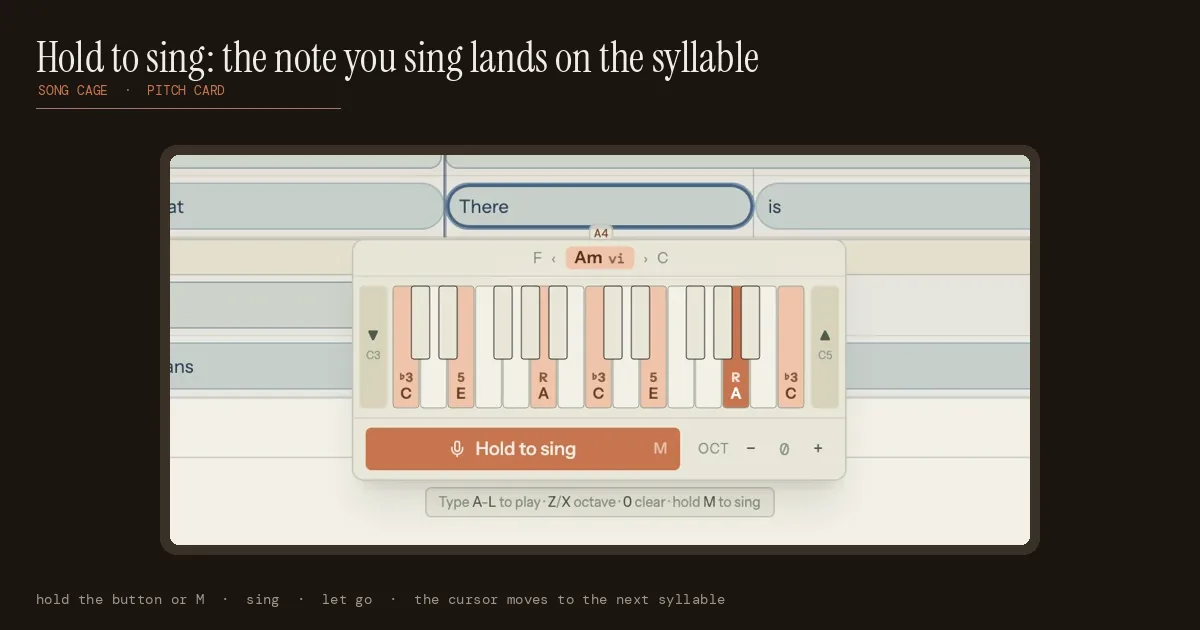
Paste the lyric into Sheet view, and headers like [Chorus] become sections. In Timeline view, a word you type splits into syllables on the grid as you go, and pasted words split when you select them and choose Split syllables from the right-click menu (English only). Click a syllable and a pitch card opens under it with a Hold to sing button. Hold it, or hold the M key, sing the note, and let go. Song Cage writes the pitch it heard to that syllable, plays it once, and moves on to the next syllable, so a line goes in one sung note at a time. An octave setting on the card helps if your voice sits below the line you're writing. The melody chapter of the docs walks through every step.
Can you sing the whole line in one take?
Yes. Choose Audio in the record picker beside the Record button, sing the line into a take, and press Detect melody. The notes open in a roll under the recording. You can switch between hearing your voice and hearing the notes, fix any that came out wrong, snap them to one of the likely keys Song Cage suggests, then place the notes on an empty lyric line and type your words onto them. A small keyboard beside Record can play your first note under the count-in, so you start the take on the pitch you mean.
How does it suggest chords for your melody?
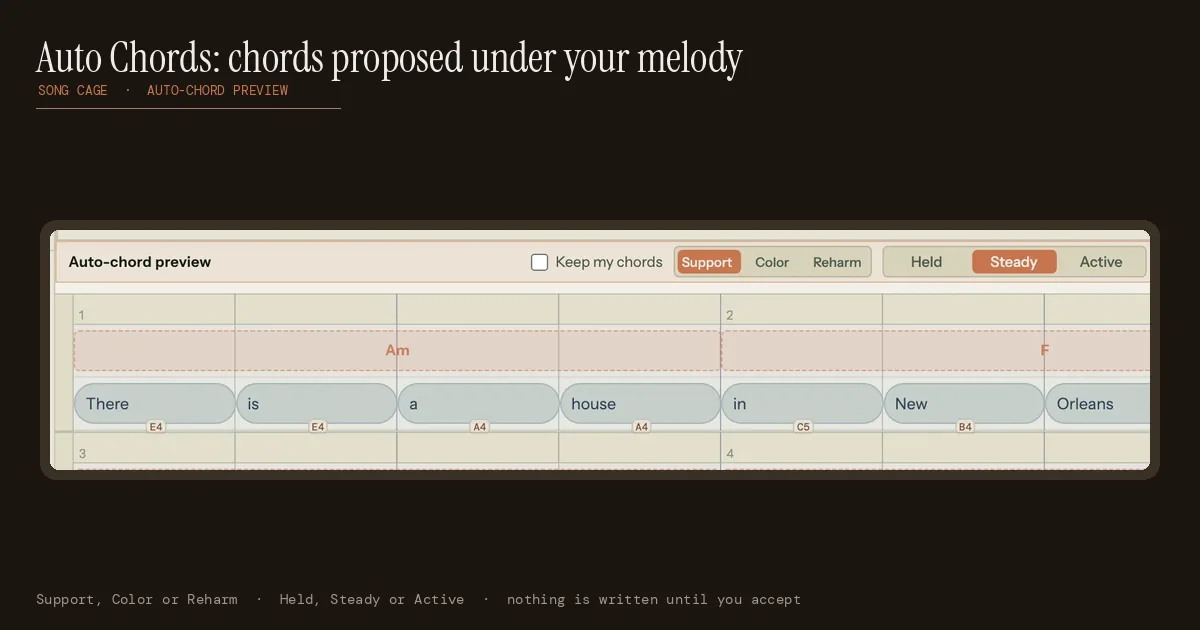
Once a section has three or more notes, the Auto Chords button proposes chords for the whole section as a preview you can accept or change, with a control for how often the chords change. Click an empty chord slot instead, and the suggestions are ranked against the melody notes under it and the chords on either side, so changing a note there changes the ranking. Press play and your tune plays over the chords, out loud. The melody plays on an instrument or a wordless sampled voice, so the words are still yours to sing.
How do you hand the song to a musician?
When you're ready to hand the song over, Export PDF makes a printable chord sheet with the chords above your lyrics, and Export MIDI writes a standard MIDI file with a chord track plus a melody track timed to your syllables, which a musician can open in a DAW or notation program. Both exports need the one-time Song Cage licence or the 14-day trial in the desktop app or plugin. The web app is free for one song, and a view-only share link is free too.
The free iPhone and Android apps are for capturing: voice memos, and a lyrics scratchpad with rhymes, slant rhymes and synonyms. The singing and note tools live on a computer, in the web app, the desktop app, or the plugin inside a DAW.
Put your own tune on your words
Paste the lyric, sing each note onto its syllable, and pick chords from suggestions built around the melody you sang. Nothing in Song Cage writes the tune for you.
Frequently Asked Questions
Can I write a song if I can't sing or play an instrument?
Yes. Start from your speaking voice: say the line, loop it until it sounds like a tune, then sing it slowly on a few steady notes. In one study, most of the occasional singers who sang slowly matched professional singers' accuracy. If singing isn't possible, pick the notes one at a time on a keyboard app, or co-write with a composer.
Do I need to read music to write a melody?
No. Irving Berlin and Lionel Bart wrote famous melodies without being able to write music down, and others transcribed what they sang or tapped out. Today a recording over a click, a MIDI file, or note names written above each syllable does the same job for anyone you work with.
What if I'm tone deaf?
True tone deafness is uncommon. In a 2017 study of 16,625 adults, 1.5% met a conservative definition of congenital amusia, and a 2005 study concluded that many students who called themselves tone-deaf may not actually have trouble perceiving music. Sing slowly on a comfortable pitch and check each note against a keyboard app before you decide.
Do I own the melody if a musician writes it for my lyrics?
Not on your own. In the US, if you both mean to write one song together, it is a joint work and you co-own all of it, in equal shares unless a signed agreement says otherwise. If you pay for the music, ownership depends on the terms you sign. Agree splits in writing first. This isn't legal advice.
If I write the lyrics and an AI writes the music, whose song is it?
Your lyrics remain your work. The US Copyright Office says that, with current technology, prompts alone don't make you the author of AI output, so on that reasoning a melody generated from your prompts isn't your authorship. Suno's terms don't promise that any copyright exists in its output, and the NSAI Song Contest excludes songs written with AI.
Can I sell lyrics without music?
Rarely. Publishers and pitch services work with finished songs and audio, songs are usually licensed rather than sold, and Jason Blume describes songs written to be sold outright as works made for hire that give up ownership. Lyric-only contests exist. The realistic path is finishing the song, on your own or with a co-writer.
How do I turn a poem into a song without an instrument?
Read it aloud over a steady beat, pick lines that could repeat as a chorus, and adjust words so the stresses land on beats. Then loop the lines and sing them slowly on steady notes. If the poem is someone else's, change as little as you can, and if it's still under copyright, get permission before you share the song.
What should I send a musician who's writing music for my words?
A typed lyric sheet with sections labeled and every chorus written out, a recording of your melody over a click, the tempo and feel you imagine with a few reference songs named, and your proposed split and credit in writing. If you have your melody as notes, send a MIDI file as well.