Most guides to finding your vocal range end at two notes: the lowest you can sing and the highest. That's half of what you need. The two notes tell you what your voice can survive. They don't tell you where a song should live, and if you write or choose songs, that's the question you're really asking.
This guide covers the whole job: how to find your range in about five minutes with a piano, a keyboard app or no instrument at all, the mistakes that make people read their range an octave wrong, why the answer moves from one day to the next, and how to turn the result into a decision about a song's key.
The short version
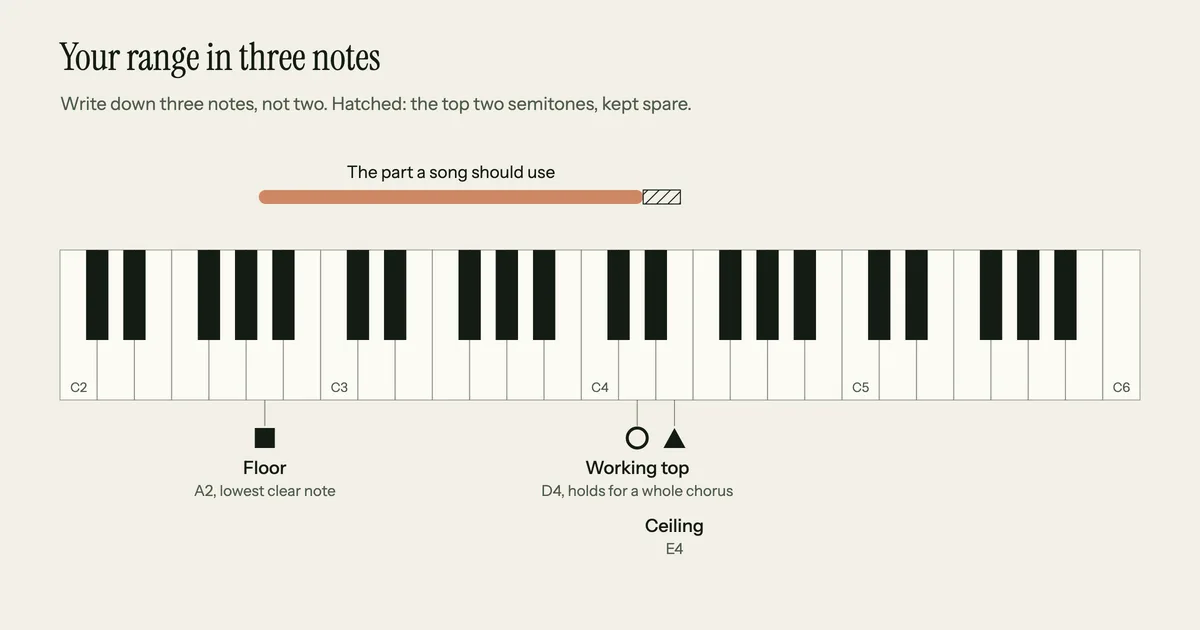
Warm up, then slide down on "ah" from a comfortable note until the sound stops being a clear, steady pitch. That's your floor. Slide up until it gets thin or forced. That's your ceiling. Then write down a third note: the highest one you could sing for a whole chorus. That middle span, not the extremes, is the part a song has to fit.
What is your vocal range?
Your vocal range is the span from the lowest note you can sing clearly to the highest, written as two note names such as A2 to E4. The letter is the note and the number is the octave. Middle C on a piano is C4, so A2 sits well below it and E4 a little above.
Octave numbers count up from C, not from A. That trips people up: B3 is the white key just below middle C, and C4 is the one directly above it, even though they sit side by side. Everything from C4 up to the next B is octave 4.
"Clearly" carries the definition. A croak at the bottom that you can't hold doesn't count, and neither does a squeak at the top you could only hit by straining. The line sits there because a song needs notes you can repeat, at a steady pitch, every time you sing it. So when you test, count only a note you held for about a second without it wobbling, cracking or fading out.
How do you find your vocal range at home?
Use a piano or keyboard app, start on a note you can speak comfortably, and move down one key at a time, singing each one on "ah", until a note stops being clear. Then go back to the start and move up the same way. Write down the last clear note at each end.
Here's the method in order:
- Warm up for two or three minutes. Hum, do a few lip trills, slide gently up and down. A cold voice gives you a range that's smaller than your real one.
- Find your starting note. Speak "uh-huh" and match it on the keyboard. Adult speaking voices average around 120 Hz for men and 210 Hz for women, according to the review by Hartmut Traunmüller and Anders Eriksson at Stockholm University (PDF). On a piano that's between A♯2 and B2 for men, and close to G♯3 for women.
- Walk down. Play a key, sing it on "ah", hold it, then go one key lower. Stop when the note turns to rumble or you can't hold it steady. The last clean one is your floor.
- Walk up. Return to the start and climb one key at a time. Stop at the first note that feels pinched or thin. The last easy one is your ceiling.
- Find your working top. Sing a line from a song you know at full voice, three times through, a few notes under your ceiling. The highest note that still feels good on the third pass is the one to write for.
How can you find your vocal range without a piano?
Use something that names the note you're singing: a free online vocal range test, a pitch detector or a tuner app. Hold each note for a second so the reading settles, and check any very low result against a second reading before you trust it.
The free Song Cage vocal range test does the five steps above for you. You sing your lowest note, then your highest. It keeps only a note you held steadily for half a second, shows the result on a keyboard, and ranks the keys that fit. Nothing is recorded. A pitch detector is the manual version: it names each note as you sing it, so you can walk down and up yourself and write the numbers down.
Two things trip microphones. A laptop's built-in mic barely picks up the lowest notes of a bass voice, so it hears the overtones instead and can report a note an octave too high. A headset mic close to your mouth fixes most of that. And breathy or very quiet notes don't read well, so sing your floor at a normal speaking volume, not a whisper.
Why do people get their vocal range an octave wrong?
Usually because they matched the piano in the wrong octave. A man singing along to middle C is often singing C3, an octave lower, without noticing, because the two sound like the same note. Ear and voice agree; only the number is off.
Notes an octave apart share a name and blend so closely that it's easy to lose track of which one you're on. It's why men and women can sing "Happy Birthday" together, an octave apart, and hear one tune. It also means a man who plays C4 and sings back what feels like the same note is usually singing C3. Write down C4 and every number after it is twelve semitones too high.
The fix is simple. Before you start, sing a note, then play C4 and C3 one after the other and decide which one you're actually matching. If the higher key sounds like a different, thinner version of your note, you're on the lower one. A pitch detector settles it without any judgment at all, since it reports the octave number directly.
Why does your vocal range change from day to day?
Range shifts with warm-up, fatigue, illness and how much you've used your voice that day. Your floor and ceiling can each move a note or two. Test more than once, at the time of day you usually sing, before you decide a song's key.
There's research on the morning question specifically, and it's more mixed than singers' folklore. A 1999 study by Miriam van Mersbergen, Katherine Verdolini and Ingo Titze (Journal of Voice) compared morning and evening voice range profiles in young, untrained women and found no clear time-of-day difference across the 20 women tested. The authors were careful not to generalise: other groups, trained singers in particular, still need testing.
Voice quality is another matter. Jenny Pierce and colleagues recorded 45 women three times a day for a week and found their voices were generally worse in the morning on acoustic measures (JSLHR, 2021). So your notes may be there at 8 a.m. but sound rougher. For a fair comparison, retest at the same time of day, after the same warm-up.
How wide is a normal vocal range?
Wider than most people use. Measured from the lowest held note to the highest falsetto, adults average about three octaves. The part that sounds good at full voice is much smaller, often about one good octave, and that smaller part is what a song has to fit.
The three-octave figure comes from Harry Hollien, Donald Dew and Patricia Philips, who measured 332 men and 202 women aged 18 to 36 (Journal of Speech and Hearing Research, 1971). Each subject sang up the scale from their lowest steady note to their highest falsetto note. The men averaged 38 semitones, from 78 Hz to 698 Hz (about D♯2 to F5). The women averaged 37, from 139 Hz to 1108 Hz (about C♯3 to C♯6).
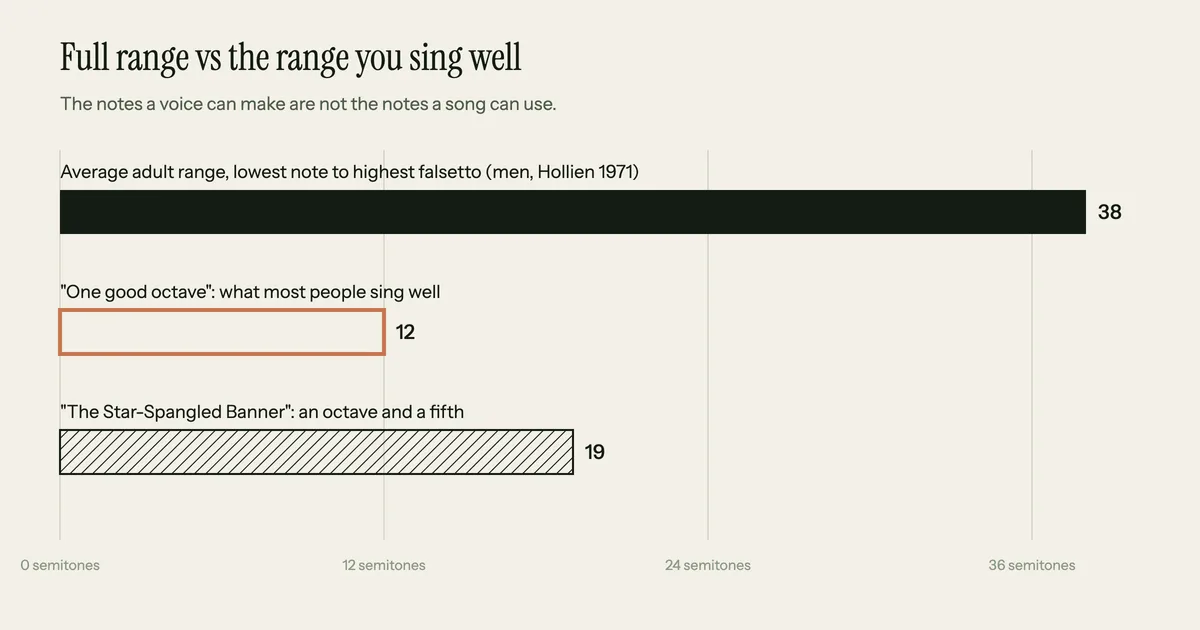
That's every note the voice can make, not every note worth singing. Prince Charles Alexander, a professor of the practice in music at Northeastern University, put the practical version bluntly in 2026: most people, "even good singers that are out of practice, have one good octave," and anything outside it "can sound strained" (Northeastern Global News).
If you want to know which voice type your numbers point to, the vocal range test draws the six classical types on the same keyboard as your result.
Which part of your range should a song use?
The comfortable middle, which singers call the tessitura. Put a song's home note low in that zone and keep its highest note a couple of semitones under your ceiling. A song that lives at your extremes can be sung once; it can't be sung night after night.
"The Star-Spangled Banner" is the standard example of a melody that's too wide for most voices. It spans an octave and a fifth, 19 semitones, and its highest note, on "red glare" and "free", sits a full octave above the note it starts on (Northeastern, above). That's the same span as a-ha's "Take On Me," according to an analysis by music theorist Alyssa Barna in the Washington Post. Kenneth Slowik, director of the Smithsonian Chamber Music Society, explained that it's traditionally sung in B♭ because going higher makes the top note hard for altos and basses, and going lower makes it hard for tenors and sopranos (Smithsonian).
The lesson for your own songs: a 19-semitone melody is wider than an octave and a half (18 semitones), so a voice with one good octave can't sing all of it comfortably in any key. Know your comfortable span before you write the chorus that goes up a fifth.
How do you check whether a song fits your range?
Find the song's lowest and highest melody notes and lay them over your own range. If the top lands within two semitones of your ceiling, or the bottom sits under your floor, move the key. If both ends are out at once, the melody is too wide and needs rewriting, not transposing.
For a cover, look up the sheet music or sing the highest and lowest phrases into a pitch detector. For your own song, the melody often exists only in your head, which makes it harder to measure.
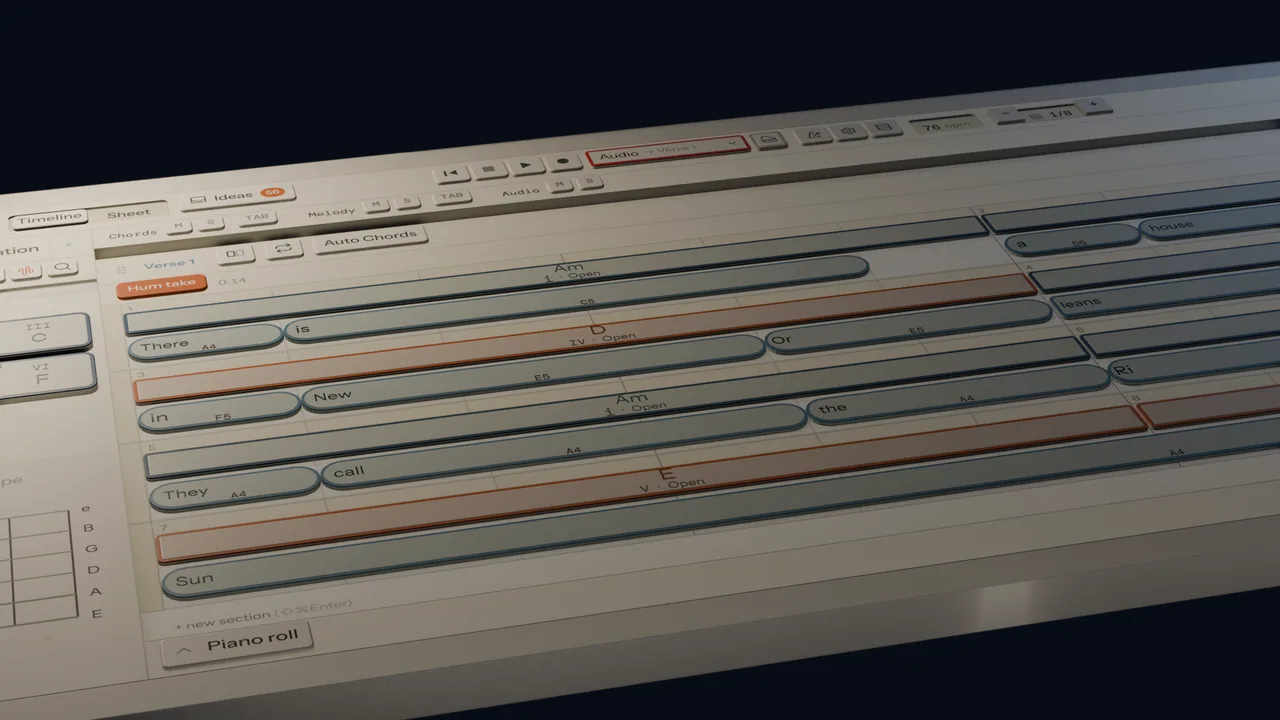
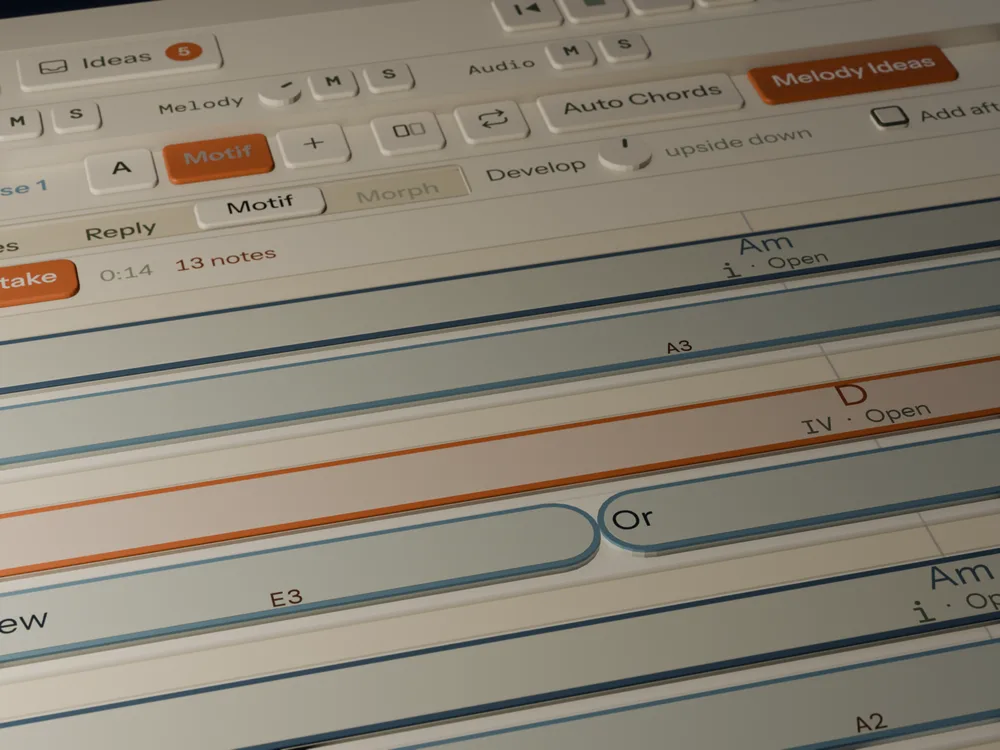
That's the gap Song Cage fills. You sing or hum the melody into a section, press Detect melody, and the notes land in a piano roll under your lyrics, so the song's lowest and highest notes are right there on the keyboard. If the top is too close to your ceiling, pick a new key from the key chip and choose Move song to that key: chords, melody notes and guitar voicings all come with it. Recorded takes keep their original pitch until you sing them again. The changing keys chapter walks through both options.
When the top fits but the verse drops into rumble, no key will fix it. Your Song Is in the Wrong Key for Your Voice covers how far to move a key and what to do when it can't move at all, and How to Change Key in a Song covers moving up for a last chorus.
What are the most common mistakes?
Testing cold, counting notes you can't hold, testing sitting down at speaking volume, and reading your result an octave off. Each one gives you a range that's wrong in a predictable direction, so each one is easy to correct once you know about it.
Five ways to misread your range
- No warm-up. Your ceiling comes out low. Two minutes of humming and lip trills first.
- Counting the croak. A note you can't hold for a second isn't part of your range. Your floor comes out too low.
- Counting the squeal. A note you reached by straining once isn't usable. Your ceiling comes out too high.
- Testing quietly, sitting down. You'll sing a song standing, at full voice, three choruses deep. Test the top that way.
- The octave slip. Matching middle C when you're singing the C below it. Every number ends up 12 semitones off.
Write down three notes, not two: floor, ceiling, and the working top from step 5. Then retest in a week, at the same time of day, and keep the lower of the two ceilings. Songs get written on good days and sung on ordinary ones.
See where your song sits in your voice
Hum the melody into Song Cage and it writes the notes under your lyrics, lowest to highest. If the chorus sits too high, move the whole song to a new key in one step, chords and melody together.
Frequently Asked Questions
Does falsetto count in your vocal range?
It counts in your total range, and researchers include it: the Hollien study measured up to each subject's highest falsetto note. For a song, count a falsetto note only if you'd actually sing it there. If you use falsetto only for effect, write down two ceilings, one with it and one without.
Can your vocal range get bigger?
Somewhat, with regular practice, usually by a few notes at each end over months rather than days. In a 1995 Journal of Voice study of 224 adults, trained women reached a wider span of notes than untrained ones (Sulter, Schutte and Miller). For a song that sits badly today, changing the key is faster.
Is vocal range the same as voice type?
No. Range is one clue to voice type. A teacher also listens for where your voice sits most comfortably and where it changes register, so two people with the same range can be different types. The vocal range test names the closest type and names two when you sit between them.
Does your speaking voice tell you your range?
It tells you where to start the test, not where it ends. Speaking pitch sits in the lower part of most people's singing range, so it's a safe starting note for walking down and then up. Your range runs well past it in both directions.
Do I need to know music theory to find my range?
No. You need a way to name the notes you sing: a keyboard with labels, a pitch detector or a range test. Knowing that middle C is C4 is enough to read the result. For what your ear is doing while you match notes, see Perfect Pitch vs Relative Pitch.