Table of Contents
- What do the new AI music labels actually cover?
- What did the record companies propose for the charts?
- The gap is not theoretical
- What did the Haven case actually test?
- What happened when Sweden drew a broader line?
- Why can't a machine-written song be detected?
- Why should songwriters care more than listeners?
- What would "substantially human made" mean at the writing stage?
- Has anyone already drawn the line at composition?
- The honest version of the sticker
- Where Song Cage sits, including the uncomfortable part
- Frequently Asked Questions
The music industry spent July building a filing system for AI, and it left out the part where songs get written.
On July 10, eight organisations covering most of the recorded music business proposed two labels for recordings. An uppercase "AI" for tracks that are AI-generated, meaning the lead vocal or the key instrumental came out of a model, or the whole thing came out of a prompt. A lowercase "ai" for tracks that are AI-assisted, where humans performed the lead vocal and the primary instruments but a model touched some expressive element along the way. The press immediately compared the design to the parental advisory sticker, and the comparison is apt. Everyone already knows how to read that sticker.
Nineteen days later, on July 29, eleven record companies went further, proposing that a recording be kept off official charts unless it clears a set of tests, one of which is that the track be "substantially human made."
Both proposals are reasonable. But read the announcement closely and you find one sentence that should stop any songwriter cold. The system, it says, "does not cover the use of generative AI in lyrics, composition, music videos or cover art at this point."
Lyrics. Composition. The song itself.
So the industry is about to certify how a record was performed while the stage where the song was actually written stays entirely unlabelled. You will soon be able to look at a track and know whether a machine sang it. You will have no way to know whether a machine wrote it.
A condensed version of this argument appeared in Hypebot on August 20, 2026.
What do the new AI music labels actually cover?
The July 10 framework labels sound recordings, not songs. "AI-Generated" means generative AI produced the entirety or primary portion of a recording's creative elements. "AI-Assisted" means humans performed the lead vocal and primary instruments while a model handled some expressive element. Both are voluntary and self-reported.
The coalition is broader than the headlines suggested: IFPI and the RIAA announced it alongside the Grammys, SAG-AFTRA, the Human Artistry Campaign, and three independent-sector bodies, A2IM, WIN and IMPALA. That matters, because the independents represent exactly the writers most exposed here.
The critical design fact is that nothing is being detected. Billboard reports there is no mention of AI detection in the proposal at all. Artists, labels and distributors disclose, and the label follows. Which means the reason composition sits outside the system is not that composition is undetectable. It is a choice about scope.
What did the record companies propose for the charts?
On July 29, eleven companies including Universal, Sony and Warner proposed that recordings made with generative AI be excluded from official charts unless they satisfy six criteria. "Substantially human made" is one of the six, alongside lawful AI services, no stream manipulation, legal compliance, respecting the AI tool's terms, and downstream disclosure.
The full group is Believe, BMG, Concord, Dirty Hit, Glassnote, HYBE, Mom+Pop, Partisan, Sony Music, Universal Music Group and Warner Music Group. The announcement frames it as drawing "a clear boundary between human-led creativity and works that are purely synthetic."
The two proposals are explicitly linked. As Music Ally noted, the labels said any track falling into the "AI-Generated" category would not be chart-eligible, because it would fail the human-made test. So the chart rule inherits the labeling framework's scope, and therefore inherits its blind spot.
| Proposed chart-eligibility criterion | What it targets | Reaches songwriting? |
|---|---|---|
| The generative AI services used are properly authorised and lawful | Licensing of the model | No |
| The track is substantially human made | The recording | No |
| It raises no stream or chart manipulation concerns | Fraud | No |
| It complies with copyright, related rights and personality rights | Legal exposure | Indirectly |
| Releasing it does not breach the AI service's own terms | Contract | No |
| The AI use is signalled to consumers on streaming services | Disclosure | No |
All six must be satisfied. Not one of them asks who wrote the melody or the lyric.
Neither has been adopted by anyone. Billboard states plainly that neither system "has been formally adopted by any streaming service or charting organization as of yet, including the Billboard charts."
The gap is not theoretical
Two songs have already run into chart rules over AI, and it is worth looking closely at what each case actually tested.
What did the Haven case actually test?
In October 2025, a track called "I Run" by the British duo HAVEN. went viral on TikTok. Its vocal sounded uncannily like Jorja Smith, who denied any involvement. Smith's distributor The Orchard, joined by the RIAA and IFPI, issued takedown notices alleging the song misrepresented another artist. Spotify pulled it, citing a prohibition on artist impersonation, and the BBC reported the original was suspended by both the Official Charts Company in the UK and the Billboard charts.
Here is the detail that matters. Harrison Walker says the voice was his own, run through Suno to give his vocal a female tone, and that he and Jacob Donaghue wrote and produced the song themselves in Pro Tools. The duo re-recorded it with singer Kaitlin Aragon in November 2025, and that version reached number nine on the UK Singles Chart.
Look at what the fix corrected. A performance. The one thing the system caught was a human performance that had been machine-transformed. Nobody in that process asked where the melody came from, or who chose the chord under the hook, because on HAVEN.'s account those were never in question and there was no mechanism to ask.
What happened when Sweden drew a broader line?
Sweden went further, and its regulator promptly admitted how hard the line is to hold.
In January 2026, a folk-pop track called "Jag vet, du är inte min" ("I know, you're not mine") was the biggest new Swedish hit of the year with roughly five million Spotify streams. The credited artist, Jacub, did not exist. Journalist Emanuel Karlsten traced the production to employees of a Danish music company, two of whom worked in its AI department. IFPI Sweden barred the song from Sverigetopplistan, the official chart.
The rule IFPI Sweden applied is notably wider than the industry framework. "Our rule is that if it is a song that is mainly AI-generated, it does not have the right to be on the top list," CEO Ludvig Werner told the BBC. A song, not a recording. In principle that reaches the writing.
But Werner also said the quiet part out loud: "We are humbled that we have to review and clarify our rules. It is not an easy line to draw, and it is not easy to guard the line afterwards either." That is the head of the only body to actually enforce a ban telling you the standard is unstable.
Why can't a machine-written song be detected?
A performance leaves an acoustic fingerprint. Composition leaves nothing. There is no spectral signature for a chord progression, and no forensic test distinguishes a model's lyric from one written at a kitchen table at two in the morning. Detection tools currently flag only fully synthetic recordings.
Deezer built the leading detector, has run it since January 2025, and has since made it commercially available to other organisations. Its tool is already used by Billboard to determine which charting tracks are AI-generated, and Ars Technica reports Deezer claims a false-positive rate under 0.01 percent.
Even so, its reach is narrow. Billboard notes the tool, "like nearly all others on the market, only flags 100% AI-generated recordings from the most prolific models like Suno and Udio. It does not flag or penalize songs partially generated by AI." Deezer's own headline figures are contested too: several sources told Billboard the system has flagged AI-assisted songs as well.
So the honest picture is not that performance is solved and writing is hard. Detection is blunt at the edges of the recording, and absent from the song.
Why should songwriters care more than listeners?
The scale is not small. Deezer reported in April that roughly 44 percent of everything newly delivered to it was fully AI-generated, about 75,000 tracks a day. In July it said June had peaked above half, averaging 90,000 tracks a day. Oliver Schusser, VP of Apple Music, told Billboard's podcast that "more than a third of what we get today is actually what we would say is 100% AI." His blunter line was that "every label in the world is delivering AI," whether they know it or not.
Those numbers describe finished recordings, and it is tempting for a guitarist to file them under someone else's problem. Slop uploaded by bots, competing for playlist slots, not competing with you.
Except the writing tools got there first and much more quietly. A model that suggests your next four bars, finishes your second verse, or hands you a chord because it has seen that chord work is not a recording tool. It leaves no trace in the audio. It will never trip a detector, and under a self-reported system covering recordings only, it will never earn a sticker either. Run that suggestion through your own hands, play it on your own guitar, sing it in your own voice, and by every standard the industry proposed this month you have made a fully human record.
Maybe you have. That is a real question and I do not think it has an obvious answer. But notice that the labeling debate has quietly decided not to ask it.
What would "substantially human made" mean at the writing stage?
If the phrase is going to carry weight, someone has to define it at the point where the song exists rather than where the file exists.
There is a distinction worth building on, and songwriters already understand it intuitively, because it is the difference between a good teacher and a ghostwriter. A teacher can tell you that your strong syllables are landing on weak beats, that your phrase is arching upward while your lyric is about loss, that the chord you reached for is borrowed from the parallel minor and that is why it aches. Every one of those is a description of what you already did. You remain the author of the next decision.
A ghostwriter hands you the line. The line may be better than yours. You are no longer the author of it.
The test, in one question
Does the tool describe a decision you already made, or make the next decision for you? A tool that shows you why a chord works is doing something categorically different from a tool that picks the chord, even when the two sit side by side in the same menu and cost the same money.
The industry's new labels cannot see that difference, because it happens before there is a recording to label.
Has anyone already drawn the line at composition?
Yes. Bandcamp already prohibits music "generated wholly or in substantial part by AI," and its rule explicitly covers tracks composed or produced by AI, not only voice clones. IFPI Sweden's chart rule also reaches the song rather than the recording. The gap in the July proposals is closable, because two organisations have already closed it.
Neither is a clean model. Bandcamp's standard is a platform terms-of-service rule rather than a metadata label, so it operates as removal instead of disclosure. Sweden's is a judgment call that its own chief executive says is hard to draw and harder to police. But both prove the category is writable, and that the July framework's silence on composition reflects difficulty rather than impossibility.
It is also worth being precise about who is on which side. The BBC noted Sweden's ban is stricter than Billboard's approach, which holds that its charts reflect listener behaviour and that tracks qualify on sales, streams and airplay even when generated by algorithms. That is a defensible position. It is simply a different one, and it is not the position the July proposals took.
The honest version of the sticker
I would rather the industry admit the gap than paper over it, and the coalition deserves credit for saying plainly that lyrics and composition are out of scope "at this point." That last phrase is an invitation.
If the labels expand to cover writing, they will be self-reported, exactly as the recording labels already are. Self-reporting only works if there is a norm behind it, and norms come from the people doing the work rather than from trade bodies. Which means the useful move for a working songwriter is not to wait for a sticker. It is to be able to answer the question about your own songs, and to pick tools that make the answer easy rather than uncomfortable.
There is reason to think the question is coming. In a recent Luminate survey, 42 percent of respondents said they were less interested in a song once they learned generative AI was involved in making it. There is friction inside the industry too: three sources told Billboard they worry the AI-assisted tag "may be a step too far as AI becomes a more normal part of the creative process." That is a debate about how much disclosure is too much, running at the same moment that the writing stage gets none at all.
Those listeners are going to start asking. The labels will tell them who sang it. Nobody has volunteered to tell them who wrote it.
Where Song Cage sits, including the uncomfortable part
I build a songwriting tool, so I should apply my own test to it rather than exempt it.
Most of Song Cage sits on the teacher side by design. It shows you every chord in your key with its scale-degree function, marks borrowed chords by the mode they came from, splits your lyric into syllables so you can see which beat each one lands on, and names the voicing under your fingers. Those are descriptions of decisions you already made. There is no generative AI in it, and it does not write lyrics, titles or progressions for you.
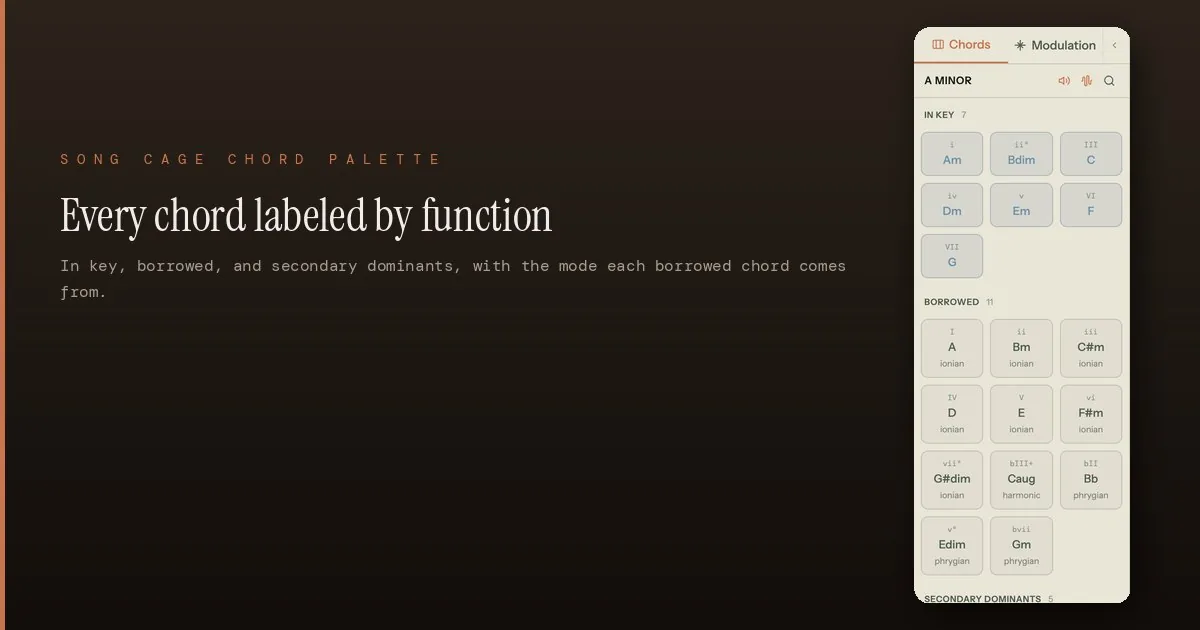
Each chip in that palette names the function rather than choosing for you: bIII+ marked as coming from harmonic minor, bII from Phrygian. That is the teacher behaviour made literal.
The honest exception is Auto Chords. It proposes diatonic chords scored against notes you already sang, as a preview you accept or reject rather than an edit it performs. I think that sits on the teacher side, because it only responds to a melody you wrote and it never chooses for you. But it is the feature where my own line gets thinnest, and I would rather say so than pretend the boundary is obvious. It is not.
Write it yourself, and know that you did
Song Cage shows you the theory behind the choices you are already making. It does not make them for you.
Frequently Asked Questions
Do the new AI music labels cover lyrics and composition?
No. The July 10, 2026 framework states that the system "does not cover the use of generative AI in lyrics, composition, music videos or cover art at this point." The two labels apply to sound recordings only, meaning they describe how a track was performed and produced rather than who wrote the song.
What is the difference between the "AI" and "ai" labels?
Uppercase "AI" marks an AI-Generated recording, where generative AI produced the entirety or primary portion of the creative elements, such as the lead vocal, the key instrumental, or a fully prompt-generated track. Lowercase "ai" marks an AI-Assisted recording, where humans performed the lead vocal and primary instruments but a model handled some expressive element.
Does "substantially human made" apply to songwriting?
Not as currently proposed. "Substantially human made" is one of six chart-eligibility criteria the record companies put forward on July 29, 2026, and it inherits the labeling framework's scope, which covers recordings. A song whose melody or lyric came from a model but whose performance is entirely human would satisfy it as written.
Can AI-written lyrics or melodies be detected?
There is no reliable forensic test. A performance leaves an acoustic fingerprint that detectors can analyse, but a chord progression or a lyric leaves no signature. Even for recordings, Billboard reports that current tools "only flag 100% AI-generated recordings" and do not flag songs partially generated by AI. Any labeling of the writing stage would have to be self-reported.
Have the AI labeling and chart proposals been adopted?
Not yet. Billboard reported that neither system "has been formally adopted by any streaming service or charting organization as of yet, including the Billboard charts." Both are voluntary proposals intended as a roadmap for chart compilers and streaming services to consider. Individual platforms including Deezer, Spotify and Apple Music already run their own separate AI disclosure or detection systems.
Has any platform banned AI-composed music outright?
Bandcamp prohibits music "generated wholly or in substantial part by AI," and its rule explicitly extends to tracks composed or produced by AI, not just voice clones. IFPI Sweden also bars songs that are "mainly AI-generated" from the official Swedish chart, a standard that reaches the song rather than only the recording.