Table of Contents
- What counts as a melody idea?
- Where do melody ideas come from?
- Say the line out loud, then sing what you said
- Mumble before you have words
- Start from a rhythm on one note
- Borrow a shape, not the notes
- Sing over the chords instead of playing over them
- Steal from a sound you hear every day
- How do you get ten ideas out of one phrase?
- Answer it
- Move it
- Keep the bones, rewrite the rest
- Turn it upside down or backwards
- What if you like parts of two takes?
- Why do melody ideas disappear?
- How do you know which melody idea to keep?
- Where Song Cage fits
- Frequently Asked Questions
A melody idea is usually smaller than you think: two bars, a rhythm, a shape that goes up and comes back. The trouble starts when that is all you ever get, or when you get one and hum it so many times it stops meaning anything. This guide covers the front end of a melody: where ideas come from, how to get more than one out of a phrase you already like, and how to tell which fragments deserve a song. If you already have the idea and want to build a whole tune around it, How to Write a Melody From Scratch picks up where this one stops.
Quick summary
Melody ideas come from speech, mumbling, rhythm, borrowed contours, singing over chords and everyday sounds. To get more from one phrase, answer it, move it up a step, keep its strong-beat notes, turn it upside down or backwards, or splice two takes. Capture each fragment the day it arrives.
What counts as a melody idea?
A melody idea is a fragment, not a tune: one to four bars with a rhythm you could tap and a shape you could draw in the air. It might be five notes. It does not need words, chords or a key yet. If you can sing it back tomorrow, it is worth keeping.
Harold Arlen's "Over the Rainbow" started as that kind of fragment. Driving past Schwab's drugstore on Sunset Boulevard on the way to Grauman's Chinese Theatre, he asked his wife to stop the car and jotted the tune on the music paper he always carried, according to Columbia News. Yip Harburg wrote the words.
An idea is also different from a hook. A hook is the part of a finished song people remember and come back for; an idea is raw material that might become a hook, a verse line, or nothing at all (more on that in What Is a Hook in a Song?). Keeping the two apart takes the pressure off. You are not trying to write the chorus of the year in one go. You are trying to collect enough small fragments that one of them turns out to be good.
Where do melody ideas come from?
Melody ideas come from six places: the rise and fall of ordinary speech, wordless mumbling before you have lyrics, a rhythm sung on one note, the outline of a song you love, singing over a chord loop instead of playing along, and everyday sounds like a doorbell or a whistle. None of them needs an instrument. Each one below comes with a writer who has worked that way.
Say the line out loud, then sing what you said
Speech already has a melody. Leoš Janáček spent more than three decades writing down what he called nápěvky mluvy, "tunelets of speech": the pitch and rhythm of things people said, notated by the thousand in his notebooks from 1897 until 1928, the year he died (Pearl, 2006). Steve Reich built Different Trains (1988) the same way. He chose short recorded phrases that were "more or less clearly pitched," notated them, and in his words, "the strings then literally imitate that speech melody" (Steve Reich).
You can do a small version in five minutes. Say your lyric line out loud three times, once bored, once angry, once pleading, and record it. Then sing each reading back, exaggerating wherever your voice already rose and fell. The stressed syllables will pull towards the high or long notes, which is half the work of fitting lyrics to a melody done before you have started.
Mumble before you have words
Words lock a melody's rhythm before you know what the rhythm should be, so plenty of writers sing sounds first. Jeff Tweedy told The Atlantic that "one of the primary ways I write lyrics is to sing and record vocal sounds without words, vowel and consonants that sound like language but don't actually mean anything." He calls them mumble tracks. Producer Finn Keane told Music Week that Charli XCX usually does a mumble track over a beat without any lyrics.
Put a loop on, or just tap a steady pulse, and sing nonsense for two minutes without stopping. Open vowels like "ah" and "oh" help you find the high notes; hard consonants like "da" and "ka" help you find the rhythm. Then listen back and mark the seconds where something happened. You are looking for one bar, not a song.
Start from a rhythm on one note
Rhythm is the easiest part of a melody to invent, because there are no wrong notes in it. Tap a pattern on the table, or say one word over and over in a rhythm you like, then sing that pattern on a single note. Once it feels good on one note, let the pitch move only where the pattern leans: the long notes and the downbeats. Everything else can stay put or step to a neighbouring note.
This gets you out of a common trap. Starting from pitch often produces an even string of notes that sounds like a scale exercise. Starting from rhythm means the idea has a groove before it has a tune, and a groove is what makes a fragment worth singing twice. How to Vary a Melody Without Losing the Tune goes into which rhythm changes a tune survives and which ones flatten it.
Borrow a shape, not the notes
Every melody has a contour: where it leaps, where it climbs, where it falls back. Contours are not owned. Arlen opened songs with an octave leap often enough that Columbia News calls it one of his trademarks; it is the "Some-where" at the start of "Over the Rainbow." That leap is a shape, and anyone can use it.
Pick a song you love and draw its first line on paper as a single pencil line, up and down. Then write a new line that follows the drawing with different notes and a different rhythm. Keep only the outline. The drawing works as a constraint, which is exactly what a blank page is missing, and the result carries the same lift without borrowing anything a listener would recognise.
Sing over the chords instead of playing over them
If you write on guitar or piano, your fingers have habits. A melody found on an instrument can end up sitting wherever the hand is comfortable: the same scale shape, the notes of the chord you are already holding. Your voice has different habits, so it finds different lines.
Record four bars of chords you like, set them to loop, and put the instrument down. Sing over the loop for a few minutes the way you would sing along to the radio if you did not know the words. Try starting on a note that is not in the first chord. Try coming in late, on beat two. Try leaving a whole bar empty. The goal is to get away from whatever your hands would have played, and that only works if they are not on the keys.
Steal from a sound you hear every day
Yip Harburg remembered the "Someday I'll wish upon a star" passage of "Over the Rainbow" as the way Arlen whistled to call his dog. Arlen said it was meant to sound like a child's piano exercise (Columbia News). Either way, it came from something heard every day. Janáček had the same habit: alongside speech, he wrote down the sounds around him at the Luhačovice spa (Janáček Luhačovice).
A doorbell, a reversing truck, the tune your washing machine plays when it finishes, a bird that sings the same phrase every morning: each is a melody idea someone has already pitched for you. Sing it back, then change the rhythm. You will rarely keep the original, but it gets the first bar down.
How do you get ten ideas out of one phrase?
Develop the phrase instead of replacing it. Answer it with a second phrase, move it up or down a step, keep its strongest notes and rewrite the rest, or turn it upside down. Each move gives you a new line that still sounds related to the first, which is what a song needs.
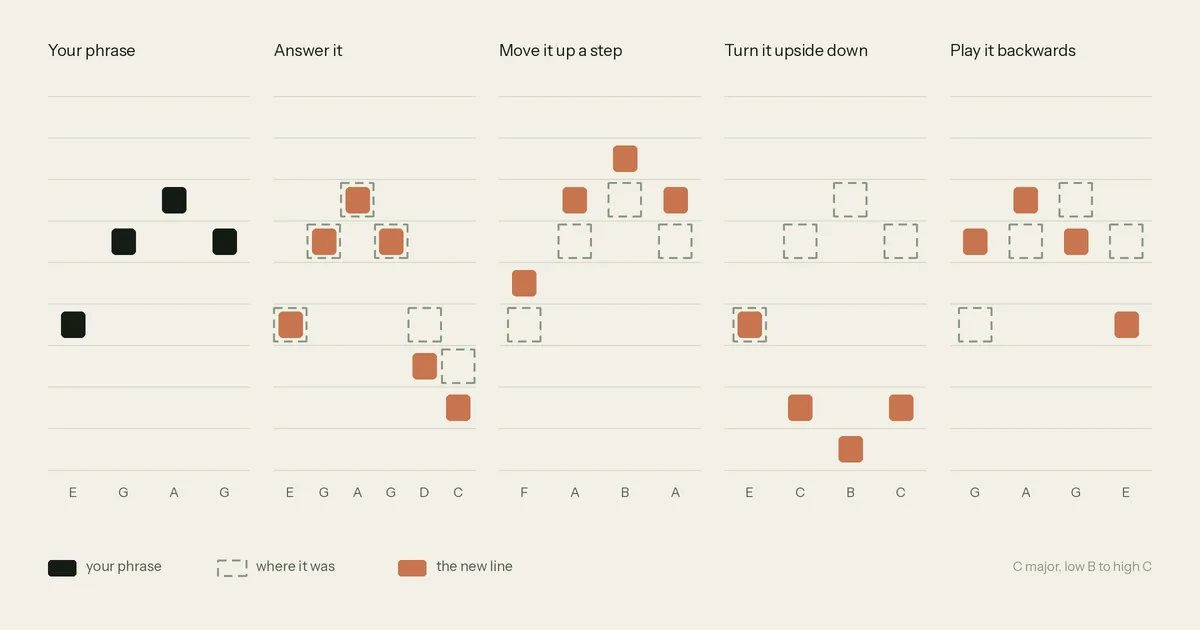
A lot of fragments get thrown away because they are unfinished, not because they are bad. The examples below all use one small phrase in C major, E G A G, so you can try each on a keyboard or sing it.
Answer it
A phrase that ends away from home sounds like a question. Sing E G A G E D: it stops on D and leans forward. Sing it again and change only the ending, E G A G D C, and it lands. That pair is a question and an answer. It was already in the first page of Janáček's speech melodies: a teacher's sentence and a pupil repeating it, overheard in 1897, which written down make a call and a response, the second ending on the home note (Pearl, 2006). Keep the start, change the last two notes, and you have a second line.
Move it
Sing the same shape a step higher: F A B A. Then a step higher again: G B C B. Repeating a shape at a new pitch is called a sequence, and it is how a four-note idea becomes a phrase that climbs somewhere. Two steps is usually enough; three in a row starts to sound like an exercise.
Keep the bones, rewrite the rest
Find the notes of your phrase that land on the strong beats. Those carry the tune. Keep them where they are and rewrite everything between them: different passing notes, a different rhythm, a pickup before the first one. It still sounds like your idea because the skeleton has not moved. How to Vary a Melody walks through finding that skeleton in an eight-bar loop.
Turn it upside down or backwards
Inversion flips every interval, so E G A G becomes E C B C. Retrograde plays it backwards: G A G E. Both are textbook moves, and both often sound wrong the first time you hear them. Sing the result anyway, change the one note that bothers you, and you will often have a line you would never have found by hunting.
What if you like parts of two takes?
If you have sung the same idea twice and like part of each, splice them: the first half of one take with the second half of the other, or the rhythm of one with the notes of the other. Two takes of the same idea are already two ideas, and there are more in between them.
Why do melody ideas disappear?
Because you trust yourself to remember them. Paul McCartney said he and John Lennon "had a rule that came in very early out of sheer practicality, which was, if we couldn't remember the song the next day, then it was no good" (Barry Miles, Many Years From Now, 1997, quoted in Skidmore College's Beatles course notes). The rule produced memorable songs, and it also cost them. In 2015 he told the London Evening Standard: "If the next morning you couldn't remember it – it was gone. There must have been dozens lost this way" (The Guardian).
Phones fixed that and made a new problem. In 2018 McCartney said he had "thousands of sketches" and that "it's too easy to put ideas down now" (NME). Both halves are right. Capture everything the day it arrives, then give each fragment one development pass, an answer or a move or a new rhythm, before you record the next. A fragment with a second line already attached is much closer to a song than a fragment on its own. How to Come Up With Song Ideas covers the capture habit for lyrics and titles too.
How do you know which melody idea to keep?
Run each fragment through a few quick checks:
- Can you sing it back the next day? McCartney's rule works better as a filter than as a storage system.
- Does it fit your voice? Check the highest and lowest notes against your range, or find your range first with the vocal range test.
- Does something in it repeat? A rhythm or a two-note turn that comes back gives a listener something to hold.
- Does it leave room for words? A line so busy that every syllable has to fight for a note will be hard to write lyrics on.
- Does it still work over a different chord? If it does, it can go in more than one place in the song.
An idea that passes most of those is worth a writing session. One that passes none still belongs in the pile. It might turn out to be the answer to a better phrase later.
Where Song Cage fits
Song Cage is a songwriting app that keeps the melody, the words and the chords of an idea together. You can sing a note straight onto a syllable (hold M and sing), record a whole take and turn it into notes you can edit, or drag in a voice memo from the Ideas inbox and detect the melody there (Writing Melody).
Once a section has a melody, Melody Ideas makes the development moves above on your own line. Bones keeps the notes that carry your tune and regrows the rest from your own hook. Reply answers your phrase with one made out of it. Motif moves it, turns it upside down or backwards, or rebuilds it as the chorus or the verse it would sit beside. Morph walks your melody towards another version of the section. Each move has one knob, and each idea lands as a new version of the section in its own tab, with your words back on the new notes and the chords left where they were. Your own line is never written over.
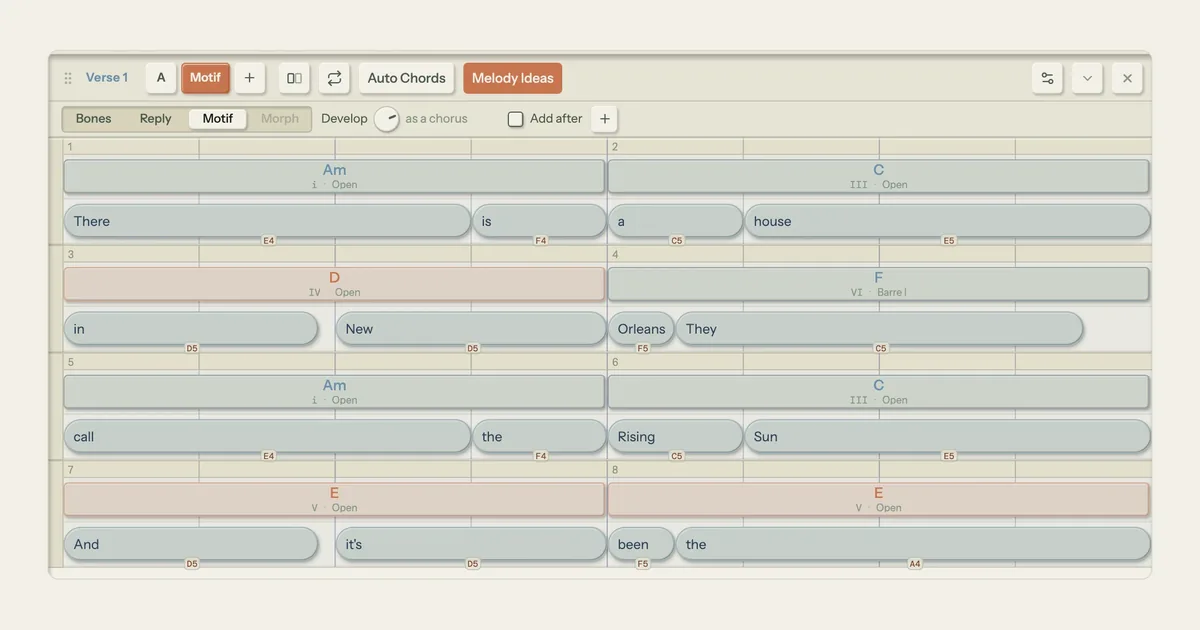
Every idea starts from the melody you sang. There is no prompt and no generative AI (here is where we draw that line). Melody Ideas comes with the Song Cage licence and the 14-day trial, in the web app, the desktop app and the plugin (all the melody tools).
Get more out of the melody you already have
Sing the idea in, put your words on it, and let Melody Ideas answer it, move it, or rebuild it as a chorus. Every idea lands as its own version of the section.
Frequently Asked Questions
How do you come up with melody ideas fast?
Sing instead of hunting on an instrument. Put on a chord loop or a steady tap, record yourself singing nonsense syllables for two minutes without stopping, then listen back for the one bar that works. Speaking your lyric line out loud and exaggerating its rise and fall is the other quick route, because speech already has a melody to borrow.
Can you come up with melody ideas without an instrument?
Yes. Speech, mumbling, rhythm and everyday sounds need nothing but your voice and something to record it on. An instrument helps later, when you want to check the notes or put chords under them, and an app that turns a sung take into notes can do that part for you.
How many melody ideas should you write?
More than feels necessary. Graham English at Speed Songwriting suggests five ten-minute sprints a day for 20 short ideas, five days a week, which comes to 100 (Speed Songwriting). Jon Brantingham's "phrase storming" asks for as many two-bar ideas as you can write in a fixed time (Art of Composing). The habit matters more than the number: lots of small fragments, judged later.
What is the difference between a melody idea and a hook?
A melody idea is raw material, a fragment you have not tested yet. A hook is the part of a finished song that listeners remember and come back for. Some ideas become hooks; most become verse lines, answers to other phrases, or nothing. What Is a Hook in a Song? covers hooks in depth.
Are melody idea generators worth using?
They can break a blank page, but many start from nothing: you pick a key, a scale and a randomness setting, then accept what comes out. The methods in this guide start from something you already have, your voice, your words or a phrase you like, which is why the results sound like you. If you write in a DAW, Melody Rack is a separate plugin that works the same way, growing new lines out of a take you sang.