
Most lists of metaphors in songs stop at pointing them out. That's the easy half. The hard half is writing one of your own that the listener actually sees, instead of one they've heard a thousand times and skate straight past. Pat Pattison, who teaches lyric writing at Berklee, opens his metaphor lesson with the honest version: "Metaphors are not user-friendly."
This guide covers what a metaphor is inside a lyric, how it differs from a simile, the three kinds songwriters use, why some go stale, and a step-by-step way to build a fresh one, with a worked example from a blank line to a four-line verse.
The short version
A metaphor in a song says one thing is something it literally isn't, so the listener brings everything they know about the second thing to the first. How to write a metaphor: start from the word already in your line, ask what it's like, then ask what else is like that, and skip the first answers, because those are the worn ones. Then carry the picture through the next lines instead of dropping it after one.
What is a metaphor in a song?
A metaphor in a song names one thing as another thing it literally isn't, so the listener borrows what they know about the second to feel the first. "Love Is a Battlefield" asks you to bring danger, sides and wounds to a relationship in four words, without explaining any of them.
That song, written by Holly Knight and Mike Chapman, reached number five on the Billboard Hot 100 for Pat Benatar in December 1983 (Wikipedia). Its title does the work a paragraph of plain statement couldn't.
Pattison's definition is the most useful one for writers: a metaphor is "a collision between ideas that don't get along," and "all metaphors must be literally false" (American Songwriter). If the two things really are the same, you've written a definition, not a metaphor.
The two halves can be swapped independently, which is worth knowing. Tom Cochrane's "Life Is a Highway" started in the 1970s as "Love Is a Highway," and he shelved it as unusable. Years later he changed the subject from love to life, kept the highway, and it peaked at number six in the US in 1992 (Wikipedia). Same picture, different thing being pictured, a different song.
What's the difference between a metaphor and a simile in a song?
A simile compares with "like" or "as": cold as ice, fall like rain. A metaphor drops the comparison word and says the thing is the other thing. In a lyric the choice is about commitment and syllables: the metaphor is shorter and bolder, the simile keeps the comparison visible.
Katy Perry's "Firework" (2010) uses both, in different places. Its verses ask whether you ever feel like a plastic bag or a house of cards, which are similes, and its chorus says you are a firework, which is a metaphor (Wikipedia). The verses describe how it feels; the chorus commits to what you are. That's a good division of labour: similes for the doubt, the metaphor for the claim the whole song is built on.
The picture had its own simile-to-metaphor journey. Perry has said the chorus was inspired by a passage in Jack Kerouac's On the Road about people who burn like yellow roman candles. Kerouac compared. The song asserts.
The practical difference for a songwriter is length. "Like" and "as" cost a syllable each, and sometimes the melody has no room for them. Other times the extra syllable is exactly what the phrase needs to land on the beat. Choose by singing it, not by rule. Our guide to fitting lyrics to a melody covers how stressed syllables meet strong beats.
What are the three kinds of metaphor?
Pattison sorts lyric metaphors by which words collide. An expressed identity sets two nouns equal ("fear is a shadow"). A qualifying metaphor pairs an adjective with a noun, or an adverb with a verb, that don't belong together ("hasty clouds"). A verbal metaphor gives a subject a verb it can't literally do ("clouds sail").
| Kind | What collides | Pattison's examples |
|---|---|---|
| Expressed identity | A noun with a noun | fear is a shadow; a cloud is a sailing ship |
| Qualifying | An adjective with a noun, or an adverb with a verb | hasty clouds; to sing blindly |
| Verbal | A verb with its subject or object | clouds sail; he tortured his clutch; frost gobbles summer down |
Types and examples from Pat Pattison, "Making Metaphors, Part One," American Songwriter, 2018.
Most writers only reach for the first kind, because "my love is a ___" is the template everyone learned at school. The other two are quieter and often better in a verse. A qualifying metaphor slips the picture into a single adjective, so the line still sounds like plain speech. A verbal metaphor lets the picture move. "The phone sat silent" is a statement; "the phone sulked" is a small story.
Which form of a metaphor fits the melody?
An expressed identity comes in three forms, and Pattison asks writers to run every picture through all of them: "x is y" (fear is a shadow), "the y of x" (the shadow of fear) and "x's y" (fear's shadow). The meaning barely changes. The shape changes a lot. The first two are five syllables each, with the stress in different places; the third is three. When a melody gives you three notes, "fear's shadow" fits where the other two can't. Write all three down before you choose.
What are some songs with metaphors?
Many of the best-known songs with metaphors put the metaphor in the title, so the chorus repeats it every time it comes round. The eight hits below are sorted by Pattison's three kinds. Most are expressed identities, but a qualifying and a verbal metaphor both made it into titles that reached the top five.
| Song | Artist, year | The picture | Kind |
|---|---|---|---|
| Love Is a Battlefield | Pat Benatar, 1983 | love as a battlefield | Expressed identity: x is y |
| Life Is a Highway | Tom Cochrane, 1991 | life as a highway | Expressed identity: x is y |
| Total Eclipse of the Heart | Bonnie Tyler, 1983 | a heart gone dark like the sun in an eclipse | Expressed identity: the y of x |
| Firework | Katy Perry, 2010 | the listener as a firework | Expressed identity in the chorus, similes in the verses |
| Hungry Heart | Bruce Springsteen, 1980 | a heart with an appetite | Qualifying: adjective and noun |
| Killing Me Softly with His Song | Roberta Flack, 1973 | a song that kills | Verbal: the verb collides with its object |
| Umbrella | Rihanna featuring Jay-Z, 2007 | shelter as an umbrella | Extended across the chorus |
| Bridge over Troubled Water | Simon & Garfunkel, 1970 | a friend as a bridge | A simile in the chorus, from a metaphor in a 1959 gospel line |
Chart facts from each song's Wikipedia entry. The kinds follow Pat Pattison's three types.
"Hungry Heart" shows how small a qualifying metaphor can be: one adjective, and a heart has an appetite. It was Springsteen's first top-five hit on the Billboard Hot 100, peaking at number five in 1980 (Wikipedia). "Killing Me Softly with His Song," written by Charles Fox and Norman Gimbel, is a verbal metaphor: a song can't literally kill anyone, and the title lives in that collision. Roberta Flack took it to number one in the US in 1973 (Wikipedia). "Total Eclipse of the Heart," written by Jim Steinman, is Pattison's second form, "the y of x," and it spent four weeks at number one in the US (Wikipedia).
Why do some metaphors sound like clichés?
A metaphor goes worn when the pairing has been printed so often that listeners stop seeing a picture and hear only a statement. "Heavy heart" and "bitter enemy" are metaphors, technically. They no longer feel like collisions, so they slide past without an image.
Pattison files "break my heart" under "total snores." The reason it snores is older than pop music. In Metaphors We Live By (1980), the linguist George Lakoff and the philosopher Mark Johnson showed that everyday English is built on metaphors nobody notices (Wikipedia). Their first example is ARGUMENT IS WAR: we attack a position, shoot down a point, win an argument. Later in the book they list LOVE IS WAR too, with phrases like "she pursued him relentlessly" and "he won her hand in marriage."
That explains both sides of "Love Is a Battlefield." The title lands at once because English already half-thinks it. It also means the title alone isn't fresh; the song has to earn the picture with details. If your metaphor is one the language already uses, it will be understood instantly and felt barely at all.
The fix is rarely a new subject. Keep the word your line is about, keep the quality you meant, and swap the thing you compared it to for one that hasn't been paired with it a million times.
How do you write a metaphor for a song?
Start from the word your line is already about. Ask what it's like, then ask what else is like that, and skip the first few answers. Try the picture in every form, keep the one that fits the melody, then use that thing's own verbs and details in the next lines.
Those middle questions are Pattison's: "What characteristics does my idea have?" and "What else has those characteristics?" Here is the full method.
- Pick the subject from your own line. If the line says "I can't stop thinking about the night you left," the subject might be the night, the thinking, or you. Choose the word the line hinges on.
- Name a quality it has. Not the deepest one, just a true one: heavy, quiet, late, cold.
- Find something else with that quality, and pass on the first ones. Your first three answers are probably everyone's first three answers.
- Write it in every form. "X is y," "the y of x," "x's y," and the simile "quality as y." Sing each over the melody.
- Carry it. List what the new thing does, what it's like and what it has. Spend those words in the next two or three lines.
- Test it. It must be literally false. It must not fight the picture in the next line.
Worked example: turning a heavy heart into a curtain
Here's that method run in Song Cage's Metaphor tool, starting from the word "heart."
From a worn line to a verse
- Subject: heart. One of the qualities the tool offers for it is heavy.
- Things that are heavy: rain, load, burden and weight sit on the row marked worn, because print pairs them with "heavy" all the time. Among the fresh ones is curtain.
- The same picture in each form: "the heart is a heavy curtain," "the curtain of the heart," "the heart's curtain," and the simile "heavy as a curtain."
- What a curtain does: rise, fall, part, close, hang, draw, sway, drop.
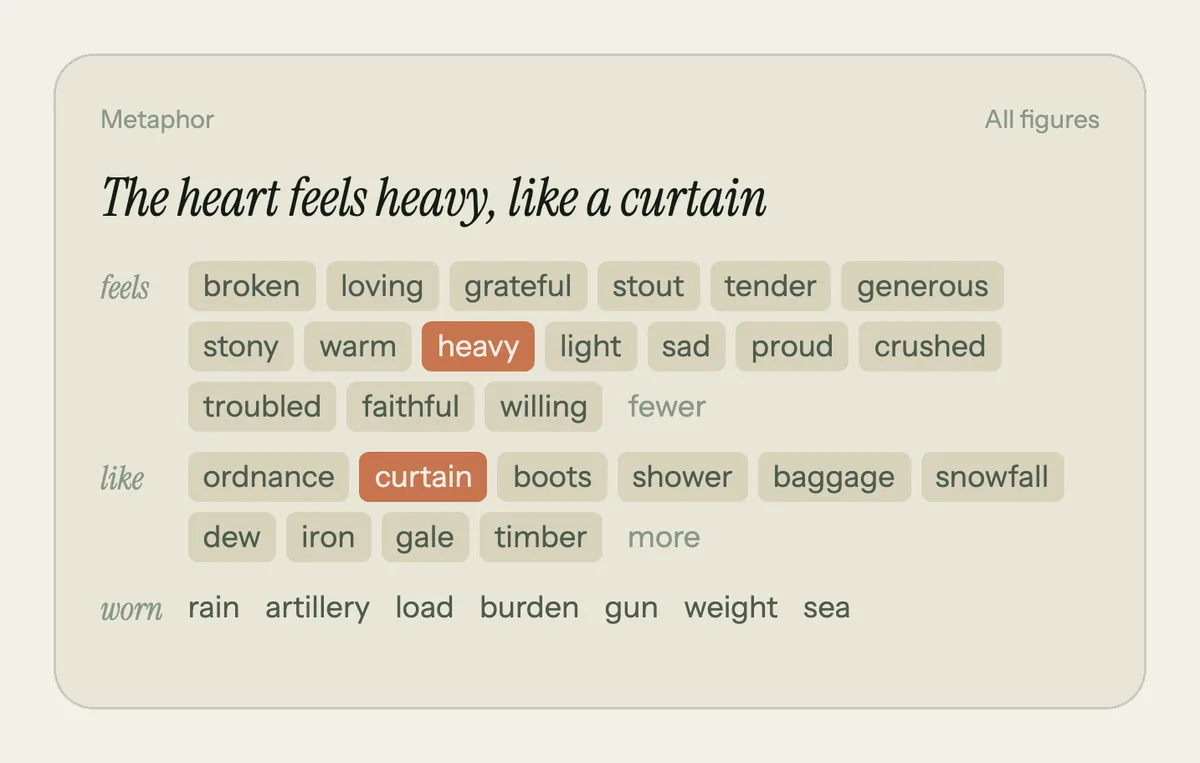
A curtain brings its own overtones: a stage, the end of a show, a window shut against the light. Using only the curtain's own verbs, a first draft of a verse might read:
A draft verse built on the curtain
My heart's a heavy curtain,
it fell the night you left.
It hangs across the doorway,
it sways with every breath.
"Fell," "hangs" and "sways" are all things a curtain does, so the picture runs through four lines instead of stopping after one. "Left" and "breath" are a slant rhyme, and our guide to rhyme schemes covers when a near rhyme beats a perfect one. The verse isn't finished, but it's a picture the listener hasn't been handed before, and it came from the word that was already in the line.
What makes a mixed metaphor go wrong?
A mixed metaphor puts two pictures in one image that can't exist together: a curtain that drowns, a highway that blossoms. Inside a single line it confuses, because the listener tries to see both and sees neither. Across sections it's fine. A new verse can bring a new picture. The test is simple: could you film the line? If one camera can't hold it, pick one of the two pictures.
What is an extended metaphor in a song?
An extended metaphor keeps one picture going across a verse, a chorus or a whole song, so each new line adds a detail of the same thing instead of starting a new comparison. Done well, the listener ends up living inside the picture rather than being told about it.
Rihanna's "Umbrella" (2007) builds its chorus on one image: shelter offered under her umbrella to someone in bad weather. It held number one on the Billboard Hot 100 for seven straight weeks and on the UK chart for ten (Wikipedia). Blender described its "metaphorical themes of protection and loyalty," and one image of cover carries both.
Extended metaphors are also borrowed and rebuilt. Paul Simon took the title idea for "Bridge over Troubled Water" (1970) from a line Claude Jeter sang with the Swan Silvertones in their 1959 recording of "Mary Don't You Weep," promising to be a bridge over deep water (Wikipedia). Jeter's line was a metaphor. Simon's chorus turns it into a simile with "like," then builds the whole song on that one picture, and it spent six weeks at number one.
Pattison's version of the move is to run a picture until it grows: "clouds are sailing ships on rivers of wind." The method is the carry step above. Find what your thing does and has, and keep spending those words.
Where should a metaphor go in a song?
Put your strongest metaphor where it will repeat: the title and the chorus. Use the verses to make it concrete with details. A title metaphor such as "Life Is a Highway" or "Firework" gives the chorus one picture to come back to, and the verses earn it.
Look at how many metaphor titles became the hook: "Love Is a Battlefield," "Life Is a Highway," "Firework," "Umbrella." A metaphor in the chorus gets heard four or five times in one listen, so it has time to sink in. A metaphor buried in the second line of verse two gets heard once.
The verses work differently. That's where "show, don't tell" applies: concrete objects and actions that make the chorus picture feel earned. Our guide on how to write song lyrics has a full section on showing in verses.
One main picture per section is a reasonable ceiling. Three metaphors in four lines don't add up to a richer image. They compete, and the listener keeps none of them.
How does Song Cage help you write a metaphor?
Song Cage's Metaphor tool sits at the top of Words › Explore, beside your lyrics. It starts from the word your cursor is on, so you rarely need to type one. For a thing or a feeling, you pick what it feels like, then something else that feels that way. For a quality you pick something that has it ("lonely as the moor"), and for an action, something that does it ("fall like rain").
The sentence you're building sits at the top. Under it, the same picture appears in each form, under Metaphor and Simile, ready to copy. Pairings that are everywhere already are kept on a separate row marked worn: you can use them, they're just harder to make your own. Carry the curtain through the verse (named for whatever you picked) lists what your picture does, what it's like and what it has.
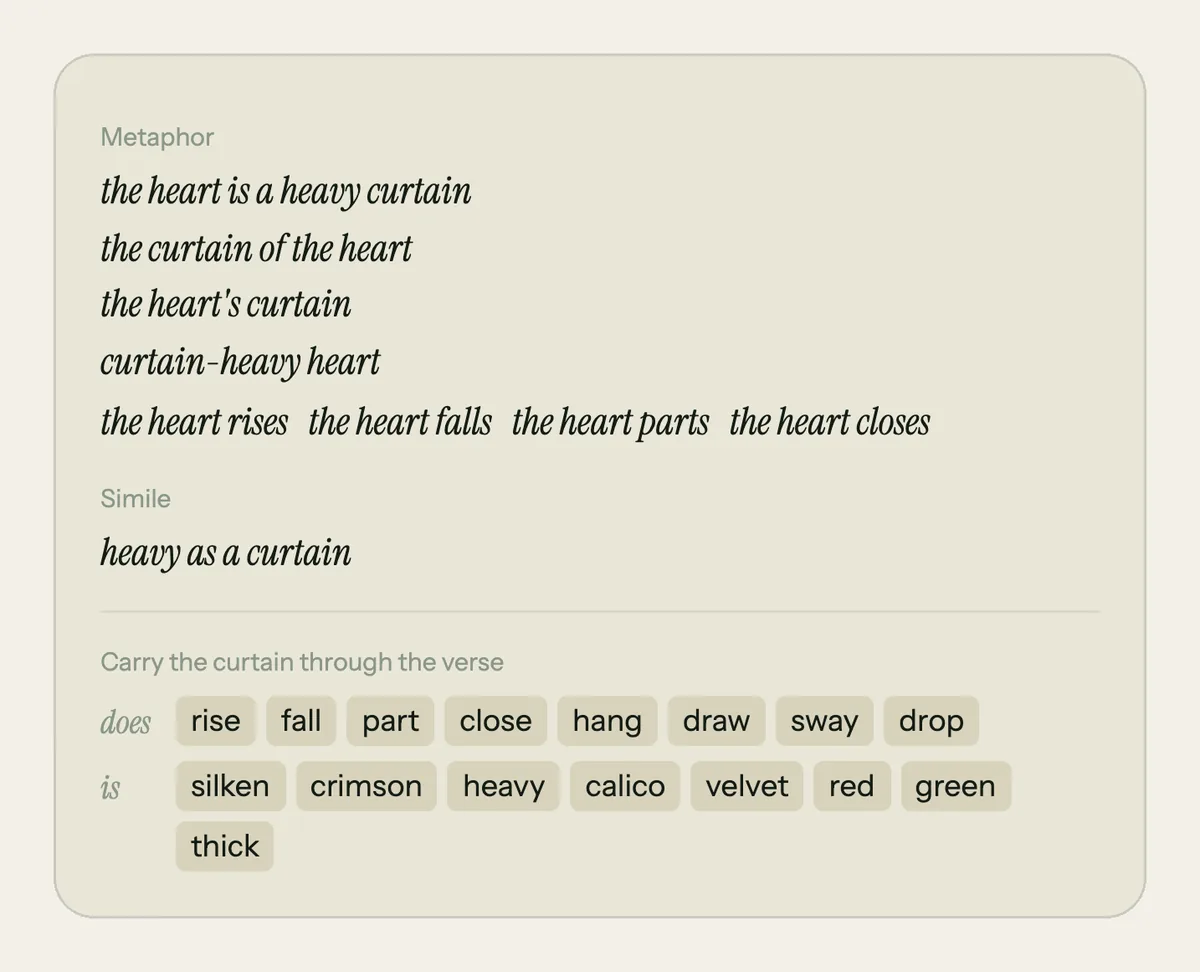
Nothing is written for you. Every line is put together from your word and your picks. All figures opens a reference of 34 figures of speech in four groups (Pictures, Sound, Repetition and Wordplay), each with what it is, why it works in a song, an example and something to try. It's in English; the Word Tools chapter of the docs has the details. Rhymes and slant rhymes sit in the same panel, and the Sound group pairs well with our guide to internal rhyme.
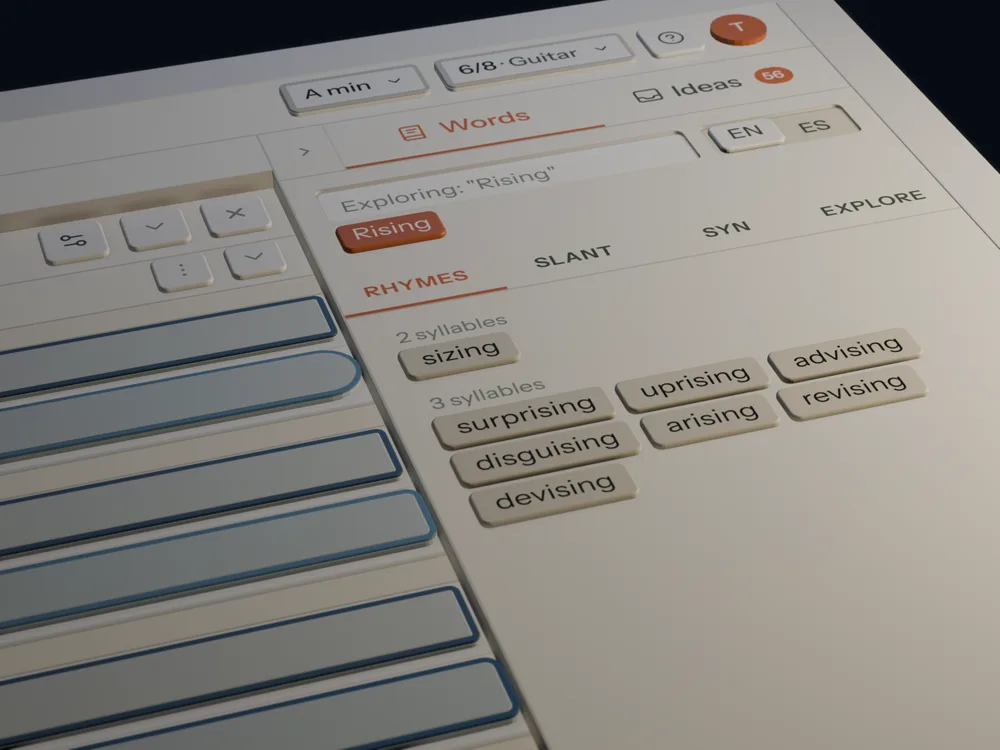
Turn the word you're stuck on into a picture
Click a word in your lyric and the Metaphor tool asks what it's like, then what else is like that. It keeps the worn pairings apart and gives you the picture's own words for the next lines.
Frequently Asked Questions
What is an example of a metaphor in a song?
Many of the clearest examples are titles. "Love Is a Battlefield" (Pat Benatar, 1983) calls love a battlefield, "Life Is a Highway" (Tom Cochrane, 1991) calls life a highway, and "Firework" (Katy Perry, 2010) calls the listener a firework. Each states that one thing is another thing it literally isn't.
Is a simile a type of metaphor?
They're close relatives. A simile makes the comparison out loud with "like" or "as," and a metaphor leaves those words out. A metaphor says love is a battlefield; a simile says love is like a battlefield. In a lyric the simile costs an extra syllable and sounds a little less certain.
Is personification a metaphor?
Yes, it's one form of it. Personification gives a thing a human action or feeling, like "the phone sulked." In Pattison's terms that's a verbal metaphor: the verb collides with a subject that can't literally do it.
How many metaphors should a song have?
There's no number, but one main picture per section is a safe ceiling. A song built on one strong metaphor, carried through, usually beats a song with a new comparison in every line, because the listener can only hold so many pictures at once.
Can a whole song be one metaphor?
Yes. That's an extended metaphor. Rihanna's "Umbrella" builds its chorus on one image of shelter, and "Bridge over Troubled Water" builds an entire song on a single picture, though its chorus states it as a simile. The trick is to keep adding details of the same thing rather than switching to a new comparison.